Management Accounting
Faculty: Nabaraj Adhikari, M.Phil. TU
Unit I: Introduction
• Management accounting - Basic concepts.
• Need of Management Accounting.
• Limitations of Management Accounting.
• Management vs. Financial Accounting.
• Concept and classification of costs
• Segregation and forecasting of cost.
What is Management Accounting?
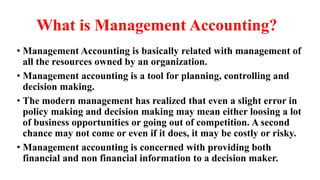
• Management Accounting is basically related with management of
all the resources owned by an organization.
• Management accounting is a tool for planning, controlling and
decision making.
• The modern management has realized that even a slight error in
policy making and decision making may mean either loosing a lot
of business opportunities or going out of competition. A second
chance may not come or even if it does, it may be costly or risky.
• Management accounting is concerned with providing both
financial and non financial information to a decision maker.
Continue….
• Management accounting the term used to describe the
accounting methods, systems and techniques, which coupled
with special knowledge and ability, assist management in
minimizing losses.
• Managerial accounting is an emerging discipline. Even a decade
ago it was used to in Human resource management but in
modern business era it serves as internal source of business
consultant.
• With the changing environmental factors and cutthroat
competition in the market, the demand for thoughtful decision
making is highly appreciable for which managerial accounting is
important.
Need and importance of Managerial
Accounting
1. Collection of data.
2. Identification and modifications of relevant information.
3. Interpretation of financial information.
4. Providing information for planning, budgeting and decision making.
5. Facilitating management control.
6. Use of qualitative information.
7. Formulation of business budgets.
8. Motivating employee and Managers.
9. Performance measurement.
Limitations of Management Accounting
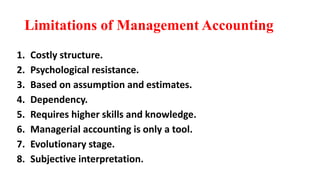
1. Costly structure.
2. Psychological resistance.
3. Based on assumption and estimates.
4. Dependency.
5. Requires higher skills and knowledge.
6. Managerial accounting is only a tool.
7. Evolutionary stage.
8. Subjective interpretation.
What is Financial Accounting?
• Financial accounting is the preparation and communication of financial
information to its users.
• Financial accounting is based on Generally Accepted Accounting
Principles[GAAP].
• It records only monetary transactions.
• It is fully guided by GAAP.
• The data and information which financial accounting provides is
historical natured.
• Under financial accounting, the reports are generally prepared for a
certain specified period.
Continue….
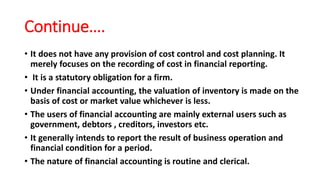
• It does not have any provision of cost control and cost planning. It
merely focuses on the recording of cost in financial reporting.
• It is a statutory obligation for a firm.
• Under financial accounting, the valuation of inventory is made on the
basis of cost or market value whichever is less.
• The users of financial accounting are mainly external users such as
government, debtors , creditors, investors etc.
• It generally intends to report the result of business operation and
financial condition for a period.
• The nature of financial accounting is routine and clerical.
Managerial Accounting
Vs.
Financial Accounting
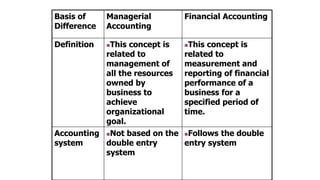
Basis of
Difference
Managerial
Accounting
Financial Accounting
Definition This concept is
related to
management of
all the resources
owned by
business to
achieve
organizational
goal.
This concept is
related to
measurement and
reporting of financial
performance of a
business for a
specified period of
time.
Accounting
system
Not based on the
double entry
system
Follows the double
entry system
Managerial
Accounting
Financial Accounting
Accounting
principles
No need to use
accounting
principles
Adopt any
accounting
techniques that
generates useful
accounting
information
Use Generally
Accepted Accounting
Principles for
recording
transactions
Users of
informatio
n
It is useful for
internal purpose as
its like internal
business
consultant.
It is useful for both
internal and external
users.
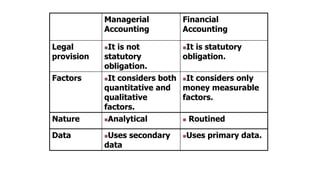
Managerial
Accounting
Financial
Accounting
Legal
provision
It is not
statutory
obligation.
It is statutory
obligation.
Factors It considers both
quantitative and
qualitative
factors.
It considers only
money measurable
factors.
Nature Analytical  Routined
Data Uses secondary
data
Uses primary data.
Managerial
Accounting
Financial
Accounting
Time
focus
Future
orientation:
forecasts,
estimates and
historic data for
management
actions
Past orientation:
use of historic data
for reporting and
evaluation
Accountin
g period
It is not
maintained for a
specific
accounting
period.
It is maintained for
a specific accounting
period.
Meaning of cost
• The resources which are used or sacrificed to achieve an objective
called cost.
• Cost is different from expenses. Expenses are the some costs which
is charged against revenue for a specified period.
• Cost is an economic concept but expenses is a term that falls within
the domain of accounting.
• Sacrifice or giving up of resources for the attainment of specific
goods or services is called cost.
• Usually costs are made with the view that it would provide more
returns in the future.
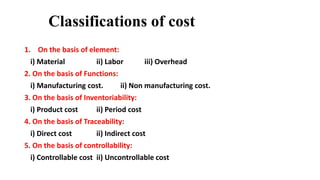
Classifications of cost
1. On the basis of element:
i) Material ii) Labor iii) Overhead
2. On the basis of Functions:
i) Manufacturing cost. ii) Non manufacturing cost.
3. On the basis of Inventoriability:
i) Product cost ii) Period cost
4. On the basis of Traceability:
i) Direct cost ii) Indirect cost
5. On the basis of controllability:
i) Controllable cost ii) Uncontrollable cost
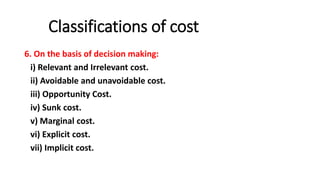
Classifications of cost
6. On the basis of decision making:
i) Relevant and Irrelevant cost.
ii) Avoidable and unavoidable cost.
iii) Opportunity Cost.
iv) Sunk cost.
v) Marginal cost.
vi) Explicit cost.
vii) Implicit cost.
Classifications of cost
7. On the basis of Behavior:
i) Variable cost
ii) Fixed cost
iii) Semi-variable cost
Segregation of semi-variable cost into variable
and fixed cost:
1. High-low method.
2. Least-square method.
Management Accounts.pptx

Management Accounts.pptx

  • 1.
  • 2.
    Unit I: Introduction •Management accounting - Basic concepts. • Need of Management Accounting. • Limitations of Management Accounting. • Management vs. Financial Accounting. • Concept and classification of costs • Segregation and forecasting of cost.
  • 3.
    What is ManagementAccounting? • Management Accounting is basically related with management of all the resources owned by an organization. • Management accounting is a tool for planning, controlling and decision making. • The modern management has realized that even a slight error in policy making and decision making may mean either loosing a lot of business opportunities or going out of competition. A second chance may not come or even if it does, it may be costly or risky. • Management accounting is concerned with providing both financial and non financial information to a decision maker.
  • 4.
    Continue…. • Management accountingthe term used to describe the accounting methods, systems and techniques, which coupled with special knowledge and ability, assist management in minimizing losses. • Managerial accounting is an emerging discipline. Even a decade ago it was used to in Human resource management but in modern business era it serves as internal source of business consultant. • With the changing environmental factors and cutthroat competition in the market, the demand for thoughtful decision making is highly appreciable for which managerial accounting is important.
  • 5.
    Need and importanceof Managerial Accounting 1. Collection of data. 2. Identification and modifications of relevant information. 3. Interpretation of financial information. 4. Providing information for planning, budgeting and decision making. 5. Facilitating management control. 6. Use of qualitative information. 7. Formulation of business budgets. 8. Motivating employee and Managers. 9. Performance measurement.
  • 6.
    Limitations of ManagementAccounting 1. Costly structure. 2. Psychological resistance. 3. Based on assumption and estimates. 4. Dependency. 5. Requires higher skills and knowledge. 6. Managerial accounting is only a tool. 7. Evolutionary stage. 8. Subjective interpretation.
  • 7.
    What is FinancialAccounting? • Financial accounting is the preparation and communication of financial information to its users. • Financial accounting is based on Generally Accepted Accounting Principles[GAAP]. • It records only monetary transactions. • It is fully guided by GAAP. • The data and information which financial accounting provides is historical natured. • Under financial accounting, the reports are generally prepared for a certain specified period.
  • 8.
    Continue…. • It doesnot have any provision of cost control and cost planning. It merely focuses on the recording of cost in financial reporting. • It is a statutory obligation for a firm. • Under financial accounting, the valuation of inventory is made on the basis of cost or market value whichever is less. • The users of financial accounting are mainly external users such as government, debtors , creditors, investors etc. • It generally intends to report the result of business operation and financial condition for a period. • The nature of financial accounting is routine and clerical.
  • 9.
  • 10.
    Basis of Difference Managerial Accounting Financial Accounting DefinitionThis concept is related to management of all the resources owned by business to achieve organizational goal. This concept is related to measurement and reporting of financial performance of a business for a specified period of time. Accounting system Not based on the double entry system Follows the double entry system
  • 11.
    Managerial Accounting Financial Accounting Accounting principles No needto use accounting principles Adopt any accounting techniques that generates useful accounting information Use Generally Accepted Accounting Principles for recording transactions Users of informatio n It is useful for internal purpose as its like internal business consultant. It is useful for both internal and external users.
  • 12.
    Managerial Accounting Financial Accounting Legal provision It is not statutory obligation. Itis statutory obligation. Factors It considers both quantitative and qualitative factors. It considers only money measurable factors. Nature Analytical  Routined Data Uses secondary data Uses primary data.
  • 13.
    Managerial Accounting Financial Accounting Time focus Future orientation: forecasts, estimates and historic datafor management actions Past orientation: use of historic data for reporting and evaluation Accountin g period It is not maintained for a specific accounting period. It is maintained for a specific accounting period.
  • 14.
    Meaning of cost •The resources which are used or sacrificed to achieve an objective called cost. • Cost is different from expenses. Expenses are the some costs which is charged against revenue for a specified period. • Cost is an economic concept but expenses is a term that falls within the domain of accounting. • Sacrifice or giving up of resources for the attainment of specific goods or services is called cost. • Usually costs are made with the view that it would provide more returns in the future.
  • 15.
    Classifications of cost 1.On the basis of element: i) Material ii) Labor iii) Overhead 2. On the basis of Functions: i) Manufacturing cost. ii) Non manufacturing cost. 3. On the basis of Inventoriability: i) Product cost ii) Period cost 4. On the basis of Traceability: i) Direct cost ii) Indirect cost 5. On the basis of controllability: i) Controllable cost ii) Uncontrollable cost
  • 16.
    Classifications of cost 6.On the basis of decision making: i) Relevant and Irrelevant cost. ii) Avoidable and unavoidable cost. iii) Opportunity Cost. iv) Sunk cost. v) Marginal cost. vi) Explicit cost. vii) Implicit cost.
  • 17.
    Classifications of cost 7.On the basis of Behavior: i) Variable cost ii) Fixed cost iii) Semi-variable cost
  • 18.
    Segregation of semi-variablecost into variable and fixed cost: 1. High-low method. 2. Least-square method.