Management Accounting:
A Road of Discovery
Management Accounting:
A Road of Discovery
James T. Mackey
Michael F. Thomas
Presentations by:
Roderick S. Barclay
Texas A&M University - Commerce
James T. Mackey
California State University - Sacramento
© 2000 South-Western College Publishing
Chapter 1
What is Management Accounting?
Accounting for Planning,
Control, and Evaluation
Key Learning Objectives
• Discuss the differences between
financial and management
accounting information.
• Describe eight modern management
trends changing the role of
accounting in organizations.
• Contrast the four accounting
certifications and discuss the role of
ethics in management accounting.
• Define the four types of accounting
systems and relate them to their four
organizational roles.
• Explain stewardship and why the
dominant goal of accounting
systems historically has been
financial reporting.
Why Do We Have Accounting Systems?
 Accounting systems are artifacts. They are created by
men to help accomplish tasks. Audited statement
reduce investors risk.
 Audited statements allow a company to borrow capital from
someone else.
 Records and internal financial controls safeguard the
company’s assets
 Balance Sheets allow the comparison of Assets, Liabilities
and Owner’s Equity.
 Income Statements describe the change in Owners’ Equity
from operations.
Needs Determine the Form of
Accounting Data
 Managers need changing information to meet
changing needs!
 Types of Accounting Systems
 Financial Accounting
 Rules and procedures
 Accounting information systems and internal controls
 Auditing
 Cost Accounting
 Product costing
 Activity-based costing
 Management Accounting
 Decision support
 Organizational control
 Cost management
 Profit management
 Investment management
 Tax Accounting
 Individuals
 Partnerships and corporations
 Estate and trusts
 International taxation
 Special tax issues and topics
 Regulated Accounting Systems
 Financial Accounting or Generally Accepted Accounting
Principles (GAAP). Provide the basis for traditional
accounting information systems and internal controls.
 Tax Accounting. This is the collection of data to meet rules
set by Congress and enforced by the Internal Revenue
Service (IRS).
 Fund Accounting. An accounting system designed to provide
governance information for government agencies and not-
for-profit organizations.
 Cost Accounting. This aspect of cost accounting is to
comply with rules set by the Federal government for
government contractors. Rules set by the Cost Accounting
Standards Board (CASB).
The Goal of Good Management is to
Create Value
 Cost Management is applying the value criteria to
every decision we make, every activity we perform,
and every process we complete.
 Modern accounting systems do not just evaluate
good stewardship but must provide managers with
the information managers need to improve value.
 Management accounting systems are used to
enhance both decision making and management
control.
 Management accounting systems do not need to be
perfect, only ‘good enough’ to increase value.
The Three Management Functions
 Questions asked:
 What do I want to do?
 How can I do it?
 Am I getting it done?
 How well did I do it?
 Management functions:
 Planning for the future
(Strategic)
 Planning for the future
(Operational)
 Monitoring and
controlling the present
 Evaluating the past
Data Characteristics of Financial vs.
Managerial Accounting
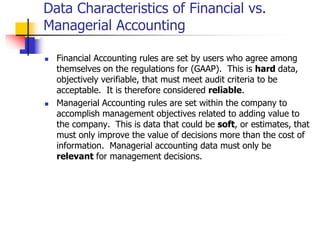
 Financial Accounting rules are set by users who agree among
themselves on the regulations for (GAAP). This is hard data,
objectively verifiable, that must meet audit criteria to be
acceptable. It is therefore considered reliable.
 Managerial Accounting rules are set within the company to
accomplish management objectives related to adding value to
the company. This is data that could be soft, or estimates, that
must only improve the value of decisions more than the cost of
information. Managerial accounting data must only be
relevant for management decisions.
Another Issue
 ‘The Invisible Hand of the market place’
assumes market prices can promote
efficiency. A perfect market reveals all the
information needed for purchasers to find the
‘best prices’ for goods or services. But what
are the prices managers use to run a
company? An example follows.
An Example
 The Sudbury Redi Mix company purchased a new ready mix
truck last year. The following information pertains to this truck:
 a. On the Balance Sheet:
Trucks and Equipment $200,000
less: Accumulated Depreciation* 40,000
Net Book Value $160,000
*This depreciation schedule is acceptable by the IRS for tax
purposes.
 b. Blue Book Value: $150,000
 c. Net cash flows expected from the additional truck over its
service life is $300,000.
Questions
 Which financial numbers obey GAAP?
 Why can these numbers be used by the IRS?
 Why doesn’t the IRS use $300, 000 or $150,000 for tax
purposes?
 For what kind of decisions would the $150,000 be relevant?
 For what kind of decisions would the $300,000 be relevant?
 Why do we call the Net Book Value data hard?
 Why do we call the Blue Book Value data soft?
 If you own shares in Sudbury Company, which information do
you want to use to estimate the value of your stock?
Different financial data is needed for different purposes
or decisions!!
New Management Trends to Create Value
 Encourage Management Accounting Systems
Redesign, for example.
 Customer focus
 Quality focus
 Delivery focus
 Outsourcing and the virtual company
 Communications
 Shortening product life cycles
 Team development
 Deregulation in the service sector
Managerial Accounting Systems:
Unregulated
 Decision Support — Management accounting data
has value if it improves management decisions.
 Control Support — Management accounting data
reports the results of management actions, thus it is
useful for control if management behavior is
influenced by the accounting reports.
WHAT GETS MEASURED GETS DONE!
SUITABLE CONTROL MOTIVATES GOOD JUDGEMENT
GOOD JUDGMENT REQUIRES GOOD INFORMATION!
Characteristics of Management
Accounting Systems
 Key Ideas:
 The costs and benefits of better decisions
 One set of books for many different uses
 Enhanced information quality for better decisions
The Professional Management Accountant
 Professional Certifications
 Certified Public Accountant (CPA)
 Certified Management Accountant (CMA)
 Certified Internal Auditor (CIA)
 Certified Information Systems Auditor (CISA)
 Certified in Financial Management (CFM)
 Chartered Accountant (CA)
Ethical Responsibilities of the CMA
 Competence
 Objectivity
 Integrity
 Confidentiality
 Maintain professional knowledge and skills
 Follow laws and regulations
 Analyze all relevant data and provide complete
information
 Communicate all information fairly
 Fully disclose all relevant information
 Communicate favorable as well as unfavorable
information including limitations of the information
 Avoid apparent or actual conflicts of interest
 Support attaining the legitimate goals of the
organization
 Avoid activities that will discredit the profession
 Do not disclose confidential information unless
legally obligated to do so
 Do not allow subordinates to disclose confidential
information
Professional Characteristics of The
Management Accountant
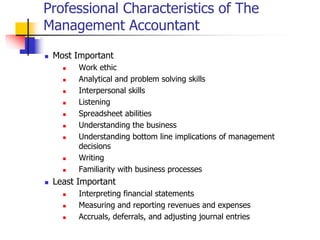
 Most Important
 Work ethic
 Analytical and problem solving skills
 Interpersonal skills
 Listening
 Spreadsheet abilities
 Understanding the business
 Understanding bottom line implications of management
decisions
 Writing
 Familiarity with business processes
 Least Important
 Interpreting financial statements
 Measuring and reporting revenues and expenses
 Accruals, deferrals, and adjusting journal entries

01.ppt

  • 1.
  • 2.
    Management Accounting: A Roadof Discovery James T. Mackey Michael F. Thomas Presentations by: Roderick S. Barclay Texas A&M University - Commerce James T. Mackey California State University - Sacramento © 2000 South-Western College Publishing
  • 3.
    Chapter 1 What isManagement Accounting? Accounting for Planning, Control, and Evaluation
  • 4.
    Key Learning Objectives •Discuss the differences between financial and management accounting information. • Describe eight modern management trends changing the role of accounting in organizations. • Contrast the four accounting certifications and discuss the role of ethics in management accounting. • Define the four types of accounting systems and relate them to their four organizational roles. • Explain stewardship and why the dominant goal of accounting systems historically has been financial reporting.
  • 5.
    Why Do WeHave Accounting Systems?  Accounting systems are artifacts. They are created by men to help accomplish tasks. Audited statement reduce investors risk.  Audited statements allow a company to borrow capital from someone else.  Records and internal financial controls safeguard the company’s assets  Balance Sheets allow the comparison of Assets, Liabilities and Owner’s Equity.  Income Statements describe the change in Owners’ Equity from operations.
  • 6.
    Needs Determine theForm of Accounting Data  Managers need changing information to meet changing needs!  Types of Accounting Systems  Financial Accounting  Rules and procedures  Accounting information systems and internal controls  Auditing  Cost Accounting  Product costing  Activity-based costing
  • 7.
     Management Accounting Decision support  Organizational control  Cost management  Profit management  Investment management  Tax Accounting  Individuals  Partnerships and corporations  Estate and trusts  International taxation  Special tax issues and topics
  • 8.
     Regulated AccountingSystems  Financial Accounting or Generally Accepted Accounting Principles (GAAP). Provide the basis for traditional accounting information systems and internal controls.  Tax Accounting. This is the collection of data to meet rules set by Congress and enforced by the Internal Revenue Service (IRS).  Fund Accounting. An accounting system designed to provide governance information for government agencies and not- for-profit organizations.  Cost Accounting. This aspect of cost accounting is to comply with rules set by the Federal government for government contractors. Rules set by the Cost Accounting Standards Board (CASB).
  • 9.
    The Goal ofGood Management is to Create Value  Cost Management is applying the value criteria to every decision we make, every activity we perform, and every process we complete.  Modern accounting systems do not just evaluate good stewardship but must provide managers with the information managers need to improve value.  Management accounting systems are used to enhance both decision making and management control.  Management accounting systems do not need to be perfect, only ‘good enough’ to increase value.
  • 10.
    The Three ManagementFunctions  Questions asked:  What do I want to do?  How can I do it?  Am I getting it done?  How well did I do it?  Management functions:  Planning for the future (Strategic)  Planning for the future (Operational)  Monitoring and controlling the present  Evaluating the past
  • 11.
    Data Characteristics ofFinancial vs. Managerial Accounting  Financial Accounting rules are set by users who agree among themselves on the regulations for (GAAP). This is hard data, objectively verifiable, that must meet audit criteria to be acceptable. It is therefore considered reliable.  Managerial Accounting rules are set within the company to accomplish management objectives related to adding value to the company. This is data that could be soft, or estimates, that must only improve the value of decisions more than the cost of information. Managerial accounting data must only be relevant for management decisions.
  • 12.
    Another Issue  ‘TheInvisible Hand of the market place’ assumes market prices can promote efficiency. A perfect market reveals all the information needed for purchasers to find the ‘best prices’ for goods or services. But what are the prices managers use to run a company? An example follows.
  • 13.
    An Example  TheSudbury Redi Mix company purchased a new ready mix truck last year. The following information pertains to this truck:  a. On the Balance Sheet: Trucks and Equipment $200,000 less: Accumulated Depreciation* 40,000 Net Book Value $160,000 *This depreciation schedule is acceptable by the IRS for tax purposes.  b. Blue Book Value: $150,000  c. Net cash flows expected from the additional truck over its service life is $300,000.
  • 14.
    Questions  Which financialnumbers obey GAAP?  Why can these numbers be used by the IRS?  Why doesn’t the IRS use $300, 000 or $150,000 for tax purposes?  For what kind of decisions would the $150,000 be relevant?  For what kind of decisions would the $300,000 be relevant?  Why do we call the Net Book Value data hard?  Why do we call the Blue Book Value data soft?  If you own shares in Sudbury Company, which information do you want to use to estimate the value of your stock? Different financial data is needed for different purposes or decisions!!
  • 15.
    New Management Trendsto Create Value  Encourage Management Accounting Systems Redesign, for example.  Customer focus  Quality focus  Delivery focus  Outsourcing and the virtual company  Communications  Shortening product life cycles  Team development  Deregulation in the service sector
  • 16.
    Managerial Accounting Systems: Unregulated Decision Support — Management accounting data has value if it improves management decisions.  Control Support — Management accounting data reports the results of management actions, thus it is useful for control if management behavior is influenced by the accounting reports. WHAT GETS MEASURED GETS DONE! SUITABLE CONTROL MOTIVATES GOOD JUDGEMENT GOOD JUDGMENT REQUIRES GOOD INFORMATION!
  • 17.
    Characteristics of Management AccountingSystems  Key Ideas:  The costs and benefits of better decisions  One set of books for many different uses  Enhanced information quality for better decisions
  • 18.
    The Professional ManagementAccountant  Professional Certifications  Certified Public Accountant (CPA)  Certified Management Accountant (CMA)  Certified Internal Auditor (CIA)  Certified Information Systems Auditor (CISA)  Certified in Financial Management (CFM)  Chartered Accountant (CA)
  • 19.
    Ethical Responsibilities ofthe CMA  Competence  Objectivity  Integrity  Confidentiality  Maintain professional knowledge and skills  Follow laws and regulations  Analyze all relevant data and provide complete information  Communicate all information fairly  Fully disclose all relevant information  Communicate favorable as well as unfavorable information including limitations of the information  Avoid apparent or actual conflicts of interest  Support attaining the legitimate goals of the organization  Avoid activities that will discredit the profession  Do not disclose confidential information unless legally obligated to do so  Do not allow subordinates to disclose confidential information
  • 20.
    Professional Characteristics ofThe Management Accountant  Most Important  Work ethic  Analytical and problem solving skills  Interpersonal skills  Listening  Spreadsheet abilities  Understanding the business  Understanding bottom line implications of management decisions  Writing  Familiarity with business processes  Least Important  Interpreting financial statements  Measuring and reporting revenues and expenses  Accruals, deferrals, and adjusting journal entries