1-1
Chapter 1
Managerial
Accounting
Learning Objectives
After studying this chapter, you should be able to:
[1] Explain the distinguishing features of managerial accounting.
[2] Identify the three broad functions of management.
[3] Define the three classes of manufacturing costs.
[4] Distinguish between product and period costs.
[5] Explain the difference between a merchandising and a manufacturing income
statement.
[6] Indicate how cost of goods manufactured is determined.
1-2
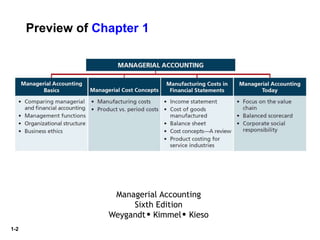
Preview of Chapter 1
Managerial Accounting
Sixth Edition
Weygandt Kimmel Kieso
1-3
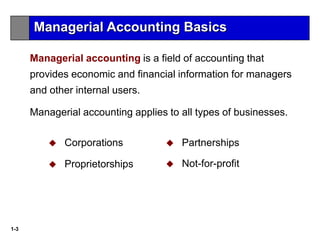
Managerial accounting is a field of accounting that
provides economic and financial information for managers
and other internal users.
Managerial accounting applies to all types of businesses.
 Corporations
 Proprietorships
 Partnerships
 Not-for-profit
Managerial Accounting Basics
1-4 LO 1 Explain the distinguishing features of managerial accounting.
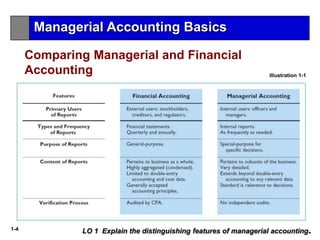
Comparing Managerial and Financial
Accounting Illustration 1-1
Managerial Accounting Basics
1-5
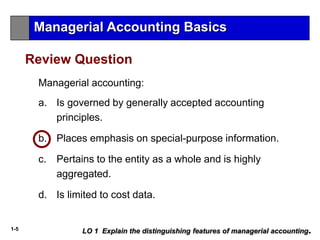
a. Is governed by generally accepted accounting
principles.
b. Places emphasis on special-purpose information.
c. Pertains to the entity as a whole and is highly
aggregated.
d. Is limited to cost data.
Managerial accounting:
Review Question
LO 1 Explain the distinguishing features of managerial accounting.
Managerial Accounting Basics
1-6
LO 2 Identify the three broad functions of management.
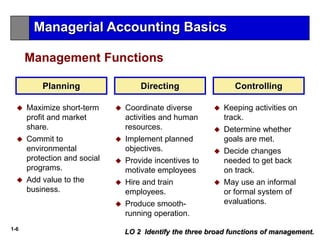
Management Functions
Planning
 Maximize short-term
profit and market
share.
 Commit to
environmental
protection and social
programs.
 Add value to the
business.
Directing Controlling
 Coordinate diverse
activities and human
resources.
 Implement planned
objectives.
 Provide incentives to
motivate employees
 Hire and train
employees.
 Produce smooth-
running operation.
 Keeping activities on
track.
 Determine whether
goals are met.
 Decide changes
needed to get back
on track.
 May use an informal
or formal system of
evaluations.
Managerial Accounting Basics
1-7
1-8
LO 2 Identify the three broad functions of management.
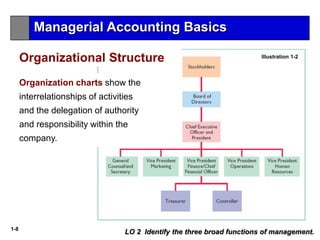
Illustration 1-2
Organization charts show the
interrelationships of activities
and the delegation of authority
and responsibility within the
company.
Organizational Structure
Managerial Accounting Basics
1-9
LO 2 Identify the three broad functions of management.
Business Ethics
 All employees are expected to act ethically.
 Many organizations have codes of business ethics.
 Past financial frauds:
► Enron,
► Global Crossing,
► WorldCom
Managerial Accounting Basics
1-10
LO 2 Identify the three broad functions of management.
Business Ethics
Creating Proper Incentives
 Systems and controls sometimes create incentives
for managers to take unethical actions.
 Controls need to be effective and realistic.
Managerial Accounting Basics
1-11
LO 2 Identify the three broad functions of management.
Business Ethics
Sarbanes-Oxley Act (SOX)
 Clarifies management’s responsibilities.
 Requires certifications by CEO and CFO.
 Selection criteria for Board of Directors and Audit
Committee.
 Substantially increased penalties for misconduct.
Code of Ethical Standards
Managerial Accounting Basics
1-12
a. Planning, directing, and selling.
b. Directing, manufacturing, and controlling.
c. Planning, manufacturing, and controlling.
d. Planning, directing, and controlling.
The management of an organization performs several
broad functions. They are:
LO 2 Identify the three broad functions of management.
Managerial Accounting Basics
Review Question
1-13
Indicate whether the following statements are true or false.
1. Managerial accountants have a single role within an
organization, collecting and reporting costs to
management.
2. Financial accounting reports are general-purpose and
intended for external users.
3. Managerial accounting reports are special-purpose and
issued as frequently as needed.
False
True
True
LO 2 Identify the three broad functions of management.
1-14
False
False
True
LO 2 Identify the three broad functions of management.
Indicate whether the following statements are true or false.
4. Managers’ activities and responsibilities can be classified
into three broad functions: cost accounting, budgeting,
and internal control.
5. As a result of the Sarbanes-Oxley Act, managerial
accounting reports must now comply with generally
accepted accounting principles (GAAP).
6. Top managers must certify that a company maintains an
adequate system of internal controls.
1-15
LO 3 Define the three classes of manufacturing costs.
Managers should ask questions such as the following.
1. What costs are involved in making a product or
providing a service?
2. If we decrease production volume, will costs decrease?
3. What impact will automation have on total costs?
4. How can we best control costs?
Manufacturing Costs
1-16
LO 3 Define the three classes of manufacturing costs.
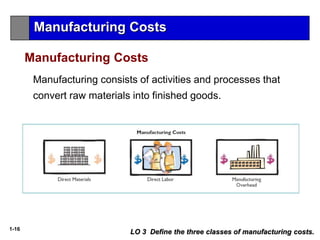
Manufacturing consists of activities and processes that
convert raw materials into finished goods.
Manufacturing Costs
Manufacturing Costs
1-17
Direct Materials
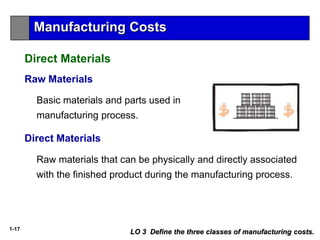
Raw Materials
Basic materials and parts used in
manufacturing process.
LO 3 Define the three classes of manufacturing costs.
Direct Materials
Raw materials that can be physically and directly associated
with the finished product during the manufacturing process.
Manufacturing Costs
1-18
Indirect Materials
 Not physically part of the finished product or they are
an insignificant part of finished product in terms of
cost.
 Considered part of manufacturing overhead.
LO 3 Define the three classes of manufacturing costs.
Direct Materials
Manufacturing Costs
1-19
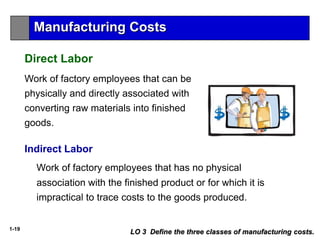
Work of factory employees that can be
physically and directly associated with
converting raw materials into finished
goods.
Indirect Labor
Work of factory employees that has no physical
association with the finished product or for which it is
impractical to trace costs to the goods produced.
LO 3 Define the three classes of manufacturing costs.
Direct Labor
Manufacturing Costs
1-20
 Costs that are indirectly associated with manufacturing
the finished product.
 Includes all manufacturing costs except direct materials
and direct labor.
 Also called factory overhead, indirect manufacturing
costs, or burden.
LO 3 Define the three classes of manufacturing costs.
Manufacturing Overhead
Manufacturing Costs
1-21
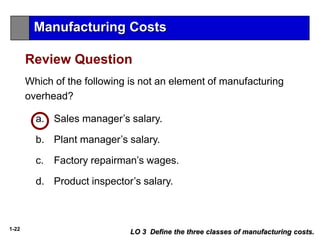
1-22
Which of the following is not an element of manufacturing
overhead?
a. Sales manager’s salary.
b. Plant manager’s salary.
c. Factory repairman’s wages.
d. Product inspector’s salary.
Review Question
LO 3 Define the three classes of manufacturing costs.
Manufacturing Costs
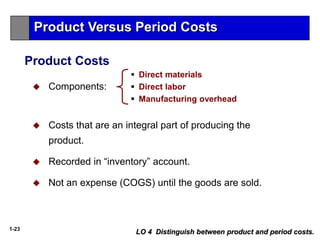
1-23
 Components:
 Costs that are an integral part of producing the
product.
 Recorded in “inventory” account.
 Not an expense (COGS) until the goods are sold.
LO 4 Distinguish between product and period costs.
Product Costs
 Direct materials
 Direct labor
 Manufacturing overhead
Product Versus Period Costs
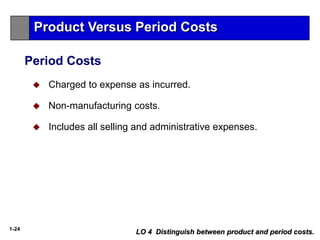
1-24
 Charged to expense as incurred.
 Non-manufacturing costs.
 Includes all selling and administrative expenses.
LO 4 Distinguish between product and period costs.
Period Costs
Product Versus Period Costs
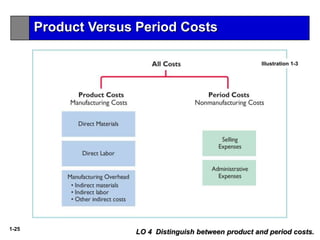
1-25
LO 4 Distinguish between product and period costs.
Illustration 1-3
Product Versus Period Costs
1-26
LO 4 Distinguish between product and period costs.
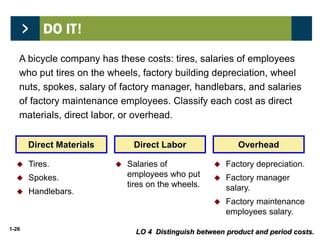
A bicycle company has these costs: tires, salaries of employees
who put tires on the wheels, factory building depreciation, wheel
nuts, spokes, salary of factory manager, handlebars, and salaries
of factory maintenance employees. Classify each cost as direct
materials, direct labor, or overhead.
Direct Materials
 Tires.
 Spokes.
 Handlebars.
Direct Labor Overhead
 Salaries of
employees who put
tires on the wheels.
 Factory depreciation.
 Factory manager
salary.
 Factory maintenance
employees salary.
1-27
Under a periodic inventory system, the income statements
of a merchandiser and a manufacturer differ in the cost of
goods sold section.
LO 5 Explain the difference between a merchandising
and a manufacturing income statement.
Income Statement
“COGS”
Manufacturing Costs in Financial Statements
1-28
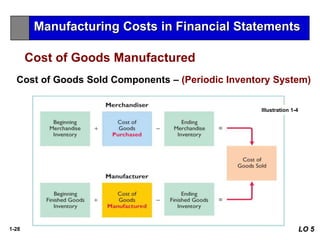
Cost of Goods Sold Components – (Periodic Inventory System)
LO 5
Illustration 1-4
Cost of Goods Manufactured
Manufacturing Costs in Financial Statements
1-29
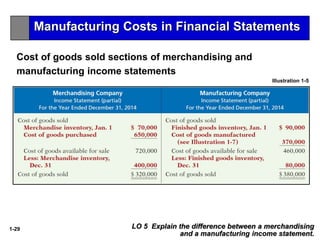
Cost of goods sold sections of merchandising and
manufacturing income statements
Illustration 1-5
LO 5 Explain the difference between a merchandising
and a manufacturing income statement.
Manufacturing Costs in Financial Statements
1-30
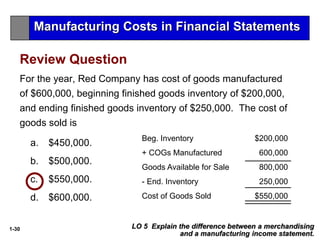
a. $450,000.
b. $500,000.
c. $550,000.
d. $600,000.
For the year, Red Company has cost of goods manufactured
of $600,000, beginning finished goods inventory of $200,000,
and ending finished goods inventory of $250,000. The cost of
goods sold is
Review Question
LO 5 Explain the difference between a merchandising
and a manufacturing income statement.
Beg. Inventory $200,000
+ COGs Manufactured 600,000
Goods Available for Sale 800,000
- End. Inventory 250,000
Cost of Goods Sold $550,000
Manufacturing Costs in Financial Statements
1-31
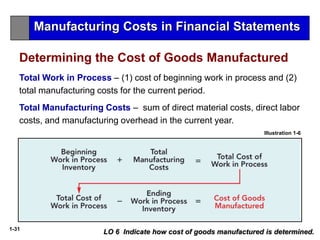
Determining the Cost of Goods Manufactured
Total Work in Process – (1) cost of beginning work in process and (2)
total manufacturing costs for the current period.
Total Manufacturing Costs – sum of direct material costs, direct labor
costs, and manufacturing overhead in the current year.
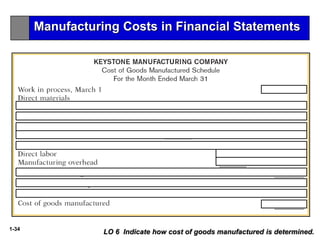
LO 6 Indicate how cost of goods manufactured is determined.
Illustration 1-6
Manufacturing Costs in Financial Statements
1-32
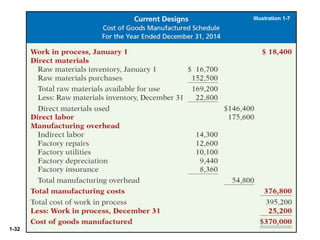
Illustration 1-8
Illustration 1-7
1-33
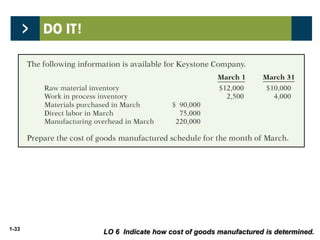
LO 6 Indicate how cost of goods manufactured is determined.
1-34
LO 6 Indicate how cost of goods manufactured is determined.
Manufacturing Costs in Financial Statements
1-35
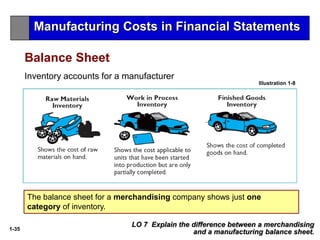
LO 7 Explain the difference between a merchandising
and a manufacturing balance sheet.
Illustration 1-8
Inventory accounts for a manufacturer
The balance sheet for a merchandising company shows just one
category of inventory.
Balance Sheet
Manufacturing Costs in Financial Statements
1-36
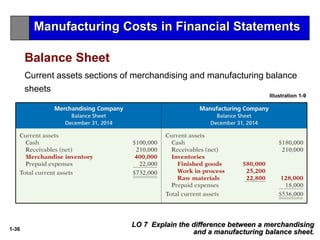
LO 7 Explain the difference between a merchandising
and a manufacturing balance sheet.
Illustration 1-9
Current assets sections of merchandising and manufacturing balance
sheets
Balance Sheet
Manufacturing Costs in Financial Statements
1-37
a. Raw materials and work in process only
b. Work in process only
c. Raw materials only
d. Raw materials, work in process, and finished goods
A cost of goods manufactured schedule shows beginning and
ending inventories for:
Review Question
LO 7 Explain the difference between a merchandising
and a manufacturing balance sheet.
Manufacturing Costs in Financial Statements
1-38
LO 7 Explain the difference between a merchandising
and a manufacturing balance sheet.
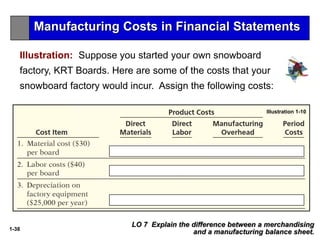
Illustration 1-10
Illustration: Suppose you started your own snowboard
factory, KRT Boards. Here are some of the costs that your
snowboard factory would incur. Assign the following costs:
Manufacturing Costs in Financial Statements
1-39
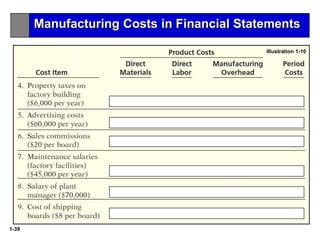
Illustration 1-10
Manufacturing Costs in Financial Statements
1-40
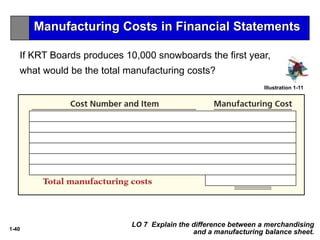
If KRT Boards produces 10,000 snowboards the first year,
what would be the total manufacturing costs?
LO 7 Explain the difference between a merchandising
and a manufacturing balance sheet.
Illustration 1-11
Manufacturing Costs in Financial Statements
1-41
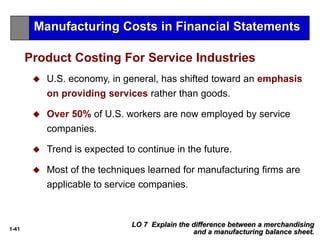
 U.S. economy, in general, has shifted toward an emphasis
on providing services rather than goods.
 Over 50% of U.S. workers are now employed by service
companies.
 Trend is expected to continue in the future.
 Most of the techniques learned for manufacturing firms are
applicable to service companies.
Product Costing For Service Industries
LO 7 Explain the difference between a merchandising
and a manufacturing balance sheet.
Manufacturing Costs in Financial Statements
1-42
1-43
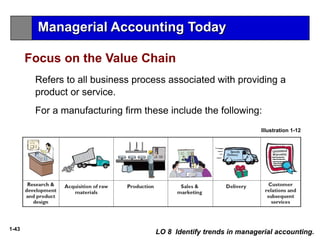
Refers to all business process associated with providing a
product or service.
For a manufacturing firm these include the following:
LO 8 Identify trends in managerial accounting.
Focus on the Value Chain
Illustration 1-12
Managerial Accounting Today
1-44
Just-In-Time Inventory Methods
 Inventory system in which goods are manufactured or
purchased just in time for sale.
LO 8 Identify trends in managerial accounting.
 Reduce defects in finished products, with the goal of
zero defects.
Total Quality Management (TQM)
Managerial Accounting Today
1-45
 Constraints (“bottlenecks” ) limit the company’s potential
profitability.
 A specific approach to identify and manage these
constraints in order to achieve company goals.
Theory of Constraints
LO 8 Identify trends in managerial accounting.
 Software programs designed to manage all major
business processes.
Enterprise Resource Planning (ERP)
Managerial Accounting Today
1-46
 Allocates overhead based on use of activities.
 Results in more accurate product costing and scrutiny of
all activities in the value chain.
LO 8 Identify trends in managerial accounting.
Activity-Based Costing (ABC)
Managerial Accounting Today
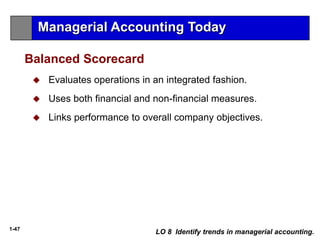
1-47
 Evaluates operations in an integrated fashion.
 Uses both financial and non-financial measures.
 Links performance to overall company objectives.
Balanced Scorecard
LO 8 Identify trends in managerial accounting.
Managerial Accounting Today
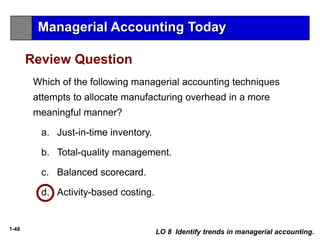
1-48
Which of the following managerial accounting techniques
attempts to allocate manufacturing overhead in a more
meaningful manner?
a. Just-in-time inventory.
b. Total-quality management.
c. Balanced scorecard.
d. Activity-based costing.
Review Question
LO 8 Identify trends in managerial accounting.
Managerial Accounting Today
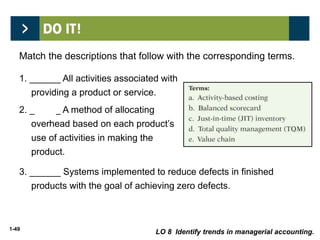
1-49
3. ______ Systems implemented to reduce defects in finished
products with the goal of achieving zero defects.
1. ______ All activities associated with
providing a product or service.
2. ______ A method of allocating
overhead based on each product’s
use of activities in making the
product.
Match the descriptions that follow with the corresponding terms.
e
a
d
LO 8 Identify trends in managerial accounting.
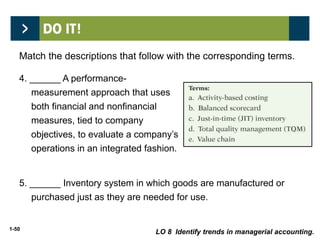
1-50
4. ______ A performance-
measurement approach that uses
both financial and nonfinancial
measures, tied to company
objectives, to evaluate a company’s
operations in an integrated fashion.
b
c5. ______ Inventory system in which goods are manufactured or
purchased just as they are needed for use.
LO 8 Identify trends in managerial accounting.
Match the descriptions that follow with the corresponding terms.
1-51
Copyright © 2012 John Wiley & Sons, Inc. All rights reserved.
Reproduction or translation of this work beyond that permitted in
Section 117 of the 1976 United States Copyright Act without the
express written permission of the copyright owner is unlawful.
Request for further information should be addressed to the
Permissions Department, John Wiley & Sons, Inc. The purchaser
may make back-up copies for his/her own use only and not for
distribution or resale. The Publisher assumes no responsibility for
errors, omissions, or damages, caused by the use of these
programs or from the use of the information contained herein.
Copyright

Managerial accounting Ch01

  • 1.
    1-1 Chapter 1 Managerial Accounting Learning Objectives Afterstudying this chapter, you should be able to: [1] Explain the distinguishing features of managerial accounting. [2] Identify the three broad functions of management. [3] Define the three classes of manufacturing costs. [4] Distinguish between product and period costs. [5] Explain the difference between a merchandising and a manufacturing income statement. [6] Indicate how cost of goods manufactured is determined.
  • 2.
    1-2 Preview of Chapter1 Managerial Accounting Sixth Edition Weygandt Kimmel Kieso
  • 3.
    1-3 Managerial accounting isa field of accounting that provides economic and financial information for managers and other internal users. Managerial accounting applies to all types of businesses.  Corporations  Proprietorships  Partnerships  Not-for-profit Managerial Accounting Basics
  • 4.
    1-4 LO 1Explain the distinguishing features of managerial accounting. Comparing Managerial and Financial Accounting Illustration 1-1 Managerial Accounting Basics
  • 5.
    1-5 a. Is governedby generally accepted accounting principles. b. Places emphasis on special-purpose information. c. Pertains to the entity as a whole and is highly aggregated. d. Is limited to cost data. Managerial accounting: Review Question LO 1 Explain the distinguishing features of managerial accounting. Managerial Accounting Basics
  • 6.
    1-6 LO 2 Identifythe three broad functions of management. Management Functions Planning  Maximize short-term profit and market share.  Commit to environmental protection and social programs.  Add value to the business. Directing Controlling  Coordinate diverse activities and human resources.  Implement planned objectives.  Provide incentives to motivate employees  Hire and train employees.  Produce smooth- running operation.  Keeping activities on track.  Determine whether goals are met.  Decide changes needed to get back on track.  May use an informal or formal system of evaluations. Managerial Accounting Basics
  • 7.
  • 8.
    1-8 LO 2 Identifythe three broad functions of management. Illustration 1-2 Organization charts show the interrelationships of activities and the delegation of authority and responsibility within the company. Organizational Structure Managerial Accounting Basics
  • 9.
    1-9 LO 2 Identifythe three broad functions of management. Business Ethics  All employees are expected to act ethically.  Many organizations have codes of business ethics.  Past financial frauds: ► Enron, ► Global Crossing, ► WorldCom Managerial Accounting Basics
  • 10.
    1-10 LO 2 Identifythe three broad functions of management. Business Ethics Creating Proper Incentives  Systems and controls sometimes create incentives for managers to take unethical actions.  Controls need to be effective and realistic. Managerial Accounting Basics
  • 11.
    1-11 LO 2 Identifythe three broad functions of management. Business Ethics Sarbanes-Oxley Act (SOX)  Clarifies management’s responsibilities.  Requires certifications by CEO and CFO.  Selection criteria for Board of Directors and Audit Committee.  Substantially increased penalties for misconduct. Code of Ethical Standards Managerial Accounting Basics
  • 12.
    1-12 a. Planning, directing,and selling. b. Directing, manufacturing, and controlling. c. Planning, manufacturing, and controlling. d. Planning, directing, and controlling. The management of an organization performs several broad functions. They are: LO 2 Identify the three broad functions of management. Managerial Accounting Basics Review Question
  • 13.
    1-13 Indicate whether thefollowing statements are true or false. 1. Managerial accountants have a single role within an organization, collecting and reporting costs to management. 2. Financial accounting reports are general-purpose and intended for external users. 3. Managerial accounting reports are special-purpose and issued as frequently as needed. False True True LO 2 Identify the three broad functions of management.
  • 14.
    1-14 False False True LO 2 Identifythe three broad functions of management. Indicate whether the following statements are true or false. 4. Managers’ activities and responsibilities can be classified into three broad functions: cost accounting, budgeting, and internal control. 5. As a result of the Sarbanes-Oxley Act, managerial accounting reports must now comply with generally accepted accounting principles (GAAP). 6. Top managers must certify that a company maintains an adequate system of internal controls.
  • 15.
    1-15 LO 3 Definethe three classes of manufacturing costs. Managers should ask questions such as the following. 1. What costs are involved in making a product or providing a service? 2. If we decrease production volume, will costs decrease? 3. What impact will automation have on total costs? 4. How can we best control costs? Manufacturing Costs
  • 16.
    1-16 LO 3 Definethe three classes of manufacturing costs. Manufacturing consists of activities and processes that convert raw materials into finished goods. Manufacturing Costs Manufacturing Costs
  • 17.
    1-17 Direct Materials Raw Materials Basicmaterials and parts used in manufacturing process. LO 3 Define the three classes of manufacturing costs. Direct Materials Raw materials that can be physically and directly associated with the finished product during the manufacturing process. Manufacturing Costs
  • 18.
    1-18 Indirect Materials  Notphysically part of the finished product or they are an insignificant part of finished product in terms of cost.  Considered part of manufacturing overhead. LO 3 Define the three classes of manufacturing costs. Direct Materials Manufacturing Costs
  • 19.
    1-19 Work of factoryemployees that can be physically and directly associated with converting raw materials into finished goods. Indirect Labor Work of factory employees that has no physical association with the finished product or for which it is impractical to trace costs to the goods produced. LO 3 Define the three classes of manufacturing costs. Direct Labor Manufacturing Costs
  • 20.
    1-20  Costs thatare indirectly associated with manufacturing the finished product.  Includes all manufacturing costs except direct materials and direct labor.  Also called factory overhead, indirect manufacturing costs, or burden. LO 3 Define the three classes of manufacturing costs. Manufacturing Overhead Manufacturing Costs
  • 21.
  • 22.
    1-22 Which of thefollowing is not an element of manufacturing overhead? a. Sales manager’s salary. b. Plant manager’s salary. c. Factory repairman’s wages. d. Product inspector’s salary. Review Question LO 3 Define the three classes of manufacturing costs. Manufacturing Costs
  • 23.
    1-23  Components:  Coststhat are an integral part of producing the product.  Recorded in “inventory” account.  Not an expense (COGS) until the goods are sold. LO 4 Distinguish between product and period costs. Product Costs  Direct materials  Direct labor  Manufacturing overhead Product Versus Period Costs
  • 24.
    1-24  Charged toexpense as incurred.  Non-manufacturing costs.  Includes all selling and administrative expenses. LO 4 Distinguish between product and period costs. Period Costs Product Versus Period Costs
  • 25.
    1-25 LO 4 Distinguishbetween product and period costs. Illustration 1-3 Product Versus Period Costs
  • 26.
    1-26 LO 4 Distinguishbetween product and period costs. A bicycle company has these costs: tires, salaries of employees who put tires on the wheels, factory building depreciation, wheel nuts, spokes, salary of factory manager, handlebars, and salaries of factory maintenance employees. Classify each cost as direct materials, direct labor, or overhead. Direct Materials  Tires.  Spokes.  Handlebars. Direct Labor Overhead  Salaries of employees who put tires on the wheels.  Factory depreciation.  Factory manager salary.  Factory maintenance employees salary.
  • 27.
    1-27 Under a periodicinventory system, the income statements of a merchandiser and a manufacturer differ in the cost of goods sold section. LO 5 Explain the difference between a merchandising and a manufacturing income statement. Income Statement “COGS” Manufacturing Costs in Financial Statements
  • 28.
    1-28 Cost of GoodsSold Components – (Periodic Inventory System) LO 5 Illustration 1-4 Cost of Goods Manufactured Manufacturing Costs in Financial Statements
  • 29.
    1-29 Cost of goodssold sections of merchandising and manufacturing income statements Illustration 1-5 LO 5 Explain the difference between a merchandising and a manufacturing income statement. Manufacturing Costs in Financial Statements
  • 30.
    1-30 a. $450,000. b. $500,000. c.$550,000. d. $600,000. For the year, Red Company has cost of goods manufactured of $600,000, beginning finished goods inventory of $200,000, and ending finished goods inventory of $250,000. The cost of goods sold is Review Question LO 5 Explain the difference between a merchandising and a manufacturing income statement. Beg. Inventory $200,000 + COGs Manufactured 600,000 Goods Available for Sale 800,000 - End. Inventory 250,000 Cost of Goods Sold $550,000 Manufacturing Costs in Financial Statements
  • 31.
    1-31 Determining the Costof Goods Manufactured Total Work in Process – (1) cost of beginning work in process and (2) total manufacturing costs for the current period. Total Manufacturing Costs – sum of direct material costs, direct labor costs, and manufacturing overhead in the current year. LO 6 Indicate how cost of goods manufactured is determined. Illustration 1-6 Manufacturing Costs in Financial Statements
  • 32.
  • 33.
    1-33 LO 6 Indicatehow cost of goods manufactured is determined.
  • 34.
    1-34 LO 6 Indicatehow cost of goods manufactured is determined. Manufacturing Costs in Financial Statements
  • 35.
    1-35 LO 7 Explainthe difference between a merchandising and a manufacturing balance sheet. Illustration 1-8 Inventory accounts for a manufacturer The balance sheet for a merchandising company shows just one category of inventory. Balance Sheet Manufacturing Costs in Financial Statements
  • 36.
    1-36 LO 7 Explainthe difference between a merchandising and a manufacturing balance sheet. Illustration 1-9 Current assets sections of merchandising and manufacturing balance sheets Balance Sheet Manufacturing Costs in Financial Statements
  • 37.
    1-37 a. Raw materialsand work in process only b. Work in process only c. Raw materials only d. Raw materials, work in process, and finished goods A cost of goods manufactured schedule shows beginning and ending inventories for: Review Question LO 7 Explain the difference between a merchandising and a manufacturing balance sheet. Manufacturing Costs in Financial Statements
  • 38.
    1-38 LO 7 Explainthe difference between a merchandising and a manufacturing balance sheet. Illustration 1-10 Illustration: Suppose you started your own snowboard factory, KRT Boards. Here are some of the costs that your snowboard factory would incur. Assign the following costs: Manufacturing Costs in Financial Statements
  • 39.
  • 40.
    1-40 If KRT Boardsproduces 10,000 snowboards the first year, what would be the total manufacturing costs? LO 7 Explain the difference between a merchandising and a manufacturing balance sheet. Illustration 1-11 Manufacturing Costs in Financial Statements
  • 41.
    1-41  U.S. economy,in general, has shifted toward an emphasis on providing services rather than goods.  Over 50% of U.S. workers are now employed by service companies.  Trend is expected to continue in the future.  Most of the techniques learned for manufacturing firms are applicable to service companies. Product Costing For Service Industries LO 7 Explain the difference between a merchandising and a manufacturing balance sheet. Manufacturing Costs in Financial Statements
  • 42.
  • 43.
    1-43 Refers to allbusiness process associated with providing a product or service. For a manufacturing firm these include the following: LO 8 Identify trends in managerial accounting. Focus on the Value Chain Illustration 1-12 Managerial Accounting Today
  • 44.
    1-44 Just-In-Time Inventory Methods Inventory system in which goods are manufactured or purchased just in time for sale. LO 8 Identify trends in managerial accounting.  Reduce defects in finished products, with the goal of zero defects. Total Quality Management (TQM) Managerial Accounting Today
  • 45.
    1-45  Constraints (“bottlenecks”) limit the company’s potential profitability.  A specific approach to identify and manage these constraints in order to achieve company goals. Theory of Constraints LO 8 Identify trends in managerial accounting.  Software programs designed to manage all major business processes. Enterprise Resource Planning (ERP) Managerial Accounting Today
  • 46.
    1-46  Allocates overheadbased on use of activities.  Results in more accurate product costing and scrutiny of all activities in the value chain. LO 8 Identify trends in managerial accounting. Activity-Based Costing (ABC) Managerial Accounting Today
  • 47.
    1-47  Evaluates operationsin an integrated fashion.  Uses both financial and non-financial measures.  Links performance to overall company objectives. Balanced Scorecard LO 8 Identify trends in managerial accounting. Managerial Accounting Today
  • 48.
    1-48 Which of thefollowing managerial accounting techniques attempts to allocate manufacturing overhead in a more meaningful manner? a. Just-in-time inventory. b. Total-quality management. c. Balanced scorecard. d. Activity-based costing. Review Question LO 8 Identify trends in managerial accounting. Managerial Accounting Today
  • 49.
    1-49 3. ______ Systemsimplemented to reduce defects in finished products with the goal of achieving zero defects. 1. ______ All activities associated with providing a product or service. 2. ______ A method of allocating overhead based on each product’s use of activities in making the product. Match the descriptions that follow with the corresponding terms. e a d LO 8 Identify trends in managerial accounting.
  • 50.
    1-50 4. ______ Aperformance- measurement approach that uses both financial and nonfinancial measures, tied to company objectives, to evaluate a company’s operations in an integrated fashion. b c5. ______ Inventory system in which goods are manufactured or purchased just as they are needed for use. LO 8 Identify trends in managerial accounting. Match the descriptions that follow with the corresponding terms.
  • 51.
    1-51 Copyright © 2012John Wiley & Sons, Inc. All rights reserved. Reproduction or translation of this work beyond that permitted in Section 117 of the 1976 United States Copyright Act without the express written permission of the copyright owner is unlawful. Request for further information should be addressed to the Permissions Department, John Wiley & Sons, Inc. The purchaser may make back-up copies for his/her own use only and not for distribution or resale. The Publisher assumes no responsibility for errors, omissions, or damages, caused by the use of these programs or from the use of the information contained herein. Copyright