PANNEL MEMBERS Mr. Farrukh Ijaz Mr. M A Rauf Khokher Mr. Abdul Hafeez Mr. M Adeel Farooq Mr. Kamran Farooq Ms. Tayyaba Manzar Ms. Sidra Ashraf  Ms. Tauseef Ms. Bushra
MANAGEMENT STYLES
MANAGEMENT STYLES Introduction Historical Background Management Theories Management Styles Advantages / Disadvantages Situational Management Style Conflict Management Style Bad Management Style Shift to Leadership Conclusion
INTRODUCTION
HISTORICAL BACKGROUND
EGYPTIAN PYRAMIDS   Massive Stone Design   Built 4500 Yrs ago   2.3 Million Stone Blocks   Base 230 m long    Height 146 m   Built using rollers, ropes  .   and levers
GREAT CHINA WALL   688 BC TO 1644 AD   300 YRS – 500 KM   TOTAL 6000 KM    RENOVATION 200 YRS AGO   BASE 20 FT    TOP 11 FEET WIDE   HEIGHT 7 TO 37 FT   ALL MADE BY HANDS
SYDNEY OPERA HOUSE    Completed 1940-1973   Power cable  645 KM   Rooms 1000   Theatres  05   Hall Capacity  2679  Persons   Seating Capacity  1547    Height 183 m    Width  120 m wide   Organ – 10,000 pipes   Roof is made of 1,056,000 tiles  .
MANAGEMENT THEORIES Scientific Management Theory Frederick Taylor(1890-1940) Bureaucratic Management Theory Max Weber (1930-1950) Human Relations Movement (1930-today)
MANAGEMENT STYLES
MANAGEMENT STYLES Management by: Coaching and Development Competitive Edge  Consensus  Decision Models  Exception  Information Systems  Interaction
MANAGEMENT STYLES Management by: Matrices Objectives  Organizational Development  Performance  Styles  Walking Around  Work Simplification
Directive Democrat:  Makes decisions participative; closely supervises subordinates. Directive Autocrat:  Makes decisions unilaterally; closely supervises subordinates. Permissive Democrat:  Makes decisions participative; gives subordinates latitude in carrying out their work. Permissive Autocrat:  Makes decisions unilaterally; gives subordinates latitude in carrying out their work.   MANAGEMENT STYLES
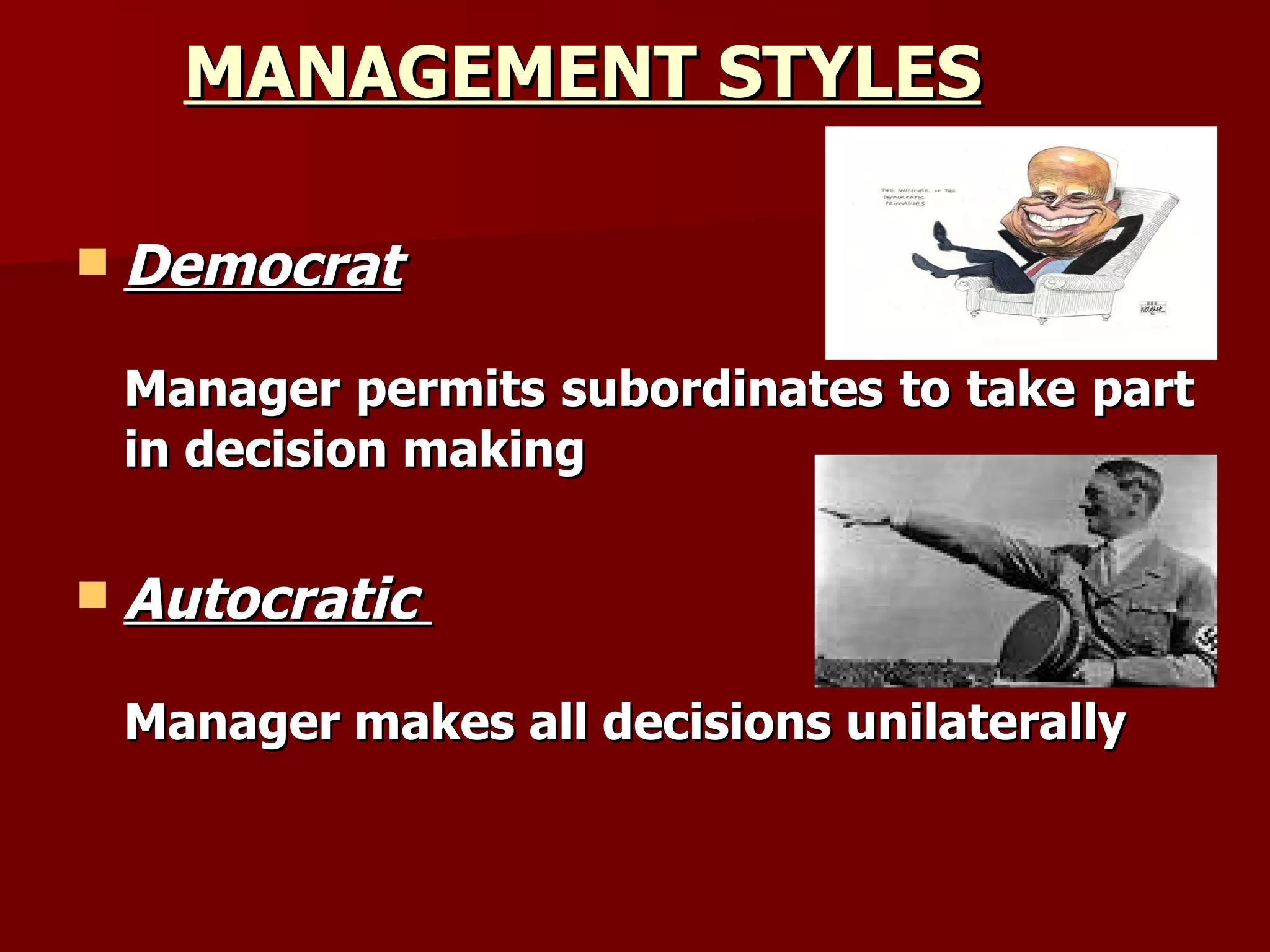
Democrat   Manager permits subordinates to take part in decision making Autocratic   Manager makes all decisions unilaterally MANAGEMENT STYLES
ADVANTAGES / DISADVANTAGES MANAGEMENT STYLES No two-way communication Creates “them and us” attitude Quick decision  making Effective when  employing workers  AUTOCRAT Mistakes or errors  can be made if workers are not skilled or experienced enough Authority is delegated to workers Useful when  complex decision is required DEMOCRAT Disadvantages Advantages Style
MANAGEMENT STYLES BY SITUATION
TELLING Works best when employees are neither willing nor able to do the job (high need of support and high need of guidance) DELEGATING Works best when the employees are willing to do the job and know how to go about it (low need of support and low need of guidance) MANAGEMENT STYLE  BY SITUATION
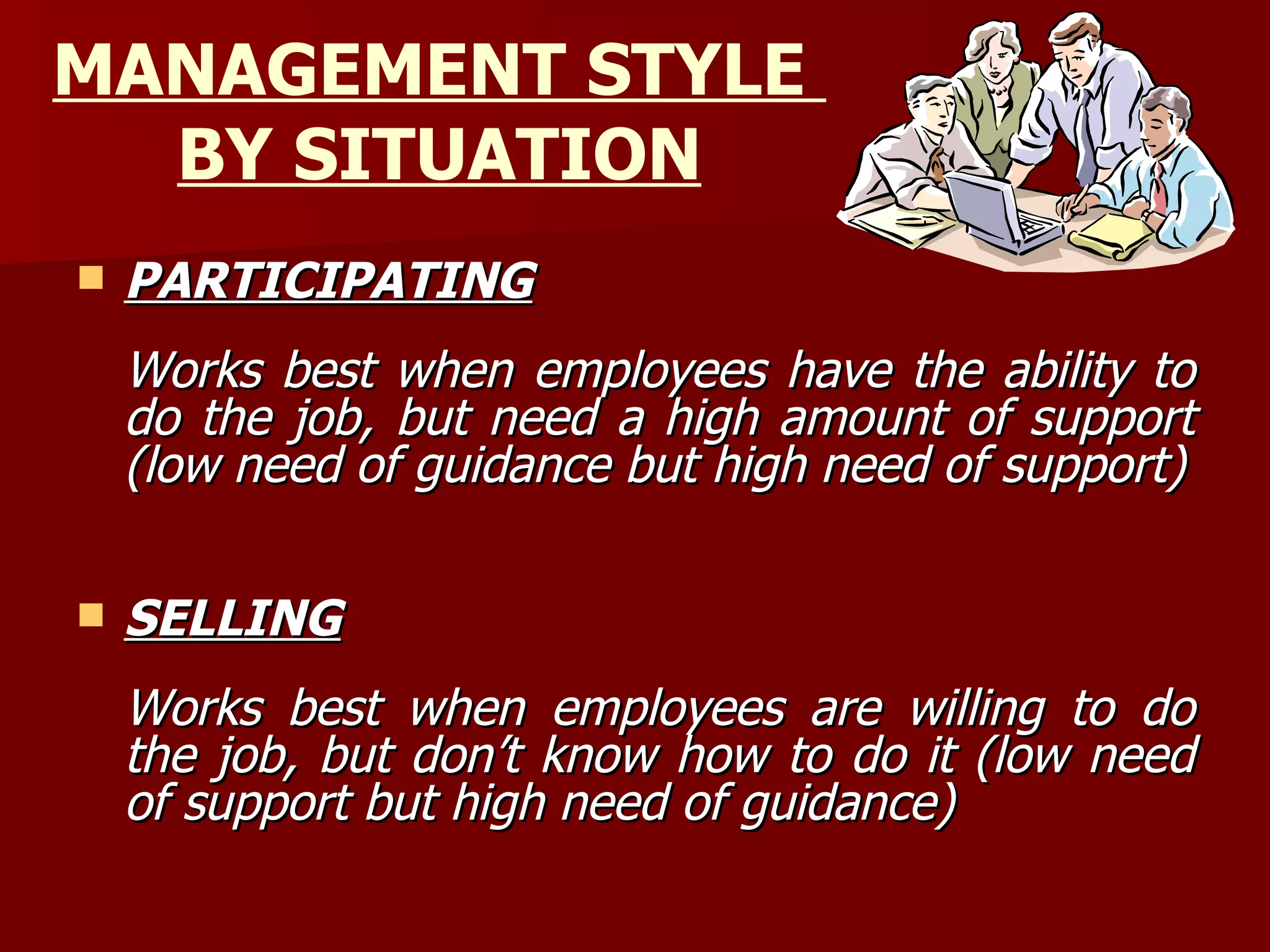
PARTICIPATING   Works best when employees have the ability to do the job, but need a high amount of support (low need of guidance but high need of support) SELLING Works best when employees are willing to do the job, but don’t know how to do it (low need of support but high need of guidance) MANAGEMENT STYLE  BY SITUATION
The different styles depend on the situation and the relationship behavior (amount of support required) and task behavior (amount of guidance required). MANAGEMENT STYLE  BY SITUATION (write up)
Collaborating  – I  win, you win Competing  –  I win, you lose Accommodating  –  I lose, you win Compromising  –  I bend, you bend Avoiding  –  You bend, I bend CONFLICT  MANAGEMENT STYLE
The Bland Boss The Grunt The Control-Freak The Politician The Absent Manager The Whip-Cracker The Spiteful Manager BAD  MANAGEMENT STYLES
MANAGEMENT STYLE  SHIFT TO LEADERSHIP
MANAGEMENT STYLE  SHIFT TO LEADERSHIP Formal Authority Personal Charisma Power Makes Facilitates Decision Plans details Sets direction Approach Objectives Vision Seeks Short Term Long Term Horizon Sub ordinates Followers Have Managing Work Leading People Focus Stability Change Essence Manager Leader Subject
MANAGEMENT STYLE  SHIFT TO LEADERSHIP Results Achievement Wants Action Striving Likes Money for work Excitement for work Exchange Transitional Transformational Style Tell Sell Persuasion Reactive Proactive Dynamic Control Passion Energy Head Heart Appeals to  Manager Leader Subject
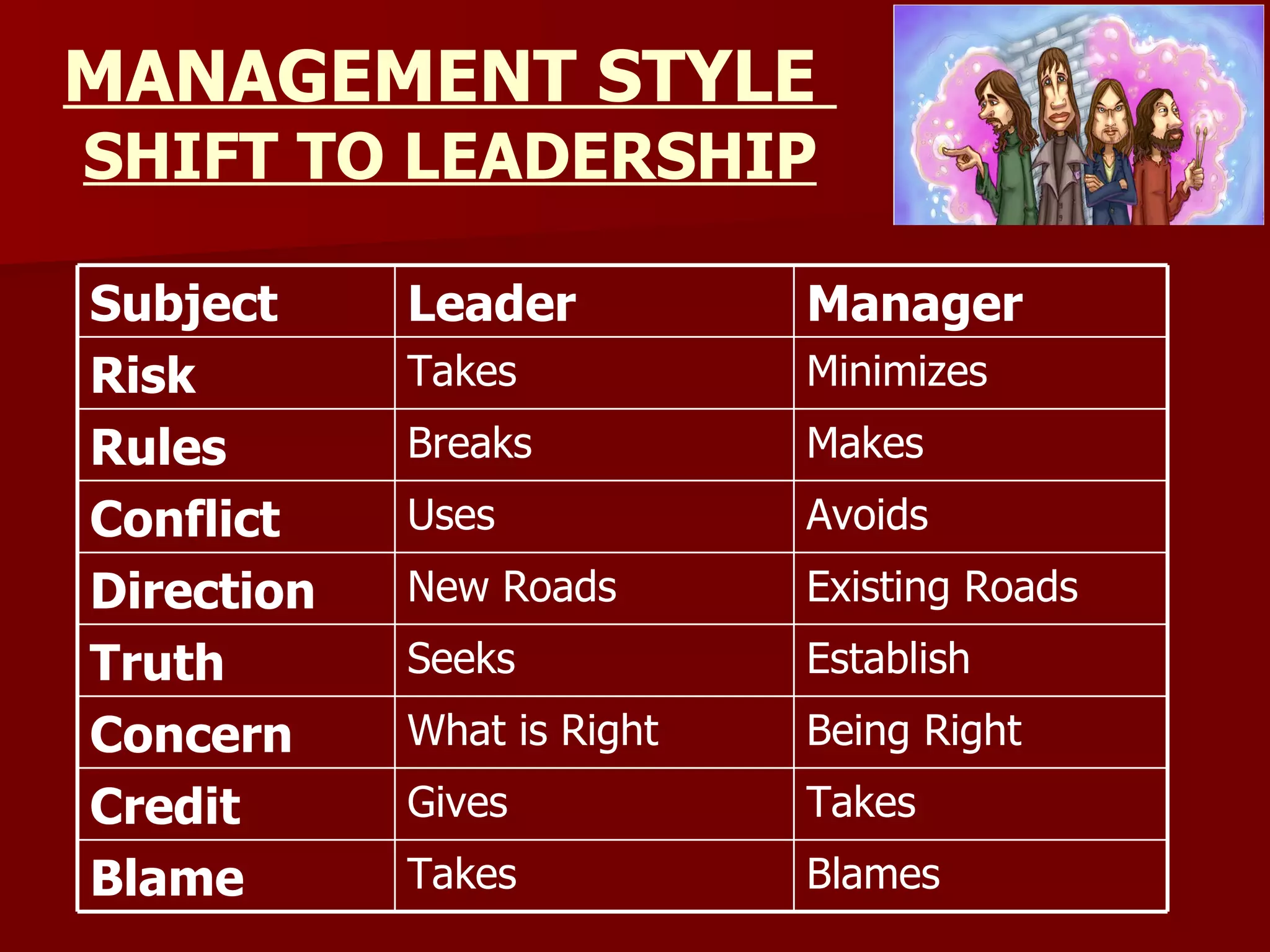
MANAGEMENT STYLE  SHIFT TO LEADERSHIP Blames Takes Blame Takes Gives Credit Being Right What is Right Concern Establish Seeks Truth Existing Roads New Roads Direction Avoids Uses Conflict Makes Breaks Rules Minimizes Takes Risk Manager Leader Subject
CONCLUSION
 

Management Styles

  • 1.
  • 2.
    PANNEL MEMBERS Mr.Farrukh Ijaz Mr. M A Rauf Khokher Mr. Abdul Hafeez Mr. M Adeel Farooq Mr. Kamran Farooq Ms. Tayyaba Manzar Ms. Sidra Ashraf Ms. Tauseef Ms. Bushra
  • 3.
  • 4.
    MANAGEMENT STYLES IntroductionHistorical Background Management Theories Management Styles Advantages / Disadvantages Situational Management Style Conflict Management Style Bad Management Style Shift to Leadership Conclusion
  • 5.
  • 6.
  • 7.
    EGYPTIAN PYRAMIDS Massive Stone Design Built 4500 Yrs ago 2.3 Million Stone Blocks Base 230 m long Height 146 m Built using rollers, ropes . and levers
  • 8.
    GREAT CHINA WALL 688 BC TO 1644 AD 300 YRS – 500 KM TOTAL 6000 KM RENOVATION 200 YRS AGO BASE 20 FT TOP 11 FEET WIDE HEIGHT 7 TO 37 FT ALL MADE BY HANDS
  • 9.
    SYDNEY OPERA HOUSE Completed 1940-1973 Power cable 645 KM Rooms 1000 Theatres 05 Hall Capacity 2679 Persons Seating Capacity 1547 Height 183 m Width 120 m wide Organ – 10,000 pipes Roof is made of 1,056,000 tiles .
  • 10.
    MANAGEMENT THEORIES ScientificManagement Theory Frederick Taylor(1890-1940) Bureaucratic Management Theory Max Weber (1930-1950) Human Relations Movement (1930-today)
  • 11.
  • 12.
    MANAGEMENT STYLES Managementby: Coaching and Development Competitive Edge Consensus Decision Models Exception Information Systems Interaction
  • 13.
    MANAGEMENT STYLES Managementby: Matrices Objectives Organizational Development Performance Styles Walking Around Work Simplification
  • 14.
    Directive Democrat: Makes decisions participative; closely supervises subordinates. Directive Autocrat: Makes decisions unilaterally; closely supervises subordinates. Permissive Democrat: Makes decisions participative; gives subordinates latitude in carrying out their work. Permissive Autocrat: Makes decisions unilaterally; gives subordinates latitude in carrying out their work. MANAGEMENT STYLES
  • 15.
    Democrat Manager permits subordinates to take part in decision making Autocratic Manager makes all decisions unilaterally MANAGEMENT STYLES
  • 16.
    ADVANTAGES / DISADVANTAGESMANAGEMENT STYLES No two-way communication Creates “them and us” attitude Quick decision making Effective when employing workers AUTOCRAT Mistakes or errors can be made if workers are not skilled or experienced enough Authority is delegated to workers Useful when complex decision is required DEMOCRAT Disadvantages Advantages Style
  • 17.
  • 18.
    TELLING Works bestwhen employees are neither willing nor able to do the job (high need of support and high need of guidance) DELEGATING Works best when the employees are willing to do the job and know how to go about it (low need of support and low need of guidance) MANAGEMENT STYLE BY SITUATION
  • 19.
    PARTICIPATING Works best when employees have the ability to do the job, but need a high amount of support (low need of guidance but high need of support) SELLING Works best when employees are willing to do the job, but don’t know how to do it (low need of support but high need of guidance) MANAGEMENT STYLE BY SITUATION
  • 20.
    The different stylesdepend on the situation and the relationship behavior (amount of support required) and task behavior (amount of guidance required). MANAGEMENT STYLE BY SITUATION (write up)
  • 21.
    Collaborating –I win, you win Competing – I win, you lose Accommodating – I lose, you win Compromising – I bend, you bend Avoiding – You bend, I bend CONFLICT MANAGEMENT STYLE
  • 22.
    The Bland BossThe Grunt The Control-Freak The Politician The Absent Manager The Whip-Cracker The Spiteful Manager BAD MANAGEMENT STYLES
  • 23.
    MANAGEMENT STYLE SHIFT TO LEADERSHIP
  • 24.
    MANAGEMENT STYLE SHIFT TO LEADERSHIP Formal Authority Personal Charisma Power Makes Facilitates Decision Plans details Sets direction Approach Objectives Vision Seeks Short Term Long Term Horizon Sub ordinates Followers Have Managing Work Leading People Focus Stability Change Essence Manager Leader Subject
  • 25.
    MANAGEMENT STYLE SHIFT TO LEADERSHIP Results Achievement Wants Action Striving Likes Money for work Excitement for work Exchange Transitional Transformational Style Tell Sell Persuasion Reactive Proactive Dynamic Control Passion Energy Head Heart Appeals to Manager Leader Subject
  • 26.
    MANAGEMENT STYLE SHIFT TO LEADERSHIP Blames Takes Blame Takes Gives Credit Being Right What is Right Concern Establish Seeks Truth Existing Roads New Roads Direction Avoids Uses Conflict Makes Breaks Rules Minimizes Takes Risk Manager Leader Subject
  • 27.
  • 28.