Advanced Administration
Training course accredited
by GAFM
Table of Content
2
1. Introduction, Roles, Competencies and Personal Effectiveness
2. Effective Planning, Organizing & Time Management
3. Individual Behavior, and Personality
4. Foundations of Group Behavior – Understanding Team Dynamics
5. Meeting Management
6. Problem Solving and Decision Making
7. Stress Management, Job Satisfaction
8. Communication in teams and Organization
9. Workplace Emotions and Moods
Table of Content
3
10. Motivation Concepts
11. Conflict and Negotiation in the work place
12. Delegation of Authority
13. Business Writing Skills
1. Introduction, Roles, Competencies
and Personal Effectiveness
4
The Importance of Interpersonal Skills
Interpersonal skills are the behaviors and tactics a person uses to interact with others effectively..
Below are ten reasons that demonstrate why they are so important:
04
01
02
03
Increase Clients
Satisfaction
Demonstrate Social Awareness
over the company
Keep a constructive Feedback Loop Open
Enhancing Effective Communication
5
08
05
06
07
Encourage Empathy
over the company
Make a lot of Effective Leaders
over the company
Foster and Maintain Personal
Relationships between employees
Attract and retain high-performing
employees
The Importance of Interpersonal Skills
5
6
What Managers do in the company?
Managers get things done through other people.
• Make decisions.
• Allocate resources.
• Direct activities of others to
attain goals.
Managerial Activities
6
7
a collection of people, who are involved in pursuing defined
objectives. It can be understood as a social system which comprises
all formal human relationships.
ORGANIZATION
7
8
the process of coordinating work activities so that they are
completed efficiently and effectively with and through other
people.
MANAGEMENT
8
9
Effectiveness
Efficiency
“Doing the right things”
Attaining organizational goals
“Doing things right”
Getting the most output for the least
inputs
Efficiency Vs. Effectiveness
9
10
Video
Efficiency Vs. Effectiveness
10
11
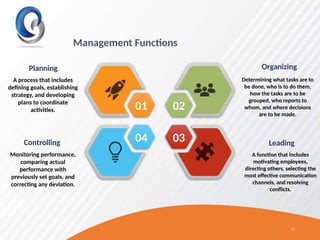
11
01 02
04 03
Planning
A process that includes
defining goals, establishing
strategy, and developing
plans to coordinate
activities.
Organizing
Determining what tasks are to
be done, who is to do them,
how the tasks are to be
grouped, who reports to
whom, and where decisions
are to be made.
Controlling
Monitoring performance,
comparing actual
performance with
previously set goals, and
correcting any deviation.
Leading
A function that includes
motivating employees,
directing others, selecting the
most effective communication
channels, and resolving
conflicts.
Management Functions
11
12
Management Functions
Management Skills
1. Planning.
2. Organizing.
3. Leading.
4. Controlling.
5. Staffing.
Self-rating
1. 1.2.3.4.5.6.7.8.9.10
2. 1.2.3.4.5.6.7.8.9.10
3. 1.2.3.4.5.6.7.8.9.10
4. 1.2.3.4.5.6.7.8.9.10
5. 1.2.3.4.5.6.7.8.9.10
How would you rate yourself on these skills?
12
13
01 02 03
Interpersonal
Role
1-Figurehead
required to perform a number of
routine duties of a legal or social
nature.
2-Leader
Responsible for the motivation and
direction of employees.
3-Liaison
Maintains a network of outside
contacts who provide favors and
information.
Informational
Role
Decisional
Role
Management Roles
Henry Mintzberg concluded that managers perform ten different, highly interrelated roles—or sets of behaviors
as shown below:
1-Monitor
Receives a wide variety of info;
serves as nerve center of internal
and external information of the
organization.
2-Disseminator
Transmits information received from
outsiders or from other employees
to members of the organization
3-Spokesperson
Transmits information to outsiders
on organization’s plans, policies, and
results; serves as expert on
organization’s industry
1-Entrepreneur
Searches organization and its
environment for opportunities and
initiates projects to bring change.
2-Disturbance handler
Responsible for corrective action
when organization faces
important, unexpected disturbances
3-Resource allocator
Makes or approves significant
organizational decisions.
4- Negotiator
Responsible for representing the
organization at major
Negotiations.
13
14
Video
Management Roles
14
15
Managerial Activities: Fred Luthans
Fred Luthans looked at what managers do from a somewhat different perspective, Luthans and his
associates studied more than 450 managers. All engaged in Four managerial activities:
Decision making, planning, and
controlling
01 02
03
Traditional
Management
04
Exchanging routine information
and processing paperwork.
Communication
Motivating, disciplining,
managing conflict, staffing, and
training.
Human Resource
Management
Socializing, politicking, and
interacting with outsiders.
Networking
15
16
Effective versus Successful Managerial Activities
Allocation of Activities by Time:
16
Introduction to the competencies
A competency is generally defined as a combination of skills, knowledge and
behaviours that enables an individual to perform a task or an activity successfully
within a given job.
Competencies are observable behaviours that can be measured and evaluated,
and thus are essential in terms of defining job requirements, recruiting, retaining
and developing employees.
17
18
What are the Competencies of Office Manager?
01
02
03
04
Communication Skills
Problem Solving
Decision Making
Planning & Organizing
05
06
07
08
Time Management
Attention to details
Accuracy
Initiative
18
19
The Challenges of moving from Employee to Manager
05
04
03
02
01 Readiness
Expectations
Development
Tasks of the new role
Colleagues & Team
19
Activity
How should you will approach being
a manager?
20
21
The Management of the Task, Team and Individual
Adair’s Model:
• Managers need to consider
all of the elements shown in
the model.
• Achieving balance in
addressing all will lead to
consistent long-term success.
• Ignoring an element or
focusing too much on one
element will impact
negatively on team
performance and success.
21
22
Feedback & The Johari Window Model
The Johari window model is used to enhance the individual’s perception on others. This model is
based on two ideas- trust can be acquired by revealing information about you to others and learning
yourselves from their feedbacks.
What we choose to
share with others
(being Open).
What others observe
but we don’t know.
What we choose to
keep hidden (Private)
from others.
May be buried
deeply or never have
been exposed.
Over time, increase the size of the public area by reducing the size of the
other areas through regular & open feedback (A), self-disclosure (B) & self
or shared discovery (C). 22
Activity
Johari Window Model
23
24
2. Effective Planning, Organizing & Time
Management
24
Time Management
Time Management refers to managing time effectively so that the right time is allocated to the
right activity
05
04
03
02
01 Improved productivity through improved use of time by the personnel
Better performance in terms of on time delivery to customers
Increased profitability through better use of the resources
To have more control over our job responsibilities
To reduce stress
Why do we need Time Management ?!
24
25
The second Habits of the 7 habits of
highly effective people.
Define your mission and goals
in life
25
26
The third Habits of the 7 habits of highly
effective people.
Prioritize, and do the most important
things first
26
Video
Time Management
27
28
• Procrastination
• Afraid to Delegate
• Not Wanting to Say
"NO"
• Problems With
Objectives / Priorities
• Interruptions we face
during the day.
• Being a slave on the
telephone
• Unexpected /Unwanted
visitors.
• Needless reports / Junk
mail.
• Meetings without agenda
MAJOR TIME
WASTERS
MINOR TIME
WASTERS
Time Wasters
28
29
Pareto’s Principle (80/20 Rule)
80% of Work gives 20% Results &
20% of Work gives 80% Results.
• Effective vs. Efficient
• Smart work vs. Hard work
29
30
Stephen Covey’s Time Management Matrix
Things that are both
“urgent” and
“important”
we need to spend
time here
Quadrant of
Quality
do our long-range
planning,
anticipate and
prevent problems
Things that are
“urgent, but not
important” - Quadrant
of Deception
The noise of urgency
creates the illusion of
importance.
Things that are “not
urgent, not
important” -
Quadrant of Waste
We often “escape” to
Quadrant IV for
survival.
30
Question
Where is the best quadrant I need to
spend time in?!
31
32
How to use time Effectively ?!
03
01
04
02 05
06
Effective Planning
Setting goals and
objectives
Setting deadlines
Spending the right
time on the right
activity
Prioritizing activities
as per their
importance
Delegation of
responsibilities
32
33
SMART Goals
01 02 03 04 05
Specific
Each target should be
a detailed statement
of your desired result.
Exactly what is it you
wish to accomplish?.
Measurable
Identify the means
by which you will
achieve each target.
How will you know
when you have
reached it?
Achievable
Describe your targets
using action verbs.
What will you do (step-
by-step) to reach your
targets?
Realistic
Choose targets that
are important to you,
that are possible &
achievable
Time Bound
Determine deadlines
for each of your
targets. Deadlines can
be flexible and
adjusted as needed
33
Video
SMART Goals
34
Activity
Write your 5 years SMART Goals
35
36
Time Management : Who’s got the Monkey ?!
• Monkeys are issues / actions may be problems, tasks or other
items at work that people bring to you to solve.
• They can come from just about anywhere, without warning …
and you have to manage them!
• “monkey on your back” metaphor describes issues, and the
ownership of issues.
• ‘Monkey Management’ helps to transform from a manager
under time pressure to an effective one.
What are the Monkeys?!
Types of Monkeys
1. Upward-leaping monkeys! From a subordinate or team
member to their boss, project manager, etc.
2. Downward-leaping monkeys! From a higher-level manager,
i.e., your boss …
3. Sideways-leaping monkeys! Shifting peer-to-peer.
36
Video
What is Monkey Management ?!
37
38
Time Management : Who’s got the Monkey ?!
1. Monkeys should be fed or shot.
No one likes a starving monkey. They tend to be very disagreeable
and squeal and raise a ruckus. Monkeys must be fed periodically.
2. Every monkey should have an assigned feeding time and a
degree of initiative.
the manager should select an appropriate time for the next feeding
and should have a number of action steps for the employee to take.
3. The monkey population should be kept “manage-able”.
Managers should keep the list of problems that are in various stages
of solution at a manageable number.
4. Monkeys should be fed by appointment only.
By setting specific times for addressing the problem, managers
empower employees to make interim decisions about the problem,
and still report back.
5. Monkey feeding appointments may be rescheduled.
6. Monkeys shall be fed face to face.
Six Rules to Manage Monkeys
38
39
3. Individual Behavior, and Personality
What is personality ?!
The sum total of ways in which an individual reacts and interacts with others, the measurable
traits a person exhibits.
Common Methods for Measuring Personality
Individuals evaluate themselves
on a series of factors, such as “I
worry a lot about the future.”
Though self-report measures
work well when well constructed,
one weakness is that the
respondent might lie or practice
impression management to
create a good impression.
provide an independent
assessment of personality. Here,
a co-worker or another observer
does the rating. Though the
results of self-report surveys and
observer-ratings surveys are
strongly correlated, research
suggests observer-ratings surveys
are a better predictor of success
on the job.
SELF-REPORTING
SURVEYS
OBSERVER-RATINGS
SURVEYS
39
40
Personality Traits
Personality traits are enduring characteristics that describe an individual’s behavior.
The more consistent the characteristic over time, and the more frequently it occurs in diverse
situations, the more important that trait is in describing the individual.
Two dominant frameworks used to describe personality as showing below:
Myers-Briggs Type
Indicator (MBTI®)
Big Five
Model
40
41
Personality Traits
Myers-Briggs Type Indicator (MBTI®)
is the most widely used personality assessment instrument in the world.10 It is a 100-question personality test that
asks people how they usually feel or act in particular situations.
Participants are classified on four axes to determine one of 16 possible personality types as below:
outgoing, sociable,
and assertive
practical and prefer
routine and order
focus on details
use reason and logic
to handle problems
want control and
prefer their world to
be ordered and
structured
quiet and shy
rely on unconscious
processes and look
at the “big picture.”
rely on their personal
values and emotions
flexible and
spontaneous
41
42
Personality Traits
Myers-Briggs Type Indicator (MBTI®)
Benefits of describing / determining personality traits:
05
04
03
02
01 Greater understanding of yourself, others.
Improve communication skills & Ability to understand and reduce conflict
Improve Time Management
Knowledge of your managerial style & its strengths and drawbacks
Identifying the tasks and jobs that give you satisfaction
42
Video
Myers-Briggs Type Indicator (MBTI®)
43
44
Personality Traits
Myers-Briggs Type Indicator (MBTI®)
44
45
Personality Traits
Myers-Briggs Type Indicator (MBTI®)
45
Activity
Myers-Briggs Type Indicator (MBTI®)
Test
46
https://www.16personalities.com/
47
Personality Traits
The Big Five Personality Model
The Big Five Model—that five basic dimensions underlie all others and encompass most of the significant variation
in human personality, below are the Big Five factors:
01 02 03 04 05
Extraversion Agreeableness Conscientiousness Emotional stability Openness to
experience
Captures our comfort
level with relationships
Extraverts tend to be
gregarious, assertive,
and sociable.
Introverts tend to be
reserved, timid, and
quiet.
Refers to an individual’s
propensity to defer to
others.
Highly agreeable people
are cooperative, warm,
and trusting. low on
agreeableness are cold,
disagreeable, and
antagonistic.
is a measure of
reliability. A highly
conscientious person is
responsible, organized,
dependable and
persistent. Those who
score low on this
dimension are easily
distracted, disorganized
and unreliable
often labeled by its
converse, taps a person’s
ability to withstand
stress. People with
positive emotional
stability tend to be calm,
self-confident, and
secure. Those with high
negative scores tend to
be nervous, anxious,
depressed, and insecure.
addresses range of
interests and fascination
with novelty. Extremely
open people are
creative, curious, and
artistically sensitive.
Those at the other end
of the category are
conventional and find
comfort in the familiar.
47
Video
The Big Five Personality Model
48
49
Personality Traits
The Big Five Personality
Model
49
50
Personality Traits
Model of How Big Five Traits Influence OB Criteria
Demonstrate how the
Big Five traits predict
behavior at work.
50
Activity
Big Five Personality
Test
https://www.truity.com/test/big-five-personality-test 51
52
4. Foundations of Group Behavior –
Understanding Team Dynamics
Defining and Classifying Groups
Group is Two or more individuals interacting and interdependent, who have come together to
achieve particular objectives.
Informal Group
• Alliances that are neither
formally structured nor
organizationally determined.
• Appear naturally in response
to the need for social
contact.
• Deeply affect behavior and
performance.
Formal Group
Defined by the organization’s
structure with designated
work assignments
establishing tasks.
52
53
The Five-Stage Model of Group
development
Members feel much
uncertainty
Lots of conflict
between members
of the group
Members have
developed close
relationships and
cohesiveness
The group is finally
fully functional
wrapping up
activities and
preparing to disband
53
Video
Team Work
54
55
Group Proprieties
Work groups have properties that shape members’ behavior and help explain and predict
individual behavior within the group as well as the performance of the group itself.
 Group Property 1: Roles
Role
A set of expected behavior patterns attributed to someone occupying a given position in a
social unit.
Role Perception
An individual’s view of how he or she is supposed to act in a given situation – received by
external stimuli.
Role Expectations
How others believe a person should act in a given situation.
Role Conflict
A situation in which an individual is confronted by divergent role expectations.
55
56
Group Proprieties
 Group Property 2: Norms
Norms
Acceptable standards of behavior within a group that are shared by the group’s members
Classes of Norms
• Performance norms - level of acceptable work
• Appearance norms - what to wear
• Social arrangement norms - friendships and the like
• Allocation of resources norms - distribution and assignments of jobs and material
 Group Property 3: Status
Status
A socially defined position or rank given to groups or group members by others – it
differentiates group members.
56
57
Group Proprieties
 Group Property 3: Status
What Determines Status?
1. The power a person wields over others. Because they likely control the group’s resources,
people who control the outcomes tend to be perceived as high status.
2. A person’s ability to contribute to a group’s goals. People whose contributions are critical to
the group’s success tend to have high status.
3. An individual’s personal characteristics. Someone whose personal characteristics are positively
valued by the group (good looks, intelligence, money, or a friendly personality) typically has
higher status than someone with fewer valued attributes.
 Group Property 4: Size
• Group size affects behavior
• Size:
 Twelve or more members is a “large” group
 Seven or fewer is a “small” group
57
58
Group Proprieties
Attribute Small Large
Speed X
Individual Performance X
Problem Solving X
Diverse Input X
Fact-Finding Goals X
Overall Performance X
Best use of Group based on size
58
59
Group Proprieties
 Group Property 5: Cohesiveness
Degree to which group members are attracted to each other and are motivated to stay in the group.
What can you do to encourage group cohesiveness?
2
1
3
4
5
6
Make the group smaller.
Encourage agreement with group goals.
Increase time members spend together.
Increase group status and admission difficulty.
Stimulate competition with other groups.
Give rewards to the group, not to individuals.
59
60
Differences Between Groups and Teams
60
61
Types of Teams
Groups of 5 to 12
employees from the
same department
who meet for a few
hours each week to
discuss ways of
improving quality,
efficiency, and the
work environment
Groups of 10 to 15
people who who
perform highly related
or interdependent
jobs and take on many
of the responsibilities
of their former
supervisors
Employees from about
the same hierarchical
level, but from different
work areas, who come
together to accomplish
a task
Teams that use
computer technology
to tie together
physically dispersed
members in order to
achieve a common
goal
61
62
Importance of Team Work
Team members Can
learn from each other.
Improves relations
among the employees.
Healthy competition
among the team
members.
Creates synergy .(high
motivation,
performance level)
Increase outputs at a
faster pace.
Higher quality of
decision making
62
63
Key Components of Effective Teams
63
64
Key Components of Effective Teams
Rewarding: Providing
Incentives to Be a
Good Team Player
• Rework the reward system to
encourage cooperative efforts
rather than competitive (individual)
ones
• Continue to recognize individual
contributions while still
emphasizing the importance of
teamwork
Selecting: Hiring
Team Players
Make team skills one of the
interpersonal skills in the
hiring process.
Training: Creating
Team Players
Individualistic learning plan
can be beneficial to enhance
the capabilities of the team
players.
64
65
What is leadership ?!
Leadership is the ability to influence a group toward the achievement of goals.
 Trait Theories of Leadership
 Theories that consider personal qualities and characteristics that differentiate leaders from
non leaders.
 Traits can predict leadership, but they are better at predicting leader emergence than
effectiveness
 Behavioral Theories of Leadership
 Theories proposing that specific behaviors differentiate leaders from non leaders.
Differences between theories of leadership:
 Trait theory: leadership is inherent, so we must identify the leader based on his or her traits
 Behavioral theory: leadership is a skill set and can be taught to anyone, so we must identify
the proper behaviors to teach potential leaders.
65
Video
Leadership
66
67
Charismatic Leadership and
Transformational Leadership
 charismatic leadership theory
 A leadership theory that states that followers make attributions of heroic or extraordinary
leadership abilities when they observe certain behaviors
Four characteristics of charismatic leaders:
2
1
3 4
Have a vision Are willing to take personal risks to
achieve the vision
Are sensitive to follower needs Exhibit behaviors that are out of the
ordinary
A four-step process How Charismatic Leaders Influence Followers:
2
1
3 4
Leader articulates an attractive vision communicates high performance expectations
and confidence in follower ability
Leader conveys a new set of values by
setting an example.
Leader engages in emotion-inducing and
often unconventional behavior to
demonstrate convictions about the vision.
67
68
Charismatic Leadership and
Transformational Leadership
Transformational Leaders
Transactional Leaders
Inspire followers to transcend their
own self-interests for the good of
the organization; they can have a
profound and extraordinary effect
on followers.
• Idealized Influence:
Provides vision and sense of
mission, instills pride, gains respect
and trust.
• Inspiration:
Communicate high expectations,
uses symbols to focus efforts,
expresses important issues simply.
• Intellectual Stimulation:
Promotes intelligence, rationality,
and problem solving
• Individualized Consideration:
Gives personal attention, coaches,
advises.
Leaders who guide or motivate
their followers in the direction of
established goals by clarifying role
and task requirements
• Contingent Reward:
Contracts exchange of rewards for
effort, promises rewards for good
performance, recognizes
accomplishments
• Management by Exception:
 Active: Watches and searches for
deviations from rules and
standards, takes corrective action
 Passive: Intervenes only if
standards are not met
• Laissez-Faire:
Abdicates responsibilities, avoids
making decisions
68
69
5. Meeting Management
Your Meetings experience !!
1. What types of meeting do you usually conduct?
2. What is effective about your meetings?
3. What is ineffective about your meeting?
4. What are the causes of the ineffectiveness?
5. What is the one thing you gain from this attending work meetings?
69
70
Meeting Goals and Purpose
Meeting Goals
and Purpose
Identifying & Solving
problems
Brainstorming /
Generating ideas
Gathering & Exchange
information
Planning & Organizing
for tasks execution
Decision Making
70
71
Effective Meeting Management
Opening the
meeting
Selecting Meeting
Participants
Establishing Ground
rules
Developing Meeting
Agenda
Meetings’ Time
Management
Evaluating the meeting
process
Evaluate the overall
meeting outputs
Closing the meeting
02
01
04
03
06
05
08
07
71
72
Effective Meeting Management
01
02
03
04
Selecting Meeting
Participants
Developing Meeting
Agenda
Opening the
meeting
Establishing Ground
rules
• The decision about who is to attend depends on
what you want to accomplish in the meeting.
• Follow-up your call with a meeting email, including
the purpose of the meeting, the meeting agenda.
• Develop the agenda together with key participants in
the meeting if possible.
• The agenda should be organized so that these
activities are conducted during the meeting.
• Always start on time; this respects those who
showed up on time and reminds late-comers that
the scheduling is serious.
• Welcome attendees and thank them for their time.
• Review the agenda at the beginning of each
meeting, giving participants a chance to understand
all proposed topics, change them and accept them.
• It pays to have a few basic ground rules that
can be used for most of your meetings. These
ground rules cultivate the basic ingredients
needed for a successful meeting.
72
73
Effective Meeting Management
05
06
07
08
Meetings’ Time
Management
Evaluating the meeting
process
Evaluate the overall
meeting outputs
Closing the meeting
• Time seems to run out before tasks are completed.
Therefore, the biggest challenge is keeping
momentum to keep the process moving.
• You might ask attendees to help you keep track of
the time.
• people will often complain about a meeting being a
complete waste of time.
• Get their feedback during the meeting when you can
improve the meeting process right away.
• Leave 5-10 minutes at the end of the meeting to
evaluate the meeting; don't skip this portion of the
meeting.
• Have each member rank the meeting from 1-5, with
5 as the highest, and have each member explain
their ranking.
• Always end meetings on time and attempt to end
on a positive note.
• At the end of a meeting, Clarify that meeting
minutes, review actions, and set the time for the
next meeting and ask each person if they can make
it or not (to get their commitment). 73
Video
Effective Meeting Management
74
75
6. Problem Solving and Decision Making
Problem Solving
A systematic approach to defining
the problem and creating a vast
number of possible solutions
without judging these solution.
“Problem solving is a cognitive
processing directed at achieving a
goal where no solution method is
obvious to the problem solver”.
>>>>>>>>>
>>>>>>>>>
75
76
Problem Solving steps
01 DEFINE THE PROBLEM
Express the issue in a clear, one- sentence problem statement. Identify root causes,
limiting assumptions, system and organizational boundaries and interfaces. Identify
resources.
02
ANALYSIS OF THE PROBLEM
• Investigate in Detail (evaluate the facts)
 Obtain valid information about “what is”
 Write a statement that identifies the root problem
• Use appropriate tools and techniques
 Check sheets, reports, observations
 Brainstorming
76
77
Problem Solving steps
IDENTIFICATION & GENERATE ALTERNATIVE SOLUTIONS
• Postpone evaluating alternatives initially
• Include all involved individuals in the generating of alternatives
• Specify alternatives consistent with organizational goals
• Specify short- and long-term alternatives
• Brainstorm on others' ideas
• Seek alternatives that may solve the problem
PROPOSE AND SELECT THE SOLUTION
• Evaluate alternatives relative to a target standard
• Evaluate all alternatives without bias
• Evaluate alternatives relative to established goals
• Evaluate both proven and possible outcomes
• State the selected alternative explicitly
03
04
77
78
Problem Solving steps
IMPLEMENT AND FOLLOW UP ON THE SOLUTION
• Develop a plan of action
 Specify steps to be completed
 Determine resources needed to implement plan
 Group member responsibilities to be agreed upon
 Determine timeline of events
 Provide for emergencies and/or contingencies
 Determine expected impact and actual impact
 Plan for assessment of your proposed plan
• Gather feedback from all affected parties
• Seek acceptance or consensus by all those affected
• Establish ongoing measures and monitoring
• Evaluate long-term results based on final solution
05
78
79
Individual Decision Making
 Problem
 A perceived discrepancy between the current state of affairs and a desired state
 Decisions
 Choices made from among alternatives developed from data.
Perception Linkage to Decision Making:
 All elements of problem identification and the decision making process are influenced by
perception.
Decision-Making Models in Organizations
1. Rational Decision-Making
 The rational decision-making model relies on a number of assumptions, including that the
decision maker has complete information, is able to identify all the relevant options in an
unbiased manner, and chooses the option with the highest utility.
79
80
Individual Decision Making
2. Intuitive decision Making
 A non-conscious process created from distilled experience that results in quick decisions
 Relies on holistic associations
 Affectively charged – engaging the emotions
 Rational Decision-Making
 Steps in the Rational Decision-Making Model:
Define the problem
Identify the decision criteria
Allocate weights to criteria
Develop the alternatives
Evaluate the alternatives
Select the best alternative.
80
81
Individual Decision Making
 Common Biases and Errors in Decision Making
04
01
02
03
Availability Bias
Confirmation Bias
Anchoring Bias
Overconfidence Bias
Believing too much in our own ability
to make good decisions – especially
when outside of own expertise
Using early, first received information
as the basis for making subsequent
judgments
Selecting and using only facts that
support our decision
Emphasizing information that is most
readily at hand
81
82
Individual Decision Making
 Common Biases and Errors in Decision Making
08
05
06
07
Hindsight Bias
Winner’s Curse
Randomness Error
Escalation of Commitment
Increasing commitment to a decision in
spite of evidence that it is wrong –
especially if responsible for the decision!
Creating meaning out of random
events - superstitions
Highest bidder pays too much due to
value overestimation
Likelihood increases with the number of
people in auction
After an outcome is already known,
believing it could have been accurately
predicted beforehand
82
83
Individual Decision Making
 Organizational Constraints in Decision Making
Managerial evaluation
criteria influence actions
01 02 03
04 05
Performance
Evaluation
Managers will make the
decision with the greatest
personal payoff for them
Reward Systems
Limit the alternative
choices of decision makers
Formal Regulations
Past decisions influence
current decisions
Historical Precedents
Restrict ability to gather or
evaluate information
System-imposed
Time Constraints
83
84
Individual Decision Making
 Three Ethical Decision Criteria
Utilitarianism
• Imposing and enforcing
rules fairly and
impartially.
• Equitable distribution of
benefits and costs
• Decisions made based solely
on the outcome
• Seeking the greatest good
for the greatest number.
• Dominant method for
business people
Rights
• Decisions consistent with
fundamental liberties and
privileges.
• Respecting and protecting
basic rights of individuals
such as whistle-blowers
Justice
Pro: Promotes efficiency and productivity
Con: Can ignore individual rights, especially minorities
Pro: Protects individuals from harm, preserves rights
Con: Creates an overly legalistic work environment
Pro: Protects the interests of weaker members
Con: Encourages a sense of entitlement
84
85
Improving Creativity in Decision Making
 Creativity
 The ability to produce novel and useful ideas
 Who has the greatest creative potential?
 Those who score high in openness to experience.
 People who are intelligent, independent, self-confident, risk-taking, have an internal locus-
of-control, tolerant of ambiguity, low need for structure, and who persevere in the face of
frustration
 The Three-Component Model of Creativity in decision making:
Proposition that individual creativity results from a mixture of three components:
 Expertise
This is the foundation
 Creative-Thinking Skills
The personality characteristics associated with creativity.
 Intrinsic Task Motivation
The desire to do the job because of its characteristics.
85
86
Groups decision Making vs. Individual
choice
• Generate more complete
information and knowledge.
• Offer increased diversity of
views and greater creativity
• Increased acceptance of
decisions.
• Generally more accurate (but
not as accurate as the most
accurate group member).
• Time-consuming activity
• Conformity pressures in the
group
• Discussions can be dominated
by a few members
• A situation of ambiguous
responsibility
STRENGTHS OF GROUP
DECISION MAKING
WEAKNESSES OF GROUP
DECISION MAKING
86
87
Group Decision-making Techniques
ELECTRONIC
MEETING
Uses computers to hold large
meetings of up to 50 people
INTERACTING
GROUPS
Made in interacting groups
where members meet face-to-
face and rely on verbal and
nonverbal communication
NOMINAL GROUP
TECHNIQUE (NGT)
Works by restricting discussion
during the decision-making process.
Members are physically present but
operate independently.
BRAINSTORMING
overcome the pressures for
conformity that dampen creativity
by encouraging any and all
alternatives while withholding
criticism.
87
88
Evaluating Group Decision-making
Techniques Effectiveness
Effectiveness Criteria
Type of Group
Interacting
Brain-
storming Nominal Electronic
Number and quality of ideas Low Moderate High High
Social Pressure High Low Moderate Low
Money Costs Low Low Low High
Speed Moderate Moderate Moderate Moderate
Task Orientation Low High High High
Potential for Interpersonal
Conflict High Low Moderate Moderate
Commitment to Solution High N/A Moderate Moderate
Development of Group
Cohesiveness High High Moderate Low
88
89
Stress Management
Stress is A dynamic condition in which an individual is confronted with an opportunity, constraint,
or demand related to what he or she desires and for which the outcome is perceived to be both
uncertain and important
 Types of Stress
01 02
Challenge Stressors
Stress associated with
workload, pressure to
complete tasks, and time
urgency
Hindrance Stressors
Stress that keeps you from
reaching your goals, such as
Routine, office politics,
• Cause greater harm than
challenge stressors
7. Stress Management, Job Satisfaction
89
90
A model for Stress
90
91
Managing Stress
• Implementing time management
• Increasing physical exercise
• Relaxation training
• Expanding social support
network
• Improved personnel selection and
job placement
• Training
• Use of realistic goal setting
• Redesigning of jobs
• Increased employee involvement
• Improved organizational
communication
• Offering employee sabbaticals
• Establishment of corporate
wellness programs.
INDIVIDUAL APPROACHES ORGANIZATIONAL APPROACHES
91
Question
What are you doing to manage
stress?!
92
93
What Are the Major Job Attitudes?!
We each have thousands of attitudes, but OB focuses our attention on a very limited number of work-related
attitudes, Most of the research in OB has looked at major attitudes:
Job Satisfaction
Describes a positive
feeling about a job,
resulting from an
evaluation of its
characteristics.
Job Involvement
Measures the degree to
which people identify
psychologically with their
job and consider
perceived performance
level important to self-
worth
Organizational
Commitment
The degree to which
an employee identifies
with a particular
organization and its
goals and wishes to
maintain membership
in the organization.
Perceived
organizational
support (POS)
Is the degree to which
employees believe the
organization values
their contribution and
cares about their well-
being.
Employee
Engagement
The degree of
involvement, satisfaction
with, and enthusiasm for
the job he or she does.
93
94
Job Satisfaction
Job Satisfaction is a positive feeling about a job resulting from an evaluation of its characteristics.
How to measure the job satisfaction?!
A response to one question, such
as “All things considered, how
satisfied are you with your job?”
Respondents circle a number
between 1 and 5 on a scale from
“highly satisfied” to “highly
dissatisfied.”
It identifies key elements in a job such
as the nature of the work, supervision,
present pay, promotion opportunities,
and relationships with co-workers.
Respondents rate these on a
standardized scale, and researchers add
the ratings to create an overall job
satisfaction score.
Single global rating
Summation score
It identifies key elements in a job such
as the nature of the work, supervision,
present pay, promotion opportunities,
and relationships with co-workers.
Respondents rate these on a
standardized scale, and researchers add
the ratings to create an overall job
satisfaction score.
Summation score
94
95
Job Satisfaction
What Are the Main Causes of Job Dissatisfaction?
95
96
Job Satisfaction
Employee Responses to Dissatisfaction
Neglect
The neglect response
passively allows
conditions to worsen and
includes chronic
absenteeism or lateness,
reduced effort, and
increased error rate.
Exit
The exit response directs
behavior toward leaving
the organization,
including looking for a
new position as well as
resigning
Loyalty
The loyalty response means
passively but optimistically waiting
for conditions to improve, including
speaking up for the organization in
the face of external criticism and
trusting the organization and its
management to “do the right thing.”
Voice
The voice response includes
actively and constructively
attempting to improve conditions,
including suggesting
improvements, discussing problems
with superiors, and undertaking
some forms of union activity.
96
97
Job Satisfaction
Outcomes of
Job
Satisfaction
03
01
04
02 05
06
Job Performance
Satisfied workers are more
productive and more
productive workers are
more satisfied!
Organizational
Citizenship Behaviors
Satisfaction influences OCB
through perceptions of
fairness.
Customer Satisfaction
Satisfied frontline employees
increase customer
satisfaction and loyalty.
Workplace Deviance
Dissatisfied workers are
more likely to unionize,
abuse substances, steal, be
tardy, and withdraw.
Turnover
Satisfied employees are
less likely to quit.
Absenteeism
Satisfied employees are
moderately less likely to
miss work.
97
Activity
Employee Satisfaction Survey
98
99
8. Communication in teams and
Organization
Function of Communication
Communication is the transference and the understanding of meaning
Control
member
behavior
Provide
information
needed to make
decisions
Provide a release
for emotional
expression
Foster
motivation for
what is to be
done
Communication Functions:
99
Video
What is Communication ?!
100
101
The Communication Process
101
102
Direction of Communication
Communication that flows from
one level of a group or
organization to a lower level.
Group leaders and managers use
it to assign goals, provide job
instructions, explain policies and
procedures, point out problems
that need attention, and offer
feedback about performance.
Flows to a higher level in the
group or organization. It’s used to
provide feedback to higher-ups,
inform them of progress toward
goals, and relay current
problems.
it keeps managers aware of how
employees feel about their jobs,
co-workers, and the organization
in general.
When communication takes
place among members of the
same work group,
members of work groups at the
same level, managers at the
same level, or any other
horizontally equivalent workers.
It saves time and facilitates
coordination.
Lateral
Communication
Upward
Communication
Downward
Communication
102
103
Interpersonal Communication
Written
Communication
Advantages: Tangible and verifiable
Disadvantages: Time-consuming
and lacks feedback
Oral
Communication
Advantages: Speed and feedback
Disadvantage: Distortion of the
message
NONVERBAL
COMMUNICATION
Advantages: Supports other communications
and provides observable expression of
emotions and feelings.
Disadvantage: Misperception of body
language or gestures can influence receiver’s
interpretation of message.
103
104
Organizational Communication
Rigidly follows the
chain of command
Relies on a central figure to act as the
conduit for all communication
Team with a strong leader
All group members
communicate actively with
each other
Small Group Network Effectiveness
104
105
Suggestions for Reducing the Negative
Consequences of Rumors
1. Announce timetables for making important decisions.
2. Explain decisions and behaviors that may appear inconsistent or secretive.
3. Emphasize the downside, as well as the upside, of current decisions and future plans.
4. Openly discuss worst-case possibilities—they are almost never as anxiety-provoking as the unspoken fantasy.
Electronic Communications
01
02
03
04
Email
Instant/Text
Messaging
Networking Software
Blogs and Video
conferencing
105
106
Choice of Communication Channel
how channel richness underlies the choice of communication channel.
106
107
Barriers to Effective Communication
Silence
It’s easy to ignore silence
or lack of communication,
precisely because it is
defined by the absence of
information.
Filtering
A sender’s manipulation
of information so that it
will be seen more
favorably by the receiver
Communication
Apprehension
Undue tension and anxiety about
oral communication, written
communication, or both
Information Overload
A condition in which information
inflow exceeds an individual’s
processing capacity
Language
Words have different
meanings to different people.
Emotions
How a receiver feels at the
time a message is received
will influence how the
message is interpreted.
Gender Differences
Men tend to talk to
emphasize status while
women talk to create
connections
Selective Perception
People selectively interpret
what they see on the basis of
their interests, background,
experience, and attitudes
107
Video
Effective Communication
108
109
9. Workplace Emotions and Moods
What are Emotions and Moods?
Intense feelings that
are directed at
someone or something
Feelings that tend to be
less intense than
emotions and that lack
a contextual stimulus.
109
110
The Basic Emotions
Many researchers agree on six essentially universal basic emotions:
Fear
Disgust
Surprise
Anger
Sadness
Happiness
110
111
The Basic Moods: Positive and Negative Affect
One way to classify emotions is by
whether they are positive or
negative, Being neutral is being non
emotional. When we group
emotions into positive and negative
categories, they become mood
states because we are now looking
at them more generally instead of
isolating one particular emotion.
111
112
Sources of Emotions and Moods
1. Personality
There is a trait component –
affect intensity.
2. Day and Time of the Week
There is a common pattern for
all of us as being happier toward
the end of the week.
3. Weather
4. Stress
Even low levels of constant
stress can worsen moods.
5. Social Activities
Physical, informal and dining
activities increase positive
moods.
6. Sleep
Poor sleep quality increases
negative affect.
7. Exercise
Does somewhat improve mood,
especially for depressed people.
8. Age
Older folks experience fewer
negative emotions.
9. Gender
Women tend to be more
emotionally expressive, feel
emotions more intensely, have
longer lasting moods, express
emotions more frequently than do
men.
112
113
Emotional Labor
An employee’s expression of organizationally desired emotions during interpersonal
transactions at work.
Emotional dissonance:
The true challenge arises when employees have to project one emotion while feeling another.
Types of Emotions:
01
Felt Emotions:
are an individual’s actual emotions.
02
Displayed Emotions:
those that the organization requires workers to show and
considers appropriate in a given job.
113
114
Emotional Intelligence (EI)
is a person’s ability to:
Understand
emotions in the
self and others,
understand the
meaning of these
emotions, and
regulate one’s
emotions
accordingly in a
cascading model
01 02 03
Emotional Intelligence (EI) plays an important role in job performance
114
Video
Emotional Intelligence (EI)
115
116
Organizational Behavior Applications of
Emotions and Moods
01 02 03 04 05
Selection
EI should be a hiring
factor, especially for
social jobs.
Decision Making
Positive emotions can
lead to better
decisions.
Creativity
Positive mood
increases flexibility,
openness, and
creativity.
Motivation
Positive mood affects
expectations of
success; feedback
amplifies this effect.
Leadership
Emotions are important
to acceptance of
messages from
organizational leaders.
116
117
Organizational Behavior Applications of
Emotions and Moods
06 07 08 09 10
Negotiation
Emotions , skillfully
displayed, can affect
negotiations.
Customer Services
Emotions affect service
quality delivered to
customers which, in
turn, affects customer
relationships.
Job Attitudes
Can carry over to
home but dissipate
overnight.
Deviant Workplace
Behaviors
Negative emotions lead
to employee deviance
(actions that violate
norms and threaten the
organization).
Manager’s
Influence
Leaders who are in a
good mood, use humor,
and praise employees
increase positive moods
in the workplace.
117
118
10. Motivation Concepts
What is Motivation?
Motivation is the processes that account for an individual’s intensity, direction, and persistence
of effort toward attaining a goal – specifically, an organizational goal.
The three key elements of Motivation:
2
1
3
Intensity
Direction
Persistence
how hard a person tries.
effort that is channelled toward,
and consistent with, organizational
goals.
how long a person can
maintain effort.
118
119
Early Theories of Motivation
Four theories of employee motivation formulated during the 1950s, These early theories may not be valid, but
they do form the basis for contemporary theories and are still used by practicing managers.
MCGREGOR’S
THEORY X AND
THEORY Y
MASLOW’S
HIERARCHY OF NEEDS
THEORY
HERZBERG’S TWO-
FACTOR THEORY
MCCLELLAND’S
THEORY OF
NEEDS
1
2
3
4
119
120
Early Theories of Motivation
 Maslow’s Hierarchy of Needs
Assumptions
 Individuals cannot move to the next higher level until all needs at the current
(lower) level are satisfied.
 Must move in hierarchical order.
120
Video
Maslow’s Hierarchy of Needs
121
122
Early Theories of Motivation
 McGregor’s Theory X and Theory Y
Two distinct views of human beings: Theory X (basically negative) and Theory Y (positive).
 Managers used a set of assumptions based on their view.
 The assumptions molded their behavior toward employees
Under Theory X, managers believe
employees inherently dislike work
and must therefore be directed or
even coerced into performing it.
Under Theory Y, in contrast,
managers assume employees can
view work as being as natural as
rest or play, and therefore the
average person can learn to accept,
and even seek, responsibility.
122
123
Early Theories of Motivation
 Herzberg’s Two-Factor Theory
A theory that relates intrinsic factors to job satisfaction and associates extrinsic factors with dissatisfaction.
Also called motivation hygiene theory.
The Key Point for this theory : Satisfaction and dissatisfaction are not opposites but separate constructs
123
124
Early Theories of Motivation
 McClelland’s Three Needs Theory
A theory that states achievement, power, and affiliation are three important needs that help explain motivation.
McClelland’s theory of needs looks at three needs:
Need for Affiliation
(nAff)
The desire for friendly
and close interpersonal
relationships.
Need for
Achievement (nAch)
The drive to excel, to
achieve in relation to a
set of standards, to
strive to succeed.
Need for power
(nPow)
The need to make
others behave in a way
they would not have
otherwise.
124
125
Contemporary Theories of Motivation
Contemporary theories have one thing in common: each has a reasonable degree of valid supporting
documentation
We call them “contemporary theories” because they represent the current state of thinking in explaining employee
motivation.
Cognitive Evaluation Theory
Self-Efficacy Theory
(Social Cognitive Theory)
Equity Theory
Goal-Setting Theory
Reinforcement Theory
3
1 2
4
5
125
126
Contemporary Theories of Motivation
 Cognitive Evaluation Theory
A version of self-determination theory which holds that allocating extrinsic rewards for
behavior that had been previously intrinsically rewarding tends to decrease the overall level of
motivation if the rewards are seen as controlling.
Example:
If you’re reading a novel a week because your English literature instructor requires you to, you
can attribute your reading behavior to an external source. However, if you find yourself
continuing to read a novel a week after the course is over, your natural inclination is to say, “I
must enjoy reading novels because I’m still reading one a week.”
Major Implications for Work Rewards:
• Intrinsic and extrinsic rewards are not independent.
• Extrinsic rewards decrease intrinsic rewards.
• Pay should be noncontingent on performance.
• Verbal rewards increase intrinsic motivation, tangible rewards reduce it.
126
127
Contemporary Theories of Motivation
 Goal-Setting Theory
A theory that says that specific and difficult goals, with self-generated feedback, lead to higher
performance.
Why are people motivated by difficult goals?
• Challenging goals get our attention and thus tend to help us focus.
• Difficult goals energize us because we have to work harder to attain them.
• When goals are difficult, people persist in trying to attain them.
• Difficult goals lead us to discover strategies that help us perform the job or task more
effectively.
Relationship between goals and performance depends on:
• Goal commitment (the more public the better!)
• Task characteristics (simple, well-learned)
• national culture.
127
128
Contemporary Theories of Motivation
 Goal-Setting Theory
Management By Objectives (MBO) is a systematic way to utilize goal-setting.
Goals must be:
 Tangible √ Verifiable
 Measurable
Corporate goals are broken down into smaller, more specific goals at each level of organization.
Four common ingredients to
MBO programs:
 Goal Specificity
 Participative decision making
 Explicit time period
 Performance feedback
128
129
Contemporary Theories of Motivation
 Self-Efficacy Theory
An individual’s belief that he or she is capable of performing a task
Higher efficacy is related to:
• Greater confidence.
• Greater persistence in the face of difficulties.
• Better response to negative feedback (work harder).
Four ways self-efficacy can be increased:
• Enactive mastery
 Most important source of efficacy
 Gaining relevant experience with task or job
 “Practice makes Perfect”
• Vicarious modeling
 Increasing confidence by watching others perform the task
 Most effective when observer sees the model to be similar to him- or herself
• Verbal persuasion
 Motivation through verbal conviction
• Arousal
 Getting “psyched up” – emotionally aroused – to complete task.
 Can hurt performance if emotion is not a component of the task.
129
130
Contemporary Theories of Motivation
 Reinforcement Theory
A theory that says that behavior is a function of its consequences.
Reinforcement theory ignores the inner state of the individual and concentrates solely on what
happens when he or she takes some action.
Reinforcement strongly influences behavior but not likely to be the sole cause.
 Equity Theory
A theory that says that individuals compare their job inputs and outcomes with those of others
and then respond to eliminate any inequities.
 When ratios are equal:
state of equity exists – no tension as the situation is considered fair - we perceive that our
situation is fair and justice prevails.
 When ratios are unequal:
tension exists due to unfairness ( under rewarded states cause anger - Overrewarded states
cause guilt).
Tension motivates people to act to bring their situation into equity
130
131
Contemporary Theories of Motivation
 Equity Theory
Equity Theory’s “Relevant Others” can be four different situation:
1. Self–inside. An employee’s experiences in a different position inside the employee’s
current organization.
2. Self–outside. An employee’s experiences in a situation or position outside the employee’s
current organization.
3. Other–inside. Another individual or group of individuals inside the employee’s
organization.
4. Other–outside. Another individual or group of individuals outside the employee’s
organization.
 Organizational Justice
Overall perception of what is fair in the workplace. Made up of:
 Distributive Justice :Fairness of outcome
Example: I got the pay raise I deserved.
 Procedural Justice: Fairness of outcome process
Example: I had input into the process used to give raises and was given a
good explanation of why I received the raise I did.
 Interactional Justice: Being treated with dignity and respect
Example: When telling me about my raise, my supervisor was very nice
and complimentary
131
132
Motivating by Job Design: The Job Characteristics
Model
Increasingly, research on motivation focuses on approaches that link motivational concepts to
changes in the way work is structured.
The job characteristics model (JCM) says we can describe any job in terms of five core job
dimensions:
1. Skill variety is the degree to which a job requires a variety of different activities so the
worker can use a number of different skills and talent.
2. Task identity is the degree to which a job requires completion of a whole and identifiable
piece of work.
3. Task significance is the degree to which a job affects the lives or work of other people.
4. Autonomy is the degree to which a job provides the worker freedom, independence, and
discretion in scheduling work and determining the procedures in carrying it out.
5. Feedback is the degree to which carrying out work activities generates direct and clear
information about your own performance.
132
133
 How can job be redesigned ?!
Job Enrichment
The vertical expansion of
jobs, which increases the
degree to which the worker
controls the planning,
execution, and evaluation of
the work.
Job Rotation
The periodic shifting of an
employee from one task to
another with similar skill
requirements at the same
organizational level.
Job Enlargement
is an increase in job tasks and
responsibilities to make a
position more challenging. It is a
horizontal expansion, which
means that the tasks added are
at the same level as those in the
current position.
Motivating by Job Design: The Job Characteristics
Model
133
134
 Alternative Work Arrangements to motivation
Job Sharing The Virtual Office
Telecommuting
Flextime
Employees work during a
common core time period
each day but have
discretion in forming their
total workday from a
flexible set of hours
outside the core
The practice of having
two or more people split
a 40-hour-a-week job
Employees do their work
at home at least two days
a week on a computer
that is linked to their
office
.
Employees work out of
their home on a relatively
permanent basis
Motivating by Job Design: The Job Characteristics
Model
134
135
Employee Involvement
A participative process that uses the input of employees to increase their commitment to the
organization’s success
By increasing worker autonomy and control over work lives (involvement), organizations:
 Increase employee motivation.
 Gain greater organizational commitment.
 Experience greater worker productivity.
 Observe higher levels of job satisfaction.
Types of Employee Involvement Programs
Participative
Management
Representative
Participation
Subordinates share a
significant degree of decision-
making power with their
immediate superiors
Works Councils
Groups of nominated
or elected employees
who must be
consulted for any
personnel decisions
Board Representative
An employee sits on a
company’s board of
directors & represents the
interests of the firm’s
employees
135
136
11. Conflict and Negotiation in the work
place
What is Conflict ?!
A process that begins when one party perceives that another party has negatively affected, or
is about to negatively affect, something that the first party cares about.
 Transitions in Conflict Thought
• The belief that all conflict is harmful
and must be avoided
• Conflict resulted from:
 Poor communication
 Lack of openness
 Failure to respond to employee
needs
• The belief that conflict is not only a
positive force in a group but also an
absolute necessity for a group to
perform effectively.
• The interactionist view does not
propose that all conflicts are good.
Rather, functional conflict ,
dysfunctional conflict, Task Conflict,
Process Conflict, Relationship Conflict.
TRADITIONAL VIEW OF CONFLICT INTERACTIONIST VIEW OF CONFLICT
Functional Conflict: Conflict that supports the goals of the group and improves its performance
Dysfunctional Conflict: Conflict that hinders group performance
Task conflict relates to the content and goals of the work. Relationship conflict focuses on interpersonal
relationships. Process conflict relates to how the work gets done.
136
137
Conflict Process
137
138
Dimensions of Conflict-Handling
Intentions
138
Video
Conflict Management
139
140
Conflict Management Techniques
140
141
Negotiation
A process in which two or more parties exchange goods or services and attempt to agree on
the exchange rate for them.
 Two General Approaches:
 Distributive Bargaining: Negotiation that seeks to divide up a fixed amount of resources; a win-
lose situation.
 Integrative Bargaining: Negotiation that seeks one or more settlements that can create a win-
win solution.
141
142
The Negotiation Process
Preparation and
Planning
Before you start negotiating, you need
to do your homework and be prepared
and planned for the negotiation.
Clarification and
Justification
When you have exchanged initial
positions, both you and the other party
will explain, amplify, clarify, bolster, and
justify your original demands.
Closure
and Implementation
The final step in the negotiation process
is formalizing the agreement you have
worked out and developing any
procedures necessary for implementing
and monitoring it.
Definition of Ground Rules
Once you’ve done your planning and
developed a strategy, you’re ready to
begin defining with the other party the
ground rules and procedures of the
negotiation itself.
Bargaining and Problem Solving
The essence of the negotiation process is the
actual give-and-take in trying to hash out an
agreement. This is where both parties will
undoubtedly need to make concessions.
142
143
Individual Differences in Negotiation
Effectiveness
Moods/
Emotions
Personality
Traits
Culture
Gender
• Extroverts and agreeable people
weaker at distributive negotiation
– disagreeable introvert is best
• Ability to show anger helps in
distributive bargaining
• Positive moods and emotions
help integrative bargaining.
• Men and women negotiate the same
way, but may experience different
outcomes
• Women and men take on gender
stereotypes in negotiations: tender and
tough
• Women are less likely to negotiate
• some negotiation tactics
yield superior outcomes
across cultures.
143
144
Third-Party Negotiations
01 02 03 04
Mediator
A neutral third party who
facilitates a negotiated
solution by using
reasoning, persuasion, and
suggestions for alternatives
Arbitrator
A third party to a
negotiation who has the
authority to dictate an
agreement.
Conciliator
A trusted third party who
provides an informal
communication link
between the negotiator
and the opponent
Consultant
An impartial third party,
skilled in conflict
management, who attempts
to facilitate creative problem
solving through
communication and analysis
144
145
11. Delegation of Authority
What is Delegation ?!
Delegation is the assignment of responsibility to another person for the purpose of carrying out
specific job-related activities. Delegation is a shift of decision- making authority from one
organizational level to another.
Benefits of Delegation
2
1
3
Manager / Supervisor Benefits
Employee Benefits
Organizational Benefits
Reduced stress - Improved time
management - Increased trust
Professional knowledge and skill
development - Elevated self-esteem and
confidence - Sense of achievement
Increased teamwork - Increased
productivity and efficiency
145
146
Barriers of delegation
LOOSING CREDIT &
CONTROL
LOOSING TASK YOU
ENJOY
NOT ENOUGH
EXPERIENCE
FEAR OF FAILURE
NOT ENOUGH TIME
NO CONFIDENCE IN
TEAM MEMBERS
146
147
Steps for delegation
E-Ensure
understanding
I –Introduce the
task
D-Demonstrate clearly
what needs to be done
A-Allocate authority,
information and resources
L-Let go S-Support and
monitor
147
148
12. Business Writing Skills
The quality of your relationships and
results will be determined by the quality
and quantity of your communication
with other people.
Ronnie Morris
Central Area Vice President
Coca-Cola Bottling Company of North Texas
148
149
Texting Etiquette
01 02 03 04 05
Be careful with
abbreviations.
Be aware of your
perceived tone.
Never send bad
news via text.
Don’t change meeting
times or venues in a
text.
Always double check
when using the voice-
to-text feature.
149
150
Email Etiquette
01 02 03 04 05
Don’t use e-mail to
avoid personal
contact.
Remember that e-mail
isn’t private.
Use the subject field
to indicate content
and purpose.
Your tone cannot be
heard in an e-mail.
& Don’t send chain
letters or junk mail.
Use a signature that
includes contact
information.
150
151
The KISS Concept In Writing
HEADLINES
BULLET POINTS
TO THE POINT
SHORT
SENTENCES
Keep It Short & Simple (KISS)
151
Email General Format
Basics:
• Write a salutation for each new subject email.
• Try to keep the email brief (one screen length).
• Check for punctuation, spelling, and grammatical errors.
• Use caps when appropriate.
• Format your email for plain text rather than HTML.
• Use a font that has a professional or neutral look.
Lists & Bullets:
• When you are writing directions or want to emphasize important points, number your
directions or bullet your main points.
152
153
Email General Format
The Tone:
• Write in a positive tone “When you complete the report.” instead of “If you complete the report.”
• Avoid negative words that begin with “un, non, ex” or that end with “less” (useless, non-existent,
undecided).
• Use smiles , winks ;), and other graphical symbols only when appropriate.
☺
• Use contractions to add a friendly tone. (don’t, won’t, can’t).
The Addresses:
• Avoid sending emails to more than four addresses at once.
• Instead, create a mailing list so that readers do not have to scroll too much before getting to the
actual message.
The Attachments:
• When you are sending an attachment tell your respondent what the name of the file is, what
program it is saved in, and the version of the program.
“This file is in MSWord 2000 under the name “LabFile.”
153
154
The Writing Process…step by step
06
05
04
03
02
01
Organization
Introduction is used
to grab the readers’
attention &
introduce the idea
Body helps to
elaborate upon the
main Idea.
Conclusion serves to
wrap up the
argument
Revising:
Review higher-order
concerns:
• Clear communication
of ideas
• Organization of
Paragraph structure
• Strong introduction
and conclusion.
Collection
• Gathering ideas
• Locating and
evaluating research
• Conducting interviews
• Consulting others
Drafting
• Give yourself time
to work on your
• project.
• Find a comfortable
place to do your
writing.
• Avoid distractions.
Proofreading
Review later-order
concerns:
• Spelling
• Punctuation
• Sentence structure
• Documentation
style
Invention
coming up with your
topic
Brainstorming:
Getting your ideas on
paper so you can give
yourself the widest
range of topics
possible
154
155
8 Keys to Better Business Writing
01
KNOW WHY YOU’RE WRITING
• Be clear about objectives.
• Address your audience appropriately.
• State the goals you want to achieve.
02 UNDERSTAND YOUR READERS
• Get to the point quickly.
• Focus on what’s relevant.
• Use a tone that fits your audience.
155
156
8 Keys to Better Business Writing
WRITE YOUR FIRST DRAFT IN 4 PARTS
• Research
• Organizes the material
• Writes first draft
• Edits and tightens
REVISE AND EDIT
• Do I have a clear, concise opening?
• Have I said all I need to say?
• Have I proved my point with specifics?
• Have I avoided repetitions?
• Have I closed smoothly?
03
04
Two of the most common expectations
are that your message will:
• Get to the point
• Be kept as simple as possible
156
157
8 Keys to Better Business Writing
BE RELENTLESSLY CLEAR
• Illustrate your points with specifics –
SHOW – DON’T TELL
DON’T WASTE WORDS
• Trim wordy passages
• Get rid of “filler words”
for example, change February of 2014 to February 2014. Replace
words ending in “ion” with verbs; Change “provided protection” to
“protected.” Get rid of filler like “in terms of.”
06
05
157
158
8 Keys to Better Business Writing
NEVER USE BUSINESS-SPEAK
• Stay away from trite expressions, such as “mission-critical” or
words like “enormity.”
• Avoid jargon that others might not understand.
• Watch the use of abbreviations such as APW, PDS, SOP, CEU, etc.
RELAX AND FIND THE RIGHT TONE
• Vary the length and structure of your sentences.
• You want short sentences and long sentences. A short sentence is
good for emphasis.
• Use courtesies like “thank you” and “we appreciate.”
• Use personal pronouns instead of formal language.
08
07
158
159
Which of the two emails below would you
prefer to receive?
01 02
159
Activity
Write an Email
160
Report Writing
What is Report ?!
Reports are documents which presents specific, focused content-often the result of an experiment,
investigation, or inquiry to a specific audience.
What is importance and purpose of reports in business?
• To communicate information with others.
• To records events for decision making.
• To recommend specific action.
• To sell or persuade.
161
162
The Reporting Process
Decide the Objective
Take some time to think about the
purpose of the report.
Having a clear purpose from the outset
ensures that you stay focused, which
makes it easier to engage your reader.
Understand Your Audience
Writing a formal annual report for
your stakeholders is very different to a
financial review. Tailor your language,
use of data and supporting graphics to
the audience.
Report Format and Type
Before you start, check the report format
and type. Do you need to craft a formal,
informal, financial, annual, technical,
fact-finding or problem-solving report?
You should also confirm if any templates
are available within the organization.
Structure the Report
A report typically has four
elements:
1. Executive Summary
2. Introduction
3. Report Body
4. Conclusion
Gather the Facts and Data
Including engaging facts and data
will solidify your argument. Start
with your collaborative project site
and work out as needed. Remember
to cite sources such as articles, case
studies, and interviews.
Edit
The first draft of the report is rarely
perfect so you will need to edit and
revise the content. If possible, set
the document aside for a few days
before reviewing or ask a colleague
to review.
01
02
03
04
05
06
162
163
Report Structure
EXECUTIVE
SUMMARY
is written once the
report is finished.
As the first item
the reader
encounters, this is
the most important
section of the
document. They
will likely use the
summary to
decide how much
of the report they
need to read so
make it count!
BODY
It’s now time to put
your writing skills to
work! This is the
longest section of
the report and
should present
details background,
analysis,
recommendations
for consideration.
Draw upon data and
supporting graphics
to support your
position
INTRODUCTION
Provide a context
for the report and
outline the
structure of the
contents. Identify
the scope of the
report and any
particular used
methodologies
CONCLUSION
Bring together the
various elements
of the report in a
clear and concise
manner. Identify
next steps and any
actions that your
reader needs to
take.
163
164
Memo
• Memos is the abbreviation for the word Memorandum.
• Memos are destined for INTERNAL communication more than external communication.
• Memos help in solving problems:
 by informing the reader about new information, like policy changes, price increases, etc.
 by persuading the reader to take an action, such as attend a meeting, use less paper, or
change a current production procedure.
164
Memo structure
A. The Header
Make sure that the main page mentions the word MEMO at the top.
To: From: Date:
B. The Core
• This is where you write down information or instructions.
• Start by greeting the reader.
• If the information is one subject with no steps, write a paragraph.
• If the information is requires steps then write in bullets.
• Write clear, concise to the point sentences complete with all necessary information
C.The closure:
Write a small paragraph containing the following:
• inviting sentence to follow content.
• Greet your reader.
• Sign the document.
165
166
Questions
167
Thank You
168

Office Management training material.pptx

  • 1.
  • 2.
    Table of Content 2 1.Introduction, Roles, Competencies and Personal Effectiveness 2. Effective Planning, Organizing & Time Management 3. Individual Behavior, and Personality 4. Foundations of Group Behavior – Understanding Team Dynamics 5. Meeting Management 6. Problem Solving and Decision Making 7. Stress Management, Job Satisfaction 8. Communication in teams and Organization 9. Workplace Emotions and Moods
  • 3.
    Table of Content 3 10.Motivation Concepts 11. Conflict and Negotiation in the work place 12. Delegation of Authority 13. Business Writing Skills
  • 4.
    1. Introduction, Roles,Competencies and Personal Effectiveness 4 The Importance of Interpersonal Skills Interpersonal skills are the behaviors and tactics a person uses to interact with others effectively.. Below are ten reasons that demonstrate why they are so important: 04 01 02 03 Increase Clients Satisfaction Demonstrate Social Awareness over the company Keep a constructive Feedback Loop Open Enhancing Effective Communication
  • 5.
    5 08 05 06 07 Encourage Empathy over thecompany Make a lot of Effective Leaders over the company Foster and Maintain Personal Relationships between employees Attract and retain high-performing employees The Importance of Interpersonal Skills 5
  • 6.
    6 What Managers doin the company? Managers get things done through other people. • Make decisions. • Allocate resources. • Direct activities of others to attain goals. Managerial Activities 6
  • 7.
    7 a collection ofpeople, who are involved in pursuing defined objectives. It can be understood as a social system which comprises all formal human relationships. ORGANIZATION 7
  • 8.
    8 the process ofcoordinating work activities so that they are completed efficiently and effectively with and through other people. MANAGEMENT 8
  • 9.
    9 Effectiveness Efficiency “Doing the rightthings” Attaining organizational goals “Doing things right” Getting the most output for the least inputs Efficiency Vs. Effectiveness 9
  • 10.
  • 11.
    11 11 01 02 04 03 Planning Aprocess that includes defining goals, establishing strategy, and developing plans to coordinate activities. Organizing Determining what tasks are to be done, who is to do them, how the tasks are to be grouped, who reports to whom, and where decisions are to be made. Controlling Monitoring performance, comparing actual performance with previously set goals, and correcting any deviation. Leading A function that includes motivating employees, directing others, selecting the most effective communication channels, and resolving conflicts. Management Functions 11
  • 12.
    12 Management Functions Management Skills 1.Planning. 2. Organizing. 3. Leading. 4. Controlling. 5. Staffing. Self-rating 1. 1.2.3.4.5.6.7.8.9.10 2. 1.2.3.4.5.6.7.8.9.10 3. 1.2.3.4.5.6.7.8.9.10 4. 1.2.3.4.5.6.7.8.9.10 5. 1.2.3.4.5.6.7.8.9.10 How would you rate yourself on these skills? 12
  • 13.
    13 01 02 03 Interpersonal Role 1-Figurehead requiredto perform a number of routine duties of a legal or social nature. 2-Leader Responsible for the motivation and direction of employees. 3-Liaison Maintains a network of outside contacts who provide favors and information. Informational Role Decisional Role Management Roles Henry Mintzberg concluded that managers perform ten different, highly interrelated roles—or sets of behaviors as shown below: 1-Monitor Receives a wide variety of info; serves as nerve center of internal and external information of the organization. 2-Disseminator Transmits information received from outsiders or from other employees to members of the organization 3-Spokesperson Transmits information to outsiders on organization’s plans, policies, and results; serves as expert on organization’s industry 1-Entrepreneur Searches organization and its environment for opportunities and initiates projects to bring change. 2-Disturbance handler Responsible for corrective action when organization faces important, unexpected disturbances 3-Resource allocator Makes or approves significant organizational decisions. 4- Negotiator Responsible for representing the organization at major Negotiations. 13
  • 14.
  • 15.
    15 Managerial Activities: FredLuthans Fred Luthans looked at what managers do from a somewhat different perspective, Luthans and his associates studied more than 450 managers. All engaged in Four managerial activities: Decision making, planning, and controlling 01 02 03 Traditional Management 04 Exchanging routine information and processing paperwork. Communication Motivating, disciplining, managing conflict, staffing, and training. Human Resource Management Socializing, politicking, and interacting with outsiders. Networking 15
  • 16.
    16 Effective versus SuccessfulManagerial Activities Allocation of Activities by Time: 16
  • 17.
    Introduction to thecompetencies A competency is generally defined as a combination of skills, knowledge and behaviours that enables an individual to perform a task or an activity successfully within a given job. Competencies are observable behaviours that can be measured and evaluated, and thus are essential in terms of defining job requirements, recruiting, retaining and developing employees. 17
  • 18.
    18 What are theCompetencies of Office Manager? 01 02 03 04 Communication Skills Problem Solving Decision Making Planning & Organizing 05 06 07 08 Time Management Attention to details Accuracy Initiative 18
  • 19.
    19 The Challenges ofmoving from Employee to Manager 05 04 03 02 01 Readiness Expectations Development Tasks of the new role Colleagues & Team 19
  • 20.
    Activity How should youwill approach being a manager? 20
  • 21.
    21 The Management ofthe Task, Team and Individual Adair’s Model: • Managers need to consider all of the elements shown in the model. • Achieving balance in addressing all will lead to consistent long-term success. • Ignoring an element or focusing too much on one element will impact negatively on team performance and success. 21
  • 22.
    22 Feedback & TheJohari Window Model The Johari window model is used to enhance the individual’s perception on others. This model is based on two ideas- trust can be acquired by revealing information about you to others and learning yourselves from their feedbacks. What we choose to share with others (being Open). What others observe but we don’t know. What we choose to keep hidden (Private) from others. May be buried deeply or never have been exposed. Over time, increase the size of the public area by reducing the size of the other areas through regular & open feedback (A), self-disclosure (B) & self or shared discovery (C). 22
  • 23.
  • 24.
    24 2. Effective Planning,Organizing & Time Management 24 Time Management Time Management refers to managing time effectively so that the right time is allocated to the right activity 05 04 03 02 01 Improved productivity through improved use of time by the personnel Better performance in terms of on time delivery to customers Increased profitability through better use of the resources To have more control over our job responsibilities To reduce stress Why do we need Time Management ?! 24
  • 25.
    25 The second Habitsof the 7 habits of highly effective people. Define your mission and goals in life 25
  • 26.
    26 The third Habitsof the 7 habits of highly effective people. Prioritize, and do the most important things first 26
  • 27.
  • 28.
    28 • Procrastination • Afraidto Delegate • Not Wanting to Say "NO" • Problems With Objectives / Priorities • Interruptions we face during the day. • Being a slave on the telephone • Unexpected /Unwanted visitors. • Needless reports / Junk mail. • Meetings without agenda MAJOR TIME WASTERS MINOR TIME WASTERS Time Wasters 28
  • 29.
    29 Pareto’s Principle (80/20Rule) 80% of Work gives 20% Results & 20% of Work gives 80% Results. • Effective vs. Efficient • Smart work vs. Hard work 29
  • 30.
    30 Stephen Covey’s TimeManagement Matrix Things that are both “urgent” and “important” we need to spend time here Quadrant of Quality do our long-range planning, anticipate and prevent problems Things that are “urgent, but not important” - Quadrant of Deception The noise of urgency creates the illusion of importance. Things that are “not urgent, not important” - Quadrant of Waste We often “escape” to Quadrant IV for survival. 30
  • 31.
    Question Where is thebest quadrant I need to spend time in?! 31
  • 32.
    32 How to usetime Effectively ?! 03 01 04 02 05 06 Effective Planning Setting goals and objectives Setting deadlines Spending the right time on the right activity Prioritizing activities as per their importance Delegation of responsibilities 32
  • 33.
    33 SMART Goals 01 0203 04 05 Specific Each target should be a detailed statement of your desired result. Exactly what is it you wish to accomplish?. Measurable Identify the means by which you will achieve each target. How will you know when you have reached it? Achievable Describe your targets using action verbs. What will you do (step- by-step) to reach your targets? Realistic Choose targets that are important to you, that are possible & achievable Time Bound Determine deadlines for each of your targets. Deadlines can be flexible and adjusted as needed 33
  • 34.
  • 35.
    Activity Write your 5years SMART Goals 35
  • 36.
    36 Time Management :Who’s got the Monkey ?! • Monkeys are issues / actions may be problems, tasks or other items at work that people bring to you to solve. • They can come from just about anywhere, without warning … and you have to manage them! • “monkey on your back” metaphor describes issues, and the ownership of issues. • ‘Monkey Management’ helps to transform from a manager under time pressure to an effective one. What are the Monkeys?! Types of Monkeys 1. Upward-leaping monkeys! From a subordinate or team member to their boss, project manager, etc. 2. Downward-leaping monkeys! From a higher-level manager, i.e., your boss … 3. Sideways-leaping monkeys! Shifting peer-to-peer. 36
  • 37.
    Video What is MonkeyManagement ?! 37
  • 38.
    38 Time Management :Who’s got the Monkey ?! 1. Monkeys should be fed or shot. No one likes a starving monkey. They tend to be very disagreeable and squeal and raise a ruckus. Monkeys must be fed periodically. 2. Every monkey should have an assigned feeding time and a degree of initiative. the manager should select an appropriate time for the next feeding and should have a number of action steps for the employee to take. 3. The monkey population should be kept “manage-able”. Managers should keep the list of problems that are in various stages of solution at a manageable number. 4. Monkeys should be fed by appointment only. By setting specific times for addressing the problem, managers empower employees to make interim decisions about the problem, and still report back. 5. Monkey feeding appointments may be rescheduled. 6. Monkeys shall be fed face to face. Six Rules to Manage Monkeys 38
  • 39.
    39 3. Individual Behavior,and Personality What is personality ?! The sum total of ways in which an individual reacts and interacts with others, the measurable traits a person exhibits. Common Methods for Measuring Personality Individuals evaluate themselves on a series of factors, such as “I worry a lot about the future.” Though self-report measures work well when well constructed, one weakness is that the respondent might lie or practice impression management to create a good impression. provide an independent assessment of personality. Here, a co-worker or another observer does the rating. Though the results of self-report surveys and observer-ratings surveys are strongly correlated, research suggests observer-ratings surveys are a better predictor of success on the job. SELF-REPORTING SURVEYS OBSERVER-RATINGS SURVEYS 39
  • 40.
    40 Personality Traits Personality traitsare enduring characteristics that describe an individual’s behavior. The more consistent the characteristic over time, and the more frequently it occurs in diverse situations, the more important that trait is in describing the individual. Two dominant frameworks used to describe personality as showing below: Myers-Briggs Type Indicator (MBTI®) Big Five Model 40
  • 41.
    41 Personality Traits Myers-Briggs TypeIndicator (MBTI®) is the most widely used personality assessment instrument in the world.10 It is a 100-question personality test that asks people how they usually feel or act in particular situations. Participants are classified on four axes to determine one of 16 possible personality types as below: outgoing, sociable, and assertive practical and prefer routine and order focus on details use reason and logic to handle problems want control and prefer their world to be ordered and structured quiet and shy rely on unconscious processes and look at the “big picture.” rely on their personal values and emotions flexible and spontaneous 41
  • 42.
    42 Personality Traits Myers-Briggs TypeIndicator (MBTI®) Benefits of describing / determining personality traits: 05 04 03 02 01 Greater understanding of yourself, others. Improve communication skills & Ability to understand and reduce conflict Improve Time Management Knowledge of your managerial style & its strengths and drawbacks Identifying the tasks and jobs that give you satisfaction 42
  • 43.
  • 44.
  • 45.
  • 46.
    Activity Myers-Briggs Type Indicator(MBTI®) Test 46 https://www.16personalities.com/
  • 47.
    47 Personality Traits The BigFive Personality Model The Big Five Model—that five basic dimensions underlie all others and encompass most of the significant variation in human personality, below are the Big Five factors: 01 02 03 04 05 Extraversion Agreeableness Conscientiousness Emotional stability Openness to experience Captures our comfort level with relationships Extraverts tend to be gregarious, assertive, and sociable. Introverts tend to be reserved, timid, and quiet. Refers to an individual’s propensity to defer to others. Highly agreeable people are cooperative, warm, and trusting. low on agreeableness are cold, disagreeable, and antagonistic. is a measure of reliability. A highly conscientious person is responsible, organized, dependable and persistent. Those who score low on this dimension are easily distracted, disorganized and unreliable often labeled by its converse, taps a person’s ability to withstand stress. People with positive emotional stability tend to be calm, self-confident, and secure. Those with high negative scores tend to be nervous, anxious, depressed, and insecure. addresses range of interests and fascination with novelty. Extremely open people are creative, curious, and artistically sensitive. Those at the other end of the category are conventional and find comfort in the familiar. 47
  • 48.
    Video The Big FivePersonality Model 48
  • 49.
    49 Personality Traits The BigFive Personality Model 49
  • 50.
    50 Personality Traits Model ofHow Big Five Traits Influence OB Criteria Demonstrate how the Big Five traits predict behavior at work. 50
  • 51.
  • 52.
    52 4. Foundations ofGroup Behavior – Understanding Team Dynamics Defining and Classifying Groups Group is Two or more individuals interacting and interdependent, who have come together to achieve particular objectives. Informal Group • Alliances that are neither formally structured nor organizationally determined. • Appear naturally in response to the need for social contact. • Deeply affect behavior and performance. Formal Group Defined by the organization’s structure with designated work assignments establishing tasks. 52
  • 53.
    53 The Five-Stage Modelof Group development Members feel much uncertainty Lots of conflict between members of the group Members have developed close relationships and cohesiveness The group is finally fully functional wrapping up activities and preparing to disband 53
  • 54.
  • 55.
    55 Group Proprieties Work groupshave properties that shape members’ behavior and help explain and predict individual behavior within the group as well as the performance of the group itself.  Group Property 1: Roles Role A set of expected behavior patterns attributed to someone occupying a given position in a social unit. Role Perception An individual’s view of how he or she is supposed to act in a given situation – received by external stimuli. Role Expectations How others believe a person should act in a given situation. Role Conflict A situation in which an individual is confronted by divergent role expectations. 55
  • 56.
    56 Group Proprieties  GroupProperty 2: Norms Norms Acceptable standards of behavior within a group that are shared by the group’s members Classes of Norms • Performance norms - level of acceptable work • Appearance norms - what to wear • Social arrangement norms - friendships and the like • Allocation of resources norms - distribution and assignments of jobs and material  Group Property 3: Status Status A socially defined position or rank given to groups or group members by others – it differentiates group members. 56
  • 57.
    57 Group Proprieties  GroupProperty 3: Status What Determines Status? 1. The power a person wields over others. Because they likely control the group’s resources, people who control the outcomes tend to be perceived as high status. 2. A person’s ability to contribute to a group’s goals. People whose contributions are critical to the group’s success tend to have high status. 3. An individual’s personal characteristics. Someone whose personal characteristics are positively valued by the group (good looks, intelligence, money, or a friendly personality) typically has higher status than someone with fewer valued attributes.  Group Property 4: Size • Group size affects behavior • Size:  Twelve or more members is a “large” group  Seven or fewer is a “small” group 57
  • 58.
    58 Group Proprieties Attribute SmallLarge Speed X Individual Performance X Problem Solving X Diverse Input X Fact-Finding Goals X Overall Performance X Best use of Group based on size 58
  • 59.
    59 Group Proprieties  GroupProperty 5: Cohesiveness Degree to which group members are attracted to each other and are motivated to stay in the group. What can you do to encourage group cohesiveness? 2 1 3 4 5 6 Make the group smaller. Encourage agreement with group goals. Increase time members spend together. Increase group status and admission difficulty. Stimulate competition with other groups. Give rewards to the group, not to individuals. 59
  • 60.
  • 61.
    61 Types of Teams Groupsof 5 to 12 employees from the same department who meet for a few hours each week to discuss ways of improving quality, efficiency, and the work environment Groups of 10 to 15 people who who perform highly related or interdependent jobs and take on many of the responsibilities of their former supervisors Employees from about the same hierarchical level, but from different work areas, who come together to accomplish a task Teams that use computer technology to tie together physically dispersed members in order to achieve a common goal 61
  • 62.
    62 Importance of TeamWork Team members Can learn from each other. Improves relations among the employees. Healthy competition among the team members. Creates synergy .(high motivation, performance level) Increase outputs at a faster pace. Higher quality of decision making 62
  • 63.
    63 Key Components ofEffective Teams 63
  • 64.
    64 Key Components ofEffective Teams Rewarding: Providing Incentives to Be a Good Team Player • Rework the reward system to encourage cooperative efforts rather than competitive (individual) ones • Continue to recognize individual contributions while still emphasizing the importance of teamwork Selecting: Hiring Team Players Make team skills one of the interpersonal skills in the hiring process. Training: Creating Team Players Individualistic learning plan can be beneficial to enhance the capabilities of the team players. 64
  • 65.
    65 What is leadership?! Leadership is the ability to influence a group toward the achievement of goals.  Trait Theories of Leadership  Theories that consider personal qualities and characteristics that differentiate leaders from non leaders.  Traits can predict leadership, but they are better at predicting leader emergence than effectiveness  Behavioral Theories of Leadership  Theories proposing that specific behaviors differentiate leaders from non leaders. Differences between theories of leadership:  Trait theory: leadership is inherent, so we must identify the leader based on his or her traits  Behavioral theory: leadership is a skill set and can be taught to anyone, so we must identify the proper behaviors to teach potential leaders. 65
  • 66.
  • 67.
    67 Charismatic Leadership and TransformationalLeadership  charismatic leadership theory  A leadership theory that states that followers make attributions of heroic or extraordinary leadership abilities when they observe certain behaviors Four characteristics of charismatic leaders: 2 1 3 4 Have a vision Are willing to take personal risks to achieve the vision Are sensitive to follower needs Exhibit behaviors that are out of the ordinary A four-step process How Charismatic Leaders Influence Followers: 2 1 3 4 Leader articulates an attractive vision communicates high performance expectations and confidence in follower ability Leader conveys a new set of values by setting an example. Leader engages in emotion-inducing and often unconventional behavior to demonstrate convictions about the vision. 67
  • 68.
    68 Charismatic Leadership and TransformationalLeadership Transformational Leaders Transactional Leaders Inspire followers to transcend their own self-interests for the good of the organization; they can have a profound and extraordinary effect on followers. • Idealized Influence: Provides vision and sense of mission, instills pride, gains respect and trust. • Inspiration: Communicate high expectations, uses symbols to focus efforts, expresses important issues simply. • Intellectual Stimulation: Promotes intelligence, rationality, and problem solving • Individualized Consideration: Gives personal attention, coaches, advises. Leaders who guide or motivate their followers in the direction of established goals by clarifying role and task requirements • Contingent Reward: Contracts exchange of rewards for effort, promises rewards for good performance, recognizes accomplishments • Management by Exception:  Active: Watches and searches for deviations from rules and standards, takes corrective action  Passive: Intervenes only if standards are not met • Laissez-Faire: Abdicates responsibilities, avoids making decisions 68
  • 69.
    69 5. Meeting Management YourMeetings experience !! 1. What types of meeting do you usually conduct? 2. What is effective about your meetings? 3. What is ineffective about your meeting? 4. What are the causes of the ineffectiveness? 5. What is the one thing you gain from this attending work meetings? 69
  • 70.
    70 Meeting Goals andPurpose Meeting Goals and Purpose Identifying & Solving problems Brainstorming / Generating ideas Gathering & Exchange information Planning & Organizing for tasks execution Decision Making 70
  • 71.
    71 Effective Meeting Management Openingthe meeting Selecting Meeting Participants Establishing Ground rules Developing Meeting Agenda Meetings’ Time Management Evaluating the meeting process Evaluate the overall meeting outputs Closing the meeting 02 01 04 03 06 05 08 07 71
  • 72.
    72 Effective Meeting Management 01 02 03 04 SelectingMeeting Participants Developing Meeting Agenda Opening the meeting Establishing Ground rules • The decision about who is to attend depends on what you want to accomplish in the meeting. • Follow-up your call with a meeting email, including the purpose of the meeting, the meeting agenda. • Develop the agenda together with key participants in the meeting if possible. • The agenda should be organized so that these activities are conducted during the meeting. • Always start on time; this respects those who showed up on time and reminds late-comers that the scheduling is serious. • Welcome attendees and thank them for their time. • Review the agenda at the beginning of each meeting, giving participants a chance to understand all proposed topics, change them and accept them. • It pays to have a few basic ground rules that can be used for most of your meetings. These ground rules cultivate the basic ingredients needed for a successful meeting. 72
  • 73.
    73 Effective Meeting Management 05 06 07 08 Meetings’Time Management Evaluating the meeting process Evaluate the overall meeting outputs Closing the meeting • Time seems to run out before tasks are completed. Therefore, the biggest challenge is keeping momentum to keep the process moving. • You might ask attendees to help you keep track of the time. • people will often complain about a meeting being a complete waste of time. • Get their feedback during the meeting when you can improve the meeting process right away. • Leave 5-10 minutes at the end of the meeting to evaluate the meeting; don't skip this portion of the meeting. • Have each member rank the meeting from 1-5, with 5 as the highest, and have each member explain their ranking. • Always end meetings on time and attempt to end on a positive note. • At the end of a meeting, Clarify that meeting minutes, review actions, and set the time for the next meeting and ask each person if they can make it or not (to get their commitment). 73
  • 74.
  • 75.
    75 6. Problem Solvingand Decision Making Problem Solving A systematic approach to defining the problem and creating a vast number of possible solutions without judging these solution. “Problem solving is a cognitive processing directed at achieving a goal where no solution method is obvious to the problem solver”. >>>>>>>>> >>>>>>>>> 75
  • 76.
    76 Problem Solving steps 01DEFINE THE PROBLEM Express the issue in a clear, one- sentence problem statement. Identify root causes, limiting assumptions, system and organizational boundaries and interfaces. Identify resources. 02 ANALYSIS OF THE PROBLEM • Investigate in Detail (evaluate the facts)  Obtain valid information about “what is”  Write a statement that identifies the root problem • Use appropriate tools and techniques  Check sheets, reports, observations  Brainstorming 76
  • 77.
    77 Problem Solving steps IDENTIFICATION& GENERATE ALTERNATIVE SOLUTIONS • Postpone evaluating alternatives initially • Include all involved individuals in the generating of alternatives • Specify alternatives consistent with organizational goals • Specify short- and long-term alternatives • Brainstorm on others' ideas • Seek alternatives that may solve the problem PROPOSE AND SELECT THE SOLUTION • Evaluate alternatives relative to a target standard • Evaluate all alternatives without bias • Evaluate alternatives relative to established goals • Evaluate both proven and possible outcomes • State the selected alternative explicitly 03 04 77
  • 78.
    78 Problem Solving steps IMPLEMENTAND FOLLOW UP ON THE SOLUTION • Develop a plan of action  Specify steps to be completed  Determine resources needed to implement plan  Group member responsibilities to be agreed upon  Determine timeline of events  Provide for emergencies and/or contingencies  Determine expected impact and actual impact  Plan for assessment of your proposed plan • Gather feedback from all affected parties • Seek acceptance or consensus by all those affected • Establish ongoing measures and monitoring • Evaluate long-term results based on final solution 05 78
  • 79.
    79 Individual Decision Making Problem  A perceived discrepancy between the current state of affairs and a desired state  Decisions  Choices made from among alternatives developed from data. Perception Linkage to Decision Making:  All elements of problem identification and the decision making process are influenced by perception. Decision-Making Models in Organizations 1. Rational Decision-Making  The rational decision-making model relies on a number of assumptions, including that the decision maker has complete information, is able to identify all the relevant options in an unbiased manner, and chooses the option with the highest utility. 79
  • 80.
    80 Individual Decision Making 2.Intuitive decision Making  A non-conscious process created from distilled experience that results in quick decisions  Relies on holistic associations  Affectively charged – engaging the emotions  Rational Decision-Making  Steps in the Rational Decision-Making Model: Define the problem Identify the decision criteria Allocate weights to criteria Develop the alternatives Evaluate the alternatives Select the best alternative. 80
  • 81.
    81 Individual Decision Making Common Biases and Errors in Decision Making 04 01 02 03 Availability Bias Confirmation Bias Anchoring Bias Overconfidence Bias Believing too much in our own ability to make good decisions – especially when outside of own expertise Using early, first received information as the basis for making subsequent judgments Selecting and using only facts that support our decision Emphasizing information that is most readily at hand 81
  • 82.
    82 Individual Decision Making Common Biases and Errors in Decision Making 08 05 06 07 Hindsight Bias Winner’s Curse Randomness Error Escalation of Commitment Increasing commitment to a decision in spite of evidence that it is wrong – especially if responsible for the decision! Creating meaning out of random events - superstitions Highest bidder pays too much due to value overestimation Likelihood increases with the number of people in auction After an outcome is already known, believing it could have been accurately predicted beforehand 82
  • 83.
    83 Individual Decision Making Organizational Constraints in Decision Making Managerial evaluation criteria influence actions 01 02 03 04 05 Performance Evaluation Managers will make the decision with the greatest personal payoff for them Reward Systems Limit the alternative choices of decision makers Formal Regulations Past decisions influence current decisions Historical Precedents Restrict ability to gather or evaluate information System-imposed Time Constraints 83
  • 84.
    84 Individual Decision Making Three Ethical Decision Criteria Utilitarianism • Imposing and enforcing rules fairly and impartially. • Equitable distribution of benefits and costs • Decisions made based solely on the outcome • Seeking the greatest good for the greatest number. • Dominant method for business people Rights • Decisions consistent with fundamental liberties and privileges. • Respecting and protecting basic rights of individuals such as whistle-blowers Justice Pro: Promotes efficiency and productivity Con: Can ignore individual rights, especially minorities Pro: Protects individuals from harm, preserves rights Con: Creates an overly legalistic work environment Pro: Protects the interests of weaker members Con: Encourages a sense of entitlement 84
  • 85.
    85 Improving Creativity inDecision Making  Creativity  The ability to produce novel and useful ideas  Who has the greatest creative potential?  Those who score high in openness to experience.  People who are intelligent, independent, self-confident, risk-taking, have an internal locus- of-control, tolerant of ambiguity, low need for structure, and who persevere in the face of frustration  The Three-Component Model of Creativity in decision making: Proposition that individual creativity results from a mixture of three components:  Expertise This is the foundation  Creative-Thinking Skills The personality characteristics associated with creativity.  Intrinsic Task Motivation The desire to do the job because of its characteristics. 85
  • 86.
    86 Groups decision Makingvs. Individual choice • Generate more complete information and knowledge. • Offer increased diversity of views and greater creativity • Increased acceptance of decisions. • Generally more accurate (but not as accurate as the most accurate group member). • Time-consuming activity • Conformity pressures in the group • Discussions can be dominated by a few members • A situation of ambiguous responsibility STRENGTHS OF GROUP DECISION MAKING WEAKNESSES OF GROUP DECISION MAKING 86
  • 87.
    87 Group Decision-making Techniques ELECTRONIC MEETING Usescomputers to hold large meetings of up to 50 people INTERACTING GROUPS Made in interacting groups where members meet face-to- face and rely on verbal and nonverbal communication NOMINAL GROUP TECHNIQUE (NGT) Works by restricting discussion during the decision-making process. Members are physically present but operate independently. BRAINSTORMING overcome the pressures for conformity that dampen creativity by encouraging any and all alternatives while withholding criticism. 87
  • 88.
    88 Evaluating Group Decision-making TechniquesEffectiveness Effectiveness Criteria Type of Group Interacting Brain- storming Nominal Electronic Number and quality of ideas Low Moderate High High Social Pressure High Low Moderate Low Money Costs Low Low Low High Speed Moderate Moderate Moderate Moderate Task Orientation Low High High High Potential for Interpersonal Conflict High Low Moderate Moderate Commitment to Solution High N/A Moderate Moderate Development of Group Cohesiveness High High Moderate Low 88
  • 89.
    89 Stress Management Stress isA dynamic condition in which an individual is confronted with an opportunity, constraint, or demand related to what he or she desires and for which the outcome is perceived to be both uncertain and important  Types of Stress 01 02 Challenge Stressors Stress associated with workload, pressure to complete tasks, and time urgency Hindrance Stressors Stress that keeps you from reaching your goals, such as Routine, office politics, • Cause greater harm than challenge stressors 7. Stress Management, Job Satisfaction 89
  • 90.
    90 A model forStress 90
  • 91.
    91 Managing Stress • Implementingtime management • Increasing physical exercise • Relaxation training • Expanding social support network • Improved personnel selection and job placement • Training • Use of realistic goal setting • Redesigning of jobs • Increased employee involvement • Improved organizational communication • Offering employee sabbaticals • Establishment of corporate wellness programs. INDIVIDUAL APPROACHES ORGANIZATIONAL APPROACHES 91
  • 92.
    Question What are youdoing to manage stress?! 92
  • 93.
    93 What Are theMajor Job Attitudes?! We each have thousands of attitudes, but OB focuses our attention on a very limited number of work-related attitudes, Most of the research in OB has looked at major attitudes: Job Satisfaction Describes a positive feeling about a job, resulting from an evaluation of its characteristics. Job Involvement Measures the degree to which people identify psychologically with their job and consider perceived performance level important to self- worth Organizational Commitment The degree to which an employee identifies with a particular organization and its goals and wishes to maintain membership in the organization. Perceived organizational support (POS) Is the degree to which employees believe the organization values their contribution and cares about their well- being. Employee Engagement The degree of involvement, satisfaction with, and enthusiasm for the job he or she does. 93
  • 94.
    94 Job Satisfaction Job Satisfactionis a positive feeling about a job resulting from an evaluation of its characteristics. How to measure the job satisfaction?! A response to one question, such as “All things considered, how satisfied are you with your job?” Respondents circle a number between 1 and 5 on a scale from “highly satisfied” to “highly dissatisfied.” It identifies key elements in a job such as the nature of the work, supervision, present pay, promotion opportunities, and relationships with co-workers. Respondents rate these on a standardized scale, and researchers add the ratings to create an overall job satisfaction score. Single global rating Summation score It identifies key elements in a job such as the nature of the work, supervision, present pay, promotion opportunities, and relationships with co-workers. Respondents rate these on a standardized scale, and researchers add the ratings to create an overall job satisfaction score. Summation score 94
  • 95.
    95 Job Satisfaction What Arethe Main Causes of Job Dissatisfaction? 95
  • 96.
    96 Job Satisfaction Employee Responsesto Dissatisfaction Neglect The neglect response passively allows conditions to worsen and includes chronic absenteeism or lateness, reduced effort, and increased error rate. Exit The exit response directs behavior toward leaving the organization, including looking for a new position as well as resigning Loyalty The loyalty response means passively but optimistically waiting for conditions to improve, including speaking up for the organization in the face of external criticism and trusting the organization and its management to “do the right thing.” Voice The voice response includes actively and constructively attempting to improve conditions, including suggesting improvements, discussing problems with superiors, and undertaking some forms of union activity. 96
  • 97.
    97 Job Satisfaction Outcomes of Job Satisfaction 03 01 04 0205 06 Job Performance Satisfied workers are more productive and more productive workers are more satisfied! Organizational Citizenship Behaviors Satisfaction influences OCB through perceptions of fairness. Customer Satisfaction Satisfied frontline employees increase customer satisfaction and loyalty. Workplace Deviance Dissatisfied workers are more likely to unionize, abuse substances, steal, be tardy, and withdraw. Turnover Satisfied employees are less likely to quit. Absenteeism Satisfied employees are moderately less likely to miss work. 97
  • 98.
  • 99.
    99 8. Communication inteams and Organization Function of Communication Communication is the transference and the understanding of meaning Control member behavior Provide information needed to make decisions Provide a release for emotional expression Foster motivation for what is to be done Communication Functions: 99
  • 100.
  • 101.
  • 102.
    102 Direction of Communication Communicationthat flows from one level of a group or organization to a lower level. Group leaders and managers use it to assign goals, provide job instructions, explain policies and procedures, point out problems that need attention, and offer feedback about performance. Flows to a higher level in the group or organization. It’s used to provide feedback to higher-ups, inform them of progress toward goals, and relay current problems. it keeps managers aware of how employees feel about their jobs, co-workers, and the organization in general. When communication takes place among members of the same work group, members of work groups at the same level, managers at the same level, or any other horizontally equivalent workers. It saves time and facilitates coordination. Lateral Communication Upward Communication Downward Communication 102
  • 103.
    103 Interpersonal Communication Written Communication Advantages: Tangibleand verifiable Disadvantages: Time-consuming and lacks feedback Oral Communication Advantages: Speed and feedback Disadvantage: Distortion of the message NONVERBAL COMMUNICATION Advantages: Supports other communications and provides observable expression of emotions and feelings. Disadvantage: Misperception of body language or gestures can influence receiver’s interpretation of message. 103
  • 104.
    104 Organizational Communication Rigidly followsthe chain of command Relies on a central figure to act as the conduit for all communication Team with a strong leader All group members communicate actively with each other Small Group Network Effectiveness 104
  • 105.
    105 Suggestions for Reducingthe Negative Consequences of Rumors 1. Announce timetables for making important decisions. 2. Explain decisions and behaviors that may appear inconsistent or secretive. 3. Emphasize the downside, as well as the upside, of current decisions and future plans. 4. Openly discuss worst-case possibilities—they are almost never as anxiety-provoking as the unspoken fantasy. Electronic Communications 01 02 03 04 Email Instant/Text Messaging Networking Software Blogs and Video conferencing 105
  • 106.
    106 Choice of CommunicationChannel how channel richness underlies the choice of communication channel. 106
  • 107.
    107 Barriers to EffectiveCommunication Silence It’s easy to ignore silence or lack of communication, precisely because it is defined by the absence of information. Filtering A sender’s manipulation of information so that it will be seen more favorably by the receiver Communication Apprehension Undue tension and anxiety about oral communication, written communication, or both Information Overload A condition in which information inflow exceeds an individual’s processing capacity Language Words have different meanings to different people. Emotions How a receiver feels at the time a message is received will influence how the message is interpreted. Gender Differences Men tend to talk to emphasize status while women talk to create connections Selective Perception People selectively interpret what they see on the basis of their interests, background, experience, and attitudes 107
  • 108.
  • 109.
    109 9. Workplace Emotionsand Moods What are Emotions and Moods? Intense feelings that are directed at someone or something Feelings that tend to be less intense than emotions and that lack a contextual stimulus. 109
  • 110.
    110 The Basic Emotions Manyresearchers agree on six essentially universal basic emotions: Fear Disgust Surprise Anger Sadness Happiness 110
  • 111.
    111 The Basic Moods:Positive and Negative Affect One way to classify emotions is by whether they are positive or negative, Being neutral is being non emotional. When we group emotions into positive and negative categories, they become mood states because we are now looking at them more generally instead of isolating one particular emotion. 111
  • 112.
    112 Sources of Emotionsand Moods 1. Personality There is a trait component – affect intensity. 2. Day and Time of the Week There is a common pattern for all of us as being happier toward the end of the week. 3. Weather 4. Stress Even low levels of constant stress can worsen moods. 5. Social Activities Physical, informal and dining activities increase positive moods. 6. Sleep Poor sleep quality increases negative affect. 7. Exercise Does somewhat improve mood, especially for depressed people. 8. Age Older folks experience fewer negative emotions. 9. Gender Women tend to be more emotionally expressive, feel emotions more intensely, have longer lasting moods, express emotions more frequently than do men. 112
  • 113.
    113 Emotional Labor An employee’sexpression of organizationally desired emotions during interpersonal transactions at work. Emotional dissonance: The true challenge arises when employees have to project one emotion while feeling another. Types of Emotions: 01 Felt Emotions: are an individual’s actual emotions. 02 Displayed Emotions: those that the organization requires workers to show and considers appropriate in a given job. 113
  • 114.
    114 Emotional Intelligence (EI) isa person’s ability to: Understand emotions in the self and others, understand the meaning of these emotions, and regulate one’s emotions accordingly in a cascading model 01 02 03 Emotional Intelligence (EI) plays an important role in job performance 114
  • 115.
  • 116.
    116 Organizational Behavior Applicationsof Emotions and Moods 01 02 03 04 05 Selection EI should be a hiring factor, especially for social jobs. Decision Making Positive emotions can lead to better decisions. Creativity Positive mood increases flexibility, openness, and creativity. Motivation Positive mood affects expectations of success; feedback amplifies this effect. Leadership Emotions are important to acceptance of messages from organizational leaders. 116
  • 117.
    117 Organizational Behavior Applicationsof Emotions and Moods 06 07 08 09 10 Negotiation Emotions , skillfully displayed, can affect negotiations. Customer Services Emotions affect service quality delivered to customers which, in turn, affects customer relationships. Job Attitudes Can carry over to home but dissipate overnight. Deviant Workplace Behaviors Negative emotions lead to employee deviance (actions that violate norms and threaten the organization). Manager’s Influence Leaders who are in a good mood, use humor, and praise employees increase positive moods in the workplace. 117
  • 118.
    118 10. Motivation Concepts Whatis Motivation? Motivation is the processes that account for an individual’s intensity, direction, and persistence of effort toward attaining a goal – specifically, an organizational goal. The three key elements of Motivation: 2 1 3 Intensity Direction Persistence how hard a person tries. effort that is channelled toward, and consistent with, organizational goals. how long a person can maintain effort. 118
  • 119.
    119 Early Theories ofMotivation Four theories of employee motivation formulated during the 1950s, These early theories may not be valid, but they do form the basis for contemporary theories and are still used by practicing managers. MCGREGOR’S THEORY X AND THEORY Y MASLOW’S HIERARCHY OF NEEDS THEORY HERZBERG’S TWO- FACTOR THEORY MCCLELLAND’S THEORY OF NEEDS 1 2 3 4 119
  • 120.
    120 Early Theories ofMotivation  Maslow’s Hierarchy of Needs Assumptions  Individuals cannot move to the next higher level until all needs at the current (lower) level are satisfied.  Must move in hierarchical order. 120
  • 121.
  • 122.
    122 Early Theories ofMotivation  McGregor’s Theory X and Theory Y Two distinct views of human beings: Theory X (basically negative) and Theory Y (positive).  Managers used a set of assumptions based on their view.  The assumptions molded their behavior toward employees Under Theory X, managers believe employees inherently dislike work and must therefore be directed or even coerced into performing it. Under Theory Y, in contrast, managers assume employees can view work as being as natural as rest or play, and therefore the average person can learn to accept, and even seek, responsibility. 122
  • 123.
    123 Early Theories ofMotivation  Herzberg’s Two-Factor Theory A theory that relates intrinsic factors to job satisfaction and associates extrinsic factors with dissatisfaction. Also called motivation hygiene theory. The Key Point for this theory : Satisfaction and dissatisfaction are not opposites but separate constructs 123
  • 124.
    124 Early Theories ofMotivation  McClelland’s Three Needs Theory A theory that states achievement, power, and affiliation are three important needs that help explain motivation. McClelland’s theory of needs looks at three needs: Need for Affiliation (nAff) The desire for friendly and close interpersonal relationships. Need for Achievement (nAch) The drive to excel, to achieve in relation to a set of standards, to strive to succeed. Need for power (nPow) The need to make others behave in a way they would not have otherwise. 124
  • 125.
    125 Contemporary Theories ofMotivation Contemporary theories have one thing in common: each has a reasonable degree of valid supporting documentation We call them “contemporary theories” because they represent the current state of thinking in explaining employee motivation. Cognitive Evaluation Theory Self-Efficacy Theory (Social Cognitive Theory) Equity Theory Goal-Setting Theory Reinforcement Theory 3 1 2 4 5 125
  • 126.
    126 Contemporary Theories ofMotivation  Cognitive Evaluation Theory A version of self-determination theory which holds that allocating extrinsic rewards for behavior that had been previously intrinsically rewarding tends to decrease the overall level of motivation if the rewards are seen as controlling. Example: If you’re reading a novel a week because your English literature instructor requires you to, you can attribute your reading behavior to an external source. However, if you find yourself continuing to read a novel a week after the course is over, your natural inclination is to say, “I must enjoy reading novels because I’m still reading one a week.” Major Implications for Work Rewards: • Intrinsic and extrinsic rewards are not independent. • Extrinsic rewards decrease intrinsic rewards. • Pay should be noncontingent on performance. • Verbal rewards increase intrinsic motivation, tangible rewards reduce it. 126
  • 127.
    127 Contemporary Theories ofMotivation  Goal-Setting Theory A theory that says that specific and difficult goals, with self-generated feedback, lead to higher performance. Why are people motivated by difficult goals? • Challenging goals get our attention and thus tend to help us focus. • Difficult goals energize us because we have to work harder to attain them. • When goals are difficult, people persist in trying to attain them. • Difficult goals lead us to discover strategies that help us perform the job or task more effectively. Relationship between goals and performance depends on: • Goal commitment (the more public the better!) • Task characteristics (simple, well-learned) • national culture. 127
  • 128.
    128 Contemporary Theories ofMotivation  Goal-Setting Theory Management By Objectives (MBO) is a systematic way to utilize goal-setting. Goals must be:  Tangible √ Verifiable  Measurable Corporate goals are broken down into smaller, more specific goals at each level of organization. Four common ingredients to MBO programs:  Goal Specificity  Participative decision making  Explicit time period  Performance feedback 128
  • 129.
    129 Contemporary Theories ofMotivation  Self-Efficacy Theory An individual’s belief that he or she is capable of performing a task Higher efficacy is related to: • Greater confidence. • Greater persistence in the face of difficulties. • Better response to negative feedback (work harder). Four ways self-efficacy can be increased: • Enactive mastery  Most important source of efficacy  Gaining relevant experience with task or job  “Practice makes Perfect” • Vicarious modeling  Increasing confidence by watching others perform the task  Most effective when observer sees the model to be similar to him- or herself • Verbal persuasion  Motivation through verbal conviction • Arousal  Getting “psyched up” – emotionally aroused – to complete task.  Can hurt performance if emotion is not a component of the task. 129
  • 130.
    130 Contemporary Theories ofMotivation  Reinforcement Theory A theory that says that behavior is a function of its consequences. Reinforcement theory ignores the inner state of the individual and concentrates solely on what happens when he or she takes some action. Reinforcement strongly influences behavior but not likely to be the sole cause.  Equity Theory A theory that says that individuals compare their job inputs and outcomes with those of others and then respond to eliminate any inequities.  When ratios are equal: state of equity exists – no tension as the situation is considered fair - we perceive that our situation is fair and justice prevails.  When ratios are unequal: tension exists due to unfairness ( under rewarded states cause anger - Overrewarded states cause guilt). Tension motivates people to act to bring their situation into equity 130
  • 131.
    131 Contemporary Theories ofMotivation  Equity Theory Equity Theory’s “Relevant Others” can be four different situation: 1. Self–inside. An employee’s experiences in a different position inside the employee’s current organization. 2. Self–outside. An employee’s experiences in a situation or position outside the employee’s current organization. 3. Other–inside. Another individual or group of individuals inside the employee’s organization. 4. Other–outside. Another individual or group of individuals outside the employee’s organization.  Organizational Justice Overall perception of what is fair in the workplace. Made up of:  Distributive Justice :Fairness of outcome Example: I got the pay raise I deserved.  Procedural Justice: Fairness of outcome process Example: I had input into the process used to give raises and was given a good explanation of why I received the raise I did.  Interactional Justice: Being treated with dignity and respect Example: When telling me about my raise, my supervisor was very nice and complimentary 131
  • 132.
    132 Motivating by JobDesign: The Job Characteristics Model Increasingly, research on motivation focuses on approaches that link motivational concepts to changes in the way work is structured. The job characteristics model (JCM) says we can describe any job in terms of five core job dimensions: 1. Skill variety is the degree to which a job requires a variety of different activities so the worker can use a number of different skills and talent. 2. Task identity is the degree to which a job requires completion of a whole and identifiable piece of work. 3. Task significance is the degree to which a job affects the lives or work of other people. 4. Autonomy is the degree to which a job provides the worker freedom, independence, and discretion in scheduling work and determining the procedures in carrying it out. 5. Feedback is the degree to which carrying out work activities generates direct and clear information about your own performance. 132
  • 133.
    133  How canjob be redesigned ?! Job Enrichment The vertical expansion of jobs, which increases the degree to which the worker controls the planning, execution, and evaluation of the work. Job Rotation The periodic shifting of an employee from one task to another with similar skill requirements at the same organizational level. Job Enlargement is an increase in job tasks and responsibilities to make a position more challenging. It is a horizontal expansion, which means that the tasks added are at the same level as those in the current position. Motivating by Job Design: The Job Characteristics Model 133
  • 134.
    134  Alternative WorkArrangements to motivation Job Sharing The Virtual Office Telecommuting Flextime Employees work during a common core time period each day but have discretion in forming their total workday from a flexible set of hours outside the core The practice of having two or more people split a 40-hour-a-week job Employees do their work at home at least two days a week on a computer that is linked to their office . Employees work out of their home on a relatively permanent basis Motivating by Job Design: The Job Characteristics Model 134
  • 135.
    135 Employee Involvement A participativeprocess that uses the input of employees to increase their commitment to the organization’s success By increasing worker autonomy and control over work lives (involvement), organizations:  Increase employee motivation.  Gain greater organizational commitment.  Experience greater worker productivity.  Observe higher levels of job satisfaction. Types of Employee Involvement Programs Participative Management Representative Participation Subordinates share a significant degree of decision- making power with their immediate superiors Works Councils Groups of nominated or elected employees who must be consulted for any personnel decisions Board Representative An employee sits on a company’s board of directors & represents the interests of the firm’s employees 135
  • 136.
    136 11. Conflict andNegotiation in the work place What is Conflict ?! A process that begins when one party perceives that another party has negatively affected, or is about to negatively affect, something that the first party cares about.  Transitions in Conflict Thought • The belief that all conflict is harmful and must be avoided • Conflict resulted from:  Poor communication  Lack of openness  Failure to respond to employee needs • The belief that conflict is not only a positive force in a group but also an absolute necessity for a group to perform effectively. • The interactionist view does not propose that all conflicts are good. Rather, functional conflict , dysfunctional conflict, Task Conflict, Process Conflict, Relationship Conflict. TRADITIONAL VIEW OF CONFLICT INTERACTIONIST VIEW OF CONFLICT Functional Conflict: Conflict that supports the goals of the group and improves its performance Dysfunctional Conflict: Conflict that hinders group performance Task conflict relates to the content and goals of the work. Relationship conflict focuses on interpersonal relationships. Process conflict relates to how the work gets done. 136
  • 137.
  • 138.
  • 139.
  • 140.
  • 141.
    141 Negotiation A process inwhich two or more parties exchange goods or services and attempt to agree on the exchange rate for them.  Two General Approaches:  Distributive Bargaining: Negotiation that seeks to divide up a fixed amount of resources; a win- lose situation.  Integrative Bargaining: Negotiation that seeks one or more settlements that can create a win- win solution. 141
  • 142.
    142 The Negotiation Process Preparationand Planning Before you start negotiating, you need to do your homework and be prepared and planned for the negotiation. Clarification and Justification When you have exchanged initial positions, both you and the other party will explain, amplify, clarify, bolster, and justify your original demands. Closure and Implementation The final step in the negotiation process is formalizing the agreement you have worked out and developing any procedures necessary for implementing and monitoring it. Definition of Ground Rules Once you’ve done your planning and developed a strategy, you’re ready to begin defining with the other party the ground rules and procedures of the negotiation itself. Bargaining and Problem Solving The essence of the negotiation process is the actual give-and-take in trying to hash out an agreement. This is where both parties will undoubtedly need to make concessions. 142
  • 143.
    143 Individual Differences inNegotiation Effectiveness Moods/ Emotions Personality Traits Culture Gender • Extroverts and agreeable people weaker at distributive negotiation – disagreeable introvert is best • Ability to show anger helps in distributive bargaining • Positive moods and emotions help integrative bargaining. • Men and women negotiate the same way, but may experience different outcomes • Women and men take on gender stereotypes in negotiations: tender and tough • Women are less likely to negotiate • some negotiation tactics yield superior outcomes across cultures. 143
  • 144.
    144 Third-Party Negotiations 01 0203 04 Mediator A neutral third party who facilitates a negotiated solution by using reasoning, persuasion, and suggestions for alternatives Arbitrator A third party to a negotiation who has the authority to dictate an agreement. Conciliator A trusted third party who provides an informal communication link between the negotiator and the opponent Consultant An impartial third party, skilled in conflict management, who attempts to facilitate creative problem solving through communication and analysis 144
  • 145.
    145 11. Delegation ofAuthority What is Delegation ?! Delegation is the assignment of responsibility to another person for the purpose of carrying out specific job-related activities. Delegation is a shift of decision- making authority from one organizational level to another. Benefits of Delegation 2 1 3 Manager / Supervisor Benefits Employee Benefits Organizational Benefits Reduced stress - Improved time management - Increased trust Professional knowledge and skill development - Elevated self-esteem and confidence - Sense of achievement Increased teamwork - Increased productivity and efficiency 145
  • 146.
    146 Barriers of delegation LOOSINGCREDIT & CONTROL LOOSING TASK YOU ENJOY NOT ENOUGH EXPERIENCE FEAR OF FAILURE NOT ENOUGH TIME NO CONFIDENCE IN TEAM MEMBERS 146
  • 147.
    147 Steps for delegation E-Ensure understanding I–Introduce the task D-Demonstrate clearly what needs to be done A-Allocate authority, information and resources L-Let go S-Support and monitor 147
  • 148.
    148 12. Business WritingSkills The quality of your relationships and results will be determined by the quality and quantity of your communication with other people. Ronnie Morris Central Area Vice President Coca-Cola Bottling Company of North Texas 148
  • 149.
    149 Texting Etiquette 01 0203 04 05 Be careful with abbreviations. Be aware of your perceived tone. Never send bad news via text. Don’t change meeting times or venues in a text. Always double check when using the voice- to-text feature. 149
  • 150.
    150 Email Etiquette 01 0203 04 05 Don’t use e-mail to avoid personal contact. Remember that e-mail isn’t private. Use the subject field to indicate content and purpose. Your tone cannot be heard in an e-mail. & Don’t send chain letters or junk mail. Use a signature that includes contact information. 150
  • 151.
    151 The KISS ConceptIn Writing HEADLINES BULLET POINTS TO THE POINT SHORT SENTENCES Keep It Short & Simple (KISS) 151
  • 152.
    Email General Format Basics: •Write a salutation for each new subject email. • Try to keep the email brief (one screen length). • Check for punctuation, spelling, and grammatical errors. • Use caps when appropriate. • Format your email for plain text rather than HTML. • Use a font that has a professional or neutral look. Lists & Bullets: • When you are writing directions or want to emphasize important points, number your directions or bullet your main points. 152
  • 153.
    153 Email General Format TheTone: • Write in a positive tone “When you complete the report.” instead of “If you complete the report.” • Avoid negative words that begin with “un, non, ex” or that end with “less” (useless, non-existent, undecided). • Use smiles , winks ;), and other graphical symbols only when appropriate. ☺ • Use contractions to add a friendly tone. (don’t, won’t, can’t). The Addresses: • Avoid sending emails to more than four addresses at once. • Instead, create a mailing list so that readers do not have to scroll too much before getting to the actual message. The Attachments: • When you are sending an attachment tell your respondent what the name of the file is, what program it is saved in, and the version of the program. “This file is in MSWord 2000 under the name “LabFile.” 153
  • 154.
    154 The Writing Process…stepby step 06 05 04 03 02 01 Organization Introduction is used to grab the readers’ attention & introduce the idea Body helps to elaborate upon the main Idea. Conclusion serves to wrap up the argument Revising: Review higher-order concerns: • Clear communication of ideas • Organization of Paragraph structure • Strong introduction and conclusion. Collection • Gathering ideas • Locating and evaluating research • Conducting interviews • Consulting others Drafting • Give yourself time to work on your • project. • Find a comfortable place to do your writing. • Avoid distractions. Proofreading Review later-order concerns: • Spelling • Punctuation • Sentence structure • Documentation style Invention coming up with your topic Brainstorming: Getting your ideas on paper so you can give yourself the widest range of topics possible 154
  • 155.
    155 8 Keys toBetter Business Writing 01 KNOW WHY YOU’RE WRITING • Be clear about objectives. • Address your audience appropriately. • State the goals you want to achieve. 02 UNDERSTAND YOUR READERS • Get to the point quickly. • Focus on what’s relevant. • Use a tone that fits your audience. 155
  • 156.
    156 8 Keys toBetter Business Writing WRITE YOUR FIRST DRAFT IN 4 PARTS • Research • Organizes the material • Writes first draft • Edits and tightens REVISE AND EDIT • Do I have a clear, concise opening? • Have I said all I need to say? • Have I proved my point with specifics? • Have I avoided repetitions? • Have I closed smoothly? 03 04 Two of the most common expectations are that your message will: • Get to the point • Be kept as simple as possible 156
  • 157.
    157 8 Keys toBetter Business Writing BE RELENTLESSLY CLEAR • Illustrate your points with specifics – SHOW – DON’T TELL DON’T WASTE WORDS • Trim wordy passages • Get rid of “filler words” for example, change February of 2014 to February 2014. Replace words ending in “ion” with verbs; Change “provided protection” to “protected.” Get rid of filler like “in terms of.” 06 05 157
  • 158.
    158 8 Keys toBetter Business Writing NEVER USE BUSINESS-SPEAK • Stay away from trite expressions, such as “mission-critical” or words like “enormity.” • Avoid jargon that others might not understand. • Watch the use of abbreviations such as APW, PDS, SOP, CEU, etc. RELAX AND FIND THE RIGHT TONE • Vary the length and structure of your sentences. • You want short sentences and long sentences. A short sentence is good for emphasis. • Use courtesies like “thank you” and “we appreciate.” • Use personal pronouns instead of formal language. 08 07 158
  • 159.
    159 Which of thetwo emails below would you prefer to receive? 01 02 159
  • 160.
  • 161.
    Report Writing What isReport ?! Reports are documents which presents specific, focused content-often the result of an experiment, investigation, or inquiry to a specific audience. What is importance and purpose of reports in business? • To communicate information with others. • To records events for decision making. • To recommend specific action. • To sell or persuade. 161
  • 162.
    162 The Reporting Process Decidethe Objective Take some time to think about the purpose of the report. Having a clear purpose from the outset ensures that you stay focused, which makes it easier to engage your reader. Understand Your Audience Writing a formal annual report for your stakeholders is very different to a financial review. Tailor your language, use of data and supporting graphics to the audience. Report Format and Type Before you start, check the report format and type. Do you need to craft a formal, informal, financial, annual, technical, fact-finding or problem-solving report? You should also confirm if any templates are available within the organization. Structure the Report A report typically has four elements: 1. Executive Summary 2. Introduction 3. Report Body 4. Conclusion Gather the Facts and Data Including engaging facts and data will solidify your argument. Start with your collaborative project site and work out as needed. Remember to cite sources such as articles, case studies, and interviews. Edit The first draft of the report is rarely perfect so you will need to edit and revise the content. If possible, set the document aside for a few days before reviewing or ask a colleague to review. 01 02 03 04 05 06 162
  • 163.
    163 Report Structure EXECUTIVE SUMMARY is writtenonce the report is finished. As the first item the reader encounters, this is the most important section of the document. They will likely use the summary to decide how much of the report they need to read so make it count! BODY It’s now time to put your writing skills to work! This is the longest section of the report and should present details background, analysis, recommendations for consideration. Draw upon data and supporting graphics to support your position INTRODUCTION Provide a context for the report and outline the structure of the contents. Identify the scope of the report and any particular used methodologies CONCLUSION Bring together the various elements of the report in a clear and concise manner. Identify next steps and any actions that your reader needs to take. 163
  • 164.
    164 Memo • Memos isthe abbreviation for the word Memorandum. • Memos are destined for INTERNAL communication more than external communication. • Memos help in solving problems:  by informing the reader about new information, like policy changes, price increases, etc.  by persuading the reader to take an action, such as attend a meeting, use less paper, or change a current production procedure. 164
  • 165.
    Memo structure A. TheHeader Make sure that the main page mentions the word MEMO at the top. To: From: Date: B. The Core • This is where you write down information or instructions. • Start by greeting the reader. • If the information is one subject with no steps, write a paragraph. • If the information is requires steps then write in bullets. • Write clear, concise to the point sentences complete with all necessary information C.The closure: Write a small paragraph containing the following: • inviting sentence to follow content. • Greet your reader. • Sign the document. 165
  • 166.
  • 167.
  • 168.

Editor's Notes