Be a better manager in 2013


    by Toronto Training and HR

          January 2013
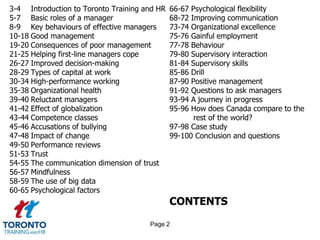
3-4 Introduction to Toronto Training and HR   66-67 Psychological flexibility
5-7 Basic roles of a manager                  68-72 Improving communication
8-9 Key behaviours of effective managers      73-74 Organizational excellence
10-18 Good management                         75-76 Gainful employment
19-20 Consequences of poor management         77-78 Behaviour
21-25 Helping first-line managers cope        79-80 Supervisory interaction

26-27 Improved decision-making                81-84 Supervisory skills
28-29 Types of capital at work                85-86 Drill
30-34 High-performance working                87-90 Positive management
35-38 Organizational health                   91-92 Questions to ask managers
39-40 Reluctant managers                      93-94 A journey in progress
41-42 Effect of globalization                 95-96 How does Canada compare to the
43-44 Competence classes                             rest of the world?
45-46 Accusations of bullying                 97-98 Case study
47-48 Impact of change                        99-100 Conclusion and questions
49-50 Performance reviews
51-53 Trust
54-55 The communication dimension of trust
56-57 Mindfulness
58-59 The use of big data
60-65 Psychological factors
                                              CONTENTS
                                      Page 2
Introduction


     Page 3
Introduction to Toronto Training
              and HR
Toronto Training and HR is a specialist training and
human resources consultancy headed by Timothy Holden
10 years in banking
10 years in training and human resources
Freelance practitioner since 2006
The core services provided by Toronto Training and HR
are:
              Training event design
              Training event delivery
              Reducing costs, saving time plus improving
              employee engagement and morale
              Services for job seekers
                           Page 4
Basic roles of a manager


           Page 5
Basic roles of a manager 1 of 2
              • Analyzing what needs to be
                done in a situation then
                organizing and motivating
                others to do it
              • Making best use of the
                resources available
              • Communicating and sharing
                information
              • Making decisions
              • Providing feedback on
                performance
              Page 6
Basic roles of a manager 2 of 2
              • Monitoring progress
              • Hiring people for appropriate
                jobs
              • Delegating responsibility


              Page 7
Key behaviours of
effective managers


        Page 8
Key behaviours of effective
       managers
           ENCOURAGE GOOD EMPLOYEES
           AND HELP THEM BECOME TOP
           PERFORMERS
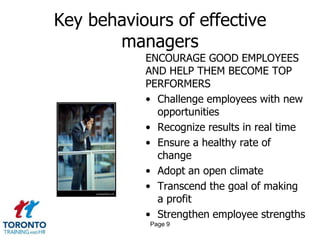
           • Challenge employees with new
             opportunities
           • Recognize results in real time
           • Ensure a healthy rate of
             change
           • Adopt an open climate
           • Transcend the goal of making
             a profit
           • Strengthen employee strengths
            Page 9
Good management


      Page 10
Good management 1 of 8
         •   Providing direction
         •   Working with people
         •   Using resources
         •   Facilitating change
         •   Achieving results


         Page 11
Good management 2 of 8
         BUSINESS BENEFITS
         • Improved business
           performance
         • Improved employee
           performance-wellbeing and
           engagement


         Page 12
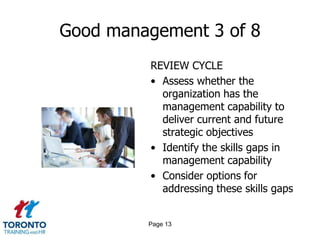
Good management 3 of 8
         REVIEW CYCLE
         • Assess whether the
           organization has the
           management capability to
           deliver current and future
           strategic objectives
         • Identify the skills gaps in
           management capability
         • Consider options for
           addressing these skills gaps


         Page 13
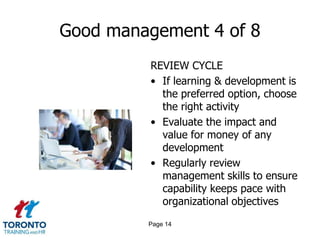
Good management 4 of 8
         REVIEW CYCLE
         • If learning & development is
           the preferred option, choose
           the right activity
         • Evaluate the impact and
           value for money of any
           development
         • Regularly review
           management skills to ensure
           capability keeps pace with
           organizational objectives
         Page 14
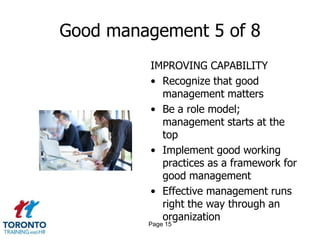
Good management 5 of 8
         IMPROVING CAPABILITY
         • Recognize that good
           management matters
         • Be a role model;
           management starts at the
           top
         • Implement good working
           practices as a framework for
           good management
         • Effective management runs
           right the way through an
           organization
         Page 15
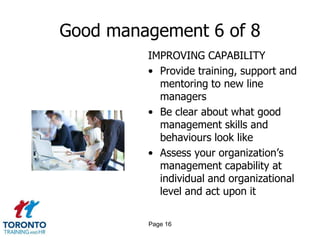
Good management 6 of 8
         IMPROVING CAPABILITY
         • Provide training, support and
           mentoring to new line
           managers
         • Be clear about what good
           management skills and
           behaviours look like
         • Assess your organization’s
           management capability at
           individual and organizational
           level and act upon it

         Page 16
Good management 7 of 8
         IMPROVING CAPABILITY
         • Make the most of the
           practical tools that are
           available
         • Invest in your workforce
           routinely, and as part of your
           business strategy
         • Be authentic about good
           management and employee
           engagement


         Page 17
Good management 8 of 8
         ESSENTIAL ELEMENTS
         • Targets
         • Incentives
         • Monitoring


         Page 18
Consequences of poor
    management


        Page 19
Consequences of poor
    management
        • Business costs
        • Business survival


        Page 20
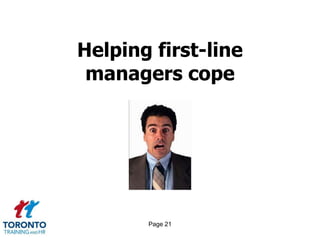
Helping first-line
 managers cope


       Page 21
Helping first-line managers cope

               1 of 4
           MAKE THEM FEEL VALUED AND FULLY
           EQUIPPED
           • Ensure first-line managers are clear
             about their role, their
             responsibilities and their objectives
           • Promote any existing initiatives that
             provide support to first-line

             managers
           • Run surveys or focus groups to find
             out what first-line managers need in
             order to flourish-and publish the
             results
                Page 22
Helping first-line managers cope
               2 of 4
           MAKE THEM FEEL VALUED AND FULLY
           EQUIPPED
           • Invest in appropriate training to
             equip first-line managers with the
             necessary knowledge, skills and
             behaviours
           • Create first-line manager champions
             who can act as role models for
             others
           • Create a networking forum where
             first-line managers can resolve
             problems and share ideas
               Page 23
Helping first-line managers cope
               3 of 4
           MAKE THEM FEEL VALUED AND FULLY
           EQUIPPED
           • Ask senior managers to attend first-
             line manager meetings to discuss
             strategic initiatives
           • Strengthen links with middle and
             senior managers through coaching
             and mentoring
           • Develop a culture in which open
             and honest conversations can take
             place between first-line managers
             and their bosses
                Page 24
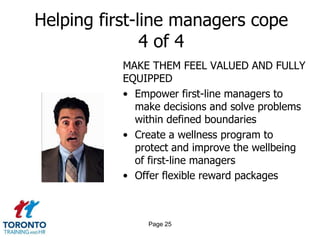
Helping first-line managers cope
               4 of 4
           MAKE THEM FEEL VALUED AND FULLY
           EQUIPPED
           • Empower first-line managers to
             make decisions and solve problems
             within defined boundaries
           • Create a wellness program to
             protect and improve the wellbeing
             of first-line managers
           • Offer flexible reward packages


               Page 25
Improved decision-making


          Page 26
Improved decision-making
         • Observe first
         • Make decisions closest to the
           point of activity
         • Define decision rights and
           expectations
         • Use standards to capture and
           utilize experience


           Page 27
Types of capital at work


          Page 28
Types of capital at work
        •   Traditional economic capital
        •   Social capital
        •   Human capital
        •   Positive psychological capital


            Page 29
High performance working


          Page 30
High performance working 1 of 4
              LINKS TO MANAGEMENT
              CAPABILITY
              • Empowering individuals and
                making the most of their
                skills e.g. provide autonomy
                instead of
                control, continuously develop
                people and let them apply
                themselves, use
                performance management
                to ensure effort is focused
                on added value activities
              Page 31
High performance working 2 of 4
           LINKS TO MANAGEMENT
           CAPABILITY
           • Impact on employee engagement
             and contribution to improved
             productivity/performance-
             understanding what drives
             engagement and the implications
             for management skills
             development


               Page 32
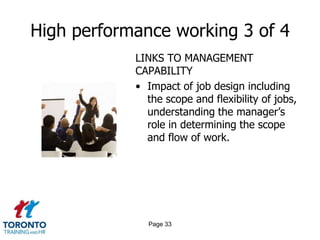
High performance working 3 of 4
            LINKS TO MANAGEMENT
            CAPABILITY
            • Impact of job design including
              the scope and flexibility of jobs,
              understanding the manager’s
              role in determining the scope
              and flow of work.


              Page 33
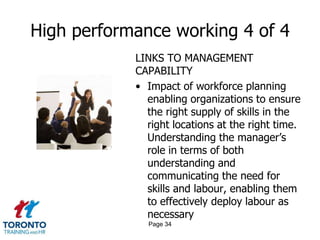
High performance working 4 of 4
            LINKS TO MANAGEMENT
            CAPABILITY
            • Impact of workforce planning
              enabling organizations to ensure
              the right supply of skills in the
              right locations at the right time.
              Understanding the manager’s
              role in terms of both
              understanding and
              communicating the need for
              skills and labour, enabling them
              to effectively deploy labour as
              necessary
              Page 34
Organizational health


         Page 35
Organizational health 1 of 3
         SYMPTOMS OF POOR HEALTH
         • Declining profits
         • Decreasing productivity
         • Increasing absenteeism
         • Barriers to open communication
         • All decision making at the top
           managerial levels
         • Lack of commitment to the
           organization
         • Low levels of motivation and
           morale
             Page 36
Organizational health 2 of 3
         SYMPTOMS OF POOR HEALTH
         • Reputation of the organization
           ignored by employees
         • Existence of unethical behaviour
         • Lack of goal setting
         • Lack of mentoring
         • Lack of learning & development
           programs
         • Lack of trust among employees


             Page 37
Organizational health 3 of 3
         DIMENSIONS OF ORGANIZATIONAL
         HEALTH
         • Communication
         • Participation and involvement
         • Loyalty and commitment
         • Morale
         • Institutional reputation
         • Ethics
         • Performance recognition
         • Goal alignment
         • Leadership
         • Development
         • Resource utilization
Reluctant managers


       Page 39
Reluctant managers
       •   Is this you?
       •   Recent statistics
       •   Recognize results in real time
       •   Be true to yourself
       •   Thinkers and feelers
       •   Treat others how they want to
           be treated


       Page 40
Effect of globalization


          Page 41
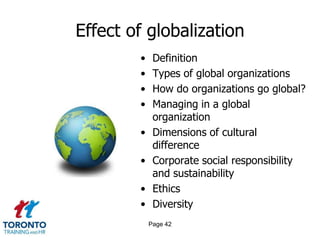
Effect of globalization
        •    Definition
        •    Types of global organizations
        •    How do organizations go global?
        •    Managing in a global
             organization
        •    Dimensions of cultural
             difference
        •    Corporate social responsibility
             and sustainability
        •    Ethics
        •    Diversity
            Page 42
Competence classes


       Page 43
Competence classes
       •   Methodological class
       •   Self-dispositive class
       •   Social competence class
       •   Business management class
       •   Leadership class
       •   Personal competencies


       Page 44
Accusations of bullying


          Page 45
Accusations of bullying
         • Cultivate
         • Calculate
         • Compensate

         • Types of justice


          Page 46
Impact of change


      Page 47
Impact of change
      • External drivers
      • Internal drivers


      Page 48
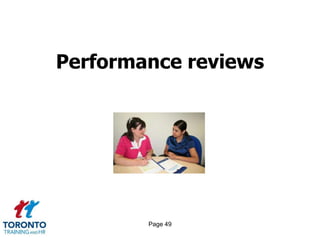
Performance reviews


        Page 49
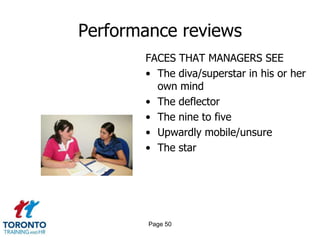
Performance reviews
       FACES THAT MANAGERS SEE
       • The diva/superstar in his or her
         own mind
       • The deflector
       • The nine to five
       • Upwardly mobile/unsure
       • The star


        Page 50
Trust


 Page 51
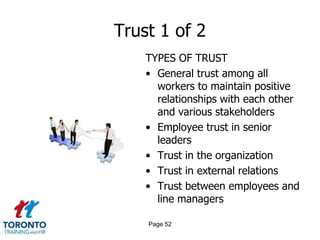
Trust 1 of 2
    TYPES OF TRUST
    • General trust among all
      workers to maintain positive
      relationships with each other
      and various stakeholders
    • Employee trust in senior
      leaders
    • Trust in the organization
    • Trust in external relations
    • Trust between employees and
      line managers

    Page 52
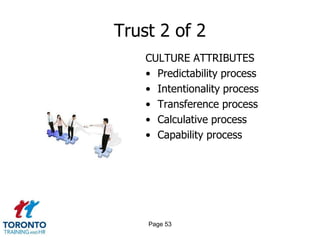
Trust 2 of 2
    CULTURE ATTRIBUTES
    • Predictability process
    • Intentionality process
    • Transference process
    • Calculative process
    • Capability process


    Page 53
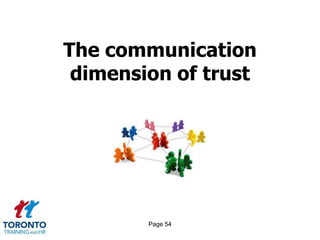
The communication
 dimension of trust


        Page 54
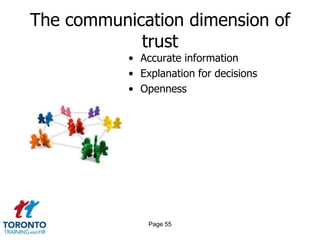
The communication dimension of
            trust
           • Accurate information
           • Explanation for decisions
           • Openness


               Page 55
Mindfulness


    Page 56
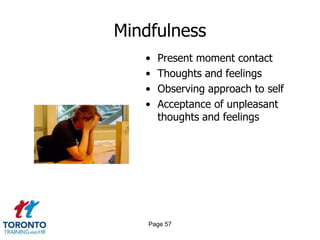
Mindfulness
   •   Present moment contact
   •   Thoughts and feelings
   •   Observing approach to self
   •   Acceptance of unpleasant
       thoughts and feelings


    Page 57
The use of big data


        Page 58
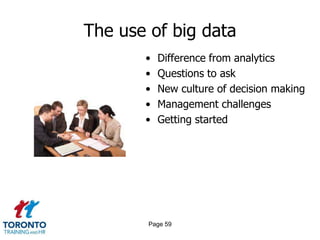
The use of big data
       •   Difference from analytics
       •   Questions to ask
       •   New culture of decision making
       •   Management challenges
       •   Getting started


        Page 59
Psychological factors


         Page 60
Psychological factors 1 of 5
          ATTITUDES
          • Components of an attitude
          • Job satisfaction
          • Job involvement
          • Organizational commitment
          • Perceived organizational support
          • Employee engagement factors
          • Consistency
          • Cognitive dissonance
          • Surveys
          • Implication for managers
            Page 61
Psychological factors 2 of 5
          PERSONALITY
          • MBTI
          • Big Five model
          • Locus of control
          • Self esteem
          • Self-monitoring
          • Emotions
          • Emotional intelligence
          • Implications for managers
          • Personality Job Fit Theory
          • Personality and occupations
            Page 62
Psychological factors 3 of 5
          PERCEPTION
          • Factors influencing perception
          • Attribution theory
          • Shortcuts
          • Implications for managers


            Page 63
Psychological factors 4 of 5
          PERCEPTION


            Page 64
Psychological factors 5 of 5
          LEARNING
          • Theories of learning
          • Shaping behaviour
          • Implications for managers


            Page 65
Psychological flexibility


           Page 66
Psychological flexibility
          • Values affirmation
          • Commitment to values-directed
            action


          Page 67
Improving communication


          Page 68
Improving communication 1 of 4
           • Seek out and provide contact for
             organizational information-ensure
             that the team clearly understands
             its priorities and goals fit into the
             organization’s overall goals
           • Make information relevant by
             translating information so
             employees understand how they fit
             in and what’s in it for them
           • Provide job-related information so
             the team receives essential
             information to help them do their
             jobs more effectively
Improving communication 2 of 4
           • Provide information and feedback
             on individual performance and other
             employee-related matters such as
             recognition of achievements and
             contributions, or ways to be better
           • Provide information with a sense of
             empathy
           • Managers need to understand how
             they are performing from
             employees’ point of view through
             activities from engagement surveys
             to listening sessions conducted by
             impartial third-party organizations
Improving communication 3 of 4
           • Establish a cadence of
             communications that enables
             employees to know there will be
             predictable, reliable and consistent
             opportunities for getting information
             from leaders and supervisors plus
             giving their feedback


               Page 71
Improving communication 4 of 4
           WHAT DO THE BEST BOSSES DO
           • Tell employees what is expected
             of them
           • Explain clearly how their
             departments and individual efforts
             contribute to the success of the
             organization
           • Provide constant feedback on job
             performance


              Page 72
Organizational excellence


           Page 73
Organizational excellence
         •   Positive corporate culture
         •   Positive management
         •   Positive workers
         •   Good work


             Page 74
Gainful employment


       Page 75
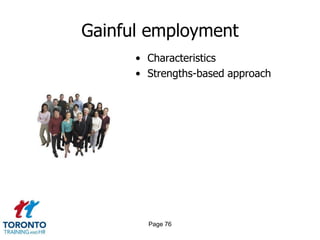
Gainful employment
      • Characteristics
      • Strengths-based approach


        Page 76
Behaviour


   Page 77
Behaviour
 • Focus of organizational behaviour
 • Goals of organizational behaviour


   Page 78
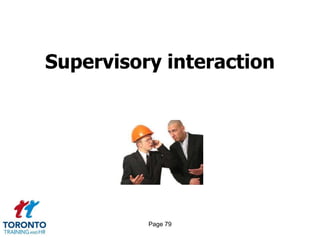
Supervisory interaction


          Page 79
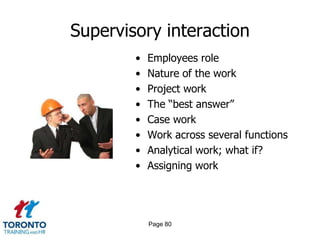
Supervisory interaction
        •   Employees role
        •   Nature of the work
        •   Project work
        •   The “best answer”
        •   Case work
        •   Work across several functions
        •   Analytical work; what if?
        •   Assigning work


            Page 80
Supervisory skills


       Page 81
Supervisory skills 1 of 3
         WHY DEVELOP SUPERVISORY
         SKILLS?
         • Benefits
         • Current “training” process
         • Challenges with the current
           process


           Page 82
Supervisory skills 2 of 3
         WHAT SUPERVISORY SKILLS ARE
         NEEEDED?
         • Discover the skills needed-self,
           others and systems
         • Review the job profile
         • Select the most important skills-
           important tasks for success, most
           important skills for success
         • Assess current skill level for each
           supervisory skill identified-skills
           to build on and skills to be
           developed
           Page 83
Supervisory skills 3 of 3
         CREATING A PERSONAL
         DEVELOPMENT PLAN
         • Definition
         • How to create one
         • Development solutions
         • Different ways to develop skills
         • Follow-up
         • Review and update


           Page 84
Drill


 Page 85
Drill


 Page 86
Positive management


        Page 87
Positive management 1 of 3
          • Definition of meaning
          • A meaning-centred approach to
            positive management
          • Levels of purpose
          • Assessment of purpose
          • Wheel of understanding
          • Areas of responsibility
          • Toxic elements in the workplace
          • Intrinsic sources of work
            satisfaction
          • Extrinsic sources of enjoyment
            Page 88
Positive management 2 of 3
          HOW TO BE A GOOD BOSS
          • Earn your employees’ respect
          • Earn your workers’ trust
          • Maintain good relationships
          • Get employees actively engaged
            in their work


            Page 89
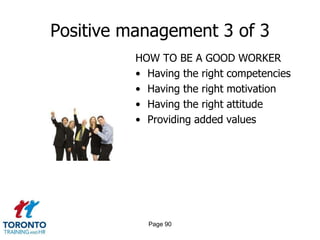
Positive management 3 of 3
          HOW TO BE A GOOD WORKER
          • Having the right competencies
          • Having the right motivation
          • Having the right attitude
          • Providing added values


            Page 90
Questions to ask
  managers


      Page 91
Questions to ask managers
          • Interconnection of targets
          • Clarity and comparability of
            goals
          • Consequence management
          • Installing a talent mind-set
          • Removing poor performers
          • Unique employee value
            proposition
          • Retaining talent
          • Continuous improvement
          • Performance tracking
          • Performance dialogue
A journey in progress


         Page 93
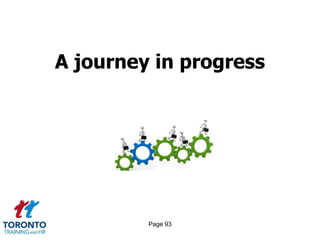
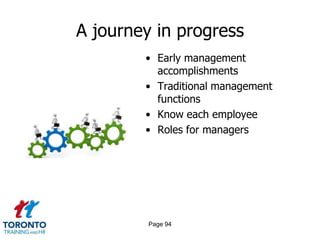
A journey in progress
        • Early management
          accomplishments
        • Traditional management
          functions
        • Know each employee
        • Roles for managers


         Page 94
How does Canada
compare to the rest of the
        world?


           Page 95
How does Canada compare to the
      rest of the world?


             Page 96
Case study


   Page 97
Case study


   Page 98
Conclusion and questions


          Page 99
Conclusion and questions
Summary
Videos
Questions


                Page 100

Management January 2013

  • 1.
    Be a bettermanager in 2013 by Toronto Training and HR January 2013
  • 2.
    3-4 Introduction toToronto Training and HR 66-67 Psychological flexibility 5-7 Basic roles of a manager 68-72 Improving communication 8-9 Key behaviours of effective managers 73-74 Organizational excellence 10-18 Good management 75-76 Gainful employment 19-20 Consequences of poor management 77-78 Behaviour 21-25 Helping first-line managers cope 79-80 Supervisory interaction 26-27 Improved decision-making 81-84 Supervisory skills 28-29 Types of capital at work 85-86 Drill 30-34 High-performance working 87-90 Positive management 35-38 Organizational health 91-92 Questions to ask managers 39-40 Reluctant managers 93-94 A journey in progress 41-42 Effect of globalization 95-96 How does Canada compare to the 43-44 Competence classes rest of the world? 45-46 Accusations of bullying 97-98 Case study 47-48 Impact of change 99-100 Conclusion and questions 49-50 Performance reviews 51-53 Trust 54-55 The communication dimension of trust 56-57 Mindfulness 58-59 The use of big data 60-65 Psychological factors CONTENTS Page 2
  • 3.
  • 4.
    Introduction to TorontoTraining and HR Toronto Training and HR is a specialist training and human resources consultancy headed by Timothy Holden 10 years in banking 10 years in training and human resources Freelance practitioner since 2006 The core services provided by Toronto Training and HR are: Training event design Training event delivery Reducing costs, saving time plus improving employee engagement and morale Services for job seekers Page 4
  • 5.
    Basic roles ofa manager Page 5
  • 6.
    Basic roles ofa manager 1 of 2 • Analyzing what needs to be done in a situation then organizing and motivating others to do it • Making best use of the resources available • Communicating and sharing information • Making decisions • Providing feedback on performance Page 6
  • 7.
    Basic roles ofa manager 2 of 2 • Monitoring progress • Hiring people for appropriate jobs • Delegating responsibility Page 7
  • 8.
  • 9.
    Key behaviours ofeffective managers ENCOURAGE GOOD EMPLOYEES AND HELP THEM BECOME TOP PERFORMERS • Challenge employees with new opportunities • Recognize results in real time • Ensure a healthy rate of change • Adopt an open climate • Transcend the goal of making a profit • Strengthen employee strengths Page 9
  • 10.
  • 11.
    Good management 1of 8 • Providing direction • Working with people • Using resources • Facilitating change • Achieving results Page 11
  • 12.
    Good management 2of 8 BUSINESS BENEFITS • Improved business performance • Improved employee performance-wellbeing and engagement Page 12
  • 13.
    Good management 3of 8 REVIEW CYCLE • Assess whether the organization has the management capability to deliver current and future strategic objectives • Identify the skills gaps in management capability • Consider options for addressing these skills gaps Page 13
  • 14.
    Good management 4of 8 REVIEW CYCLE • If learning & development is the preferred option, choose the right activity • Evaluate the impact and value for money of any development • Regularly review management skills to ensure capability keeps pace with organizational objectives Page 14
  • 15.
    Good management 5of 8 IMPROVING CAPABILITY • Recognize that good management matters • Be a role model; management starts at the top • Implement good working practices as a framework for good management • Effective management runs right the way through an organization Page 15
  • 16.
    Good management 6of 8 IMPROVING CAPABILITY • Provide training, support and mentoring to new line managers • Be clear about what good management skills and behaviours look like • Assess your organization’s management capability at individual and organizational level and act upon it Page 16
  • 17.
    Good management 7of 8 IMPROVING CAPABILITY • Make the most of the practical tools that are available • Invest in your workforce routinely, and as part of your business strategy • Be authentic about good management and employee engagement Page 17
  • 18.
    Good management 8of 8 ESSENTIAL ELEMENTS • Targets • Incentives • Monitoring Page 18
  • 19.
    Consequences of poor management Page 19
  • 20.
    Consequences of poor management • Business costs • Business survival Page 20
  • 21.
  • 22.
    Helping first-line managerscope 1 of 4 MAKE THEM FEEL VALUED AND FULLY EQUIPPED • Ensure first-line managers are clear about their role, their responsibilities and their objectives • Promote any existing initiatives that provide support to first-line managers • Run surveys or focus groups to find out what first-line managers need in order to flourish-and publish the results Page 22
  • 23.
    Helping first-line managerscope 2 of 4 MAKE THEM FEEL VALUED AND FULLY EQUIPPED • Invest in appropriate training to equip first-line managers with the necessary knowledge, skills and behaviours • Create first-line manager champions who can act as role models for others • Create a networking forum where first-line managers can resolve problems and share ideas Page 23
  • 24.
    Helping first-line managerscope 3 of 4 MAKE THEM FEEL VALUED AND FULLY EQUIPPED • Ask senior managers to attend first- line manager meetings to discuss strategic initiatives • Strengthen links with middle and senior managers through coaching and mentoring • Develop a culture in which open and honest conversations can take place between first-line managers and their bosses Page 24
  • 25.
    Helping first-line managerscope 4 of 4 MAKE THEM FEEL VALUED AND FULLY EQUIPPED • Empower first-line managers to make decisions and solve problems within defined boundaries • Create a wellness program to protect and improve the wellbeing of first-line managers • Offer flexible reward packages Page 25
  • 26.
  • 27.
    Improved decision-making • Observe first • Make decisions closest to the point of activity • Define decision rights and expectations • Use standards to capture and utilize experience Page 27
  • 28.
    Types of capitalat work Page 28
  • 29.
    Types of capitalat work • Traditional economic capital • Social capital • Human capital • Positive psychological capital Page 29
  • 30.
  • 31.
    High performance working1 of 4 LINKS TO MANAGEMENT CAPABILITY • Empowering individuals and making the most of their skills e.g. provide autonomy instead of control, continuously develop people and let them apply themselves, use performance management to ensure effort is focused on added value activities Page 31
  • 32.
    High performance working2 of 4 LINKS TO MANAGEMENT CAPABILITY • Impact on employee engagement and contribution to improved productivity/performance- understanding what drives engagement and the implications for management skills development Page 32
  • 33.
    High performance working3 of 4 LINKS TO MANAGEMENT CAPABILITY • Impact of job design including the scope and flexibility of jobs, understanding the manager’s role in determining the scope and flow of work. Page 33
  • 34.
    High performance working4 of 4 LINKS TO MANAGEMENT CAPABILITY • Impact of workforce planning enabling organizations to ensure the right supply of skills in the right locations at the right time. Understanding the manager’s role in terms of both understanding and communicating the need for skills and labour, enabling them to effectively deploy labour as necessary Page 34
  • 35.
  • 36.
    Organizational health 1of 3 SYMPTOMS OF POOR HEALTH • Declining profits • Decreasing productivity • Increasing absenteeism • Barriers to open communication • All decision making at the top managerial levels • Lack of commitment to the organization • Low levels of motivation and morale Page 36
  • 37.
    Organizational health 2of 3 SYMPTOMS OF POOR HEALTH • Reputation of the organization ignored by employees • Existence of unethical behaviour • Lack of goal setting • Lack of mentoring • Lack of learning & development programs • Lack of trust among employees Page 37
  • 38.
    Organizational health 3of 3 DIMENSIONS OF ORGANIZATIONAL HEALTH • Communication • Participation and involvement • Loyalty and commitment • Morale • Institutional reputation • Ethics • Performance recognition • Goal alignment • Leadership • Development • Resource utilization
  • 39.
  • 40.
    Reluctant managers • Is this you? • Recent statistics • Recognize results in real time • Be true to yourself • Thinkers and feelers • Treat others how they want to be treated Page 40
  • 41.
  • 42.
    Effect of globalization • Definition • Types of global organizations • How do organizations go global? • Managing in a global organization • Dimensions of cultural difference • Corporate social responsibility and sustainability • Ethics • Diversity Page 42
  • 43.
  • 44.
    Competence classes • Methodological class • Self-dispositive class • Social competence class • Business management class • Leadership class • Personal competencies Page 44
  • 45.
  • 46.
    Accusations of bullying • Cultivate • Calculate • Compensate • Types of justice Page 46
  • 47.
  • 48.
    Impact of change • External drivers • Internal drivers Page 48
  • 49.
  • 50.
    Performance reviews FACES THAT MANAGERS SEE • The diva/superstar in his or her own mind • The deflector • The nine to five • Upwardly mobile/unsure • The star Page 50
  • 51.
  • 52.
    Trust 1 of2 TYPES OF TRUST • General trust among all workers to maintain positive relationships with each other and various stakeholders • Employee trust in senior leaders • Trust in the organization • Trust in external relations • Trust between employees and line managers Page 52
  • 53.
    Trust 2 of2 CULTURE ATTRIBUTES • Predictability process • Intentionality process • Transference process • Calculative process • Capability process Page 53
  • 54.
  • 55.
    The communication dimensionof trust • Accurate information • Explanation for decisions • Openness Page 55
  • 56.
    Mindfulness Page 56
  • 57.
    Mindfulness • Present moment contact • Thoughts and feelings • Observing approach to self • Acceptance of unpleasant thoughts and feelings Page 57
  • 58.
    The use ofbig data Page 58
  • 59.
    The use ofbig data • Difference from analytics • Questions to ask • New culture of decision making • Management challenges • Getting started Page 59
  • 60.
  • 61.
    Psychological factors 1of 5 ATTITUDES • Components of an attitude • Job satisfaction • Job involvement • Organizational commitment • Perceived organizational support • Employee engagement factors • Consistency • Cognitive dissonance • Surveys • Implication for managers Page 61
  • 62.
    Psychological factors 2of 5 PERSONALITY • MBTI • Big Five model • Locus of control • Self esteem • Self-monitoring • Emotions • Emotional intelligence • Implications for managers • Personality Job Fit Theory • Personality and occupations Page 62
  • 63.
    Psychological factors 3of 5 PERCEPTION • Factors influencing perception • Attribution theory • Shortcuts • Implications for managers Page 63
  • 64.
    Psychological factors 4of 5 PERCEPTION Page 64
  • 65.
    Psychological factors 5of 5 LEARNING • Theories of learning • Shaping behaviour • Implications for managers Page 65
  • 66.
  • 67.
    Psychological flexibility • Values affirmation • Commitment to values-directed action Page 67
  • 68.
  • 69.
    Improving communication 1of 4 • Seek out and provide contact for organizational information-ensure that the team clearly understands its priorities and goals fit into the organization’s overall goals • Make information relevant by translating information so employees understand how they fit in and what’s in it for them • Provide job-related information so the team receives essential information to help them do their jobs more effectively
  • 70.
    Improving communication 2of 4 • Provide information and feedback on individual performance and other employee-related matters such as recognition of achievements and contributions, or ways to be better • Provide information with a sense of empathy • Managers need to understand how they are performing from employees’ point of view through activities from engagement surveys to listening sessions conducted by impartial third-party organizations
  • 71.
    Improving communication 3of 4 • Establish a cadence of communications that enables employees to know there will be predictable, reliable and consistent opportunities for getting information from leaders and supervisors plus giving their feedback Page 71
  • 72.
    Improving communication 4of 4 WHAT DO THE BEST BOSSES DO • Tell employees what is expected of them • Explain clearly how their departments and individual efforts contribute to the success of the organization • Provide constant feedback on job performance Page 72
  • 73.
  • 74.
    Organizational excellence • Positive corporate culture • Positive management • Positive workers • Good work Page 74
  • 75.
  • 76.
    Gainful employment • Characteristics • Strengths-based approach Page 76
  • 77.
    Behaviour Page 77
  • 78.
    Behaviour • Focusof organizational behaviour • Goals of organizational behaviour Page 78
  • 79.
  • 80.
    Supervisory interaction • Employees role • Nature of the work • Project work • The “best answer” • Case work • Work across several functions • Analytical work; what if? • Assigning work Page 80
  • 81.
  • 82.
    Supervisory skills 1of 3 WHY DEVELOP SUPERVISORY SKILLS? • Benefits • Current “training” process • Challenges with the current process Page 82
  • 83.
    Supervisory skills 2of 3 WHAT SUPERVISORY SKILLS ARE NEEEDED? • Discover the skills needed-self, others and systems • Review the job profile • Select the most important skills- important tasks for success, most important skills for success • Assess current skill level for each supervisory skill identified-skills to build on and skills to be developed Page 83
  • 84.
    Supervisory skills 3of 3 CREATING A PERSONAL DEVELOPMENT PLAN • Definition • How to create one • Development solutions • Different ways to develop skills • Follow-up • Review and update Page 84
  • 85.
  • 86.
  • 87.
  • 88.
    Positive management 1of 3 • Definition of meaning • A meaning-centred approach to positive management • Levels of purpose • Assessment of purpose • Wheel of understanding • Areas of responsibility • Toxic elements in the workplace • Intrinsic sources of work satisfaction • Extrinsic sources of enjoyment Page 88
  • 89.
    Positive management 2of 3 HOW TO BE A GOOD BOSS • Earn your employees’ respect • Earn your workers’ trust • Maintain good relationships • Get employees actively engaged in their work Page 89
  • 90.
    Positive management 3of 3 HOW TO BE A GOOD WORKER • Having the right competencies • Having the right motivation • Having the right attitude • Providing added values Page 90
  • 91.
    Questions to ask managers Page 91
  • 92.
    Questions to askmanagers • Interconnection of targets • Clarity and comparability of goals • Consequence management • Installing a talent mind-set • Removing poor performers • Unique employee value proposition • Retaining talent • Continuous improvement • Performance tracking • Performance dialogue
  • 93.
    A journey inprogress Page 93
  • 94.
    A journey inprogress • Early management accomplishments • Traditional management functions • Know each employee • Roles for managers Page 94
  • 95.
    How does Canada compareto the rest of the world? Page 95
  • 96.
    How does Canadacompare to the rest of the world? Page 96
  • 97.
    Case study Page 97
  • 98.
    Case study Page 98
  • 99.
  • 100.