


The document discusses training, development, and their differences. It provides an overview of traditional and modern views of training, with the modern view seeing training as a complex process requiring motivation and support to lead to improved performance. Training is presented as a formal way to modify employee behavior and skills through learning activities, while development focuses more on future career growth. The document outlines reasons companies provide training, including increased productivity and quality, and reduced accidents and turnover. It discusses when training is needed and its advantages for both employees and organizations.
Training is theformal and systematic
modification of behavior through learning
which occurs as a result of education,
instruction, development and planned
experience.
Development is any learning activity, which
is directed towards future, needs rather
than present needs, and which is concerned
more with career growth than immediate
performance
3.
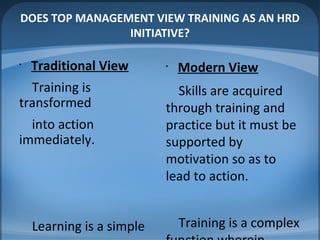
DOES TOP MANAGEMENTVIEW TRAINING AS AN HRD
INITIATIVE?
•
Traditional View
Training is
transformed
into action
immediately.
Learning is a simple
•
Modern View
Skills are acquired
through training and
practice but it must be
supported by
motivation so as to
lead to action.
Training is a complex
4.
Cont’d.
•
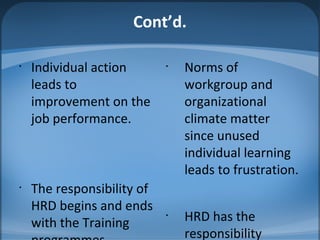
Individual action
leads to
improvementon the
job performance.
•
The responsibility of
HRD begins and ends
with the Training
•
Norms of
workgroup and
organizational
climate matter
since unused
individual learning
leads to frustration.
•
HRD has the
responsibility
5.
OLD AND CONSERVATIVEVIEW:
•
Why should management spend on training
when the employee may quit after he has
been trained?
•
The employee should pay for the training
either through contribution, sacrifice or by
signing a bond.
6.
MODERN AND PROGRESSIVEVIEW
•
Modern management should spend on
training irrespective of who will quit.
•
It is better to have some trained employees
who will stay on than to have none of the
employees trained.
•
When a trained employee leaves he takes
with him a gratitude and that in the end
enhances organization's brand image.
Purpose of Training
•
Toincrease productivity and quality
•
To promote versatility and adaptability to new
methods
•
To reduce the number of accidents
•
To reduce labour turnover
9.
When does theneed for training arise?
•
The installation of new equipment or
techniques
•
A change in working methods or
products produced
•
A realization that performance is
inadequate
•
Labour shortage, necessitating the
upgrading of some
10.
Advantages of Training
1.Leadsto improved profitability and/or more positive
attitudes toward profits orientation.
2. Improves the job knowledge and skills at all levels of the
organization.
3. Improves the morale of the workforce.
4. Helps people identify with organizational goals.
5. Helps create a better corporate image.
11.
6. Fasters authentically,openness and trust.
7. Improves the relationship between boss and subordinate.
8. Aids in organizational development.
9. Learns from the trainee.
10. Helps prepare guidelines for work
12.
Areas of Training
TheAreas of Training in which training is
offered may be classified into the following
categories:
Knowledge
Here the trainee learns about a set of rules
and
regulations about the job, the staff and the
products or services offered by the company.
The
aim is to make the new employee fully aware
of
13.
Areas of TrainingConti.
Social Skills
The employee is made to learn about himself
and other,
develop a right mental attitude, towards the
job,
colleagues and the company. The principal
focus is on
teaching the employee how to be a team
member and
get ahead.
14.
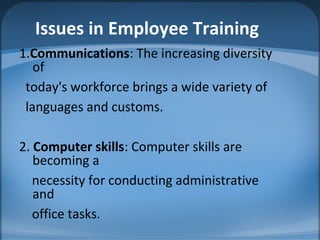
Issues in EmployeeTraining
1.Communications: The increasing diversity
of
today's workforce brings a wide variety of
languages and customs.
2. Computer skills: Computer skills are
becoming a
necessity for conducting administrative
and
office tasks.
15.
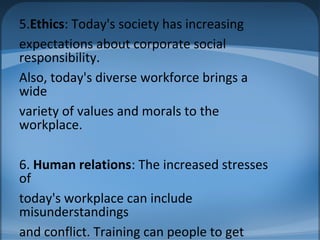
5.Ethics: Today's societyhas increasing
expectations about corporate social
responsibility.
Also, today's diverse workforce brings a
wide
variety of values and morals to the
workplace.
6. Human relations: The increased stresses
of
today's workplace can include
misunderstandings
and conflict. Training can people to get
16.
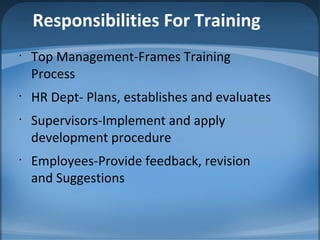
Responsibilities For Training
•
TopManagement-Frames Training
Process
•
HR Dept- Plans, establishes and evaluates
•
Supervisors-Implement and apply
development procedure
•
Employees-Provide feedback, revision
and Suggestions