Prepared by Dr D Santhanakrishnan, Associate Professor & Head, B.Com PA, Sri Ramakrishna College
of Arts & Science, Coimbatore 641006.
Unit 1: Introduction to Management - Definition and nature of management -
Evolution of management theories - Functions of management (planning, organizing,
leading, controlling) - Managerial roles and skills - Henry Fayol’s 14 Principles of
Management - Ethical and social responsibilities of managers - Globalization and its
impact on management - Challenges faced by modern managers
Two Mark Questions for "Introduction to Management"
Understand Level (6 Questions)
1. Explain the nature of management.
2. Describe the role of planning in management.
3. What is meant by managerial roles?
4. Explain the significance of Henry Fayol’s 14 principles of management.
5. How does globalization impact management practices?
6. Describe one major challenge faced by modern managers.
Remember Level (6 Questions)
1. Define management.
2. List the four functions of management.
3. Name any two management theories.
4. What is organizing in the context of management?
5. Identify one ethical responsibility of managers.
6. Mention one social responsibility of managers.
Four Mark Questions for "Introduction to Management"
Remember and Understand Level (6 Questions)
1. Remember: Define management and explain its importance in organizations.
2. Understand: Discuss the evolution of management theories.
3. Remember: List and describe the four primary functions of management.
4. Understand: Explain Henry Fayol’s principle of unity of command.
5. Remember: Identify the key roles of a manager.
6. Understand: Discuss the ethical responsibilities of managers.
Analyze, Apply, Create, and Evaluate Level (4 Questions)
1. Analyze: Compare and contrast the functions of planning and controlling in
management.
Prepared by Dr D Santhanakrishnan, Associate Professor & Head, B.Com PA, Sri Ramakrishna College
of Arts & Science, Coimbatore 641006.
2. Apply: Apply Henry Fayol’s principles to a real-world organizational scenario.
3. Create: Design a plan to address a modern management challenge in a
globalized environment.
4. Evaluate: Evaluate the impact of globalization on the functions of management.
Six Mark Questions for "Introduction to Management"
Remember and Understand Level (6 Questions)
1. Remember: Define and explain the nature of management.
2. Understand: Describe the major theories in the evolution of management
thought.
3. Remember: Explain the functions of management with examples.
4. Understand: Discuss the significance of managerial roles and skills.
5. Remember: Describe Henry Fayol’s 14 principles of management in detail.
6. Understand: Explain the social responsibilities of managers.
Analyze, Apply, Create, and Evaluate Level (4 Questions)
1. Analyze: Evaluate the challenges faced by modern managers in a globalized
economy.
2. Apply: Apply the functions of management to solve an organizational problem.
3. Create: Develop a management strategy that incorporates ethical and social
responsibilities.
4. Evaluate: Assess the relevance of Henry Fayol’s principles in contemporary
management practices.
Prepared by Dr D Santhanakrishnan, Associate Professor & Head, B.Com PA, Sri Ramakrishna College
of Arts & Science, Coimbatore 641006.
Unit 2: Planning and Decision Making - Importance of planning - Types of
plans (strategic, tactical, operational) - Steps in the planning process -
Decision-making process - Tools and techniques for decision making (SWOT
analysis, PESTLE, Route Cause Analysis, Gap Analysis) - Risk management
and contingency planning - Innovation and creativity in planning
Two Mark Questions for "Planning and Decision Making"
Understand Level (6 Questions)
1. Explain the importance of planning in management.
2. Describe the difference between strategic and tactical plans.
3. What is the purpose of a SWOT analysis?
4. Explain the role of risk management in planning.
5. What is contingency planning?
6. Describe the significance of innovation in the planning process.
Remember Level (6 Questions)
1. Define planning.
2. List the types of plans.
3. What is the first step in the planning process?
4. Define decision-making.
5. Name two tools used in decision making.
6. What does PESTLE analysis stand for?
Four Mark Questions for "Planning and Decision Making"
Remember and Understand Level (6 Questions)
1. Remember: Define planning and explain its importance in achieving
organizational goals.
2. Understand: Discuss the differences between strategic, tactical, and operational
plans.
3. Remember: List and describe the steps involved in the planning process.
4. Understand: Explain the decision-making process in management.
5. Remember: Identify and explain the key components of SWOT analysis.
6. Understand: Describe the role of contingency planning in risk management.
Prepared by Dr D Santhanakrishnan, Associate Professor & Head, B.Com PA, Sri Ramakrishna College
of Arts & Science, Coimbatore 641006.
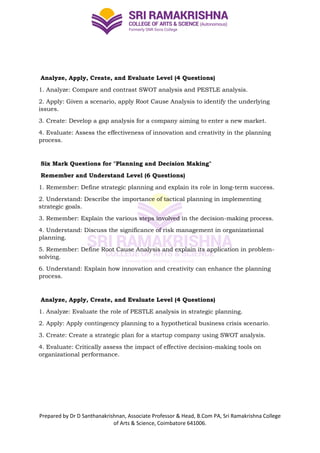
Analyze, Apply, Create, and Evaluate Level (4 Questions)
1. Analyze: Compare and contrast SWOT analysis and PESTLE analysis.
2. Apply: Given a scenario, apply Root Cause Analysis to identify the underlying
issues.
3. Create: Develop a gap analysis for a company aiming to enter a new market.
4. Evaluate: Assess the effectiveness of innovation and creativity in the planning
process.
Six Mark Questions for "Planning and Decision Making"
Remember and Understand Level (6 Questions)
1. Remember: Define strategic planning and explain its role in long-term success.
2. Understand: Describe the importance of tactical planning in implementing
strategic goals.
3. Remember: Explain the various steps involved in the decision-making process.
4. Understand: Discuss the significance of risk management in organizational
planning.
5. Remember: Define Root Cause Analysis and explain its application in problem-
solving.
6. Understand: Explain how innovation and creativity can enhance the planning
process.
Analyze, Apply, Create, and Evaluate Level (4 Questions)
1. Analyze: Evaluate the role of PESTLE analysis in strategic planning.
2. Apply: Apply contingency planning to a hypothetical business crisis scenario.
3. Create: Create a strategic plan for a startup company using SWOT analysis.
4. Evaluate: Critically assess the impact of effective decision-making tools on
organizational performance.
Prepared by Dr D Santhanakrishnan, Associate Professor & Head, B.Com PA, Sri Ramakrishna College
of Arts & Science, Coimbatore 641006.
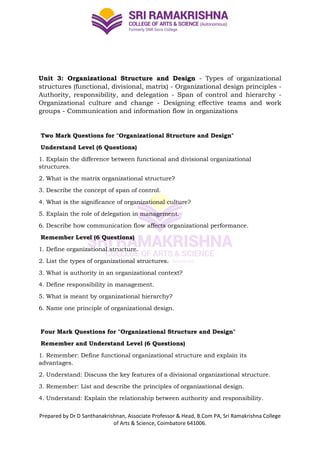
Unit 3: Organizational Structure and Design - Types of organizational
structures (functional, divisional, matrix) - Organizational design principles -
Authority, responsibility, and delegation - Span of control and hierarchy -
Organizational culture and change - Designing effective teams and work
groups - Communication and information flow in organizations
Two Mark Questions for "Organizational Structure and Design"
Understand Level (6 Questions)
1. Explain the difference between functional and divisional organizational
structures.
2. What is the matrix organizational structure?
3. Describe the concept of span of control.
4. What is the significance of organizational culture?
5. Explain the role of delegation in management.
6. Describe how communication flow affects organizational performance.
Remember Level (6 Questions)
1. Define organizational structure.
2. List the types of organizational structures.
3. What is authority in an organizational context?
4. Define responsibility in management.
5. What is meant by organizational hierarchy?
6. Name one principle of organizational design.
Four Mark Questions for "Organizational Structure and Design"
Remember and Understand Level (6 Questions)
1. Remember: Define functional organizational structure and explain its
advantages.
2. Understand: Discuss the key features of a divisional organizational structure.
3. Remember: List and describe the principles of organizational design.
4. Understand: Explain the relationship between authority and responsibility.
Prepared by Dr D Santhanakrishnan, Associate Professor & Head, B.Com PA, Sri Ramakrishna College
of Arts & Science, Coimbatore 641006.
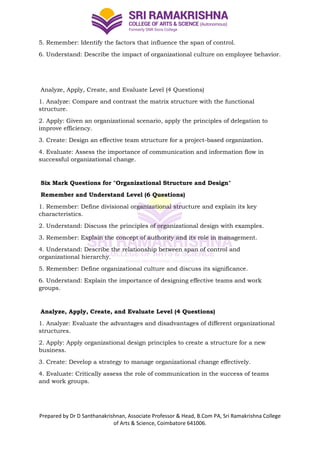
5. Remember: Identify the factors that influence the span of control.
6. Understand: Describe the impact of organizational culture on employee behavior.
Analyze, Apply, Create, and Evaluate Level (4 Questions)
1. Analyze: Compare and contrast the matrix structure with the functional
structure.
2. Apply: Given an organizational scenario, apply the principles of delegation to
improve efficiency.
3. Create: Design an effective team structure for a project-based organization.
4. Evaluate: Assess the importance of communication and information flow in
successful organizational change.
Six Mark Questions for "Organizational Structure and Design"
Remember and Understand Level (6 Questions)
1. Remember: Define divisional organizational structure and explain its key
characteristics.
2. Understand: Discuss the principles of organizational design with examples.
3. Remember: Explain the concept of authority and its role in management.
4. Understand: Describe the relationship between span of control and
organizational hierarchy.
5. Remember: Define organizational culture and discuss its significance.
6. Understand: Explain the importance of designing effective teams and work
groups.
Analyze, Apply, Create, and Evaluate Level (4 Questions)
1. Analyze: Evaluate the advantages and disadvantages of different organizational
structures.
2. Apply: Apply organizational design principles to create a structure for a new
business.
3. Create: Develop a strategy to manage organizational change effectively.
4. Evaluate: Critically assess the role of communication in the success of teams
and work groups.
Prepared by Dr D Santhanakrishnan, Associate Professor & Head, B.Com PA, Sri Ramakrishna College
of Arts & Science, Coimbatore 641006.
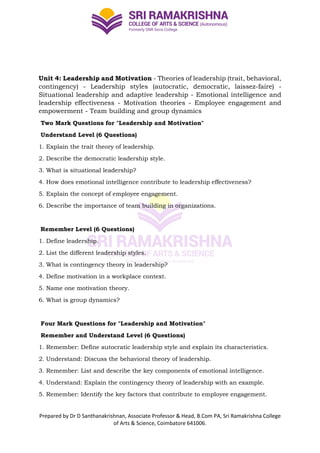
Unit 4: Leadership and Motivation - Theories of leadership (trait, behavioral,
contingency) - Leadership styles (autocratic, democratic, laissez-faire) -
Situational leadership and adaptive leadership - Emotional intelligence and
leadership effectiveness - Motivation theories - Employee engagement and
empowerment - Team building and group dynamics
Two Mark Questions for "Leadership and Motivation"
Understand Level (6 Questions)
1. Explain the trait theory of leadership.
2. Describe the democratic leadership style.
3. What is situational leadership?
4. How does emotional intelligence contribute to leadership effectiveness?
5. Explain the concept of employee engagement.
6. Describe the importance of team building in organizations.
Remember Level (6 Questions)
1. Define leadership.
2. List the different leadership styles.
3. What is contingency theory in leadership?
4. Define motivation in a workplace context.
5. Name one motivation theory.
6. What is group dynamics?
Four Mark Questions for "Leadership and Motivation"
Remember and Understand Level (6 Questions)
1. Remember: Define autocratic leadership style and explain its characteristics.
2. Understand: Discuss the behavioral theory of leadership.
3. Remember: List and describe the key components of emotional intelligence.
4. Understand: Explain the contingency theory of leadership with an example.
5. Remember: Identify the key factors that contribute to employee engagement.
Prepared by Dr D Santhanakrishnan, Associate Professor & Head, B.Com PA, Sri Ramakrishna College
of Arts & Science, Coimbatore 641006.
6. Understand: Describe the role of motivation theories in enhancing employee
performance.
Analyze, Apply, Create, and Evaluate Level (4 Questions)
1. Analyze: Compare and contrast autocratic and laissez-faire leadership styles.
2. Apply: Apply situational leadership to a given management scenario.
3. Create: Develop a team-building activity to enhance group dynamics in an
organization.
4. Evaluate: Assess the effectiveness of different leadership styles in various
organizational contexts.
Six Mark Questions for "Leadership and Motivation"
Remember and Understand Level (6 Questions)
1. Remember: Define and explain the democratic leadership style.
2. Understand: Discuss the key principles of adaptive leadership.
3. Remember: Explain the significance of emotional intelligence in leadership.
4. Understand: Describe Maslow's Hierarchy of Needs theory of motivation.
5. Remember: Define team building and explain its importance in organizational
success.
6. Understand: Discuss the role of group dynamics in team performance.
Analyze, Apply, Create, and Evaluate Level (4 Questions)
1. Analyze: Evaluate the strengths and weaknesses of the trait theory of leadership.
2. Apply: Apply the principles of adaptive leadership to manage a diverse team.
3. Create: Design a motivational program based on Herzberg’s Two-Factor Theory
for a sales team.
4. Evaluate: Critically assess the impact of emotional intelligence on leadership
effectiveness and organizational outcomes.
Prepared by Dr D Santhanakrishnan, Associate Professor & Head, B.Com PA, Sri Ramakrishna College
of Arts & Science, Coimbatore 641006.
Unit 5: Control and Performance Management - Control process (setting
standards, measuring performance, comparing results, taking corrective
action) - Types of control (financial, operational, strategic) - Performance
measurement and evaluation - Balanced scorecard approach - Quality
management and continuous improvement - Benchmarking and best
practices – Ethical considerations in control and performance management
Two Mark Questions for "Control and Performance Management"
Understand Level (6 Questions)
1. Explain the purpose of setting standards in the control process.
2. What is the difference between financial and operational control?
3. Describe the concept of performance measurement.
4. What is the balanced scorecard approach?
5. Explain the importance of continuous improvement in quality management.
6. Describe benchmarking in the context of best practices.
Remember Level (6 Questions)
1. Define the control process.
2. List the four steps in the control process.
3. What is strategic control?
4. Define performance evaluation.
5. What is meant by quality management?
6. Name one ethical consideration in performance management.
Four Mark Questions for "Control and Performance Management"
Remember and Understand Level (6 Questions)
1. Remember: Define the control process and explain its significance in
management.
2. Understand: Discuss the types of control: financial, operational, and strategic.
3. Remember: List and describe the steps involved in performance measurement
and evaluation.
4. Understand: Explain the balanced scorecard approach and its benefits.
Prepared by Dr D Santhanakrishnan, Associate Professor & Head, B.Com PA, Sri Ramakrishna College
of Arts & Science, Coimbatore 641006.
5. Remember: Identify the key principles of quality management.
6. Understand: Describe the concept of benchmarking and its role in achieving best
practices.
Analyze, Apply, Create, and Evaluate Level (4 Questions)
1. Analyze: Compare and contrast financial and operational control.
2. Apply: Given a scenario, apply the steps of the control process to address
performance issues.
3. Create: Develop a balanced scorecard for a hypothetical organization.
4. Evaluate: Assess the impact of ethical considerations on performance
management practices.
Six Mark Questions for "Control and Performance Management"
Remember and Understand Level (6 Questions)
1. Remember: Define and explain the control process with examples.
2. Understand: Discuss the differences between financial, operational, and strategic
control.
3. Remember: Explain the performance measurement and evaluation process.
4. Understand: Describe the balanced scorecard approach and how it integrates
financial and non-financial measures.
5. Remember: Define quality management and discuss its significance in
organizational performance.
6. Understand: Explain the concept of continuous improvement and its importance
in quality management.
Analyze, Apply, Create, and Evaluate Level (4 Questions)
1. Analyze: Evaluate the effectiveness of different types of control in managing
organizational performance.
2. Apply: Apply benchmarking techniques to improve performance in a given
organization.
3. Create: Design a comprehensive performance management system incorporating
best practices and benchmarking.
4. Evaluate: Critically assess the role of ethical considerations in ensuring fair and
effective performance management.

Management Concepts Question Bank all units

  • 1.
    Prepared by DrD Santhanakrishnan, Associate Professor & Head, B.Com PA, Sri Ramakrishna College of Arts & Science, Coimbatore 641006. Unit 1: Introduction to Management - Definition and nature of management - Evolution of management theories - Functions of management (planning, organizing, leading, controlling) - Managerial roles and skills - Henry Fayol’s 14 Principles of Management - Ethical and social responsibilities of managers - Globalization and its impact on management - Challenges faced by modern managers Two Mark Questions for "Introduction to Management" Understand Level (6 Questions) 1. Explain the nature of management. 2. Describe the role of planning in management. 3. What is meant by managerial roles? 4. Explain the significance of Henry Fayol’s 14 principles of management. 5. How does globalization impact management practices? 6. Describe one major challenge faced by modern managers. Remember Level (6 Questions) 1. Define management. 2. List the four functions of management. 3. Name any two management theories. 4. What is organizing in the context of management? 5. Identify one ethical responsibility of managers. 6. Mention one social responsibility of managers. Four Mark Questions for "Introduction to Management" Remember and Understand Level (6 Questions) 1. Remember: Define management and explain its importance in organizations. 2. Understand: Discuss the evolution of management theories. 3. Remember: List and describe the four primary functions of management. 4. Understand: Explain Henry Fayol’s principle of unity of command. 5. Remember: Identify the key roles of a manager. 6. Understand: Discuss the ethical responsibilities of managers. Analyze, Apply, Create, and Evaluate Level (4 Questions) 1. Analyze: Compare and contrast the functions of planning and controlling in management.
  • 2.
    Prepared by DrD Santhanakrishnan, Associate Professor & Head, B.Com PA, Sri Ramakrishna College of Arts & Science, Coimbatore 641006. 2. Apply: Apply Henry Fayol’s principles to a real-world organizational scenario. 3. Create: Design a plan to address a modern management challenge in a globalized environment. 4. Evaluate: Evaluate the impact of globalization on the functions of management. Six Mark Questions for "Introduction to Management" Remember and Understand Level (6 Questions) 1. Remember: Define and explain the nature of management. 2. Understand: Describe the major theories in the evolution of management thought. 3. Remember: Explain the functions of management with examples. 4. Understand: Discuss the significance of managerial roles and skills. 5. Remember: Describe Henry Fayol’s 14 principles of management in detail. 6. Understand: Explain the social responsibilities of managers. Analyze, Apply, Create, and Evaluate Level (4 Questions) 1. Analyze: Evaluate the challenges faced by modern managers in a globalized economy. 2. Apply: Apply the functions of management to solve an organizational problem. 3. Create: Develop a management strategy that incorporates ethical and social responsibilities. 4. Evaluate: Assess the relevance of Henry Fayol’s principles in contemporary management practices.
  • 3.
    Prepared by DrD Santhanakrishnan, Associate Professor & Head, B.Com PA, Sri Ramakrishna College of Arts & Science, Coimbatore 641006. Unit 2: Planning and Decision Making - Importance of planning - Types of plans (strategic, tactical, operational) - Steps in the planning process - Decision-making process - Tools and techniques for decision making (SWOT analysis, PESTLE, Route Cause Analysis, Gap Analysis) - Risk management and contingency planning - Innovation and creativity in planning Two Mark Questions for "Planning and Decision Making" Understand Level (6 Questions) 1. Explain the importance of planning in management. 2. Describe the difference between strategic and tactical plans. 3. What is the purpose of a SWOT analysis? 4. Explain the role of risk management in planning. 5. What is contingency planning? 6. Describe the significance of innovation in the planning process. Remember Level (6 Questions) 1. Define planning. 2. List the types of plans. 3. What is the first step in the planning process? 4. Define decision-making. 5. Name two tools used in decision making. 6. What does PESTLE analysis stand for? Four Mark Questions for "Planning and Decision Making" Remember and Understand Level (6 Questions) 1. Remember: Define planning and explain its importance in achieving organizational goals. 2. Understand: Discuss the differences between strategic, tactical, and operational plans. 3. Remember: List and describe the steps involved in the planning process. 4. Understand: Explain the decision-making process in management. 5. Remember: Identify and explain the key components of SWOT analysis. 6. Understand: Describe the role of contingency planning in risk management.
  • 4.
    Prepared by DrD Santhanakrishnan, Associate Professor & Head, B.Com PA, Sri Ramakrishna College of Arts & Science, Coimbatore 641006. Analyze, Apply, Create, and Evaluate Level (4 Questions) 1. Analyze: Compare and contrast SWOT analysis and PESTLE analysis. 2. Apply: Given a scenario, apply Root Cause Analysis to identify the underlying issues. 3. Create: Develop a gap analysis for a company aiming to enter a new market. 4. Evaluate: Assess the effectiveness of innovation and creativity in the planning process. Six Mark Questions for "Planning and Decision Making" Remember and Understand Level (6 Questions) 1. Remember: Define strategic planning and explain its role in long-term success. 2. Understand: Describe the importance of tactical planning in implementing strategic goals. 3. Remember: Explain the various steps involved in the decision-making process. 4. Understand: Discuss the significance of risk management in organizational planning. 5. Remember: Define Root Cause Analysis and explain its application in problem- solving. 6. Understand: Explain how innovation and creativity can enhance the planning process. Analyze, Apply, Create, and Evaluate Level (4 Questions) 1. Analyze: Evaluate the role of PESTLE analysis in strategic planning. 2. Apply: Apply contingency planning to a hypothetical business crisis scenario. 3. Create: Create a strategic plan for a startup company using SWOT analysis. 4. Evaluate: Critically assess the impact of effective decision-making tools on organizational performance.
  • 5.
    Prepared by DrD Santhanakrishnan, Associate Professor & Head, B.Com PA, Sri Ramakrishna College of Arts & Science, Coimbatore 641006. Unit 3: Organizational Structure and Design - Types of organizational structures (functional, divisional, matrix) - Organizational design principles - Authority, responsibility, and delegation - Span of control and hierarchy - Organizational culture and change - Designing effective teams and work groups - Communication and information flow in organizations Two Mark Questions for "Organizational Structure and Design" Understand Level (6 Questions) 1. Explain the difference between functional and divisional organizational structures. 2. What is the matrix organizational structure? 3. Describe the concept of span of control. 4. What is the significance of organizational culture? 5. Explain the role of delegation in management. 6. Describe how communication flow affects organizational performance. Remember Level (6 Questions) 1. Define organizational structure. 2. List the types of organizational structures. 3. What is authority in an organizational context? 4. Define responsibility in management. 5. What is meant by organizational hierarchy? 6. Name one principle of organizational design. Four Mark Questions for "Organizational Structure and Design" Remember and Understand Level (6 Questions) 1. Remember: Define functional organizational structure and explain its advantages. 2. Understand: Discuss the key features of a divisional organizational structure. 3. Remember: List and describe the principles of organizational design. 4. Understand: Explain the relationship between authority and responsibility.
  • 6.
    Prepared by DrD Santhanakrishnan, Associate Professor & Head, B.Com PA, Sri Ramakrishna College of Arts & Science, Coimbatore 641006. 5. Remember: Identify the factors that influence the span of control. 6. Understand: Describe the impact of organizational culture on employee behavior. Analyze, Apply, Create, and Evaluate Level (4 Questions) 1. Analyze: Compare and contrast the matrix structure with the functional structure. 2. Apply: Given an organizational scenario, apply the principles of delegation to improve efficiency. 3. Create: Design an effective team structure for a project-based organization. 4. Evaluate: Assess the importance of communication and information flow in successful organizational change. Six Mark Questions for "Organizational Structure and Design" Remember and Understand Level (6 Questions) 1. Remember: Define divisional organizational structure and explain its key characteristics. 2. Understand: Discuss the principles of organizational design with examples. 3. Remember: Explain the concept of authority and its role in management. 4. Understand: Describe the relationship between span of control and organizational hierarchy. 5. Remember: Define organizational culture and discuss its significance. 6. Understand: Explain the importance of designing effective teams and work groups. Analyze, Apply, Create, and Evaluate Level (4 Questions) 1. Analyze: Evaluate the advantages and disadvantages of different organizational structures. 2. Apply: Apply organizational design principles to create a structure for a new business. 3. Create: Develop a strategy to manage organizational change effectively. 4. Evaluate: Critically assess the role of communication in the success of teams and work groups.
  • 7.
    Prepared by DrD Santhanakrishnan, Associate Professor & Head, B.Com PA, Sri Ramakrishna College of Arts & Science, Coimbatore 641006. Unit 4: Leadership and Motivation - Theories of leadership (trait, behavioral, contingency) - Leadership styles (autocratic, democratic, laissez-faire) - Situational leadership and adaptive leadership - Emotional intelligence and leadership effectiveness - Motivation theories - Employee engagement and empowerment - Team building and group dynamics Two Mark Questions for "Leadership and Motivation" Understand Level (6 Questions) 1. Explain the trait theory of leadership. 2. Describe the democratic leadership style. 3. What is situational leadership? 4. How does emotional intelligence contribute to leadership effectiveness? 5. Explain the concept of employee engagement. 6. Describe the importance of team building in organizations. Remember Level (6 Questions) 1. Define leadership. 2. List the different leadership styles. 3. What is contingency theory in leadership? 4. Define motivation in a workplace context. 5. Name one motivation theory. 6. What is group dynamics? Four Mark Questions for "Leadership and Motivation" Remember and Understand Level (6 Questions) 1. Remember: Define autocratic leadership style and explain its characteristics. 2. Understand: Discuss the behavioral theory of leadership. 3. Remember: List and describe the key components of emotional intelligence. 4. Understand: Explain the contingency theory of leadership with an example. 5. Remember: Identify the key factors that contribute to employee engagement.
  • 8.
    Prepared by DrD Santhanakrishnan, Associate Professor & Head, B.Com PA, Sri Ramakrishna College of Arts & Science, Coimbatore 641006. 6. Understand: Describe the role of motivation theories in enhancing employee performance. Analyze, Apply, Create, and Evaluate Level (4 Questions) 1. Analyze: Compare and contrast autocratic and laissez-faire leadership styles. 2. Apply: Apply situational leadership to a given management scenario. 3. Create: Develop a team-building activity to enhance group dynamics in an organization. 4. Evaluate: Assess the effectiveness of different leadership styles in various organizational contexts. Six Mark Questions for "Leadership and Motivation" Remember and Understand Level (6 Questions) 1. Remember: Define and explain the democratic leadership style. 2. Understand: Discuss the key principles of adaptive leadership. 3. Remember: Explain the significance of emotional intelligence in leadership. 4. Understand: Describe Maslow's Hierarchy of Needs theory of motivation. 5. Remember: Define team building and explain its importance in organizational success. 6. Understand: Discuss the role of group dynamics in team performance. Analyze, Apply, Create, and Evaluate Level (4 Questions) 1. Analyze: Evaluate the strengths and weaknesses of the trait theory of leadership. 2. Apply: Apply the principles of adaptive leadership to manage a diverse team. 3. Create: Design a motivational program based on Herzberg’s Two-Factor Theory for a sales team. 4. Evaluate: Critically assess the impact of emotional intelligence on leadership effectiveness and organizational outcomes.
  • 9.
    Prepared by DrD Santhanakrishnan, Associate Professor & Head, B.Com PA, Sri Ramakrishna College of Arts & Science, Coimbatore 641006. Unit 5: Control and Performance Management - Control process (setting standards, measuring performance, comparing results, taking corrective action) - Types of control (financial, operational, strategic) - Performance measurement and evaluation - Balanced scorecard approach - Quality management and continuous improvement - Benchmarking and best practices – Ethical considerations in control and performance management Two Mark Questions for "Control and Performance Management" Understand Level (6 Questions) 1. Explain the purpose of setting standards in the control process. 2. What is the difference between financial and operational control? 3. Describe the concept of performance measurement. 4. What is the balanced scorecard approach? 5. Explain the importance of continuous improvement in quality management. 6. Describe benchmarking in the context of best practices. Remember Level (6 Questions) 1. Define the control process. 2. List the four steps in the control process. 3. What is strategic control? 4. Define performance evaluation. 5. What is meant by quality management? 6. Name one ethical consideration in performance management. Four Mark Questions for "Control and Performance Management" Remember and Understand Level (6 Questions) 1. Remember: Define the control process and explain its significance in management. 2. Understand: Discuss the types of control: financial, operational, and strategic. 3. Remember: List and describe the steps involved in performance measurement and evaluation. 4. Understand: Explain the balanced scorecard approach and its benefits.
  • 10.
    Prepared by DrD Santhanakrishnan, Associate Professor & Head, B.Com PA, Sri Ramakrishna College of Arts & Science, Coimbatore 641006. 5. Remember: Identify the key principles of quality management. 6. Understand: Describe the concept of benchmarking and its role in achieving best practices. Analyze, Apply, Create, and Evaluate Level (4 Questions) 1. Analyze: Compare and contrast financial and operational control. 2. Apply: Given a scenario, apply the steps of the control process to address performance issues. 3. Create: Develop a balanced scorecard for a hypothetical organization. 4. Evaluate: Assess the impact of ethical considerations on performance management practices. Six Mark Questions for "Control and Performance Management" Remember and Understand Level (6 Questions) 1. Remember: Define and explain the control process with examples. 2. Understand: Discuss the differences between financial, operational, and strategic control. 3. Remember: Explain the performance measurement and evaluation process. 4. Understand: Describe the balanced scorecard approach and how it integrates financial and non-financial measures. 5. Remember: Define quality management and discuss its significance in organizational performance. 6. Understand: Explain the concept of continuous improvement and its importance in quality management. Analyze, Apply, Create, and Evaluate Level (4 Questions) 1. Analyze: Evaluate the effectiveness of different types of control in managing organizational performance. 2. Apply: Apply benchmarking techniques to improve performance in a given organization. 3. Create: Design a comprehensive performance management system incorporating best practices and benchmarking. 4. Evaluate: Critically assess the role of ethical considerations in ensuring fair and effective performance management.