MANAGEMENT
ACCOUNTING
INTRODUCTION
•The origin of management accounting can
be traced to overcome the limitations of
financial accounting and cost accounting .
• Management accounting is the bridge
which joins the two shores, first is
accounting and second is management
regarding the functions of business.
• Management accounting may be defined
as tools and techniques that provides
accounting information to carry out
business.
DEFINITION
 According to RN Anthony , Management
accounting is concerned with accounting
information that is used to management.
 In other words, management accounting is
the presentation of accounting information in
such a way as to assist the management in
creation of policy and the day to day
operation of an undertaking.
NATURE
 As accounting assistance in connection with
management functions
 As managerial analysis
 As managerial decision making
 As accounting evaluation
 As art , Science and Profession
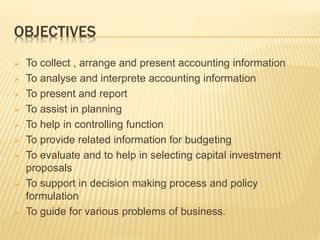
OBJECTIVES
 To collect , arrange and present accounting information
 To analyse and interprete accounting information
 To present and report
 To assist in planning
 To help in controlling function
 To provide related information for budgeting
 To evaluate and to help in selecting capital investment
proposals
 To support in decision making process and policy
formulation
 To guide for various problems of business.
DIFFERENCE BETWEEN FINANCIAL AND
MANAGEMENT ACCOUNTING
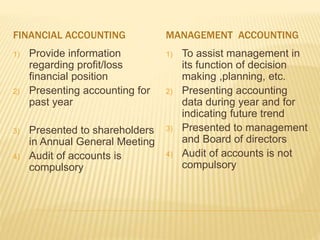
FINANCIAL ACCOUNTING MANAGEMENT ACCOUNTING
1) Provide information
regarding profit/loss
financial position
2) Presenting accounting for
past year
3) Presented to shareholders
in Annual General Meeting
4) Audit of accounts is
compulsory
1) To assist management in
its function of decision
making ,planning, etc.
2) Presenting accounting
data during year and for
indicating future trend
3) Presented to management
and Board of directors
4) Audit of accounts is not
compulsory
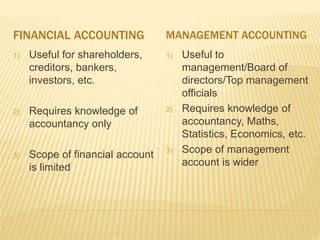
FINANCIAL ACCOUNTING MANAGEMENT ACCOUNTING
1) Useful for shareholders,
creditors, bankers,
investors, etc.
2) Requires knowledge of
accountancy only
3) Scope of financial account
is limited
1) Useful to
management/Board of
directors/Top management
officials
2) Requires knowledge of
accountancy, Maths,
Statistics, Economics, etc.
3) Scope of management
account is wider
SCOPE
 Financial accounting
 Cost accounting
 Budgeting and forecasting
 Cost control procedure
 Statistical methods
 Legal provisions
 Organization & method
FUNCTIONS
 Modification of data
 Analysis & interpretation of data
 Facilitating Management control
 Formulation of business budgets
 Use of qualitative information
LIMITATIONS
 This system mainly relies upon the information of
financial and cost accounting. If these are wrong,
defective or of error, then decision may lead to wrong
direction.
 This system is a tool to help management. It cannot
take place of effective management.
 To introduce this system is an expensive activity for
small units.
 As this system is very wide, one cannot take quick
and exact decision.
 Management accountant should have knowledge of
accounting, Statistic, Economical, Mathematics etc.

Management accounting introduction

  • 1.
    MANAGEMENT ACCOUNTING INTRODUCTION •The origin ofmanagement accounting can be traced to overcome the limitations of financial accounting and cost accounting . • Management accounting is the bridge which joins the two shores, first is accounting and second is management regarding the functions of business. • Management accounting may be defined as tools and techniques that provides accounting information to carry out business.
  • 2.
    DEFINITION  According toRN Anthony , Management accounting is concerned with accounting information that is used to management.  In other words, management accounting is the presentation of accounting information in such a way as to assist the management in creation of policy and the day to day operation of an undertaking.
  • 3.
    NATURE  As accountingassistance in connection with management functions  As managerial analysis  As managerial decision making  As accounting evaluation  As art , Science and Profession
  • 4.
    OBJECTIVES  To collect, arrange and present accounting information  To analyse and interprete accounting information  To present and report  To assist in planning  To help in controlling function  To provide related information for budgeting  To evaluate and to help in selecting capital investment proposals  To support in decision making process and policy formulation  To guide for various problems of business.
  • 5.
    DIFFERENCE BETWEEN FINANCIALAND MANAGEMENT ACCOUNTING
  • 6.
    FINANCIAL ACCOUNTING MANAGEMENTACCOUNTING 1) Provide information regarding profit/loss financial position 2) Presenting accounting for past year 3) Presented to shareholders in Annual General Meeting 4) Audit of accounts is compulsory 1) To assist management in its function of decision making ,planning, etc. 2) Presenting accounting data during year and for indicating future trend 3) Presented to management and Board of directors 4) Audit of accounts is not compulsory
  • 7.
    FINANCIAL ACCOUNTING MANAGEMENTACCOUNTING 1) Useful for shareholders, creditors, bankers, investors, etc. 2) Requires knowledge of accountancy only 3) Scope of financial account is limited 1) Useful to management/Board of directors/Top management officials 2) Requires knowledge of accountancy, Maths, Statistics, Economics, etc. 3) Scope of management account is wider
  • 8.
    SCOPE  Financial accounting Cost accounting  Budgeting and forecasting  Cost control procedure  Statistical methods  Legal provisions  Organization & method
  • 9.
    FUNCTIONS  Modification ofdata  Analysis & interpretation of data  Facilitating Management control  Formulation of business budgets  Use of qualitative information
  • 10.
    LIMITATIONS  This systemmainly relies upon the information of financial and cost accounting. If these are wrong, defective or of error, then decision may lead to wrong direction.  This system is a tool to help management. It cannot take place of effective management.  To introduce this system is an expensive activity for small units.  As this system is very wide, one cannot take quick and exact decision.  Management accountant should have knowledge of accounting, Statistic, Economical, Mathematics etc.