Introduction
to
Management
After completing this session. You should be able to:
a. Describe the meaning of Management
b. Know the Management Process
c. Identify the Mangers’ Roles
d. Describe the functions of Management
e. Identify the Principles of Management
f. Identify the Features of Management
Learning Objectives
After completing this session. You should be able to:
g. Describe the Importance of studying
Management
h. Identify the differences among
Organization, Administration and
Management
i. Differentiate Between Administration
and Management and
j. Describe the different Levels and Skills
of managers.
Learning Objectives (cont….)
Management
Management means many things to many people.
To a layman management means an impressive
person occupying an air-condition chamber with an
overstaked table and cushioned chair.
Some people suggest management as commanding
other.
To many others, management is nothing more than
clerical work and putting fancy signatures.
Meaning of Management
The word MANAGEMENT originated from the
Latin word “Managiare” which means, “to train
up the horses”.
But by the passage of time, it relates human
being in lieu of horses.
So the meaning of the word ‘MANAGEMENT’
is “to handle” the overall activities of the
organization.
Meaning of Management
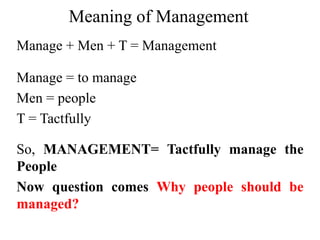
Manage + Men + T = Management
Manage = to manage
Men = people
T = Tactfully
So, MANAGEMENT= Tactfully manage the
People
Now question comes Why people should be
managed?
Meaning of Management
People must be managed to achieve the
organizational objectives in a systematic
process.
To achieve the goals, all elements (6 ‘M’; Men,
Machine, Materials, Money, Market and
Method) of the organization must be utilized
efficiently and effectively by the authoprity in
Management.
Definition of Management
As there is no universally accepted definition for
management, it is difficult to define it.
A simple traditional definition, "art of getting
things done by others".
This definition brings in two elements
accomplishment of objectives, and
direction of group activities towards the goal.
The weaknesses of this definition is that firstly it
uses the word "art", whereas management is not
merely an art, but it is both art and science.
Secondly, the definition does not state the various
functions of a manager clearly.
Definition of Management
Management is a distinct Process Consisting of
planning, organizing, actuating and controlling
performed to determine and accomplish stated
objectives with the use of human beings and
other resources.
To manage is to forecast and plan to organize
to command to coordinate and to control.
Management is the art of directing and
inspiring people.
Definition of Management
Kreitner’s definition :
‘Management is a problem solving process of
effectively achieving organizational objectives
through the efficient use of scarce resources in a
changing environment.’
F.W. Taylor (father of scientific management)
‘Management is an art of knowing what to do,
when to do and see that it is done in the best and
cheapest way‘.
Definition of Management
Henri Fayol (father of modern management)
"Management is the process by which co-operative
group directs actions towards common goals."
Joseph Massie
"Management is that process by which managers
create, direct, maintain and operate purposive
organisation through systematic, coordinated and
cooperative human efforts."
McFarland
"Management is the coordination of all resources
through the process of planning, organising,
directing and controlling in order to attain stated
goals."
Definition of Management
P
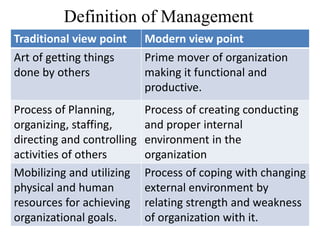
Traditional view point Modern view point
Art of getting things
done by others
Prime mover of organization
making it functional and
productive.
Process of Planning,
organizing, staffing,
directing and controlling
activities of others
Process of creating conducting
and proper internal
environment in the
organization
Mobilizing and utilizing
physical and human
resources for achieving
organizational goals.
Process of coping with changing
external environment by
relating strength and weakness
of organization with it.

Management

  • 1.
  • 2.
    After completing thissession. You should be able to: a. Describe the meaning of Management b. Know the Management Process c. Identify the Mangers’ Roles d. Describe the functions of Management e. Identify the Principles of Management f. Identify the Features of Management Learning Objectives
  • 3.
    After completing thissession. You should be able to: g. Describe the Importance of studying Management h. Identify the differences among Organization, Administration and Management i. Differentiate Between Administration and Management and j. Describe the different Levels and Skills of managers. Learning Objectives (cont….)
  • 4.
    Management Management means manythings to many people. To a layman management means an impressive person occupying an air-condition chamber with an overstaked table and cushioned chair. Some people suggest management as commanding other. To many others, management is nothing more than clerical work and putting fancy signatures.
  • 5.
    Meaning of Management Theword MANAGEMENT originated from the Latin word “Managiare” which means, “to train up the horses”. But by the passage of time, it relates human being in lieu of horses. So the meaning of the word ‘MANAGEMENT’ is “to handle” the overall activities of the organization.
  • 6.
    Meaning of Management Manage+ Men + T = Management Manage = to manage Men = people T = Tactfully So, MANAGEMENT= Tactfully manage the People Now question comes Why people should be managed?
  • 7.
    Meaning of Management Peoplemust be managed to achieve the organizational objectives in a systematic process. To achieve the goals, all elements (6 ‘M’; Men, Machine, Materials, Money, Market and Method) of the organization must be utilized efficiently and effectively by the authoprity in Management.
  • 8.
    Definition of Management Asthere is no universally accepted definition for management, it is difficult to define it. A simple traditional definition, "art of getting things done by others". This definition brings in two elements accomplishment of objectives, and direction of group activities towards the goal. The weaknesses of this definition is that firstly it uses the word "art", whereas management is not merely an art, but it is both art and science. Secondly, the definition does not state the various functions of a manager clearly.
  • 9.
    Definition of Management Managementis a distinct Process Consisting of planning, organizing, actuating and controlling performed to determine and accomplish stated objectives with the use of human beings and other resources. To manage is to forecast and plan to organize to command to coordinate and to control. Management is the art of directing and inspiring people.
  • 10.
    Definition of Management Kreitner’sdefinition : ‘Management is a problem solving process of effectively achieving organizational objectives through the efficient use of scarce resources in a changing environment.’ F.W. Taylor (father of scientific management) ‘Management is an art of knowing what to do, when to do and see that it is done in the best and cheapest way‘.
  • 11.
    Definition of Management HenriFayol (father of modern management) "Management is the process by which co-operative group directs actions towards common goals." Joseph Massie "Management is that process by which managers create, direct, maintain and operate purposive organisation through systematic, coordinated and cooperative human efforts." McFarland "Management is the coordination of all resources through the process of planning, organising, directing and controlling in order to attain stated goals."
  • 12.
    Definition of Management P Traditionalview point Modern view point Art of getting things done by others Prime mover of organization making it functional and productive. Process of Planning, organizing, staffing, directing and controlling activities of others Process of creating conducting and proper internal environment in the organization Mobilizing and utilizing physical and human resources for achieving organizational goals. Process of coping with changing external environment by relating strength and weakness of organization with it.