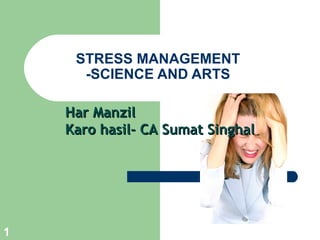

STRESS MANAGEMENT
      -SCIENCE AND ARTS

    Har Manzil
    Karo hasil- CA Sumat Singhal


1
STRESS


       IS A PART OF
        EVERYDAY LIFE
       IS NECESSARY

    TIME, MONEY, AND
      RELATIONSHIPS
      ENSURE THAT
      STRESS WILL
      ALWAYS BE WITH US
2
STRESS

    DEFINITION:

    THE NON-SPECIFIC RESPONSE OF THE
     BODY TO ANY DEMAND

    Hans Selye, MD


3
STRESS MANAGEMENT

    NOT ALL STRESS IS NEGATIVE
    EUSTRESS: POSITIVE STRESS
    RESULTS FROM EXHILARATING
     EXPERIENCES:
        WINNING THE LOTTERY
        UNEXPECTED PROMOTION
        AWARD

4
DISTRESS


    STRESS OF:
    LOSING, FAILING, OVERWORKING AND NOT
     COPING
    CAN BE HARMFUL AND IT IS NORMAL FROM
     TIME TO TIME


5
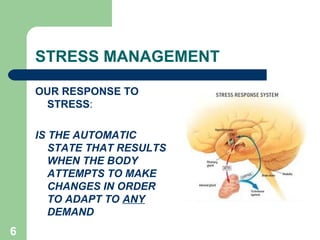
STRESS MANAGEMENT

    OUR RESPONSE TO
     STRESS:

    IS THE AUTOMATIC
       STATE THAT RESULTS
       WHEN THE BODY
       ATTEMPTS TO MAKE
       CHANGES IN ORDER
       TO ADAPT TO ANY
       DEMAND
6
STRESS MANAGEMENT

    CAUSES OF STRESS FALL INTO TWO
     CATEGORIES:

     EXTERNAL
     INTERNAL


7
STRESS MANAGEMENT

    EXTERNAL STRESSOR
    MAY BE MAJOR LIFE EVENTS:
    (REFER TO HOLMES-RAHE SCALE)

     MOVING
     DEATH OF SPOUSE, FAMILY MEMBER OR
      FRIEND
     DIVORCE

8
STRESS MANAGEMENT

    MAY BE CAUSED BY EVERYDAY
      PRESSURES SUCH AS:
     FINANCIAL
     DEADLINES
     ARGUMENTS
     FAMILY CONCERNS
     LACK OF SLEEP


9
INTERNAL STRESSORS


“INSIDE OURSELVES”

THIS TYPE OF STRESSOR MAY PLAY A GREATER
  ROLE IN THE STRESS OF DAILY LIFE
EXAMPLES ARE:
“VALUES AND BELIEFS”
      FAITH
      GOALS
      SELF-IMAGE
      EXPECTATIONS OF SELVES & OTHERS
MECHANISM OF STRESS


      DRIVEN   BY HORMONES
      HORMONES    ACT LIKE A CONDUCTOR
      HORMONESINNERVATE BODY
      SYSTEMS/ORGANS


11
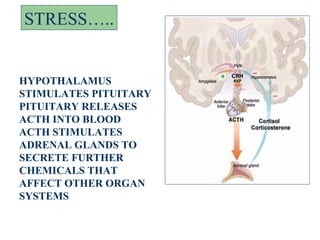
STRESS…..


HYPOTHALAMUS
STIMULATES PITUITARY
PITUITARY RELEASES
ACTH INTO BLOOD
ACTH STIMULATES
ADRENAL GLANDS TO
SECRETE FURTHER
CHEMICALS THAT
AFFECT OTHER ORGAN
SYSTEMS
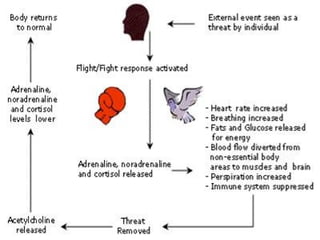
RESULT OF STRESS


14
STRESS MANAGEMENT


     MANY PEOPLE HAVE SYMPTOMS OF
      DISTRESS EVERYDAY.
     WE ACCEPT IT AS PART OF A NORMAL
      DAY.
     TO REDUCE THE WEAR AND TEAR ON
      OURSELVES, WE MUST INCREASE
      AWARENESS

15
STRESS MANAGEMENT

     COMMON SYMPTOMS OF STRESS

      PHYSICAL
      MENTAL EMOTIONAL
      BEHAVIORAL
      COGNITIVE


16
PHYSICAL SYMPTOMS :


        MUSCLE TENSION
        NAUSEA, VOMITING
        HEADACHES
        JAW, NECK & BACK PAIN
        DIARRHEA
        SLEEP DISTURBANCES
        DRY MOUTH, SWEATY PALMS
        UPPER RESPIRATORY INFECTIONS
        COLD HANDS
        BREATHING CHANGES (E.G., SHALLOW, SIGHING)
17
EMOTIONAL/MENTAL SYMPTOMS

        ANXIETY, WORRY, GUILT, NERVOUSNESS
        ANGER, FRUSTRATION
        MOODINESS
        DEPRESSION
        APPETITE VARIES
        RACING THOUGHTS
        NIGHTMARES
        DIMINISHED CONCENTRATION
        IMPAIRED MEMORY OR FORGETFULNESS


18
SYMPTOMS OF STRESS

      INDECISIVENESS
      CLOSE TO TEARS OR CRYING
      LONELINESS
      FEAR OF GETTING CLOSE
      SUICIDAL THINKING
      TROUBLE LEARNING NEW INFO
      CONFUSED/DISORGANIZED


19
BEHAVIORAL SYMPTOMS

        TARDINESS
        SERIOUS APPEARANCE
        NERVOUS BEHAVIOR/HABITS
        RUSHING/PACING
        INCREASED FRUSTRATION/IRRITABLE
        MORE ACCIDENTS
        OVERREACTING


20
BEHAVIORAL SYMPTOMS

      REDUCED  PRODUCTIVITY
      SOCIAL WITHDRAWAL
      DEFENSIVE
      SLEEP PROBLEMS/TIREDNESS
      INCREASED USE OF OTC DRUGS
      INCREASED TOBACCO
      INCREASED ALCOHOL
      INCREASED RECREATIONAL DRUGS

21
22
LONG TERM EFFECTS

     ARE HARMFUL.
     MOST OF US BOUNCE BACK. UNDER
      LONG-TERM STRESS HOWEVER:
        OUR PERSONALITIES CHANGE
        MAY BECOME DEPRESSED
        FEEL HELPLESS/HOPELESS
        BECOME EXPLOSIVE/IMPULSIVE


23
LONG TERM EFFECTS OF STRESS


      HAVE EXAGGERATED FEARS
      DEVELOP ANXIETY/PANIC
      DEVELOP PHYSICAL PROBLEMS
       INCLUDING CV DISEASE, HBP, ULCERS OR
       HEADACHES


24
STRESS MANAGEMENT

     GET ORGANIZED:
          USE CALENDERS OR “TO DO LISTS”
     KNOW YOUR LIMITS:
          BE REALISTIC
     CHANGE ATTITUDE:
          LEARN TO SEE STRESSFUL SITUATIONS AS
          CHALLENGES
     TALK IT OVER:
          TALK THE SITUATION OVER WITH A FRIEND
25
STRESS MANAGEMENT


     LEARN TO SAY “NO”:
       THERE ARE SOME DEMANDS THAT WE
       HAVE NO CONTROL OVER. SEPARATE
       THOSE FROM ACTIVITIES OVER WHICH
       WE HAVE SOME CONTROL, AND LEARN
       TO SAY “NO” TO DEMANDS.


26
STRESS MANAGEMENT

     POSITIVE SELF TALK:

      LEARN THAT YOU CAN MANAGE A
      STRESSFUL SITUATION BY WHAT YOU
      SAY TO YOURSELF, “I CAN HANDLE THIS
      ONE STEP AT A TIME”.


27
STRESS MANAGEMENT

      DEEP BREATHING
      PROGRESSIVE MUSCLE RELAXATION
      BIOFEEDBACK
      MEDITATION
      BEGIN AN EXERCISE PROGRAM
      REAPPRAISE YOUR LIFE AND PRIORITIES


28
You are not responsible for what
         people think about you.
     But you are responsible for what
     you give them to think about you.
29
BREATHING

Breathing helps to slow down
or to even stop the stress
response!
Takes time to practice,
learn well and use daily.
Often, people do not learn
how to breathe correctly, and
do not use it consistently…
BREATHING

   Slowly inhale counting one, pause for a
    moment and slowly exhale counting two
   Slowly inhale counting three, pause for a
    moment and slowly exhale counting four..
   Continue inhaling and counting four and
    exhaling…
STRESS MANAGEMENT

     LOVE, PRAY, FORGIVE

        REALIZE THAT MOST STRESS COMES
        FROM WITHIN, NOT WITHOUT.

        TAKE TIME TO SMELL THE FLOWERS
        AND TASTE THE STRAWBERRIES.

32
STAY IN THE PRESENT
       Worry about the future and
        regrets about the past keep you
        stressed and away from
        enjoying the moment!
       May manage distress by

        focusing on the present!
       Can control focus by what you

        pay attention too!
MINDFUL AWARENESS
   Close your eyes & Breathe
     Notice your body, how
     the heart beats, how the
     intake of air feels, how
     the stomach feels…
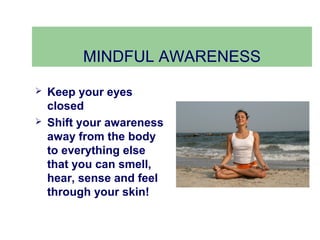
MINDFUL AWARENESS
   Keep your eyes
    closed
   Shift your awareness
    away from the body
    to everything else
    that you can smell,
    hear, sense and feel
    through your skin!
It's better to lose your Ego to the one you Love,
 than to lose the one you LOVE because of EGO.

                    JOHN KEATS


36
AWARENESS

   Shift back and forth between what is
    going on in the body and what is going
    on around you!

   Can ignore physical and body
    sensations and manage worry!

   Learn to control both internal & external
    sensations!
MANAGE THE
   BODY
       Care for your self through eating right,
        getting enough sleep and exercising!

       Follow a routine to keep the body
        healthy, balanced and resilient!
       AVOID sugar, nicotine, alcohol and
        caffeine! They over stimulate and
        produce highs and lows that lead to
        distress-especially in excess
MUSCLE RELAXATION

 Move down your body, tightening
  and then relaxing the major
  muscle groups from your back
  down to your toes..
 If any one or two muscles groups
  are not relaxed, you may return
  and repeat the tightening and
  releasing technique..
 Enjoy the relaxation for a few
  moments!
MORE FUN

   Often we take life too seriously and fail to
    have enough fun…
   See potential problems rather than joys
    and remain tightly wired & stressed
   Schedule more play time!
   Laugh, joke and have more fun!
   Find pleasure & delights every day!
The happiest people do not
     Necessarily have the best of all
           They simply appreciate
41     What they find on their way.
Thought Stopping

     Ruminative worry has a life of
      it’s own!
     Disturbs and interferes with
      every other thought…
     Goal is to interrupt the
      negative thought and then to
      replace it!
SUMMARY
   Stress is a part of every one’s Life
   Can learn techniques and methods to
    manage stress!

   It is like learning to ride a bike, to
    rollerblade or to play an instrument – once
    you know it you can use it for life!

   Use these techniques daily!
Write your Sad times in Sand.
 Write your Good times in Stone.
 GEORGE BERNARD SHAW


44

Manage your stress

  • 1.
    STRESS MANAGEMENT -SCIENCE AND ARTS Har Manzil Karo hasil- CA Sumat Singhal 1
  • 2.
    STRESS  IS A PART OF EVERYDAY LIFE  IS NECESSARY TIME, MONEY, AND RELATIONSHIPS ENSURE THAT STRESS WILL ALWAYS BE WITH US 2
  • 3.
    STRESS DEFINITION: THE NON-SPECIFIC RESPONSE OF THE BODY TO ANY DEMAND Hans Selye, MD 3
  • 4.
    STRESS MANAGEMENT NOT ALL STRESS IS NEGATIVE EUSTRESS: POSITIVE STRESS RESULTS FROM EXHILARATING EXPERIENCES: WINNING THE LOTTERY UNEXPECTED PROMOTION AWARD 4
  • 5.
    DISTRESS STRESS OF: LOSING, FAILING, OVERWORKING AND NOT COPING CAN BE HARMFUL AND IT IS NORMAL FROM TIME TO TIME 5
  • 6.
    STRESS MANAGEMENT OUR RESPONSE TO STRESS: IS THE AUTOMATIC STATE THAT RESULTS WHEN THE BODY ATTEMPTS TO MAKE CHANGES IN ORDER TO ADAPT TO ANY DEMAND 6
  • 7.
    STRESS MANAGEMENT CAUSES OF STRESS FALL INTO TWO CATEGORIES:  EXTERNAL  INTERNAL 7
  • 8.
    STRESS MANAGEMENT EXTERNAL STRESSOR MAY BE MAJOR LIFE EVENTS: (REFER TO HOLMES-RAHE SCALE)  MOVING  DEATH OF SPOUSE, FAMILY MEMBER OR FRIEND  DIVORCE 8
  • 9.
    STRESS MANAGEMENT MAY BE CAUSED BY EVERYDAY PRESSURES SUCH AS:  FINANCIAL  DEADLINES  ARGUMENTS  FAMILY CONCERNS  LACK OF SLEEP 9
  • 10.
    INTERNAL STRESSORS “INSIDE OURSELVES” THISTYPE OF STRESSOR MAY PLAY A GREATER ROLE IN THE STRESS OF DAILY LIFE EXAMPLES ARE: “VALUES AND BELIEFS” FAITH GOALS SELF-IMAGE EXPECTATIONS OF SELVES & OTHERS
  • 11.
    MECHANISM OF STRESS  DRIVEN BY HORMONES  HORMONES ACT LIKE A CONDUCTOR  HORMONESINNERVATE BODY SYSTEMS/ORGANS 11
  • 12.
    STRESS….. HYPOTHALAMUS STIMULATES PITUITARY PITUITARY RELEASES ACTHINTO BLOOD ACTH STIMULATES ADRENAL GLANDS TO SECRETE FURTHER CHEMICALS THAT AFFECT OTHER ORGAN SYSTEMS
  • 14.
  • 15.
    STRESS MANAGEMENT MANY PEOPLE HAVE SYMPTOMS OF DISTRESS EVERYDAY. WE ACCEPT IT AS PART OF A NORMAL DAY. TO REDUCE THE WEAR AND TEAR ON OURSELVES, WE MUST INCREASE AWARENESS 15
  • 16.
    STRESS MANAGEMENT COMMON SYMPTOMS OF STRESS  PHYSICAL  MENTAL EMOTIONAL  BEHAVIORAL  COGNITIVE 16
  • 17.
    PHYSICAL SYMPTOMS :  MUSCLE TENSION  NAUSEA, VOMITING  HEADACHES  JAW, NECK & BACK PAIN  DIARRHEA  SLEEP DISTURBANCES  DRY MOUTH, SWEATY PALMS  UPPER RESPIRATORY INFECTIONS  COLD HANDS  BREATHING CHANGES (E.G., SHALLOW, SIGHING) 17
  • 18.
    EMOTIONAL/MENTAL SYMPTOMS  ANXIETY, WORRY, GUILT, NERVOUSNESS  ANGER, FRUSTRATION  MOODINESS  DEPRESSION  APPETITE VARIES  RACING THOUGHTS  NIGHTMARES  DIMINISHED CONCENTRATION  IMPAIRED MEMORY OR FORGETFULNESS 18
  • 19.
    SYMPTOMS OF STRESS  INDECISIVENESS  CLOSE TO TEARS OR CRYING  LONELINESS  FEAR OF GETTING CLOSE  SUICIDAL THINKING  TROUBLE LEARNING NEW INFO  CONFUSED/DISORGANIZED 19
  • 20.
    BEHAVIORAL SYMPTOMS  TARDINESS  SERIOUS APPEARANCE  NERVOUS BEHAVIOR/HABITS  RUSHING/PACING  INCREASED FRUSTRATION/IRRITABLE  MORE ACCIDENTS  OVERREACTING 20
  • 21.
    BEHAVIORAL SYMPTOMS  REDUCED PRODUCTIVITY  SOCIAL WITHDRAWAL  DEFENSIVE  SLEEP PROBLEMS/TIREDNESS  INCREASED USE OF OTC DRUGS  INCREASED TOBACCO  INCREASED ALCOHOL  INCREASED RECREATIONAL DRUGS 21
  • 22.
  • 23.
    LONG TERM EFFECTS ARE HARMFUL. MOST OF US BOUNCE BACK. UNDER LONG-TERM STRESS HOWEVER:  OUR PERSONALITIES CHANGE  MAY BECOME DEPRESSED  FEEL HELPLESS/HOPELESS  BECOME EXPLOSIVE/IMPULSIVE 23
  • 24.
    LONG TERM EFFECTSOF STRESS  HAVE EXAGGERATED FEARS  DEVELOP ANXIETY/PANIC  DEVELOP PHYSICAL PROBLEMS INCLUDING CV DISEASE, HBP, ULCERS OR HEADACHES 24
  • 25.
    STRESS MANAGEMENT GET ORGANIZED: USE CALENDERS OR “TO DO LISTS” KNOW YOUR LIMITS: BE REALISTIC CHANGE ATTITUDE: LEARN TO SEE STRESSFUL SITUATIONS AS CHALLENGES TALK IT OVER: TALK THE SITUATION OVER WITH A FRIEND 25
  • 26.
    STRESS MANAGEMENT LEARN TO SAY “NO”: THERE ARE SOME DEMANDS THAT WE HAVE NO CONTROL OVER. SEPARATE THOSE FROM ACTIVITIES OVER WHICH WE HAVE SOME CONTROL, AND LEARN TO SAY “NO” TO DEMANDS. 26
  • 27.
    STRESS MANAGEMENT POSITIVE SELF TALK: LEARN THAT YOU CAN MANAGE A STRESSFUL SITUATION BY WHAT YOU SAY TO YOURSELF, “I CAN HANDLE THIS ONE STEP AT A TIME”. 27
  • 28.
    STRESS MANAGEMENT  DEEP BREATHING  PROGRESSIVE MUSCLE RELAXATION  BIOFEEDBACK  MEDITATION  BEGIN AN EXERCISE PROGRAM  REAPPRAISE YOUR LIFE AND PRIORITIES 28
  • 29.
    You are notresponsible for what people think about you. But you are responsible for what you give them to think about you. 29
  • 30.
    BREATHING Breathing helps toslow down or to even stop the stress response! Takes time to practice, learn well and use daily. Often, people do not learn how to breathe correctly, and do not use it consistently…
  • 31.
    BREATHING  Slowly inhale counting one, pause for a moment and slowly exhale counting two  Slowly inhale counting three, pause for a moment and slowly exhale counting four..  Continue inhaling and counting four and exhaling…
  • 32.
    STRESS MANAGEMENT LOVE, PRAY, FORGIVE REALIZE THAT MOST STRESS COMES FROM WITHIN, NOT WITHOUT. TAKE TIME TO SMELL THE FLOWERS AND TASTE THE STRAWBERRIES. 32
  • 33.
    STAY IN THEPRESENT  Worry about the future and regrets about the past keep you stressed and away from enjoying the moment!  May manage distress by focusing on the present!  Can control focus by what you pay attention too!
  • 34.
    MINDFUL AWARENESS Close your eyes & Breathe Notice your body, how the heart beats, how the intake of air feels, how the stomach feels…
  • 35.
    MINDFUL AWARENESS  Keep your eyes closed  Shift your awareness away from the body to everything else that you can smell, hear, sense and feel through your skin!
  • 36.
    It's better tolose your Ego to the one you Love, than to lose the one you LOVE because of EGO. JOHN KEATS 36
  • 37.
    AWARENESS  Shift back and forth between what is going on in the body and what is going on around you!  Can ignore physical and body sensations and manage worry!  Learn to control both internal & external sensations!
  • 38.
    MANAGE THE BODY  Care for your self through eating right, getting enough sleep and exercising!  Follow a routine to keep the body healthy, balanced and resilient!  AVOID sugar, nicotine, alcohol and caffeine! They over stimulate and produce highs and lows that lead to distress-especially in excess
  • 39.
    MUSCLE RELAXATION  Movedown your body, tightening and then relaxing the major muscle groups from your back down to your toes..  If any one or two muscles groups are not relaxed, you may return and repeat the tightening and releasing technique..  Enjoy the relaxation for a few moments!
  • 40.
    MORE FUN  Often we take life too seriously and fail to have enough fun…  See potential problems rather than joys and remain tightly wired & stressed  Schedule more play time!  Laugh, joke and have more fun!  Find pleasure & delights every day!
  • 41.
    The happiest peopledo not Necessarily have the best of all They simply appreciate 41 What they find on their way.
  • 42.
    Thought Stopping  Ruminative worry has a life of it’s own!  Disturbs and interferes with every other thought…  Goal is to interrupt the negative thought and then to replace it!
  • 43.
    SUMMARY  Stress is a part of every one’s Life  Can learn techniques and methods to manage stress!  It is like learning to ride a bike, to rollerblade or to play an instrument – once you know it you can use it for life!  Use these techniques daily!
  • 44.
    Write your Sadtimes in Sand. Write your Good times in Stone. GEORGE BERNARD SHAW 44