Outline of thelecture
• Power System Operation
- Centralised Control Applications - an
example
• SCADA
- SCADA architecture & Components
- SCADA system functions
- Non functional aspects
4.
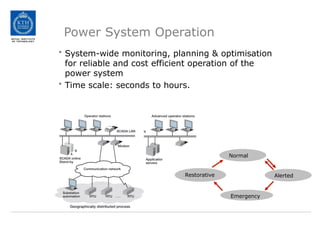
Power System Operation
•System-wide monitoring, planning & optimisation
for reliable and cost efficient operation of the
power system
• Time scale: seconds to hours.
Normal
Alerted
Emergency
Restorative
5.
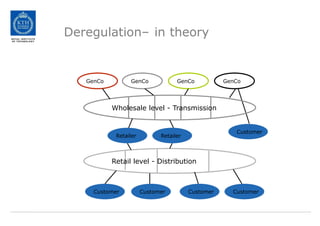
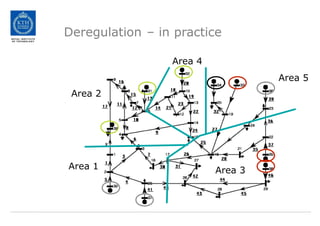
Deregulation– in theory
Wholesalelevel - Transmission
GenCo GenCo GenCo GenCo
Retailer Retailer
Retail level - Distribution
Customer Customer Customer Customer
Customer
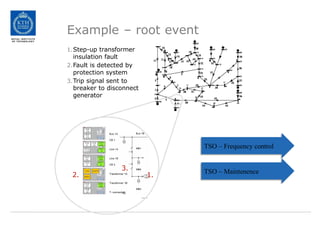
Example – rootevent
1.Step-up transformer
insulation fault
2.Fault is detected by
protection system
3.Trip signal sent to
breaker to disconnect
generator
1.
2.
3.
TSO – Frequency control
TSO – Maintenence
9.
TSO - FrequencyControl
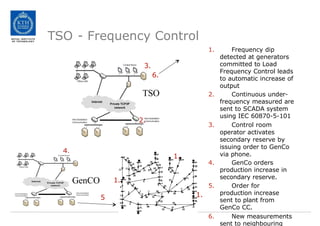
1. Frequency dip
detected at generators
committed to Load
Frequency Control leads
to automatic increase of
output
2. Continuous under-
frequency measured are
sent to SCADA system
using IEC 60870-5-101
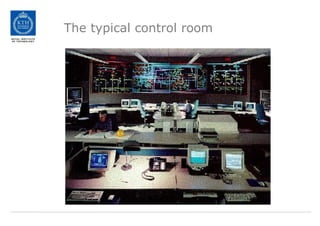
3. Control room
operator activates
secondary reserve by
issuing order to GenCo
via phone.
4. GenCo orders
production increase in
secondary reserve.
5. Order for
production increase
sent to plant from
GenCo CC.
6. New measurements
sent to neighbouring
2.
3.
1.
1.
1.
4.
GenCO
5
6.
TSO
10.
TSO- Repair &Maintenance
1.
2.
3.
4.
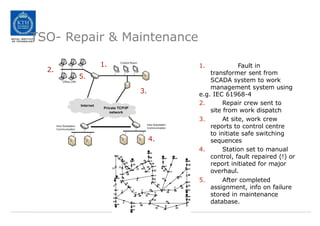
1. Fault in
transformer sent from
SCADA system to work
management system using
e.g. IEC 61968-4
2. Repair crew sent to
site from work dispatch
3. At site, work crew
reports to control centre
to initiate safe switching
sequences
4. Station set to manual
control, fault repaired (!) or
report initiated for major
overhaul.
5. After completed
assignment, info on failure
stored in maintenance
database.
5.
11.
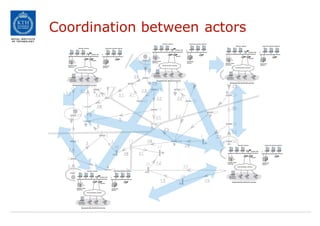
Central control &coordination
• On the deregulated Power market, all actors
- Distribution Network Operators
- Transmission Network Operators
- Generating companies
• All need some central platform to manage their
assets dispersed across large areas.
• Enter – the SCADA system
12.
Outline of thelecture
• Power System Operation
- Centralised Control Applications
• SCADA
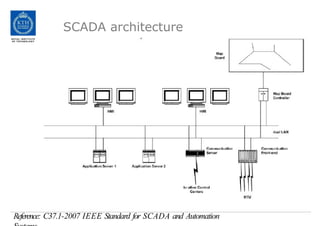
- SCADA architecture & Components
- SCADA system functions
- Non functional aspects
13.
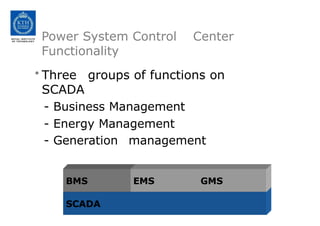
Power System ControlCenter
Functionality
• Three groups of functions on
SCADA
- Business Management
- Energy Management
- Generation management
SCADA
BMS EMS GMS
14.
What is SCADA?
SupervisoryControl And Data Acquistion
- Collect measurements and status data from the process
- Remotely intervene in the process
- Centralized system platform
- Based on distributed I/O
Applicable Processes
- Oil or Gas prodcution facilities
- Piplelines for gas, oils, chemicals or water.
- Railway/Transportation Process
- Nuclear, Gas, Hyrdo generation plants
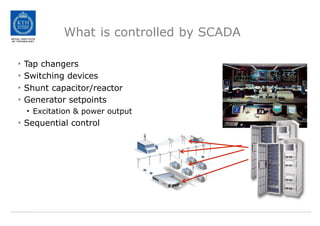
What is controlledby SCADA
• Tap changers
• Switching devices
• Shunt capacitor/reactor
• Generator setpoints
• Excitation & power output
• Sequential control
SCADA Components
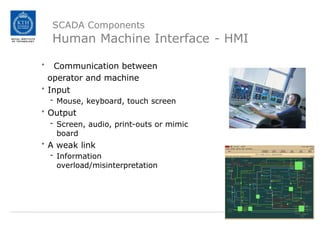
Human MachineInterface - HMI
• Communication between
operator and machine
• Input
- Mouse, keyboard, touch screen
• Output
- Screen, audio, print-outs or mimic
board
• A weak link
- Information
overload/misinterpretation
19.
SCADA components
Application Servers
•Application servers provide the computing platform for
the SCADA System, included servers are:
- Real-time database
- Historical database
- Energy Management applications
• State Estimation
• Optimal/Dispatcher Powerflow
• Voltage Stability Assessment
• Etc….
- Geographic Information Systems
• Distribution Management
20.
SCADA Components
System ConfigurationServers
• Allows configuration of the SCADA system
environment, typical servers include:
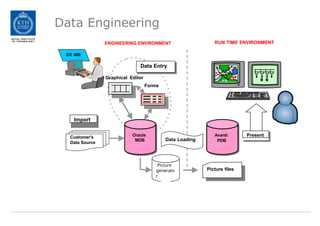
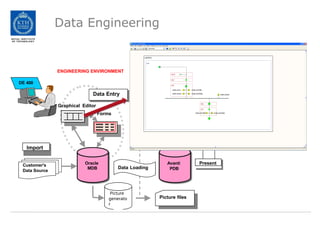
- Data engineering of the SCADA system providing
manual data entry into the SCADA topology database
including lidnes, circuitbreakers, stations, …..
- SubstationdDevice configuration, such as IED
configuration tools and databses of IED configuration.
Remote access tools for configuration
21.
Data Engineering
DE 400
Forms
DataEntry
Import
Customer's
Data Source
RUN TIME ENVIRONMENT
Oracle
MDB
Picture
generato
r
Picture files
Avanti
PDB
A-
B-
C-
RUN TIME ENVIRONMENT
Graphical Editor
Data Loading
Present
ENGINEERING ENVIRONMENT
22.
Data Engineering
DE 400
Forms
DataEntry
Import
Customer's
Data Source
RUN TIME ENVIRONMENT
Oracle
MDB
Picture
generato
r
Picture files
Avanti
PDB
A-
B-
C-
RUN TIME ENVIRONMENT
Graphical Editor
Data Loading
Present
ENGINEERING ENVIRONMENT
23.
SCADA components
Communication Servers
•Variety of servers for communication
- Communication to other Control centers using ICCP
- Communication to office applications
24.
SCADA components
Communication FrontEnd
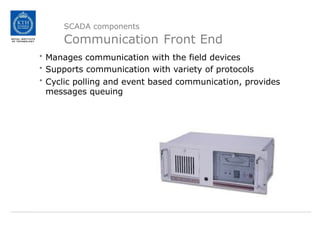
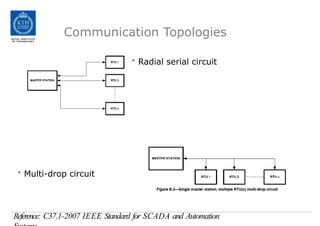
• Manages communication with the field devices
• Supports communication with variety of protocols
• Cyclic polling and event based communication, provides
messages queuing
25.
SCADA Components
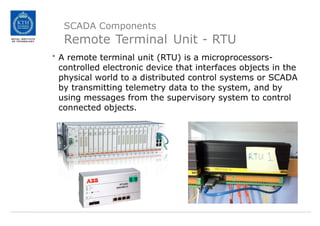
Remote TerminalUnit - RTU
• A remote terminal unit (RTU) is a microprocessors-
controlled electronic device that interfaces objects in the
physical world to a distributed control systems or SCADA
by transmitting telemetry data to the system, and by
using messages from the supervisory system to control
connected objects.
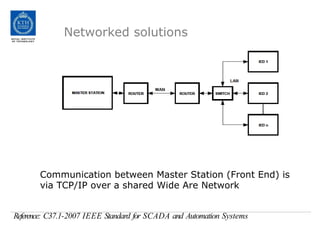
Networked solutions
Communication betweenMaster Station (Front End) is
via TCP/IP over a shared Wide Are Network
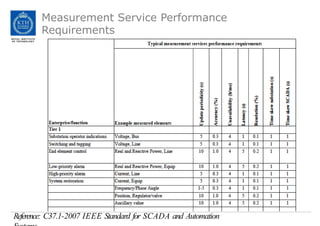
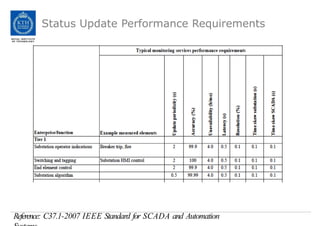
Reference: C37.1-2007 IEEE Standard for SCADA and Automation Systems
28.
Communication Principles
• CyclicPolling
- Front-End communication server requests data
periodically from each RTU.
- Period times vary from 2-4 up to 10-15 seconds.
- Real-time?
• Report By Exception
- Cyclic polling as above
- RTU only responds if a value has changed
• Balanced protocols
- The RTU can send a request to be polled by the Front-End
29.
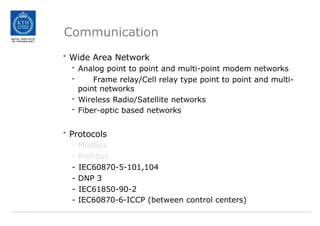
Communication
• Wide AreaNetwork
- Analog point to point and multi-point modem networks
- Frame relay/Cell relay type point to point and multi-
point networks
- Wireless Radio/Satellite networks
- Fiber-optic based networks
• Protocols
- Modbus
- Profibus
- IEC60870-5-101,104
- DNP 3
- IEC61850-90-2
- IEC60870-6-ICCP (between control centers)
30.
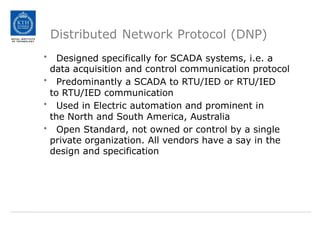
Distributed Network Protocol(DNP)
• Designed specifically for SCADA systems, i.e. a
data acquisition and control communication protocol
• Predominantly a SCADA to RTU/IED or RTU/IED
to RTU/IED communication
• Used in Electric automation and prominent in
the North and South America, Australia
• Open Standard, not owned or control by a single
private organization. All vendors have a say in the
design and specification
31.
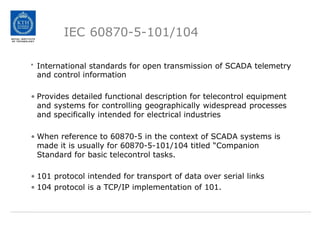
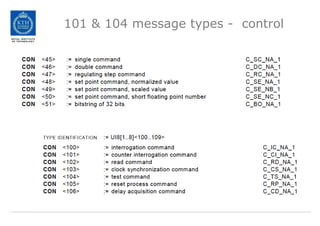
IEC 60870-5-101/104
• Internationalstandards for open transmission of SCADA telemetry
and control information
• Provides detailed functional description for telecontrol equipment
and systems for controlling geographically widespread processes
and specifically intended for electrical industries
• When reference to 60870-5 in the context of SCADA systems is
made it is usually for 60870-5-101/104 titled “Companion
Standard for basic telecontrol tasks.
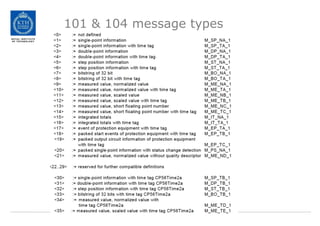
• 101 protocol intended for transport of data over serial links
• 104 protocol is a TCP/IP implementation of 101.
IEC 60870-6
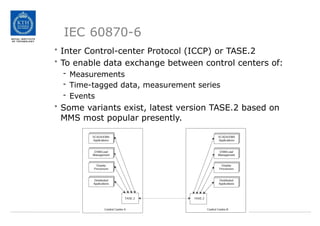
• InterControl-center Protocol (ICCP) or TASE.2
• To enable data exchange between control centers of:
- Measurements
- Time-tagged data, measurement series
- Events
• Some variants exist, latest version TASE.2 based on
MMS most popular presently.
35.
IEC 61850-90-2
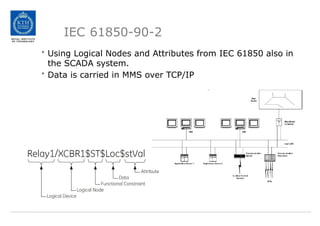
• UsingLogical Nodes and Attributes from IEC 61850 also in
the SCADA system.
• Data is carried in MMS over TCP/IP
36.
Outline of thelecture
• Power System Operation
- Centralised Control Applications
• SCADA
- SCADA architecture & Components
- SCADA system functions
- Non functional aspects
37.
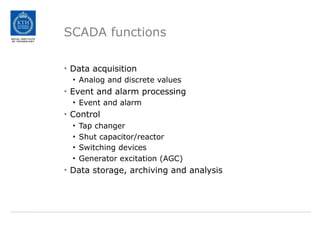
SCADA functions
• Dataacquisition
• Analog and discrete values
• Event and alarm processing
• Event and alarm
• Control
• Tap changer
• Shut capacitor/reactor
• Switching devices
• Generator excitation (AGC)
• Data storage, archiving and analysis
38.
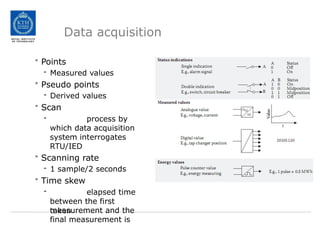
Data acquisition
taken
• Points
-Measured values
• Pseudo points
- Derived values
• Scan
- process by
which data acquisition
system interrogates
RTU/IED
• Scanning rate
- 1 sample/2 seconds
• Time skew
- elapsed time
between the first
measurement and the
final measurement is
39.
SCADA: Data Acquisition(Cont.)
• Measurements and Status Indications Collected
are stored in a Real Time Database.
• The Values are Time tagged in the database.
• As new Values come in from the RTUs/IEDs old
values are overwritten (or archived).
40.
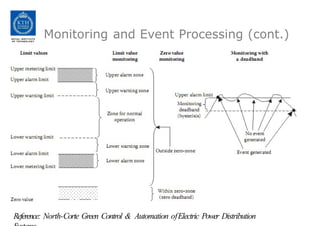
Monitoring and EventProcessing
• Events
• Changing positions
• Breaker / Disconnector opens or closes
• Value above/below a threshold
• Equipment activated
• Reactor or capacitor engaged
• Automatic changes
• On load tap changer changes state
• Alarms
• Critical events
• It is a matter of definition
41.
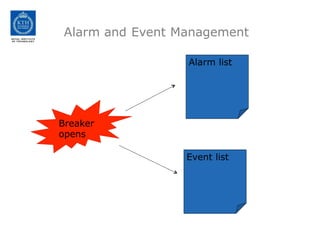
Alarm and EventManagement
Alarm list
Event list
Breaker
opens
42.
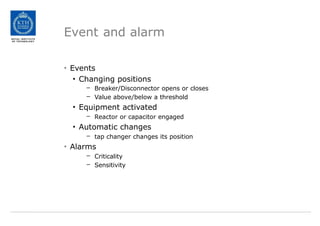
Event and alarm
•Events
• Changing positions
– Breaker/Disconnector opens or closes
– Value above/below a threshold
• Equipment activated
– Reactor or capacitor engaged
• Automatic changes
– tap changer changes its position
• Alarms
– Criticality
– Sensitivity
43.
Monitoring and EventProcessing (cont.)
Reference: North-Corte Green Control & Automation ofElectric Power Distribution
44.
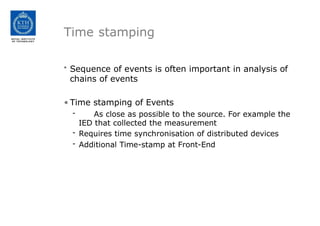
Time stamping
• Sequenceof events is often important in analysis of
chains of events
• Time stamping of Events
- As close as possible to the source. For example the
IED that collected the measurement
- Requires time synchronisation of distributed devices
- Additional Time-stamp at Front-End
45.
SCADA: Data Storage,Archiving and
Analysis
• Data Collected from the process is sometimes
archived, this due to many reasons:
• Regulations
• Billing
• Future Load planning
• Performance Audits
• Post Mortem Review, in case of
disturbances or interruptions in the process.
• Changed Values are “archived” at cyclic
intervals, the interval depends on the importance of
the values. Examples of cyclic intervals are: every
scan interval, every 10 seconds or every hour.
46.
Sequence of Eventsrecorders
• Local function implemented in Substation Controller
that keeps a record of all events in the substation
• Not all events are sent to the SCADA system
• SER logfiles can be uploaded to the SCADA system to
enable analysis
47.
SCADA: Control Functions
•Individual Device Control
• Direct open/close commands to individual devices
• Check-back before Operate function.
• Control Messages to Regulating Equipment
• E.g. Raising or lowering tap changer taps
• Sequential Control
• E.g. in the case of a set of sequential switching
steps to restore power through predefined backup
configuration.
• Automatic Control
• Triggered by an event of lapse of specific time
period that invokes a control actions
• E.g. automatically changing load tab changer
due to voltage set point violation
48.
Outline of thelecture
• Power System Operation
- Centralised Control Applications
• SCADA
- SCADA architecture & Components
- SCADA system functions
- Non functional aspects
49.
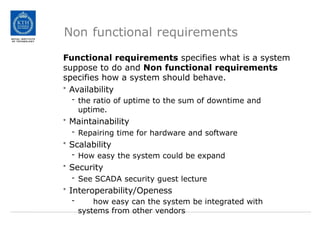
Non functional requirements
Functionalrequirements specifies what is a system
suppose to do and Non functional requirements
specifies how a system should behave.
• Availability
- the ratio of uptime to the sum of downtime and
uptime.
• Maintainability
- Repairing time for hardware and software
• Scalability
- How easy the system could be expand
• Security
- See SCADA security guest lecture
• Interoperability/Openess
- how easy can the system be integrated with
systems from other vendors
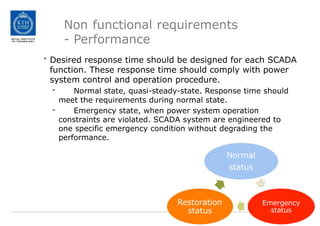
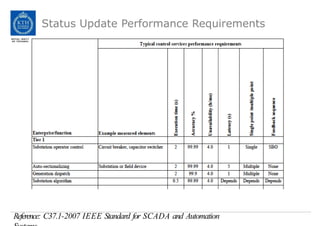
Non functional requirements
-Performance
• Desired response time should be designed for each SCADA
function. These response time should comply with power
system control and operation procedure.
- Normal state, quasi-steady-state. Response time should
meet the requirements during normal state.
- Emergency state, when power system operation
constraints are violated. SCADA system are engineered to
one specific emergency condition without degrading the
performance.
Normal
status
Emergency
status
Restoration
status