JSS Medical College, Mysuru
Mammography :TECHNIQUE , INDICATION AND
CONTRAIDICATION
Presenter
Dr.Vishwanath Patil
PG Resident
Moderator
Dr. Sudha Kiran Das
Associate Professor
JSS Medical College, Mysuru
INTRODUCTION
• A mammogram is a x ray exam of breast to detect and
evaluate any changes in the breast.
• X-ray was first used to examine the breast by German surgeon
Albert Salmon.
• Modern mammography came into existence since late 1960.
JSS Medical College, Mysuru
INTRODUCTION
• Modern machines are safe and uses the lowest possible dose.
• If women has yearly mammogram staring from age 40 and
continue until 90.She will get total 20-40 rads.
• Benefits pleural effusion mammography outweigh any
possible harm from the radiation.
JSS Medical College, Mysuru
RADIATION DOSE
• Mean glandular radiation dose to the breast is approximately
2 mGy (0.2 rad) per exposure.
• With present mammographic equipment, there is little or no
radiation related risk to the women over 40 years of age.
JSS Medical College, Mysuru
Types of of Mammogram
• Screening mammogram.
• Diagnostic mammogram.
JSS Medical College, Mysuru
American College of Radiology Recommendations for
Imaging Screening for Breast Cancer
• Women at average risk for breast cancer
∘Annual screening from age 40
• Women at increased risk for breast cancer
1. Women with certain BRCA1 or BRCA2 mutations or who are
untested but have first-degree relatives (mothers, sisters, or
daughters) who are proved to have BRCA mutations
– ■Yearly starting by age 30 (but not before age 25)
JSS Medical College, Mysuru
American College of Radiology Recommendations for
Imaging Screening for Breast Cancer
2. Women with ≥20% lifetime risk for breast cancer on the basis
of family history (both maternal and paternal) and Women with
mothers or sisters with pre-menopausal breast cancer
■Yearly starting by age 30 (but not before age 25), or 10
years earlier than the age of diagnosis of the youngest affected
relative, whichever is later
JSS Medical College, Mysuru
American College of Radiology Recommendations for
Imaging Screening for Breast Cancer
3. Women with histories of mantle radiation (usually for
Hodgkin's disease) received between the ages of 10 and 30.
■Yearly starting 8 years after the radiation therapy, but not
before age 25.
JSS Medical College, Mysuru
American College of Radiology Recommendations for
Imaging Screening for Breast Cancer
4. Women with biopsy-proven lobular neoplasia (lobular
carcinoma in situ and atypical lobular hyperplasia), atypical
ductal hyperplasia (ADH), ductal carcinoma in situ (DCIS),
invasive breast cancer or ovarian cancer
■Yearly from time of diagnosis, regardless of age.
JSS Medical College, Mysuru
• Age at Which Annual Screening With Mammography Should
Stop.
• When life expectancy is <5 to 7 years on the basis of age or
comorbid conditions
•When abnormal results of screening would not be acted on
because of age or comorbid conditions
JSS Medical College, Mysuru
INDICATIONS
• Breast Cancer.
• Breast Lump.
• Nipple Discharge.
• Focal Breast Pain.
• Follow up for previously evaluated Mammographic
findings.
• BIRADS ( Breast Imaging Reporting and Detection
System).
JSS Medical College, Mysuru
CONTRAINDICATIONS
• Size of cancer relative to Breast Size.
• First or Second-trimester pregnancy.
• Prior radiation therapy to chest/mediastinal.
• Active Collagen Vascular disease.
JSS Medical College, Mysuru
Mammography
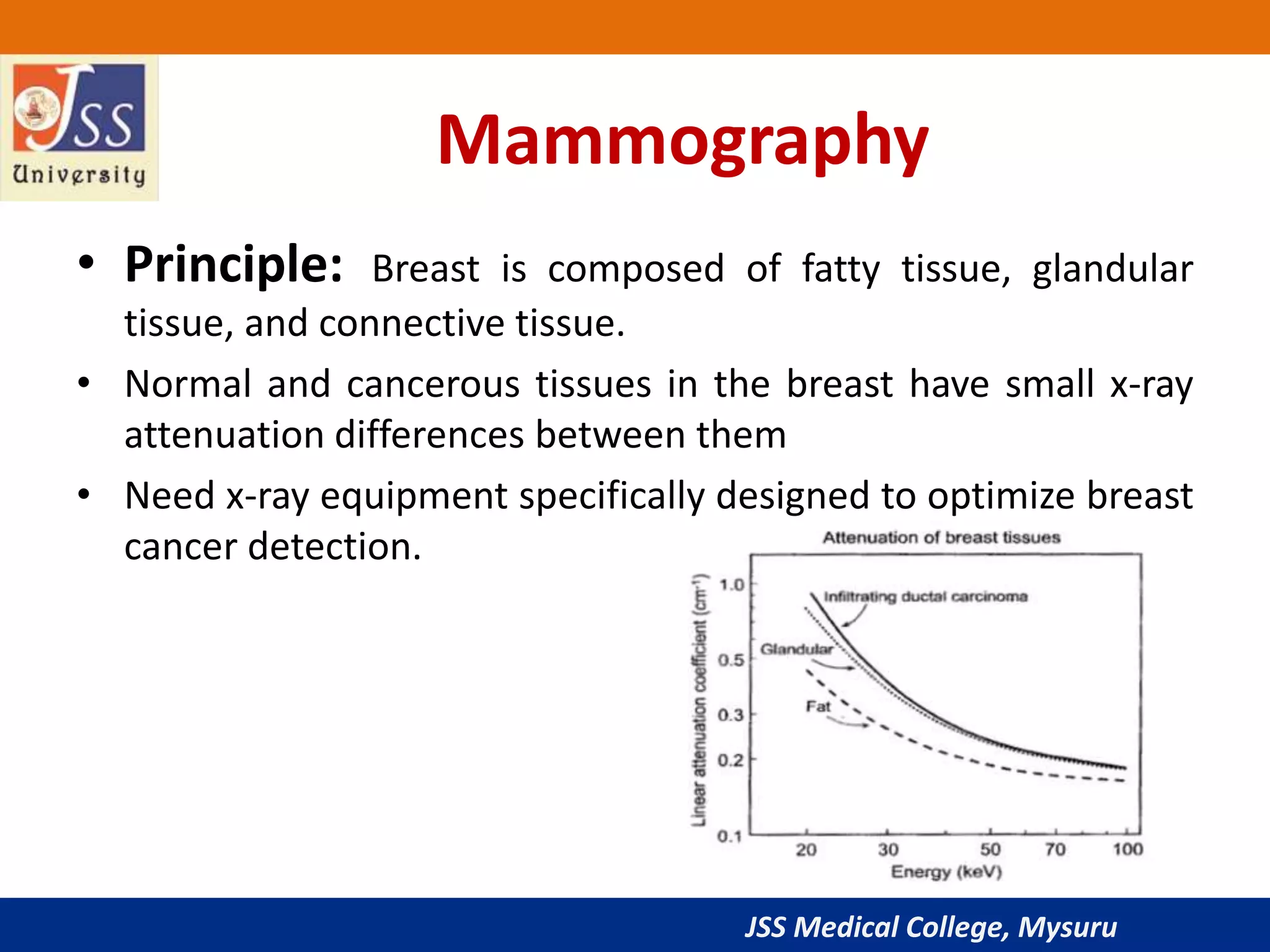
• Principle: Breast is composed of fatty tissue, glandular
tissue, and connective tissue.
• Normal and cancerous tissues in the breast have small x-ray
attenuation differences between them
• Need x-ray equipment specifically designed to optimize breast
cancer detection.
JSS Medical College, Mysuru
Modern Equipment
 Dedicated
Mammography
Equipment
 Specialized X-ray Tubes
 Optimized Screen/Film
detector systems
 Breast Compression
Devices
JSS Medical College, Mysuru
X-ray Tube Design
 Cathode and Filament Circuit
 Low operating voltage
below 35 – 40 kVp
Typically 23 or 24 kVp at the lowest
 dual filaments in a focusing cup
0.3 mm (contact) and 0.1 mm (magnification) focal spot sizes
 small focal spot
minimizes geometric blurring
maintains spatial resolution
 Typical tube currents are
100 mA (+/- 25 mA) for large (0.3 mm) focal spot
25 mA (+/- 10 mA) for small focal spot
JSS Medical College, Mysuru
X-ray Tube Design
 Anode
 rotating anode design
 Molybdenum (Mo), and dual track molybdenum/rhodium (Mo/Rh)
targets are used
 Characteristic x-ray production is the major reason for choosing
molybdenum and rhodium
For molybdenum, characteristic radiation occurs at 17.5 and 19.6
keV
For rhodium, 20.2 and 22.7 keV
JSS Medical College, Mysuru
X-ray Tube Design
 Heel effect - lower x-ray
intensity on the anode side
of the field (attenuation
through the target)
 Thus cathode-anode axis is
placed from the chest wall
(greater penetration of x-
rays) to the nipple in breast
imaging
 A more uniform exposure
is achieved
 This orientation also
minimizes equipment bulk
near the patient’s head for
easier positioning
JSS Medical College, Mysuru
MAMOGRAPHY POSITIONING
• Bring the breast back to its true anatomical
position.
• Use palpable and anatomical landmarks for
positioning and clinical image evaluation.
• It should be consistent and Reproducible with
the goal of maintaining improving quality.
JSS Medical College, Mysuru
• Normal or natural position of the breast is
when the nipple is perpendicular to chest
wall.
JSS Medical College, Mysuru
Anatomical landmarks that will be used for
positioning and clinical image analysis are
• Perimeter.
• Pectoralis muscle.
• Posterior nipple line (PNL).
JSS Medical College, Mysuru
Perimeter used for positioning
and clinical image analysis
JSS Medical College, Mysuru
Pectoralis used for positioning and clinical
image analysis
JSS Medical College, Mysuru
PNL
• Elevate the breast so that the PNL is close as possible to
perpendicular plane to the chest wall.
JSS Medical College, Mysuru
PNL
• PNL measurement of CC should be within 1cm of the PNL
measurement on the MLO. according to American College of
Radiologists, 2017.
JSS Medical College, Mysuru
The craniocaudal view
• It includes maximum
amount of breast tissue
in axial plane.
• Visualization of medial
breast tissue (Cleavage).
• Visualization of
pectoralis muscle on
approximately 30% of
all CCs.
JSS Medical College, Mysuru
The craniocaudal view
JSS Medical College, Mysuru
Standard method
• Stand on medial side of breast to be imaged.
• Elevate the breast so that the PNL is perpendicular to chest
wall.
• Adjust the height of IR to elevated IMF( Inframammary fold ).
• Pull the breasts with both hands.
• Anchor the breast
• Lift the contralateral breast .
• Guide patients head forward.
• Pull on lateral breast tissue.
JSS Medical College, Mysuru
Method
• Elevate the breast so the
PNL is perpendicular to
the chest wall and pull the
breast on with both hands.
JSS Medical College, Mysuru
CC View Method
JSS Medical College, Mysuru
CC View Method
JSS Medical College, Mysuru
Nipple Centered
• Nipple should be centered on CC view, if possible ,and without
sacrificing breast.
• Nipple may not be centered due to prominent medial or
lateral fullness of the breast.
JSS Medical College, Mysuru
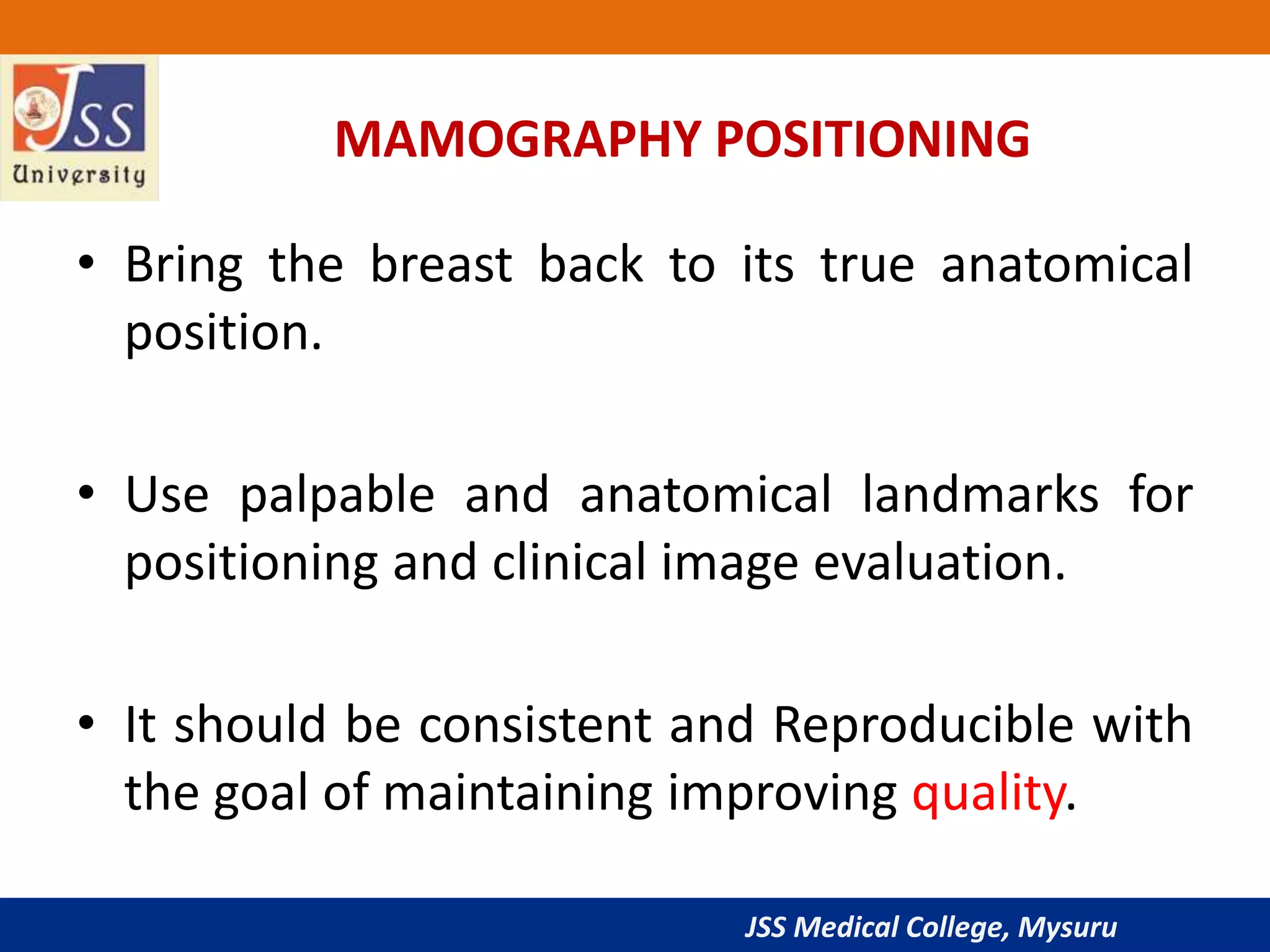
MEDIO LATERAL OBLIQUE
• Inclusion of all the breast
tissue within perimeter.
• Pectoralis muscle fully
visualized.
• Tissue well separated.
• Tissue visualized back to
retro-mammary fat space.
• IMF.
JSS Medical College, Mysuru
MLO
POSITION:
• C-arm of the unit is rotated
to 45 angle, so that the
cassette is parallel to
pectoral muscle.
• The film holder is kept high
in axillary fossa.
• Arm is abducted at elbow.
JSS Medical College, Mysuru
Recommended angulation for MLO
• Keep the angulation
consistent.
• Steeper a angle for patient
with longer thorax and
small breasts.
• Lesser angles for shorter
thorax and larger breast.
JSS Medical College, Mysuru
Some additional View
• XCCL –Exaggerated CC lateral.
• CV –Cleavage.
• LM-90 degree latero-medial view.
• ML-90 degree mediolateral view.
• TAN –Tangential.
JSS Medical College, Mysuru
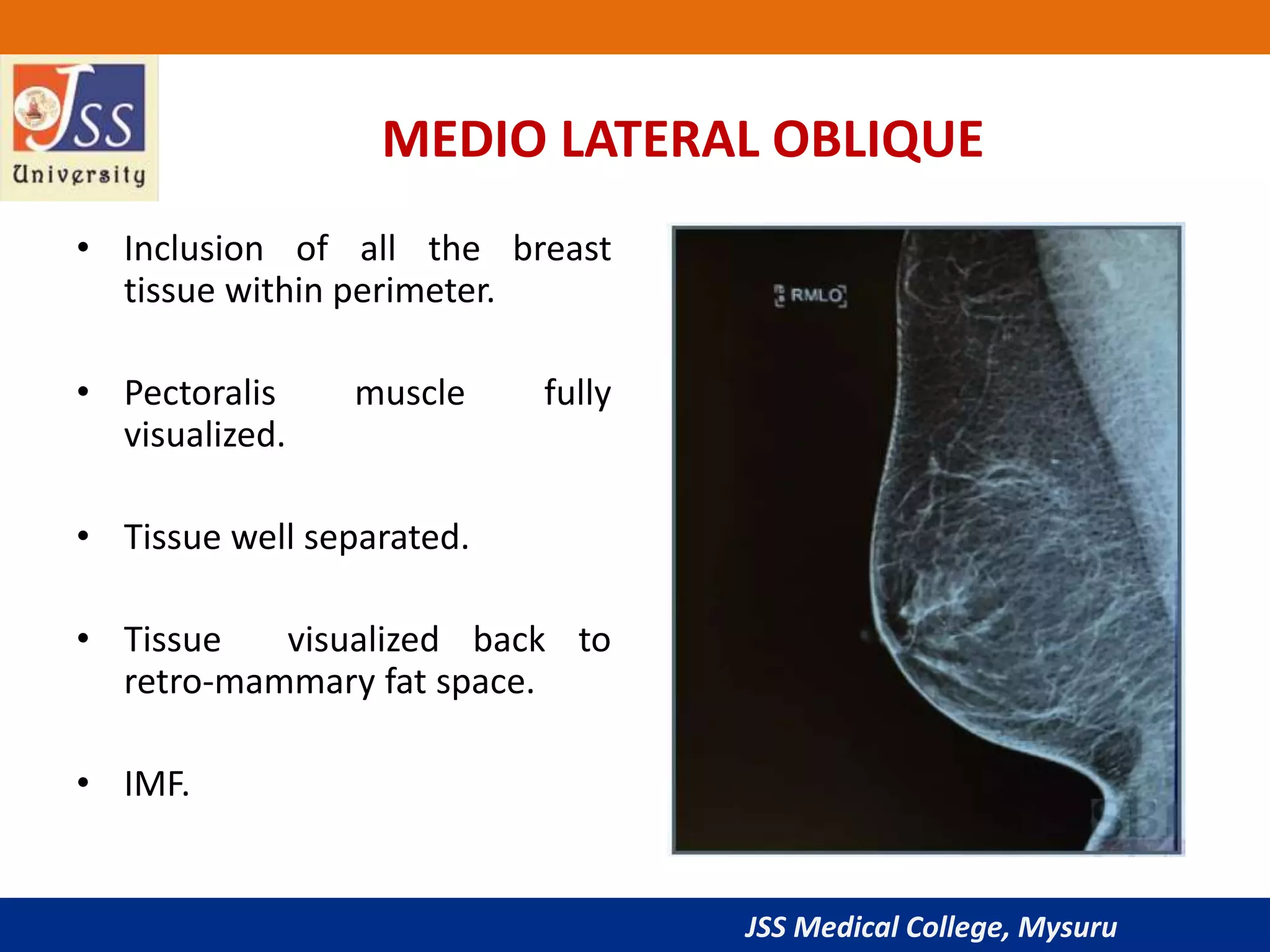
XCCL
• Done visualize the lateral
breast tissue in CC
projection.
• Done when lateral
posterior breast tissue is
excluded on the CC
image.
JSS Medical College, Mysuru
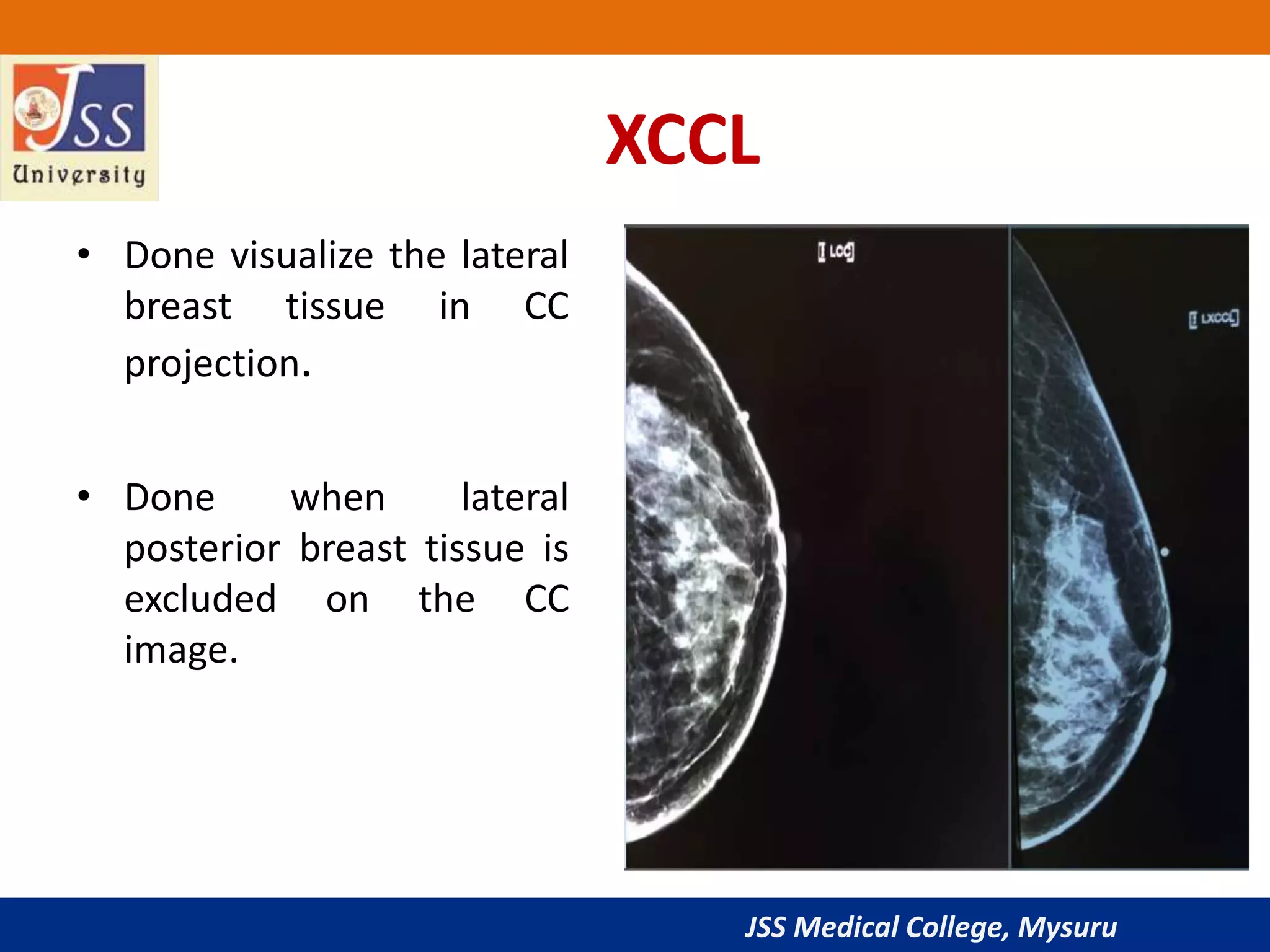
CV View
• To visualize the medial breast in CC projection.
JSS Medical College, Mysuru
LM & ML Views
• LM Shows medial breast in better detail.
• ML shows lateral breast in better detail.
JSS Medical College, Mysuru
LM & ML Views
JSS Medical College, Mysuru
Tangential View.
• To prove the existence of dermal calcifications.
• Enhanced visualization of palpable masses
that may otherwise be superimposed on
glandular breast tissue.
JSS Medical College, Mysuru
Tangential View.
• Mark on the palpable
mass or area identified
by localizing skin
calcification.
JSS Medical College, Mysuru
Tangential View.
• Draw and imaginary
line between the
breast and mark.
JSS Medical College, Mysuru
Tangential View.
• Position the breast so
that lesion in tangent to
the beam by angling the
tube ,or breast.
JSS Medical College, Mysuru
Reporting
JSS Medical College, Mysuru
Reference
• Rhonda-Joy I Sweeney, MHSc, PGDip HSc, 1Sarah J Lewis, PhD, MEd, 2,3Peter Hogg, MPhil, BSc and 1Mark
F McEntee, PhD, BSc . A review of mammographic positioning image quality criteria for the
craniocaudal projection.
• Breast Cancer Screening With Imaging: Recommendations From the Society of Breast Imaging and the ACR
on the Use of Mammography, Breast MRI, Breast Ultrasound, and Other Technologies for the Detection of
Clinically Occult Breast Cancer:AJR
JSS Medical College, Mysuru

Mammography technique

  • 1.
    JSS Medical College,Mysuru Mammography :TECHNIQUE , INDICATION AND CONTRAIDICATION Presenter Dr.Vishwanath Patil PG Resident Moderator Dr. Sudha Kiran Das Associate Professor
  • 2.
    JSS Medical College,Mysuru INTRODUCTION • A mammogram is a x ray exam of breast to detect and evaluate any changes in the breast. • X-ray was first used to examine the breast by German surgeon Albert Salmon. • Modern mammography came into existence since late 1960.
  • 3.
    JSS Medical College,Mysuru INTRODUCTION • Modern machines are safe and uses the lowest possible dose. • If women has yearly mammogram staring from age 40 and continue until 90.She will get total 20-40 rads. • Benefits pleural effusion mammography outweigh any possible harm from the radiation.
  • 4.
    JSS Medical College,Mysuru RADIATION DOSE • Mean glandular radiation dose to the breast is approximately 2 mGy (0.2 rad) per exposure. • With present mammographic equipment, there is little or no radiation related risk to the women over 40 years of age.
  • 5.
    JSS Medical College,Mysuru Types of of Mammogram • Screening mammogram. • Diagnostic mammogram.
  • 6.
    JSS Medical College,Mysuru American College of Radiology Recommendations for Imaging Screening for Breast Cancer • Women at average risk for breast cancer ∘Annual screening from age 40 • Women at increased risk for breast cancer 1. Women with certain BRCA1 or BRCA2 mutations or who are untested but have first-degree relatives (mothers, sisters, or daughters) who are proved to have BRCA mutations – ■Yearly starting by age 30 (but not before age 25)
  • 7.
    JSS Medical College,Mysuru American College of Radiology Recommendations for Imaging Screening for Breast Cancer 2. Women with ≥20% lifetime risk for breast cancer on the basis of family history (both maternal and paternal) and Women with mothers or sisters with pre-menopausal breast cancer ■Yearly starting by age 30 (but not before age 25), or 10 years earlier than the age of diagnosis of the youngest affected relative, whichever is later
  • 8.
    JSS Medical College,Mysuru American College of Radiology Recommendations for Imaging Screening for Breast Cancer 3. Women with histories of mantle radiation (usually for Hodgkin's disease) received between the ages of 10 and 30. ■Yearly starting 8 years after the radiation therapy, but not before age 25.
  • 9.
    JSS Medical College,Mysuru American College of Radiology Recommendations for Imaging Screening for Breast Cancer 4. Women with biopsy-proven lobular neoplasia (lobular carcinoma in situ and atypical lobular hyperplasia), atypical ductal hyperplasia (ADH), ductal carcinoma in situ (DCIS), invasive breast cancer or ovarian cancer ■Yearly from time of diagnosis, regardless of age.
  • 10.
    JSS Medical College,Mysuru • Age at Which Annual Screening With Mammography Should Stop. • When life expectancy is <5 to 7 years on the basis of age or comorbid conditions •When abnormal results of screening would not be acted on because of age or comorbid conditions
  • 11.
    JSS Medical College,Mysuru INDICATIONS • Breast Cancer. • Breast Lump. • Nipple Discharge. • Focal Breast Pain. • Follow up for previously evaluated Mammographic findings. • BIRADS ( Breast Imaging Reporting and Detection System).
  • 12.
    JSS Medical College,Mysuru CONTRAINDICATIONS • Size of cancer relative to Breast Size. • First or Second-trimester pregnancy. • Prior radiation therapy to chest/mediastinal. • Active Collagen Vascular disease.
  • 13.
    JSS Medical College,Mysuru Mammography • Principle: Breast is composed of fatty tissue, glandular tissue, and connective tissue. • Normal and cancerous tissues in the breast have small x-ray attenuation differences between them • Need x-ray equipment specifically designed to optimize breast cancer detection.
  • 14.
    JSS Medical College,Mysuru Modern Equipment  Dedicated Mammography Equipment  Specialized X-ray Tubes  Optimized Screen/Film detector systems  Breast Compression Devices
  • 15.
    JSS Medical College,Mysuru X-ray Tube Design  Cathode and Filament Circuit  Low operating voltage below 35 – 40 kVp Typically 23 or 24 kVp at the lowest  dual filaments in a focusing cup 0.3 mm (contact) and 0.1 mm (magnification) focal spot sizes  small focal spot minimizes geometric blurring maintains spatial resolution  Typical tube currents are 100 mA (+/- 25 mA) for large (0.3 mm) focal spot 25 mA (+/- 10 mA) for small focal spot
  • 16.
    JSS Medical College,Mysuru X-ray Tube Design  Anode  rotating anode design  Molybdenum (Mo), and dual track molybdenum/rhodium (Mo/Rh) targets are used  Characteristic x-ray production is the major reason for choosing molybdenum and rhodium For molybdenum, characteristic radiation occurs at 17.5 and 19.6 keV For rhodium, 20.2 and 22.7 keV
  • 17.
    JSS Medical College,Mysuru X-ray Tube Design  Heel effect - lower x-ray intensity on the anode side of the field (attenuation through the target)  Thus cathode-anode axis is placed from the chest wall (greater penetration of x- rays) to the nipple in breast imaging  A more uniform exposure is achieved  This orientation also minimizes equipment bulk near the patient’s head for easier positioning
  • 18.
    JSS Medical College,Mysuru MAMOGRAPHY POSITIONING • Bring the breast back to its true anatomical position. • Use palpable and anatomical landmarks for positioning and clinical image evaluation. • It should be consistent and Reproducible with the goal of maintaining improving quality.
  • 19.
    JSS Medical College,Mysuru • Normal or natural position of the breast is when the nipple is perpendicular to chest wall.
  • 20.
    JSS Medical College,Mysuru Anatomical landmarks that will be used for positioning and clinical image analysis are • Perimeter. • Pectoralis muscle. • Posterior nipple line (PNL).
  • 21.
    JSS Medical College,Mysuru Perimeter used for positioning and clinical image analysis
  • 22.
    JSS Medical College,Mysuru Pectoralis used for positioning and clinical image analysis
  • 23.
    JSS Medical College,Mysuru PNL • Elevate the breast so that the PNL is close as possible to perpendicular plane to the chest wall.
  • 24.
    JSS Medical College,Mysuru PNL • PNL measurement of CC should be within 1cm of the PNL measurement on the MLO. according to American College of Radiologists, 2017.
  • 25.
    JSS Medical College,Mysuru The craniocaudal view • It includes maximum amount of breast tissue in axial plane. • Visualization of medial breast tissue (Cleavage). • Visualization of pectoralis muscle on approximately 30% of all CCs.
  • 26.
    JSS Medical College,Mysuru The craniocaudal view
  • 27.
    JSS Medical College,Mysuru Standard method • Stand on medial side of breast to be imaged. • Elevate the breast so that the PNL is perpendicular to chest wall. • Adjust the height of IR to elevated IMF( Inframammary fold ). • Pull the breasts with both hands. • Anchor the breast • Lift the contralateral breast . • Guide patients head forward. • Pull on lateral breast tissue.
  • 28.
    JSS Medical College,Mysuru Method • Elevate the breast so the PNL is perpendicular to the chest wall and pull the breast on with both hands.
  • 29.
    JSS Medical College,Mysuru CC View Method
  • 30.
    JSS Medical College,Mysuru CC View Method
  • 31.
    JSS Medical College,Mysuru Nipple Centered • Nipple should be centered on CC view, if possible ,and without sacrificing breast. • Nipple may not be centered due to prominent medial or lateral fullness of the breast.
  • 32.
    JSS Medical College,Mysuru MEDIO LATERAL OBLIQUE • Inclusion of all the breast tissue within perimeter. • Pectoralis muscle fully visualized. • Tissue well separated. • Tissue visualized back to retro-mammary fat space. • IMF.
  • 33.
    JSS Medical College,Mysuru MLO POSITION: • C-arm of the unit is rotated to 45 angle, so that the cassette is parallel to pectoral muscle. • The film holder is kept high in axillary fossa. • Arm is abducted at elbow.
  • 34.
    JSS Medical College,Mysuru Recommended angulation for MLO • Keep the angulation consistent. • Steeper a angle for patient with longer thorax and small breasts. • Lesser angles for shorter thorax and larger breast.
  • 35.
  • 36.
    JSS Medical College,Mysuru Some additional View • XCCL –Exaggerated CC lateral. • CV –Cleavage. • LM-90 degree latero-medial view. • ML-90 degree mediolateral view. • TAN –Tangential.
  • 37.
    JSS Medical College,Mysuru XCCL • Done visualize the lateral breast tissue in CC projection. • Done when lateral posterior breast tissue is excluded on the CC image.
  • 38.
    JSS Medical College,Mysuru CV View • To visualize the medial breast in CC projection.
  • 39.
    JSS Medical College,Mysuru LM & ML Views • LM Shows medial breast in better detail. • ML shows lateral breast in better detail.
  • 40.
    JSS Medical College,Mysuru LM & ML Views
  • 41.
    JSS Medical College,Mysuru Tangential View. • To prove the existence of dermal calcifications. • Enhanced visualization of palpable masses that may otherwise be superimposed on glandular breast tissue.
  • 42.
    JSS Medical College,Mysuru Tangential View. • Mark on the palpable mass or area identified by localizing skin calcification.
  • 43.
    JSS Medical College,Mysuru Tangential View. • Draw and imaginary line between the breast and mark.
  • 44.
    JSS Medical College,Mysuru Tangential View. • Position the breast so that lesion in tangent to the beam by angling the tube ,or breast.
  • 45.
    JSS Medical College,Mysuru Reporting
  • 46.
    JSS Medical College,Mysuru Reference • Rhonda-Joy I Sweeney, MHSc, PGDip HSc, 1Sarah J Lewis, PhD, MEd, 2,3Peter Hogg, MPhil, BSc and 1Mark F McEntee, PhD, BSc . A review of mammographic positioning image quality criteria for the craniocaudal projection. • Breast Cancer Screening With Imaging: Recommendations From the Society of Breast Imaging and the ACR on the Use of Mammography, Breast MRI, Breast Ultrasound, and Other Technologies for the Detection of Clinically Occult Breast Cancer:AJR
  • 47.