Malaria- Diagnosis
Demonstration of the Parasite
• asexual forms of the parasite - peripheral-blood
  smears.
• negative blood smear- repeat smears .
• stains- Giemsa at pH 7.2 is preferred; Wright's,
  Field's, or Leishman's stain .
• Both thin and thick smears .
• The level of parasitemia is expressed as the number
  of parasitized erythrocytes per 1000 RBCs.
• advantage of concentrating the parasites (by 40- to
  100-fold and thus increasing diagnostic sensitivity.
• Both parasites and WBCs are counted, and the
  number of parasites per unit volume is calculated
  from the total leukocyte count. This figure is
  converted to the number of parasitized erythrocytes
  per microliter.
• A minimum of 200 WBCs should be counted under
  oil immersion. .
• 100–200 fields should be examined
• In high-transmission areas, the presence of up to
  10,000 parasites/L of blood may be tolerated without
  symptoms or signs in partially immune individuals.
  Thus the detection of malaria parasites is sensitive
  but only poorly specific in identifying malaria as the
  cause of illness.
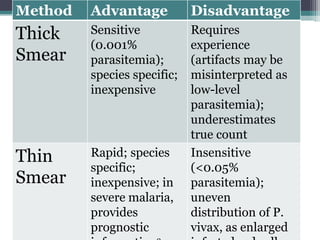
Method   Advantage           Disadvantage
Thick    Sensitive           Requires
         (0.001%             experience
Smear    parasitemia);       (artifacts may be
         species specific;   misinterpreted as
         inexpensive         low-level
                             parasitemia);
                             underestimates
                             true count
Thin     Rapid; species      Insensitive
         specific;           (<0.05%
Smear    inexpensive; in     parasitemia);
         severe malaria,     uneven
         provides            distribution of P.
         prognostic          vivax, as enlarged
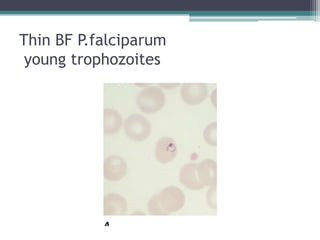
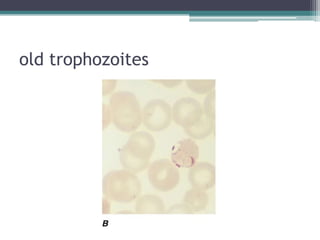
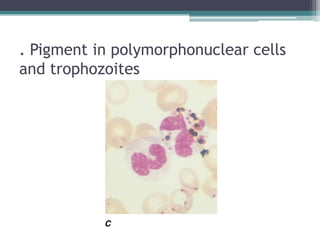
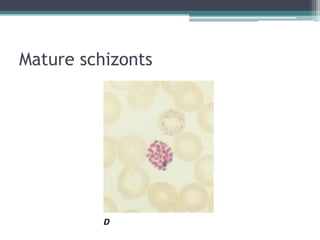
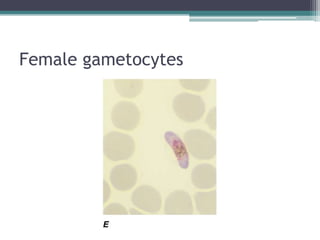
Thin BF P.falciparum
 young trophozoites
old trophozoites
. Pigment in polymorphonuclear cells
and trophozoites
Mature schizonts
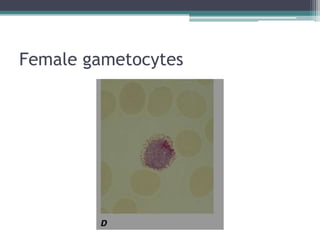
Female gametocytes
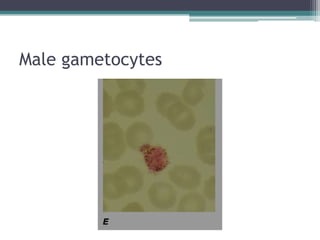
Male gametocytes
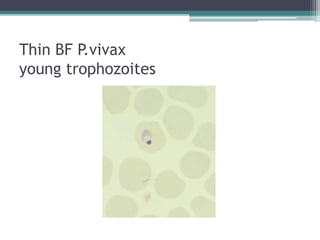
Thin BF P.vivax
young trophozoites
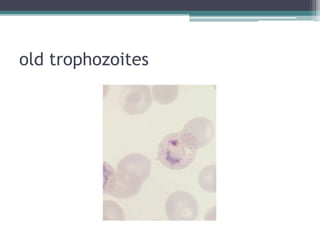
old trophozoites
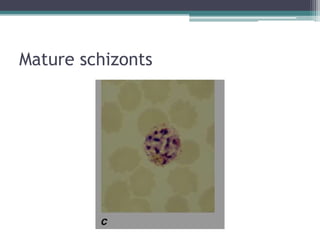
Mature schizonts
Female gametocytes
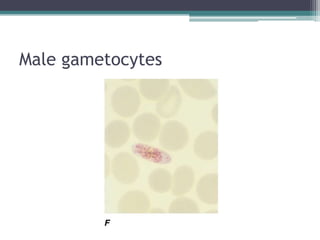
Male gametocytes
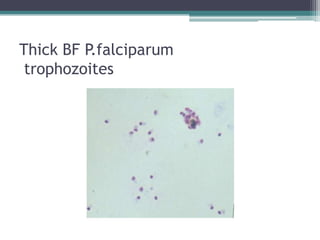
Thick BF P.falciparum
 trophozoites
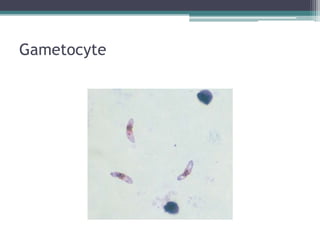
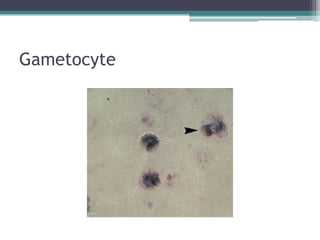
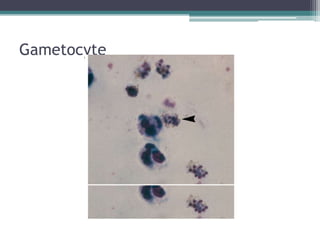
Gametocyte
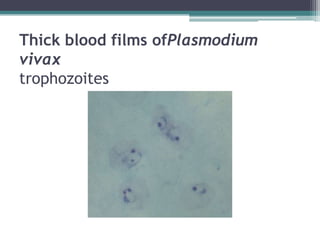
Thick blood films ofPlasmodium
vivax
trophozoites
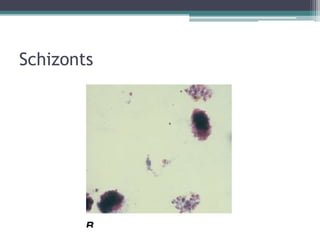
Schizonts
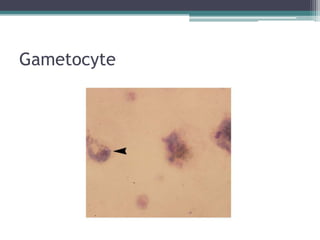
Gametocyte
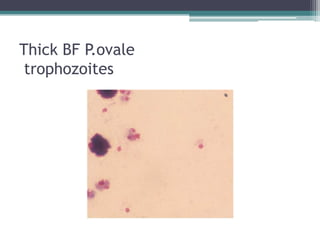
Thick BF P.ovale
 trophozoites
Schizonts
Gametocyte
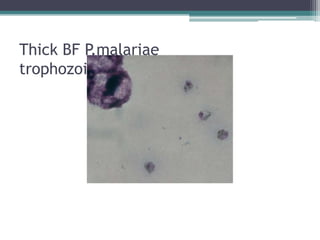
Thick BF P.malariae
trophozoites
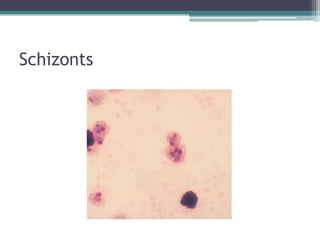
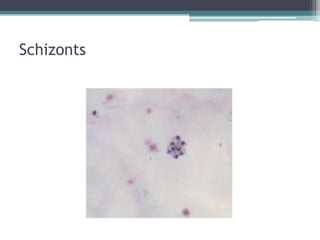
Schizonts
Gametocyte
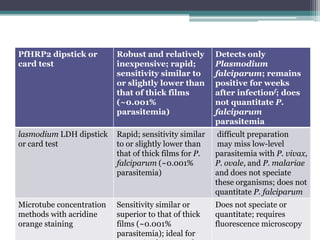
Immunochromatographic Test
PfHRP2 dipstick or
card test
                          Robust and relatively
                          inexpensive; rapid;
                                                       Detects only
                                                       Plasmodium
                          sensitivity similar to       falciparum; remains
                          or slightly lower than       positive for weeks
                          that of thick films          after infectionf; does
                          (~0.001%                     not quantitate P.
                          parasitemia)                 falciparum
                                                       parasitemia
lasmodium LDH dipstick    Rapid; sensitivity similar    difficult preparation
or card test              to or slightly lower than     may miss low-level
                          that of thick films for P.   parasitemia with P. vivax,
                          falciparum (~0.001%          P. ovale, and P. malariae
                          parasitemia)                 and does not speciate
                                                       these organisms; does not
                                                       quantitate P. falciparum
Microtube concentration   Sensitivity similar or       Does not speciate or
methods with acridine     superior to that of thick    quantitate; requires
orange staining           films (~0.001%               fluorescence microscopy
                          parasitemia); ideal for
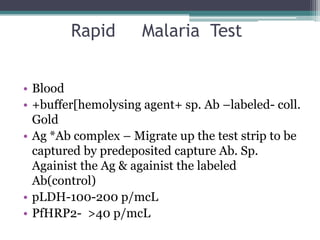
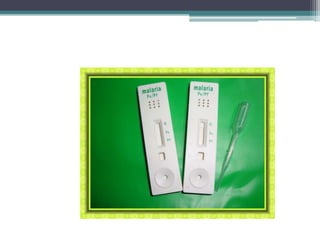
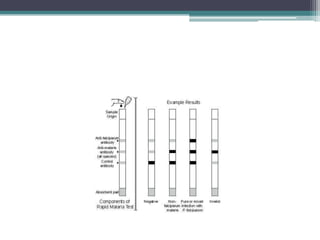
Rapid        Malaria Test


• Blood
• +buffer[hemolysing agent+ sp. Ab –labeled- coll.
  Gold
• Ag *Ab complex – Migrate up the test strip to be
  captured by predeposited capture Ab. Sp.
  Againist the Ag & againist the labeled
  Ab(control)
• pLDH-100-200 p/mcL
• PfHRP2- >40 p/mcL
• Malaria cannot be diagnosed clinically with
  accuracy, but treatment should be started on clinical
  grounds if the laboratory confirmation is likely to be
  delayed. In areas of the world where malaria is
  endemic and transmission is high, low-level
  asymptomatic parasitemia is common in otherwise-
  healthy people. Thus malaria may not be the cause
  of a fever, although in this context the presence of
  >10,000 parasites/L (–0.2% parasitemia) does
  indicate that malaria is the cause. Antibody and
  polymerase chain reaction tests have no role in the
  diagnosis of malaria.
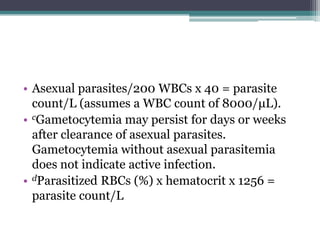
• Asexual parasites/200 WBCs x 40 = parasite
  count/L (assumes a WBC count of 8000/μL).
• cGametocytemia may persist for days or weeks
  after clearance of asexual parasites.
  Gametocytemia without asexual parasitemia
  does not indicate active infection.
• dParasitized RBCs (%) x hematocrit x 1256 =
  parasite count/L
; in general, patients with >105 parasites/L are at
   increased risk of dying,
 a poor prognosis - predominance of more mature P.
   falciparum parasites (i.e., >20% of parasites with
   visible pigment) in the peripheral blood film or by
   the presence of phagocytosed malarial pigment in
   >5% of neutrophils.
 In P. falciparum infections, gametocytemia peaks 1
   week after the peak of asexual parasites. Because the
   mature gametocytes of P. falciparum are not
   affected by most antimalarial drugs, their
   persistence does not constitute evidence of drug
   resistance.
• Phagocytosed malarial pigment seen inside
  monocytes or polymorphonuclear leukocytes -clue
  to recent infection . After the clearance of the
  parasites, this intraphagocytic malarial pigment is
  often evident for several days in the peripheral blood
  or for longer in bone marrow aspirates or smears of
  fluid expressed after intradermal puncture. Staining
  of parasites with the fluorescent dye acridine orange
  allows more rapid diagnosis of malaria (but not
  speciation of the infection) in patients with low-level
  parasitemia.
• Normochromic, normocytic anemia
• . The leukocyte count is generally normal, or rised
• slight monocytosis, lymphopenia, and eosinopenia, with
  reactive lymphocytosis and eosinophilia in the weeks
  after the acute infection.
• The erythrocyte sedimentation rate, plasma viscosity,
  and levels of C-reactive protein and other acute-phase
  proteins are high.
• The platelet count is usually reduced to ~105/L
• . Severe infections may be accompanied by prolonged
  prothrombin and partial thromboplastin times and by
  more severe thrombocytopenia. Levels of antithrombin
  III are reduced even in mild infection.
electrolytes, blood urea nitrogen (BUN), and creatinine
  are usually normal.
severe malaria may - metabolic acidosis, hypoglycemia,
  low sodium, bicarbonate, calcium, phosphate, and
  albumin together with elevations in lactate, BUN,
  creatinine, urate, muscle and liver enzymes, and
  conjugated and unconjugated bilirubin.
Hypergammaglobulinemia is usual in immune and semi-
  immune subjects. Urinalysis generally gives normal
  results. In adults and children with cerebral malaria, the
  mean opening pressure at lumbar puncture is ~160 mm
  of cerebrospinal fluid (CSF); usually the CSF is normal
  or has a slightly elevated total protein level [<1.0 g/L ]
  and cell count (<20/L)
MALARIA DIAGNOSIS

MALARIA DIAGNOSIS

  • 1.
  • 2.
    Demonstration of theParasite • asexual forms of the parasite - peripheral-blood smears. • negative blood smear- repeat smears . • stains- Giemsa at pH 7.2 is preferred; Wright's, Field's, or Leishman's stain . • Both thin and thick smears . • The level of parasitemia is expressed as the number of parasitized erythrocytes per 1000 RBCs. • advantage of concentrating the parasites (by 40- to 100-fold and thus increasing diagnostic sensitivity.
  • 3.
    • Both parasitesand WBCs are counted, and the number of parasites per unit volume is calculated from the total leukocyte count. This figure is converted to the number of parasitized erythrocytes per microliter. • A minimum of 200 WBCs should be counted under oil immersion. . • 100–200 fields should be examined • In high-transmission areas, the presence of up to 10,000 parasites/L of blood may be tolerated without symptoms or signs in partially immune individuals. Thus the detection of malaria parasites is sensitive but only poorly specific in identifying malaria as the cause of illness.
  • 4.
    Method Advantage Disadvantage Thick Sensitive Requires (0.001% experience Smear parasitemia); (artifacts may be species specific; misinterpreted as inexpensive low-level parasitemia); underestimates true count Thin Rapid; species Insensitive specific; (<0.05% Smear inexpensive; in parasitemia); severe malaria, uneven provides distribution of P. prognostic vivax, as enlarged
  • 5.
    Thin BF P.falciparum young trophozoites
  • 6.
  • 7.
    . Pigment inpolymorphonuclear cells and trophozoites
  • 8.
  • 9.
  • 10.
  • 11.
  • 12.
  • 13.
  • 14.
  • 15.
  • 16.
  • 17.
  • 18.
    Thick blood filmsofPlasmodium vivax trophozoites
  • 19.
  • 20.
  • 21.
    Thick BF P.ovale trophozoites
  • 22.
  • 23.
  • 24.
  • 25.
  • 26.
  • 27.
    Immunochromatographic Test PfHRP2 dipstickor card test Robust and relatively inexpensive; rapid; Detects only Plasmodium sensitivity similar to falciparum; remains or slightly lower than positive for weeks that of thick films after infectionf; does (~0.001% not quantitate P. parasitemia) falciparum parasitemia lasmodium LDH dipstick Rapid; sensitivity similar difficult preparation or card test to or slightly lower than may miss low-level that of thick films for P. parasitemia with P. vivax, falciparum (~0.001% P. ovale, and P. malariae parasitemia) and does not speciate these organisms; does not quantitate P. falciparum Microtube concentration Sensitivity similar or Does not speciate or methods with acridine superior to that of thick quantitate; requires orange staining films (~0.001% fluorescence microscopy parasitemia); ideal for
  • 28.
    Rapid Malaria Test • Blood • +buffer[hemolysing agent+ sp. Ab –labeled- coll. Gold • Ag *Ab complex – Migrate up the test strip to be captured by predeposited capture Ab. Sp. Againist the Ag & againist the labeled Ab(control) • pLDH-100-200 p/mcL • PfHRP2- >40 p/mcL
  • 31.
    • Malaria cannotbe diagnosed clinically with accuracy, but treatment should be started on clinical grounds if the laboratory confirmation is likely to be delayed. In areas of the world where malaria is endemic and transmission is high, low-level asymptomatic parasitemia is common in otherwise- healthy people. Thus malaria may not be the cause of a fever, although in this context the presence of >10,000 parasites/L (–0.2% parasitemia) does indicate that malaria is the cause. Antibody and polymerase chain reaction tests have no role in the diagnosis of malaria.
  • 32.
    • Asexual parasites/200WBCs x 40 = parasite count/L (assumes a WBC count of 8000/μL). • cGametocytemia may persist for days or weeks after clearance of asexual parasites. Gametocytemia without asexual parasitemia does not indicate active infection. • dParasitized RBCs (%) x hematocrit x 1256 = parasite count/L
  • 33.
    ; in general,patients with >105 parasites/L are at increased risk of dying, a poor prognosis - predominance of more mature P. falciparum parasites (i.e., >20% of parasites with visible pigment) in the peripheral blood film or by the presence of phagocytosed malarial pigment in >5% of neutrophils. In P. falciparum infections, gametocytemia peaks 1 week after the peak of asexual parasites. Because the mature gametocytes of P. falciparum are not affected by most antimalarial drugs, their persistence does not constitute evidence of drug resistance.
  • 34.
    • Phagocytosed malarialpigment seen inside monocytes or polymorphonuclear leukocytes -clue to recent infection . After the clearance of the parasites, this intraphagocytic malarial pigment is often evident for several days in the peripheral blood or for longer in bone marrow aspirates or smears of fluid expressed after intradermal puncture. Staining of parasites with the fluorescent dye acridine orange allows more rapid diagnosis of malaria (but not speciation of the infection) in patients with low-level parasitemia.
  • 35.
    • Normochromic, normocyticanemia • . The leukocyte count is generally normal, or rised • slight monocytosis, lymphopenia, and eosinopenia, with reactive lymphocytosis and eosinophilia in the weeks after the acute infection. • The erythrocyte sedimentation rate, plasma viscosity, and levels of C-reactive protein and other acute-phase proteins are high. • The platelet count is usually reduced to ~105/L • . Severe infections may be accompanied by prolonged prothrombin and partial thromboplastin times and by more severe thrombocytopenia. Levels of antithrombin III are reduced even in mild infection.
  • 36.
    electrolytes, blood ureanitrogen (BUN), and creatinine are usually normal. severe malaria may - metabolic acidosis, hypoglycemia, low sodium, bicarbonate, calcium, phosphate, and albumin together with elevations in lactate, BUN, creatinine, urate, muscle and liver enzymes, and conjugated and unconjugated bilirubin. Hypergammaglobulinemia is usual in immune and semi- immune subjects. Urinalysis generally gives normal results. In adults and children with cerebral malaria, the mean opening pressure at lumbar puncture is ~160 mm of cerebrospinal fluid (CSF); usually the CSF is normal or has a slightly elevated total protein level [<1.0 g/L ] and cell count (<20/L)