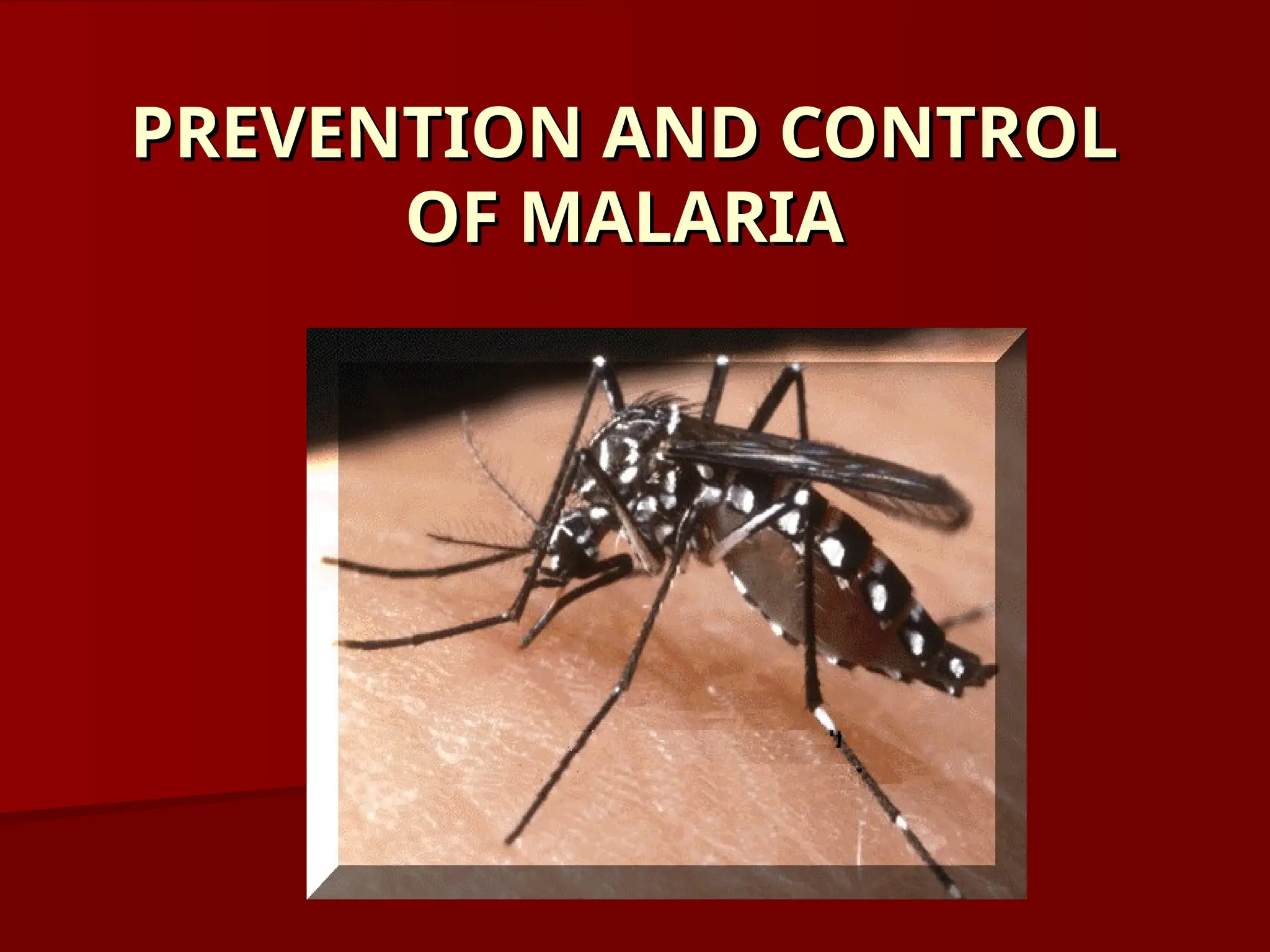
PREVENTION AND CONTROL
OF MALARIA
OF MALARIA
History
History
Military
Military
Medicine
Medicine
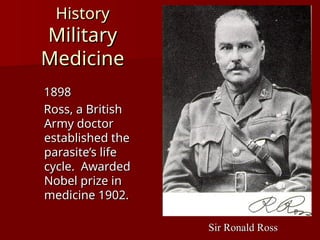
1898
1898
Ross, a British
Ross, a British
Army doctor
Army doctor
established the
established the
parasite’s life
parasite’s life
cycle. Awarded
cycle. Awarded
Nobel prize in
Nobel prize in
medicine 1902.
medicine 1902.
Sir Ronald Ross
Sir Ronald Ross
SHOULD WE FIGHT MALARIA ?
 1.8 billion people - 40% of world population live
1.8 billion people - 40% of world population live
in malarious areas.
in malarious areas.
 Transmission occurs in
Transmission occurs in 100 countries
100 countries
throughout Africa, Asia, Oceania, and Latin
America, on certain Caribbean islands, and in
Turkey.
Turkey.
 Malaria results in HUMAN RESOURCE WASTAGE
Malaria results in HUMAN RESOURCE WASTAGE
and is a SET BACK FOR ECONOMIC GROWTH.
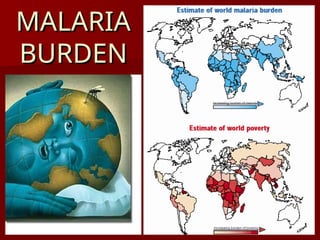
MALARIA
MALARIA
BURDEN
BURDEN
STRATAGIES FOR THE
STRATAGIES FOR THE
CONTROL AND ERADICATION
OF MALARIA
OF MALARIA
MANAGEMENT OF MALARIA
CASES.
CASES.
ACTIVE INTERVENTION
ACTIVE INTERVENTION
MEASURES.
MEASURES.
MANAGEMENT OF MALARIA
CASES
CASES
CASE DETECTION
CASE DETECTION
DISEASE CONTROL STRATEGIES USING
CHEMOTHERAPY
CHEMOTHERAPY
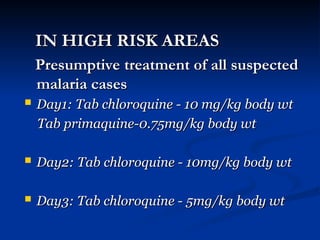
IN HIGH RISK AREAS
IN HIGH RISK AREAS
Presumptive treatment of all suspected
malaria cases
malaria cases
 Day1: Tab chloroquine - 10 mg/kg body wt
Day1: Tab chloroquine - 10 mg/kg body wt
Tab primaquine-0.75mg/kg body wt
 Day2: Tab chloroquine - 10mg/kg body wt
Day2: Tab chloroquine - 10mg/kg body wt
 Day3: Tab chloroquine - 5mg/kg body wt
Day3: Tab chloroquine - 5mg/kg body wt
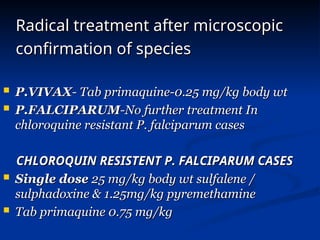
Radical treatment after microscopic
confirmation of species
 P.VIVAX
P.VIVAX- Tab primaquine-0.25 mg/kg body wt
- Tab primaquine-0.25 mg/kg body wt
 P.FALCIPARUM
P.FALCIPARUM-No further treatment In
-No further treatment In
chloroquine resistant P. falciparum cases
CHLOROQUIN RESISTENT P. FALCIPARUM CASES
 Single dose
Single dose 25 mg/kg body wt sulfalene /
25 mg/kg body wt sulfalene /
sulphadoxine & 1.25mg/kg pyremethamine
 Tab primaquine 0.75 mg/kg
Tab primaquine 0.75 mg/kg
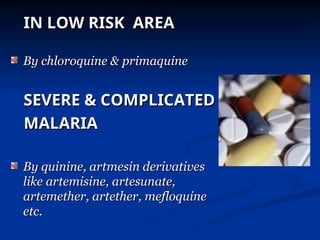
IN LOW RISK AREA
IN LOW RISK AREA
By chloroquine & primaquine
SEVERE & COMPLICATED
MALARIA
MALARIA
By quinine, artmesin derivatives
like artemisine, artesunate,
artemether, artether, mefloquine
etc.
etc.
MASS DRUG ADMINISTRATION
 In highly endemic areas (API >5/1000
In highly endemic areas (API >5/1000
population) along with anti mosquito measures.
CONTRAINDICATIONS
CONTRAINDICATIONS:
:
 In children below 5 yrs.
In children below 5 yrs.
CHEMOPROPHYLAXIS
CHEMOPROPHYLAXIS
Drugs
Drugs used are
used are
 Chloroquine
Chloroquine
 Proguanil
Proguanil
 Sulphadoxine + pyrimethamine
Sulphadoxine + pyrimethamine
 Sulphalene + pyrimethamine
Sulphalene + pyrimethamine
 Mefloquine
Mefloquine
 Quinine
Quinine
 Doxycycline
Doxycycline
 Halofantrine
Halofantrine
SPECIAL RECOMMENDATIONS
SPECIAL RECOMMENDATIONS :-
:-
 It is recommended for
It is recommended for travelers
travelers from non-endemic
from non-endemic
areas ,
areas , soldiers, police, labour forces
soldiers, police, labour forces in highly
in highly
endemic areas.
endemic areas.
 In
In pregnant women
pregnant women in areas where transmission
in areas where transmission
is very intense causing anaemia & low birth weight.
 It should begin a week before arrival in the malaria's
It should begin a week before arrival in the malaria's
area & continued for 4 to 6 weeks after leaving the
area.
area.
ACTIVE INTERVENTION MEASURES
1.STRATIFICATION OF THE PROBLEM
2.VECTOR CONTROL STRATEGIES
STRATIFICATION OF THE PROBLEM
STRATIFICATION OF THE PROBLEM:
:
Under modified plan of operation in Indian
endemic areas have been stratified according to
API as:
API as:
 Areas with API <2
Areas with API <2
 Areas with API >2
Areas with API >2
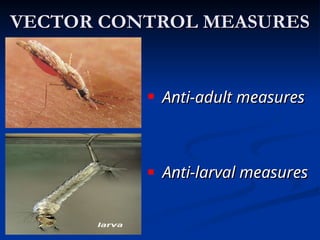
VECTOR CONTROL MEASURES
Anti-adult measures
Anti-adult measures
Anti-larval measures
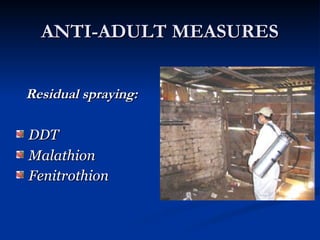
ANTI-ADULT MEASURES
ANTI-ADULT MEASURES
Residual spraying:
Residual spraying:
DDT
DDT
Malathion
Malathion
Fenitrothion
Fenitrothion
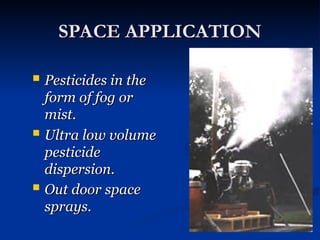
SPACE APPLICATION
SPACE APPLICATION
 Pesticides in the
Pesticides in the
form of fog or
form of fog or
mist.
mist.
 Ultra low volume
Ultra low volume
pesticide
pesticide
dispersion.
dispersion.
 Out door space
Out door space
sprays.
sprays.
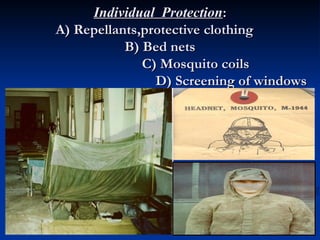
Individual Protection
Individual Protection:
:
A) Repellants,protective clothing
B) Bed nets
B) Bed nets
C) Mosquito coils
C) Mosquito coils
D) Screening of windows
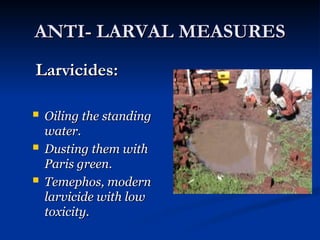
ANTI- LARVAL MEASURES
Larvicides:
Larvicides:
 Oiling the standing
Oiling the standing
water.
water.
 Dusting them with
Dusting them with
Paris green.
Paris green.
 Temephos, modern
Temephos, modern
larvicide with low
larvicide with low
toxicity.
toxicity.
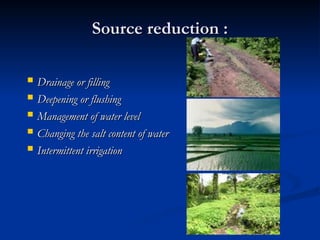
Source reduction :
Source reduction :
 Drainage or filling
Drainage or filling
 Deepening or flushing
Deepening or flushing
 Management of water level
Management of water level
 Changing the salt content of water
Changing the salt content of water
 Intermittent irrigation
Intermittent irrigation
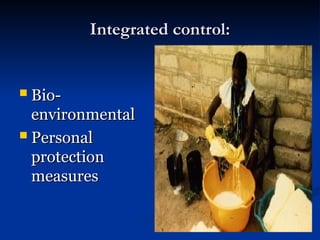
Integrated control:
Integrated control:
 Bio-
Bio-
environmental
environmental
 Personal
Personal
protection
protection
measures
measures
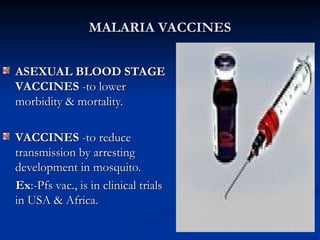
MALARIA VACCINES
MALARIA VACCINES
ASEXUAL BLOOD STAGE
ASEXUAL BLOOD STAGE
VACCINES
VACCINES -to lower
-to lower
morbidity & mortality.
VACCINES
VACCINES -to reduce
-to reduce
transmission by arresting
development in mosquito.
Ex
Ex:-Pfs vac., is in clinical trials
:-Pfs vac., is in clinical trials
in USA & Africa.
in USA & Africa.
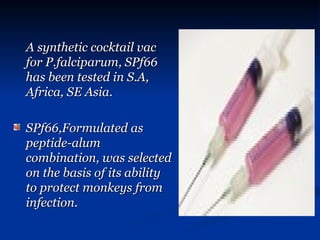
A synthetic cocktail vac
for P.falciparum, SPf66
has been tested in S.A,
Africa, SE Asia.
Africa, SE Asia.
SPf66,Formulated as
SPf66,Formulated as
peptide-alum
peptide-alum
combination, was selected
on the basis of its ability
to protect monkeys from
infection.
infection.
NATIONAL ANTI-MALARIA PROGRAMME
NMCP was launched in April 1953.Incidence declined
from 75 to 2 million cases from 1953 to 58.
NMEP was launched in 1958.It is divided into
preparatory, attack, consolidation & maintence
phases.
phases.
MPO, is the revised strategy was put in to operation
from April 1977 to review the situation as resurgence
of malaria has grown to epidemic proportions.
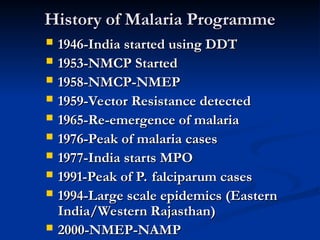
History of Malaria Programme
 1946-India started using DDT
1946-India started using DDT
 1953-NMCP Started
1953-NMCP Started
 1958-NMCP-NMEP
1958-NMCP-NMEP
 1959-Vector Resistance detected
1959-Vector Resistance detected
 1965-Re-emergence of malaria
1965-Re-emergence of malaria
 1976-Peak of malaria cases
1976-Peak of malaria cases
 1977-India starts MPO
1977-India starts MPO
 1991-Peak of P. falciparum cases
1991-Peak of P. falciparum cases
 1994-Large scale epidemics (Eastern
1994-Large scale epidemics (Eastern
India/Western Rajasthan)
 2000-NMEP-NAMP
2000-NMEP-NAMP
MODIFIED PLAN OF OPERATION
OBJECTIVES
OBJECTIVES
To prevent deaths due to malaria.
To reduce malaria morbidity.
To maintain agricultural & industrial
production.
production.
To consolidate the gains so far achieved.
2)RECLASSIFICATION OF AREAS
Areas with
Areas with API>=2
API>=2 are taken up for spray operations
are taken up for spray operations
3)AREAS WITH API>2
3)AREAS WITH API>2
Spraying
Spraying: - DDT, Malathion, Pyrethroids
: - DDT, Malathion, Pyrethroids
Entomological assessment
Entomological assessment :- By susceptibility
:- By susceptibility
tests
tests
Surveillance
Surveillance:- Active & passive
:- Active & passive
Treatment of cases
Treatment of cases
4)AREAS WITH API < 2
Focal spraying
Focal spraying
Surveillance
Surveillance :- carried out every fortnight.
:- carried out every fortnight.
Treatment
Treatment :- Detected cases should receive
:- Detected cases should receive
radical treatment
radical treatment
Follow up
Follow up :- Blood Smears are followed up in
:- Blood Smears are followed up in
+ve cases on completion of radical treat. &
thereafter at monthly intervals for 12 months.
Epidemiological investigation
Epidemiological investigation :-Mass surveys
:-Mass surveys
5)DRUG DISTRIBUTION CENTRES & FEVER
TREATMENT DEPOTS
TREATMENT DEPOTS
Drug Policy
Drug Policy for malaria treatment under national anti-
for malaria treatment under national anti-
malaria program is as follows :
Any fever in endemic areas during transmission season
without any other obvious cause may be considered as
malaria & investigated/treated accordingly.
Drug resistance foci are prevalent in the country but
chloroquine is still the safe, effective & cheap anti-
malarial drug & is simple to be administered.
The best approach in malaria treatment is diagnosis &
treatment on the same day.
6)URBAN MALARIA SCHEME
Methodology is by
Methodology is by
Anti larval measures
Drug treatment
Drug treatment.
.
It includes urban areas with > 50,000 population &
slide +vity rate of 5% & above.
7)
7) P.FALCIPARUM CONTAINMENT
P.FALCIPARUM CONTAINMENT
8)
8) RESEARCH
RESEARCH
9)
9) HEALTH EDUCATION
HEALTH EDUCATION
10)
10) REORGANIZATION
REORGANIZATION
Administrative boundaries are set up with
division of areas into zones.
DMO, AMO, Lab technicians, Multi purpose
workers are posted & Lab services are
decentralized.
decentralized.
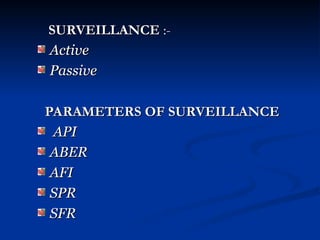
SURVEILLANCE
SURVEILLANCE :-
:-
Active
Active
Passive
Passive
PARAMETERS OF SURVEILLANCE
API
API
ABER
ABER
AFI
AFI
SPR
SPR
SFR
SFR
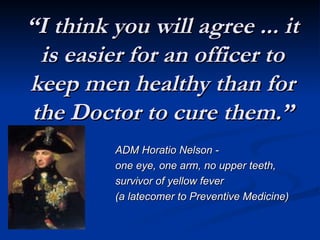
“
“I think you will agree ... it
I think you will agree ... it
is easier for an officer to
keep men healthy than for
the Doctor to cure them.”
ADM Horatio Nelson -
one eye, one arm, no upper teeth,
survivor of yellow fever
(a latecomer to Preventive Medicine)
MALARIA CONTROL THROUGH PHC
In 1999 NMEP was renamed as National anti malaria
programme.
programme.
ENHANCED MALARIA CONTROL
ENHANCED MALARIA CONTROL PROJECT
PROJECT
was launched on 30th September 1997, spread over 5
years.
years.
Components strengthened under it are :-
 Early case detection & treatment
Early case detection & treatment
 Selective vector control &personal protection
Selective vector control &personal protection
measures like insecticide treated mosquito net
 Epidemic planning & rapid response
Epidemic planning & rapid response
 Intersectoral coordination
Intersectoral coordination
 Institutional & management capabilities strengthened
Institutional & management capabilities strengthened
 Use of larvivorus fish
Use of larvivorus fish
Govt.of India provides funds for it
It received 2 years extension up to March 2005
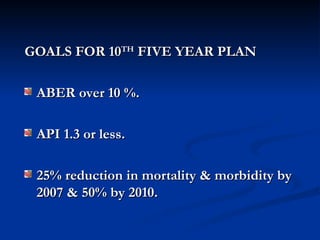
GOALS FOR 10
GOALS FOR 10TH
TH
FIVE YEAR PLAN
FIVE YEAR PLAN
ABER over 10 %.
ABER over 10 %.
API 1.3 or less.
API 1.3 or less.
25% reduction in mortality & morbidity by
2007 & 50% by 2010.
2007 & 50% by 2010.
The Worlds Priorities? Annual
Expenditure
Expenditure
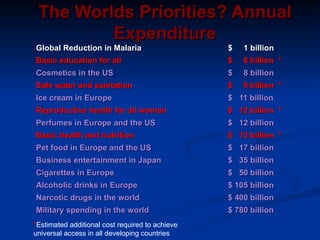
Global Reduction in Malaria
Global Reduction in Malaria $ 1 billion
$ 1 billion
Basic education for all
Basic education for all $ 6 billion *
$ 6 billion *
Cosmetics in the US
Cosmetics in the US $ 8 billion
$ 8 billion
Safe water and sanitation
Safe water and sanitation $ 9 billion *
$ 9 billion *
Ice cream in Europe
Ice cream in Europe $ 11 billion
$ 11 billion
Reproductive health for all women
Reproductive health for all women $ 12 billion *
$ 12 billion *
Perfumes in Europe and the US
Perfumes in Europe and the US $ 12 billion
$ 12 billion
Basic health and nutrition
Basic health and nutrition $ 13 billion *
$ 13 billion *
Pet food in Europe and the US
Pet food in Europe and the US $ 17 billion
$ 17 billion
Business entertainment in Japan
Business entertainment in Japan $ 35 billion
$ 35 billion
Cigarettes in Europe
Cigarettes in Europe $ 50 billion
$ 50 billion
Alcoholic drinks in Europe
Alcoholic drinks in Europe $ 105 billion
$ 105 billion
Narcotic drugs in the world
Narcotic drugs in the world $ 400 billion
$ 400 billion
Military spending in the world
Military spending in the world $ 780 billion
$ 780 billion
*Estimated additional cost required to achieve
universal access in all developing countries
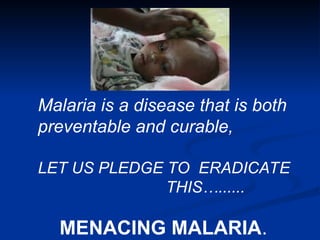
Malaria is a disease that is both
preventable and curable,
LET US PLEDGE TO ERADICATE
THIS…......
MENACING MALARIA.
A PRESENTATION BY :
A PRESENTATION BY :
TEJASWINI RAO,
TEJASWINI RAO,

C07 P06 MALARIA PREVENTION and management

  • 1.
    PREVENTION AND CONTROL PREVENTIONAND CONTROL OF MALARIA OF MALARIA
  • 2.
    History History Military Military Medicine Medicine 1898 1898 Ross, a British Ross,a British Army doctor Army doctor established the established the parasite’s life parasite’s life cycle. Awarded cycle. Awarded Nobel prize in Nobel prize in medicine 1902. medicine 1902. Sir Ronald Ross Sir Ronald Ross
  • 3.
    SHOULD WE FIGHTMALARIA ? SHOULD WE FIGHT MALARIA ?  1.8 billion people - 40% of world population live 1.8 billion people - 40% of world population live in malarious areas. in malarious areas.  Transmission occurs in Transmission occurs in 100 countries 100 countries throughout Africa, Asia, Oceania, and Latin throughout Africa, Asia, Oceania, and Latin America, on certain Caribbean islands, and in America, on certain Caribbean islands, and in Turkey. Turkey.  Malaria results in HUMAN RESOURCE WASTAGE Malaria results in HUMAN RESOURCE WASTAGE and is a SET BACK FOR ECONOMIC GROWTH. and is a SET BACK FOR ECONOMIC GROWTH.
  • 4.
  • 5.
    STRATAGIES FOR THE STRATAGIESFOR THE CONTROL AND ERADICATION CONTROL AND ERADICATION OF MALARIA OF MALARIA
  • 6.
    MANAGEMENT OF MALARIA MANAGEMENTOF MALARIA CASES. CASES. ACTIVE INTERVENTION ACTIVE INTERVENTION MEASURES. MEASURES.
  • 7.
    MANAGEMENT OF MALARIA MANAGEMENTOF MALARIA CASES CASES CASE DETECTION CASE DETECTION DISEASE CONTROL STRATEGIES USING DISEASE CONTROL STRATEGIES USING CHEMOTHERAPY CHEMOTHERAPY
  • 8.
    IN HIGH RISKAREAS IN HIGH RISK AREAS Presumptive treatment of all suspected Presumptive treatment of all suspected malaria cases malaria cases  Day1: Tab chloroquine - 10 mg/kg body wt Day1: Tab chloroquine - 10 mg/kg body wt Tab primaquine-0.75mg/kg body wt Tab primaquine-0.75mg/kg body wt  Day2: Tab chloroquine - 10mg/kg body wt Day2: Tab chloroquine - 10mg/kg body wt  Day3: Tab chloroquine - 5mg/kg body wt Day3: Tab chloroquine - 5mg/kg body wt
  • 9.
    Radical treatment aftermicroscopic Radical treatment after microscopic confirmation of species confirmation of species  P.VIVAX P.VIVAX- Tab primaquine-0.25 mg/kg body wt - Tab primaquine-0.25 mg/kg body wt  P.FALCIPARUM P.FALCIPARUM-No further treatment In -No further treatment In chloroquine resistant P. falciparum cases chloroquine resistant P. falciparum cases CHLOROQUIN RESISTENT P. FALCIPARUM CASES CHLOROQUIN RESISTENT P. FALCIPARUM CASES  Single dose Single dose 25 mg/kg body wt sulfalene / 25 mg/kg body wt sulfalene / sulphadoxine & 1.25mg/kg pyremethamine sulphadoxine & 1.25mg/kg pyremethamine  Tab primaquine 0.75 mg/kg Tab primaquine 0.75 mg/kg
  • 10.
    IN LOW RISKAREA IN LOW RISK AREA By chloroquine & primaquine By chloroquine & primaquine SEVERE & COMPLICATED SEVERE & COMPLICATED MALARIA MALARIA By quinine, artmesin derivatives By quinine, artmesin derivatives like artemisine, artesunate, like artemisine, artesunate, artemether, artether, mefloquine artemether, artether, mefloquine etc. etc.
  • 11.
    MASS DRUG ADMINISTRATION MASSDRUG ADMINISTRATION  In highly endemic areas (API >5/1000 In highly endemic areas (API >5/1000 population) along with anti mosquito measures. population) along with anti mosquito measures. CONTRAINDICATIONS CONTRAINDICATIONS: :  In children below 5 yrs. In children below 5 yrs.
  • 12.
    CHEMOPROPHYLAXIS CHEMOPROPHYLAXIS Drugs Drugs used are usedare  Chloroquine Chloroquine  Proguanil Proguanil  Sulphadoxine + pyrimethamine Sulphadoxine + pyrimethamine  Sulphalene + pyrimethamine Sulphalene + pyrimethamine  Mefloquine Mefloquine  Quinine Quinine  Doxycycline Doxycycline  Halofantrine Halofantrine
  • 13.
    SPECIAL RECOMMENDATIONS SPECIAL RECOMMENDATIONS:- :-  It is recommended for It is recommended for travelers travelers from non-endemic from non-endemic areas , areas , soldiers, police, labour forces soldiers, police, labour forces in highly in highly endemic areas. endemic areas.  In In pregnant women pregnant women in areas where transmission in areas where transmission is very intense causing anaemia & low birth weight. is very intense causing anaemia & low birth weight.  It should begin a week before arrival in the malaria's It should begin a week before arrival in the malaria's area & continued for 4 to 6 weeks after leaving the area & continued for 4 to 6 weeks after leaving the area. area.
  • 14.
    ACTIVE INTERVENTION MEASURES ACTIVEINTERVENTION MEASURES 1.STRATIFICATION OF THE PROBLEM 1.STRATIFICATION OF THE PROBLEM 2.VECTOR CONTROL STRATEGIES 2.VECTOR CONTROL STRATEGIES STRATIFICATION OF THE PROBLEM STRATIFICATION OF THE PROBLEM: : Under modified plan of operation in Indian Under modified plan of operation in Indian endemic areas have been stratified according to endemic areas have been stratified according to API as: API as:  Areas with API <2 Areas with API <2  Areas with API >2 Areas with API >2
  • 15.
    VECTOR CONTROL MEASURES VECTORCONTROL MEASURES Anti-adult measures Anti-adult measures Anti-larval measures Anti-larval measures
  • 16.
    ANTI-ADULT MEASURES ANTI-ADULT MEASURES Residualspraying: Residual spraying: DDT DDT Malathion Malathion Fenitrothion Fenitrothion
  • 17.
    SPACE APPLICATION SPACE APPLICATION Pesticides in the Pesticides in the form of fog or form of fog or mist. mist.  Ultra low volume Ultra low volume pesticide pesticide dispersion. dispersion.  Out door space Out door space sprays. sprays.
  • 18.
    Individual Protection Individual Protection: : A)Repellants,protective clothing A) Repellants,protective clothing B) Bed nets B) Bed nets C) Mosquito coils C) Mosquito coils D) Screening of windows D) Screening of windows
  • 19.
    ANTI- LARVAL MEASURES ANTI-LARVAL MEASURES Larvicides: Larvicides:  Oiling the standing Oiling the standing water. water.  Dusting them with Dusting them with Paris green. Paris green.  Temephos, modern Temephos, modern larvicide with low larvicide with low toxicity. toxicity.
  • 20.
    Source reduction : Sourcereduction :  Drainage or filling Drainage or filling  Deepening or flushing Deepening or flushing  Management of water level Management of water level  Changing the salt content of water Changing the salt content of water  Intermittent irrigation Intermittent irrigation
  • 21.
    Integrated control: Integrated control: Bio- Bio- environmental environmental  Personal Personal protection protection measures measures
  • 22.
    MALARIA VACCINES MALARIA VACCINES ASEXUALBLOOD STAGE ASEXUAL BLOOD STAGE VACCINES VACCINES -to lower -to lower morbidity & mortality. morbidity & mortality. VACCINES VACCINES -to reduce -to reduce transmission by arresting transmission by arresting development in mosquito. development in mosquito. Ex Ex:-Pfs vac., is in clinical trials :-Pfs vac., is in clinical trials in USA & Africa. in USA & Africa.
  • 23.
    A synthetic cocktailvac A synthetic cocktail vac for P.falciparum, SPf66 for P.falciparum, SPf66 has been tested in S.A, has been tested in S.A, Africa, SE Asia. Africa, SE Asia. SPf66,Formulated as SPf66,Formulated as peptide-alum peptide-alum combination, was selected combination, was selected on the basis of its ability on the basis of its ability to protect monkeys from to protect monkeys from infection. infection.
  • 24.
    NATIONAL ANTI-MALARIA PROGRAMME NATIONALANTI-MALARIA PROGRAMME NMCP was launched in April 1953.Incidence declined NMCP was launched in April 1953.Incidence declined from 75 to 2 million cases from 1953 to 58. from 75 to 2 million cases from 1953 to 58. NMEP was launched in 1958.It is divided into NMEP was launched in 1958.It is divided into preparatory, attack, consolidation & maintence preparatory, attack, consolidation & maintence phases. phases. MPO, is the revised strategy was put in to operation MPO, is the revised strategy was put in to operation from April 1977 to review the situation as resurgence from April 1977 to review the situation as resurgence of malaria has grown to epidemic proportions. of malaria has grown to epidemic proportions.
  • 25.
    History of MalariaProgramme History of Malaria Programme  1946-India started using DDT 1946-India started using DDT  1953-NMCP Started 1953-NMCP Started  1958-NMCP-NMEP 1958-NMCP-NMEP  1959-Vector Resistance detected 1959-Vector Resistance detected  1965-Re-emergence of malaria 1965-Re-emergence of malaria  1976-Peak of malaria cases 1976-Peak of malaria cases  1977-India starts MPO 1977-India starts MPO  1991-Peak of P. falciparum cases 1991-Peak of P. falciparum cases  1994-Large scale epidemics (Eastern 1994-Large scale epidemics (Eastern India/Western Rajasthan) India/Western Rajasthan)  2000-NMEP-NAMP 2000-NMEP-NAMP
  • 26.
    MODIFIED PLAN OFOPERATION MODIFIED PLAN OF OPERATION OBJECTIVES OBJECTIVES To prevent deaths due to malaria. To prevent deaths due to malaria. To reduce malaria morbidity. To reduce malaria morbidity. To maintain agricultural & industrial To maintain agricultural & industrial production. production. To consolidate the gains so far achieved. To consolidate the gains so far achieved.
  • 27.
    2)RECLASSIFICATION OF AREAS 2)RECLASSIFICATIONOF AREAS Areas with Areas with API>=2 API>=2 are taken up for spray operations are taken up for spray operations 3)AREAS WITH API>2 3)AREAS WITH API>2 Spraying Spraying: - DDT, Malathion, Pyrethroids : - DDT, Malathion, Pyrethroids Entomological assessment Entomological assessment :- By susceptibility :- By susceptibility tests tests Surveillance Surveillance:- Active & passive :- Active & passive Treatment of cases Treatment of cases
  • 28.
    4)AREAS WITH API< 2 4)AREAS WITH API < 2 Focal spraying Focal spraying Surveillance Surveillance :- carried out every fortnight. :- carried out every fortnight. Treatment Treatment :- Detected cases should receive :- Detected cases should receive radical treatment radical treatment Follow up Follow up :- Blood Smears are followed up in :- Blood Smears are followed up in +ve cases on completion of radical treat. & +ve cases on completion of radical treat. & thereafter at monthly intervals for 12 months. thereafter at monthly intervals for 12 months. Epidemiological investigation Epidemiological investigation :-Mass surveys :-Mass surveys
  • 29.
    5)DRUG DISTRIBUTION CENTRES& FEVER 5)DRUG DISTRIBUTION CENTRES & FEVER TREATMENT DEPOTS TREATMENT DEPOTS Drug Policy Drug Policy for malaria treatment under national anti- for malaria treatment under national anti- malaria program is as follows : malaria program is as follows : Any fever in endemic areas during transmission season Any fever in endemic areas during transmission season without any other obvious cause may be considered as without any other obvious cause may be considered as malaria & investigated/treated accordingly. malaria & investigated/treated accordingly. Drug resistance foci are prevalent in the country but Drug resistance foci are prevalent in the country but chloroquine is still the safe, effective & cheap anti- chloroquine is still the safe, effective & cheap anti- malarial drug & is simple to be administered. malarial drug & is simple to be administered. The best approach in malaria treatment is diagnosis & The best approach in malaria treatment is diagnosis & treatment on the same day. treatment on the same day.
  • 30.
    6)URBAN MALARIA SCHEME 6)URBANMALARIA SCHEME Methodology is by Methodology is by Anti larval measures Anti larval measures Drug treatment Drug treatment. . It includes urban areas with > 50,000 population & It includes urban areas with > 50,000 population & slide +vity rate of 5% & above. slide +vity rate of 5% & above. 7) 7) P.FALCIPARUM CONTAINMENT P.FALCIPARUM CONTAINMENT 8) 8) RESEARCH RESEARCH 9) 9) HEALTH EDUCATION HEALTH EDUCATION
  • 31.
    10) 10) REORGANIZATION REORGANIZATION Administrative boundariesare set up with Administrative boundaries are set up with division of areas into zones. division of areas into zones. DMO, AMO, Lab technicians, Multi purpose DMO, AMO, Lab technicians, Multi purpose workers are posted & Lab services are workers are posted & Lab services are decentralized. decentralized.
  • 32.
    SURVEILLANCE SURVEILLANCE :- :- Active Active Passive Passive PARAMETERS OFSURVEILLANCE PARAMETERS OF SURVEILLANCE API API ABER ABER AFI AFI SPR SPR SFR SFR
  • 33.
    “ “I think youwill agree ... it I think you will agree ... it is easier for an officer to is easier for an officer to keep men healthy than for keep men healthy than for the Doctor to cure them.” the Doctor to cure them.” ADM Horatio Nelson - ADM Horatio Nelson - one eye, one arm, no upper teeth, one eye, one arm, no upper teeth, survivor of yellow fever survivor of yellow fever (a latecomer to Preventive Medicine) (a latecomer to Preventive Medicine)
  • 34.
    MALARIA CONTROL THROUGHPHC MALARIA CONTROL THROUGH PHC In 1999 NMEP was renamed as National anti malaria In 1999 NMEP was renamed as National anti malaria programme. programme. ENHANCED MALARIA CONTROL ENHANCED MALARIA CONTROL PROJECT PROJECT was launched on 30th September 1997, spread over 5 was launched on 30th September 1997, spread over 5 years. years.
  • 35.
    Components strengthened underit are :- Components strengthened under it are :-  Early case detection & treatment Early case detection & treatment  Selective vector control &personal protection Selective vector control &personal protection measures like insecticide treated mosquito net measures like insecticide treated mosquito net  Epidemic planning & rapid response Epidemic planning & rapid response  Intersectoral coordination Intersectoral coordination  Institutional & management capabilities strengthened Institutional & management capabilities strengthened  Use of larvivorus fish Use of larvivorus fish Govt.of India provides funds for it Govt.of India provides funds for it It received 2 years extension up to March 2005 It received 2 years extension up to March 2005
  • 36.
    GOALS FOR 10 GOALSFOR 10TH TH FIVE YEAR PLAN FIVE YEAR PLAN ABER over 10 %. ABER over 10 %. API 1.3 or less. API 1.3 or less. 25% reduction in mortality & morbidity by 25% reduction in mortality & morbidity by 2007 & 50% by 2010. 2007 & 50% by 2010.
  • 37.
    The Worlds Priorities?Annual The Worlds Priorities? Annual Expenditure Expenditure Global Reduction in Malaria Global Reduction in Malaria $ 1 billion $ 1 billion Basic education for all Basic education for all $ 6 billion * $ 6 billion * Cosmetics in the US Cosmetics in the US $ 8 billion $ 8 billion Safe water and sanitation Safe water and sanitation $ 9 billion * $ 9 billion * Ice cream in Europe Ice cream in Europe $ 11 billion $ 11 billion Reproductive health for all women Reproductive health for all women $ 12 billion * $ 12 billion * Perfumes in Europe and the US Perfumes in Europe and the US $ 12 billion $ 12 billion Basic health and nutrition Basic health and nutrition $ 13 billion * $ 13 billion * Pet food in Europe and the US Pet food in Europe and the US $ 17 billion $ 17 billion Business entertainment in Japan Business entertainment in Japan $ 35 billion $ 35 billion Cigarettes in Europe Cigarettes in Europe $ 50 billion $ 50 billion Alcoholic drinks in Europe Alcoholic drinks in Europe $ 105 billion $ 105 billion Narcotic drugs in the world Narcotic drugs in the world $ 400 billion $ 400 billion Military spending in the world Military spending in the world $ 780 billion $ 780 billion *Estimated additional cost required to achieve universal access in all developing countries
  • 38.
    Malaria is adisease that is both preventable and curable, LET US PLEDGE TO ERADICATE THIS…...... MENACING MALARIA.
  • 40.
    A PRESENTATION BY: A PRESENTATION BY : TEJASWINI RAO, TEJASWINI RAO,