PRIMAL LEADERSHIP 
Realizing the Power of Emotional 
Intelligence 
Based on Primal Leadership by Daniel 
Goldman, et.al. Harvard Business School Press, 
2002 
Aung Tun Thet
The Vital Emotional Component 
of Leadership 
Gifted leadership occurs 
where the hear and head – 
feeling and thought – 
meet. 
The manner in which 
leaders act – not just what 
they do, but how they do it 
– is a fundamental key to 
effective leadership. 
The reason lies in the 
brain.
The Brain is an Open Loop 
We rely on connections with 
other people for our emotional 
stability. 
Emotions are contagious. 
The more positive the overall 
moods of people, the more 
cooperative they worked 
together and the better the 
results.
Laughter and the Open Loop 
Among working groups, 
cheerfulness and warmth 
spreads most easily. 
Laughter is largely 
involuntary. 
Laughter in the workplace 
signals trust, comfort, and a 
shared sense of the world.
Why Good Leaders Must Read 
Emotions 
Resonant leaders are 
attuned to their people’s 
feelings and move them 
in a positive emotional 
direction. 
Emotionally intelligent 
(EI) leaders used empathy 
to attune to the emotions 
of the people they lead.
The Four Dimensions of 
Emotional Intelligence 
Self-awareness 
Self-Management 
Social Awareness 
Relationship 
Management
Self-awareness 
Emotional self-awareness: 
Reading one’s own emotions 
and recognizing their impact 
and using “gut sense” to guide 
decisions. 
Accurate self-assessment: 
Knowing one’s strengths and 
limits. 
Self-confidence: A sound 
sense of one’s self-worth and 
capabilities.
Self-management 
Emotional self-control: Keeping disruptive 
emotions and impulses under control. 
Transparency: Displaying honesty, integrity 
and trustworthiness. 
Adaptability: Flexibility in adapting to 
changing situations or overcoming obstacles. 
Achievement: The drive to improve 
performance to meet inner standards of 
excellence 
Initiative: Readiness to act and seize 
opportunities. 
Optimism: Seeing the upside in events.
Social Awareness 
Empathy: Sensing others’ emotions, 
understanding their perspective, and 
taking active interest in their 
concerns. 
Organizational Awareness: 
Reading the currents, decision 
networks, and politics at the 
organizational level. 
Service: Recognizing and meeting 
follower, client or customer needs.
Relationship Management 
Inspirational leadership: Guiding and 
motivating with a compelling vision. 
Influence: Wielding a range of tactics for 
persuasion. 
Developing others: Bolstering others’ 
abilities through feedback and guidance. 
Change catalyst: Initiating, managing and 
leading in new directions. 
Building bonds: Cultivating and 
maintaining relationship webs. 
Teamwork and collaboration: 
Cooperation and teambuilding
The Leadership Repertoire 
Six distinct approaches to 
leadership 
Four of the styles – visionary, 
coaching, affiliative and 
democratic – create the kind of 
resonance that boosts 
performance. 
The other two – pace-setting and 
commanding – should be 
applied with caution.
Visionary Style 
Articulates where the group is going, but not how it 
gets there – setting people free to innovate, 
experiment and take risks. 
Inspirational leadership is the EI competence which 
underpins the visionary style. 
Transparency, another EI competence is crucial. 
The EI competence which matters most to visionary 
leadership is Empathy – the ability to sense what 
others feel and understand their perspectives..
Coaching Style 
The art of one-on-one. 
Coaches help people identify their unique 
strengths and weaknesses, tying those to their 
personal and career aspirations. 
Effective coaching exemplifies the EI competency 
of developing others, which lets a leader act as a 
counselor. 
It work hand-in-hand with two other EI 
competencies: emotional awareness and empathy.
Affiliative Style 
A caring approach. 
Represents collaborative competency in action. 
Most concerned with promoting harmony and 
fostering friendly interactions. 
Focus on the emotional needs of others, using 
empathy. 
Many leaders combined the Affiliative Style with 
Visionary Style – a potent combination.
Democratic Style 
Builds upon a triad of EI competences – 
teamwork and collaboration, conflict 
management and influence. 
Great listening skills and true collaborators. 
Quell conflict and create harmony. 
Empathy also plays a role. 
Works best when a leader is unsure of the 
direction to take and need ideas from others.
Pacesetting Style 
Must be applied sparingly, restricted to settings 
where it truly works. 
Obsessive about doing things better and faster, 
quickly pinpointing poor performers. 
Pacesetter who lacks empathy can easily be blinded 
to the pain of those who achieve what the leader 
demands. 
Works best when combined with the passion of the 
visionary style and the teambuilding of the 
affiliative style.
Commanding Style 
The least effective style. 
Demands immediate compliance with orders, 
without explanations. 
Works on limited circumstances, and only when 
used judiciously – for e.g., genuine emergencies. 
Draws on three EI competencies – influence, 
achievement and initiative. 
In addition, self-awareness, emotional self 
control and empathy are crucial.
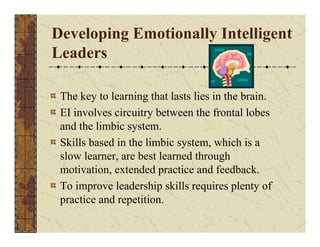
Developing Emotionally Intelligent 
Leaders 
The key to learning that lasts lies in the brain. 
EI involves circuitry between the frontal lobes 
and the limbic system. 
Skills based in the limbic system, which is a 
slow learner, are best learned through 
motivation, extended practice and feedback. 
To improve leadership skills requires plenty of 
practice and repetition.
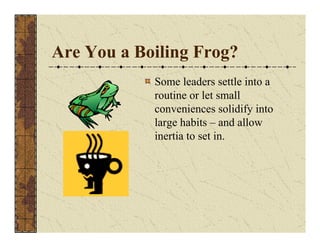
Are You a Boiling Frog? 
Some leaders settle into a 
routine or let small 
conveniences solidify into 
large habits – and allow 
inertia to set in.
Self-Directed Learning 
Leadership development must be self-directed. 
Self-directed learning involves five discoveries: each representing a 
discontinuity. 
The first discovery: My ideal self – Who do I want to be? 
The second discovery: My real self: Who am I? What are my 
strengths and weaknesses? 
The third discovery: My learning agenda – How can I build on my 
strengths while reducing my gaps? 
The fourth discovery: Experimenting with and practicing new 
thoughts, behaviours and feelings to the point of mastery. 
The fifth discovery: Developing supportive and trusting relationships 
that make change possible.
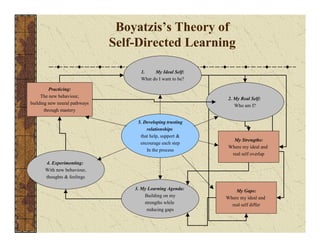
Boyatzis’s Theory of 
Self-Directed Learning 
1. My Ideal Self: 
What do I want to be? 
2. My Real Self: 
Who am I? 
My Strengths: 
Where my ideal and 
real self overlap 
My Gaps: 
Where my ideal and 
real self differ 
3. My Learning Agenda: 
Building on my 
strengths while 
reducing gaps 
4. Experimenting: 
With new behaviour, 
thoughts & feelings 
5. Developing trusting 
relationships 
that help, support & 
encourage each step 
In the process 
Practicing: 
The new behaviour, 
building new neural pathways 
through mastery
The First Discovery: 
The Motivation to Change 
The first discovery – the ideal self is where the change 
begins. 
You, 15 years from now and were living your ideal life: 
what kinds of people are around you? what does your 
environment look and feel like? What would you be doing 
during a typical day? 
What are your guiding principles? 
What are your core values in the areas of life that are 
important to you, such as family, relationships, work, 
spirituality, and health?
The second discovery: 
Looking at Your Real Self 
Taking stock of your real self starts with an 
inventory of your talents and passions – the 
person you actually are. 
Actively seek negative feedback, using 360 
degree evaluation. 
Multiple views gives a more complete picture. 
Then, examine your strengths and gaps. 
Create a personal balance sheet, listing both.
The third discovery: 
a practical plan to learn leadership skills 
Focus on improvements you are passionate about, building 
on your strengths while filling the gaps. 
Set specific, manageable learning goals. 
Goals: 
‰ should build strengths; 
‰ must be your own, not someone else’s; 
‰ must be flexible & feasible, with manageable steps; 
‰ must fit your learning style.
The Fourth Discovery: 
Experimenting 
Reconfigure your brain as you practice new 
behaviours to the point of mastery. 
Rehearse the behaviour at every opportunity until 
it becomes automatic. 
Use the mental rehearsal technique. Envision 
yourself repeating the behaviour you want to 
master over and over again.
The Fifth Discovery: 
Supporting & Trusting Relationships 
Having supportive people around you when you 
want to change makes big difference. 
Positive groups help people make positive 
changes, especially when the relationships are 
filled with candor, trust & psychological safety. 
This safety is crucial for learning to occur. 
Find a mentor, hire an executive coach.
Building EI Organizations 
Changing a single leader is only the beginning. 
The rest of the job is to develop a critical mass of 
resonant leaders and thereby transform how 
people work together.
Parallel Transformations 
Leadership development works when there is 
parallel transformations in the organizations that 
those leaders guide. 
Groups only begin to change when the understand 
how they work, especially if there is discordance. 
They must understand what the underlying group 
norms are, and then develop the ideal vision for 
the group.
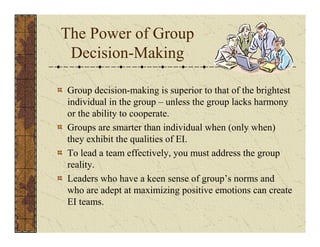
The Power of Group 
Decision-Making 
Group decision-making is superior to that of the brightest 
individual in the group – unless the group lacks harmony 
or the ability to cooperate. 
Groups are smarter than individual when (only when) 
they exhibit the qualities of EI. 
To lead a team effectively, you must address the group 
reality. 
Leaders who have a keen sense of group’s norms and 
who are adept at maximizing positive emotions can create 
EI teams.
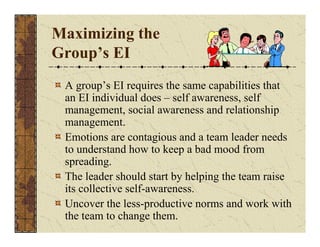
Maximizing the 
Group’s EI 
A group’s EI requires the same capabilities that 
an EI individual does – self awareness, self 
management, social awareness and relationship 
management. 
Emotions are contagious and a team leader needs 
to understand how to keep a bad mood from 
spreading. 
The leader should start by helping the team raise 
its collective self-awareness. 
Uncover the less-productive norms and work with 
the team to change them.
Reality and the Ideal 
Vision 
A leader who wants to change an organization 
must first understand its reality. 
Change begins when EI leaders actively question 
the emotional reality and cultural norms 
underlying the organization’s daily activities and 
behaviour. 
The leader has to pay attention to people’s 
emotions. 
Even toxic organizations can change.
Dynamic Inquiry 
A process which can help you discover an 
organization’s emotional reality. 
Uses focused conversations and open-ended 
questions to get to feelings. 
Themes become apparent from these 
conversations, which are then taken to smaller 
groups for more discussion.
Creating Sustainable 
Change 
Cultivate a dispersed cadre of EI leaders. 
Leadership training must be a strategic priority 
and be managed at the highest level. Commitment 
must come from the top. 
Design a process that lets those leaders uncover 
their own dreams and personal ideals, examine 
their strengths and gaps, and use their daily work 
as a learning laboratory.
Leadership Development 
Process 
Self-directed 
A tie in to the organizational culture 
Learning events emphasizing individual change 
Learning about emotional competencies 
Creative learning experiences 
Relationships that support learning, such as 
executive coaching

monkey management slide show

  • 1.
    PRIMAL LEADERSHIP Realizingthe Power of Emotional Intelligence Based on Primal Leadership by Daniel Goldman, et.al. Harvard Business School Press, 2002 Aung Tun Thet
  • 2.
    The Vital EmotionalComponent of Leadership Gifted leadership occurs where the hear and head – feeling and thought – meet. The manner in which leaders act – not just what they do, but how they do it – is a fundamental key to effective leadership. The reason lies in the brain.
  • 3.
    The Brain isan Open Loop We rely on connections with other people for our emotional stability. Emotions are contagious. The more positive the overall moods of people, the more cooperative they worked together and the better the results.
  • 4.
    Laughter and theOpen Loop Among working groups, cheerfulness and warmth spreads most easily. Laughter is largely involuntary. Laughter in the workplace signals trust, comfort, and a shared sense of the world.
  • 5.
    Why Good LeadersMust Read Emotions Resonant leaders are attuned to their people’s feelings and move them in a positive emotional direction. Emotionally intelligent (EI) leaders used empathy to attune to the emotions of the people they lead.
  • 6.
    The Four Dimensionsof Emotional Intelligence Self-awareness Self-Management Social Awareness Relationship Management
  • 7.
    Self-awareness Emotional self-awareness: Reading one’s own emotions and recognizing their impact and using “gut sense” to guide decisions. Accurate self-assessment: Knowing one’s strengths and limits. Self-confidence: A sound sense of one’s self-worth and capabilities.
  • 8.
    Self-management Emotional self-control:Keeping disruptive emotions and impulses under control. Transparency: Displaying honesty, integrity and trustworthiness. Adaptability: Flexibility in adapting to changing situations or overcoming obstacles. Achievement: The drive to improve performance to meet inner standards of excellence Initiative: Readiness to act and seize opportunities. Optimism: Seeing the upside in events.
  • 9.
    Social Awareness Empathy:Sensing others’ emotions, understanding their perspective, and taking active interest in their concerns. Organizational Awareness: Reading the currents, decision networks, and politics at the organizational level. Service: Recognizing and meeting follower, client or customer needs.
  • 10.
    Relationship Management Inspirationalleadership: Guiding and motivating with a compelling vision. Influence: Wielding a range of tactics for persuasion. Developing others: Bolstering others’ abilities through feedback and guidance. Change catalyst: Initiating, managing and leading in new directions. Building bonds: Cultivating and maintaining relationship webs. Teamwork and collaboration: Cooperation and teambuilding
  • 11.
    The Leadership Repertoire Six distinct approaches to leadership Four of the styles – visionary, coaching, affiliative and democratic – create the kind of resonance that boosts performance. The other two – pace-setting and commanding – should be applied with caution.
  • 12.
    Visionary Style Articulateswhere the group is going, but not how it gets there – setting people free to innovate, experiment and take risks. Inspirational leadership is the EI competence which underpins the visionary style. Transparency, another EI competence is crucial. The EI competence which matters most to visionary leadership is Empathy – the ability to sense what others feel and understand their perspectives..
  • 13.
    Coaching Style Theart of one-on-one. Coaches help people identify their unique strengths and weaknesses, tying those to their personal and career aspirations. Effective coaching exemplifies the EI competency of developing others, which lets a leader act as a counselor. It work hand-in-hand with two other EI competencies: emotional awareness and empathy.
  • 14.
    Affiliative Style Acaring approach. Represents collaborative competency in action. Most concerned with promoting harmony and fostering friendly interactions. Focus on the emotional needs of others, using empathy. Many leaders combined the Affiliative Style with Visionary Style – a potent combination.
  • 15.
    Democratic Style Buildsupon a triad of EI competences – teamwork and collaboration, conflict management and influence. Great listening skills and true collaborators. Quell conflict and create harmony. Empathy also plays a role. Works best when a leader is unsure of the direction to take and need ideas from others.
  • 16.
    Pacesetting Style Mustbe applied sparingly, restricted to settings where it truly works. Obsessive about doing things better and faster, quickly pinpointing poor performers. Pacesetter who lacks empathy can easily be blinded to the pain of those who achieve what the leader demands. Works best when combined with the passion of the visionary style and the teambuilding of the affiliative style.
  • 17.
    Commanding Style Theleast effective style. Demands immediate compliance with orders, without explanations. Works on limited circumstances, and only when used judiciously – for e.g., genuine emergencies. Draws on three EI competencies – influence, achievement and initiative. In addition, self-awareness, emotional self control and empathy are crucial.
  • 18.
    Developing Emotionally Intelligent Leaders The key to learning that lasts lies in the brain. EI involves circuitry between the frontal lobes and the limbic system. Skills based in the limbic system, which is a slow learner, are best learned through motivation, extended practice and feedback. To improve leadership skills requires plenty of practice and repetition.
  • 19.
    Are You aBoiling Frog? Some leaders settle into a routine or let small conveniences solidify into large habits – and allow inertia to set in.
  • 20.
    Self-Directed Learning Leadershipdevelopment must be self-directed. Self-directed learning involves five discoveries: each representing a discontinuity. The first discovery: My ideal self – Who do I want to be? The second discovery: My real self: Who am I? What are my strengths and weaknesses? The third discovery: My learning agenda – How can I build on my strengths while reducing my gaps? The fourth discovery: Experimenting with and practicing new thoughts, behaviours and feelings to the point of mastery. The fifth discovery: Developing supportive and trusting relationships that make change possible.
  • 21.
    Boyatzis’s Theory of Self-Directed Learning 1. My Ideal Self: What do I want to be? 2. My Real Self: Who am I? My Strengths: Where my ideal and real self overlap My Gaps: Where my ideal and real self differ 3. My Learning Agenda: Building on my strengths while reducing gaps 4. Experimenting: With new behaviour, thoughts & feelings 5. Developing trusting relationships that help, support & encourage each step In the process Practicing: The new behaviour, building new neural pathways through mastery
  • 22.
    The First Discovery: The Motivation to Change The first discovery – the ideal self is where the change begins. You, 15 years from now and were living your ideal life: what kinds of people are around you? what does your environment look and feel like? What would you be doing during a typical day? What are your guiding principles? What are your core values in the areas of life that are important to you, such as family, relationships, work, spirituality, and health?
  • 23.
    The second discovery: Looking at Your Real Self Taking stock of your real self starts with an inventory of your talents and passions – the person you actually are. Actively seek negative feedback, using 360 degree evaluation. Multiple views gives a more complete picture. Then, examine your strengths and gaps. Create a personal balance sheet, listing both.
  • 24.
    The third discovery: a practical plan to learn leadership skills Focus on improvements you are passionate about, building on your strengths while filling the gaps. Set specific, manageable learning goals. Goals: ‰ should build strengths; ‰ must be your own, not someone else’s; ‰ must be flexible & feasible, with manageable steps; ‰ must fit your learning style.
  • 25.
    The Fourth Discovery: Experimenting Reconfigure your brain as you practice new behaviours to the point of mastery. Rehearse the behaviour at every opportunity until it becomes automatic. Use the mental rehearsal technique. Envision yourself repeating the behaviour you want to master over and over again.
  • 26.
    The Fifth Discovery: Supporting & Trusting Relationships Having supportive people around you when you want to change makes big difference. Positive groups help people make positive changes, especially when the relationships are filled with candor, trust & psychological safety. This safety is crucial for learning to occur. Find a mentor, hire an executive coach.
  • 27.
    Building EI Organizations Changing a single leader is only the beginning. The rest of the job is to develop a critical mass of resonant leaders and thereby transform how people work together.
  • 28.
    Parallel Transformations Leadershipdevelopment works when there is parallel transformations in the organizations that those leaders guide. Groups only begin to change when the understand how they work, especially if there is discordance. They must understand what the underlying group norms are, and then develop the ideal vision for the group.
  • 29.
    The Power ofGroup Decision-Making Group decision-making is superior to that of the brightest individual in the group – unless the group lacks harmony or the ability to cooperate. Groups are smarter than individual when (only when) they exhibit the qualities of EI. To lead a team effectively, you must address the group reality. Leaders who have a keen sense of group’s norms and who are adept at maximizing positive emotions can create EI teams.
  • 30.
    Maximizing the Group’sEI A group’s EI requires the same capabilities that an EI individual does – self awareness, self management, social awareness and relationship management. Emotions are contagious and a team leader needs to understand how to keep a bad mood from spreading. The leader should start by helping the team raise its collective self-awareness. Uncover the less-productive norms and work with the team to change them.
  • 31.
    Reality and theIdeal Vision A leader who wants to change an organization must first understand its reality. Change begins when EI leaders actively question the emotional reality and cultural norms underlying the organization’s daily activities and behaviour. The leader has to pay attention to people’s emotions. Even toxic organizations can change.
  • 32.
    Dynamic Inquiry Aprocess which can help you discover an organization’s emotional reality. Uses focused conversations and open-ended questions to get to feelings. Themes become apparent from these conversations, which are then taken to smaller groups for more discussion.
  • 33.
    Creating Sustainable Change Cultivate a dispersed cadre of EI leaders. Leadership training must be a strategic priority and be managed at the highest level. Commitment must come from the top. Design a process that lets those leaders uncover their own dreams and personal ideals, examine their strengths and gaps, and use their daily work as a learning laboratory.
  • 34.
    Leadership Development Process Self-directed A tie in to the organizational culture Learning events emphasizing individual change Learning about emotional competencies Creative learning experiences Relationships that support learning, such as executive coaching