The Case for Executive Coaching
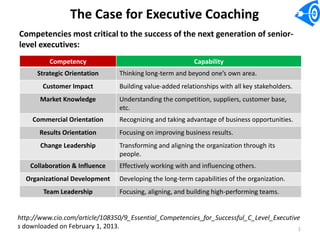
Competencies most critical to the success of the next generation of senior-
level executives:
          Competency                                      Capability
      Strategic Orientation     Thinking long-term and beyond one’s own area.
        Customer Impact         Building value-added relationships with all key stakeholders.
       Market Knowledge         Understanding the competition, suppliers, customer base,
                                etc.
    Commercial Orientation      Recognizing and taking advantage of business opportunities.
       Results Orientation      Focusing on improving business results.
       Change Leadership        Transforming and aligning the organization through its
                                people.
    Collaboration & Influence   Effectively working with and influencing others.
  Organizational Development    Developing the long-term capabilities of the organization.
        Team Leadership         Focusing, aligning, and building high-performing teams.


http://www.cio.com/article/108350/9_Essential_Competencies_for_Successful_C_Level_Executive
s downloaded on February 1, 2013.                                                         1
Development Actions and Activities


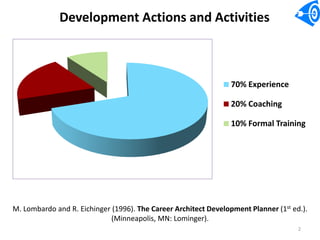
                                                                 70% Experience

                                                                 20% Coaching

                                                                 10% Formal Training


M. Lombardo and R. Eichinger (1996). The Career Architect Development Planner (1st ed.).
                             (Minneapolis, MN: Lominger).
                                                                                     2
The Case for Executive Coaching
 $800,000 – Estimated total cost of replacing a $200,000/YR executive


                                                          16% Separation
                                                          24% Vacancy
                                                          17% Replacement
                                                          20% Socializing
                                                          23% Ramp Up


Sage HRMS (2011). ROEI™: Return on Employee Investment™ [White Paper]. (St.
                           Petersburg, FL: Sage).                             3
Assessing Executive Performance
 Is your organization losing high-performing senior-level executives while
  retaining mediocre ones?
 Is your organization losing high-potential mid-level executives while
  retaining average ones?
 Do your senior-level executives sometimes appear to lack self- and/or
  situational awareness?
 Do you consider your senior-level executives to be competent, self-
  assured, and self-motivated?
 Do others consider your senior-level executives to be business savvy,
  knowledgeable, and self-confident?
 Are you and your team taking the required steps to maximize your
  organization’s effectiveness?
 Are you ensuring optimal executive performance and enhancing executive
  retention?
                                                                              4
Development Actions and Activities
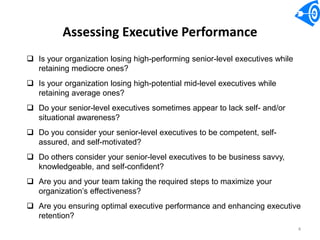
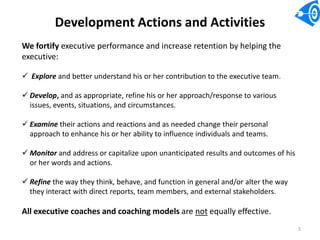
We fortify executive performance and increase retention by helping the
executive:

 Explore and better understand his or her contribution to the executive team.

 Develop, and as appropriate, refine his or her approach/response to various
  issues, events, situations, and circumstances.

 Examine their actions and reactions and as needed change their personal
  approach to enhance his or her ability to influence individuals and teams.

 Monitor and address or capitalize upon unanticipated results and outcomes of his
  or her words and actions.

 Refine the way they think, behave, and function in general and/or alter the way
  they interact with direct reports, team members, and external stakeholders.

All executive coaches and coaching models are not equally effective.
                                                                                     5
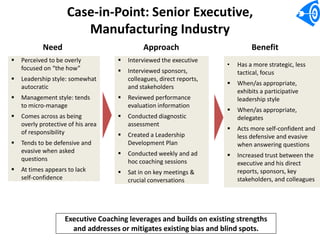
Case-in-Point: Senior Executive,
                        Manufacturing Industry
            Need                             Approach                          Benefit
   Perceived to be overly             Interviewed the executive
                                                                      •   Has a more strategic, less
    focused on “the how”               Interviewed sponsors,             tactical, focus
   Leadership style: somewhat          colleagues, direct reports,
                                                                         When/as appropriate,
    autocratic                          and stakeholders
                                                                          exhibits a participative
   Management style: tends            Reviewed performance              leadership style
    to micro-manage                     evaluation information
                                                                         When/as appropriate,
   Comes across as being              Conducted diagnostic              delegates
    overly protective of his area       assessment
                                                                         Acts more self-confident and
    of responsibility                  Created a Leadership              less defensive and evasive
   Tends to be defensive and           Development Plan                  when answering questions
    evasive when asked                 Conducted weekly and ad          Increased trust between the
    questions                           hoc coaching sessions             executive and his direct
   At times appears to lack           Sat in on key meetings &          reports, sponsors, key
    self-confidence                     crucial conversations             stakeholders, and colleagues


                    Executive Coaching leverages and builds on existing strengths
                      and addresses or mitigates existing bias and blind spots.
 Need to fortify or reinvigorate your executive performance?
 Need to strengthen your executive bench?
 Need to formulate and/or implement your leadership
  development strategy?
 Need to launch an executive coaching program?

Contact BKSimerson@sbcglobal.net or Tepke@sbcglobal.net for
information on how we might work together.

     http://www.linkedin.com/pub/bk-simerson-ed-d/2/376/427
       http://www.linkedin.com/pub/daniel-tepke/7/81a/230/
                                                                7

Slideshare executive coaching v3

  • 1.
    The Case forExecutive Coaching Competencies most critical to the success of the next generation of senior- level executives: Competency Capability Strategic Orientation Thinking long-term and beyond one’s own area. Customer Impact Building value-added relationships with all key stakeholders. Market Knowledge Understanding the competition, suppliers, customer base, etc. Commercial Orientation Recognizing and taking advantage of business opportunities. Results Orientation Focusing on improving business results. Change Leadership Transforming and aligning the organization through its people. Collaboration & Influence Effectively working with and influencing others. Organizational Development Developing the long-term capabilities of the organization. Team Leadership Focusing, aligning, and building high-performing teams. http://www.cio.com/article/108350/9_Essential_Competencies_for_Successful_C_Level_Executive s downloaded on February 1, 2013. 1
  • 2.
    Development Actions andActivities 70% Experience 20% Coaching 10% Formal Training M. Lombardo and R. Eichinger (1996). The Career Architect Development Planner (1st ed.). (Minneapolis, MN: Lominger). 2
  • 3.
    The Case forExecutive Coaching $800,000 – Estimated total cost of replacing a $200,000/YR executive 16% Separation 24% Vacancy 17% Replacement 20% Socializing 23% Ramp Up Sage HRMS (2011). ROEI™: Return on Employee Investment™ [White Paper]. (St. Petersburg, FL: Sage). 3
  • 4.
    Assessing Executive Performance Is your organization losing high-performing senior-level executives while retaining mediocre ones?  Is your organization losing high-potential mid-level executives while retaining average ones?  Do your senior-level executives sometimes appear to lack self- and/or situational awareness?  Do you consider your senior-level executives to be competent, self- assured, and self-motivated?  Do others consider your senior-level executives to be business savvy, knowledgeable, and self-confident?  Are you and your team taking the required steps to maximize your organization’s effectiveness?  Are you ensuring optimal executive performance and enhancing executive retention? 4
  • 5.
    Development Actions andActivities We fortify executive performance and increase retention by helping the executive:  Explore and better understand his or her contribution to the executive team.  Develop, and as appropriate, refine his or her approach/response to various issues, events, situations, and circumstances.  Examine their actions and reactions and as needed change their personal approach to enhance his or her ability to influence individuals and teams.  Monitor and address or capitalize upon unanticipated results and outcomes of his or her words and actions.  Refine the way they think, behave, and function in general and/or alter the way they interact with direct reports, team members, and external stakeholders. All executive coaches and coaching models are not equally effective. 5
  • 6.
    Case-in-Point: Senior Executive, Manufacturing Industry Need Approach Benefit  Perceived to be overly  Interviewed the executive • Has a more strategic, less focused on “the how”  Interviewed sponsors, tactical, focus  Leadership style: somewhat colleagues, direct reports,  When/as appropriate, autocratic and stakeholders exhibits a participative  Management style: tends  Reviewed performance leadership style to micro-manage evaluation information  When/as appropriate,  Comes across as being  Conducted diagnostic delegates overly protective of his area assessment  Acts more self-confident and of responsibility  Created a Leadership less defensive and evasive  Tends to be defensive and Development Plan when answering questions evasive when asked  Conducted weekly and ad  Increased trust between the questions hoc coaching sessions executive and his direct  At times appears to lack  Sat in on key meetings & reports, sponsors, key self-confidence crucial conversations stakeholders, and colleagues Executive Coaching leverages and builds on existing strengths and addresses or mitigates existing bias and blind spots.
  • 7.
     Need tofortify or reinvigorate your executive performance?  Need to strengthen your executive bench?  Need to formulate and/or implement your leadership development strategy?  Need to launch an executive coaching program? Contact BKSimerson@sbcglobal.net or Tepke@sbcglobal.net for information on how we might work together. http://www.linkedin.com/pub/bk-simerson-ed-d/2/376/427 http://www.linkedin.com/pub/daniel-tepke/7/81a/230/ 7