Blitzscaling
When the market is up from grabs, risk isn’t inefficiency,
the risk is playing too safe.
-Chris Yeh and Reid Hoffman
Sections
1. Basics of Blitzscaling
2. Business Model Innovation
3. Strategy Innovation
4. Management Innovation
Section 1
Basics of Blitzscaling
Blitzscaling is scaling rapidly in the face of
uncertainty.
3 important characteristics of Blitzscaling
1. It is both, an offensive and defensive strategy
2. It is based on positive feedback loops
a. Scale to occupy a high ground,
b. More capital and talent flows in,
c. Leading to raising your status
3. It comes with some massive risks
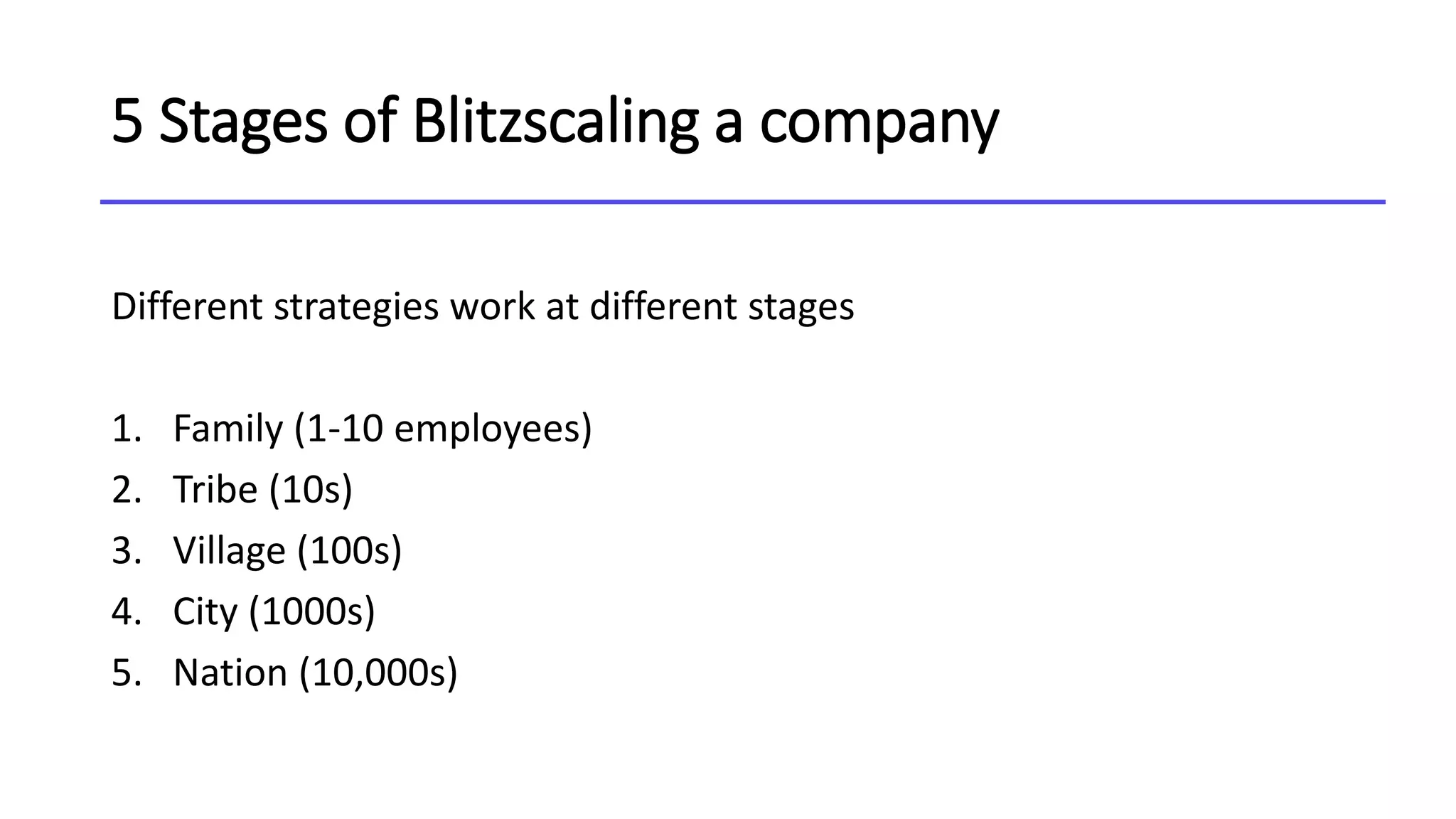
5 Stages of Blitzscaling a company
Different strategies work at different stages
1. Family (1-10 employees)
2. Tribe (10s)
3. Village (100s)
4. City (1000s)
5. Nation (10,000s)
3 techniques for Blitzscaling
1. Business model innovation
2. Strategic innovation
3. Management innovation
Section 2
Business Model Innovation
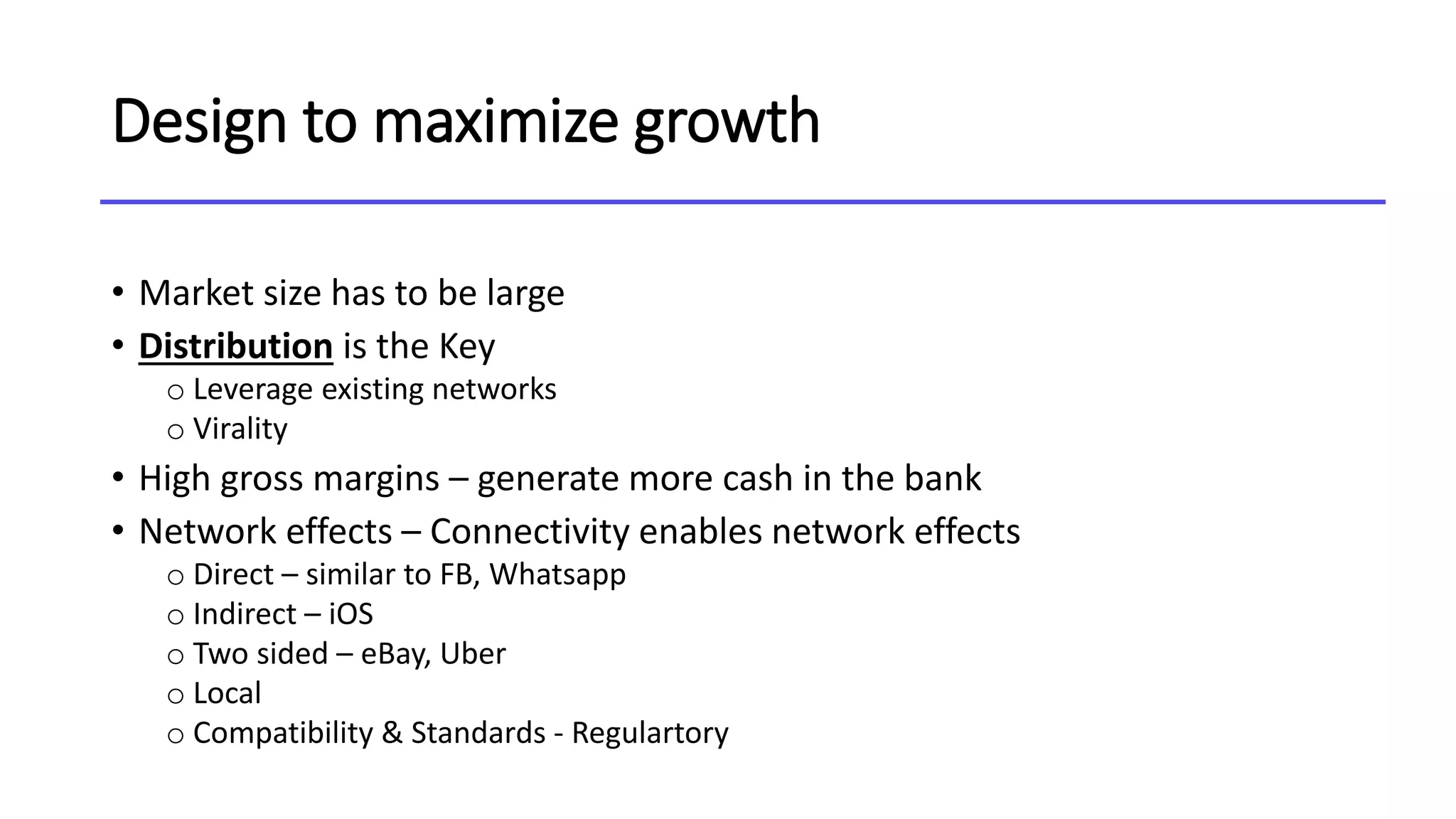
Design to maximize growth
• Market size has to be large
• Distribution is the Key
o Leverage existing networks
o Virality
• High gross margins – generate more cash in the bank
• Network effects – Connectivity enables network effects
o Direct – similar to FB, Whatsapp
o Indirect – iOS
o Two sided – eBay, Uber
o Local
o Compatibility & Standards - Regulartory
2 growth limiters in scaling
1. Lack of Product-Market fit
2. Operational Scalability
• Human limitations – people
• Infrastructure – Server, bandwidth
Copy successful models
• Think and copy wherever you can
• But be careful, eToys had copied only the technology without the
front/back office of Amazon
Proven Scalable Business Models
• Bits rather than atoms – Software is eating the world
• Platforms
• Free or Premium – SaaS, Enterprise
• Marketplaces
• Subscription
• Digital Goods
• Feeds
Underlying principle of Business Model innovation
• Moore’s law – Scale
• Automation
• Adapt for scale, don’t optimize
• Contrarian principle (Slide 29)
Quick way to test business scalability
• Market Size
• Distribution
• Gross Margin
• Network effects
• Product Market Fit
• Operational Scalability
Section 3
Strategy Innovation
Top strategies
• First scaler advantage is real
• Solve a tough problem – Be the first to crack steep learning curve
• Competition – Startups can capitalize on new opportunity better
Correct way to scale
It is not a 1 or 2 step process
1. Do things that don’t scale
2. Reach the next stage of blitzscaling
3. Figure out 1 or 2 things that scale
4. Reach the next stage of blitzscaling
5. Repeat till market dominance
How founder’s role changes
• Family(1-10) – Personally pulls levers of growth
• Tribe(10s) – Founder manages people who pull lever
• Villages(100s) – Design an org that pulls lever
• City(1,000s) – Founder makes high-level decision about growth
• Country(10,000s) – Founder brings org into blitzscaling into other
product lines
When to stop blitzscaling
• Declining growth
• Worsening unit economics
• Decreasing productivity
• Increasing overhead costs
Section 3
Management Innovation
8 key transitions during scaling a company
Transition #1: Small team to large teams
• People have elastic limits. There are 3 types of people you need while scaling –
“Marines to take the beach, Army to take the country, Police to govern the country.”
• Encourage employees to focus less on title more on growth of the company.
• An engineering manager at tribe stage might not become VP at Village stage.
Highlight how much they have grown with respect to themselves (like currently
handling 30 employees to 3 before)
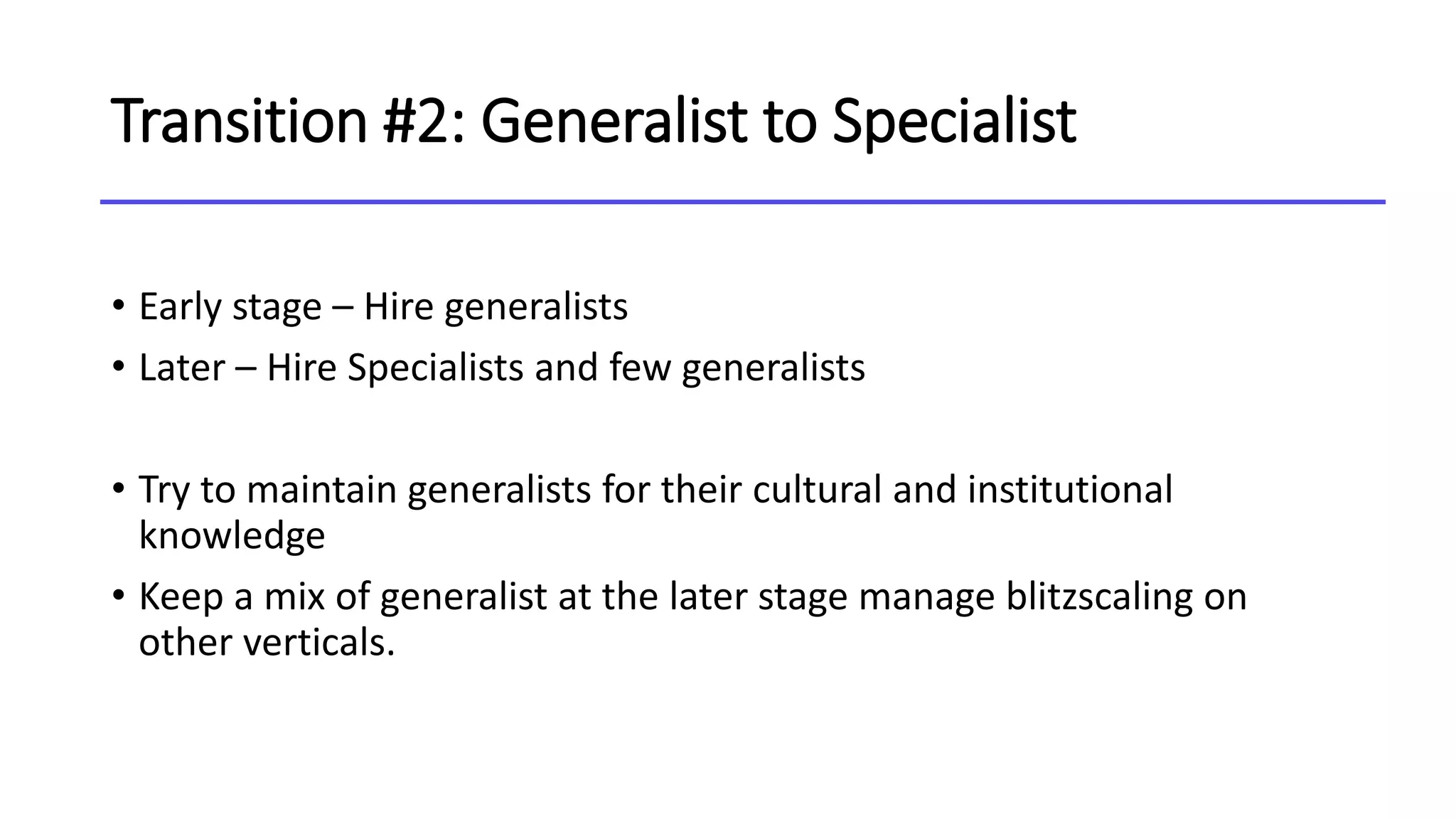
Transition #2: Generalist to Specialist
• Early stage – Hire generalists
• Later – Hire Specialists and few generalists
• Try to maintain generalists for their cultural and institutional
knowledge
• Keep a mix of generalist at the later stage manage blitzscaling on
other verticals.
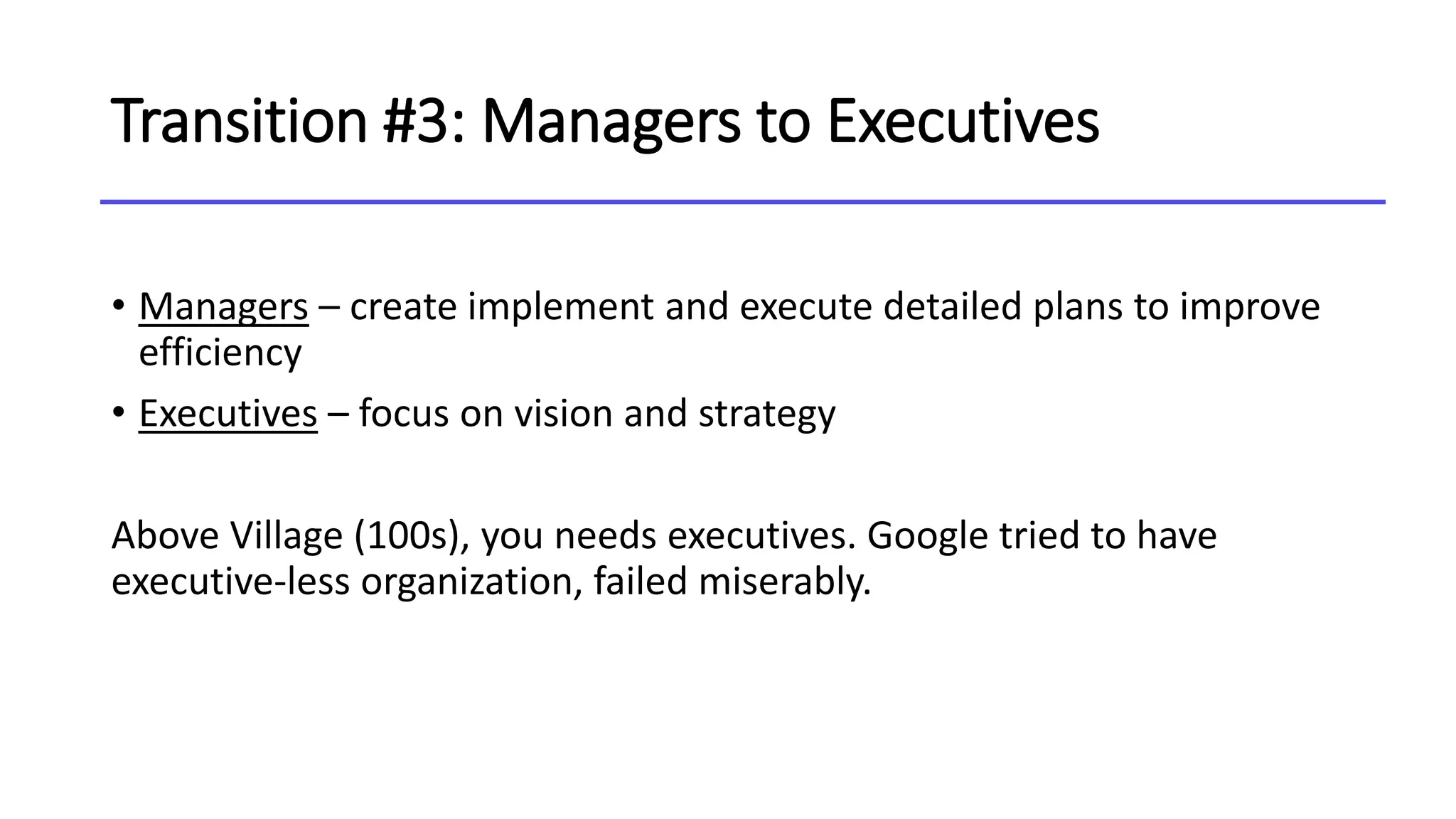
Transition #3: Managers to Executives
• Managers – create implement and execute detailed plans to improve
efficiency
• Executives – focus on vision and strategy
Above Village (100s), you needs executives. Google tried to have
executive-less organization, failed miserably.
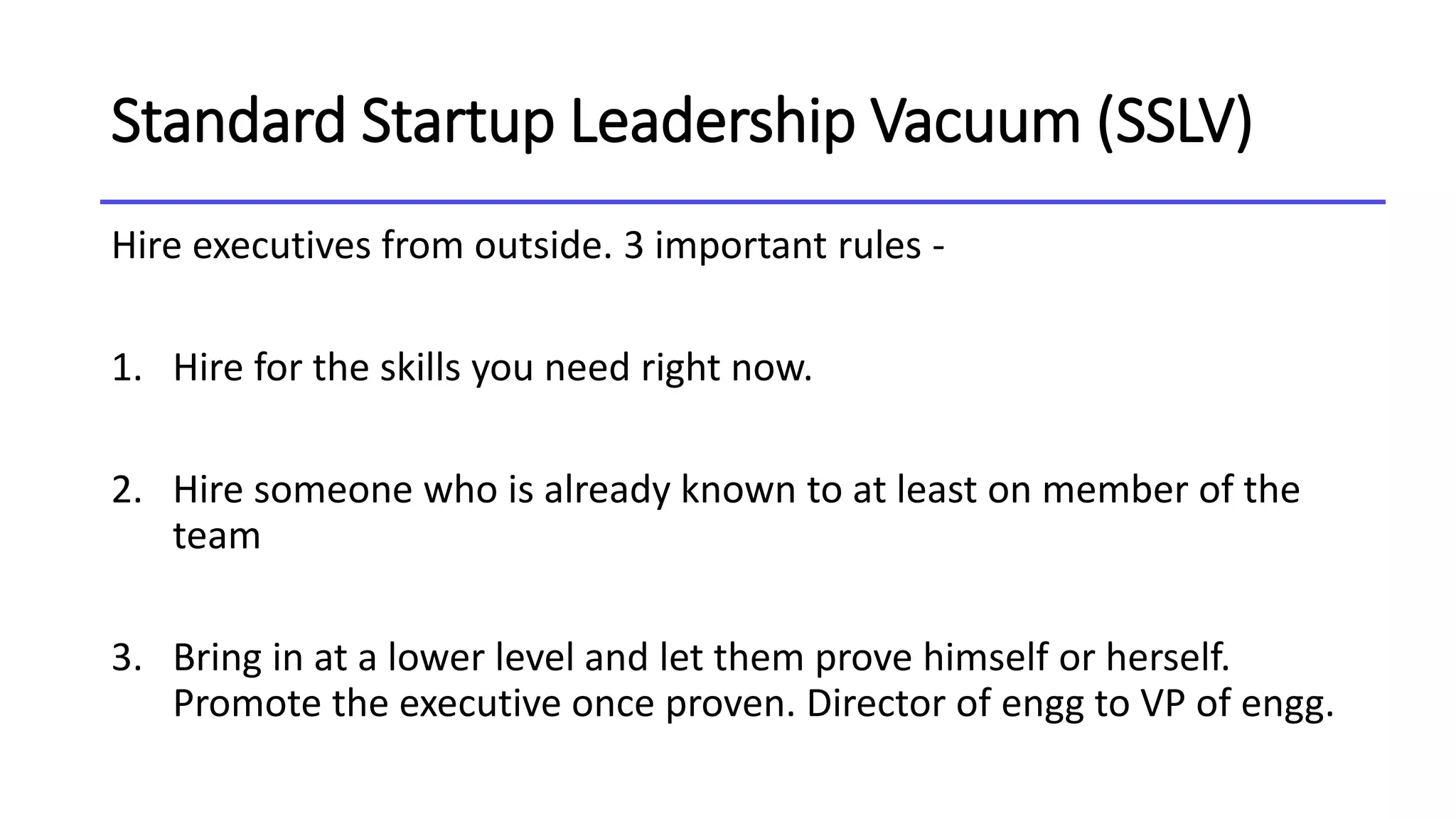
Standard Startup Leadership Vacuum (SSLV)
Hire executives from outside. 3 important rules -
1. Hire for the skills you need right now.
2. Hire someone who is already known to at least on member of the
team
3. Bring in at a lower level and let them prove himself or herself.
Promote the executive once proven. Director of engg to VP of engg.
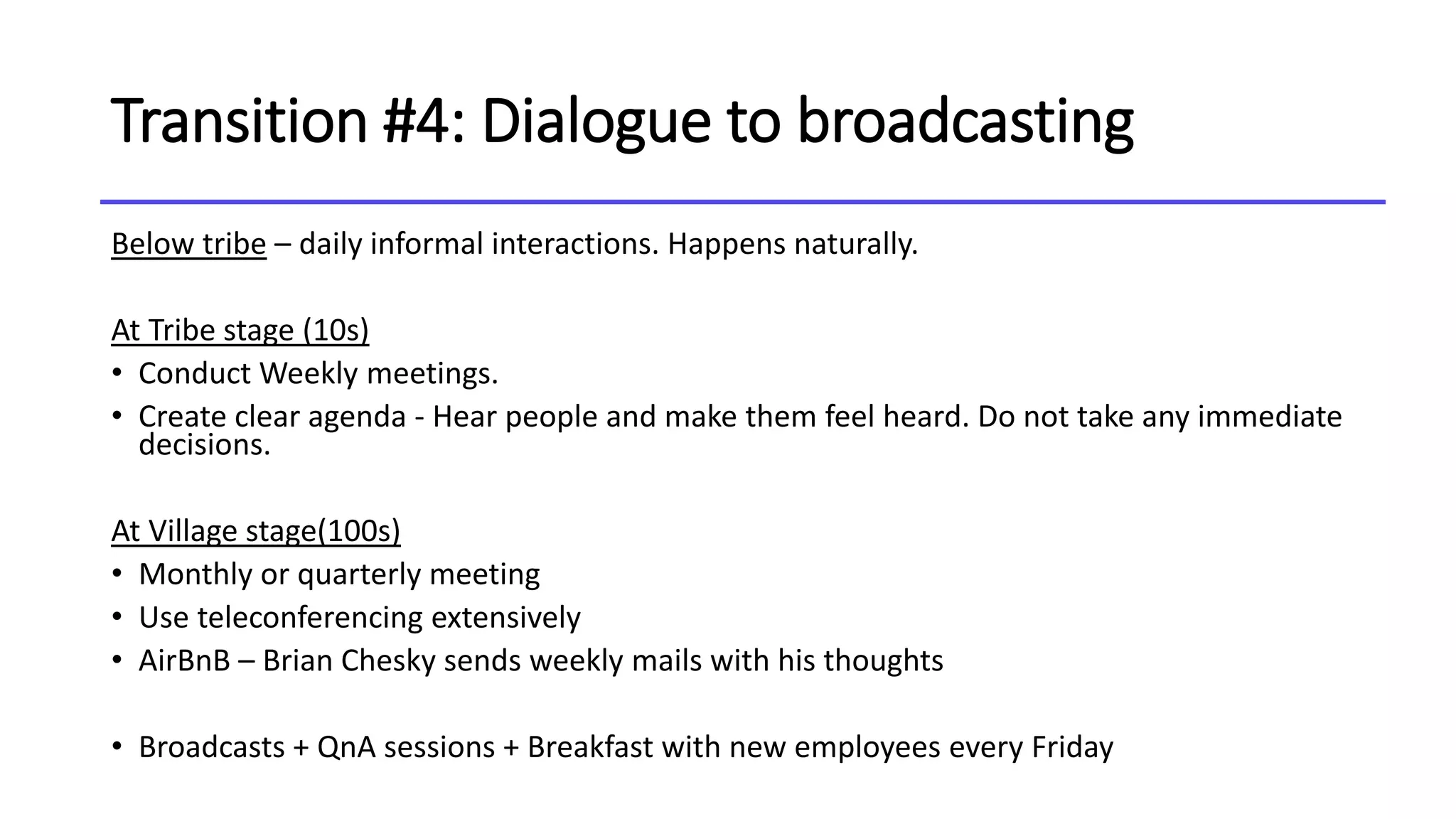
Transition #4: Dialogue to broadcasting
Below tribe – daily informal interactions. Happens naturally.
At Tribe stage (10s)
• Conduct Weekly meetings.
• Create clear agenda - Hear people and make them feel heard. Do not take any immediate
decisions.
At Village stage(100s)
• Monthly or quarterly meeting
• Use teleconferencing extensively
• AirBnB – Brian Chesky sends weekly mails with his thoughts
• Broadcasts + QnA sessions + Breakfast with new employees every Friday
Transition #5: Inspiration to Data
Define 3-5 clear metrics. Not vanity clear.
At Village size(100s) – Create dashboard for important stakeholders
City (1,000s) and Nation (10,000s) - Dedicated Business Intelligence(BI)
team
Transition #6: Single focus to multi-threading
• Start after City Stage(1,000s)
• Start threads only when strategically necessary
• Incentivize thread owners - Threads are like apps on a platform.
Incentivize the primary head of a thread to be responsible not only to
his or her thread but also partially responsible for other threads.
Transition #7: Pirate to Navy
• At village stage, shift starts form Pirate to Navy
• Leadership should grow from thinking like a Captain to Admiral.
• Defined structure will only help stabilizing organization.
Global Management
a. Have set of local managers responsible for the region
b. Understand how the markets differ from each other
c. Have a unified executive team to coordinate global challenges – Uber had
skipped this.
Transition #9: Founder to leader
• Maintain certain humility and sense of perspective.
Learn about
• Delegation
• Amplification – to amplify your impact from delegation
• Make yourself better – have a set of advisors
9 counter-intuitive rules while Blitzscaling
• Embrace Chaos – Uncertainty is a part. Have A, B and Z plan – Z is for survival
• Hire Mr/Ms Right now not Mr/Ms Right
• Tolerate bad management
• Launch product that embarrasses you – Observe, orient, decide and act.
• Let some fires burn – Work on them in priority of urgency, efficacy and
dependency.
• Do things that don’t scale
• Ignore your customers (at times) – provide best customer service you can without
slowing down.
• Raise too much money
• Evolve your culture
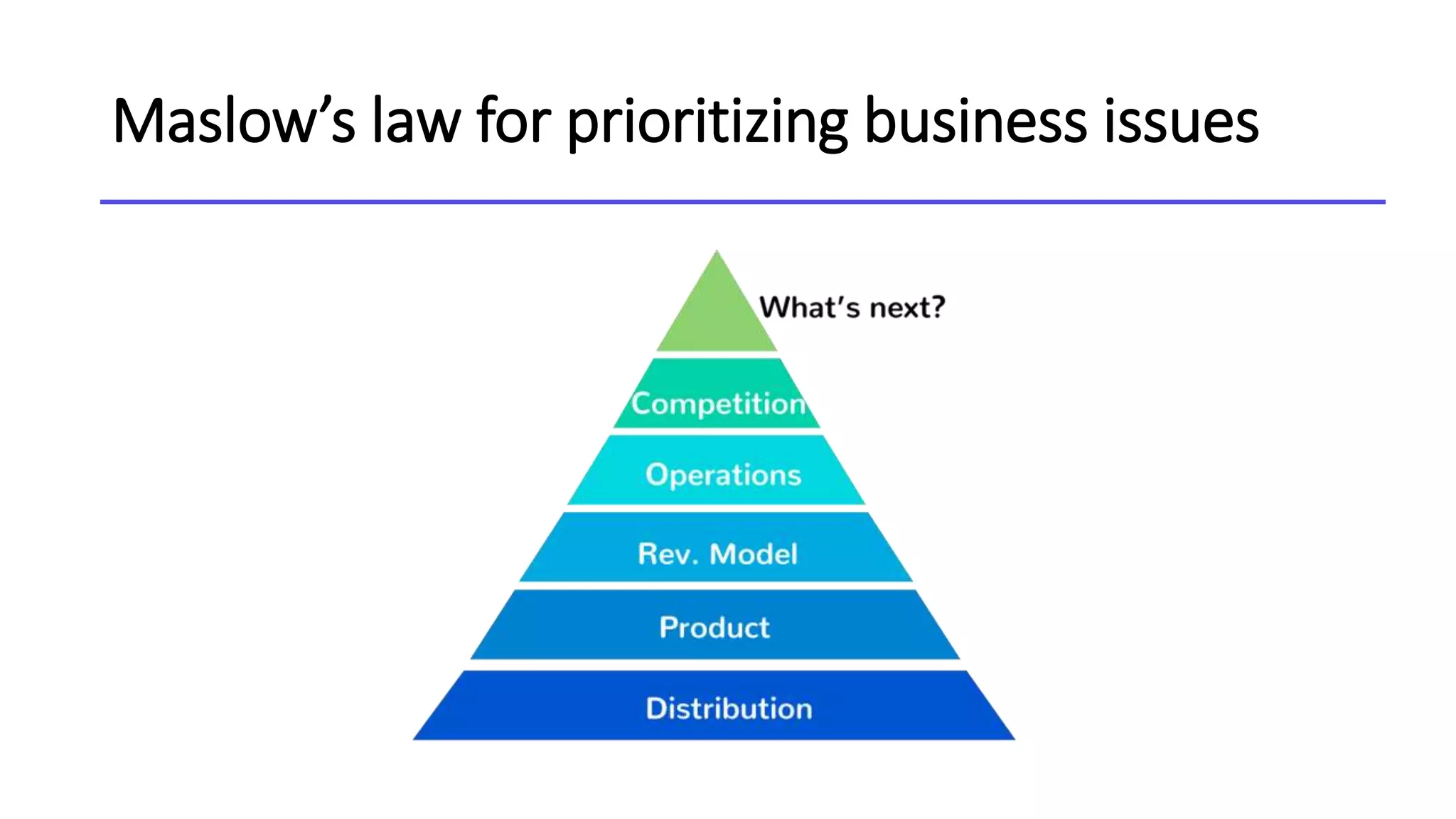
Maslow’s law for prioritizing business issues
Culture
How to develop culture?
Don’t enforce, Mix of the 2 below
1. Let it evolve on its own organically
2. But Observe for some critical things.
2 important things for evolving culture
1. Keep Communicating
2. People management – hiring, firing, promoting
Culture Contd
Everyone should know
• What is your organization trying to do?
• How are you trying to achieve goals?
• What are the acceptable risks?
• Trade off in certain values.
• Kind of behaviour expected.
Uber’s culture code change after Dara as CEO
1. We celebrate differences
2. We do the right thing
3. We act like owners
4. We make big bold bets

Blitzscaling

  • 1.
    Blitzscaling When the marketis up from grabs, risk isn’t inefficiency, the risk is playing too safe. -Chris Yeh and Reid Hoffman
  • 2.
    Sections 1. Basics ofBlitzscaling 2. Business Model Innovation 3. Strategy Innovation 4. Management Innovation
  • 3.
    Section 1 Basics ofBlitzscaling Blitzscaling is scaling rapidly in the face of uncertainty.
  • 4.
    3 important characteristicsof Blitzscaling 1. It is both, an offensive and defensive strategy 2. It is based on positive feedback loops a. Scale to occupy a high ground, b. More capital and talent flows in, c. Leading to raising your status 3. It comes with some massive risks
  • 5.
    5 Stages ofBlitzscaling a company Different strategies work at different stages 1. Family (1-10 employees) 2. Tribe (10s) 3. Village (100s) 4. City (1000s) 5. Nation (10,000s)
  • 6.
    3 techniques forBlitzscaling 1. Business model innovation 2. Strategic innovation 3. Management innovation
  • 7.
  • 8.
    Design to maximizegrowth • Market size has to be large • Distribution is the Key o Leverage existing networks o Virality • High gross margins – generate more cash in the bank • Network effects – Connectivity enables network effects o Direct – similar to FB, Whatsapp o Indirect – iOS o Two sided – eBay, Uber o Local o Compatibility & Standards - Regulartory
  • 9.
    2 growth limitersin scaling 1. Lack of Product-Market fit 2. Operational Scalability • Human limitations – people • Infrastructure – Server, bandwidth
  • 10.
    Copy successful models •Think and copy wherever you can • But be careful, eToys had copied only the technology without the front/back office of Amazon
  • 11.
    Proven Scalable BusinessModels • Bits rather than atoms – Software is eating the world • Platforms • Free or Premium – SaaS, Enterprise • Marketplaces • Subscription • Digital Goods • Feeds
  • 12.
    Underlying principle ofBusiness Model innovation • Moore’s law – Scale • Automation • Adapt for scale, don’t optimize • Contrarian principle (Slide 29)
  • 13.
    Quick way totest business scalability • Market Size • Distribution • Gross Margin • Network effects • Product Market Fit • Operational Scalability
  • 14.
  • 15.
    Top strategies • Firstscaler advantage is real • Solve a tough problem – Be the first to crack steep learning curve • Competition – Startups can capitalize on new opportunity better
  • 16.
    Correct way toscale It is not a 1 or 2 step process 1. Do things that don’t scale 2. Reach the next stage of blitzscaling 3. Figure out 1 or 2 things that scale 4. Reach the next stage of blitzscaling 5. Repeat till market dominance
  • 17.
    How founder’s rolechanges • Family(1-10) – Personally pulls levers of growth • Tribe(10s) – Founder manages people who pull lever • Villages(100s) – Design an org that pulls lever • City(1,000s) – Founder makes high-level decision about growth • Country(10,000s) – Founder brings org into blitzscaling into other product lines
  • 18.
    When to stopblitzscaling • Declining growth • Worsening unit economics • Decreasing productivity • Increasing overhead costs
  • 19.
    Section 3 Management Innovation 8key transitions during scaling a company
  • 20.
    Transition #1: Smallteam to large teams • People have elastic limits. There are 3 types of people you need while scaling – “Marines to take the beach, Army to take the country, Police to govern the country.” • Encourage employees to focus less on title more on growth of the company. • An engineering manager at tribe stage might not become VP at Village stage. Highlight how much they have grown with respect to themselves (like currently handling 30 employees to 3 before)
  • 21.
    Transition #2: Generalistto Specialist • Early stage – Hire generalists • Later – Hire Specialists and few generalists • Try to maintain generalists for their cultural and institutional knowledge • Keep a mix of generalist at the later stage manage blitzscaling on other verticals.
  • 22.
    Transition #3: Managersto Executives • Managers – create implement and execute detailed plans to improve efficiency • Executives – focus on vision and strategy Above Village (100s), you needs executives. Google tried to have executive-less organization, failed miserably.
  • 23.
    Standard Startup LeadershipVacuum (SSLV) Hire executives from outside. 3 important rules - 1. Hire for the skills you need right now. 2. Hire someone who is already known to at least on member of the team 3. Bring in at a lower level and let them prove himself or herself. Promote the executive once proven. Director of engg to VP of engg.
  • 24.
    Transition #4: Dialogueto broadcasting Below tribe – daily informal interactions. Happens naturally. At Tribe stage (10s) • Conduct Weekly meetings. • Create clear agenda - Hear people and make them feel heard. Do not take any immediate decisions. At Village stage(100s) • Monthly or quarterly meeting • Use teleconferencing extensively • AirBnB – Brian Chesky sends weekly mails with his thoughts • Broadcasts + QnA sessions + Breakfast with new employees every Friday
  • 25.
    Transition #5: Inspirationto Data Define 3-5 clear metrics. Not vanity clear. At Village size(100s) – Create dashboard for important stakeholders City (1,000s) and Nation (10,000s) - Dedicated Business Intelligence(BI) team
  • 26.
    Transition #6: Singlefocus to multi-threading • Start after City Stage(1,000s) • Start threads only when strategically necessary • Incentivize thread owners - Threads are like apps on a platform. Incentivize the primary head of a thread to be responsible not only to his or her thread but also partially responsible for other threads.
  • 27.
    Transition #7: Pirateto Navy • At village stage, shift starts form Pirate to Navy • Leadership should grow from thinking like a Captain to Admiral. • Defined structure will only help stabilizing organization. Global Management a. Have set of local managers responsible for the region b. Understand how the markets differ from each other c. Have a unified executive team to coordinate global challenges – Uber had skipped this.
  • 28.
    Transition #9: Founderto leader • Maintain certain humility and sense of perspective. Learn about • Delegation • Amplification – to amplify your impact from delegation • Make yourself better – have a set of advisors
  • 29.
    9 counter-intuitive ruleswhile Blitzscaling • Embrace Chaos – Uncertainty is a part. Have A, B and Z plan – Z is for survival • Hire Mr/Ms Right now not Mr/Ms Right • Tolerate bad management • Launch product that embarrasses you – Observe, orient, decide and act. • Let some fires burn – Work on them in priority of urgency, efficacy and dependency. • Do things that don’t scale • Ignore your customers (at times) – provide best customer service you can without slowing down. • Raise too much money • Evolve your culture
  • 30.
    Maslow’s law forprioritizing business issues
  • 31.
    Culture How to developculture? Don’t enforce, Mix of the 2 below 1. Let it evolve on its own organically 2. But Observe for some critical things. 2 important things for evolving culture 1. Keep Communicating 2. People management – hiring, firing, promoting
  • 32.
    Culture Contd Everyone shouldknow • What is your organization trying to do? • How are you trying to achieve goals? • What are the acceptable risks? • Trade off in certain values. • Kind of behaviour expected.
  • 33.
    Uber’s culture codechange after Dara as CEO 1. We celebrate differences 2. We do the right thing 3. We act like owners 4. We make big bold bets