LEAN

© Copyright 2013 Jagriti Prasad
WHAT IS LEAN ?

© Copyright 2013 Jagriti Prasad
 Lean improves processes by eliminating wasteful
activities which do not add value to the process.
 It aims at a smarter, leaner, faster and efficient
enterprise.

 Maximize customer value while minimizing
waste.
 In layman terms, lean means creating more value
for customers with fewer resources.
© Copyright 2013 Jagriti Prasad
What is “Value” here ?
“Value" is defined as any action or process that a
customer would be willing to pay for.

© Copyright 2013 Jagriti Prasad
Origin of Lean

Lean manufacturing is a management
philosophy derived mostly from the Toyota
Production System (TPS) and identified as
"Lean" only in the 1990s.

© Copyright 2013 Jagriti Prasad
Who is the father of lean ?
Taiichi Ohno
He devised the seven wastes (or muda in
Japanese) as part of this system.

© Copyright 2013 Jagriti Prasad
What is “muda” or “waste” in a
process?
Any activity which absorbs resources and adds no
value from the customers perspective.

© Copyright 2013 Jagriti Prasad
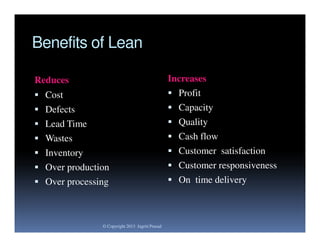
Benefits of Lean
Reduces
 Cost

 Defects
 Lead Time
 Wastes
 Inventory
 Over production
 Over processing

© Copyright 2013 Jagriti Prasad

Increases
 Profit
 Capacity
 Quality
 Cash flow
 Customer satisfaction
 Customer responsiveness
 On time delivery
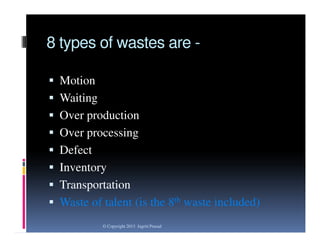
8 types of wastes are  Motion
 Waiting

 Over production
 Over processing
 Defect

 Inventory
 Transportation
 Waste of talent (is the 8th waste included)
© Copyright 2013 Jagriti Prasad
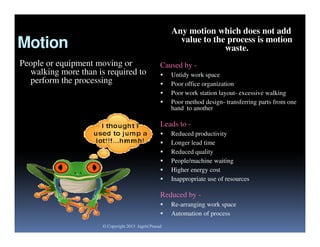
Any motion which does not add
value to the process is motion
waste.

Motion
People or equipment moving or
walking more than is required to
perform the processing

Caused by 




Untidy work space
Poor office organization
Poor work station layout- excessive walking
Poor method design- transferring parts from one
hand to another

Leads to 






Reduced productivity
Longer lead time
Reduced quality
People/machine waiting
Higher energy cost
Inappropriate use of resources

Reduced by 

© Copyright 2013 Jagriti Prasad

Re-arranging work space
Automation of process
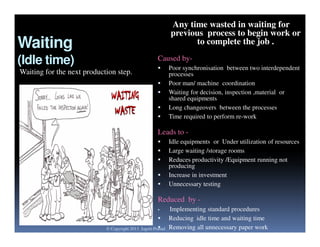
Any time wasted in waiting for
previous process to begin work or
to complete the job .

Waiting
(Idle time)

Caused by-

Waiting for the next production step.







Poor synchronisation between two interdependent
processes
Poor man/ machine coordination
Waiting for decision, inspection ,material or
shared equipments
Long changeovers between the processes
Time required to perform re-work

Leads to 





Idle equipments or Under utilization of resources
Large waiting /storage rooms
Reduces productivity /Equipment running not
producing
Increase in investment
Unnecessary testing

Reduced by 

© Copyright 2013



Jagriti Prasad

Implementing standard procedures
Reducing idle time and waiting time
Removing all unnecessary paper work
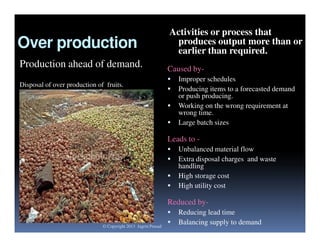
Over production
Production ahead of demand.
Disposal of over production of fruits.

Activities or process that
produces output more than or
earlier than required.
Caused by




Improper schedules
Producing items to a forecasted demand
or push producing.
Working on the wrong requirement at
wrong time.
Large batch sizes

Leads to 




Unbalanced material flow
Extra disposal charges and waste
handling
High storage cost
High utility cost

Reduced by© Copyright 2013 Jagriti Prasad




Reducing lead time
Balancing supply to demand
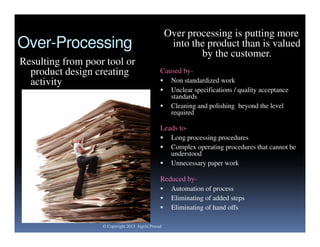
Over processing is putting more
into the product than is valued
by the customer.

Over-Processing
Resulting from poor tool or
product design creating
activity

Caused by



Non standardized work
Unclear specifications / quality acceptance
standards
Cleaning and polishing beyond the level
required

Leads to



Long processing procedures
Complex operating procedures that cannot be
understood
Unnecessary paper work

Reduced by


© Copyright 2013 Jagriti Prasad

Automation of process
Eliminating of added steps
Eliminating of hand offs
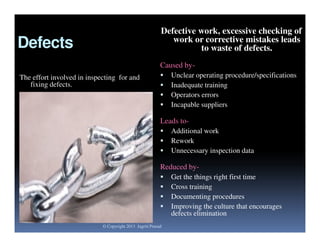
Defective work, excessive checking of
work or corrective mistakes leads
to waste of defects.

Defects

Caused byThe effort involved in inspecting for and
fixing defects.






Unclear operating procedure/specifications
Inadequate training
Operators errors
Incapable suppliers

Leads to



Additional work
Rework
Unnecessary inspection data

Reduced by



© Copyright 2013 Jagriti Prasad

Get the things right first time
Cross training
Documenting procedures
Improving the culture that encourages
defects elimination
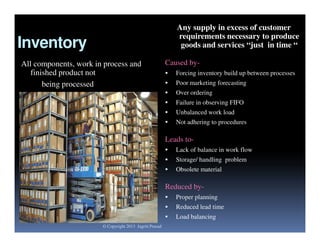
Any supply in excess of customer
requirements necessary to produce
goods and services “just in time “

Inventory
All components, work in process and
finished product not
being processed

Caused by

Forcing inventory build up between processes



Poor marketing forecasting



Over ordering



Failure in observing FIFO



Unbalanced work load



Not adhering to procedures

Leads to

Lack of balance in work flow



Storage/ handling problem



Obsolete material

Reduced by


Reduced lead time


© Copyright 2013 Jagriti Prasad

Proper planning
Load balancing
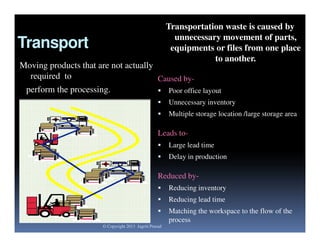
Transportation waste is caused by
unnecessary movement of parts,
equipments or files from one place
to another.

Transport

Moving products that are not actually
required to
Caused byperform the processing.
 Poor office layout


Unnecessary inventory



Multiple storage location /large storage area

Leads to

Large lead time



Delay in production

Reduced by

Reducing inventory



Reducing lead time



Matching the workspace to the flow of the
process

© Copyright 2013 Jagriti Prasad
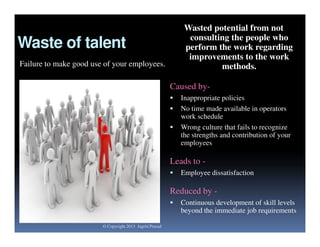
Wasted potential from not
consulting the people who
perform the work regarding
improvements to the work
methods.

Waste of talent
Failure to make good use of your employees.

Caused by



Inappropriate policies
No time made available in operators
work schedule
Wrong culture that fails to recognize
the strengths and contribution of your
employees

Leads to 

Employee dissatisfaction

Reduced by 

© Copyright 2013 Jagriti Prasad

Continuous development of skill levels
beyond the immediate job requirements
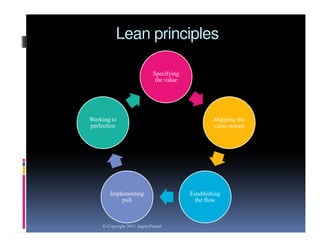
Lean principles
Specifying
the value

Working to
perfection

Implementing
pull

© Copyright 2013 Jagriti Prasad

Mapping the
value stream

Establishing
the flow
Lean principles
Specification of the value - Identifying wastes and defining value from the
customers perspective and expressing value in terms of a specific product/process.

Mapping the value stream - Mapping all the value added and non value added steps
that brings a product or service to the customer.

Establishing the flow - Continually improving the movement of products, services
or information through the process.

Implementing pull - Ensuring that a service process or upstream process does
nothing until indicated by the proceeding process or the downstream process.
Customer gets exactly what they want and when they want it, ensuring lead time
comparison and correct value specification.

Work to perfection - Creating value for the customers by continually eliminating
waste in all activities. Continuously finding ways to improve the process by
reducing inventory or reducing over production.
© Copyright 2013 Jagriti Prasad
Summary
There is always more waste that can be identified.

Following steps can be kept in mind while ensuring
continuous improvement in the process  People needs to be involved and cross trained.
 Continuous improvement leads to innovation.
 Root cause analysis should be used to solve a problem.
 Objective of the lean should be communicated to all.

© Copyright 2013 Jagriti Prasad
Thanks!
Jagriti Prasad
E- mail – jagriti_knp@yahoo.com

© Copyright 2013 Jagriti Prasad

Lean Manufacturing

  • 1.
    LEAN © Copyright 2013Jagriti Prasad
  • 2.
    WHAT IS LEAN? © Copyright 2013 Jagriti Prasad
  • 3.
     Lean improvesprocesses by eliminating wasteful activities which do not add value to the process.  It aims at a smarter, leaner, faster and efficient enterprise.  Maximize customer value while minimizing waste.  In layman terms, lean means creating more value for customers with fewer resources. © Copyright 2013 Jagriti Prasad
  • 4.
    What is “Value”here ? “Value" is defined as any action or process that a customer would be willing to pay for. © Copyright 2013 Jagriti Prasad
  • 5.
    Origin of Lean Leanmanufacturing is a management philosophy derived mostly from the Toyota Production System (TPS) and identified as "Lean" only in the 1990s. © Copyright 2013 Jagriti Prasad
  • 6.
    Who is thefather of lean ? Taiichi Ohno He devised the seven wastes (or muda in Japanese) as part of this system. © Copyright 2013 Jagriti Prasad
  • 7.
    What is “muda”or “waste” in a process? Any activity which absorbs resources and adds no value from the customers perspective. © Copyright 2013 Jagriti Prasad
  • 8.
    Benefits of Lean Reduces Cost  Defects  Lead Time  Wastes  Inventory  Over production  Over processing © Copyright 2013 Jagriti Prasad Increases  Profit  Capacity  Quality  Cash flow  Customer satisfaction  Customer responsiveness  On time delivery
  • 9.
    8 types ofwastes are  Motion  Waiting  Over production  Over processing  Defect  Inventory  Transportation  Waste of talent (is the 8th waste included) © Copyright 2013 Jagriti Prasad
  • 10.
    Any motion whichdoes not add value to the process is motion waste. Motion People or equipment moving or walking more than is required to perform the processing Caused by     Untidy work space Poor office organization Poor work station layout- excessive walking Poor method design- transferring parts from one hand to another Leads to       Reduced productivity Longer lead time Reduced quality People/machine waiting Higher energy cost Inappropriate use of resources Reduced by   © Copyright 2013 Jagriti Prasad Re-arranging work space Automation of process
  • 11.
    Any time wastedin waiting for previous process to begin work or to complete the job . Waiting (Idle time) Caused by- Waiting for the next production step.      Poor synchronisation between two interdependent processes Poor man/ machine coordination Waiting for decision, inspection ,material or shared equipments Long changeovers between the processes Time required to perform re-work Leads to      Idle equipments or Under utilization of resources Large waiting /storage rooms Reduces productivity /Equipment running not producing Increase in investment Unnecessary testing Reduced by  © Copyright 2013   Jagriti Prasad Implementing standard procedures Reducing idle time and waiting time Removing all unnecessary paper work
  • 12.
    Over production Production aheadof demand. Disposal of over production of fruits. Activities or process that produces output more than or earlier than required. Caused by    Improper schedules Producing items to a forecasted demand or push producing. Working on the wrong requirement at wrong time. Large batch sizes Leads to     Unbalanced material flow Extra disposal charges and waste handling High storage cost High utility cost Reduced by© Copyright 2013 Jagriti Prasad   Reducing lead time Balancing supply to demand
  • 13.
    Over processing isputting more into the product than is valued by the customer. Over-Processing Resulting from poor tool or product design creating activity Caused by   Non standardized work Unclear specifications / quality acceptance standards Cleaning and polishing beyond the level required Leads to   Long processing procedures Complex operating procedures that cannot be understood Unnecessary paper work Reduced by   © Copyright 2013 Jagriti Prasad Automation of process Eliminating of added steps Eliminating of hand offs
  • 14.
    Defective work, excessivechecking of work or corrective mistakes leads to waste of defects. Defects Caused byThe effort involved in inspecting for and fixing defects.     Unclear operating procedure/specifications Inadequate training Operators errors Incapable suppliers Leads to   Additional work Rework Unnecessary inspection data Reduced by    © Copyright 2013 Jagriti Prasad Get the things right first time Cross training Documenting procedures Improving the culture that encourages defects elimination
  • 15.
    Any supply inexcess of customer requirements necessary to produce goods and services “just in time “ Inventory All components, work in process and finished product not being processed Caused by Forcing inventory build up between processes  Poor marketing forecasting  Over ordering  Failure in observing FIFO  Unbalanced work load  Not adhering to procedures Leads to Lack of balance in work flow  Storage/ handling problem  Obsolete material Reduced by  Reduced lead time  © Copyright 2013 Jagriti Prasad Proper planning Load balancing
  • 16.
    Transportation waste iscaused by unnecessary movement of parts, equipments or files from one place to another. Transport Moving products that are not actually required to Caused byperform the processing.  Poor office layout  Unnecessary inventory  Multiple storage location /large storage area Leads to Large lead time  Delay in production Reduced by Reducing inventory  Reducing lead time  Matching the workspace to the flow of the process © Copyright 2013 Jagriti Prasad
  • 17.
    Wasted potential fromnot consulting the people who perform the work regarding improvements to the work methods. Waste of talent Failure to make good use of your employees. Caused by   Inappropriate policies No time made available in operators work schedule Wrong culture that fails to recognize the strengths and contribution of your employees Leads to  Employee dissatisfaction Reduced by  © Copyright 2013 Jagriti Prasad Continuous development of skill levels beyond the immediate job requirements
  • 18.
    Lean principles Specifying the value Workingto perfection Implementing pull © Copyright 2013 Jagriti Prasad Mapping the value stream Establishing the flow
  • 19.
    Lean principles Specification ofthe value - Identifying wastes and defining value from the customers perspective and expressing value in terms of a specific product/process. Mapping the value stream - Mapping all the value added and non value added steps that brings a product or service to the customer. Establishing the flow - Continually improving the movement of products, services or information through the process. Implementing pull - Ensuring that a service process or upstream process does nothing until indicated by the proceeding process or the downstream process. Customer gets exactly what they want and when they want it, ensuring lead time comparison and correct value specification. Work to perfection - Creating value for the customers by continually eliminating waste in all activities. Continuously finding ways to improve the process by reducing inventory or reducing over production. © Copyright 2013 Jagriti Prasad
  • 20.
    Summary There is alwaysmore waste that can be identified. Following steps can be kept in mind while ensuring continuous improvement in the process  People needs to be involved and cross trained.  Continuous improvement leads to innovation.  Root cause analysis should be used to solve a problem.  Objective of the lean should be communicated to all. © Copyright 2013 Jagriti Prasad
  • 21.
    Thanks! Jagriti Prasad E- mail– jagriti_knp@yahoo.com © Copyright 2013 Jagriti Prasad