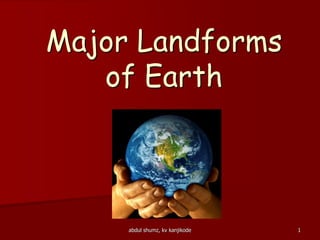
Major Landforms
of Earth
1abdul shumz, kv kanjikode
abdul shumz, kv kanjikode 2
Landforms of Earth:
Types of Landforms
1. Mountains 6. Lakes
2. Valleys 7. Ocean
3. Plains 8. Coast
4. Plateau 9. Deserts
5. Islands 10. Rivers
3abdul shumz, kv kanjikode
Internal processes: This
process leads to the upliftment
and sinking of the earth’s surface
at several places.
Landforms are a
result of:
4abdul shumz, kv kanjikode
abdul shumz, kv kanjikode 5
which are the Internal processes?
abdul shumz, kv kanjikode 6
Internal processes:
examples:
Earthquakes
Volcanic eruptions
Movement of earth plates
External process: It is the
continuous wearing down and
rebuilding of the land surface.
The wearing down of earth’s
surface is called erosion. The
surface is rebuilt by the process
of deposition.
7abdul shumz, kv kanjikode
abdul shumz, kv kanjikode 8
External processes:
examples:
Landslides
Floods
Tsunami
Earthquakes
Volcanoes
Glaciers
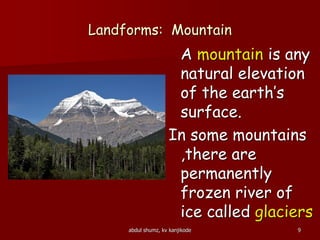
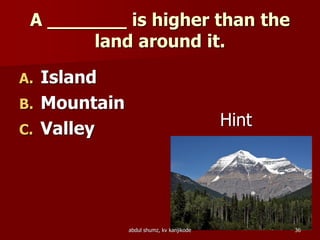
Landforms: Mountain
A mountain is any
natural elevation
of the earth’s
surface.
In some mountains
,there are
permanently
frozen river of
ice called glaciers
9abdul shumz, kv kanjikode
abdul shumz, kv kanjikode 10
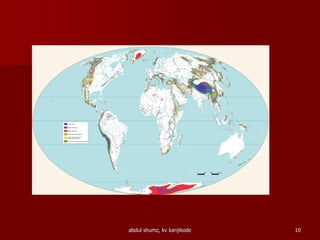
The Himalayas - India, Asia
the Alps- Europe
the Andes- South America
The Appalachians- North America
Mountains vary in their
heights and shape.
11abdul shumz, kv kanjikode
abdul shumz, kv kanjikode 12
Mountains may be arranged in
a line known as range.
Many mountain systems
consist of a series of parallel
ranges extending over
hundreds of kilometres.
TYPES OF
MOUNTAINS
• FOLD MOUNTAINS
• BLOCK
MOUNTAINS
• VOLCANIC
MOUNTAINS
abdul shumz, kv kanjikode 13
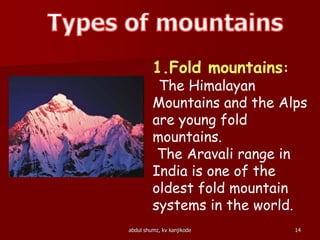
1.Fold mountains:
The Himalayan
Mountains and the Alps
are young fold
mountains.
The Aravali range in
India is one of the
oldest fold mountain
systems in the world.
14abdul shumz, kv kanjikode
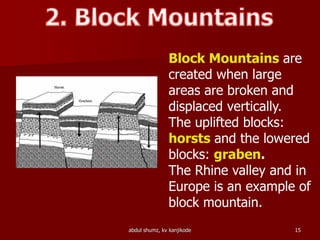
Block Mountains are
created when large
areas are broken and
displaced vertically.
The uplifted blocks:
horsts and the lowered
blocks: graben.
The Rhine valley and in
Europe is an example of
block mountain.
15abdul shumz, kv kanjikode
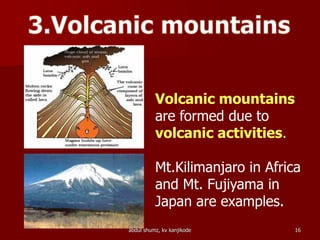
Volcanic mountains
are formed due to
volcanic activities.
Mt.Kilimanjaro in Africa
and Mt. Fujiyama in
Japan are examples.
16abdul shumz, kv kanjikode
abdul shumz, kv kanjikode 17
Mountains are very useful.
• Storehouse of water.
• Rivers have their source.
• in Reservoirs the water is
harnessed.
• Water used for irrigation and
• Generation of hydro-electricity.
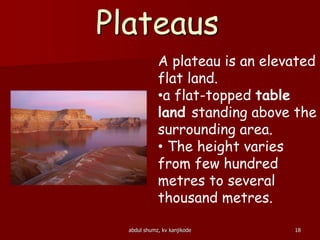
Plateaus
A plateau is an elevated
flat land.
•a flat-topped table
land standing above the
surrounding area.
• The height varies
from few hundred
metres to several
thousand metres.
18abdul shumz, kv kanjikode
abdul shumz, kv kanjikode 19
The Deccan plateau in India is one of
the oldest plateaus.
The East African Plateau in Kenya,
Tanzania and Uganda and the
Western plateau of Australia are
other examples.
The Tibet plateau is the highest
plateau in the world with a height of
4,000 to 6,000 metres above mean s.l.
* Rich in mineral deposits.
* African plateau is famous for
gold and diamond mining.
* In India huge reserves of iron,
coal and manganese are found in
the Chhotanagpur plateau.
* waterfalls :
In India the Jog falls in
Karnataka biggest waterfall.
20abdul shumz, kv kanjikode
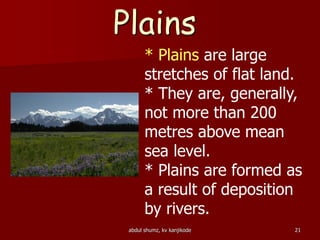
Plains
* Plains are large
stretches of flat land.
* They are, generally,
not more than 200
metres above mean
sea level.
* Plains are formed as
a result of deposition
by rivers.
21abdul shumz, kv kanjikode
abdul shumz, kv kanjikode 22
Generally, plains are very
fertile.
Construction of transport
network is easy.
Plains are very thickly-
populated regions of the
world.
largest plains: in Asia, Ganga and
the Brahmaputra in India and the
Yangtze in China.
Plains are most useful:
* great concentration of people
* Easy to construct houses
• highly productive for cultivation.
•Indo-Gangetic plains are the most
densely populated regions in India.
23abdul shumz, kv kanjikode
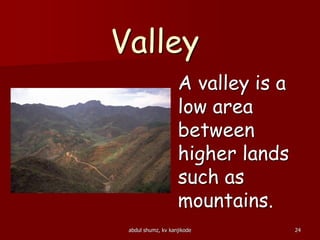
Valley
A valley is a
low area
between
higher lands
such as
mountains.
24abdul shumz, kv kanjikode
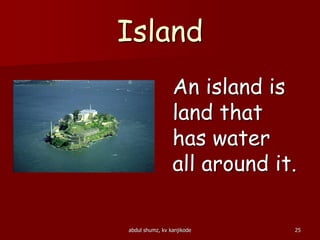
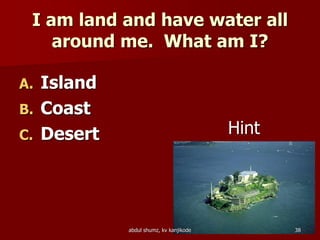
Island
An island is
land that
has water
all around it.
25abdul shumz, kv kanjikode
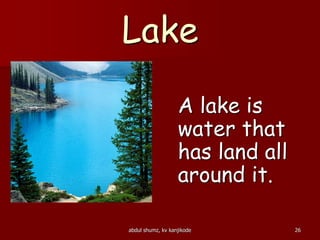
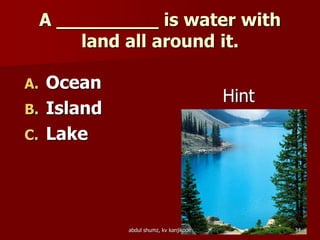
Lake
A lake is
water that
has land all
around it.
26abdul shumz, kv kanjikode
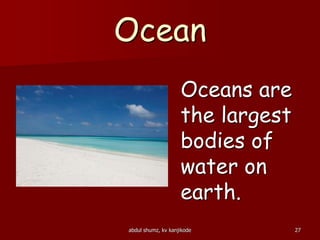
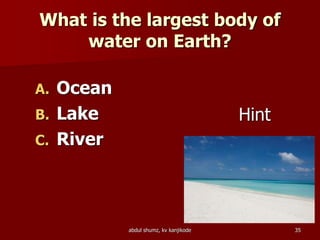
Ocean
Oceans are
the largest
bodies of
water on
earth.
27abdul shumz, kv kanjikode
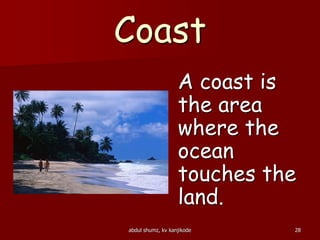
Coast
A coast is
the area
where the
ocean
touches the
land.
28abdul shumz, kv kanjikode
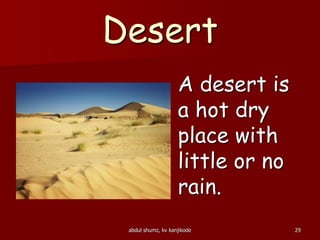
Desert
A desert is
a hot dry
place with
little or no
rain.
29abdul shumz, kv kanjikode
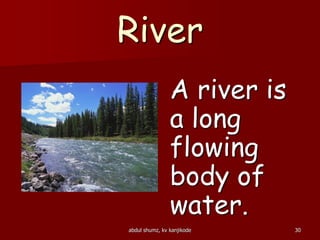
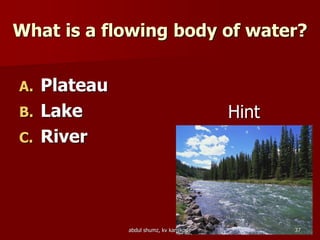
River
A river is
a long
flowing
body of
water.
30abdul shumz, kv kanjikode
Humans have been living on different kinds of
landforms in different ways. Life is difficult in
mountainous areas. Plains provide much better
conditions. It is easy to grow crops, build a
house or a road in a plain than a mountain. Can
you point out some differences in the ways
people live on different kinds of landforms?
Sometimes, natural calamities such as
earthquakes, volcanic eruption, storms and
floods cause widespread destruction. Huge loss
of life and property takes place.
31abdul shumz, kv kanjikode
By creative awareness about such
incidences we may lower the risks. You
may find out from your own surroundings
in how many ways we use the land and
water. Quite often we use the land in a
wasteful manner, for example constructing
houses on a fertile land. Similarly we throw
garbage on land or in water making them
dirty. We should avoid using such
important gifts of nature in a careless
manner. The available land is not only for
our use. It is our duty to leave the earth a
better place for future generations as well.
32abdul shumz, kv kanjikode
Now let’s review!
33abdul shumz, kv kanjikode
A _________ is water with
land all around it.
A. Ocean
B. Island
C. Lake
Hint
34abdul shumz, kv kanjikode
What is the largest body of
water on Earth?
A. Ocean
B. Lake
C. River
Hint
35abdul shumz, kv kanjikode
A _______ is higher than the
land around it.
A. Island
B. Mountain
C. Valley Hint
36abdul shumz, kv kanjikode
What is a flowing body of water?
A. Plateau
B. Lake
C. River
Hint
37abdul shumz, kv kanjikode
I am land and have water all
around me. What am I?
A. Island
B. Coast
C. Desert Hint
38abdul shumz, kv kanjikode
abdul shumz, kv kanjikode 39
Mail your suggestions to:
abdul.shumz@gmail.com

Major Landforms on Earth, Geography class 6 cbse

  • 1.
  • 2.
    abdul shumz, kvkanjikode 2 Landforms of Earth:
  • 3.
    Types of Landforms 1.Mountains 6. Lakes 2. Valleys 7. Ocean 3. Plains 8. Coast 4. Plateau 9. Deserts 5. Islands 10. Rivers 3abdul shumz, kv kanjikode
  • 4.
    Internal processes: This processleads to the upliftment and sinking of the earth’s surface at several places. Landforms are a result of: 4abdul shumz, kv kanjikode
  • 5.
    abdul shumz, kvkanjikode 5 which are the Internal processes?
  • 6.
    abdul shumz, kvkanjikode 6 Internal processes: examples: Earthquakes Volcanic eruptions Movement of earth plates
  • 7.
    External process: Itis the continuous wearing down and rebuilding of the land surface. The wearing down of earth’s surface is called erosion. The surface is rebuilt by the process of deposition. 7abdul shumz, kv kanjikode
  • 8.
    abdul shumz, kvkanjikode 8 External processes: examples: Landslides Floods Tsunami Earthquakes Volcanoes Glaciers
  • 9.
    Landforms: Mountain A mountainis any natural elevation of the earth’s surface. In some mountains ,there are permanently frozen river of ice called glaciers 9abdul shumz, kv kanjikode
  • 10.
    abdul shumz, kvkanjikode 10
  • 11.
    The Himalayas -India, Asia the Alps- Europe the Andes- South America The Appalachians- North America Mountains vary in their heights and shape. 11abdul shumz, kv kanjikode
  • 12.
    abdul shumz, kvkanjikode 12 Mountains may be arranged in a line known as range. Many mountain systems consist of a series of parallel ranges extending over hundreds of kilometres.
  • 13.
    TYPES OF MOUNTAINS • FOLDMOUNTAINS • BLOCK MOUNTAINS • VOLCANIC MOUNTAINS abdul shumz, kv kanjikode 13
  • 14.
    1.Fold mountains: The Himalayan Mountainsand the Alps are young fold mountains. The Aravali range in India is one of the oldest fold mountain systems in the world. 14abdul shumz, kv kanjikode
  • 15.
    Block Mountains are createdwhen large areas are broken and displaced vertically. The uplifted blocks: horsts and the lowered blocks: graben. The Rhine valley and in Europe is an example of block mountain. 15abdul shumz, kv kanjikode
  • 16.
    Volcanic mountains are formeddue to volcanic activities. Mt.Kilimanjaro in Africa and Mt. Fujiyama in Japan are examples. 16abdul shumz, kv kanjikode
  • 17.
    abdul shumz, kvkanjikode 17 Mountains are very useful. • Storehouse of water. • Rivers have their source. • in Reservoirs the water is harnessed. • Water used for irrigation and • Generation of hydro-electricity.
  • 18.
    Plateaus A plateau isan elevated flat land. •a flat-topped table land standing above the surrounding area. • The height varies from few hundred metres to several thousand metres. 18abdul shumz, kv kanjikode
  • 19.
    abdul shumz, kvkanjikode 19 The Deccan plateau in India is one of the oldest plateaus. The East African Plateau in Kenya, Tanzania and Uganda and the Western plateau of Australia are other examples. The Tibet plateau is the highest plateau in the world with a height of 4,000 to 6,000 metres above mean s.l. * Rich in mineral deposits.
  • 20.
    * African plateauis famous for gold and diamond mining. * In India huge reserves of iron, coal and manganese are found in the Chhotanagpur plateau. * waterfalls : In India the Jog falls in Karnataka biggest waterfall. 20abdul shumz, kv kanjikode
  • 21.
    Plains * Plains arelarge stretches of flat land. * They are, generally, not more than 200 metres above mean sea level. * Plains are formed as a result of deposition by rivers. 21abdul shumz, kv kanjikode
  • 22.
    abdul shumz, kvkanjikode 22 Generally, plains are very fertile. Construction of transport network is easy. Plains are very thickly- populated regions of the world.
  • 23.
    largest plains: inAsia, Ganga and the Brahmaputra in India and the Yangtze in China. Plains are most useful: * great concentration of people * Easy to construct houses • highly productive for cultivation. •Indo-Gangetic plains are the most densely populated regions in India. 23abdul shumz, kv kanjikode
  • 24.
    Valley A valley isa low area between higher lands such as mountains. 24abdul shumz, kv kanjikode
  • 25.
    Island An island is landthat has water all around it. 25abdul shumz, kv kanjikode
  • 26.
    Lake A lake is waterthat has land all around it. 26abdul shumz, kv kanjikode
  • 27.
    Ocean Oceans are the largest bodiesof water on earth. 27abdul shumz, kv kanjikode
  • 28.
    Coast A coast is thearea where the ocean touches the land. 28abdul shumz, kv kanjikode
  • 29.
    Desert A desert is ahot dry place with little or no rain. 29abdul shumz, kv kanjikode
  • 30.
    River A river is along flowing body of water. 30abdul shumz, kv kanjikode
  • 31.
    Humans have beenliving on different kinds of landforms in different ways. Life is difficult in mountainous areas. Plains provide much better conditions. It is easy to grow crops, build a house or a road in a plain than a mountain. Can you point out some differences in the ways people live on different kinds of landforms? Sometimes, natural calamities such as earthquakes, volcanic eruption, storms and floods cause widespread destruction. Huge loss of life and property takes place. 31abdul shumz, kv kanjikode
  • 32.
    By creative awarenessabout such incidences we may lower the risks. You may find out from your own surroundings in how many ways we use the land and water. Quite often we use the land in a wasteful manner, for example constructing houses on a fertile land. Similarly we throw garbage on land or in water making them dirty. We should avoid using such important gifts of nature in a careless manner. The available land is not only for our use. It is our duty to leave the earth a better place for future generations as well. 32abdul shumz, kv kanjikode
  • 33.
    Now let’s review! 33abdulshumz, kv kanjikode
  • 34.
    A _________ iswater with land all around it. A. Ocean B. Island C. Lake Hint 34abdul shumz, kv kanjikode
  • 35.
    What is thelargest body of water on Earth? A. Ocean B. Lake C. River Hint 35abdul shumz, kv kanjikode
  • 36.
    A _______ ishigher than the land around it. A. Island B. Mountain C. Valley Hint 36abdul shumz, kv kanjikode
  • 37.
    What is aflowing body of water? A. Plateau B. Lake C. River Hint 37abdul shumz, kv kanjikode
  • 38.
    I am landand have water all around me. What am I? A. Island B. Coast C. Desert Hint 38abdul shumz, kv kanjikode
  • 39.
    abdul shumz, kvkanjikode 39 Mail your suggestions to: abdul.shumz@gmail.com