


Valleys
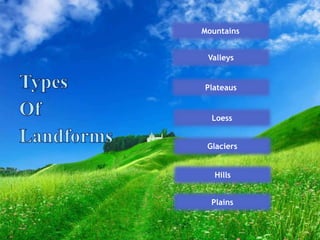
Mountains
Plateaus
Loess
Glaciers
Hills
Plains
*Mountains
*
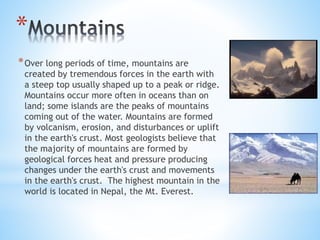
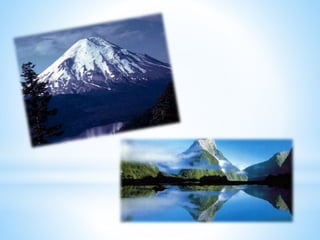
*Over long periods of time, mountains are
created by tremendous forces in the earth with
a steep top usually shaped up to a peak or ridge.
Mountains occur more often in oceans than on
land; some islands are the peaks of mountains
coming out of the water. Mountains are formed
by volcanism, erosion, and disturbances or uplift
in the earth's crust. Most geologists believe that
the majority of mountains are formed by
geological forces heat and pressure producing
changes under the earth's crust and movements
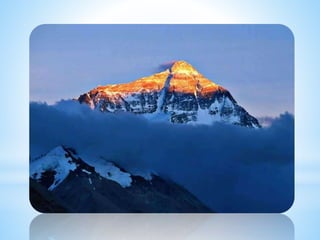
in the earth's crust. The highest mountain in the
world is located in Nepal, the Mt. Everest.
*
*
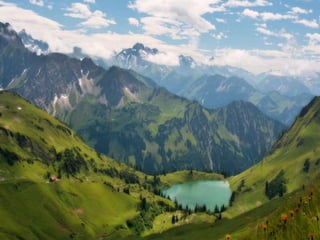
*A valley is a hollow or surface
depression of the earth bounded by
hills or mountains, a natural trough in
the earth's surface, that slopes down
to a stream, lake or the ocean,
formed by water and/or ice erosion.
Systems of valleys extend through
plains, hills, and mountains. Rivers
and streams flowing through valleys
drain interior land regions to the
ocean.
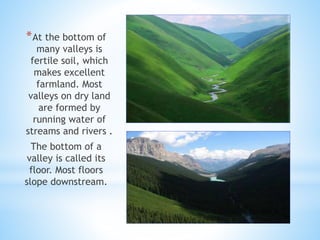
*At the bottom of
many valleys is
fertile soil, which
makes excellent
farmland. Most
valleys on dry land
are formed by
running water of
streams and rivers .
The bottom of a
valley is called its
floor. Most floors
slope downstream.
*
*
*A plateau is a large highland area of fairly level
land separated from surrounding land by steep
slopes. Some plateaus, like the plateau of
Tibet, lie between mountain ranges. Others are
higher than surrounding land. Plateaus are
widespread, and together with enclosed basins
they cover about 45 percent of the Earth's land
surface.
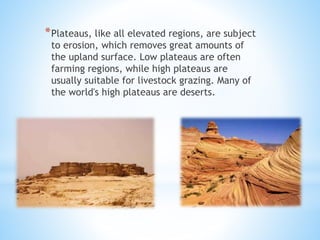
*Plateaus, like all elevated regions, are subject
to erosion, which removes great amounts of
the upland surface. Low plateaus are often
farming regions, while high plateaus are
usually suitable for livestock grazing. Many of
the world's high plateaus are deserts.
*
*
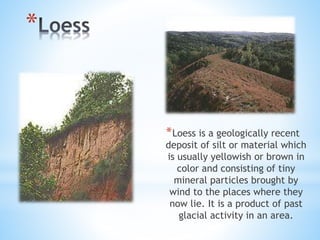
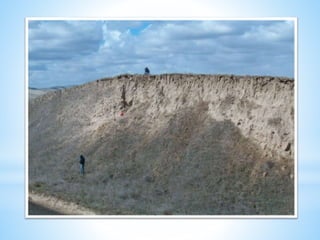
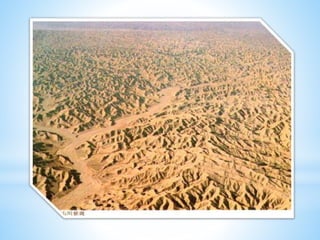
*Loess is a geologically recent
deposit of silt or material which
is usually yellowish or brown in
color and consisting of tiny
mineral particles brought by
wind to the places where they
now lie. It is a product of past
glacial activity in an area.
*
*
*Ice sheets and glaciers form
the largest component of
perennial ice on this planet.
Over 75% of the world's fresh
water is presently locked up
in these frozen reservoirs.
The Antarctic Ice Sheet is
more complicated than the
Greenland Ice Sheet. In the
past three million years,
there have been four glacial
periods, each followed by an
interglacial period. The
most recent glacial period
began about 75,000 years
ago.
*
*
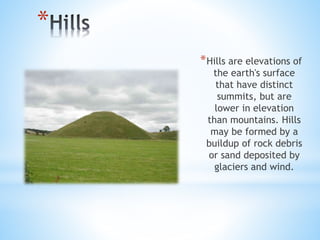
*Hills are elevations of
the earth's surface
that have distinct
summits, but are
lower in elevation
than mountains. Hills
may be formed by a
buildup of rock debris
or sand deposited by
glaciers and wind.
*Hills are also formed by deep erosion of areas
that were raised by disturbances in the earth's
crust. Erosion forms hills by carrying away all
of the soil on a mountain, causing a hill to be
left behind. Humans also make hills by digging
soil up and dumping it in a giant pile.
Volcanoes are also another way that hills are
formed. Volcanoes form hills when they erupt.
*
*
*Plains are broad, nearly level stretches of land that
have no great changes in elevation. Plains are
generally lower than the land around them; they
may be found along a coast or inland. Coastal plains
generally rise from sea level until they meet higher
landforms such as mountains or plateaus. Inland
plains may be found at high altitudes.
Land formations
Land formations
Land formations

Land formations

  • 3.
  • 4.
  • 5.
    * *Over long periodsof time, mountains are created by tremendous forces in the earth with a steep top usually shaped up to a peak or ridge. Mountains occur more often in oceans than on land; some islands are the peaks of mountains coming out of the water. Mountains are formed by volcanism, erosion, and disturbances or uplift in the earth's crust. Most geologists believe that the majority of mountains are formed by geological forces heat and pressure producing changes under the earth's crust and movements in the earth's crust. The highest mountain in the world is located in Nepal, the Mt. Everest.
  • 8.
  • 9.
    * *A valley isa hollow or surface depression of the earth bounded by hills or mountains, a natural trough in the earth's surface, that slopes down to a stream, lake or the ocean, formed by water and/or ice erosion. Systems of valleys extend through plains, hills, and mountains. Rivers and streams flowing through valleys drain interior land regions to the ocean.
  • 10.
    *At the bottomof many valleys is fertile soil, which makes excellent farmland. Most valleys on dry land are formed by running water of streams and rivers . The bottom of a valley is called its floor. Most floors slope downstream.
  • 12.
  • 13.
    * *A plateau isa large highland area of fairly level land separated from surrounding land by steep slopes. Some plateaus, like the plateau of Tibet, lie between mountain ranges. Others are higher than surrounding land. Plateaus are widespread, and together with enclosed basins they cover about 45 percent of the Earth's land surface.
  • 14.
    *Plateaus, like allelevated regions, are subject to erosion, which removes great amounts of the upland surface. Low plateaus are often farming regions, while high plateaus are usually suitable for livestock grazing. Many of the world's high plateaus are deserts.
  • 17.
  • 18.
    * *Loess is ageologically recent deposit of silt or material which is usually yellowish or brown in color and consisting of tiny mineral particles brought by wind to the places where they now lie. It is a product of past glacial activity in an area.
  • 21.
  • 22.
    * *Ice sheets andglaciers form the largest component of perennial ice on this planet. Over 75% of the world's fresh water is presently locked up in these frozen reservoirs. The Antarctic Ice Sheet is more complicated than the Greenland Ice Sheet. In the past three million years, there have been four glacial periods, each followed by an interglacial period. The most recent glacial period began about 75,000 years ago.
  • 25.
  • 26.
    * *Hills are elevationsof the earth's surface that have distinct summits, but are lower in elevation than mountains. Hills may be formed by a buildup of rock debris or sand deposited by glaciers and wind.
  • 27.
    *Hills are alsoformed by deep erosion of areas that were raised by disturbances in the earth's crust. Erosion forms hills by carrying away all of the soil on a mountain, causing a hill to be left behind. Humans also make hills by digging soil up and dumping it in a giant pile. Volcanoes are also another way that hills are formed. Volcanoes form hills when they erupt.
  • 29.
  • 30.
    * *Plains are broad,nearly level stretches of land that have no great changes in elevation. Plains are generally lower than the land around them; they may be found along a coast or inland. Coastal plains generally rise from sea level until they meet higher landforms such as mountains or plateaus. Inland plains may be found at high altitudes.