WHAT IS BIPOLAR DISORDER?
According to the National Institute Of Health, Bipolar
“is a brain disorder that causes unusual shifts in
mood, energy, activity levels, and the ability to carry
out day-to-day tasks. Symptoms of bipolar disorder
are severe. They are different from the normal ups
and downs that everyone goes through from time to
time.”
Causes:
• Genes, because the illness runs in families
• Abnormal brain structure and brain function.
National Institutes Of Health. (2015). Bipolar. Retrieved from
http://www.nimh.nih.gov/health/publications/bipolar-disorder-easy-to-read/index.shtml#What-is-
bipolar-disorder?
Everyone goes through mood changes in their lifetime, but for those with
bipolar disorder mood changes can last longer or cycle more rapidly and
are extreme in comparison with normal ups and downs.
There are four different types of bipolar disorder classified in the DSM V
(The Fifth Edition of the Diagnostic and Statistical Manual of Mental
Disorders): Bipolar I, Bipolar II, Other Specified Bipolar and Related
Disorder, and Cyclothymia or Cyclothymic Disorder.
• Bipolar I Disorder – characterized by manic episodes lasting at least a
week, or by symptoms of mania so severe that a person requires
immediate hospitalization. A person will also normally experience a
depressive episode of about two weeks. For a bipolar I diagnosis, a
person’s manic and depressive symptoms must deviate from their
normal behavior.
• Bipolar II Disorder – characterized by a cycle of depressive episodes
shifting back and forth with hypomanic episodes, without experiencing
full-blown manic or mixed episodes.
• Other Specified Bipolar and Related Disorder (previously called Bipolar Not
Otherwise Specified) – This diagnosis is characterized by those with a past
history of a major depressive disorder who meet all the requirements for
hypomania except the duration of their episodes. This can also include those
exhibit too few symptoms of hypomania to be diagnosed with Bipolar II, though
the duration of their episodes is four days or more.
• Cyclothymia or Cyclothymic Disorder – characterized by at least two years of
hypomanic episodes shifting back and forth with episodes of mild depression.
This diagnosis is considered a mild form of bipolar disorder because the
symptoms do not meet the requirements for other types of bipolar disorder.
Inspired Malibu. Bipolar Disorder Treatment Center. (2015). Retrieved from http://www.inspiremalibu.com/bipolar-treatment-center/
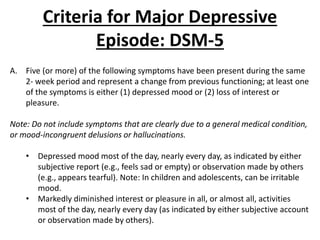
Criteria for Major Depressive
Episode: DSM-5
A. Five (or more) of the following symptoms have been present during the same
2- week period and represent a change from previous functioning; at least one
of the symptoms is either (1) depressed mood or (2) loss of interest or
pleasure.
Note: Do not include symptoms that are clearly due to a general medical condition,
or mood-incongruent delusions or hallucinations.
• Depressed mood most of the day, nearly every day, as indicated by either
subjective report (e.g., feels sad or empty) or observation made by others
(e.g., appears tearful). Note: In children and adolescents, can be irritable
mood.
• Markedly diminished interest or pleasure in all, or almost all, activities
most of the day, nearly every day (as indicated by either subjective account
or observation made by others).
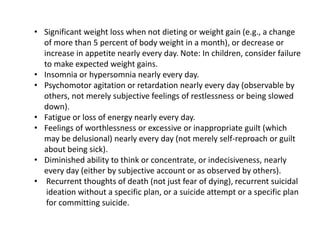
• Significant weight loss when not dieting or weight gain (e.g., a change
of more than 5 percent of body weight in a month), or decrease or
increase in appetite nearly every day. Note: In children, consider failure
to make expected weight gains.
• Insomnia or hypersomnia nearly every day.
• Psychomotor agitation or retardation nearly every day (observable by
others, not merely subjective feelings of restlessness or being slowed
down).
• Fatigue or loss of energy nearly every day.
• Feelings of worthlessness or excessive or inappropriate guilt (which
may be delusional) nearly every day (not merely self-reproach or guilt
about being sick).
• Diminished ability to think or concentrate, or indecisiveness, nearly
every day (either by subjective account or as observed by others).
• Recurrent thoughts of death (not just fear of dying), recurrent suicidal
ideation without a specific plan, or a suicide attempt or a specific plan
for committing suicide.
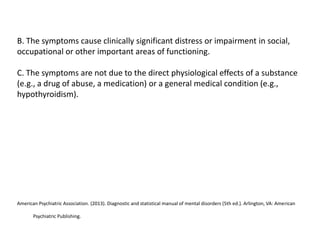
B. The symptoms cause clinically significant distress or impairment in social,
occupational or other important areas of functioning.
C. The symptoms are not due to the direct physiological effects of a substance
(e.g., a drug of abuse, a medication) or a general medical condition (e.g.,
hypothyroidism).
American Psychiatric Association. (2013). Diagnostic and statistical manual of mental disorders (5th ed.). Arlington, VA: American
Psychiatric Publishing.
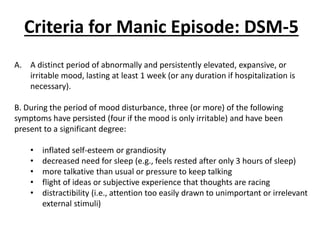
Criteria for Manic Episode: DSM-5
A. A distinct period of abnormally and persistently elevated, expansive, or
irritable mood, lasting at least 1 week (or any duration if hospitalization is
necessary).
B. During the period of mood disturbance, three (or more) of the following
symptoms have persisted (four if the mood is only irritable) and have been
present to a significant degree:
• inflated self-esteem or grandiosity
• decreased need for sleep (e.g., feels rested after only 3 hours of sleep)
• more talkative than usual or pressure to keep talking
• flight of ideas or subjective experience that thoughts are racing
• distractibility (i.e., attention too easily drawn to unimportant or irrelevant
external stimuli)
• increase in goal-directed activity (either socially, at work or school, or
sexually) or psychomotor agitation
• excessive involvement in pleasurable activities that have a high potential
for painful consequences (e.g., engaging in unrestrained buying sprees,
sexual indiscretions, or foolish business investments)
C. The mood disturbance is sufficiently severe to cause marked impairment in
occupational functioning or in usual social activities or relationships with others,
or to necessitate hospitalization to prevent harm to self or others, or there are
psychotic features.
D. The symptoms are not due to the direct physiological effects of a substance
(e.g., a drug of abuse, a medication, or other treatment) or a general medical
condition (e.g., hyperthyroidism).
Note: Manic-like episodes that are clearly caused by somatic antidepressant
treatment (e.g., medication, electroconvulsive therapy, light therapy) should not
count toward a diagnosis of Bipolar I Disorder.
American Psychiatric Association. (2013). Diagnostic and statistical manual of mental disorders (5th ed.). Arlington, VA: American
Psychiatric Publishing.
Bipolar Disorder is brain
disorder caused by genetic
and biological factors with
environmental and random
triggers. Let’s recap with a
Crash Course video.

What is bipolar disorder

  • 1.
    WHAT IS BIPOLARDISORDER? According to the National Institute Of Health, Bipolar “is a brain disorder that causes unusual shifts in mood, energy, activity levels, and the ability to carry out day-to-day tasks. Symptoms of bipolar disorder are severe. They are different from the normal ups and downs that everyone goes through from time to time.” Causes: • Genes, because the illness runs in families • Abnormal brain structure and brain function. National Institutes Of Health. (2015). Bipolar. Retrieved from http://www.nimh.nih.gov/health/publications/bipolar-disorder-easy-to-read/index.shtml#What-is- bipolar-disorder?
  • 2.
    Everyone goes throughmood changes in their lifetime, but for those with bipolar disorder mood changes can last longer or cycle more rapidly and are extreme in comparison with normal ups and downs. There are four different types of bipolar disorder classified in the DSM V (The Fifth Edition of the Diagnostic and Statistical Manual of Mental Disorders): Bipolar I, Bipolar II, Other Specified Bipolar and Related Disorder, and Cyclothymia or Cyclothymic Disorder. • Bipolar I Disorder – characterized by manic episodes lasting at least a week, or by symptoms of mania so severe that a person requires immediate hospitalization. A person will also normally experience a depressive episode of about two weeks. For a bipolar I diagnosis, a person’s manic and depressive symptoms must deviate from their normal behavior. • Bipolar II Disorder – characterized by a cycle of depressive episodes shifting back and forth with hypomanic episodes, without experiencing full-blown manic or mixed episodes.
  • 3.
    • Other SpecifiedBipolar and Related Disorder (previously called Bipolar Not Otherwise Specified) – This diagnosis is characterized by those with a past history of a major depressive disorder who meet all the requirements for hypomania except the duration of their episodes. This can also include those exhibit too few symptoms of hypomania to be diagnosed with Bipolar II, though the duration of their episodes is four days or more. • Cyclothymia or Cyclothymic Disorder – characterized by at least two years of hypomanic episodes shifting back and forth with episodes of mild depression. This diagnosis is considered a mild form of bipolar disorder because the symptoms do not meet the requirements for other types of bipolar disorder. Inspired Malibu. Bipolar Disorder Treatment Center. (2015). Retrieved from http://www.inspiremalibu.com/bipolar-treatment-center/
  • 4.
    Criteria for MajorDepressive Episode: DSM-5 A. Five (or more) of the following symptoms have been present during the same 2- week period and represent a change from previous functioning; at least one of the symptoms is either (1) depressed mood or (2) loss of interest or pleasure. Note: Do not include symptoms that are clearly due to a general medical condition, or mood-incongruent delusions or hallucinations. • Depressed mood most of the day, nearly every day, as indicated by either subjective report (e.g., feels sad or empty) or observation made by others (e.g., appears tearful). Note: In children and adolescents, can be irritable mood. • Markedly diminished interest or pleasure in all, or almost all, activities most of the day, nearly every day (as indicated by either subjective account or observation made by others).
  • 5.
    • Significant weightloss when not dieting or weight gain (e.g., a change of more than 5 percent of body weight in a month), or decrease or increase in appetite nearly every day. Note: In children, consider failure to make expected weight gains. • Insomnia or hypersomnia nearly every day. • Psychomotor agitation or retardation nearly every day (observable by others, not merely subjective feelings of restlessness or being slowed down). • Fatigue or loss of energy nearly every day. • Feelings of worthlessness or excessive or inappropriate guilt (which may be delusional) nearly every day (not merely self-reproach or guilt about being sick). • Diminished ability to think or concentrate, or indecisiveness, nearly every day (either by subjective account or as observed by others). • Recurrent thoughts of death (not just fear of dying), recurrent suicidal ideation without a specific plan, or a suicide attempt or a specific plan for committing suicide.
  • 6.
    B. The symptomscause clinically significant distress or impairment in social, occupational or other important areas of functioning. C. The symptoms are not due to the direct physiological effects of a substance (e.g., a drug of abuse, a medication) or a general medical condition (e.g., hypothyroidism). American Psychiatric Association. (2013). Diagnostic and statistical manual of mental disorders (5th ed.). Arlington, VA: American Psychiatric Publishing.
  • 7.
    Criteria for ManicEpisode: DSM-5 A. A distinct period of abnormally and persistently elevated, expansive, or irritable mood, lasting at least 1 week (or any duration if hospitalization is necessary). B. During the period of mood disturbance, three (or more) of the following symptoms have persisted (four if the mood is only irritable) and have been present to a significant degree: • inflated self-esteem or grandiosity • decreased need for sleep (e.g., feels rested after only 3 hours of sleep) • more talkative than usual or pressure to keep talking • flight of ideas or subjective experience that thoughts are racing • distractibility (i.e., attention too easily drawn to unimportant or irrelevant external stimuli)
  • 8.
    • increase ingoal-directed activity (either socially, at work or school, or sexually) or psychomotor agitation • excessive involvement in pleasurable activities that have a high potential for painful consequences (e.g., engaging in unrestrained buying sprees, sexual indiscretions, or foolish business investments) C. The mood disturbance is sufficiently severe to cause marked impairment in occupational functioning or in usual social activities or relationships with others, or to necessitate hospitalization to prevent harm to self or others, or there are psychotic features. D. The symptoms are not due to the direct physiological effects of a substance (e.g., a drug of abuse, a medication, or other treatment) or a general medical condition (e.g., hyperthyroidism). Note: Manic-like episodes that are clearly caused by somatic antidepressant treatment (e.g., medication, electroconvulsive therapy, light therapy) should not count toward a diagnosis of Bipolar I Disorder. American Psychiatric Association. (2013). Diagnostic and statistical manual of mental disorders (5th ed.). Arlington, VA: American Psychiatric Publishing.
  • 9.
    Bipolar Disorder isbrain disorder caused by genetic and biological factors with environmental and random triggers. Let’s recap with a Crash Course video.