MAINTENANCE MANAGEMENT
B.F.Tech 6nd Semester
• In general, Maintenance means to hold, keep, sustain or
preserve the building ,machine, equipment or structure to
an acceptable standard of performance, safety and/or
aesthetics.
• All of us perform or practice Some form of maintenance in
our daily life.
• Whether you own a house, car, electrical equipment or
any machine they all require maintenance to sustain their
serviceability through out their lifecycle.
Introduction
Introduction
• The same holds true for industrial equipment/system.
• Maintenance is one of the most indispensable job in any
industrial organization.
Introduction
• The exploitation of knowledge and technology has
resulted in the development of complex and sophisticated
equipment and automated machinery in every field of
engineering.
• These high investment systems, in turn, call for their
effective utilization.
• Proper maintenance helps to keep such machine and
systems in working order to meet production targets or
service requirements and to ensure a longer and trouble
free life.
Definition
British Standard Glossary of terms (3811:1993) defined
maintenance as:
• "The combination of all technical and associated
administrative actions, including supervision actions,
intended to retain an item in or restore it to a state in
which it can perform its required function. This required
function might be defined as stated condition."
Definition
• Maintenance is the routine and recurring process of
keeping a particular machine or asset in its normal
operating condition so that it can deliver its expected
performance or service without causing any loss of time
on account of accidental damage or breakdown.
• In other words, maintenance means the work that is to be
done, to keep the equipment/system in running condition
such that it can be utilized to its full designed capacity and
efficiency for maximum amount of time.
Maintenance Management
Definition:
“All the activities of management that determines the
maintenance objectives or priorities (defined as the targets
assigned and accepted by the management and
maintenance department), strategies (defined as
management methods in order to achieve maintenance
objectives) and responsibilities and implement them by
means such as maintenance planning, maintenance control
and supervision and several improving methods including
economical aspects in the organization.”
Source: Marquez Adolfo Crespo, The Maintenance Management Framework , Springer Series in Reliability
Engineering, 2007, pp 3-10
Maintenance Concept & Plan
• Maintenance concept: A statement of the overall concept
of the item/product specification or policy that controls the
type of maintenance action to be employed for the item
under consideration.
• With information available from users of equipment, the
detailed procedures are drawn to concretize the
maintenance concept.
• Maintenance plan: A document that outlines the
management and technical executable procedure to be
employed to maintain an item; usually describes facilities,
tools, schedules, and resources required.
Maintenance Concept & Plan
• The maintenance concept of equipment is related to the
operational needs of equipment, which may change from
machine to machine or system to system.
• First of all the operational concept is determined and then
the maintenance concept is developed to support the
operational concept.
• Finally, a maintenance plan is prepared on accordance
with the maintenance concept thus developed, which can
be more realistic.
Evolution of Maintenance Concept
• The idea of maintenance is very old and was introduced
along with the inception of machine.
• In early days, a machine was used as long as it worked.
When it stopped working, it was either repaired or
discarded.
• The traditional breakdown maintenance system can no
longer maintain the economic lifeline of the modern
industry.
Evolution of Maintenance Concept
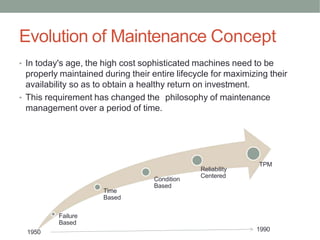
• In today's age, the high cost sophisticated machines need to be
properly maintained during their entire lifecycle for maximizing their
availability so as to obtain a healthy return on investment.
• This requirement has changed the philosophy of maintenance
management over a period of time.
Failure
Based
Time
Based
Condition
Based
Reliability
Centered
TPM
1950 1990
Systems approach
• A systems approach to maintenance involves setting up of
objectives, planning, executing and controlling the
maintenance functions, not as an isolated function but as
a part of corporate policies and strategies aimed at
achieving the well-defined overall goals of the
organization.
• Internally, the maintenance function coordinates its
activities with other functions like production and sales,
and externally it ensures availability of quality spares,
trained manpower, replacement of worn-out equipment
and so forth.
• This approach takes into account all the relevant
interacting functions both internal and external to system.
SystemApproach
The system approach to maintenance involves the
following:
• Identification of the needs of maintenance
• Analyzing the requirements for the above needs
• Determining the functional procedures for maintenance
task selection, work planning and scheduling, work order
processing, etc.
• Outlining a reporting and controlling procedure
• Development of supporting facilities and infrastructure
• Determining the cost accounting procedures
• Adopting a policy for training and quality assurance
Maintenance Objectives
• The most important objective of the maintenance function
is the maximization of availability of equipment or facilities
so as to extend help in achieving the ultimate goals of the
organization.
• Maintenance work raises the equipment performance
level and its availability but adds to its running cost.
• The objective of maintenance should also be to strike a
balance between the availability and overall running cost.
• Another important objective of maintenance is the
establishment of safe working conditions both for
operating and maintenance personnel.
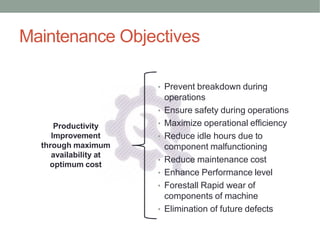
Maintenance Objectives
• Prevent breakdown during
operations
• Ensure safety during operations
• Maximize operational efficiency
• Reduce idle hours due to
component malfunctioning
• Reduce maintenance cost
• Enhance Performance level
• Forestall Rapid wear of
components of machine
• Elimination of future defects
Productivity
Improvement
through maximum
availability at
optimum cost
Responsibilities of Maintenance
Department
• To achieve the objectives of maintenance it is necessary
to lay down the responsibilities of maintenance
department.
• Following are some of the responsibilities of maintenance
department:
• Personnel Management
• Maintenance Scheduling & Job distribution
• Feedback & control
• Budgeting and financial management
• Inventory management
Personnel Management
• Maintaining availability of the sufficient trained work force
and avoiding delays in maintenance work due to
absenteeism.
• Arranging alternative facilities when sufficient trained
manpower is not available for the job.
• Minimizing conflicts among the production and
maintenance staff.
• Training and upgrading skill of maintenance personnel.
Maintenance Scheduling & Job
distribution
• Developing maintenance schedules and repair and
overhaul programmes for all equipments and machinery
• Preparation of job list and proper job allotment to the
workers and supervisors.
• No job should be left unattended and requirement of
specialization and time should be kept in mind while
assigning a job.
• Adequate supervision should be done from time to time to
ensure quality of maintenance work.
Feedback and control
• Setting up of an effective maintenance information system
for maintenance planning and execution.
• Feedback helps to take corrective decisions, if required, in
time to control the function effectively and timely keeping
in mind the operational requirements.
• Feedback helps in deciding
• Reinforcements of manpower in certain areas where required the
most.
• On timely Procurement of spare parts
• The need of external technical support
• To take and alternative decision when situation demands
Budgeting and financial management
• It is essential to budget sufficient funds for the
maintenance function well in time.
• Budgetary provisions for planned maintenance and
certain unplanned emergency work need to be made in
advance.
• This help in proper utilization of funds and monitoring of
cost.
Inventory Management
• During maintenance work, some spare parts/components
are always required and therefore, the required quantity of
those parts must be stored.
• Often, the non-availability of spare parts causes delays in
maintenance work. Therefore, inventory management is
an important aspect of maintenance.
• inventory management becomes more difficult and costly
in cases where variety of machines is more.
MAINTENANCE MANAGEMENT
Maintenance organization
Types of Maintenance Organization
Decentralized:
• In large sized plants located at different places, inter-unit
communication is difficult.
• Therefore, in such cases the decentralized type of
organization is best suited.
• The maintenance department works under the direct
control of chief engineer/manager who is in-charge of
production.
• A better coordination between production and
maintenance workforce can be achieved in this type of
organization.
Types of Maintenance Organization
Centralized:
• In relatively small factories where communication
between the departments is more easy, the centralized
type of maintenance organization is preferred.
• The maintenance function works under the direct control
of chief maintenance engineer who is responsible for all
the maintenance work in the factory.
• The responsibilities and accountabilities must be clearly
defined for maintenance as well as production personnel
to avoid confrontation.
Benefits of centralized maintenance
• More efficient compared to decentralized maintenance
• Fewer maintenance personnel required
• More effective line supervision
• Greater use of special equipment and specialized
maintenance persons
• Generally allows more effective on-the-job training
Drawbacks of centralized maintenance
• Requires more time getting to and from the work area or
job
• No one individual becomes totally familiar with complex
hardware or equipment
• More difficult supervision because of remoteness of
maintenance site from the centralized headquarters
• Higher transportation cost due to remote maintenance
work
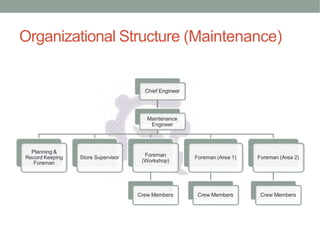
Organizational Structure (Maintenance)
Chief Engineer
Maintenance
Engineer
Planning &
Record Keeping
Foreman
Store Supervisor Foreman
(Workshop)
Crew Members
Foreman (Area 1)
Crew Members
Foreman (Area 2)
Crew Members
Types of Maintenance Systems
• Maintenance can be divided into two groups:
• Unplanned Maintenance or Breakdown Maintenance
• Planned Maintenance
• Preventive Maintenance
• Corrective maintenance
• Scheduled Maintenance
• Condition-Based Maintenance
• Reliability-centered Maintenance
• Maintenance can be performed in two modes:
• Running Maintenance (Asset is in operation)
• Shut Down Maintenance (Asset is out of service)
Source: Mishra RC, Pathak k, Maintenance Engineering and Management, PHIL Pvt. Ltd. New Delhi, 2012, p12
Breakdown Maintenance
• Breakdown maintenance is basically the “run it till it
breaks” maintenance mode.
• No actions or efforts are taken to maintain the equipment
until a component or equipment fails or becomes
inoperative.
• The work which is required to be done in the case of an
emergency failure, has to be carried out to bring back the
equipment to its original working condition.
• In case of risky equipment /systems such as aircraft,
elevators and other such items, chances with only
breakdown maintenance cannot be taken.
Breakdown Maintenance
• Even though it appears to be an economical proposition,
work would greatly suffer if the machine is not restored to
operational condition immediately.
• In this type of maintenance, during the repair, no proper
care is taken to know the real cause of the breakdown,
which in turn may lead to frequent failures of same kind.
Breakdown Maintenance
• Advantages
• Less Investment.
• Less staff.
• Disadvantages
• Increased cost due to unplanned downtime of equipment.
• Increased labor cost, especially if overtime is needed.
• Cost involved with repair or replacement of equipment.
• Possible secondary equipment or process damage from equipment
failure.
• Inefficient use of staff resources.
Planned Maintenance
• Under this type of maintenance, the work is planned
beforehand to avoid random failures.
• It decides not only the ‘when’ and ‘what’ of maintenance ,
but also by ‘whom’ it would be undertaken.
• To be able to take informed decision and planning of
maintenance activities data collection and record keeping
is important.
• Historical data may be used to decide the
periodicity/frequency of the maintenance work.
• Work study/Time study can be done for devising optimal
maintenance schedule for the given system.
Preventive Maintenance
• Preventive maintenance is the Actions performed on a
time- or machine-run-based schedule that detect,
preclude, or mitigate degradation of a component or
system with the aim of sustaining or extending its useful
life through controlling degradation to an acceptable level.
• Preventive Maintenance is the utilization of planned and
coordinated inspections, adjustments, repairs and
replacements needed in maintaining an equipment or
plant.
Preventive Maintenance
• One of the main objective of the preventive maintenance
is to detect and prevent any condition that may cause
machine failure before such failure occurs.
• This makes it possible to plan and schedule the
maintenance work without interruption in production
schedule and thus improve the availability of equipment.
Preventive Maintenance
• Following activities are taken-up as part of preventive
maintenance:
• Routine attention
• Routine Examination
• Preventive Replacement
• Planning and implementation of preventive maintenance
system is a costly affair because during inspection all
deteriorated parts/components are replaced.
• However the higher cost of maintenance is usually gets
compensated by the prolonged operational life of the
equipment.
Corrective Maintenance
• Corrective maintenance can be defined as the
maintenance carried out to restore the equipment that has
stopped working to acceptable standards.
Scheduled Maintenance
• In this type of maintenance work, the frequency of
maintenance predetermined from experience or from the
guidelines given by the equipment manufacturer.
• The actual maintenance programme is scheduled in
consultation with the production department so that the
equipment is made available for maintenance work.
• In this way , the most efficient use of idle time can be
made.
• Though scheduled maintenance is costly as compared to
breakdown maintenance, the availability of equipment is
enhanced.
Scheduled Maintenance
• Advantages
• Cost effective in many capital-intensive processes.
• Flexibility allows for the adjustment of maintenance periodicity.
• Increased component life cycle.
• Reduced equipment or process failure
• Prolonged life of equipment
• Disadvantages
• Catastrophic failures still likely to occur.
• Labor intensive.
• Includes performance of unneeded maintenance.
• Potential for incidental damage to components in conducting
unneeded maintenance.
Condition-based Maintenance
• This kind of maintenance is carried out in response to a
significant deterioration in the unit or system as indicated
by a change in a monitored parameter of equipment or
system on its condition or performance.
• It includes measurements that detect the onset of system
degradation (lower functional state), thereby allowing
stressors to be eliminated or controlled prior to any
significant deterioration in the component physical state.
• It is also called Predictive Maintenance.
• A condition-based maintenance policy is most suited to
high capital cost equipment and complex replaceable
parts.
Condition-based Maintenance
• A good knowledge of failure data is necessary for effective
implementation of condition-based maintenance.
• It is also possible to minimize inventory and order parts,
as required, well ahead of time to support the downstream
maintenance needs.
Condition-based Maintenance
Advantages
• Increased component operational life/availability.
• Allows for preemptive corrective actions.
• Decrease in equipment or process downtime.
• Decrease in costs for parts and labor.
• Better product quality.
• Improved worker and environmental safety.
• Improved worker morale.
Disadvantages
• Increased investment in diagnostic equipment.
• Increased investment in staff training.
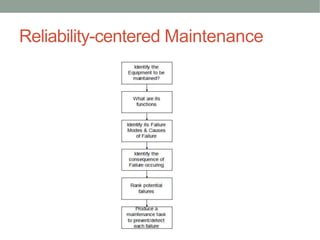
Reliability-centered Maintenance
• RCM is a process used to determine the maintenance
requirements of any physical asset in its operating
context.
• Basically, RCM methodology deals with some key issues
not dealt with by other maintenance programs.
• It recognizes that all equipment in a facility is not of equal
importance to either the process or facility safety.
• It recognizes that equipment design and operation differs
and that different equipment will have a higher probability
to undergo failures than others.
Reliability-centered Maintenance
• RCM is highly reliant on predictive maintenance but also
recognizes that maintenance activities on equipment that
is inexpensive and unimportant to facility reliability may
best be left to a reactive maintenance approach.
Reliability-centered Maintenance
Advantages
• Can be the most efficient maintenance program.
• Lower costs by eliminating unnecessary maintenance or overhauls.
• Minimize frequency of overhauls.
• Reduced probability of sudden equipment failures.
• Able to focus maintenance activities on critical components.
• Increased component reliability.
• Incorporates root cause analysis.
Disadvantages
• Can have significant startup cost, training, equipment, etc.
Design-out Maintenance
• If the maintenance cost or downtime cost of equipment is
high, then the Design Out Maintenance strategy can often
be effective.
• This strategy differs from all the others in that it is a one-
off activity, as opposed to a repetitive activity designed to
prevent failure.
• Design Out Maintenance aims to redesign those parts of
the equipment which consume high levels of maintenance
effort or spares cost or which have unacceptably high
failure rates.
Design Out Maintenance
• The high maintenance costs may have been caused by a
number of factors, including:
• Poor maintenance.
• operation of equipment outside of its original design specification
• A poor initial design.
• The Design Out Maintenance strategy can only be
implemented effectively if high maintenance cost items
can be identified and the reasons for the high cost
understood.
MAINTENANCE MANAGEMENT
Condition Monitoring
• It is a technique used to determine the condition of
equipment and predicting the failure with maximum
success.
• Condition monitoring is a maintenance technique based
on advance technology that assesses the health of an
equipment by monitoring certain parameters of the
machine/equipment performance.
• It increases the reliability and availability of equipment by
helping in undertaking corrective measures when they are
needed rather than at the scheduled or routine interval.
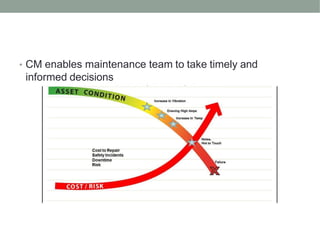
• CM enables maintenance team to take timely and
informed decisions
• Condition Monitoring helps to prepare maintenance
database which can be utilized for condition-based
maintenance planning.
• It contributes to maintenance planning, maintenance cost
reduction and saving in energy by providing early
warnings of waste and inefficiency arising from faulty
operation.
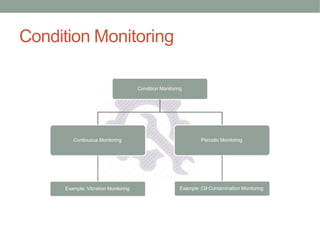
Condition Monitoring
Continuous Monitoring
Example: Vibration Monitoring
Periodic Monitoring
Example :Oil Contamination Monitoring
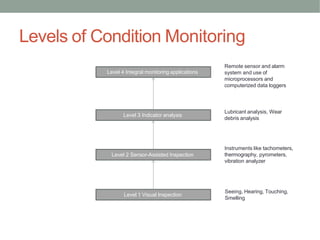
Levels of Condition Monitoring
Level 4 Integral monitoring applications
Level 3 Indicator analysis
Level 2 Sensor-Assisted Inspection
Level 1 Visual Inspection
Remote sensor and alarm
system and use of
microprocessors and
computerized data loggers
Lubricant analysis, Wear
debris analysis
Instruments like tachometers,
thermography, pyrometers,
vibration analyzer
Seeing, Hearing, Touching,
Smelling
Failure Effect
• Dynamic Effect
• Particle Contamination
• Chemical Effect
• Physical Effects
• Temperature effect
• Corrosion effect
• Condition monitoring aims at recognizing these effects
and assessing their degree with the help of some
specially designed devices.
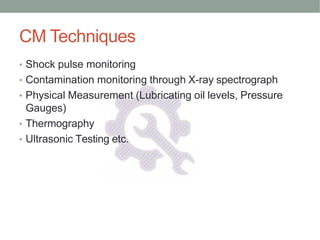
CM Techniques
• Shock pulse monitoring
• Contamination monitoring through X-ray spectrograph
• Physical Measurement (Lubricating oil levels, Pressure
Gauges)
• Thermography
• Ultrasonic Testing etc.
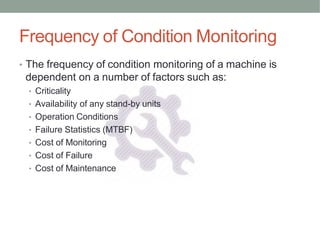
• The frequency of condition monitoring of a machine is
dependent on a number of factors such as:
• Criticality
• Availability of any stand-by units
• Operation Conditions
• Failure Statistics (MTBF)
• Cost of Monitoring
• Cost of Failure
• Cost of Maintenance
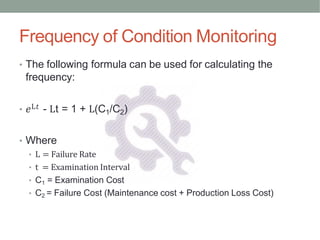
Frequency of Condition Monitoring
• The following formula can be used for calculating the
frequency:
• 𝑒L𝑡 - Lt = 1 + L(C1/C2)
• Where
• L = Failure Rate
• t = Examination Interval
• C1 = Examination Cost
• C2 = Failure Cost (Maintenance cost + Production Loss Cost)
MAINTENANCE MANAGEMENT
Maintenance Planning and Scheduling
Planned Preventive Maintenance
• The objective of planned preventive maintenance (PPM)
is to carry out the necessary and timely servicing in order
to prevent unscheduled breakdowns or undue
deterioration of equipment.
• As the work of preventive maintenance is well
coordinated, the downtime of equipment due to failure can
be minimized.
• The downtime of high-cost capital equipment is very
costly, it is therefore, preferable to carry out maintenance
on a scheduled basis.
Elements of Effective PPM
• Maintenance Policy
• Inventory Control
• Equipment Record
• Work Order System
• Job Planning & Scheduling
• Backlog Control and Priority System
• Performance Measurement
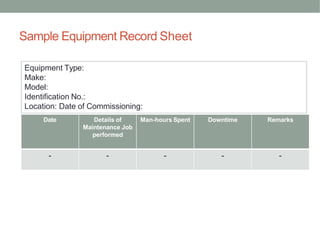
Sample Equipment Record Sheet
Date Details of
Maintenance Job
performed
Man-hours Spent Downtime Remarks
- - - - -
Equipment Type:
Make:
Model:
Identification No.:
Location: Date of Commissioning:
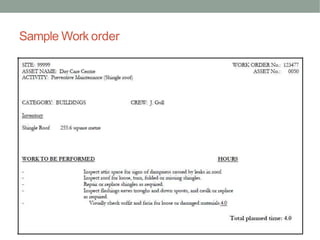
Work Order
• A work order authorizes and directs an individual or a
group to perform a given task.
• The work order system is useful for management in
controlling costs and evaluating job performance.
• A work order should at least contain information such as
requested and planned completion dates, work
description, planned start date, labor and material costs,
work category (preventive maintenance, repair,
installation, etc.), and appropriate approval signatures
Sample Work order
Checklist
• Checklists are useful tool for preventing mistakes.
• Generally, the manufaturer, along with the machine,
supplies the checklist as well.
• However, the user may modify the checklist to suit their
requirements.
• The checklist has a clear purpose and one must know
what problems a checklist will prevent.
• A checklist must have a way to record the users
responses.
• Good checklists are concise, and focused on critical few
elements.
Development of checklist
• While developing the checklist, the following points need
to be considered
The total number of subsystems that a particular machine is
comprised of.
Analysis of the functioning of these subsystems and identification of
their critical components.
Identification of indicators of functional behavior of the critical
components. These may include:
Abnormal sound
Vibrations
Wear
Cleanliness
Play and Cracks
Power/fuel consumption
Temperature
Development of checklist
• While developing the checklist…
Determination of normal, alarming and dangerous levels of
behaviors of equipment.
Determination of periodicity of inspection of various indicators
Development of proper format for conducting the checks and
formulating the reports.
MAINTENANCE MANAGEMENT
Maintenance Planning & Scheduling
Classification of maintenance work
• Routine maintenance: are maintenance operations of
periodic nature. They are planned and scheduled in
advance.
• Emergency or breakdown maintenance: This kind of
work is not planned in advance and worked upon as and
when a breakdown occurs. This kind of maintenance
work interferes with routine maintenance.
• Scheduled overhauls and shutdown maintenance:
planned and scheduled well in advance.
• Design modification: need to be planned in advance
based on the requirement of such design modification.
• Preventive maintenance: planned and scheduled in
advance.
Maintenance Planning
• Planning is the process by which the elements required to
perform a task are determined in advance, prior to the
starting of that task.
• The basic objective of planning is to convert the concept
into workable actions.
• In maintenance context, planning is therefore the task of
organizing resources to carry out a job satisfactorily within
a specified period of time.
• Good planning is a prerequisite for sound scheduling.
Planning Procedure
• Prepare an asset inventory
• identify the maintenance jobs and tasks
• Identify the frequency of task
• Determine the maintenance job work content (time
required)
• Develop a work plan
• Establish manpower requirement
• Plan and order spare parts and material
• Prepare and issue work order
• Determine budget
Estimation of maintenance work
• During planning it is important to estimate the quantity of
maintenance work to be carried out. This will help in
allocation of the adequate manpower and material in time.
• The following three methods can be used for the
estimation of maintenance work:
• Measurement by estimates
• Measurement by historical data
• Measurement by standard time data
Various levels of planning
Long range planning
• The long-range plan is more strategic in nature and identifies
important goals to be reached within three to five years.
• It sets plans for the future activities and long term
improvements. It considers the improvements in maintenance
facilities, modernization requirement of production equipment
and facility expansion.
Medium range planning
• It covers a period of upto 1 year.
• It includes major overhauls, planned plant shutdown, balancing
the staffing requirements, training requirement, estimation of
spare part requirement and material procurement.
Various Levels of Planning…
Short Range Plan
• The short-range plan focuses on high-priority goals,
usually within the coming months.
• It includes the planning which is done on daily or weekly
basis. It includes planning for routine daily or weekly jobs
like preventive maintenance, inspections and repairs.
Scheduling
• It is the process by which jobs are matched with
resources and sequenced to be executed at certain point
in time.
• Scheduling deals with phasing of planned jobs along with
monitoring, controlling and reporting of job progress.
Requirement of Effective Scheduling
• Written work orders which provide the requirements
related to workforce, material and time.
• Information related to availability of required manpower.
• Stock of spare part and information on restocking.
• Information on availability of special tools and equipment
required for maintenance work.
• Access to production schedules
• Well defined priorities of maintenance work.
• Information related to backlogs / carry over jobs.
Maintenance job priority system
• Priorities must be set to handle the mixture of backlog and
new piece of scheduled job.
• The frequency and criticality of operation are the key
factors for establishing priorities.
• Priorities are established in order to ensure that critical
jobs are scheduled first.
• Guidelines for establishing priority are developed in
coordination with production department.
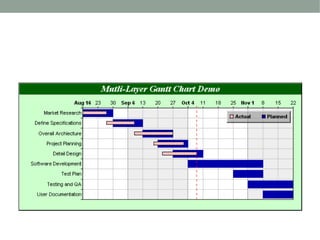
Scheduling Techniques
• The objective of a scheduling technique is to construct a
time chart showing:
• The start and finish of each job.
• The interdependency among jobs.
• The critical job which require special attention and effective
monitoring.
• Different Scheduling Techniques
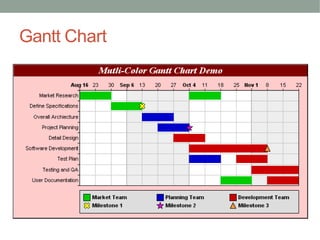
• Gantt chart
• CPM (Critical Path Method)
• PERT (Program Evaluation and Review Technique)
Gantt Chart
PERT and CPM
• PERT and CPM are similar. The major difference between
the two is that when the completion times of activities of
the project are uncertain, PERT is used and with the
certainty of completion times, CPM is employed.
• The following steps are involved with PERT and CPM:
I. Break a project into individual jobs or tasks.
II. Arrange these jobs/tasks into a logical network.
III. Determine duration time of each job/task.
IV. Develop a schedule.
V. Identify jobs/tasks that control the completion of project.
VI. Redistribute resources or funds to improve schedule.
PERT
• PERT is a statistical tool, used in project management, which
was designed to analyse and represent the tasks involved in
completing a given project.
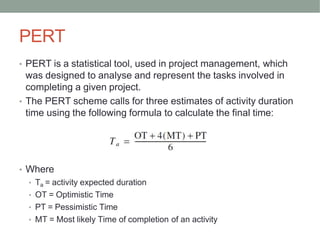
• The PERT scheme calls for three estimates of activity duration
time using the following formula to calculate the final time:
• Where
• Ta = activity expected duration
• OT = Optimistic Time
• PT = Pessimistic Time
• MT = Most likely Time of completion of an activity
CPM
• The critical path method (CPM) is a tool for scheduling a
set of project activities.
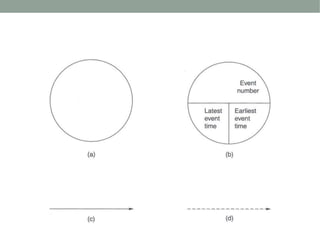
• Four symbols used to construct a CPM network
• Circle – represents an event,
• Circle with divisions
• Continuous Arrow – indicates and activity,
• Dotted arrow – denotes dummy activity or restraints
Terminologies
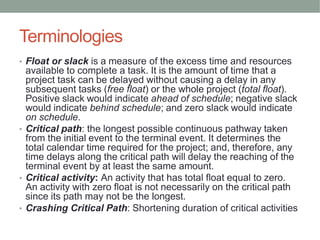
• Float or slack is a measure of the excess time and resources
available to complete a task. It is the amount of time that a
project task can be delayed without causing a delay in any
subsequent tasks (free float) or the whole project (total float).
Positive slack would indicate ahead of schedule; negative slack
would indicate behind schedule; and zero slack would indicate
on schedule.
• Critical path: the longest possible continuous pathway taken
from the initial event to the terminal event. It determines the
total calendar time required for the project; and, therefore, any
time delays along the critical path will delay the reaching of the
terminal event by at least the same amount.
• Critical activity: An activity that has total float equal to zero.
An activity with zero float is not necessarily on the critical path
since its path may not be the longest.
• Crashing Critical Path: Shortening duration of critical activities
Example
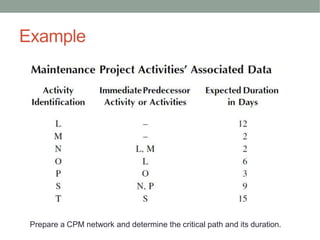
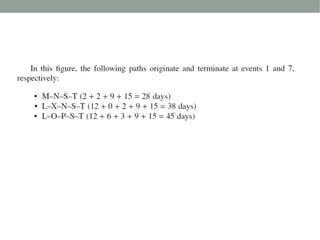
Prepare a CPM network and determine the critical path and its duration.
MAINTENANCE MANAGEMENT
Reliability and Maintainability
Reliability
• Reliability is defined as the probability that an asset or a
system will operate satisfactorily for a pre-determined
period of time, under the working condition for which is
was designed.
• A reliable piece of mechanical equipment is understood to
be basically sound, to be able to meet its design
specifications, and to give trouble-free performance in a
given environment.
Reliability
Inherent Reliability
• It is associated with the quality of material and the design
of the machine and its parts.
• It is the measure of overall robustness of the system or a
component.
• It is the maximum limit of reliability that can be achieved.
Achievable Reliability
• it depends upon the external factors such as maintenance
and operation of the equipment.
Failure Rate
• The number of failures occurring in a unit time is known
as the failure rate.
• Failure Rate (FR) or Mean Time Between Failure (MTBF)
is a measure of Reliability.
• Failure Rate is denoted by λ.
• λ = 1/MTBF
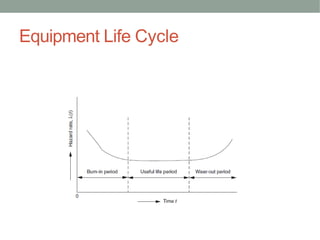
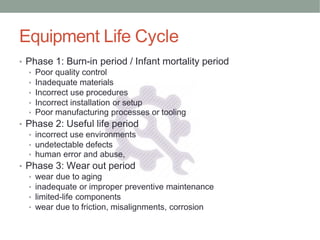
Equipment Life Cycle
• Phase 1: Burn-in period / Infant mortality period
• Poor quality control
• Inadequate materials
• Incorrect use procedures
• Incorrect installation or setup
• Poor manufacturing processes or tooling
• Phase 2: Useful life period
• incorrect use environments
• undetectable defects
• human error and abuse,
• Phase 3: Wear out period
• wear due to aging
• inadequate or improper preventive maintenance
• limited-life components
• wear due to friction, misalignments, corrosion
Repairable & Non Repairable Systems
• In reliability engineering repairable and non repairable
systems are treated differently.
• A non repairable item is replaced with a new item which
will be as good as the item replaced. Over time as items
are replaced with identical new items the failure rate will
remain constant.
• In a repairable system the repaired item following a
breakdown will not be as good as when it was first
installed (as good as new again)
• General wear and errors in the repair carried out will
result in the failure rate increasing over time.
Probability and Reliability
• Probability of occurrence of an event A is always
0≤P(A)≥1, Where P(A) is probability of occurrence of A.
• Probability of occurrence and non-occurrence is given by
P(A) + P(Ā) = 1
Where, P(Ā) is probability of non-occurrence of A.
• The probability of an intersection of independent events, Y1, Y2, Y3…
Yn is given by:
• The probability of the union of n independent events is given by:
Reliability Function
• For exponentially distributed times to failure of system,
Reliability of a system can be calculated by the following
formula:
R(t) = e-λt
R(t) = Reliability at time t
λ = 1/MTBF
and so
R(t) = e -t/MTBF
Where:
t = time since the last failure
MTBF = Mean time between failures
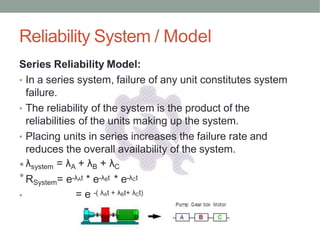
Reliability System / Model
Series Reliability Model:
• In a series system, failure of any unit constitutes system
failure.
• The reliability of the system is the product of the
reliabilities of the units making up the system.
• Placing units in series increases the failure rate and
reduces the overall availability of the system.
•λsystem = λA + λB + λC
•RSystem= e-λAt * e-λBt * e-λCt
• = e -( λAt + λBt+ λCt)
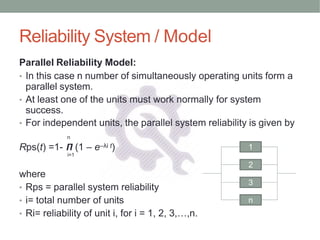
Reliability System / Model
where
• Rps = parallel system reliability
• i= total number of units
• Ri= reliability of unit i, for i = 1, 2, 3,…,n.
Rps(t) =1- 𝞟 (1 – e–λi t)
i=1
Parallel Reliability Model:
• In this case n number of simultaneously operating units form a
parallel system.
• At least one of the units must work normally for system
success.
• For independent units, the parallel system reliability is given by
n
1
2
3
n
Reliability System / Model
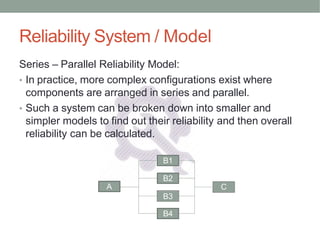
Series – Parallel Reliability Model:
• In practice, more complex configurations exist where
components are arranged in series and parallel.
• Such a system can be broken down into smaller and
simpler models to find out their reliability and then overall
reliability can be calculated.
B1
B2
B3
B4
A C
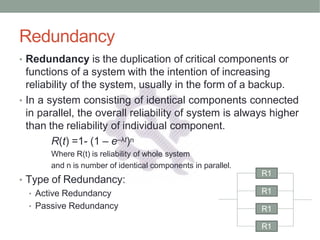
Redundancy
• Redundancy is the duplication of critical components or
functions of a system with the intention of increasing
reliability of the system, usually in the form of a backup.
• In a system consisting of identical components connected
in parallel, the overall reliability of system is always higher
than the reliability of individual component.
R(t) =1- (1 – e–λt)n
Where R(t) is reliability of whole system
and n is number of identical components in parallel.
• Type of Redundancy:
• Active Redundancy
• Passive Redundancy
R1
R1
R1
R1
Quality & Reliability
• Quality of product can be defined as the ability to ensure
complete satisfaction to customer.
• This is also associated with reliability, which means that a
quality product will have higher reliability.
• The achievement of high quality not only improves the
reliability of the equipment but also adds to its value.
Reliability Testing
• It is performed to ensure that product renders services for
the specified period of time without undesirable problems.
• Under specified conditions of temperature, stress and
environmental condition the failure rate and mode of
failure of equipment is found out.
Burn-in:
• This is a method of reliability testing where the condition
of testing are made more severe than the conditions for
which the equipment has been actually designed.
• This is done to accelerate the failure of weak or defective
components so that they fail and can be identified during
testing.
Maintainability
• Maintainability is defined as the probability of restoration
of failed device or equipment or asset to operational
effectiveness (Acceptable working condition) within a
specified period of time through the prescribed
maintenance operations.
• Maintainability is a design parameter intended to reduce
repair time.
• It is the measure of ease of maintenance.
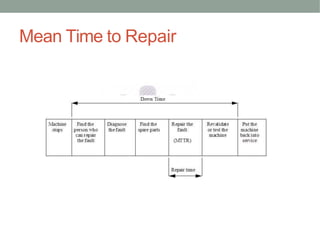
• The parameter to express the maintainability is Mean
Time To Repair (MTTR).
Mean Time to Repair
Maintainability
• Maintainability is also expressed in terms of minimum cost
of maintenance as well as the accuracy of maintenance.
• The objective of maintainability is to design the equipment
that can be maintained easily in minimum time and at
minimum cost.
• Maintainability is an important goal of design.
• Good maintainability can save on operational cost and
can also improve the safety of personnel.
Maintainability factors
Factors influencing the degree of maintainability in a
machine are:
• The need for completion of work in minimum time with
minimum number of maintenance personnel.
• The skill needed for maintenance should not be too high
• The consumption of spare parts should be minimum.
• The requirement of special tools and equipment should be
as less as possible.
• Ease of working
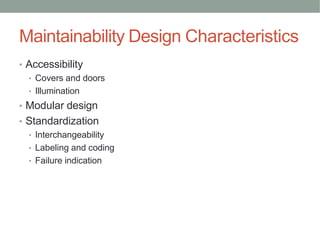
Maintainability Design Characteristics
• Accessibility
• Covers and doors
• Illumination
• Modular design
• Standardization
• Interchangeability
• Labeling and coding
• Failure indication
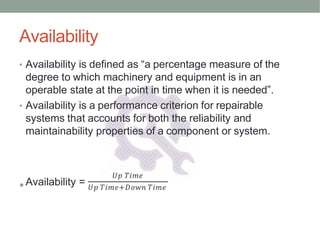
Availability
• Availability is defined as “a percentage measure of the
degree to which machinery and equipment is in an
operable state at the point in time when it is needed”.
• Availability is a performance criterion for repairable
systems that accounts for both the reliability and
maintainability properties of a component or system.
𝑈𝑝 𝑇𝑖𝑚𝑒
•Availability = 𝑈𝑝 𝑇𝑖𝑚𝑒+𝐷𝑜w𝑛 𝑇𝑖𝑚𝑒
Operational Availability
• Operational availability is a measure of the average
availability over a period of time and it includes all
experienced sources of downtime, such as administrative
downtime, logistic downtime, etc.
• It is the probability that an item will operate satisfactorily
at a given point in time when used in an actual or realistic
operating and support environment.
• It includes logistics time, ready time, and waiting or
administrative downtime, and both preventive and
corrective maintenance downtime.
• The operational availability is the availability that the
customer actually experiences.
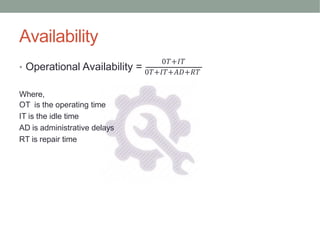
Availability
0𝑇+𝐼𝑇
• Operational Availability = 0𝑇+𝐼𝑇+𝐴𝐷+𝑅𝑇
Where,
OT is the operating time
IT is the idle time
AD is administrative delays
RT is repair time
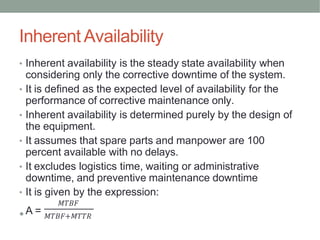
Inherent Availability
𝑀𝑇𝐵𝐹
• Inherent availability is the steady state availability when
considering only the corrective downtime of the system.
• It is defined as the expected level of availability for the
performance of corrective maintenance only.
• Inherent availability is determined purely by the design of
the equipment.
• It assumes that spare parts and manpower are 100
percent available with no delays.
• It excludes logistics time, waiting or administrative
downtime, and preventive maintenance downtime
• It is given by the expression:
•A = 𝑀𝑇𝐵𝐹+𝑀𝑇𝑇𝑅
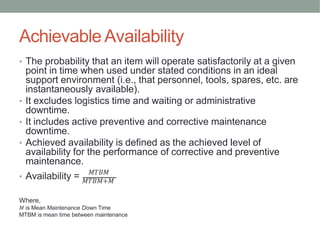
AchievableAvailability
𝑀𝑇𝐵𝑀
• The probability that an item will operate satisfactorily at a given
point in time when used under stated conditions in an ideal
support environment (i.e., that personnel, tools, spares, etc. are
instantaneously available).
• It excludes logistics time and waiting or administrative
downtime.
• It includes active preventive and corrective maintenance
downtime.
• Achieved availability is defined as the achieved level of
availability for the performance of corrective and preventive
maintenance.
• Availability = 𝑀𝑇𝐵𝑀+𝑀
Where,
𝑀 is Mean Maintenance Down Time
MTBM is mean time between maintenance
Thanks…

MAINTENANCE MANAGEMENT.pptx

  • 1.
  • 2.
    • In general,Maintenance means to hold, keep, sustain or preserve the building ,machine, equipment or structure to an acceptable standard of performance, safety and/or aesthetics. • All of us perform or practice Some form of maintenance in our daily life. • Whether you own a house, car, electrical equipment or any machine they all require maintenance to sustain their serviceability through out their lifecycle. Introduction
  • 3.
    Introduction • The sameholds true for industrial equipment/system. • Maintenance is one of the most indispensable job in any industrial organization.
  • 4.
    Introduction • The exploitationof knowledge and technology has resulted in the development of complex and sophisticated equipment and automated machinery in every field of engineering. • These high investment systems, in turn, call for their effective utilization. • Proper maintenance helps to keep such machine and systems in working order to meet production targets or service requirements and to ensure a longer and trouble free life.
  • 5.
    Definition British Standard Glossaryof terms (3811:1993) defined maintenance as: • "The combination of all technical and associated administrative actions, including supervision actions, intended to retain an item in or restore it to a state in which it can perform its required function. This required function might be defined as stated condition."
  • 6.
    Definition • Maintenance isthe routine and recurring process of keeping a particular machine or asset in its normal operating condition so that it can deliver its expected performance or service without causing any loss of time on account of accidental damage or breakdown. • In other words, maintenance means the work that is to be done, to keep the equipment/system in running condition such that it can be utilized to its full designed capacity and efficiency for maximum amount of time.
  • 7.
    Maintenance Management Definition: “All theactivities of management that determines the maintenance objectives or priorities (defined as the targets assigned and accepted by the management and maintenance department), strategies (defined as management methods in order to achieve maintenance objectives) and responsibilities and implement them by means such as maintenance planning, maintenance control and supervision and several improving methods including economical aspects in the organization.” Source: Marquez Adolfo Crespo, The Maintenance Management Framework , Springer Series in Reliability Engineering, 2007, pp 3-10
  • 8.
    Maintenance Concept &Plan • Maintenance concept: A statement of the overall concept of the item/product specification or policy that controls the type of maintenance action to be employed for the item under consideration. • With information available from users of equipment, the detailed procedures are drawn to concretize the maintenance concept. • Maintenance plan: A document that outlines the management and technical executable procedure to be employed to maintain an item; usually describes facilities, tools, schedules, and resources required.
  • 9.
    Maintenance Concept &Plan • The maintenance concept of equipment is related to the operational needs of equipment, which may change from machine to machine or system to system. • First of all the operational concept is determined and then the maintenance concept is developed to support the operational concept. • Finally, a maintenance plan is prepared on accordance with the maintenance concept thus developed, which can be more realistic.
  • 10.
    Evolution of MaintenanceConcept • The idea of maintenance is very old and was introduced along with the inception of machine. • In early days, a machine was used as long as it worked. When it stopped working, it was either repaired or discarded. • The traditional breakdown maintenance system can no longer maintain the economic lifeline of the modern industry.
  • 11.
    Evolution of MaintenanceConcept • In today's age, the high cost sophisticated machines need to be properly maintained during their entire lifecycle for maximizing their availability so as to obtain a healthy return on investment. • This requirement has changed the philosophy of maintenance management over a period of time. Failure Based Time Based Condition Based Reliability Centered TPM 1950 1990
  • 12.
    Systems approach • Asystems approach to maintenance involves setting up of objectives, planning, executing and controlling the maintenance functions, not as an isolated function but as a part of corporate policies and strategies aimed at achieving the well-defined overall goals of the organization. • Internally, the maintenance function coordinates its activities with other functions like production and sales, and externally it ensures availability of quality spares, trained manpower, replacement of worn-out equipment and so forth. • This approach takes into account all the relevant interacting functions both internal and external to system.
  • 13.
    SystemApproach The system approachto maintenance involves the following: • Identification of the needs of maintenance • Analyzing the requirements for the above needs • Determining the functional procedures for maintenance task selection, work planning and scheduling, work order processing, etc. • Outlining a reporting and controlling procedure • Development of supporting facilities and infrastructure • Determining the cost accounting procedures • Adopting a policy for training and quality assurance
  • 14.
    Maintenance Objectives • Themost important objective of the maintenance function is the maximization of availability of equipment or facilities so as to extend help in achieving the ultimate goals of the organization. • Maintenance work raises the equipment performance level and its availability but adds to its running cost. • The objective of maintenance should also be to strike a balance between the availability and overall running cost. • Another important objective of maintenance is the establishment of safe working conditions both for operating and maintenance personnel.
  • 15.
    Maintenance Objectives • Preventbreakdown during operations • Ensure safety during operations • Maximize operational efficiency • Reduce idle hours due to component malfunctioning • Reduce maintenance cost • Enhance Performance level • Forestall Rapid wear of components of machine • Elimination of future defects Productivity Improvement through maximum availability at optimum cost
  • 16.
    Responsibilities of Maintenance Department •To achieve the objectives of maintenance it is necessary to lay down the responsibilities of maintenance department. • Following are some of the responsibilities of maintenance department: • Personnel Management • Maintenance Scheduling & Job distribution • Feedback & control • Budgeting and financial management • Inventory management
  • 17.
    Personnel Management • Maintainingavailability of the sufficient trained work force and avoiding delays in maintenance work due to absenteeism. • Arranging alternative facilities when sufficient trained manpower is not available for the job. • Minimizing conflicts among the production and maintenance staff. • Training and upgrading skill of maintenance personnel.
  • 18.
    Maintenance Scheduling &Job distribution • Developing maintenance schedules and repair and overhaul programmes for all equipments and machinery • Preparation of job list and proper job allotment to the workers and supervisors. • No job should be left unattended and requirement of specialization and time should be kept in mind while assigning a job. • Adequate supervision should be done from time to time to ensure quality of maintenance work.
  • 19.
    Feedback and control •Setting up of an effective maintenance information system for maintenance planning and execution. • Feedback helps to take corrective decisions, if required, in time to control the function effectively and timely keeping in mind the operational requirements. • Feedback helps in deciding • Reinforcements of manpower in certain areas where required the most. • On timely Procurement of spare parts • The need of external technical support • To take and alternative decision when situation demands
  • 20.
    Budgeting and financialmanagement • It is essential to budget sufficient funds for the maintenance function well in time. • Budgetary provisions for planned maintenance and certain unplanned emergency work need to be made in advance. • This help in proper utilization of funds and monitoring of cost.
  • 21.
    Inventory Management • Duringmaintenance work, some spare parts/components are always required and therefore, the required quantity of those parts must be stored. • Often, the non-availability of spare parts causes delays in maintenance work. Therefore, inventory management is an important aspect of maintenance. • inventory management becomes more difficult and costly in cases where variety of machines is more.
  • 22.
  • 23.
    Types of MaintenanceOrganization Decentralized: • In large sized plants located at different places, inter-unit communication is difficult. • Therefore, in such cases the decentralized type of organization is best suited. • The maintenance department works under the direct control of chief engineer/manager who is in-charge of production. • A better coordination between production and maintenance workforce can be achieved in this type of organization.
  • 24.
    Types of MaintenanceOrganization Centralized: • In relatively small factories where communication between the departments is more easy, the centralized type of maintenance organization is preferred. • The maintenance function works under the direct control of chief maintenance engineer who is responsible for all the maintenance work in the factory. • The responsibilities and accountabilities must be clearly defined for maintenance as well as production personnel to avoid confrontation.
  • 25.
    Benefits of centralizedmaintenance • More efficient compared to decentralized maintenance • Fewer maintenance personnel required • More effective line supervision • Greater use of special equipment and specialized maintenance persons • Generally allows more effective on-the-job training
  • 26.
    Drawbacks of centralizedmaintenance • Requires more time getting to and from the work area or job • No one individual becomes totally familiar with complex hardware or equipment • More difficult supervision because of remoteness of maintenance site from the centralized headquarters • Higher transportation cost due to remote maintenance work
  • 27.
    Organizational Structure (Maintenance) ChiefEngineer Maintenance Engineer Planning & Record Keeping Foreman Store Supervisor Foreman (Workshop) Crew Members Foreman (Area 1) Crew Members Foreman (Area 2) Crew Members
  • 28.
    Types of MaintenanceSystems • Maintenance can be divided into two groups: • Unplanned Maintenance or Breakdown Maintenance • Planned Maintenance • Preventive Maintenance • Corrective maintenance • Scheduled Maintenance • Condition-Based Maintenance • Reliability-centered Maintenance • Maintenance can be performed in two modes: • Running Maintenance (Asset is in operation) • Shut Down Maintenance (Asset is out of service) Source: Mishra RC, Pathak k, Maintenance Engineering and Management, PHIL Pvt. Ltd. New Delhi, 2012, p12
  • 29.
    Breakdown Maintenance • Breakdownmaintenance is basically the “run it till it breaks” maintenance mode. • No actions or efforts are taken to maintain the equipment until a component or equipment fails or becomes inoperative. • The work which is required to be done in the case of an emergency failure, has to be carried out to bring back the equipment to its original working condition. • In case of risky equipment /systems such as aircraft, elevators and other such items, chances with only breakdown maintenance cannot be taken.
  • 30.
    Breakdown Maintenance • Eventhough it appears to be an economical proposition, work would greatly suffer if the machine is not restored to operational condition immediately. • In this type of maintenance, during the repair, no proper care is taken to know the real cause of the breakdown, which in turn may lead to frequent failures of same kind.
  • 31.
    Breakdown Maintenance • Advantages •Less Investment. • Less staff. • Disadvantages • Increased cost due to unplanned downtime of equipment. • Increased labor cost, especially if overtime is needed. • Cost involved with repair or replacement of equipment. • Possible secondary equipment or process damage from equipment failure. • Inefficient use of staff resources.
  • 32.
    Planned Maintenance • Underthis type of maintenance, the work is planned beforehand to avoid random failures. • It decides not only the ‘when’ and ‘what’ of maintenance , but also by ‘whom’ it would be undertaken. • To be able to take informed decision and planning of maintenance activities data collection and record keeping is important. • Historical data may be used to decide the periodicity/frequency of the maintenance work. • Work study/Time study can be done for devising optimal maintenance schedule for the given system.
  • 33.
    Preventive Maintenance • Preventivemaintenance is the Actions performed on a time- or machine-run-based schedule that detect, preclude, or mitigate degradation of a component or system with the aim of sustaining or extending its useful life through controlling degradation to an acceptable level. • Preventive Maintenance is the utilization of planned and coordinated inspections, adjustments, repairs and replacements needed in maintaining an equipment or plant.
  • 34.
    Preventive Maintenance • Oneof the main objective of the preventive maintenance is to detect and prevent any condition that may cause machine failure before such failure occurs. • This makes it possible to plan and schedule the maintenance work without interruption in production schedule and thus improve the availability of equipment.
  • 35.
    Preventive Maintenance • Followingactivities are taken-up as part of preventive maintenance: • Routine attention • Routine Examination • Preventive Replacement • Planning and implementation of preventive maintenance system is a costly affair because during inspection all deteriorated parts/components are replaced. • However the higher cost of maintenance is usually gets compensated by the prolonged operational life of the equipment.
  • 36.
    Corrective Maintenance • Correctivemaintenance can be defined as the maintenance carried out to restore the equipment that has stopped working to acceptable standards.
  • 37.
    Scheduled Maintenance • Inthis type of maintenance work, the frequency of maintenance predetermined from experience or from the guidelines given by the equipment manufacturer. • The actual maintenance programme is scheduled in consultation with the production department so that the equipment is made available for maintenance work. • In this way , the most efficient use of idle time can be made. • Though scheduled maintenance is costly as compared to breakdown maintenance, the availability of equipment is enhanced.
  • 38.
    Scheduled Maintenance • Advantages •Cost effective in many capital-intensive processes. • Flexibility allows for the adjustment of maintenance periodicity. • Increased component life cycle. • Reduced equipment or process failure • Prolonged life of equipment • Disadvantages • Catastrophic failures still likely to occur. • Labor intensive. • Includes performance of unneeded maintenance. • Potential for incidental damage to components in conducting unneeded maintenance.
  • 39.
    Condition-based Maintenance • Thiskind of maintenance is carried out in response to a significant deterioration in the unit or system as indicated by a change in a monitored parameter of equipment or system on its condition or performance. • It includes measurements that detect the onset of system degradation (lower functional state), thereby allowing stressors to be eliminated or controlled prior to any significant deterioration in the component physical state. • It is also called Predictive Maintenance. • A condition-based maintenance policy is most suited to high capital cost equipment and complex replaceable parts.
  • 40.
    Condition-based Maintenance • Agood knowledge of failure data is necessary for effective implementation of condition-based maintenance. • It is also possible to minimize inventory and order parts, as required, well ahead of time to support the downstream maintenance needs.
  • 41.
    Condition-based Maintenance Advantages • Increasedcomponent operational life/availability. • Allows for preemptive corrective actions. • Decrease in equipment or process downtime. • Decrease in costs for parts and labor. • Better product quality. • Improved worker and environmental safety. • Improved worker morale. Disadvantages • Increased investment in diagnostic equipment. • Increased investment in staff training.
  • 42.
    Reliability-centered Maintenance • RCMis a process used to determine the maintenance requirements of any physical asset in its operating context. • Basically, RCM methodology deals with some key issues not dealt with by other maintenance programs. • It recognizes that all equipment in a facility is not of equal importance to either the process or facility safety. • It recognizes that equipment design and operation differs and that different equipment will have a higher probability to undergo failures than others.
  • 43.
  • 44.
    Reliability-centered Maintenance • RCMis highly reliant on predictive maintenance but also recognizes that maintenance activities on equipment that is inexpensive and unimportant to facility reliability may best be left to a reactive maintenance approach.
  • 45.
    Reliability-centered Maintenance Advantages • Canbe the most efficient maintenance program. • Lower costs by eliminating unnecessary maintenance or overhauls. • Minimize frequency of overhauls. • Reduced probability of sudden equipment failures. • Able to focus maintenance activities on critical components. • Increased component reliability. • Incorporates root cause analysis. Disadvantages • Can have significant startup cost, training, equipment, etc.
  • 46.
    Design-out Maintenance • Ifthe maintenance cost or downtime cost of equipment is high, then the Design Out Maintenance strategy can often be effective. • This strategy differs from all the others in that it is a one- off activity, as opposed to a repetitive activity designed to prevent failure. • Design Out Maintenance aims to redesign those parts of the equipment which consume high levels of maintenance effort or spares cost or which have unacceptably high failure rates.
  • 47.
    Design Out Maintenance •The high maintenance costs may have been caused by a number of factors, including: • Poor maintenance. • operation of equipment outside of its original design specification • A poor initial design. • The Design Out Maintenance strategy can only be implemented effectively if high maintenance cost items can be identified and the reasons for the high cost understood.
  • 48.
  • 49.
    Condition Monitoring • Itis a technique used to determine the condition of equipment and predicting the failure with maximum success. • Condition monitoring is a maintenance technique based on advance technology that assesses the health of an equipment by monitoring certain parameters of the machine/equipment performance. • It increases the reliability and availability of equipment by helping in undertaking corrective measures when they are needed rather than at the scheduled or routine interval.
  • 50.
    • CM enablesmaintenance team to take timely and informed decisions
  • 51.
    • Condition Monitoringhelps to prepare maintenance database which can be utilized for condition-based maintenance planning. • It contributes to maintenance planning, maintenance cost reduction and saving in energy by providing early warnings of waste and inefficiency arising from faulty operation.
  • 52.
    Condition Monitoring Condition Monitoring ContinuousMonitoring Example: Vibration Monitoring Periodic Monitoring Example :Oil Contamination Monitoring
  • 53.
    Levels of ConditionMonitoring Level 4 Integral monitoring applications Level 3 Indicator analysis Level 2 Sensor-Assisted Inspection Level 1 Visual Inspection Remote sensor and alarm system and use of microprocessors and computerized data loggers Lubricant analysis, Wear debris analysis Instruments like tachometers, thermography, pyrometers, vibration analyzer Seeing, Hearing, Touching, Smelling
  • 54.
    Failure Effect • DynamicEffect • Particle Contamination • Chemical Effect • Physical Effects • Temperature effect • Corrosion effect • Condition monitoring aims at recognizing these effects and assessing their degree with the help of some specially designed devices.
  • 55.
    CM Techniques • Shockpulse monitoring • Contamination monitoring through X-ray spectrograph • Physical Measurement (Lubricating oil levels, Pressure Gauges) • Thermography • Ultrasonic Testing etc.
  • 56.
    • The frequencyof condition monitoring of a machine is dependent on a number of factors such as: • Criticality • Availability of any stand-by units • Operation Conditions • Failure Statistics (MTBF) • Cost of Monitoring • Cost of Failure • Cost of Maintenance Frequency of Condition Monitoring
  • 57.
    Frequency of ConditionMonitoring • The following formula can be used for calculating the frequency: • 𝑒L𝑡 - Lt = 1 + L(C1/C2) • Where • L = Failure Rate • t = Examination Interval • C1 = Examination Cost • C2 = Failure Cost (Maintenance cost + Production Loss Cost)
  • 58.
  • 59.
    Planned Preventive Maintenance •The objective of planned preventive maintenance (PPM) is to carry out the necessary and timely servicing in order to prevent unscheduled breakdowns or undue deterioration of equipment. • As the work of preventive maintenance is well coordinated, the downtime of equipment due to failure can be minimized. • The downtime of high-cost capital equipment is very costly, it is therefore, preferable to carry out maintenance on a scheduled basis.
  • 60.
    Elements of EffectivePPM • Maintenance Policy • Inventory Control • Equipment Record • Work Order System • Job Planning & Scheduling • Backlog Control and Priority System • Performance Measurement
  • 61.
    Sample Equipment RecordSheet Date Details of Maintenance Job performed Man-hours Spent Downtime Remarks - - - - - Equipment Type: Make: Model: Identification No.: Location: Date of Commissioning:
  • 62.
    Work Order • Awork order authorizes and directs an individual or a group to perform a given task. • The work order system is useful for management in controlling costs and evaluating job performance. • A work order should at least contain information such as requested and planned completion dates, work description, planned start date, labor and material costs, work category (preventive maintenance, repair, installation, etc.), and appropriate approval signatures
  • 63.
  • 64.
    Checklist • Checklists areuseful tool for preventing mistakes. • Generally, the manufaturer, along with the machine, supplies the checklist as well. • However, the user may modify the checklist to suit their requirements. • The checklist has a clear purpose and one must know what problems a checklist will prevent. • A checklist must have a way to record the users responses. • Good checklists are concise, and focused on critical few elements.
  • 65.
    Development of checklist •While developing the checklist, the following points need to be considered The total number of subsystems that a particular machine is comprised of. Analysis of the functioning of these subsystems and identification of their critical components. Identification of indicators of functional behavior of the critical components. These may include: Abnormal sound Vibrations Wear Cleanliness Play and Cracks Power/fuel consumption Temperature
  • 66.
    Development of checklist •While developing the checklist… Determination of normal, alarming and dangerous levels of behaviors of equipment. Determination of periodicity of inspection of various indicators Development of proper format for conducting the checks and formulating the reports.
  • 67.
  • 68.
    Classification of maintenancework • Routine maintenance: are maintenance operations of periodic nature. They are planned and scheduled in advance. • Emergency or breakdown maintenance: This kind of work is not planned in advance and worked upon as and when a breakdown occurs. This kind of maintenance work interferes with routine maintenance. • Scheduled overhauls and shutdown maintenance: planned and scheduled well in advance. • Design modification: need to be planned in advance based on the requirement of such design modification. • Preventive maintenance: planned and scheduled in advance.
  • 69.
    Maintenance Planning • Planningis the process by which the elements required to perform a task are determined in advance, prior to the starting of that task. • The basic objective of planning is to convert the concept into workable actions. • In maintenance context, planning is therefore the task of organizing resources to carry out a job satisfactorily within a specified period of time. • Good planning is a prerequisite for sound scheduling.
  • 70.
    Planning Procedure • Preparean asset inventory • identify the maintenance jobs and tasks • Identify the frequency of task • Determine the maintenance job work content (time required) • Develop a work plan • Establish manpower requirement • Plan and order spare parts and material • Prepare and issue work order • Determine budget
  • 71.
    Estimation of maintenancework • During planning it is important to estimate the quantity of maintenance work to be carried out. This will help in allocation of the adequate manpower and material in time. • The following three methods can be used for the estimation of maintenance work: • Measurement by estimates • Measurement by historical data • Measurement by standard time data
  • 72.
    Various levels ofplanning Long range planning • The long-range plan is more strategic in nature and identifies important goals to be reached within three to five years. • It sets plans for the future activities and long term improvements. It considers the improvements in maintenance facilities, modernization requirement of production equipment and facility expansion. Medium range planning • It covers a period of upto 1 year. • It includes major overhauls, planned plant shutdown, balancing the staffing requirements, training requirement, estimation of spare part requirement and material procurement.
  • 73.
    Various Levels ofPlanning… Short Range Plan • The short-range plan focuses on high-priority goals, usually within the coming months. • It includes the planning which is done on daily or weekly basis. It includes planning for routine daily or weekly jobs like preventive maintenance, inspections and repairs.
  • 74.
    Scheduling • It isthe process by which jobs are matched with resources and sequenced to be executed at certain point in time. • Scheduling deals with phasing of planned jobs along with monitoring, controlling and reporting of job progress.
  • 75.
    Requirement of EffectiveScheduling • Written work orders which provide the requirements related to workforce, material and time. • Information related to availability of required manpower. • Stock of spare part and information on restocking. • Information on availability of special tools and equipment required for maintenance work. • Access to production schedules • Well defined priorities of maintenance work. • Information related to backlogs / carry over jobs.
  • 76.
    Maintenance job prioritysystem • Priorities must be set to handle the mixture of backlog and new piece of scheduled job. • The frequency and criticality of operation are the key factors for establishing priorities. • Priorities are established in order to ensure that critical jobs are scheduled first. • Guidelines for establishing priority are developed in coordination with production department.
  • 77.
    Scheduling Techniques • Theobjective of a scheduling technique is to construct a time chart showing: • The start and finish of each job. • The interdependency among jobs. • The critical job which require special attention and effective monitoring. • Different Scheduling Techniques • Gantt chart • CPM (Critical Path Method) • PERT (Program Evaluation and Review Technique)
  • 78.
  • 80.
    PERT and CPM •PERT and CPM are similar. The major difference between the two is that when the completion times of activities of the project are uncertain, PERT is used and with the certainty of completion times, CPM is employed. • The following steps are involved with PERT and CPM: I. Break a project into individual jobs or tasks. II. Arrange these jobs/tasks into a logical network. III. Determine duration time of each job/task. IV. Develop a schedule. V. Identify jobs/tasks that control the completion of project. VI. Redistribute resources or funds to improve schedule.
  • 81.
    PERT • PERT isa statistical tool, used in project management, which was designed to analyse and represent the tasks involved in completing a given project. • The PERT scheme calls for three estimates of activity duration time using the following formula to calculate the final time: • Where • Ta = activity expected duration • OT = Optimistic Time • PT = Pessimistic Time • MT = Most likely Time of completion of an activity
  • 82.
    CPM • The criticalpath method (CPM) is a tool for scheduling a set of project activities. • Four symbols used to construct a CPM network • Circle – represents an event, • Circle with divisions • Continuous Arrow – indicates and activity, • Dotted arrow – denotes dummy activity or restraints
  • 84.
    Terminologies • Float orslack is a measure of the excess time and resources available to complete a task. It is the amount of time that a project task can be delayed without causing a delay in any subsequent tasks (free float) or the whole project (total float). Positive slack would indicate ahead of schedule; negative slack would indicate behind schedule; and zero slack would indicate on schedule. • Critical path: the longest possible continuous pathway taken from the initial event to the terminal event. It determines the total calendar time required for the project; and, therefore, any time delays along the critical path will delay the reaching of the terminal event by at least the same amount. • Critical activity: An activity that has total float equal to zero. An activity with zero float is not necessarily on the critical path since its path may not be the longest. • Crashing Critical Path: Shortening duration of critical activities
  • 85.
    Example Prepare a CPMnetwork and determine the critical path and its duration.
  • 87.
  • 88.
    Reliability • Reliability isdefined as the probability that an asset or a system will operate satisfactorily for a pre-determined period of time, under the working condition for which is was designed. • A reliable piece of mechanical equipment is understood to be basically sound, to be able to meet its design specifications, and to give trouble-free performance in a given environment.
  • 89.
    Reliability Inherent Reliability • Itis associated with the quality of material and the design of the machine and its parts. • It is the measure of overall robustness of the system or a component. • It is the maximum limit of reliability that can be achieved. Achievable Reliability • it depends upon the external factors such as maintenance and operation of the equipment.
  • 90.
    Failure Rate • Thenumber of failures occurring in a unit time is known as the failure rate. • Failure Rate (FR) or Mean Time Between Failure (MTBF) is a measure of Reliability. • Failure Rate is denoted by λ. • λ = 1/MTBF
  • 91.
  • 92.
    Equipment Life Cycle •Phase 1: Burn-in period / Infant mortality period • Poor quality control • Inadequate materials • Incorrect use procedures • Incorrect installation or setup • Poor manufacturing processes or tooling • Phase 2: Useful life period • incorrect use environments • undetectable defects • human error and abuse, • Phase 3: Wear out period • wear due to aging • inadequate or improper preventive maintenance • limited-life components • wear due to friction, misalignments, corrosion
  • 93.
    Repairable & NonRepairable Systems • In reliability engineering repairable and non repairable systems are treated differently. • A non repairable item is replaced with a new item which will be as good as the item replaced. Over time as items are replaced with identical new items the failure rate will remain constant. • In a repairable system the repaired item following a breakdown will not be as good as when it was first installed (as good as new again) • General wear and errors in the repair carried out will result in the failure rate increasing over time.
  • 94.
    Probability and Reliability •Probability of occurrence of an event A is always 0≤P(A)≥1, Where P(A) is probability of occurrence of A. • Probability of occurrence and non-occurrence is given by P(A) + P(Ā) = 1 Where, P(Ā) is probability of non-occurrence of A. • The probability of an intersection of independent events, Y1, Y2, Y3… Yn is given by: • The probability of the union of n independent events is given by:
  • 95.
    Reliability Function • Forexponentially distributed times to failure of system, Reliability of a system can be calculated by the following formula: R(t) = e-λt R(t) = Reliability at time t λ = 1/MTBF and so R(t) = e -t/MTBF Where: t = time since the last failure MTBF = Mean time between failures
  • 96.
    Reliability System /Model Series Reliability Model: • In a series system, failure of any unit constitutes system failure. • The reliability of the system is the product of the reliabilities of the units making up the system. • Placing units in series increases the failure rate and reduces the overall availability of the system. •λsystem = λA + λB + λC •RSystem= e-λAt * e-λBt * e-λCt • = e -( λAt + λBt+ λCt)
  • 97.
    Reliability System /Model where • Rps = parallel system reliability • i= total number of units • Ri= reliability of unit i, for i = 1, 2, 3,…,n. Rps(t) =1- 𝞟 (1 – e–λi t) i=1 Parallel Reliability Model: • In this case n number of simultaneously operating units form a parallel system. • At least one of the units must work normally for system success. • For independent units, the parallel system reliability is given by n 1 2 3 n
  • 98.
    Reliability System /Model Series – Parallel Reliability Model: • In practice, more complex configurations exist where components are arranged in series and parallel. • Such a system can be broken down into smaller and simpler models to find out their reliability and then overall reliability can be calculated. B1 B2 B3 B4 A C
  • 99.
    Redundancy • Redundancy isthe duplication of critical components or functions of a system with the intention of increasing reliability of the system, usually in the form of a backup. • In a system consisting of identical components connected in parallel, the overall reliability of system is always higher than the reliability of individual component. R(t) =1- (1 – e–λt)n Where R(t) is reliability of whole system and n is number of identical components in parallel. • Type of Redundancy: • Active Redundancy • Passive Redundancy R1 R1 R1 R1
  • 100.
    Quality & Reliability •Quality of product can be defined as the ability to ensure complete satisfaction to customer. • This is also associated with reliability, which means that a quality product will have higher reliability. • The achievement of high quality not only improves the reliability of the equipment but also adds to its value.
  • 101.
    Reliability Testing • Itis performed to ensure that product renders services for the specified period of time without undesirable problems. • Under specified conditions of temperature, stress and environmental condition the failure rate and mode of failure of equipment is found out. Burn-in: • This is a method of reliability testing where the condition of testing are made more severe than the conditions for which the equipment has been actually designed. • This is done to accelerate the failure of weak or defective components so that they fail and can be identified during testing.
  • 102.
    Maintainability • Maintainability isdefined as the probability of restoration of failed device or equipment or asset to operational effectiveness (Acceptable working condition) within a specified period of time through the prescribed maintenance operations. • Maintainability is a design parameter intended to reduce repair time. • It is the measure of ease of maintenance. • The parameter to express the maintainability is Mean Time To Repair (MTTR).
  • 103.
  • 104.
    Maintainability • Maintainability isalso expressed in terms of minimum cost of maintenance as well as the accuracy of maintenance. • The objective of maintainability is to design the equipment that can be maintained easily in minimum time and at minimum cost. • Maintainability is an important goal of design. • Good maintainability can save on operational cost and can also improve the safety of personnel.
  • 105.
    Maintainability factors Factors influencingthe degree of maintainability in a machine are: • The need for completion of work in minimum time with minimum number of maintenance personnel. • The skill needed for maintenance should not be too high • The consumption of spare parts should be minimum. • The requirement of special tools and equipment should be as less as possible. • Ease of working
  • 106.
    Maintainability Design Characteristics •Accessibility • Covers and doors • Illumination • Modular design • Standardization • Interchangeability • Labeling and coding • Failure indication
  • 107.
    Availability • Availability isdefined as “a percentage measure of the degree to which machinery and equipment is in an operable state at the point in time when it is needed”. • Availability is a performance criterion for repairable systems that accounts for both the reliability and maintainability properties of a component or system. 𝑈𝑝 𝑇𝑖𝑚𝑒 •Availability = 𝑈𝑝 𝑇𝑖𝑚𝑒+𝐷𝑜w𝑛 𝑇𝑖𝑚𝑒
  • 108.
    Operational Availability • Operationalavailability is a measure of the average availability over a period of time and it includes all experienced sources of downtime, such as administrative downtime, logistic downtime, etc. • It is the probability that an item will operate satisfactorily at a given point in time when used in an actual or realistic operating and support environment. • It includes logistics time, ready time, and waiting or administrative downtime, and both preventive and corrective maintenance downtime. • The operational availability is the availability that the customer actually experiences.
  • 109.
    Availability 0𝑇+𝐼𝑇 • Operational Availability= 0𝑇+𝐼𝑇+𝐴𝐷+𝑅𝑇 Where, OT is the operating time IT is the idle time AD is administrative delays RT is repair time
  • 110.
    Inherent Availability 𝑀𝑇𝐵𝐹 • Inherentavailability is the steady state availability when considering only the corrective downtime of the system. • It is defined as the expected level of availability for the performance of corrective maintenance only. • Inherent availability is determined purely by the design of the equipment. • It assumes that spare parts and manpower are 100 percent available with no delays. • It excludes logistics time, waiting or administrative downtime, and preventive maintenance downtime • It is given by the expression: •A = 𝑀𝑇𝐵𝐹+𝑀𝑇𝑇𝑅
  • 111.
    AchievableAvailability 𝑀𝑇𝐵𝑀 • The probabilitythat an item will operate satisfactorily at a given point in time when used under stated conditions in an ideal support environment (i.e., that personnel, tools, spares, etc. are instantaneously available). • It excludes logistics time and waiting or administrative downtime. • It includes active preventive and corrective maintenance downtime. • Achieved availability is defined as the achieved level of availability for the performance of corrective and preventive maintenance. • Availability = 𝑀𝑇𝐵𝑀+𝑀 Where, 𝑀 is Mean Maintenance Down Time MTBM is mean time between maintenance
  • 112.