Maintenance of Machinery and
Installation (MEng5311)
Adama Science and Technology University
School of Mechanical, Chemical and Materials Engineering
Department of Mechanical Engineering
Chapter 1
5/20/2023 Prepared by Biftu H. and Kuba D.
Introduction
Cont......
• Since the Industrial Revolution, maintenance of engineering equipment in
the field has been a challenge. Although impressive progress has been made
in maintaining equipment in the field in an effective manner, maintenance of
equipment is still a challenge due to factors such as size, cost, complexity,
and competition.
• Needless to say, today’s maintenance practices are market driven, in
particular for the manufacturing and process industry, service suppliers, and
so on.
• An event may present an immediate environmental, performance, or safety
implication. Thus, there is a definite need for effective asset management
and maintenance practices that will positively influence critical success
factors such as safety, product quality, speed of innovation, price,
profitability, and reliable delivery.
• Each year billions of dollars are spent on equipment maintenance around the
world.
• Over the years, many new developments have taken place in this area.
• The terms “maintenance” and “maintenance engineering” may mean
different things to different people. For example, the U.S. Department of
Defense sees maintenance engineering as a discipline that assists in
acquisition of resources needed for maintenance, and provides policies and
plans for the use of resources in performing or accomplishing maintenance.
• In contrast, maintenance activities are viewed as those that use resources in
physically performing those actions and tasks attendant on the equipment
maintenance function for test, servicing, repair, calibration, overhaul,
modification, and so on.
Definition of Maintenance
It is the combination of all technical and administrative actions, including
supervision actions, intended to retain an item in, or restore it to, a state in which
it can perform a required function.
Maintenance is a set of organised activities that are carried out in order to keep
an item in its best operational condition with minimum cost acquired.
Its activities required or undertaken to conserve as nearly, and as long as
possible the original condition of an asset or resource while compensating for
normal wear and tear.
• In engineering; actions are necessary for retaining or restoring a piece of
equipment, machine or system to the specified operable condition to achieve
its maximum useful life.
• Maintenance Engineering is the discipline and profession of applying
engineering concepts to the optimization of equipment, procedures, and
departmental budgets to achieve better maintainability, reliability, and
availability of equipment.
• Maintenance, and hence maintenance engineering, is increasing in importance
due to rising amounts of equipment, systems, machineries and infrastructure.
• Since the Industrial Revolution; devices, equipment, machinery and structures
have grown increasingly complex, requiring a host of personnel, vocations
and related systems needed to maintain them.
• Maintenance management is the process of overseeing maintenance
resources so that the organization does not experience downtime from broken
equipment or waste money on inefficient maintenance procedures.
• Maintenance management software (MMS) programs can assist with the
process.
• The primary objectives of maintenance management are to schedule work
efficiently, control costs and ensure regulatory compliance.
Some terms and definitions directly or indirectly used in engineering
maintenance
• Maintenance:
• All actions appropriate for retaining an item/part/equipment in, or restoring
it to, a given condition.
• Maintenance engineering:
• The activity of equipment/item maintenance that develops concepts, criteria,
and technical requirements in conception and acquisition phases to be used
and maintained in a current status during the operating phase to assure effective
maintenance support of equipment.
• is an analytical function as well as it is deliberate and methodical
8
Cont…..
• Preventive maintenance:
• All actions carried out on a planned, periodic, and specific schedule to keep an
item/equipment in stated working condition through the process of checking and
reconditioning to forestall or lower the probability of failures or an
unacceptable level of degradation
• Corrective maintenance:
• The unscheduled maintenance or repair to return items/equipment to a defined
state and carried out because maintenance persons or users perceived deficiencies
or failures.
9
Cont….
• Predictive maintenance:
• The use of modern measurement and signal processing methods to accurately
diagnose item/equipment condition during operation.
• Maintenance concept:
• A statement of the overall concept of the item/product specification or policy
that controls the type of maintenance action to be employed for the item under
consideration.
• Maintenance plan:
• A document that outlines the management and technical procedure to be employed to
maintain an item; usually describes:
• facilities, tools, schedules, and resources.
10
Cont……
• Reliability:
• The probability that an item will perform its stated function satisfactorily for the
desired period when used per the specified conditions.
• Maintainability:
• The probability that a failed item will be restored to adequately working condition.
• Active repair time:
• The component of downtime when repair persons are active to effect a repair.
11
Cont…..
• Mean time to repair (MTTR):
• A figure of merit depending on item maintainability equal to the mean item repair time.
• Overhaul:
• A comprehensive inspection and restoration of an item or a piece of equipment to an acceptable
level at a durability time or usage limit.
• Quality:
• The degree to which an item, function, or process satisfies requirements of customer and user.
• Inspection:
• The qualitative observation of an item’s performance or condition.
12
Objectives of Maintenance
Even though maintenance engineering and maintenance have the same
end objective or goal (i.e., mission-ready equipment/item at minimum
cost), the environments under which they operate differ significantly.
More specifically, maintenance engineering is an analytical function as
well as it is deliberate and methodical.
To achieve minimum breakdown and to keep the plant in good
working condition at the lowest possible cost;
 To keep the machines and other facilities in operational level, and
used act optimum (profit making) capacity.
To ensure the availability of the machines; buildings and services
required by other section, buildings and services required by other
section of the factory for efficient performance. The most important
responsibility of plant engineering is that of maintaining the plant
facilities and equipment.
Cont…..
improve and ensure maximum utilization of maintenance facilities,
and improve the maintenance organization.
FUNCTIONS OF MAINTENANCE ENGINEERING
The function of maintenance engineering can be divided into primary
and secondary. The
primary functions of maintenance are:
(i) Maintenance of existing machines and equipment
(ii) Maintenance of existing buildings
(iii) Inspection and lubrication of machine and equipment
(iv) Generation and distribution of utilities e.g. clean and dry air,
anesthesia, hot water etc.
(v) Installation of new machines and equipment
(vi) Modifications of existing machines, equipment and buildings
The secondary functions include the following:
Sanitation
Disposal of used items
Storekeeping
Fire protection
Janitorial service
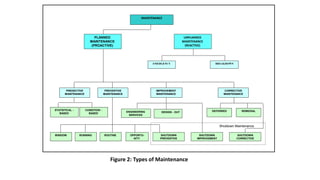
All over the world, industries have various ways to
organize maintenance activities, namely;
planned,
unplanned,
preventive,
corrective, or
predictive maintenance.
Cont……
The primary objective is arrived at achieving maximum plant
availability at minimum cost, that is:
 To prevent breakdown of equipment,
 To prolong the life span of equipment,
 To restore equipment to acceptable condition with minimum
delay after an eventual breakdown.
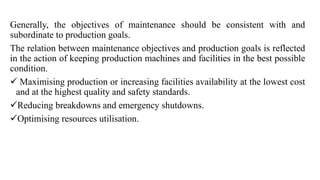
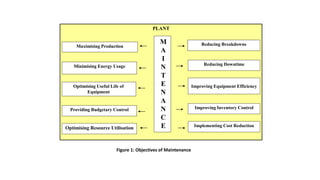
Generally, the objectives of maintenance should be consistent with and
subordinate to production goals.
The relation between maintenance objectives and production goals is reflected
in the action of keeping production machines and facilities in the best possible
condition.
 Maximising production or increasing facilities availability at the lowest cost
and at the highest quality and safety standards.
Reducing breakdowns and emergency shutdowns.
Optimising resources utilisation.
 Reducing downtime.
 Improving spares stock control.
 Improving equipment efficiency and reducing scrap rate.
 Minimising energy usage.
 Optimising the useful life of equipment.
 Providing reliable cost and budgetary control.
 Identifying and implementing cost reductions.
PLANT
M
A
I
N
T
E
N
A
N
C
E
Reducing Breakdowns
Reducing Downtime
Improving Equipment Efficiency
Improving Inventory Control
Implementing Cost Reduction
Maximising Production
Optimising Resource Utilisation
Optimising Useful Life of
Equipment
Minimising Energy Usage
Providing Budgetary Control
Figure 1: Objectives of Maintenance
MAINTENANCE
UNPLANNED
MAINTENANCE
(REACTIVE)
BREAKDOWN
EMERGENCY
PLANNED
MAINTENANCE
(PROACTIVE)
CORRECTIVE
MAINTENANCE
REMEDIAL
DEFERRED
PREDECTIVE
MAINTENANCE
CONDITION -
BASED
STATISTICAL -
BASED
PREVENTIVE
MAINTENANCE
ROUTINE
RUNNING
DESIGN - OUT
ENGINEERING
SERVICES
WINDOW
IMPROVEMENT
MAINTENANCE
SHUTDOWN
CORRECTIVE
SHUTDOWN
PREVENTIVE
SHUTDOWN
IMPROVEMENT
Shutdown Maintenance
OPPORTU-
NITY
Figure 2: Types of Maintenance

chapter -1 (9).pptx

  • 1.
    Maintenance of Machineryand Installation (MEng5311) Adama Science and Technology University School of Mechanical, Chemical and Materials Engineering Department of Mechanical Engineering
  • 2.
    Chapter 1 5/20/2023 Preparedby Biftu H. and Kuba D. Introduction
  • 3.
    Cont...... • Since theIndustrial Revolution, maintenance of engineering equipment in the field has been a challenge. Although impressive progress has been made in maintaining equipment in the field in an effective manner, maintenance of equipment is still a challenge due to factors such as size, cost, complexity, and competition. • Needless to say, today’s maintenance practices are market driven, in particular for the manufacturing and process industry, service suppliers, and so on. • An event may present an immediate environmental, performance, or safety implication. Thus, there is a definite need for effective asset management and maintenance practices that will positively influence critical success factors such as safety, product quality, speed of innovation, price, profitability, and reliable delivery.
  • 4.
    • Each yearbillions of dollars are spent on equipment maintenance around the world. • Over the years, many new developments have taken place in this area. • The terms “maintenance” and “maintenance engineering” may mean different things to different people. For example, the U.S. Department of Defense sees maintenance engineering as a discipline that assists in acquisition of resources needed for maintenance, and provides policies and plans for the use of resources in performing or accomplishing maintenance. • In contrast, maintenance activities are viewed as those that use resources in physically performing those actions and tasks attendant on the equipment maintenance function for test, servicing, repair, calibration, overhaul, modification, and so on.
  • 5.
    Definition of Maintenance Itis the combination of all technical and administrative actions, including supervision actions, intended to retain an item in, or restore it to, a state in which it can perform a required function. Maintenance is a set of organised activities that are carried out in order to keep an item in its best operational condition with minimum cost acquired. Its activities required or undertaken to conserve as nearly, and as long as possible the original condition of an asset or resource while compensating for normal wear and tear.
  • 6.
    • In engineering;actions are necessary for retaining or restoring a piece of equipment, machine or system to the specified operable condition to achieve its maximum useful life. • Maintenance Engineering is the discipline and profession of applying engineering concepts to the optimization of equipment, procedures, and departmental budgets to achieve better maintainability, reliability, and availability of equipment. • Maintenance, and hence maintenance engineering, is increasing in importance due to rising amounts of equipment, systems, machineries and infrastructure. • Since the Industrial Revolution; devices, equipment, machinery and structures have grown increasingly complex, requiring a host of personnel, vocations and related systems needed to maintain them.
  • 7.
    • Maintenance managementis the process of overseeing maintenance resources so that the organization does not experience downtime from broken equipment or waste money on inefficient maintenance procedures. • Maintenance management software (MMS) programs can assist with the process. • The primary objectives of maintenance management are to schedule work efficiently, control costs and ensure regulatory compliance.
  • 8.
    Some terms anddefinitions directly or indirectly used in engineering maintenance • Maintenance: • All actions appropriate for retaining an item/part/equipment in, or restoring it to, a given condition. • Maintenance engineering: • The activity of equipment/item maintenance that develops concepts, criteria, and technical requirements in conception and acquisition phases to be used and maintained in a current status during the operating phase to assure effective maintenance support of equipment. • is an analytical function as well as it is deliberate and methodical 8
  • 9.
    Cont….. • Preventive maintenance: •All actions carried out on a planned, periodic, and specific schedule to keep an item/equipment in stated working condition through the process of checking and reconditioning to forestall or lower the probability of failures or an unacceptable level of degradation • Corrective maintenance: • The unscheduled maintenance or repair to return items/equipment to a defined state and carried out because maintenance persons or users perceived deficiencies or failures. 9
  • 10.
    Cont…. • Predictive maintenance: •The use of modern measurement and signal processing methods to accurately diagnose item/equipment condition during operation. • Maintenance concept: • A statement of the overall concept of the item/product specification or policy that controls the type of maintenance action to be employed for the item under consideration. • Maintenance plan: • A document that outlines the management and technical procedure to be employed to maintain an item; usually describes: • facilities, tools, schedules, and resources. 10
  • 11.
    Cont…… • Reliability: • Theprobability that an item will perform its stated function satisfactorily for the desired period when used per the specified conditions. • Maintainability: • The probability that a failed item will be restored to adequately working condition. • Active repair time: • The component of downtime when repair persons are active to effect a repair. 11
  • 12.
    Cont….. • Mean timeto repair (MTTR): • A figure of merit depending on item maintainability equal to the mean item repair time. • Overhaul: • A comprehensive inspection and restoration of an item or a piece of equipment to an acceptable level at a durability time or usage limit. • Quality: • The degree to which an item, function, or process satisfies requirements of customer and user. • Inspection: • The qualitative observation of an item’s performance or condition. 12
  • 13.
    Objectives of Maintenance Eventhough maintenance engineering and maintenance have the same end objective or goal (i.e., mission-ready equipment/item at minimum cost), the environments under which they operate differ significantly. More specifically, maintenance engineering is an analytical function as well as it is deliberate and methodical. To achieve minimum breakdown and to keep the plant in good working condition at the lowest possible cost;  To keep the machines and other facilities in operational level, and used act optimum (profit making) capacity. To ensure the availability of the machines; buildings and services required by other section, buildings and services required by other section of the factory for efficient performance. The most important responsibility of plant engineering is that of maintaining the plant facilities and equipment.
  • 14.
    Cont….. improve and ensuremaximum utilization of maintenance facilities, and improve the maintenance organization.
  • 15.
    FUNCTIONS OF MAINTENANCEENGINEERING The function of maintenance engineering can be divided into primary and secondary. The primary functions of maintenance are: (i) Maintenance of existing machines and equipment (ii) Maintenance of existing buildings (iii) Inspection and lubrication of machine and equipment (iv) Generation and distribution of utilities e.g. clean and dry air, anesthesia, hot water etc. (v) Installation of new machines and equipment (vi) Modifications of existing machines, equipment and buildings
  • 16.
    The secondary functionsinclude the following: Sanitation Disposal of used items Storekeeping Fire protection Janitorial service
  • 17.
    All over theworld, industries have various ways to organize maintenance activities, namely; planned, unplanned, preventive, corrective, or predictive maintenance.
  • 18.
    Cont…… The primary objectiveis arrived at achieving maximum plant availability at minimum cost, that is:  To prevent breakdown of equipment,  To prolong the life span of equipment,  To restore equipment to acceptable condition with minimum delay after an eventual breakdown.
  • 19.
    Generally, the objectivesof maintenance should be consistent with and subordinate to production goals. The relation between maintenance objectives and production goals is reflected in the action of keeping production machines and facilities in the best possible condition.  Maximising production or increasing facilities availability at the lowest cost and at the highest quality and safety standards. Reducing breakdowns and emergency shutdowns. Optimising resources utilisation.
  • 20.
     Reducing downtime. Improving spares stock control.  Improving equipment efficiency and reducing scrap rate.  Minimising energy usage.  Optimising the useful life of equipment.  Providing reliable cost and budgetary control.  Identifying and implementing cost reductions.
  • 21.
    PLANT M A I N T E N A N C E Reducing Breakdowns Reducing Downtime ImprovingEquipment Efficiency Improving Inventory Control Implementing Cost Reduction Maximising Production Optimising Resource Utilisation Optimising Useful Life of Equipment Minimising Energy Usage Providing Budgetary Control Figure 1: Objectives of Maintenance
  • 22.
    MAINTENANCE UNPLANNED MAINTENANCE (REACTIVE) BREAKDOWN EMERGENCY PLANNED MAINTENANCE (PROACTIVE) CORRECTIVE MAINTENANCE REMEDIAL DEFERRED PREDECTIVE MAINTENANCE CONDITION - BASED STATISTICAL - BASED PREVENTIVE MAINTENANCE ROUTINE RUNNING DESIGN- OUT ENGINEERING SERVICES WINDOW IMPROVEMENT MAINTENANCE SHUTDOWN CORRECTIVE SHUTDOWN PREVENTIVE SHUTDOWN IMPROVEMENT Shutdown Maintenance OPPORTU- NITY Figure 2: Types of Maintenance