Building ServiceS SyStem:
maintenance WorkS
LECTURER NAME:
PUAN SITI NOOR ASYIKIN BINTI HJ ALIAS
STUDENT NAME:
MOHAMAD ARIFF BIN MANSOR
14DKA14F2061
MUHAMAD DANIAL HAQQIM BIN ZAKIRUDDIN
14DKA14F2059
SYED MAHMOOD BIN SYED ABD HALIM
14DKA14F2002
introduction:
 Maintenance is a set of organised activities that are carried
out in order to keep an item in its best operational
condition with minimum cost acquired. It can also be
defined as the combination of all technical and
administrative actions, including supervision actions,
intended to retain an item in, or restore it to, a state in
which it can perform a required function
maintenance
management
 All the activities of the management that determine
the maintenance objectives or priorities (defined as
targets assigned and accepted by the management
and maintenance department), strategies (defined as
a management method in order to achieve
maintenance objectives), and responsibilities and
implement them by means such as maintenance
planning, maintenance control and supervision, and
several improving methods including economical
aspects in the organization.
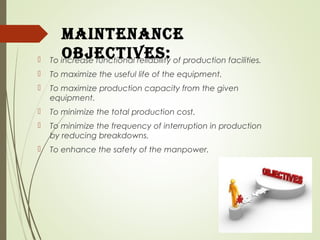
maintenance
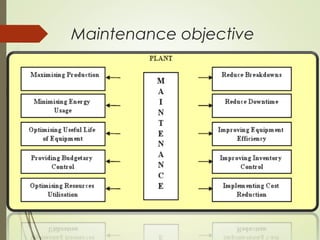
oBjectiveS: To increase functional reliability of production facilities.
 To maximize the useful life of the equipment.
 To maximize production capacity from the given
equipment.
 To minimize the total production cost.
 To minimize the frequency of interruption in production
by reducing breakdowns.
 To enhance the safety of the manpower.
Maintenance objective
importance of
maintenance
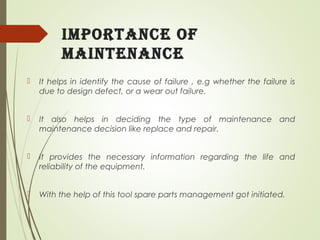
 It helps in identify the cause of failure , e.g whether the failure is
due to design defect, or a wear out failure.
 It also helps in deciding the type of maintenance and
maintenance decision like replace and repair.
 It provides the necessary information regarding the life and
reliability of the equipment.
 With the help of this tool spare parts management got initiated.
different type of
maintenance:
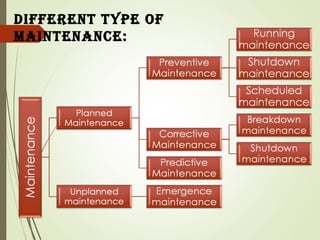
planned maintenance
In planned maintenance the maintenance action is carried out
with some fore thoughts, prior planning , record keeping and control
action. These can be further classified as :-
 Preventive maintenance
 Corrective maintenance
 Predictive maintenance
 It is based upon the principle that ‘prevention is better than cure’.
 It is a set of activities that are performed on plant equipment,
machinery, and systems before the occurrence of a failure in order
to protect them and to prevent or eliminate any degradation in
their operating conditions.
 Or the maintenance carried out at predetermined intervals or
according to prescribed criteria and intended to reduce the
probability of failure or the degradation of the functioning and the
effects limited.
 It has three types
 Running maintenance
 Scheduled maintenance
 Shut down maintenance
Preventive
Maintenance
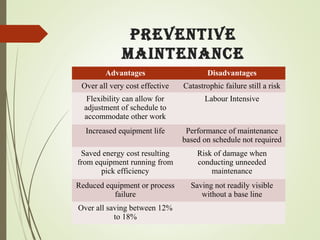
Advantages Disadvantages
Over all very cost effective Catastrophic failure still a risk
Flexibility can allow for
adjustment of schedule to
accommodate other work
Labour Intensive
Increased equipment life Performance of maintenance
based on schedule not required
Saved energy cost resulting
from equipment running from
pick efficiency
Risk of damage when
conducting unneeded
maintenance
Reduced equipment or process
failure
Saving not readily visible
without a base line
Over all saving between 12%
to 18%
Benefits of Preventive
Maintenance
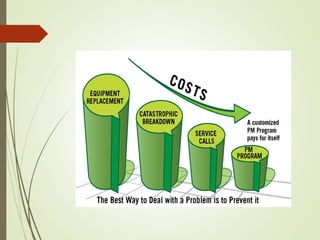
 The cost of breakdown maintenance is much greater than
preventive maintenance
 Preventive Maintenance
 Keeps equipment in good condition to prevent large
problems
 Extends the useful life of the equipment
 Finds small problems before they become big ones
 Is an excellent training tool for technicians
 Keeps equipment safer
 Parts stocking levels can be optimized
 Greatly reduces unplanned downtime
 Reduces injury
7 eleMents of
Preventive
Maintenance INSPECTION
 SERVICING
 CALIBRATION
 TESTING
 ALIGNMENT
 ADJUSTMENT
running Maintenance:
 Running maintenance which includes those
maintenance activities that are carried out while the
machine or equipment is running.
 Example – lubrication, adjustment of nuts and screws,
tightening of loose nut and bolts.
scheduled
Maintenance:
 Scheduled Maintenance is any variety of scheduled
maintenance to an object or item of equipment.
 Specifically, Planned Maintenance is a scheduled
service visit carried out by a competent and suitable
agent, to ensure that an item of equipment is
operating correctly and to therefore avoid any
unscheduled breakdown and downtime.
 Good example of PM program is car maintenance.
After so many kilometers or miles oil should be
changed, parts renewed.
shut down
Maintenance:
 Which is a set of preventive maintenance activities that are
carried out when the production line is in total stoppage
situation.
 These are performed generally after three or six months.
 These involves the inspection of plant items which are
known or suspected to occur.
CorreCtive maintenanCe:
In this type, actions such as repair, replacement, or restore
will be carried out after the occurrence of a failure in order
to eliminate the source of this failure or reduce the
frequency of its occurrence.
It also include the different types of actions like typical
adjustment of redesign equipment.
The difference between corrective maintenance and
preventive maintenance is that for the corrective
maintenance, the failure should occur before any corrective
action is taken.
It is of two types
1. Breakdown maintenance
2. Shutdown maintenance
CorreCtive maintenanCe (Cm
 The main objectives of corrective maintenance are the
maximisation of the effectiveness of all critical plant
systems, the elimination of breakdowns, the elimination of
unnecessary repair, and the reduction of the deviations from
optimum operating conditions.
 The difference between corrective maintenance and
preventive maintenance is that for the corrective
maintenance, the failure should occur before any corrective
action is taken.
 Corrective maintenance is different from run to failure
maintenance in that its activities are planned and regularly
taken out to keep plant’s machines and equipment in
optimum operating condition.
Breakdown
maintenanCe:
 It is an emergency based policy in which the plant or
equipment is operated until it fails and then it is
brought back into running condition by repair.
 The maintenance staff locate any mechanical,
electrical or any other fault to correct it immediately.
 It is feasible for the small factories where
1. There are few types of equipment.
2. Machine and equipments are simple and does not
require any specialist.
3. Where sudden failure does not cause any serious
financial loss.
PrediCtive
maintenanCe:
 As the names implies it involves the prediction of the
failure before it occurs, identifying the root cause for
those failures symptoms and eliminating those causes
before they result in extensive damage of the
equipment.
 Type of maintenance performed continuously or at
intervals according to the requirements to diagnose
and monitor a condition or system. Also
called condition based maintenance.
UnPlanned
maintenanCe:
 Maintenance action which is carried out without any
fore thoughts or prior planning is called unplanned
maintenance.
 Emergency maintenance is one of the example of
unplanned maintenance.
 In this type of maintenance the maintenance action is
executed with the help of all available maintenance
resources in least possible time, without any major time
lag.
 Examples are gas leakage in chemical plant, fire
hazards, breakdown of boiler, turbine etc.
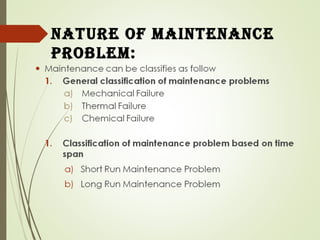
natUre of maintenanCe
ProBlem:
General ClassifiCation
maintenanCe ProBlem.
Mechanical Failure
 Worn out bushes and bearings and other moving parts.
 Fatigue of machine members
 Creep of material at high temp
 Excessive forced vibration, misalignments etc.
Thermal Failure
 Overheating of the component
 Lack of lubrication
 Inadequate of cooling
 Electrical insulation failure
Chemical Failure
 Highly corrosive fluids containing abrasive particles
 Failure of protective linings like glass , rubber etc.
ClassifiCation
maintenanCe ProBlem
Based on time sPan: Short run production problem
Maintenance problem which are carried out in a sort period of time are
known as short run production system. It may be hourly, daily ,weekly
and monthly.
Example:-
Hourly- inspection of correct lubricant, level of coolant, sharpness of
cutting tool.
Daily- cleaning of m/c, tightening of nuts, correct cooling, inspection of
various indicators, minor adjustment of parts.
Weekly- Major adjustment, lubrication, tightening of
parts.
Monthly- checking for insulation, corrosion, safety guards, checking of
worn-out and distorted parts.
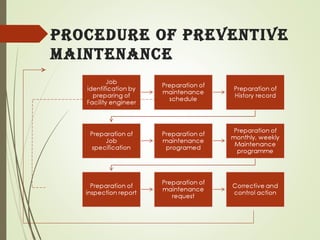
Procedure of Preventive
maintenance
ScheduleS of Preventive
maintenance:
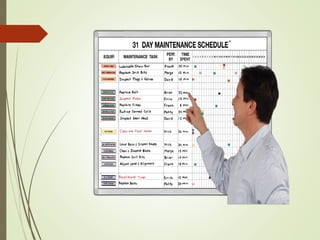
 It is simply a comprehensive list of all the incident and
their time of incident. It gives the following useful
information regarding the maintenance work.
i. What is to be done or maintained?
ii. How is to be maintained?
iii. When is to be maintained?
Besides this it may also provide the secondary information
regarding the place of maintenance and maintenance
requirement.
maintenance
Strategy :
 A maintenance strategy defines the rules for the sequence of
planned maintenance work. It contains general scheduling
information, and can therefore be assigned to as many
maintenance task lists (PM task lists) and maintenance plans
as required. A maintenance strategy contains maintenance
packages in which the following information is defined:
 The cycle in which the individual work should be performed
(for example, every two months, every 3,106.86 miles, every
500 operating hours)
 Other data which affects scheduling
maintenance
PackageS:
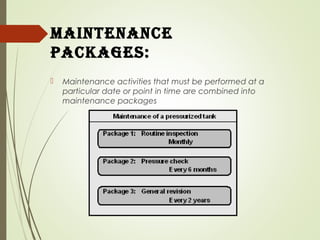
 Maintenance activities that must be performed at a
particular date or point in time are combined into
maintenance packages
concluSion:
 Good facilities is not limited with the aesthetic value of the building
only, but it comes with element of how good we apply the
technoloogy and how well we maintain it. How well we maintain a
facility is depend on how good the operator operates it. So the idea
of maintaining should be consider from the early stage during
designing th building.
 Recently, it become more and more importance, it is a field that
everybody involve in construction should know because this will
become more important to us in the future.

Pp bbs comp

  • 1.
    Building ServiceS SyStem: maintenanceWorkS LECTURER NAME: PUAN SITI NOOR ASYIKIN BINTI HJ ALIAS STUDENT NAME: MOHAMAD ARIFF BIN MANSOR 14DKA14F2061 MUHAMAD DANIAL HAQQIM BIN ZAKIRUDDIN 14DKA14F2059 SYED MAHMOOD BIN SYED ABD HALIM 14DKA14F2002
  • 2.
    introduction:  Maintenance isa set of organised activities that are carried out in order to keep an item in its best operational condition with minimum cost acquired. It can also be defined as the combination of all technical and administrative actions, including supervision actions, intended to retain an item in, or restore it to, a state in which it can perform a required function
  • 3.
    maintenance management  All theactivities of the management that determine the maintenance objectives or priorities (defined as targets assigned and accepted by the management and maintenance department), strategies (defined as a management method in order to achieve maintenance objectives), and responsibilities and implement them by means such as maintenance planning, maintenance control and supervision, and several improving methods including economical aspects in the organization.
  • 4.
    maintenance oBjectiveS: To increasefunctional reliability of production facilities.  To maximize the useful life of the equipment.  To maximize production capacity from the given equipment.  To minimize the total production cost.  To minimize the frequency of interruption in production by reducing breakdowns.  To enhance the safety of the manpower.
  • 5.
  • 7.
    importance of maintenance  Ithelps in identify the cause of failure , e.g whether the failure is due to design defect, or a wear out failure.  It also helps in deciding the type of maintenance and maintenance decision like replace and repair.  It provides the necessary information regarding the life and reliability of the equipment.  With the help of this tool spare parts management got initiated.
  • 8.
  • 9.
    planned maintenance In plannedmaintenance the maintenance action is carried out with some fore thoughts, prior planning , record keeping and control action. These can be further classified as :-  Preventive maintenance  Corrective maintenance  Predictive maintenance
  • 10.
     It isbased upon the principle that ‘prevention is better than cure’.  It is a set of activities that are performed on plant equipment, machinery, and systems before the occurrence of a failure in order to protect them and to prevent or eliminate any degradation in their operating conditions.  Or the maintenance carried out at predetermined intervals or according to prescribed criteria and intended to reduce the probability of failure or the degradation of the functioning and the effects limited.  It has three types  Running maintenance  Scheduled maintenance  Shut down maintenance
  • 12.
    Preventive Maintenance Advantages Disadvantages Over allvery cost effective Catastrophic failure still a risk Flexibility can allow for adjustment of schedule to accommodate other work Labour Intensive Increased equipment life Performance of maintenance based on schedule not required Saved energy cost resulting from equipment running from pick efficiency Risk of damage when conducting unneeded maintenance Reduced equipment or process failure Saving not readily visible without a base line Over all saving between 12% to 18%
  • 13.
    Benefits of Preventive Maintenance The cost of breakdown maintenance is much greater than preventive maintenance  Preventive Maintenance  Keeps equipment in good condition to prevent large problems  Extends the useful life of the equipment  Finds small problems before they become big ones  Is an excellent training tool for technicians  Keeps equipment safer  Parts stocking levels can be optimized  Greatly reduces unplanned downtime  Reduces injury
  • 15.
    7 eleMents of Preventive MaintenanceINSPECTION  SERVICING  CALIBRATION  TESTING  ALIGNMENT  ADJUSTMENT
  • 16.
    running Maintenance:  Runningmaintenance which includes those maintenance activities that are carried out while the machine or equipment is running.  Example – lubrication, adjustment of nuts and screws, tightening of loose nut and bolts.
  • 17.
    scheduled Maintenance:  Scheduled Maintenance isany variety of scheduled maintenance to an object or item of equipment.  Specifically, Planned Maintenance is a scheduled service visit carried out by a competent and suitable agent, to ensure that an item of equipment is operating correctly and to therefore avoid any unscheduled breakdown and downtime.  Good example of PM program is car maintenance. After so many kilometers or miles oil should be changed, parts renewed.
  • 18.
    shut down Maintenance:  Whichis a set of preventive maintenance activities that are carried out when the production line is in total stoppage situation.  These are performed generally after three or six months.  These involves the inspection of plant items which are known or suspected to occur.
  • 19.
    CorreCtive maintenanCe: In thistype, actions such as repair, replacement, or restore will be carried out after the occurrence of a failure in order to eliminate the source of this failure or reduce the frequency of its occurrence. It also include the different types of actions like typical adjustment of redesign equipment. The difference between corrective maintenance and preventive maintenance is that for the corrective maintenance, the failure should occur before any corrective action is taken. It is of two types 1. Breakdown maintenance 2. Shutdown maintenance
  • 20.
    CorreCtive maintenanCe (Cm The main objectives of corrective maintenance are the maximisation of the effectiveness of all critical plant systems, the elimination of breakdowns, the elimination of unnecessary repair, and the reduction of the deviations from optimum operating conditions.  The difference between corrective maintenance and preventive maintenance is that for the corrective maintenance, the failure should occur before any corrective action is taken.  Corrective maintenance is different from run to failure maintenance in that its activities are planned and regularly taken out to keep plant’s machines and equipment in optimum operating condition.
  • 21.
    Breakdown maintenanCe:  It isan emergency based policy in which the plant or equipment is operated until it fails and then it is brought back into running condition by repair.  The maintenance staff locate any mechanical, electrical or any other fault to correct it immediately.  It is feasible for the small factories where 1. There are few types of equipment. 2. Machine and equipments are simple and does not require any specialist. 3. Where sudden failure does not cause any serious financial loss.
  • 22.
    PrediCtive maintenanCe:  As thenames implies it involves the prediction of the failure before it occurs, identifying the root cause for those failures symptoms and eliminating those causes before they result in extensive damage of the equipment.  Type of maintenance performed continuously or at intervals according to the requirements to diagnose and monitor a condition or system. Also called condition based maintenance.
  • 23.
    UnPlanned maintenanCe:  Maintenance actionwhich is carried out without any fore thoughts or prior planning is called unplanned maintenance.  Emergency maintenance is one of the example of unplanned maintenance.  In this type of maintenance the maintenance action is executed with the help of all available maintenance resources in least possible time, without any major time lag.  Examples are gas leakage in chemical plant, fire hazards, breakdown of boiler, turbine etc.
  • 24.
  • 25.
    General ClassifiCation maintenanCe ProBlem. MechanicalFailure  Worn out bushes and bearings and other moving parts.  Fatigue of machine members  Creep of material at high temp  Excessive forced vibration, misalignments etc. Thermal Failure  Overheating of the component  Lack of lubrication  Inadequate of cooling  Electrical insulation failure Chemical Failure  Highly corrosive fluids containing abrasive particles  Failure of protective linings like glass , rubber etc.
  • 27.
    ClassifiCation maintenanCe ProBlem Based ontime sPan: Short run production problem Maintenance problem which are carried out in a sort period of time are known as short run production system. It may be hourly, daily ,weekly and monthly. Example:- Hourly- inspection of correct lubricant, level of coolant, sharpness of cutting tool. Daily- cleaning of m/c, tightening of nuts, correct cooling, inspection of various indicators, minor adjustment of parts. Weekly- Major adjustment, lubrication, tightening of parts. Monthly- checking for insulation, corrosion, safety guards, checking of worn-out and distorted parts.
  • 28.
  • 29.
    ScheduleS of Preventive maintenance: It is simply a comprehensive list of all the incident and their time of incident. It gives the following useful information regarding the maintenance work. i. What is to be done or maintained? ii. How is to be maintained? iii. When is to be maintained? Besides this it may also provide the secondary information regarding the place of maintenance and maintenance requirement.
  • 31.
    maintenance Strategy :  Amaintenance strategy defines the rules for the sequence of planned maintenance work. It contains general scheduling information, and can therefore be assigned to as many maintenance task lists (PM task lists) and maintenance plans as required. A maintenance strategy contains maintenance packages in which the following information is defined:  The cycle in which the individual work should be performed (for example, every two months, every 3,106.86 miles, every 500 operating hours)  Other data which affects scheduling
  • 32.
    maintenance PackageS:  Maintenance activitiesthat must be performed at a particular date or point in time are combined into maintenance packages
  • 33.
    concluSion:  Good facilitiesis not limited with the aesthetic value of the building only, but it comes with element of how good we apply the technoloogy and how well we maintain it. How well we maintain a facility is depend on how good the operator operates it. So the idea of maintaining should be consider from the early stage during designing th building.  Recently, it become more and more importance, it is a field that everybody involve in construction should know because this will become more important to us in the future.