10/18/2011


                                                                                  Today’s seminar topics
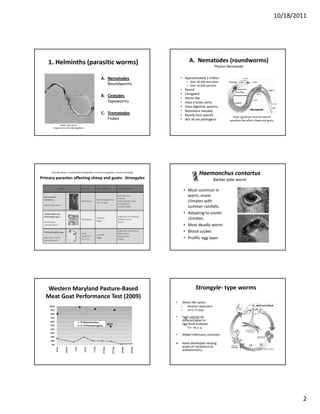
Internal parasites seminar                                                        I.  Parasites and their biology
SHEEP AND GOATS                                                                   II.  Diagnostic tools 
                                                                                       Diagnostic tools 
                                                                                  III Using anthelmintics effectively
                                                                                  III.  Using anthelmintics effectively
                                                                                  IV.  Integrated parasite management  (IPM)


                             SUSAN SCHOENIAN (Shāy‐nē‐ŭn) 
                                 Sheep & Goat Specialist
                             University of Maryland Extension
                       sschoen@umd.edu – www.sheepandgoat.com


                                                                                           Barber pole worms in abomasum
                                                                                           Image source: ScienceWatch.com


                                                                                                                 What is a parasite?
        I.  Parasites and their biology                                            A (generally undesirable) living organism that exists by stealing the 
           species, life cycles, pathogenicity, interactions                             resources  produced or collected by another living organism.

                                                                                                        [Greek:  “one who eats at the table of another]                                 


                                                                                      There are two general kinds 
There are two kinds of parasites.                                                        of internal parasites.
1. Internal (endo) – a                                                           1. Helminths
   parasite that lives                                                             multi‐cellular
   inside another                                                                      a) Nematodes
   organism.                                                                           b) Cestodes
                                                                                       c) Trematodes
2. External (ecto) – a 
   parasite that lives on                                                        2. Protozoa
   the blood of the host                                                           single cell
   or lays eggs on their                                                               a) Coccidia 
   hide or in their nose.                                                              b) Giardia
                                                                                       c) Cryptosporidium                          Haemonchus contortus (barber pole worm)
                                           External parasite: sheep ked (tick)
                                                                                                                                          Image from University of Georgia
                                         Image from Colorado State University


                                                                                                                                                                                           1
10/18/2011


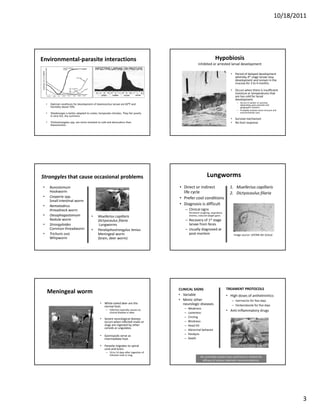
      1. Helminths (parasitic worms)                                                                               A.  Nematodes (roundworms)
                                                                                                                                     Phylum Nematoda


                                                           A. Nematodes                                   • Approximately 1 million
                                                                                                                 – Over 28,000 described
                                                              Roundworms                                         – Over 16,000 parasitic
                                                                                                          •     Round
                                                                                                          •     Elongated
                                                           B. Cestodes                                    •     Worm‐like
                                                              Tapeworms                                   •     Have a body cavity
                                                                                                          •     Have digestive systems
                                                                                                          •     Reproduce sexually
                                                           C. Trematodes                                  •     Mostly host‐specific           Most significant kind of internal 
                                                              Flukes                                      •     Not all are pathogenic       parasites that affect sheep and goats.
                  Barber pole worm
           Image source: MicrobiologyBytes


         Class Nematoda → Superfamily Strongyloidea → Family Strongylidae → Genera Strongyle
                                                                                                                           Haemonchus contortus
Primary parasites affecting sheep and goats:  Strongyles                                                                             Barber pole worm
                 Species               Location       Light  Infection      Heavy infection
                                                                                                              • Most common in 
  Haemonchus
                                                                            Lack stamina                        warm, moist 
                                                                            Anemia
  Contortus                                           Gradual weight loss
                                       Abomasum
                                                      Loss of color
                                                                            Edema (bottle jaw)                  climates with 
                                                                            Constipation
  Barber pole worm
                                                                            Sudden death
                                                                            Sudden death                        summer rainfalls.
                                                                                                                summer rainfalls
  Teladorsagia spp.                                                                                           • Adapting to cooler 
  (Ostertagia spp.)                                                         Rapid loss of condition
                                       Abomasum
                                                      Unthrifty
                                                      Daggy
                                                                            Profuse scours                      climates.
  Small brown                                                               Death
  stomach worm                                                                                                • Most deadly worm.
  Trichostrongylus spp.
                                       Small 
                                                                            Rapid loss of condition
                                                                            Black scours
                                                                                                              • Blood sucker.
                                                      Unthrifty
                                       intestines                           Dehydration
  Black scour worm
  Bankrupt worm
                                       (1st 3 m)
                                                      Daggy
                                                                            Death                             • Prolific egg layer.


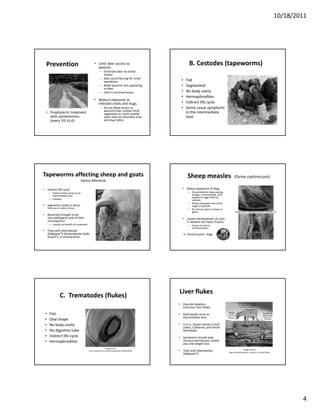
   Western Maryland Pasture‐Based                                                                                       Strongyle‐ type worms
   Meat Goat Performance Test (2009)
                                                                                                      •       Direct life cycles
                                                                                                          –      Weather dependent                                L4, adult suck blood
                                                                                                          –      14 to 21 days

                                                                                                      •       Eggs cannot be 
                                                                                                              differentiated in 
                                                                  2011                                        egg fecal analyses.
                                                                                                                 75 – 95 μ m
                                                                                                                                                 L3
                                                                                                      •       Mixed infections common.

                                                                                                              Have developed varying                                     L1
                                                                                                              levels of resistance to                        L2
                                                                                                              anthelmintics.


                                                                                                                                                                                                 2
10/18/2011


Environmental‐parasite interactions                                                                                          Hypobiosis
                                                                                                            inhibited or arrested larval development

                                                                                                                                          • Period of delayed development 
                                                                                                                                            whereby 4th stage larvae stop 
                                                                                                                                            development and remain in the 
                                                                                                                                            mucosa for 3 to 4 months.

                                                                                                                                          • Occurs when there is insufficient 
                                                                                                                                            moisture or temperatures that 
                                                                                                                                               i                       h
                                                                                                                                            are too cold for larval 
                                                                                                                                            development.
                                                                                                                                              – Occurs in winter or summer, 
    •   Optimal conditions for development of Haemonchus larvae are 82⁰F and                                                                    depending upon parasite and 
        humidity above 70%.                                                                                                                     geographic location.
                                                                                                                                              – Probably involves some immune and 
    •   Teladorsagia is better adapted to cooler, temperate climates. They fair poorly                                                          environmental cues.
        in very hot, dry summers.
                                                                                                                                          • Survival mechanism
    •   Trichostrongylus spp. are more resistant to cold and desiccation than                                                             • No host response
        Haemonchus.


Strongyles that cause occasional problems                                                                            Lungworms
•       Bunostomum                                                                           • Direct or indirect                         1. Muellerius capillaris
        Hookworm                                                                               life cycle                                 2. Dictyocaulus filaria
•       Cooperia spp.                                                                        • Prefer cool conditions
        Small intestinal worm
•       Nematodirus                                                                          • Diagnosis is difficult
        threadneck worm                                                                          – Clinical signs
                                                                                                    Persistent coughing, respiratory 
•       Oesophagastomum                    •     Muellerius capillaris                              distress, reduced weight gains
        Nodule worm                              Dictyocaulus filaria                            – Recovery of 1st stage 
•       Strongyloides                             Lungworms                                        larvae from feces
        Common threadworm                  •     Paralaphostrongylus tenius                      – Usually diagnosed at 
•       Trichuris ovis                           Meningeal worm                                    post‐mortem                              Image source: UPENN Vet School
        Whipworm                                 (brain, deer worm)


                                                                                             CLINICAL SIGNS                             TREAMENT PROTOCOLS
    Meningeal worm                                                                           • Variable                                 • High doses of anthelmintics
                                                                                             • Mimic other                                 – Ivermectin for five days
                                                  • White‐tailed deer are the                   neurologic diseases
                                                    normal host.                                                                           – Fenbendazole for five days
                                                       – Infection typically causes no          –   Weakness
                                                         clinical disease in deer.
                                                                                                                                        • Anti‐inflammatory drugs
                                                                                                –   Lameness
                                                                                                –   Circling
                                                  • Severe neurological disease 
                                                    occurs when infected snails or 
                                                    occurs when infected snails or              –   Blindness
                                                    slugs are ingested by other                 –   Head tilt
                                                    cervids or ungulates.
                                                                                                –   Abnormal behavior
                                                                                                –   Paralysis
                                                  • Gastropods serve as 
                                                    intermediate host.                          –   Death

                                                  • Parasite migrates to spinal 
                                                    cord and brain.
                                                       – 10 to 14 days after ingestion of 
                                                         infected snail or slug
                                                                                                               No controlled studies have confirmed or refuted the 
                                                                                                                efficacy of various treatment recommendations.


                                                                                                                                                                                       3
10/18/2011


  Prevention                                    • Limit deer access to 
                                                  pasture.
                                                                                                       B. Cestodes (tapeworms)
                                                      – Eliminate deer via lethal 
                                                        means.
                                                      – Deer‐proof fencing for small 
                                                        operations.                              •   Flat 
                                                      – Make pastures less appealing             •   Segmented
                                                        to deer.
                                                        Feed in enclosed areas.
                                                      – Feed in enclosed areas                   •   No body cavity
                                                                                                     No body cavity
                                                                                                 •   Hermaphrodites
                                                • Reduce exposure to 
                                                  infected snails and slugs.                     •   Indirect life cycle
                                                      – Do not allow access to                   •   Some cause symptoms 
                                                        pastures that  contain thick 
  • Prophylactic treatment                              vegetation or moist shaded                   in the intermediate 
    with anthelmintics                                  areas that are favorable snail               host.
    (every 10‐14 d).                                    and slug habits.


Tapeworms affecting sheep and goats                                                                   Sheep measles  (Ovine cysticercosis)
                                  Genus Moniezia

• Indirect life cycle                                                                             • Sheep tapeworm of dogs
      – Pasture mites serve as an                                                                     – Transmitted to sheep eating 
        intermediate host.                                                                              forages contaminated  with 
                                                                                                        tapeworm eggs shed by 
      – 6 weeks                                                                                         canines.
                                                                                                      – Sheep and goats host larval 
• Segments visible in feces.                                                                            stage of parasite
                                                                                                           g     p
     Only worm visible in feces                                                                       – No clinical signs in sheep or 
                                                                                                        goats.                                 Image source: Optimal Livestock Services, LLC
• Generally thought to be 
  non‐pathogenic and of little                                                                    • Causes development of cysts 
  consequence.                                                                                      in skeletal and heart muscle.
      – Usually no benefit to treatment                                                               – Cause of carcass 
                                                                                                        condemnation.
• Treat with albendazole 
  (Valbazen®), fenbendazole (Safe‐                                                                → Control point:  dogs
  Guard®), or praziquantel.


                                                                                               Liver flukes
                C.  Trematodes (flukes)
                                                                                               • Fasciola hepatica
                                                                                                 (common liver fluke)

 •    Flat                                                                                     • Gastropods serve as 
                                                                                                 intermediate host.
 •    Oval shape
 •    No body cavity                                                                           • In U.S., found mainly in Gulf 
                                                                                                 states, California, and Pacific 
 •    No digestive tube                                                                          Northwest.
 •    Indirect life cycle                                                                      • Symptoms include pale 
 •    Hermaphrodites                                                                             mucous membranes, bottle 
                                                                                                 jaw, and weight loss.
                                                              Image source: 
                                                                                                                                                        Image source: 
                                          http://www.flickr.com/photos/peteredin/3386220058/   • Treat with albendazole                  Agricultural Research Council in South Africa
                                                                                                 (Valbazen®).


                                                                                                                                                                                                 4
10/18/2011


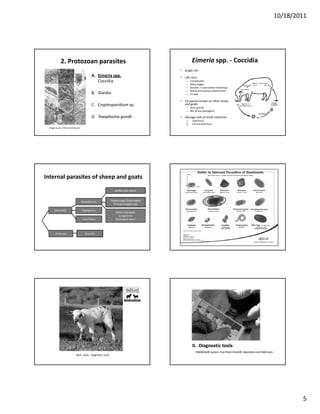
            2. Protozoan parasites                                                                 Eimeria spp. ‐ Coccidia
                                                                                         • Single cell
                                            A. Eimeria spp.                              • Life cycle
                                               Coccidia                                      –    Complicated
                                                                                             –    Many stages
                                                                                             –    Oocytes → sporulation (hatching)
                                                                                             –    Sexual and asexual reproduction
                                            B.
                                            B Giardia                                        –    21 days 

                                                                                         • 10 species known to infect sheep 
                                            C. Cryptosporidium sp.                         and goats
                                                                                             – Host specific
                                                                                             – Not all are pathogenic

                                            D. Toxoplasma gondii                         • Damage cells of small intestines
                                                                                             1.    Subclinical
                                                                                             2.    Clinical (diarrhea)
 Image source: FAO United Nations


Internal parasites of sheep and goats
                                                                Barber pole worm


                                    Roundworms               Teladorsagia (Ostertagia)
                                                               Trichostronyglus spp.

      Helminths                     Tapeworms
                                                                 Other strongyles
                                                                   Lungworms
                                    Liver flukes                 Meningeal worm


       Protozoa                       Coccidia


                                                                                                   II.  Diagnostic tools
                                                                                                   II.  Diagnostic tools
                                                                                                      FAMACHA© system, Five Point Check©, laboratory and field tests
                            Next  topic:  diagnostic tools


                                                                                                                                                                               5
10/18/2011


                                                   They all are.    
                                                                                       • Almost all sheep and goats 
                                                                                         have parasites, probably of 
                                                                                         different kinds.

                                                                                       • “Positive” egg or oocyst
                                                                                          Positive egg or oocyst
                                                                                         counts are “normal.”  
                                                                                         Negative tests are rare 
                                                                                         (during the periods of risk).

         How do you tell if your sheep or goats                                        • Some level of parasite 
                                                                                         infection is required for 
          are infected with internal parasites?                                          immunity.


They all are. 
• Clinical disease occurs at 
  a certain level of infection 
  that can vary by animal.

• Not all parasites are
  Not all parasites are 
  pathogenic or highly 
  pathogenic.

• Not all strains of parasites                          The more important question to ask is:
  are pathogenic or equally 
  pathogenic.                                           How do you tell if a sheep or goat is clinically parasitized 
                                                        (suffering negative effects) and requires anthelmintic treatment?


   Diagnostic tools                                               Diagnostic tools
                                                     ON FARM                               LABORATORY
                                  1) On‐farm
                                                     • Animal                             • Blood
                                    1) Animal                                                 – Packed cell volume
                                                        – FAMACHA©
                                    2) Fecal            – Five Point Check®  NEW!         • Fecal
                                                                                              – Si l fl
                                                                                                Simple flotation
                                                                                                             i
                                                     • Fecal
                                                                                              – Fecal egg counts
                                  2) Laboratory         – Simple flotation                        • FECRT
                                    1) Blood            – Fecal egg counts                    – Lectin staining test   NEW!
                                                            • Fecal egg count                 – Larvae
                                    2) Fecal                  reduction test (FECRT)              • Larvae culture
                                    3) Larvae           – Dipstick                                • Larval development assay
                                                                                                    [DrenchRite®]
                                                     • Carla® saliva test                         • Pasture


                                                                                                                                      6
10/18/2011


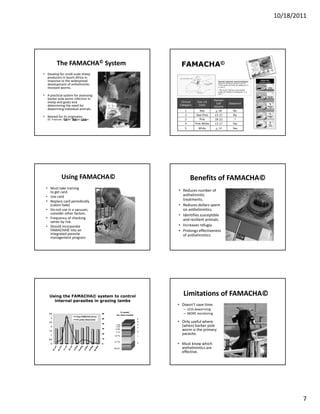
          The FAMACHA© System                                                 FAMACHA©
• Develop for small‐scale sheep 
  producers in South Africa in 
  response to the widespread                                                                            General treatment recommendations
                                                                                                        Deworm adults at scores 4 and 5*
  development of anthelmintic‐                                                                          Treat lambs and kids at categories 3,
                                                                                                        4, and 5
  resistant worms. 
                                                                                                        *The South Africans recommend
                                                                                                        goats be treated at categories 3 4,
                                                                                                                                       3, 4
                                                                                                        and 5
• A practical system for assessing 
  barber pole worm infection in                                                                       Packed
  sheep and goats and                                                         Clinical    Eye Lid
                                                                                                        Cell        Deworm?
  determining the need for                                                   Category      Color
                                                                                                      Volume
  deworming individual animals.                                                 1           Red        > 28               No
                                                                                2        Red-Pink     23-27               No
• Named for its originator:
   Dr. Francois “FAffa” MAlan CHArt                                             3           Pink      18-22                ?
                                                                                4        Pink-White   13-17              Yes
                                                                                5          White       < 12              Yes


             Using FAMACHA©                                                         Benefits of FAMACHA©
  • Must take training 
    to get card.                                                            • Reduces number of 
  • Use card                                                                  anthelmintic 
  • Replace card periodically                                                 treatments.  
    (colors fade)                                                           • Reduces dollars spent 
                                                                                                p
  • Do not use in a vacuum;                                                   on anthelmintics.
    consider other factors.                                                 • Identifies susceptible 
  • Frequency of checking                                                     and resilient animals.
    varies by risk.
  • Should incorporate                                                      • Increases refugia 
    FAMACHA© into an                                                        • Prolongs effectiveness 
    integrated parasite                                                       of anthelmintics
    management program.


    Using the FAMACHA© system to control                                       Limitations of FAMACHA©
      internal parasites in grazing lambs
                                                                            • Doesn’t save time.
                                                                               – LESS deworming
                                                        % Lambs/
    3.5                                      60
                                                    No. times treated
                                                                               – MORE monitoring
                         Avg FAMACHA Score
     3                                       50                         6
                         # Lambs Dewormed
    2.5
    2
                                             40
                                                                        5   • Only useful where
                                                                              Only useful where 
     2
                                                   1.2%
                                                   1.2%
                                                                        4
                                                                        3
                                                                              (when) barber pole 
    1.5
                                             30    4.8%
                                                   7.1%                 2
                                                                              worm is the primary 
     1
                                             20
                                                  16.7%                 1
                                                                              parasite.
    0.5                                      10
                                                  41.7%
     0                                       0                          0
                                                                            • Must know which 
                                                  26.2%                       anthelmintics are 
                                                                              effective.


                                                                                                                                                        7
10/18/2011


                                                                                                                                                                              Back
                                                                                                                                                         body condition (and coat condition)

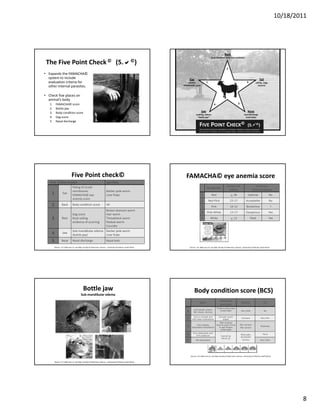
 The Five Point Check ©    (5.                                                                               ©)
                                                                                                                                                                                 2
• Expands the FAMACHA© 
  system to include                                                                                                        Eye                                                                                                       Tail
  evaluation criteria for                                                                                                anemia                  1                                                                3            soiling , dags
  other internal parasites.                                                                                          FAMACHA© score                                                                                              (scours)


• Check five places on 
  animal’s body
   1.    FAMACHA© score                                                                                                                                       4                                     5
   2.    Bottle jaw
   3.    Body condition score                                                                                                            Jaw                                                                       Nose
                                                                                                                                   swelling, edema                                                           nasal discharge
   4.    Dag score                                                                                                                   “bottle jaw”                                                              (nose bots)
   5.    Nasal discharge
                                                                                                                                       FIVE POINT CHECK©   (5.                                                                  ©)
                                                                                                                                       FOR TARGETED SELECTIVE TREATMENT OF INTERNAL PARASITES IN SMALL RUMINANTS
                                                                                                                                       G.F. BATH AND J.A. VAN WYK, FACULTY OF VETERINARY SCIENCE,  UNIVERSITY OF PRETORIA, SOUTH AFRICA


                              Five Point check©                                                                        FAMACHA© eye anemia score
   Point       What to check                                                 Specificity
                                Paling of ocular                                                                                                                                   Packed cell                              Treatment 
                                                                                                                                                  Eye lid color
                                                                                                                                                                                    volume                               recommendation
                                membranes                                    Barber pole worm
    1             Eye
                                FAMACHA© eye                                 Liver fluke                                                  1               Red                           > 28                       Optimal                          No
                                anemia score
                                                                                                                                          2          Red-Pink                          23-27                    Acceptable                          No
    2            Back           Body condition score                         All
                                                                                                                                          3              Pink                          18 22
                                                                                                                                                                                       18-22                     Borderline                           ?
                                                                             Brown stomach worm
                                Dag score                                    Hair worm
                                                                                                                                          4        Pink-White                          13-17                    Dangerous                           Yes

    3             Rear          fecal soiling                                Threadneck worm                                              5             White                           < 12                          Fatal                         Yes
                                evidence of scouring                         Nodule worm
                                                                             Coccidia
                                Sub‐mandibular edema  Barber pole worm
    4             Jaw
                                (bottle jaw)          Liver fluke
    5            Nose           Nasal discharge                              Nasal bots

        Source:  G.F. Bath and J.A. van Wyk, Faculty of Veterinary  Science,  University of Pretoria, South Africa         Source:  G.F. Bath and J.A. van Wyk, Faculty of Veterinary  Science,  University of Pretoria, South Africa


                                              Bottle jaw                                                                        Body condition score (BCS)
                                           Sub‐mandibular edema
                                                                                                                                                                       Transverse 
                                                                                                                                        Spine                                                            Muscle                              Fat
                                                                                                                                                                       processes
                                                                                                                                                                  Fingers easily pass
                                                                                                                               Individually clearly
                                                                                                                       1       felt, sharp, obvious
                                                                                                                                                                      underneath                         Very little                         No


                                                                                                                               Form a smooth line                    Smooth round
                                                                                                                       2      with deep undulations                     edges
                                                                                                                                                                                                         Concave                          Very thin

                                                                                                                                                                     Well covered
                                                                                                                                  Only slightly                   have to push firmly                   Not concave
                                                                                                                       3     detectable undulations                 to get fingers                      Not convex
                                                                                                                                                                                                                                          Moderate
                                                                                                                                                                     underneath
                                                                                                                               Only detectable with
                                                                                                                       4          firm pressure                         Cannot be
                                                                                                                                                                                                        Maximally                           Thick
                                                                                                                                                                                                        developed
                                                                                                                                                                        felt at all
                                                                                                                       5           Not detectable                                                        Convex                           Very thick


                                                                                                                            Source:  G.F. Bath and J.A. van Wyk, Faculty of Veterinary  Science,  University of Pretoria, South Africa

        Source:  G.F. Bath and J.A. van Wyk, Faculty of Veterinary  Science,  University of Pretoria, South Africa


                                                                                                                                                                                                                                                                  8
10/18/2011


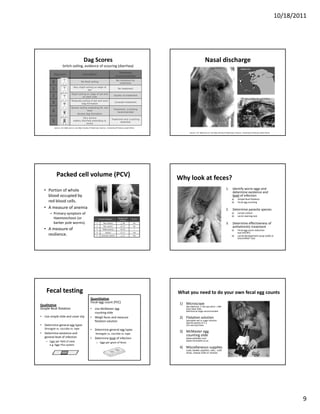
                                                 Dag Scores                                                                                            Nasal discharge
                      britch soiling, evidence of scouring (diarrhea)
                                                                                               Treatment 
           Dag score                            Description
                                                                                            recommendation
                                                                                             No indication for
         0                                    No fecal soiling
                                                                                                treatment
                                    Very slight soiling on edge of
         1                                       tail
                                                                                               No treatment

                                 Slight soiling on edge of tail and
         2                                  on each side
                                                                                           Usually no treatment

                                 Moderate soiling of tail and wool
         3                               Dag formation
                                                                                            Consider treatment

                                 Severe soiling extending far into
                                                                                           Treatment, crutching
         4                                     wool
                                                                                              recommended
                                      Severe dag formation
                                            Very severe
                                                                                        Treatment and crutching
         5                          watery diarrhea extending to
                                               hocks
                                                                                               essential

           Source:  G.F. Bath and J.A. van Wyk, Faculty of Veterinary  Science,  University of Pretoria, South Africa

                                                                                                                                   Source:  G.F. Bath and J.A. van Wyk, Faculty of Veterinary  Science,  University of Pretoria, South Africa


             Packed cell volume (PCV)                                                                                      Why look at feces?
  • Portion of whole                                                                                                                                                               1.      Identify worm eggs and 
                                                                                                                                                                                           determine existence and 
    blood occupied by                                                                                                                                                                      level of infection
                                                                                                                                                                                          a)      Simple fecal flotation
    red blood cells.                                                                                                                                                                      b)      Fecal egg counting

  • A measure of anemia
    A measure of anemia                                                                                                                                                            2.      Determine parasite species 
       – Primary symptom of                                                                                                                                                               a)      Larvae culture
                                                                                                                                                                                          b)      Lectin staining test
         Haemonchosis (or                                              Clinical Category
                                                                                               Packed Cell
                                                                                                 Volume
                                                                                                                  Tx (?)

         barber pole worms).                                       1         Non-anemic            > 28            No                                                              3.      Determine effectiveness of 
                                                                   2         Non-anemic           23-27            No                                                                      anthelmintic treatment
  • A measure of                                                   3        Mildly anemic         18-22             ?
                                                                                                                                                                                          a)      Fecal egg count reduction 
                                                                   4           Anemic             13-17            Yes                                                                            test (FECRT)
    resilience.                                                    5      Severely anemic          < 12            Yes                                                                    b)      Larval development assay (LDA) or 
                                                                                                                                                                                                  DrenchRite® test


    Fecal testing                                                                                                          What you need to do your own fecal egg counts
                                                           Quantitative
                                                           Fecal egg count (FEC)                                           1) Microscope
Qualitative                                                                                                                    40x objective  x 10x eye piece = 400
Simple fecal flotation                                    • Use McMaster egg                                                   Only need 100x
                                                                                                                               Mechanical stage recommended
                                                            counting slide
• Use simple slide and cover slip                         • Weigh feces and measure                                        2) Flotation solution
                                                            flotation solution
                                                            flotation solution                                                 Saturated salt or sugar solution
                                                                                                                                                    g
                                                                                                                               Specific gravity of 1.2
• Determine general egg types                                                                                                  Can also purchase
   Strongyle vs. coccidia vs. tape                        • Determine general egg types
• Determine existence and                                                                                                  3) McMaster egg 
                                                                 Strongyle vs. coccidia vs. tape
  general level of infection
                                                                                                                              counting slide
                                                          • Determine level of infection                                       www.vetslides.com
    – Eggs per field of view                                                                                                   www.mcmaster.co.za
                                                                  – Eggs per gram of feces
      e.g. Eggs Plus system
                                                                                                                           4) Miscellaneous supplies
                                                                                                                               scale, beaker, pipettes, vials,  craft 
                                                                                                                               sticks, cheese cloth or strainer


                                                                                                                                                                                                                                                        9
10/18/2011


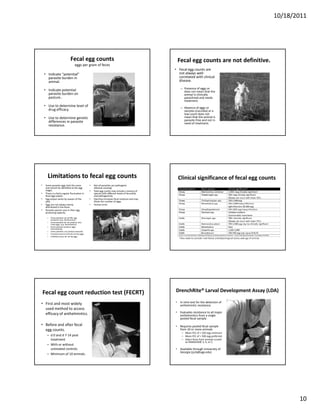
                                Fecal egg counts                                                     Fecal egg counts are not definitive.
                                    eggs per gram of feces
                                                                                                    • Fecal egg counts are 
    • Indicate “potential”                                                                            not always well‐
      parasite burden in                                                                              correlated with clinical 
      animal.                                                                                         disease.

                                                                                                       – Presence of eggs or 
    • Indicate potential                                                                                 does not mean that the 
                                                                                                         does not mean that the
      parasite burden on 
               b d                                                                                       animal is clinically 
      pasture..                                                                                          parasitized and needs 
                                                                                                         treatment.
    • Use to determine level of                                                                        – Absence of eggs or 
      drug efficacy.                                                                                     oocytes (coccidia) or a 
                                                                                                         low count does not 
    • Use to determine genetic                                                                           mean that the animal is 
      differences in parasite                                                                            parasite‐free and not in 
                                                                                                         need of treatment.
      resistance.


       Limitations to fecal egg counts                                                                Clinical significance of fecal egg counts
•    Some parasite eggs look the same             •   Not all parasites are pathogenic 
     and cannot be identified at the egg              (disease‐causing)
     stage).                                      •   Total egg counts may include a mixture of 
•    There is a fairly regular fluctuation in         species with different levels of fecundity 
     fecal egg output.                                and pathogenicity.
•    Egg output varies by season of the           •   Diarrhea increases fecal moisture and may 
     year.                                            dilute the number of eggs.
•    Eggs are not always evenly                   •   Human error.
     distributed in the feces
     distributed in the feces.
•    Parasite species vary in their egg 
     producing capacity.
      –   Some parasites are prolific egg 
          producers (e.g. Haemonchus)
      –   Some parasites do not produce very 
          many eggs. (e.g. Nematodirus)
      –   Some parasites produce eggs 
          intermittently
      –   Some parasites can produce asexually
      –   Immature worms (L4’s) do not lay eggs
      –   Inhibited larvae do not lay eggs


    Fecal egg count reduction test (FECRT)                                                          DrenchRite® Larval Development Assay (LDA)

• First and most widely                                                                             • In vitro test for the detection of 
                                                                                                      anthelmintic resistance.
  used method to access 
  efficacy of anthelmintics.                                                                        • Evaluates resistance to all major 
                                                                                                      anthelmintics from a single 
                                                                                                      pooled fecal sample.
• Before and after fecal                                                                            • Requires pooled fecal sample 
  egg counts.                                                                                         from 10 or more animals 
                                                                                                        – Mean FEC of > 350 epg minimum
      – d 0 and d 7‐14 post                                                                             – Mean FEC of > 500 epg preferred.
        treatment                                                                                       – Select feces from animals scored 
                                                                                                          as FAMACHA© 3, 4, or 5.
      – With or without 
        untreated controls                                                                          • Available through University of 
                                                                                                      Georgia (jscb@uga.edu)
      – Minimum of 10 animals.


                                                                                                                                                     10
10/18/2011


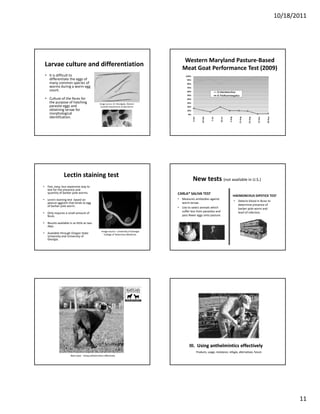
                                                                                               Western Maryland Pasture‐Based 
 Larvae culture and differentiation
                                                                                               Meat Goat Performance Test (2009)
 • It is difficult to 
   differentiate the eggs of 
   many common species of 
   worms during a worm egg 
   count. 

 • Culture of the feces for 
   the purpose of hatching                         Image source: Dr. Woodgate, Western 
   parasite eggs and                                Australia Department of Agriculture
   obtaining larvae for 
   morphological 
   identification.


                Lectin staining test
                                                                                                       New tests (not available in U.S.)
• Fast, easy, less‐expensive way to  
  test for the presence and 
  quantity of barber pole worms.                                                            CARLA® SALIVA TEST
                                                                                                                                         HAEMONCHUS DIPSTICK TEST
• Lectin‐staining test  based on                                                            • Measures antibodies against 
                                                                                                                                          • Detects blood in feces to 
  peanut agglutin that binds to egg                                                           worm larvae.
  of barber pole worm.
  of barber pole worm.                                                                                                                      determine presence of 
                                                                                            • Use to select animals which
                                                                                              Use to select animals which                   barber pole worm and 
                                                                                              suffer less from parasites and                level of infection.
• Only requires a small amount of 
  feces.                                                                                      pass fewer eggs onto pasture.

• Results available in as little as two 
  days.
                                                    Image source:  University of Georgia 
• Available through Oregon State                      College of Veterinary Medicine.
  University and University of 
  Georgia.


                                                                                                    III.  Using anthelmintics effectively
                                                                                                         Products, usage, resistance, refugia, alternatives, future 
                      Next topic:  Using anthelmintics effectively 


                                                                                                                                                                                11
10/18/2011


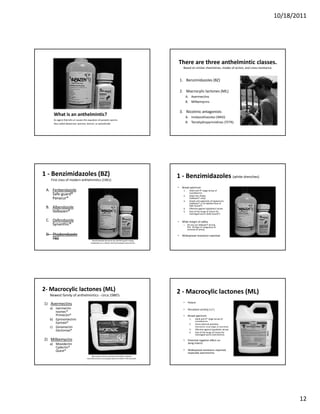
                                                                                                       There are three anthelmintic classes.
                                                                                                             Based on similar chemistries, modes of action, and cross‐resistance.


                                                                                                           1. Benzimidazoles (BZ)

                                                                                                              Macrocylic lactones (ML)
                                                                                                           2. Macrocylic lactones (ML)
                                                                                                                  A. Avermectins
                                                                                                                  B. Milbemycins

                                                                                                           3. Nicotinic antagonists
     What is an anthelmintic?                                                                                     A. Imidazothiazoles (IMID)
     An agent that kills or causes the expulsion of parasitic worms.
     Also called dewormer, wormer, drench, or parasiticide.                                                       B. Tetrahydropyrimidines (TETR)


1 ‐ Benzimidazoles (BZ)                                                                                1 ‐ Benzimidazoles (white drenches)
   First class of modern anthelmintics (1961)

                                                                                                       •    Broad spectrum
 A. Fenbendazole                                                                                             1.     Adult and 4th stage larvae of 
                                                                                                                    roundworms
    Safe‐guard®                                                                                              2.     Adult liver flukes 
    Panacur®                                                                                                        (Valbazen® only)
                                                                                                             3.     Heads and segments of tapeworms  
                                                                                                                    (Valbazen® or 2x labeled dose of 
                                                                                                                    Safe‐Guard®)
 B.
 B Albendazole                                                                                               4.     Effective against hypobiotic larvae
    Valbazen®                                                                                                5.     One of the drugs of choice for 
                                                                                                                    meningeal worm (Safe‐Guard®)

 C. Oxfendazole                                                                                        •    Wide margin of safety
    Synanthic®                                                                                               – Do not use Valbazen® during 
                                                                                                               first  30 days of  pregnancy or 
                                                                                                               removal of ram(s).

 D. Thiabendazole                                                                                      •    Widespread resistance reported.
    TBZ                                   Benzimidazoles kill worms by interfering with energy 
                                         metabolism on a cellular level by binding to beta tubulin.


2‐ Macrocylic lactones (ML)                                                                            2 ‐ Macrocylic lactones (ML)
   Newest family of anthelmintics ‐ circa 1980’s
                                                                                                             •     Potent
1) Avermectins
  a) Ivermectin                                                                                              •     Persistent activity (+/‐)
     Ivomec®
     Primectin®                                                                                              •     Broad spectrum
  b) Eprinomectrin                                                                                                  1.   Adult and 4th stage larvae of 
                                                                                                                         roundworms
     Eprinex®
     E i ®                                                                                                          2.   Some external parasites
  c) Doramectin                                                                                                          (Ivermectin: larval stages of nasal bots)
     Dectomax®                                                                                                      3.   Effective against hypobiotic larvae
                                                                                                                    4.   One of the drugs of choice for 
                                                                                                                         meningeal worm (ivermectin).

2) Milbemycins                                                                                               •     Potential negative effect on 
  a) Moxidectin                                                                                                    dung insects.
     Cydectin®
     Quest®                                                                                                  •     Widespread resistance reported, 
                                                                                                                   especially avermectins. 
                                          Macrocylic lactones interfere with GABA‐mediated 
                                     neurotransmission, causing paralysis and death of the parasite.


                                                                                                                                                                                           12
10/18/2011


3‐ Nicotinic agonists                                                                                 3 ‐ Nicotinic agonists
                                                                                                      1.        Levamisole
  1) Imidazothiazoles (IMID)                                                                                    – Clear (yellow) dewormer
       a)     Levamisole                                                                                        – Broad spectrum
                                                                            Act as agonists at                      • Adult and 4th stage 
              Prohibit®                                                  nicotinic acetylcholine                      roundworm larvae
                                                                              receptors of 
              Tramisol®                                                   nematodes, causing 
                                                                          nematodes, causing
                                                                                                                    • Hypobiotic larvae (?)
              Levasol®                                                       paralysis of the                   – Narrower margin of 
                                                                                 worms.                           safety (esp. injectable)
                                                                                                                – Resistance varies from high to low.
  2) Tetrahydropyrimidines (TETR)                                                                               – Resistance is sex‐linked.
       a)     Morantel                                                                                2.        Rumatel
              Rumatel®                                                                                          – Oral feed additive
       b)     Pyrantel                                                                                          – Effective against adult worms only
              Strongid®                                                                                         – Not much is known about resistance 
                                                                                                                  levels.


 FDA‐approved anthelmintics                                                                                            Withdrawal periods for 
 SHEEP                                       GOATS                                                                   FDA‐approved anthelmintics
 1. Ivomec® sheep drench                     1. Safe‐Guard® suspension                                                                                 Sheep                    Goats
                                                                                                           Anthelmintic
    Ivermectin                                  Fenbendazole                                                                                   Meat            Milk    Meat             Milk
      y            p
 2. Cydectin® sheep drench                                    q
                                             2. Valbazen® liquid                                           Valbazen® suspension               7 days       Not est.   7 days         Not est.
    Moxidectin                                  Albendazole                                                Prohibit® drench                   3 days       Not est.     NA              NA

 3. Prohibit® drench                            [liver flukes only]                                        Cydectin® drench                   7 days       Not est.     NA              NA
                                                                                                           Ivomec® drench                     11 days      Not est.     NA              NA
    Levamisole                               3. Rumatel® premix
                                                                                                           Rumatel® premix                      NA             NA     30 days        Not est.
 4. Valbazen® liquid                            Morantel
                                                                                                           Safe‐Guard® suspension               NA             NA     6 days         Not est.
    Albendazole
                                                                                                           Source:  Animal Drugs @ FDA  and product labels

  Different anthelmintics may be approved and available in different countries.


         Withdrawal periods for extra‐                                                                              Anthelmintic resistance
                                                                                                                    Ability of the worms to survive anthelmintic treatment
          label anthelmintics in goats
                                                                                                    • Official definition:  95% or less reduction 
         Anthelmintic                            Meat               Milk                              in fecal egg count (FECRT).
         Valbazen® suspension                    9 days            7 days
                                                                                                           a)     Widespread in parasites of sheep, goats, 
         Safe‐Guard® @ 2x label dose            16 days            4 days                                         and horses.  Has been reported in all 
                                                                                                                  anthelmintics.
         Ivomec® sheep drench
         Ivomec® sheep drench                   14 days
                                                14 days             NA
         Prohibit® drench                                                                                  b)     Developing in cattle parasites.
                                                 4 days             NA
         (1 packet/262 ml water)
         Cydectin® pour‐on (orally)             23 days             NA                                     c)     Has been detected in pig parasites.
                                                                                                                                                                                Tx
         Cydectin® sheep drench                 14 days             NA
                                                                                                    • Is likely (inevitable) to develop wherever 
         Cydectin® injectable                   120 days            NA                                anthelmintics are frequently used.
                                                                                                           – There will always be some worms that 
            Source:  Food Animal Residue Avoidance Database (FARAD) and/or                                   survive an anthelmintic treatment.
            http://www.luresext.edu/goats/training/GoatDewormerChart.pdf


                                                                                                                                                                                                      13
10/18/2011


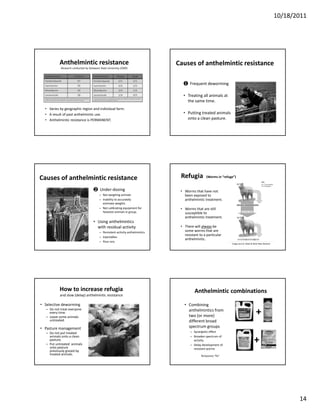
                            Anthelmintic resistance                                                                                                                                   Causes of anthelmintic resistance
                               Research conducted by Delaware State University (2009)

  Anthelmintic                                         % farms                         Anthelmintic                                Sheep                         Goat
  Fenbendazole                                               97                        Fenbendazole                                   5/5                         5/5
  Ivermectin                                                 56                        Ivermectin                                     3/4                         5/5
                                                                                                                                                                                        ❶ Frequent deworming
  Moxidectin                                                 50                        Moxidectin                                     2/4                         1/5
  Levamisole                                                 28                        Levamisole                                     1/4                         0/5
                                                                                       4 sheep and 5 goat farms in the Mid‐Atlantic region were tested for anthelmintic resistance 
                                                                                                                                                                                        • Treating all animals at 
  19 goat and 13 sheep farms in MD, DE, PA, VA, and WV were tested for anthelmintic 
  resistance using the larval development assay at the University of Georgia.          using the FECRT and larval development assay.
                                                                                                                                                                                          the same time.
  • Varies by geographic region and individual farm.
  • A result of past anthelmintic use.                                                                                                                                                  • Putting treated animals 
  • Anthelmintic resistance is PERMANENT.                                                                                                                                                 onto a clean pasture.


Causes of anthelmintic resistance                                                                                                                                                      Refugia  (Worms in “refuge”)
                                                                                       ❷ Under‐dosing                                                                                  • Worms that have not 
                                                                                                  – Not weighing animals                                                                 been exposed to 
                                                                                                  – Inability to accurately                                                              anthelmintic treatment.
                                                                                                    estimate weights
                                                                                                           lib i        i      f
                                                                                                  – Not calibrating equipment for                                                      • Worms that are still 
                                                                                                    heaviest animals in group.                                                           susceptible to 
                                                                                                                                                                                         anthelmintic treatment.
                                                                                       • Using anthelmintics 
                                                                                         with residual activity                                                                        • There will always be 
                                                                                                  – Persistent‐activity anthelmintics                                                    some worms that are 
                                                                                                                                                                                         resistant to a particular 
                                                                                                  – Injectables
                                                                                                                                                                                         anthelmintic.
                                                                                                  – Pour‐ons
                                                                                                                                                                                                                       Image source: Meat & Wool New Zealand


                             How to increase refugia                                                                                                                                            Anthelmintic combinations
                             and slow (delay) anthelmintic resistance

• Selective deworming                                                                                                                                                                    • Combining 
   – Do not treat everyone 
     every time.
   – Leave some animals 
                                                                                                                                                                                           anthelmintics from 
                                                                                                                                                                                           two (or more)                                      +
     untreated.                                                                                                                                                                            different broad 
                                                                                                                                                                                           different broad
• Pasture management                                                                                                                                                                       spectrum groups
   – Do not put treated                                                                                                                                                                      – Synergistic effect
     animals onto a clean 
                                                                                                                                                                                                                                            +
                                                                                                                                                                                             – Broaden spectrum of 
     pasture.                                                                                                                                                                                  activity
   – Put untreated  animals                                                                                                                                                                  – Delay development of 
     onto pasture                                                                                                                                                                              resistant worms
     previously grazed by 
     treated animals.                                                                                                                                                                               Temporary “fix”


                                                                                                                                                                                                                                                                      14
10/18/2011


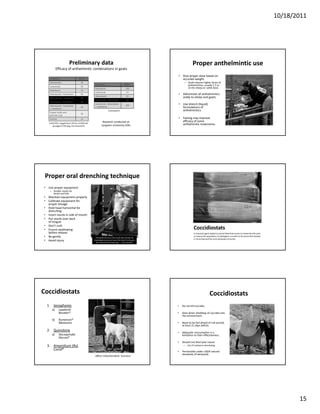
                         Preliminary data                                                                           Proper anthelmintic use
           Efficacy of anthelmintic combinations in goats
                                                                                                       • Give proper dose based on 
    Treatment                      FECR %                                                                accurate weight.
    Albendazole                      76                                                                      – Goats require higher doses of 
                                                  Treatment                           FECR %                   anthelmintics, usually 1.5 to 
    Levamisole                       39
                                                  Moxidectin                            100                    2x the sheep or cattle dose.
    Moxidectin                       74
                                                  Levamisole                            14
    Albandazole + levamisole         85                                                                • Administer all anthelmintics 
                                                  Albendazole                           21
    Albendazole + moxidectin         98                                                                  orally to sheep and goats.
                                                  Levamisole + albendazole              94
    Levamsiole + moxidectin          98
    Albendazole + levamisole
                                                  Levamisole + albendazole 
                                                                                        100            • Use drench (liquid) 
                                     99           + moxidectin                                           formulations of 
    + moxidectin
                                                                  4 animals/Tx                           anthelmintics.
    Copper oxide wire 
                                     28
    particles (2 g)
    Control                          14                                                                • Fasting may improve 
                                                          Research conducted at                          efficacy of some 
   Initial FECs ranged from 250 to 13,500 and 
       averaged 2,550 epg. 8.6 animals/Tx                Langston University (OK)                        anthelmintic treatments.


 Proper oral drenching technique
• Use proper equipment
    – Smaller nozzle for 
      lambs and kids
• Maintain equipment properly
• Calibrate equipment for 
  proper dosage
• H ld h d h i
  Hold head horizontal for 
                        lf
  drenching
• Insert nozzle in side of mouth
• Put nozzle over back 
  of tongue
• Don’t rush
• Ensure swallowing                                                                                                   Coccidiostats
  before release.                                                                                                     A chemical agent added to animal feed that serves to retard the life cycle 
• Be gentle.                                      Putting the drench in the mouth will activate the 
                                                                                                                      or reduce the population of pathogenic coccidia to the point that disease 
                                                                                                                      is minimized and the host develops immunity .
• Avoid injury                                   esophageal groove and cause the drench to by‐pass 
                                                   the rumen into the lower gut . . . and not work!


Coccidiostats                                                                                                                          Coccidiostats
  1. Ionophores                                                                                        •   Do not kill coccidia.
      a)       Lasalocid
               Bovatec®                                                                                •   Slow down shedding of coccidia into 
                                                                                                           the environment.
      b)       Rumensin®
               Monensin                                                                                •   Need to be fed ahead of risk period, 
                                                                                                           at least 21 days before.
  2. Quinolone
                                                                                                       •   Adequate consumption is a 
      a)       Decoquinate                                                                                 limitation to their effectiveness.
               Deccox®
                                                                                                       •   Should not feed year‐round 
  3. Amprolium (Rx)                                                                                         – risk of resistance developing
     Corid®                                                                                            •   Permissible under USDA natural 
                                                                                                           standards (if declared).
                                                  Affect mitochondrial  function


                                                                                                                                                                                                           15
10/18/2011


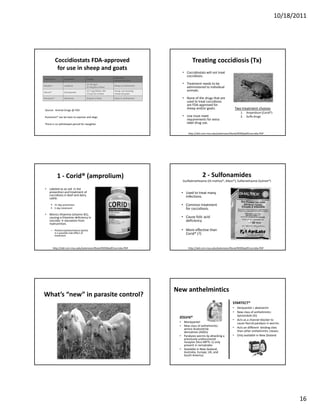
            Coccidiostats FDA‐approved                                                      Treating coccidiosis (Tx)
             for use in sheep and goats
                                                                                     • Coccidiostats will not treat 
                                                           Approved 
                                                                                       coccidiosis.
Trade name          Ingredient       Dosage
                                                           species and class
                                     15‐70 mg/d                                      • Treatment needs to be 
Bovatec®            Lasalocid                              Sheep in confinement
                                     20‐30 g/ton of feed                               administered to individual 
Deccox® 
Deccox®             Decoquinate
                                     22.7 mg/100 lbs. BW   Young, non‐lactating        animals.
                                     13.6 g/ ton of feed   sheep and goats

Rumensin®           Monensin         20 g/ton of feed      Goats in confinement      • None of the drugs that are 
                                                                                       used to treat coccidiosis 
                                                                                       are FDA‐approved for 
Source:  Animal Drugs @ FDA
                                                                                       sheep and/or goats.                  Two treatment choices
                                                                                                                                 1.   Amprolium (Corid®)
Rumensin® can be toxic to equines and dogs.                                          • Use must meet                             2.   Sulfa drugs
                                                                                       requirements for extra 
There is no withdrawal period for slaughter.                                           label drug use.

                                                                                         http://old.cvm.msu.edu/extension/Rook/ROOKpdf/coccidia.PDF


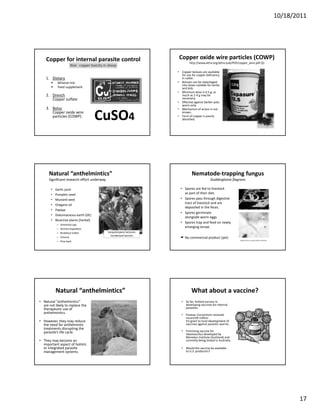
              1 ‐ Corid® (amprolium)                                                               2 ‐ Sulfonamides
                                                                                     Ssulfadimethoxine (Di‐methox®, Albon®), Sulfamethazine (Sulmet®)

• Labeled as an aid  in the 
  prevention and treatment of                                                       • Used to treat many 
  coccidiosis in beef and dairy                                                       infections.
  cattle.

            21 day prevention                                                       • Common treatment 
            5 day treatment                                                           for coccidiosis.
• Mimics thiamine (vitamin B1), 
  causing a thiamine deficiency in                                                  • Cause folic acid 
  coccidia → starvation from                                                          deficiency 
  malnutrition.

      – Polioencephalomalacia (polio)                                               • More effective than 
        is a possible side effect of                                                  Corid® (?)
        treatment.


           http://old.cvm.msu.edu/extension/Rook/ROOKpdf/coccidia.PDF                    http://old.cvm.msu.edu/extension/Rook/ROOKpdf/coccidia.PDF


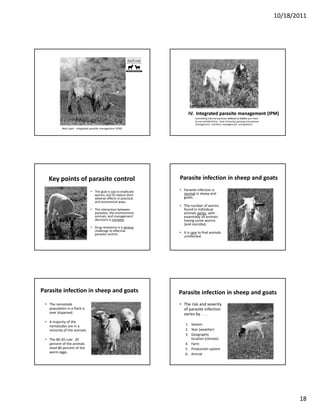
                                                                                  New anthelmintics
What’s “new” in parasite control?
                                                                                                                           STARTECT®
                                                                                                                           • Derquantel + abamectin
                                                                                                                           • New class of anthelmintic: 
                                                                                                                             Spiroindole (SI)
                                                                                   ZOLVIX® 
                                                                                                                           • Acts as a channel blocker to 
                                                                                   • Monepantel                              cause flaccid paralysis in worms.
                                                                                   • New class of anthelmintic: 
                                                                                     amino‐Acetonitrile                    • Acts on different  binding sites 
                                                                                     derivatives (ADDs)                      than other anthelmintic classes.
                                                                                   • Paralyzes worms by attacking a        • Only available in New Zealand
                                                                                     previously undiscovered 
                                                                                     receptor (Hco‐MPTL‐1) only 
                                                                                     present in nematodes
                                                                                   • Available in New Zealand, 
                                                                                     Australia, Europe, UK, and 
                                                                                     South America.


                                                                                                                                                                  16
10/18/2011


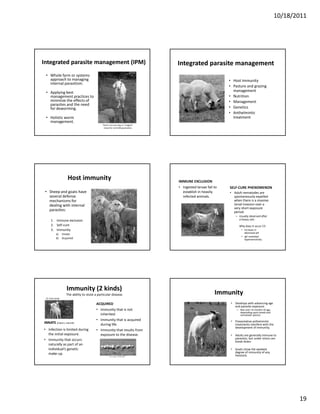
    Copper for internal parasite control                                   Copper oxide wire particles (COWP) 
                                                                                  http://www.attra.org/attra‐pub/PDF/copper_wire.pdf ($)
                        Risk:  copper toxicity in sheep
                                                                          • Copper boluses are available 
                                                                            for use for copper deficiency 
    1. Dietary                                                              in cattle.
            Mineral mix                                                   • Boluses can be repackaged 
                                                                            into doses suitable for lambs 
            Feed supplement                                                 and kids.
                                                                          • Minimum dose is 0 5 g; as
                                                                            Minimum dose is 0.5 g; as 
    2. Drench                                                               much as 2‐4 g may be 
       Copper sulfate                                                       necessary.
                                                                          • Effective against barber pole 
                                                                            worm only.
    3. Bolus                                                              • Mechanism of action is not 
       Copper oxide wire 
       particles (COWP) 
                                        CuSO4                               known.
                                                                          • Form of copper is poorly 
                                                                            absorbed.


      Natural “anthelmintics”                                                       Nematode‐trapping fungus
      Significant research effort underway                                                        Duddingtonia flagrans

       •   Garlic juice                                                     • Spores are fed to livestock 
       •   Pumpkin seed                                                       as part of their diet.
       •   Mustard seed                                                     • Spores pass through digestive 
                                                                              tract of livestock and are 
       •   Oregano oil
                                                                              deposited in the feces.
                                                                              deposited in the feces
       •   Papaya 
                                                                            • Spores germinate 
       •   Diatomaceous earth (DE)
                                                                              alongside worm eggs.
       •   Bioactive plants (herbal)
                                                                            • Spores trap and feed on newly 
            –   Artemisia spp. 
            –   Sericea lespedeza
                                                                              emerging larvae.
            –   Birdsfoot trefoil                Sesquiterpene lactones
                                                   Condensed tannins
            –   Chicory                                                        No commercial product (yet)
                                                                                                                      Image source: Louisiana State University
            –   Pine bark


           Natural “anthelmintics”                                                  What about a vaccine?
• Natural “anthelmintics”                                                   • So far, limited success in 
  are not likely to replace the                                               developing vaccines for internal 
  therapeutic use of                                                          parasites.
  anthelmintics.                                                            • Paravac Consortium received 
                                                                              record €9 million 
  However, they may reduce 
• However they may reduce                                                     EU grant to fund development of 
                                                                              EU grant to fund development of
  the need for anthelmintic                                                   vaccines against parasitic worms.
  treatments disrupting the 
  parasite’s life cycle.                                                    • Promising vaccine for 
                                                                              Haemonchus developed by 
                                                                              Moredun Institute (Scotland) and 
• They may become an                                                          currently being tested in Australia.
  important aspect of holistic 
  or integrated parasite                                                    • Would the vaccine be available 
  management systems.                                                         to U.S. producers? 


                                                                                                                                                                        17
10/18/2011


                                                                             Boer goat grazing chicory


                                                                          IV.  Integrated parasite management (IPM)
                                                                                Controlling internal parasites without or before 
                                                                                                               without or before you need 
                                                                                to use anthelmintics:  host immunity, grazing and pasture 
                                                                                management, nutrition, management, and genetics.
            Next topic:  Integrated parasite management (IPM)


   Key points of parasite control                                    Parasite infection in sheep and goats 

                                   • The goal is not to eradicate    • Parasite infection is 
                                     worms, but to reduce their        normal in sheep and 
                                     adverse effects in practical      goats.
                                     and economical ways.
                                                                     • The number of worms 
                                   • The interaction between           found in individual 
                                     parasites, the environment,       animals varies, with 
                                     animals, and management           essentially all animals 
                                     decisions is complex.             having some worms 
                                                                       (and coccidia).
                                   • Drug resistance is a serious
                                     challenge to effective 
                                     parasite control.               • It is rare to find animals 
                                                                       uninfected.


Parasite infection in sheep and goats                                Parasite infection in sheep and goats
 • The nematode                                                      • The risk and severity 
   population in a flock is                                            of parasite infection 
   over dispersed.                                                     varies by . . . 
 • A majority of the
   A majority of the 
   nematodes are in a                                                    1. Season
   minority of the animals.                                              2. Year (weather)
                                                                         3. Geographic 
 • The 80‐20 rule:  20                                                      location (climate)
   percent of the animals                                                4. Farm
   shed 80 percent of the                                                5. Production system
   worm eggs.
                                                                         6. Animal


                                                                                                                                                    18
10/18/2011


Integrated parasite management (IPM)                                                  Integrated parasite management
 • Whole farm or systems 
   approach to managing                                                                                            • Host immunity
   internal parasitism.
                                                                                                                   • Pasture and grazing 
   Applying best 
 • Applying best                                                                                                           g
                                                                                                                     management
   management practices to                                                                                         • Nutrition
   minimize the effects of                                                                                         • Management
   parasites and the need 
   for deworming.                                                                                                  • Genetics
                                                                                                                   • Anthelmintic 
 • Holistic worm                                                                                                     treatment
   management.
                                                 There is no one way or “magical” 
                                                  recipe for controlling parasites.


                       Host immunity                                                  IMMUNE EXCLUSION
                                                                                      • Ingested larvae fail to    SELF‐CURE PHENOMENON
 • Sheep and goats have                                                                 establish in heavily       • Adult nematodes are 
   several defense                                                                      infected animals.            spontaneously expelled 
   mechanisms for                                                                                                    when there is a massive 
   dealing with internal 
         g                                                                                                           larval invasion over a 
                                                                                                                     very short exposure 
                                                                                                                            h
   parasites:                                                                                                        period.
                                                                                                                       – Usually observed after 
      1. Immune exclusion                                                                                                a heavy rain.  
      2. Self‐cure                                                                                                        Why does it occur (?)
      3. Immunity                                                                                                           • Increase in 
            a)     Innate                                                                                                     abomasal pH
                                                                                                                            • IgE mediated 
            b)     Acquired                                                                                                   hypersensitivity


                      Immunity (2 kinds)
                      The ability to resist a particular disease.                                            Immunity
 St. Croix lambs

                                            ACQUIRED                                                                • Develops with advancing age 
                                                                                                                      and parasite exposure.
                                            • Immunity that is not                                                      – Not until >4 months of age, 
                                                                                                                          depending upon breed and 
                                              inherited.                                                                  nematode species.
                                                        y        q
                                            • Immunity that is acquired                                             • Preventative anthelmintic
                                                                                                                      Preventative anthelmintic 
INNATE 
INNATE (inborn, natural)                      during life.                                                            treatments interfere with the 
                                                                                                                      development of immunity.
• Infection is limited during               • Immunity that results from 
  the initial exposure.                       exposure to the disease.                                              • Adults are generally immune to 
• Immunity that occurs                                                                                                parasites, but under stress can 
                                                                                                                      break down.
  naturally as part of an 
  individual’s genetic                                                                                              • Goats show the weakest 
  make‐up.                                                                                                            degree of immunity of any 
                                                        Crossbred lambs                                               livestock.


                                                                                                                                                                19
10/18/2011


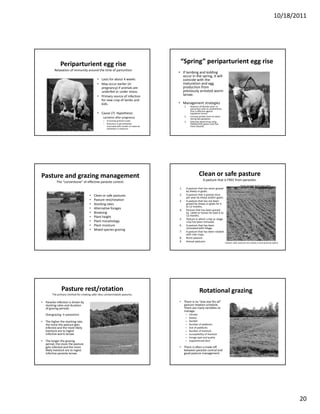
              Periparturient egg rise                                                          “Spring” periparturient egg rise
          Relaxation of immunity around the time of parturition
                                                                                              • If lambing and kidding 
                                                                                                occur in the spring, it will 
                                             • Lasts for about 4 weeks                          coincide with the 
                                             • May occur earlier (in                            maturation and egg 
                                               pregnancy) if animals are                        production from 
                                               underfed or under stress.
                                               underfed or under stress                         p
                                                                                                previously arrested worm 
                                                                                                          y
                                             • Primary source of infection                      larvae.
                                               for new crop of lambs and 
                                               kids.                                          • Management strategies
                                                                                                   1.    Deworm all females prior to 
                                                                                                         parturition with an anthelmintic 
                                                                                                         that is effective against 
                                             • Cause (?)  Hypothesis:                                    hypobiotic larvae.
                                                  Lactation after pregnancy                        2.    Increase protein level of ration 
                                                                                                         during late gestation.
                                                  –   Increasing prolactin levels                  3.    Selective deworming using 
                                                  –   Reduction in IgA antibodies                        FAMACHA© system and Five 
                                                      associated with transfer of maternal               Point Check©.
                                                      antibodies in colostrum


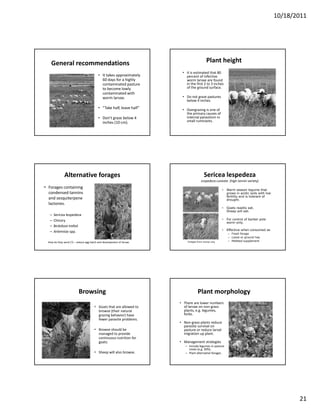
Pasture and grazing management                                                                                   Clean or safe pasture
                                                                                                                      A pasture that is FREE from parasites.
            The “cornerstone” of effective parasite control.
                                                                                                                                                            Newly planted dwarf pearl millet
                                                                                              1.    A pasture that has never grazed 
                                                                                                    by sheep or goats.
                                       •   Clean or safe pastures                             2.    A pasture that is grazed once 
                                                                                                    per year by sheep and/or goats.
                                       •   Pasture rest/rotation                              3.    A pasture that has not been 
                                       •   Stocking rates                                           grazed by sheep or goats for 6 
                                                                                                    to 12 months.
                                                                                                    to 12 months
                                       •   Alternative forages
                                            l          f                                      4.    Pasture that has been grazed 
                                       •   Browsing                                                 by  cattle or horses for past 6 to 
                                       •   Plant height                                             12 months.
                                                                                              5.    Pasture in which a hay or silage 
                                       •   Plant morphology                                         crop has been removed.
                                       •   Plant moisture                                     6.    A pasture that has been 
                                                                                                    renovated with tillage.
                                       •   Mixed species grazing
                                                                                              7.    A pasture that has been rotated 
                                                                                                    with row crops.
                                                                                              8.    Burnt pasture.
                                                                                              9.    Annual pastures.                    Cleaner, safer pastures are usually a more practical option.


               Pasture rest/rotation                                                                              Rotational grazing
        The primary method for creating safer (less contaminated) pastures.

• Parasite infection is driven by                                                             • There is no “one‐size fits all” 
  stocking rates and duration                                                                   pasture rotation schedule. 
  of grazing periods.                                                                           There are many variables to 
                                                                                                manage:
   Overgrazing → parasitism                                                                         –   Climate
                                                                                                    –   Season
• The higher the stocking rate
  The higher the stocking rate,                                                                     –   Rainfall
  the more the pasture gets                                                                         –   Number of paddocks
  infected and the more likely                                                                      –   Size of paddocks
  livestock are to ingest                                                                           –   Number of livestock
  infective worm larvae.                                                                            –   Susceptibility of livestock
                                                                                                    –   Forage type and quality
• The longer the grazing                                                                            –   Supplemental feed
  period, the more the pasture 
  gets infected and the more                                                                  • There is often a trade‐off 
  likely livestock are to ingest                                                                between parasite control and 
  infective parasite larvae.                                                                    good pasture management.


                                                                                                                                                                                                       20
10/18/2011


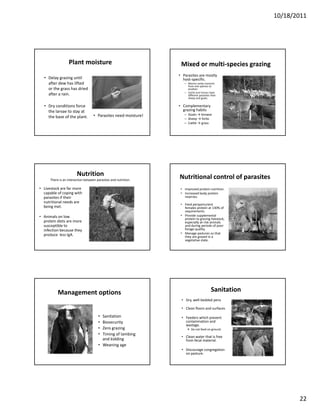
    General recommendations                                                                Plant height
                                                                        • It is estimated that 80 
                                          • It takes approximately        percent of infective 
                                            60 days for a highly          worm larvae are found 
                                            contaminated pasture          in the first 2 to 3 inches 
                                            to become lowly               of the ground surface.
                                            contaminated with 
                                                 t i t d ith
                                            worm larvae.                • Do not graze pastures 
                                                                          below 4 inches.
                                          • “Take half, leave half”     • Overgrazing is one of 
                                                                          the primary causes of 
                                          • Don’t graze below 4           internal parasitism in 
                                            inches (10 cm).               small ruminants.


               Alternative forages                                                       Sericea lespedeza
                                                                                      Lespedeza cuneata (high tannin variety)
                                                            Chicory
• Forages containing 
                                                                                                     •    Warm season legume that
  condensed tannins                                                                                       grows in acidic soils with low
                                                                                                          fertility and is tolerant of
  and sesquiterpene                                                                                       drought.
  lactones.
                                                                                                     •    Goats
                                                                                                          G t readily eat.
                                                                                                                   dil    t
                                                                                                          Sheep will eat.
   –   Sericea lespedeza
   –   Chicory                                                                                       •    For control of barber pole
                                                                                                          worm only.
   –   Birdsfoot trefoil
                                                                                                     •    Effective when consumed as
   –   Artemisia spp.
                                                                                                          – Fresh forage
                                                                                                          – Loose or ground hay
  How do they work (?) – reduce egg hatch and development of larvae.        Images from scsrpc.org        – Pelleted supplement


                          Browsing                                                  Plant morphology
                                                                       • There are lower numbers                              Red clover
                                       • Goats that are allowed to       of larvae on non‐grass 
                                         browse (their natural           plants, e.g. legumes, 
                                         grazing behavior) have          forbs.
                                         fewer parasite problems.
                                                                         Non‐grass plants reduce 
                                                                       • N           l t d
                                                                         parasite survival on 
                                       • Browse should be                pasture or reduce larval 
                                         managed to provide              migration up plant.
                                         continuous nutrition for 
                                         goats.                        • Management strategies
                                                                          – Include legumes in pasture 
                                                                            mixes (e.g. 30%).
                                       • Sheep will also browse.          – Plant alternative forages.


                                                                                                                                                  21
10/18/2011


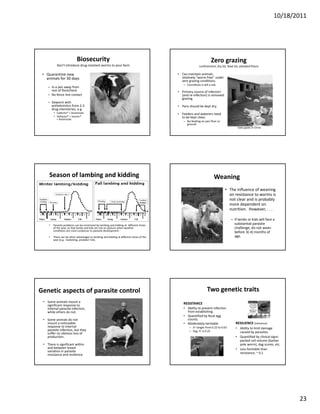
                  Plant moisture                                   Mixed or multi‐species grazing
                                                                  • Parasites are mostly 
  • Delay grazing until                                             host‐specific.
    after dew has lifted                                             – Worms rarely transmit 
                                                                       from one species to 
    or the grass has dried                                             another.
                                                                       Cattle and horses have 
                                                                     – Cattle and horses have
    after a rain.                                                      different parasites than 
                                                                       sheep and goats.

  • Dry conditions force                                          • Complementary 
    the larvae to stay at                                           grazing habits
                                    • Parasites need moisture!       – Goats → browse
    the base of the plant.                                           – Sheep → forbs
                                                                     – Cattle → grass


                        Nutrition                                 Nutritional control of parasites
      There is an interaction between parasites and nutrition. 

• Livestock are far more                                           • Improved protein nutrition.
  capable of coping with                                           • Increased body protein 
  parasites if their                                                 reserves.
  nutritional needs are 
                                                                   • Feed periparturient 
  being met.
  being met                                                          females protein at 130% of 
                                                                     f    l      t i t 130% f
                                                                     requirements.
• Animals on low                                                   • Provide supplemental 
                                                                     protein to grazing livestock, 
  protein diets are more                                             especially at‐risk animals 
  susceptible to                                                     and during periods of poor 
  infection because they                                             forage quality.
  produce  less IgA.                                               • Manage pastures so that 
                                                                     they are grazed in a 
                                                                     vegetative state.


           Management options                                                              Sanitation
                                                                   • Dry, well‐bedded pens

                                                                   • Clean floors and surfaces

                                       • Sanitation                • Feeders which prevent 
                                       • Biosecurity                 contamination and 
                                                                     contamination and
                                                                     wastage.
                                       • Zero grazing                     Do not feed on ground.
                                       • Timing of lambing 
                                                                   • Clean water that is free 
                                         and kidding                 from fecal material.
                                       • Weaning age
                                                                   • Discourage congregation 
                                                                     on pasture.


                                                                                                               22
10/18/2011


                            Biosecurity                                                                                 Zero grazing
           Don’t introduce drug‐resistant worms to your farm                                                 confinement, dry lot, feed lot, elevated floors

 • Quarantine new                                                                          • Can maintain animals 
   animals for 30 days                                                                       relatively “worm‐free” under 
                                                                                             zero grazing conditions.
                                                                                               – Coccidiosis is still a risk.
    – In a pen away from 
      rest of flock/herd.                                                                    Primary source of infection 
                                                                                           • Primary source of infection
    – No fence line contact                                                                  (and re‐infection) is removed:  
                                                                                             grazing.
    – Deworm with 
      anthelmintics from 2‐3                                                               • Pens should be kept dry.
      drug chemistries, e.g. 
         • Cydectin® + levamisole                                                          • Feeders and waterers need 
         • Valbazen® + Ivomec®                                                               to be kept clean.
           + levamisole
                                                                                               – No feeding on pen floor or 
                                                                                                 ground.
                                                                                                                                           Dairy goats in China


     Season of lambing and kidding                                                                                        Weaning
                                                                                                                                 • The influence of weaning 
                                                                                                                                   on resistance to worms is 
                                                                                                                                   not clear and is probably 
                                                                                                                                   more dependent on 
                                                                                                                                   nutrition.  However, . . .

                                                                                                                                      – If lambs or kids will face a 
     •   Parasite problems can be minimized by lambing and kidding at  different times                                                  substantial parasite 
         of the year, so that lambs and kids are not on pasture when weather                                                            challenge, do not wean 
         conditions are most conducive to parasite development.
                                                                                                                                        before 3(‐4) months of 
     •   There can be other advantages to lambing and kidding at different times of the                                                 age.
         year (e.g.  marketing, predator risk).


Genetic aspects of parasite control                                                                                 Two genetic traits 
 • Some animals mount a                                                                        RESISTANCE
   significant response to 
   internal parasite infection,                                                                • Ability to prevent infection 
   while others do not.                                                                          from establishing.
                                                                                               • Quantified by fecal egg 
 • Some animals do not                                                                           counts.
   mount a noticeable                                                                          • Moderately heritable                    RESILIENCE (tolerance)
   response to internal                                                                             – h2 ranges from 0.22 to 0.63        • Ability to limit damage 
   parasite infection, but they                                                                     – Avg. h2 is 0.25
   suffer no obvious loss of                                                                                                               caused by parasites
   production.                                                                                                                           • Quantified by clinical signs: 
                                                                                                                                           packed cell volume (barber 
 • There is significant within                                                                                                             pole worm), dag scores, etc.
   and between breed                                                                                                                     • Less heritable than 
   variation in parasite                                                                                                                   resistance, ~ 0.1
   resistance and resilience.


                                                                                                                                                                            23
10/18/2011


                    Resistance and resilience                                    (More) resistant breeds
                           Both traits are equally important!
    •   There is a cost to parasite 
        resistance as resources are                                              SHEEP                                              GOATS
        directed away from production 
        traits.                                                                  1. Hair sheep of Caribbean or                      • Kiko
                                                                                    North African heritage                          • Spanish
    •   Resilient animals may still carry  
                                                                                            St. Croix
        significant parasite loads and be a                                                                                         • Myotonic
        source of contamination to the 
                 f    t i ti t th                                                           B b d Bl kb ll
                                                                                            Barbados Blackbelly
        pasture and other animals.
                                                                                            Katahdin
    •   Correlation between two traits                                           2. Gulf Coast Native
         – No correlation between worm 
           resistance and resilience in New 
           Zealand studies.
                                                                                 Naturally‐selected resistant breeds of sheep and
         – Positive correlation between two                                      goats have developed resistance over a much
           traits in Australian work.
                                                                                 longer term (decades and perhaps centuries)
         – Low (positive) or no correlation in 
           Western Maryland Pasture‐Based                                        than short‐term (few years) genetically‐selected
           Meat Goat Performance Test.                                           resistant lines within breed.
                                                                                                                                         St. Croix sheep


        Breeding for worm resistance
                                Within breed selection

RESISTANCE
                                                  RESILIENCE
•   Cull animals with high fecal egg 
    counts.                            • Cull animals that require 
•   Don’t select replacements with         frequent deworming.
    high fecal egg counts.
                                       • Don’t select replacements that 
•   Don t use rams or bucks with high 
    Don’t use rams or bucks with high
    egg fecal counts.                      require frequent deworming.
•   Include fecal egg counts in a      • Don’t use a ram or buck that 
    selection index.                       requires frequent deworming.
•   Select animals based on a minimum 
    standard for parasite resistance.
•   Use EPD’s to select for parasite    Make sure you are comparing animals 
    resistance.                          in the same contemporary group (i.e. 
•   Use gene markers to select for      similar breed, age, and management).
    parasite resistance.


                                                                                                                                                                  24

Maine internal parasites

  • 1.
    10/18/2011 Today’s seminar topics Internal parasites seminar I.  Parasites and their biology SHEEP AND GOATS II.  Diagnostic tools  Diagnostic tools  III Using anthelmintics effectively III.  Using anthelmintics effectively IV.  Integrated parasite management  (IPM) SUSAN SCHOENIAN (Shāy‐nē‐ŭn)  Sheep & Goat Specialist University of Maryland Extension sschoen@umd.edu – www.sheepandgoat.com Barber pole worms in abomasum Image source: ScienceWatch.com What is a parasite? I.  Parasites and their biology A (generally undesirable) living organism that exists by stealing the  species, life cycles, pathogenicity, interactions resources  produced or collected by another living organism. [Greek:  “one who eats at the table of another]                                  There are two general kinds  There are two kinds of parasites. of internal parasites. 1. Internal (endo) – a  1. Helminths parasite that lives  multi‐cellular inside another  a) Nematodes organism. b) Cestodes c) Trematodes 2. External (ecto) – a  parasite that lives on  2. Protozoa the blood of the host  single cell or lays eggs on their  a) Coccidia  hide or in their nose. b) Giardia c) Cryptosporidium Haemonchus contortus (barber pole worm) External parasite: sheep ked (tick) Image from University of Georgia Image from Colorado State University 1
  • 2.
    10/18/2011 1. Helminths (parasitic worms) A.  Nematodes (roundworms) Phylum Nematoda A. Nematodes • Approximately 1 million – Over 28,000 described Roundworms – Over 16,000 parasitic • Round • Elongated B. Cestodes • Worm‐like Tapeworms • Have a body cavity • Have digestive systems • Reproduce sexually C. Trematodes • Mostly host‐specific Most significant kind of internal  Flukes • Not all are pathogenic parasites that affect sheep and goats. Barber pole worm Image source: MicrobiologyBytes Class Nematoda → Superfamily Strongyloidea → Family Strongylidae → Genera Strongyle Haemonchus contortus Primary parasites affecting sheep and goats:  Strongyles Barber pole worm Species Location Light  Infection Heavy infection • Most common in  Haemonchus Lack stamina  warm, moist  Anemia Contortus Gradual weight loss Abomasum Loss of color Edema (bottle jaw) climates with  Constipation Barber pole worm Sudden death Sudden death summer rainfalls. summer rainfalls Teladorsagia spp. • Adapting to cooler  (Ostertagia spp.) Rapid loss of condition Abomasum Unthrifty Daggy Profuse scours climates. Small brown  Death stomach worm • Most deadly worm. Trichostrongylus spp. Small  Rapid loss of condition Black scours • Blood sucker. Unthrifty intestines Dehydration Black scour worm Bankrupt worm (1st 3 m) Daggy Death • Prolific egg layer. Western Maryland Pasture‐Based  Strongyle‐ type worms Meat Goat Performance Test (2009) • Direct life cycles – Weather dependent L4, adult suck blood – 14 to 21 days • Eggs cannot be  differentiated in  2011 egg fecal analyses. 75 – 95 μ m L3 • Mixed infections common. Have developed varying  L1 levels of resistance to  L2 anthelmintics. 2
  • 3.
    10/18/2011 Environmental‐parasite interactions Hypobiosis inhibited or arrested larval development • Period of delayed development  whereby 4th stage larvae stop  development and remain in the  mucosa for 3 to 4 months. • Occurs when there is insufficient  moisture or temperatures that  i h are too cold for larval  development. – Occurs in winter or summer,  • Optimal conditions for development of Haemonchus larvae are 82⁰F and  depending upon parasite and  humidity above 70%. geographic location. – Probably involves some immune and  • Teladorsagia is better adapted to cooler, temperate climates. They fair poorly  environmental cues. in very hot, dry summers. • Survival mechanism • Trichostrongylus spp. are more resistant to cold and desiccation than  • No host response Haemonchus. Strongyles that cause occasional problems Lungworms • Bunostomum • Direct or indirect  1. Muellerius capillaris Hookworm life cycle 2. Dictyocaulus filaria • Cooperia spp. • Prefer cool conditions Small intestinal worm • Nematodirus • Diagnosis is difficult threadneck worm – Clinical signs Persistent coughing, respiratory  • Oesophagastomum • Muellerius capillaris distress, reduced weight gains Nodule worm Dictyocaulus filaria – Recovery of 1st stage  • Strongyloides Lungworms larvae from feces Common threadworm • Paralaphostrongylus tenius  – Usually diagnosed at  • Trichuris ovis Meningeal worm post‐mortem Image source: UPENN Vet School Whipworm (brain, deer worm) CLINICAL SIGNS TREAMENT PROTOCOLS Meningeal worm  • Variable • High doses of anthelmintics • Mimic other  – Ivermectin for five days • White‐tailed deer are the  neurologic diseases normal host. – Fenbendazole for five days – Infection typically causes no  – Weakness clinical disease in deer. • Anti‐inflammatory drugs – Lameness – Circling • Severe neurological disease  occurs when infected snails or  occurs when infected snails or – Blindness slugs are ingested by other  – Head tilt cervids or ungulates. – Abnormal behavior – Paralysis • Gastropods serve as  intermediate host.  – Death • Parasite migrates to spinal  cord and brain. – 10 to 14 days after ingestion of  infected snail or slug No controlled studies have confirmed or refuted the  efficacy of various treatment recommendations. 3
  • 4.
    10/18/2011 Prevention • Limit deer access to  pasture. B. Cestodes (tapeworms) – Eliminate deer via lethal  means. – Deer‐proof fencing for small  operations. • Flat  – Make pastures less appealing  • Segmented to deer. Feed in enclosed areas. – Feed in enclosed areas • No body cavity No body cavity • Hermaphrodites • Reduce exposure to  infected snails and slugs. • Indirect life cycle – Do not allow access to  • Some cause symptoms  pastures that  contain thick  • Prophylactic treatment  vegetation or moist shaded  in the intermediate  with anthelmintics  areas that are favorable snail  host. (every 10‐14 d). and slug habits. Tapeworms affecting sheep and goats Sheep measles  (Ovine cysticercosis) Genus Moniezia • Indirect life cycle • Sheep tapeworm of dogs – Pasture mites serve as an  – Transmitted to sheep eating  intermediate host. forages contaminated  with  tapeworm eggs shed by  – 6 weeks canines. – Sheep and goats host larval  • Segments visible in feces. stage of parasite g p Only worm visible in feces – No clinical signs in sheep or  goats. Image source: Optimal Livestock Services, LLC • Generally thought to be  non‐pathogenic and of little  • Causes development of cysts  consequence. in skeletal and heart muscle. – Usually no benefit to treatment – Cause of carcass  condemnation. • Treat with albendazole  (Valbazen®), fenbendazole (Safe‐ → Control point:  dogs Guard®), or praziquantel. Liver flukes C.  Trematodes (flukes) • Fasciola hepatica (common liver fluke) • Flat  • Gastropods serve as  intermediate host. • Oval shape • No body cavity • In U.S., found mainly in Gulf  states, California, and Pacific  • No digestive tube Northwest. • Indirect life cycle • Symptoms include pale  • Hermaphrodites  mucous membranes, bottle  jaw, and weight loss. Image source:  Image source:  http://www.flickr.com/photos/peteredin/3386220058/ • Treat with albendazole  Agricultural Research Council in South Africa (Valbazen®). 4
  • 5.
    10/18/2011 2. Protozoan parasites Eimeria spp. ‐ Coccidia • Single cell A. Eimeria spp. • Life cycle Coccidia – Complicated – Many stages – Oocytes → sporulation (hatching) – Sexual and asexual reproduction B. B Giardia – 21 days  • 10 species known to infect sheep  C. Cryptosporidium sp.  and goats – Host specific – Not all are pathogenic D. Toxoplasma gondii • Damage cells of small intestines 1. Subclinical 2. Clinical (diarrhea) Image source: FAO United Nations Internal parasites of sheep and goats Barber pole worm Roundworms Teladorsagia (Ostertagia) Trichostronyglus spp. Helminths Tapeworms Other strongyles Lungworms Liver flukes Meningeal worm Protozoa Coccidia II.  Diagnostic tools II.  Diagnostic tools FAMACHA© system, Five Point Check©, laboratory and field tests Next  topic:  diagnostic tools 5
  • 6.
    10/18/2011 They all are.     • Almost all sheep and goats  have parasites, probably of  different kinds. • “Positive” egg or oocyst Positive egg or oocyst counts are “normal.”   Negative tests are rare  (during the periods of risk). How do you tell if your sheep or goats  • Some level of parasite  infection is required for  are infected with internal parasites? immunity. They all are.  • Clinical disease occurs at  a certain level of infection  that can vary by animal. • Not all parasites are Not all parasites are  pathogenic or highly  pathogenic. • Not all strains of parasites  The more important question to ask is: are pathogenic or equally  pathogenic. How do you tell if a sheep or goat is clinically parasitized  (suffering negative effects) and requires anthelmintic treatment? Diagnostic tools Diagnostic tools ON FARM LABORATORY 1) On‐farm • Animal • Blood 1) Animal – Packed cell volume – FAMACHA© 2) Fecal – Five Point Check®  NEW! • Fecal – Si l fl Simple flotation i • Fecal – Fecal egg counts 2) Laboratory – Simple flotation • FECRT 1) Blood – Fecal egg counts – Lectin staining test   NEW! • Fecal egg count  – Larvae 2) Fecal reduction test (FECRT) • Larvae culture 3) Larvae – Dipstick • Larval development assay [DrenchRite®] • Carla® saliva test • Pasture 6
  • 7.
    10/18/2011 The FAMACHA© System FAMACHA© • Develop for small‐scale sheep  producers in South Africa in  response to the widespread  General treatment recommendations Deworm adults at scores 4 and 5* development of anthelmintic‐ Treat lambs and kids at categories 3, 4, and 5 resistant worms.  *The South Africans recommend goats be treated at categories 3 4, 3, 4 and 5 • A practical system for assessing  barber pole worm infection in  Packed sheep and goats and  Clinical Eye Lid Cell Deworm? determining the need for  Category Color Volume deworming individual animals. 1 Red > 28 No 2 Red-Pink 23-27 No • Named for its originator: Dr. Francois “FAffa” MAlan CHArt 3 Pink 18-22 ? 4 Pink-White 13-17 Yes 5 White < 12 Yes Using FAMACHA©  Benefits of FAMACHA© • Must take training  to get card. • Reduces number of  • Use card anthelmintic  • Replace card periodically treatments.   (colors fade) • Reduces dollars spent  p • Do not use in a vacuum;  on anthelmintics. consider other factors. • Identifies susceptible  • Frequency of checking  and resilient animals. varies by risk. • Should incorporate  • Increases refugia  FAMACHA© into an  • Prolongs effectiveness  integrated parasite  of anthelmintics management program. Using the FAMACHA© system to control Limitations of FAMACHA© internal parasites in grazing lambs • Doesn’t save time. – LESS deworming % Lambs/ 3.5 60 No. times treated – MORE monitoring Avg FAMACHA Score 3 50 6 # Lambs Dewormed 2.5 2 40 5 • Only useful where Only useful where  2 1.2% 1.2% 4 3 (when) barber pole  1.5 30 4.8% 7.1% 2 worm is the primary  1 20 16.7% 1 parasite. 0.5 10 41.7% 0 0 0 • Must know which  26.2% anthelmintics are  effective. 7
  • 8.
    10/18/2011 Back body condition (and coat condition) The Five Point Check ©    (5. ©) 2 • Expands the FAMACHA©  system to include  Eye Tail evaluation criteria for  anemia 1 3 soiling , dags other internal parasites. FAMACHA© score (scours) • Check five places on  animal’s body 1. FAMACHA© score 4 5 2. Bottle jaw 3. Body condition score Jaw Nose swelling, edema  nasal discharge 4. Dag score “bottle jaw” (nose bots) 5. Nasal discharge FIVE POINT CHECK©   (5. ©) FOR TARGETED SELECTIVE TREATMENT OF INTERNAL PARASITES IN SMALL RUMINANTS G.F. BATH AND J.A. VAN WYK, FACULTY OF VETERINARY SCIENCE,  UNIVERSITY OF PRETORIA, SOUTH AFRICA Five Point check© FAMACHA© eye anemia score Point What to check Specificity Paling of ocular  Packed cell  Treatment  Eye lid color volume recommendation membranes Barber pole worm 1 Eye FAMACHA© eye  Liver fluke 1 Red > 28 Optimal No anemia score 2 Red-Pink 23-27 Acceptable No 2 Back Body condition score All 3 Pink 18 22 18-22 Borderline ? Brown stomach worm Dag score Hair worm 4 Pink-White 13-17 Dangerous Yes 3 Rear fecal soiling Threadneck worm 5 White < 12 Fatal Yes evidence of scouring Nodule worm Coccidia Sub‐mandibular edema  Barber pole worm 4 Jaw (bottle jaw) Liver fluke 5 Nose Nasal discharge Nasal bots Source:  G.F. Bath and J.A. van Wyk, Faculty of Veterinary  Science,  University of Pretoria, South Africa Source:  G.F. Bath and J.A. van Wyk, Faculty of Veterinary  Science,  University of Pretoria, South Africa Bottle jaw Body condition score (BCS) Sub‐mandibular edema Transverse  Spine Muscle Fat processes Fingers easily pass Individually clearly 1 felt, sharp, obvious underneath Very little No Form a smooth line Smooth round 2 with deep undulations edges Concave Very thin Well covered Only slightly have to push firmly Not concave 3 detectable undulations to get fingers Not convex Moderate underneath Only detectable with 4 firm pressure Cannot be Maximally Thick developed felt at all 5 Not detectable Convex Very thick Source:  G.F. Bath and J.A. van Wyk, Faculty of Veterinary  Science,  University of Pretoria, South Africa Source:  G.F. Bath and J.A. van Wyk, Faculty of Veterinary  Science,  University of Pretoria, South Africa 8
  • 9.
    10/18/2011 Dag Scores Nasal discharge britch soiling, evidence of scouring (diarrhea) Treatment  Dag score Description recommendation No indication for 0 No fecal soiling treatment Very slight soiling on edge of 1 tail No treatment Slight soiling on edge of tail and 2 on each side Usually no treatment Moderate soiling of tail and wool 3 Dag formation Consider treatment Severe soiling extending far into Treatment, crutching 4 wool recommended Severe dag formation Very severe Treatment and crutching 5 watery diarrhea extending to hocks essential Source:  G.F. Bath and J.A. van Wyk, Faculty of Veterinary  Science,  University of Pretoria, South Africa Source:  G.F. Bath and J.A. van Wyk, Faculty of Veterinary  Science,  University of Pretoria, South Africa Packed cell volume (PCV) Why look at feces? • Portion of whole  1. Identify worm eggs and  determine existence and  blood occupied by  level of infection a) Simple fecal flotation red blood cells. b) Fecal egg counting • A measure of anemia A measure of anemia  2. Determine parasite species  – Primary symptom of  a) Larvae culture b) Lectin staining test Haemonchosis (or  Clinical Category Packed Cell Volume Tx (?) barber pole worms). 1 Non-anemic > 28 No 3. Determine effectiveness of  2 Non-anemic 23-27 No anthelmintic treatment • A measure of  3 Mildly anemic 18-22 ? a) Fecal egg count reduction  4 Anemic 13-17 Yes test (FECRT) resilience. 5 Severely anemic < 12 Yes b) Larval development assay (LDA) or  DrenchRite® test Fecal testing What you need to do your own fecal egg counts Quantitative Fecal egg count (FEC) 1) Microscope Qualitative 40x objective  x 10x eye piece = 400 Simple fecal flotation • Use McMaster egg  Only need 100x Mechanical stage recommended counting slide • Use simple slide and cover slip • Weigh feces and measure  2) Flotation solution flotation solution flotation solution Saturated salt or sugar solution g Specific gravity of 1.2 • Determine general egg types Can also purchase Strongyle vs. coccidia vs. tape  • Determine general egg types • Determine existence and  3) McMaster egg  Strongyle vs. coccidia vs. tape general level of infection counting slide • Determine level of infection www.vetslides.com – Eggs per field of view www.mcmaster.co.za – Eggs per gram of feces e.g. Eggs Plus system 4) Miscellaneous supplies scale, beaker, pipettes, vials,  craft  sticks, cheese cloth or strainer 9
  • 10.
    10/18/2011 Fecal egg counts Fecal egg counts are not definitive. eggs per gram of feces • Fecal egg counts are  • Indicate “potential”  not always well‐ parasite burden in  correlated with clinical  animal. disease. – Presence of eggs or  • Indicate potential  does not mean that the  does not mean that the parasite burden on  b d animal is clinically  pasture.. parasitized and needs  treatment. • Use to determine level of  – Absence of eggs or  drug efficacy. oocytes (coccidia) or a  low count does not  • Use to determine genetic  mean that the animal is  differences in parasite  parasite‐free and not in  need of treatment. resistance. Limitations to fecal egg counts Clinical significance of fecal egg counts • Some parasite eggs look the same  • Not all parasites are pathogenic  and cannot be identified at the egg  (disease‐causing) stage). • Total egg counts may include a mixture of  • There is a fairly regular fluctuation in  species with different levels of fecundity  fecal egg output. and pathogenicity. • Egg output varies by season of the  • Diarrhea increases fecal moisture and may  year. dilute the number of eggs. • Eggs are not always evenly  • Human error. distributed in the feces distributed in the feces. • Parasite species vary in their egg  producing capacity. – Some parasites are prolific egg  producers (e.g. Haemonchus) – Some parasites do not produce very  many eggs. (e.g. Nematodirus) – Some parasites produce eggs  intermittently – Some parasites can produce asexually – Immature worms (L4’s) do not lay eggs – Inhibited larvae do not lay eggs Fecal egg count reduction test (FECRT) DrenchRite® Larval Development Assay (LDA) • First and most widely  • In vitro test for the detection of  anthelmintic resistance. used method to access  efficacy of anthelmintics. • Evaluates resistance to all major  anthelmintics from a single  pooled fecal sample. • Before and after fecal  • Requires pooled fecal sample  egg counts. from 10 or more animals  – Mean FEC of > 350 epg minimum – d 0 and d 7‐14 post  – Mean FEC of > 500 epg preferred. treatment – Select feces from animals scored  as FAMACHA© 3, 4, or 5. – With or without  untreated controls  • Available through University of  Georgia (jscb@uga.edu) – Minimum of 10 animals. 10
  • 11.
    10/18/2011 Western Maryland Pasture‐Based  Larvae culture and differentiation Meat Goat Performance Test (2009) • It is difficult to  differentiate the eggs of  many common species of  worms during a worm egg  count.  • Culture of the feces for  the purpose of hatching  Image source: Dr. Woodgate, Western  parasite eggs and  Australia Department of Agriculture obtaining larvae for  morphological  identification. Lectin staining test New tests (not available in U.S.) • Fast, easy, less‐expensive way to   test for the presence and  quantity of barber pole worms. CARLA® SALIVA TEST HAEMONCHUS DIPSTICK TEST • Lectin‐staining test  based on  • Measures antibodies against  • Detects blood in feces to  peanut agglutin that binds to egg  worm larvae. of barber pole worm. of barber pole worm. determine presence of  • Use to select animals which Use to select animals which  barber pole worm and  suffer less from parasites and  level of infection. • Only requires a small amount of  feces. pass fewer eggs onto pasture. • Results available in as little as two  days. Image source:  University of Georgia  • Available through Oregon State  College of Veterinary Medicine. University and University of  Georgia. III.  Using anthelmintics effectively Products, usage, resistance, refugia, alternatives, future  Next topic:  Using anthelmintics effectively  11
  • 12.
    10/18/2011 There are three anthelmintic classes. Based on similar chemistries, modes of action, and cross‐resistance. 1. Benzimidazoles (BZ) Macrocylic lactones (ML) 2. Macrocylic lactones (ML) A. Avermectins B. Milbemycins 3. Nicotinic antagonists What is an anthelmintic? A. Imidazothiazoles (IMID) An agent that kills or causes the expulsion of parasitic worms. Also called dewormer, wormer, drench, or parasiticide. B. Tetrahydropyrimidines (TETR) 1 ‐ Benzimidazoles (BZ) 1 ‐ Benzimidazoles (white drenches) First class of modern anthelmintics (1961) • Broad spectrum A. Fenbendazole 1. Adult and 4th stage larvae of  roundworms Safe‐guard® 2. Adult liver flukes  Panacur® (Valbazen® only) 3. Heads and segments of tapeworms   (Valbazen® or 2x labeled dose of  Safe‐Guard®) B. B Albendazole 4. Effective against hypobiotic larvae Valbazen® 5. One of the drugs of choice for  meningeal worm (Safe‐Guard®) C. Oxfendazole • Wide margin of safety Synanthic® – Do not use Valbazen® during  first  30 days of  pregnancy or  removal of ram(s). D. Thiabendazole • Widespread resistance reported. TBZ Benzimidazoles kill worms by interfering with energy  metabolism on a cellular level by binding to beta tubulin. 2‐ Macrocylic lactones (ML) 2 ‐ Macrocylic lactones (ML) Newest family of anthelmintics ‐ circa 1980’s • Potent 1) Avermectins a) Ivermectin  • Persistent activity (+/‐) Ivomec® Primectin® • Broad spectrum b) Eprinomectrin 1. Adult and 4th stage larvae of  roundworms Eprinex® E i ® 2. Some external parasites c) Doramectin (Ivermectin: larval stages of nasal bots) Dectomax® 3. Effective against hypobiotic larvae 4. One of the drugs of choice for  meningeal worm (ivermectin). 2) Milbemycins • Potential negative effect on  a) Moxidectin  dung insects. Cydectin® Quest® • Widespread resistance reported,  especially avermectins.  Macrocylic lactones interfere with GABA‐mediated  neurotransmission, causing paralysis and death of the parasite. 12
  • 13.
    10/18/2011 3‐ Nicotinic agonists 3 ‐ Nicotinic agonists 1. Levamisole 1) Imidazothiazoles (IMID) – Clear (yellow) dewormer a) Levamisole – Broad spectrum Act as agonists at  • Adult and 4th stage  Prohibit® nicotinic acetylcholine  roundworm larvae receptors of  Tramisol® nematodes, causing  nematodes, causing • Hypobiotic larvae (?) Levasol® paralysis of the  – Narrower margin of  worms. safety (esp. injectable) – Resistance varies from high to low. 2) Tetrahydropyrimidines (TETR) – Resistance is sex‐linked. a) Morantel 2. Rumatel Rumatel® – Oral feed additive b) Pyrantel – Effective against adult worms only Strongid®  – Not much is known about resistance  levels. FDA‐approved anthelmintics Withdrawal periods for  SHEEP GOATS FDA‐approved anthelmintics 1. Ivomec® sheep drench 1. Safe‐Guard® suspension Sheep Goats Anthelmintic Ivermectin Fenbendazole Meat Milk Meat  Milk y p 2. Cydectin® sheep drench q 2. Valbazen® liquid Valbazen® suspension 7 days Not est. 7 days Not est. Moxidectin Albendazole Prohibit® drench 3 days Not est. NA NA 3. Prohibit® drench [liver flukes only] Cydectin® drench 7 days Not est. NA NA Ivomec® drench 11 days Not est. NA NA Levamisole 3. Rumatel® premix Rumatel® premix NA NA 30 days Not est. 4. Valbazen® liquid Morantel Safe‐Guard® suspension NA NA 6 days Not est. Albendazole Source:  Animal Drugs @ FDA  and product labels Different anthelmintics may be approved and available in different countries. Withdrawal periods for extra‐ Anthelmintic resistance Ability of the worms to survive anthelmintic treatment label anthelmintics in goats • Official definition:  95% or less reduction  Anthelmintic Meat  Milk in fecal egg count (FECRT). Valbazen® suspension 9 days 7 days a) Widespread in parasites of sheep, goats,  Safe‐Guard® @ 2x label dose 16 days 4 days and horses.  Has been reported in all  anthelmintics. Ivomec® sheep drench Ivomec® sheep drench 14 days 14 days NA Prohibit® drench b) Developing in cattle parasites. 4 days NA (1 packet/262 ml water) Cydectin® pour‐on (orally) 23 days NA c) Has been detected in pig parasites. Tx Cydectin® sheep drench 14 days NA • Is likely (inevitable) to develop wherever  Cydectin® injectable 120 days NA anthelmintics are frequently used. – There will always be some worms that  Source:  Food Animal Residue Avoidance Database (FARAD) and/or survive an anthelmintic treatment. http://www.luresext.edu/goats/training/GoatDewormerChart.pdf 13
  • 14.
    10/18/2011 Anthelmintic resistance Causes of anthelmintic resistance Research conducted by Delaware State University (2009) Anthelmintic % farms Anthelmintic Sheep Goat Fenbendazole 97 Fenbendazole 5/5 5/5 Ivermectin 56 Ivermectin 3/4 5/5 ❶ Frequent deworming Moxidectin 50 Moxidectin 2/4 1/5 Levamisole 28 Levamisole 1/4 0/5 4 sheep and 5 goat farms in the Mid‐Atlantic region were tested for anthelmintic resistance  • Treating all animals at  19 goat and 13 sheep farms in MD, DE, PA, VA, and WV were tested for anthelmintic  resistance using the larval development assay at the University of Georgia. using the FECRT and larval development assay. the same time. • Varies by geographic region and individual farm. • A result of past anthelmintic use. • Putting treated animals  • Anthelmintic resistance is PERMANENT. onto a clean pasture. Causes of anthelmintic resistance Refugia  (Worms in “refuge”) ❷ Under‐dosing • Worms that have not  – Not weighing animals been exposed to  – Inability to accurately  anthelmintic treatment. estimate weights lib i i f – Not calibrating equipment for  • Worms that are still  heaviest animals in group. susceptible to  anthelmintic treatment. • Using anthelmintics  with residual activity • There will always be  – Persistent‐activity anthelmintics some worms that are  resistant to a particular  – Injectables anthelmintic. – Pour‐ons Image source: Meat & Wool New Zealand How to increase refugia Anthelmintic combinations and slow (delay) anthelmintic resistance • Selective deworming • Combining  – Do not treat everyone  every time. – Leave some animals  anthelmintics from  two (or more)  + untreated. different broad  different broad • Pasture management spectrum groups – Do not put treated  – Synergistic effect animals onto a clean  + – Broaden spectrum of  pasture. activity – Put untreated  animals  – Delay development of  onto pasture  resistant worms previously grazed by  treated animals. Temporary “fix” 14
  • 15.
    10/18/2011 Preliminary data Proper anthelmintic use Efficacy of anthelmintic combinations in goats • Give proper dose based on  Treatment  FECR % accurate weight. Albendazole 76 – Goats require higher doses of  Treatment  FECR % anthelmintics, usually 1.5 to  Levamisole 39 Moxidectin 100 2x the sheep or cattle dose. Moxidectin 74 Levamisole 14 Albandazole + levamisole 85 • Administer all anthelmintics  Albendazole 21 Albendazole + moxidectin 98 orally to sheep and goats. Levamisole + albendazole 94 Levamsiole + moxidectin 98 Albendazole + levamisole Levamisole + albendazole  100 • Use drench (liquid)  99 + moxidectin formulations of  + moxidectin 4 animals/Tx anthelmintics. Copper oxide wire  28 particles (2 g) Control  14 • Fasting may improve  Research conducted at  efficacy of some  Initial FECs ranged from 250 to 13,500 and  averaged 2,550 epg. 8.6 animals/Tx Langston University (OK) anthelmintic treatments. Proper oral drenching technique • Use proper equipment – Smaller nozzle for  lambs and kids • Maintain equipment properly • Calibrate equipment for  proper dosage • H ld h d h i Hold head horizontal for  lf drenching • Insert nozzle in side of mouth • Put nozzle over back  of tongue • Don’t rush • Ensure swallowing  Coccidiostats before release. A chemical agent added to animal feed that serves to retard the life cycle  • Be gentle. Putting the drench in the mouth will activate the  or reduce the population of pathogenic coccidia to the point that disease  is minimized and the host develops immunity . • Avoid injury esophageal groove and cause the drench to by‐pass  the rumen into the lower gut . . . and not work! Coccidiostats Coccidiostats 1. Ionophores • Do not kill coccidia. a) Lasalocid Bovatec® • Slow down shedding of coccidia into  the environment. b) Rumensin® Monensin • Need to be fed ahead of risk period,  at least 21 days before. 2. Quinolone • Adequate consumption is a  a) Decoquinate limitation to their effectiveness. Deccox® • Should not feed year‐round  3. Amprolium (Rx) – risk of resistance developing Corid® • Permissible under USDA natural  standards (if declared). Affect mitochondrial  function 15
  • 16.
    10/18/2011 Coccidiostats FDA‐approved  Treating coccidiosis (Tx) for use in sheep and goats • Coccidiostats will not treat  Approved  coccidiosis. Trade name Ingredient Dosage species and class 15‐70 mg/d • Treatment needs to be  Bovatec® Lasalocid Sheep in confinement 20‐30 g/ton of feed administered to individual  Deccox®  Deccox® Decoquinate 22.7 mg/100 lbs. BW Young, non‐lactating animals. 13.6 g/ ton of feed sheep and goats Rumensin® Monensin 20 g/ton of feed Goats in confinement • None of the drugs that are  used to treat coccidiosis  are FDA‐approved for  Source:  Animal Drugs @ FDA sheep and/or goats. Two treatment choices 1. Amprolium (Corid®) Rumensin® can be toxic to equines and dogs. • Use must meet  2. Sulfa drugs requirements for extra  There is no withdrawal period for slaughter. label drug use. http://old.cvm.msu.edu/extension/Rook/ROOKpdf/coccidia.PDF 1 ‐ Corid® (amprolium) 2 ‐ Sulfonamides Ssulfadimethoxine (Di‐methox®, Albon®), Sulfamethazine (Sulmet®) • Labeled as an aid  in the  prevention and treatment of  • Used to treat many  coccidiosis in beef and dairy  infections. cattle. 21 day prevention • Common treatment  5 day treatment for coccidiosis. • Mimics thiamine (vitamin B1),  causing a thiamine deficiency in  • Cause folic acid  coccidia → starvation from  deficiency  malnutrition. – Polioencephalomalacia (polio)  • More effective than  is a possible side effect of  Corid® (?) treatment. http://old.cvm.msu.edu/extension/Rook/ROOKpdf/coccidia.PDF http://old.cvm.msu.edu/extension/Rook/ROOKpdf/coccidia.PDF New anthelmintics What’s “new” in parasite control? STARTECT® • Derquantel + abamectin • New class of anthelmintic:  Spiroindole (SI) ZOLVIX®  • Acts as a channel blocker to  • Monepantel cause flaccid paralysis in worms. • New class of anthelmintic:  amino‐Acetonitrile • Acts on different  binding sites  derivatives (ADDs) than other anthelmintic classes. • Paralyzes worms by attacking a  • Only available in New Zealand previously undiscovered  receptor (Hco‐MPTL‐1) only  present in nematodes • Available in New Zealand,  Australia, Europe, UK, and  South America. 16
  • 17.
    10/18/2011 Copper for internal parasite control Copper oxide wire particles (COWP)  http://www.attra.org/attra‐pub/PDF/copper_wire.pdf ($) Risk:  copper toxicity in sheep • Copper boluses are available  for use for copper deficiency  1. Dietary in cattle. Mineral mix • Boluses can be repackaged  into doses suitable for lambs  Feed supplement and kids. • Minimum dose is 0 5 g; as Minimum dose is 0.5 g; as  2. Drench much as 2‐4 g may be  Copper sulfate necessary. • Effective against barber pole  worm only. 3. Bolus • Mechanism of action is not  Copper oxide wire  particles (COWP)  CuSO4 known. • Form of copper is poorly  absorbed. Natural “anthelmintics” Nematode‐trapping fungus Significant research effort underway Duddingtonia flagrans • Garlic juice • Spores are fed to livestock  • Pumpkin seed as part of their diet. • Mustard seed • Spores pass through digestive  tract of livestock and are  • Oregano oil deposited in the feces. deposited in the feces • Papaya  • Spores germinate  • Diatomaceous earth (DE) alongside worm eggs. • Bioactive plants (herbal) • Spores trap and feed on newly  – Artemisia spp.  – Sericea lespedeza emerging larvae. – Birdsfoot trefoil Sesquiterpene lactones Condensed tannins – Chicory No commercial product (yet) Image source: Louisiana State University – Pine bark Natural “anthelmintics” What about a vaccine? • Natural “anthelmintics”  • So far, limited success in  are not likely to replace the  developing vaccines for internal  therapeutic use of  parasites. anthelmintics. • Paravac Consortium received  record €9 million  However, they may reduce  • However they may reduce EU grant to fund development of  EU grant to fund development of the need for anthelmintic  vaccines against parasitic worms. treatments disrupting the  parasite’s life cycle. • Promising vaccine for  Haemonchus developed by  Moredun Institute (Scotland) and  • They may become an  currently being tested in Australia. important aspect of holistic  or integrated parasite  • Would the vaccine be available  management systems. to U.S. producers?  17
  • 18.
    10/18/2011 Boer goat grazing chicory IV.  Integrated parasite management (IPM) Controlling internal parasites without or before  without or before you need  to use anthelmintics:  host immunity, grazing and pasture  management, nutrition, management, and genetics. Next topic:  Integrated parasite management (IPM) Key points of parasite control Parasite infection in sheep and goats  • The goal is not to eradicate  • Parasite infection is  worms, but to reduce their  normal in sheep and  adverse effects in practical  goats. and economical ways. • The number of worms  • The interaction between  found in individual  parasites, the environment,  animals varies, with  animals, and management  essentially all animals  decisions is complex. having some worms  (and coccidia). • Drug resistance is a serious challenge to effective  parasite control. • It is rare to find animals  uninfected. Parasite infection in sheep and goats Parasite infection in sheep and goats • The nematode  • The risk and severity  population in a flock is  of parasite infection  over dispersed. varies by . . .  • A majority of the A majority of the  nematodes are in a  1. Season minority of the animals. 2. Year (weather) 3. Geographic  • The 80‐20 rule:  20  location (climate) percent of the animals  4. Farm shed 80 percent of the  5. Production system worm eggs. 6. Animal 18
  • 19.
    10/18/2011 Integrated parasite management (IPM) Integrated parasite management • Whole farm or systems  approach to managing  • Host immunity internal parasitism. • Pasture and grazing  Applying best  • Applying best g management management practices to  • Nutrition minimize the effects of  • Management parasites and the need  for deworming. • Genetics • Anthelmintic  • Holistic worm  treatment management. There is no one way or “magical”  recipe for controlling parasites. Host immunity IMMUNE EXCLUSION • Ingested larvae fail to  SELF‐CURE PHENOMENON • Sheep and goats have  establish in heavily  • Adult nematodes are  several defense  infected animals. spontaneously expelled  mechanisms for  when there is a massive  dealing with internal  g larval invasion over a  very short exposure  h parasites: period. – Usually observed after  1. Immune exclusion a heavy rain.   2. Self‐cure Why does it occur (?) 3. Immunity • Increase in  a) Innate abomasal pH • IgE mediated  b) Acquired hypersensitivity Immunity (2 kinds) The ability to resist a particular disease. Immunity St. Croix lambs ACQUIRED • Develops with advancing age  and parasite exposure. • Immunity that is not  – Not until >4 months of age,  depending upon breed and  inherited. nematode species. y q • Immunity that is acquired  • Preventative anthelmintic Preventative anthelmintic  INNATE  INNATE (inborn, natural) during life. treatments interfere with the  development of immunity. • Infection is limited during  • Immunity that results from  the initial exposure. exposure to the disease. • Adults are generally immune to  • Immunity that occurs  parasites, but under stress can  break down. naturally as part of an  individual’s genetic  • Goats show the weakest  make‐up. degree of immunity of any  Crossbred lambs livestock. 19
  • 20.
    10/18/2011 Periparturient egg rise “Spring” periparturient egg rise Relaxation of immunity around the time of parturition • If lambing and kidding  occur in the spring, it will  • Lasts for about 4 weeks coincide with the  • May occur earlier (in  maturation and egg  pregnancy) if animals are  production from  underfed or under stress. underfed or under stress p previously arrested worm  y • Primary source of infection  larvae. for new crop of lambs and  kids. • Management strategies 1. Deworm all females prior to  parturition with an anthelmintic  that is effective against  • Cause (?)  Hypothesis: hypobiotic larvae. Lactation after pregnancy 2. Increase protein level of ration  during late gestation. – Increasing prolactin levels 3. Selective deworming using  – Reduction in IgA antibodies  FAMACHA© system and Five  associated with transfer of maternal  Point Check©. antibodies in colostrum Pasture and grazing management Clean or safe pasture A pasture that is FREE from parasites. The “cornerstone” of effective parasite control. Newly planted dwarf pearl millet 1. A pasture that has never grazed  by sheep or goats. • Clean or safe pastures 2. A pasture that is grazed once  per year by sheep and/or goats. • Pasture rest/rotation 3. A pasture that has not been  • Stocking rates grazed by sheep or goats for 6  to 12 months. to 12 months • Alternative forages l f 4. Pasture that has been grazed  • Browsing by  cattle or horses for past 6 to  • Plant height 12 months. 5. Pasture in which a hay or silage  • Plant morphology crop has been removed. • Plant moisture 6. A pasture that has been  renovated with tillage. • Mixed species grazing 7. A pasture that has been rotated  with row crops. 8. Burnt pasture. 9. Annual pastures. Cleaner, safer pastures are usually a more practical option. Pasture rest/rotation Rotational grazing The primary method for creating safer (less contaminated) pastures. • Parasite infection is driven by  • There is no “one‐size fits all”  stocking rates and duration  pasture rotation schedule.  of grazing periods. There are many variables to  manage: Overgrazing → parasitism – Climate – Season • The higher the stocking rate The higher the stocking rate,  – Rainfall the more the pasture gets  – Number of paddocks infected and the more likely  – Size of paddocks livestock are to ingest  – Number of livestock infective worm larvae. – Susceptibility of livestock – Forage type and quality • The longer the grazing  – Supplemental feed period, the more the pasture  gets infected and the more  • There is often a trade‐off  likely livestock are to ingest  between parasite control and  infective parasite larvae. good pasture management. 20
  • 21.
    10/18/2011 General recommendations Plant height • It is estimated that 80  • It takes approximately  percent of infective  60 days for a highly  worm larvae are found  contaminated pasture  in the first 2 to 3 inches  to become lowly  of the ground surface. contaminated with  t i t d ith worm larvae. • Do not graze pastures  below 4 inches. • “Take half, leave half” • Overgrazing is one of  the primary causes of  • Don’t graze below 4  internal parasitism in  inches (10 cm). small ruminants. Alternative forages Sericea lespedeza Lespedeza cuneata (high tannin variety) Chicory • Forages containing  • Warm season legume that condensed tannins  grows in acidic soils with low fertility and is tolerant of and sesquiterpene drought. lactones. • Goats G t readily eat. dil t Sheep will eat. – Sericea lespedeza – Chicory  • For control of barber pole worm only. – Birdsfoot trefoil • Effective when consumed as – Artemisia spp. – Fresh forage – Loose or ground hay How do they work (?) – reduce egg hatch and development of larvae. Images from scsrpc.org – Pelleted supplement Browsing Plant morphology • There are lower numbers  Red clover • Goats that are allowed to  of larvae on non‐grass  browse (their natural  plants, e.g. legumes,  grazing behavior) have  forbs. fewer parasite problems. Non‐grass plants reduce  • N l t d parasite survival on  • Browse should be  pasture or reduce larval  managed to provide  migration up plant. continuous nutrition for  goats. • Management strategies – Include legumes in pasture  mixes (e.g. 30%). • Sheep will also browse. – Plant alternative forages. 21
  • 22.
    10/18/2011 Plant moisture Mixed or multi‐species grazing • Parasites are mostly  • Delay grazing until  host‐specific. after dew has lifted  – Worms rarely transmit  from one species to  or the grass has dried  another. Cattle and horses have  – Cattle and horses have after a rain. different parasites than  sheep and goats. • Dry conditions force  • Complementary  the larvae to stay at  grazing habits • Parasites need moisture! – Goats → browse the base of the plant. – Sheep → forbs – Cattle → grass Nutrition Nutritional control of parasites There is an interaction between parasites and nutrition.  • Livestock are far more  • Improved protein nutrition. capable of coping with  • Increased body protein  parasites if their  reserves. nutritional needs are  • Feed periparturient  being met. being met females protein at 130% of  f l t i t 130% f requirements. • Animals on low  • Provide supplemental  protein to grazing livestock,  protein diets are more  especially at‐risk animals  susceptible to  and during periods of poor  infection because they  forage quality. produce  less IgA. • Manage pastures so that  they are grazed in a  vegetative state. Management options Sanitation • Dry, well‐bedded pens • Clean floors and surfaces • Sanitation • Feeders which prevent  • Biosecurity contamination and  contamination and wastage. • Zero grazing Do not feed on ground. • Timing of lambing  • Clean water that is free  and kidding from fecal material. • Weaning age • Discourage congregation  on pasture. 22
  • 23.
    10/18/2011 Biosecurity Zero grazing Don’t introduce drug‐resistant worms to your farm confinement, dry lot, feed lot, elevated floors • Quarantine new  • Can maintain animals  animals for 30 days relatively “worm‐free” under  zero grazing conditions. – Coccidiosis is still a risk. – In a pen away from  rest of flock/herd. Primary source of infection  • Primary source of infection – No fence line contact (and re‐infection) is removed:   grazing. – Deworm with  anthelmintics from 2‐3  • Pens should be kept dry. drug chemistries, e.g.  • Cydectin® + levamisole • Feeders and waterers need  • Valbazen® + Ivomec®   to be kept clean. + levamisole – No feeding on pen floor or  ground. Dairy goats in China Season of lambing and kidding Weaning • The influence of weaning  on resistance to worms is  not clear and is probably  more dependent on  nutrition.  However, . . . – If lambs or kids will face a  • Parasite problems can be minimized by lambing and kidding at  different times  substantial parasite  of the year, so that lambs and kids are not on pasture when weather  challenge, do not wean  conditions are most conducive to parasite development. before 3(‐4) months of  • There can be other advantages to lambing and kidding at different times of the  age. year (e.g.  marketing, predator risk). Genetic aspects of parasite control Two genetic traits  • Some animals mount a  RESISTANCE significant response to  internal parasite infection,  • Ability to prevent infection  while others do not. from establishing. • Quantified by fecal egg  • Some animals do not  counts. mount a noticeable  • Moderately heritable RESILIENCE (tolerance) response to internal  – h2 ranges from 0.22 to 0.63 • Ability to limit damage  parasite infection, but they  – Avg. h2 is 0.25 suffer no obvious loss of  caused by parasites production. • Quantified by clinical signs:  packed cell volume (barber  • There is significant within  pole worm), dag scores, etc. and between breed  • Less heritable than  variation in parasite  resistance, ~ 0.1 resistance and resilience. 23
  • 24.
    10/18/2011 Resistance and resilience (More) resistant breeds Both traits are equally important! • There is a cost to parasite  resistance as resources are  SHEEP GOATS directed away from production  traits. 1. Hair sheep of Caribbean or  • Kiko North African heritage • Spanish • Resilient animals may still carry   St. Croix significant parasite loads and be a  • Myotonic source of contamination to the  f t i ti t th B b d Bl kb ll Barbados Blackbelly pasture and other animals. Katahdin • Correlation between two traits 2. Gulf Coast Native – No correlation between worm  resistance and resilience in New  Zealand studies. Naturally‐selected resistant breeds of sheep and – Positive correlation between two  goats have developed resistance over a much traits in Australian work. longer term (decades and perhaps centuries) – Low (positive) or no correlation in  Western Maryland Pasture‐Based  than short‐term (few years) genetically‐selected Meat Goat Performance Test. resistant lines within breed. St. Croix sheep Breeding for worm resistance Within breed selection RESISTANCE RESILIENCE • Cull animals with high fecal egg  counts. • Cull animals that require  • Don’t select replacements with  frequent deworming. high fecal egg counts. • Don’t select replacements that  • Don t use rams or bucks with high  Don’t use rams or bucks with high egg fecal counts. require frequent deworming. • Include fecal egg counts in a  • Don’t use a ram or buck that  selection index. requires frequent deworming. • Select animals based on a minimum  standard for parasite resistance. • Use EPD’s to select for parasite  Make sure you are comparing animals  resistance. in the same contemporary group (i.e.  • Use gene markers to select for  similar breed, age, and management). parasite resistance. 24