VACCINATION SCHEDULE
OF DOGS AND CATS
Brand Names of these Vaccines
Nabeelahmad@mail.com
Nabeel Ahmad
2016-ag-7172
E2
Vaccination of Dogs
Guidelines and recommendations for core (recommended), non-core (optional) and not
recommended vaccines for the general veterinary practice are given. The VGG (Vaccination
guidelines group) considers that a core vaccine is one that all dogs throughout the world
must receive, at recommended intervals, in order to provide life-long protection against
infectious diseases of global significance. The core vaccines for the dog are those that
confer protection against infection by canine distemper virus (CDV), canine adenovirus
(CAV; types 1 and 2) and canine parvovirus type 2 (CPV-2) and its variants. The VGG
recognizes that particular countries will identify additional vaccines that they consider
core. A particular example of a vaccine that may be considered core in only some countries
is that against rabies virus.
Non-core vaccines are those for which use is determined on the basis of the geographical
and lifestyle exposure risks of the individual and an assessment of risk–benefit ratios
Schedule For Dogs
 Deworming
For Puppies
☐ At the age of 18 days
For Adults
☐ At Day 0 (start of protocol)
 Schedule for puppies
☐ At the age of 18 days De-worming
☐ At the age of 21 days 1St Shot (PrimaDog= Parvo)
☐ After 21 days 2nd Shot (PrimaDog=Parvo)
☐ After 21 days 3rd Shot (HexaDog/Euricane LR)
☐ After 21 days 4th Shot (HexaDog/Euricane LR)
 Annual booster
Most puppies are protected by MDA in the first weeks of life. In most puppies, passive
immunity will have waned by 8–12 weeks of age to a level that allows active immunization.
Puppies with poor MDA may be vulnerable (and capable of responding to vaccination) at an
earlier age, while others may possess MDA at such high titres that they are incapable of
responding to vaccination until ≥12 weeks of age (Friedrich & Truyen 2000). No single
primary vaccination policy will therefore cover all possible situations. The recommendation
of the VGG is for initial core vaccination at 6–8 weeks of age, then every 2–4 weeks until 16
weeks of age or older .The Canine Parvo vaccination is recommended at the age 4-8 weeks
old, Thereforethenumber ofpuppy primarycore vaccinations will be determined by the age
at which vaccination is started and the selected interval between vaccinations. Possible
schedule is outlined .By this recommendation, when vaccination is started at 6 or 7 weeks of
age, a course of four primary core vaccines would be administered with a 4-week interval,
but only three would be required with an 8- or 9-week start and a similar 4-week interval.
 Schedule for adults
☐ At Day 0 (start of protocol) Deworming
☐ At Day 7 1st shot (HexaDog/Euricane LR)
☐ At Day 21 2nd Shot (HexaDog/Euricane LR)
 Annual booster
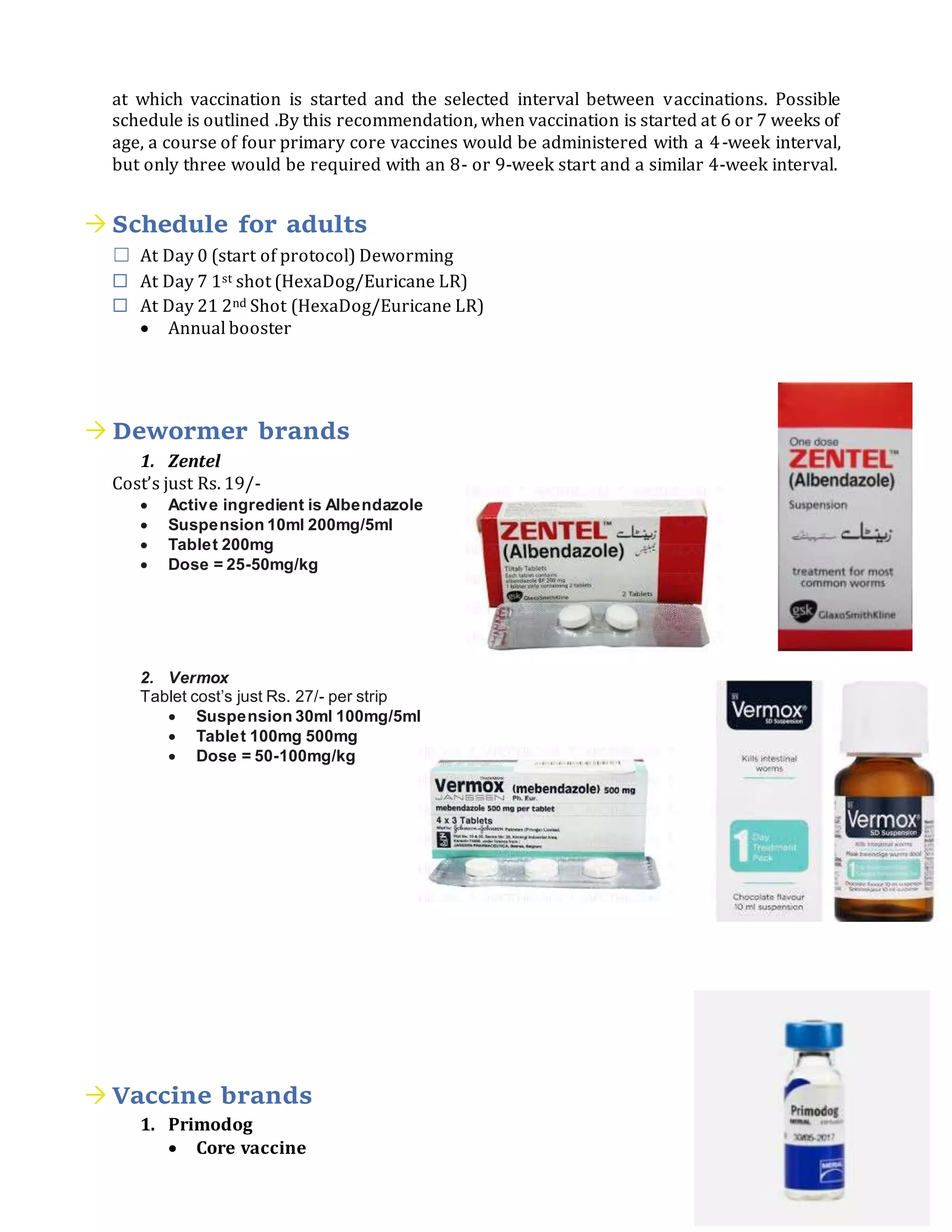
 Dewormer brands
1. Zentel
Cost’s just Rs. 19/-
 Active ingredient is Albendazole
 Suspension 10ml 200mg/5ml
 Tablet 200mg
 Dose = 25-50mg/kg
2. Vermox
Tablet cost’s just Rs. 27/- per strip
 Suspension 30ml 100mg/5ml
 Tablet 100mg 500mg
 Dose = 50-100mg/kg
 Vaccine brands
1. Primodog
 Core vaccine
 Monovalent (Parvo)
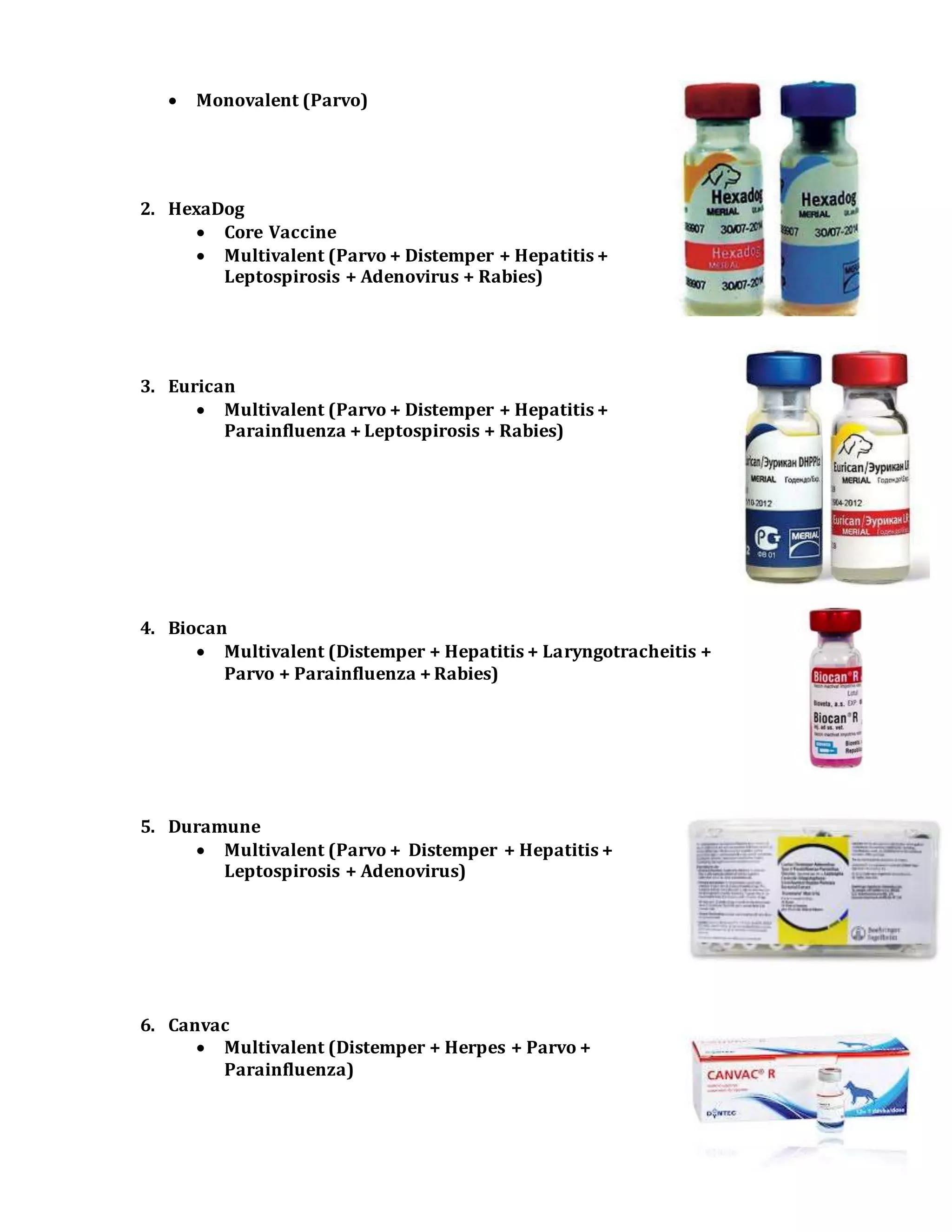
2. HexaDog
 Core Vaccine
 Multivalent (Parvo + Distemper + Hepatitis +
Leptospirosis + Adenovirus + Rabies)
3. Eurican
 Multivalent (Parvo + Distemper + Hepatitis +
Parainfluenza + Leptospirosis + Rabies)
4. Biocan
 Multivalent (Distemper + Hepatitis + Laryngotracheitis +
Parvo + Parainfluenza + Rabies)
5. Duramune
 Multivalent (Parvo + Distemper + Hepatitis +
Leptospirosis + Adenovirus)
6. Canvac
 Multivalent (Distemper + Herpes + Parvo +
Parainfluenza)
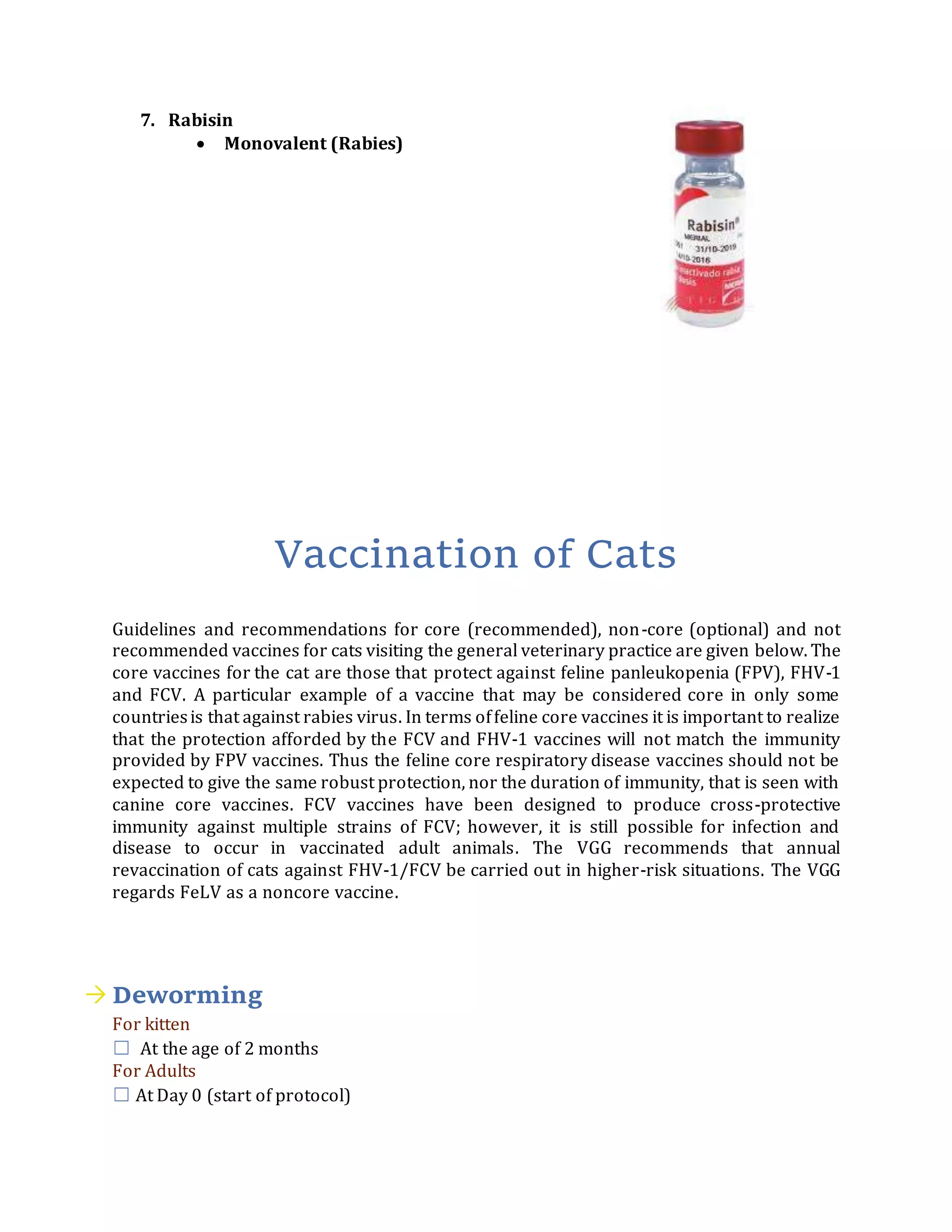
7. Rabisin
 Monovalent (Rabies)
Vaccination of Cats
Guidelines and recommendations for core (recommended), non-core (optional) and not
recommended vaccines for cats visiting the general veterinary practice are given below. The
core vaccines for the cat are those that protect against feline panleukopenia (FPV), FHV-1
and FCV. A particular example of a vaccine that may be considered core in only some
countriesis that against rabies virus. In terms offeline core vaccines it is important to realize
that the protection afforded by the FCV and FHV-1 vaccines will not match the immunity
provided by FPV vaccines. Thus the feline core respiratory disease vaccines should not be
expected to give the same robust protection, nor the duration of immunity, that is seen with
canine core vaccines. FCV vaccines have been designed to produce cross-protective
immunity against multiple strains of FCV; however, it is still possible for infection and
disease to occur in vaccinated adult animals. The VGG recommends that annual
revaccination of cats against FHV-1/FCV be carried out in higher-risk situations. The VGG
regards FeLV as a noncore vaccine.
 Deworming
For kitten
☐ At the age of 2 months
For Adults
☐ At Day 0 (start of protocol)
 Schedule for kitten
☐ At the age of 2 Months De-worming
☐ After 10 days 1st Shot (Rabisin+FeloVac)
☐ After 21 days 2nd Shot (Rabisin+FeloVac)
 Annual booster
 Schedule for adults
☐ At Day 0 (start of protocol) Deworming
☐ After 10 days 1st Shot (Rabisin+FeloVac)
☐ After 21 days 2nd Shot (Rabisin+FeloVac)
Annual booster
Typically, core vaccines (especially FPV) are currently administered triennially with
respiratory virus vaccines given according to risk and chosen non-core products being given
annually. An adult cat that received a complete course of vaccination for FPV, FHV-1 and FCV
as a kitten (including the 6- or 12-month booster), but may not have been regularly
vaccinated as an adult requires only a single dose of MLV core vaccine to boost immunity. An
adopted adult cat (or kitten over 16 weeks of age) of unknown vaccination history requires
only a single dose of MLV FPV core vaccine to engender a protective immune response to
that virus. In contrast, an adopted adult cat of unknown vaccination history should receive
two doses of MLV FHV-1/FCV vaccine (2–4 weeks apart) to establish an adequate immune
response.
 Dewormer Brands
Same as of mentioned earlier.
 Vaccine brands
1. Rabisin
 Monovalent (Rabies)
2. Fel – o – Vax
 Multivalent (Feline rhinotracheitis + Feline
calcivirus + Feline panleukopenia + Feline
leukemia virus)
3. Biofel
 Multivalent (Feline Panleukopenia + Feline Herpes virus + Feline
Calcivirus)
Note: Due to Lockdown, Getting prices of vaccines from the retailers were not an
option, but still tried to mention some.
Refrences
 WSAVA Vaccination Guidelines 2016
 LivestockPunjab.gov.pk
 UVAS Drug manual

Vaccination schedule for dogs and cats

  • 1.
    VACCINATION SCHEDULE OF DOGSAND CATS Brand Names of these Vaccines Nabeelahmad@mail.com Nabeel Ahmad 2016-ag-7172 E2
  • 2.
    Vaccination of Dogs Guidelinesand recommendations for core (recommended), non-core (optional) and not recommended vaccines for the general veterinary practice are given. The VGG (Vaccination guidelines group) considers that a core vaccine is one that all dogs throughout the world must receive, at recommended intervals, in order to provide life-long protection against infectious diseases of global significance. The core vaccines for the dog are those that confer protection against infection by canine distemper virus (CDV), canine adenovirus (CAV; types 1 and 2) and canine parvovirus type 2 (CPV-2) and its variants. The VGG recognizes that particular countries will identify additional vaccines that they consider core. A particular example of a vaccine that may be considered core in only some countries is that against rabies virus. Non-core vaccines are those for which use is determined on the basis of the geographical and lifestyle exposure risks of the individual and an assessment of risk–benefit ratios Schedule For Dogs  Deworming For Puppies ☐ At the age of 18 days For Adults ☐ At Day 0 (start of protocol)  Schedule for puppies ☐ At the age of 18 days De-worming ☐ At the age of 21 days 1St Shot (PrimaDog= Parvo) ☐ After 21 days 2nd Shot (PrimaDog=Parvo) ☐ After 21 days 3rd Shot (HexaDog/Euricane LR) ☐ After 21 days 4th Shot (HexaDog/Euricane LR)  Annual booster Most puppies are protected by MDA in the first weeks of life. In most puppies, passive immunity will have waned by 8–12 weeks of age to a level that allows active immunization. Puppies with poor MDA may be vulnerable (and capable of responding to vaccination) at an earlier age, while others may possess MDA at such high titres that they are incapable of responding to vaccination until ≥12 weeks of age (Friedrich & Truyen 2000). No single primary vaccination policy will therefore cover all possible situations. The recommendation of the VGG is for initial core vaccination at 6–8 weeks of age, then every 2–4 weeks until 16 weeks of age or older .The Canine Parvo vaccination is recommended at the age 4-8 weeks old, Thereforethenumber ofpuppy primarycore vaccinations will be determined by the age
  • 3.
    at which vaccinationis started and the selected interval between vaccinations. Possible schedule is outlined .By this recommendation, when vaccination is started at 6 or 7 weeks of age, a course of four primary core vaccines would be administered with a 4-week interval, but only three would be required with an 8- or 9-week start and a similar 4-week interval.  Schedule for adults ☐ At Day 0 (start of protocol) Deworming ☐ At Day 7 1st shot (HexaDog/Euricane LR) ☐ At Day 21 2nd Shot (HexaDog/Euricane LR)  Annual booster  Dewormer brands 1. Zentel Cost’s just Rs. 19/-  Active ingredient is Albendazole  Suspension 10ml 200mg/5ml  Tablet 200mg  Dose = 25-50mg/kg 2. Vermox Tablet cost’s just Rs. 27/- per strip  Suspension 30ml 100mg/5ml  Tablet 100mg 500mg  Dose = 50-100mg/kg  Vaccine brands 1. Primodog  Core vaccine
  • 4.
     Monovalent (Parvo) 2.HexaDog  Core Vaccine  Multivalent (Parvo + Distemper + Hepatitis + Leptospirosis + Adenovirus + Rabies) 3. Eurican  Multivalent (Parvo + Distemper + Hepatitis + Parainfluenza + Leptospirosis + Rabies) 4. Biocan  Multivalent (Distemper + Hepatitis + Laryngotracheitis + Parvo + Parainfluenza + Rabies) 5. Duramune  Multivalent (Parvo + Distemper + Hepatitis + Leptospirosis + Adenovirus) 6. Canvac  Multivalent (Distemper + Herpes + Parvo + Parainfluenza)
  • 5.
    7. Rabisin  Monovalent(Rabies) Vaccination of Cats Guidelines and recommendations for core (recommended), non-core (optional) and not recommended vaccines for cats visiting the general veterinary practice are given below. The core vaccines for the cat are those that protect against feline panleukopenia (FPV), FHV-1 and FCV. A particular example of a vaccine that may be considered core in only some countriesis that against rabies virus. In terms offeline core vaccines it is important to realize that the protection afforded by the FCV and FHV-1 vaccines will not match the immunity provided by FPV vaccines. Thus the feline core respiratory disease vaccines should not be expected to give the same robust protection, nor the duration of immunity, that is seen with canine core vaccines. FCV vaccines have been designed to produce cross-protective immunity against multiple strains of FCV; however, it is still possible for infection and disease to occur in vaccinated adult animals. The VGG recommends that annual revaccination of cats against FHV-1/FCV be carried out in higher-risk situations. The VGG regards FeLV as a noncore vaccine.  Deworming For kitten ☐ At the age of 2 months For Adults ☐ At Day 0 (start of protocol)
  • 6.
     Schedule forkitten ☐ At the age of 2 Months De-worming ☐ After 10 days 1st Shot (Rabisin+FeloVac) ☐ After 21 days 2nd Shot (Rabisin+FeloVac)  Annual booster  Schedule for adults ☐ At Day 0 (start of protocol) Deworming ☐ After 10 days 1st Shot (Rabisin+FeloVac) ☐ After 21 days 2nd Shot (Rabisin+FeloVac) Annual booster Typically, core vaccines (especially FPV) are currently administered triennially with respiratory virus vaccines given according to risk and chosen non-core products being given annually. An adult cat that received a complete course of vaccination for FPV, FHV-1 and FCV as a kitten (including the 6- or 12-month booster), but may not have been regularly vaccinated as an adult requires only a single dose of MLV core vaccine to boost immunity. An adopted adult cat (or kitten over 16 weeks of age) of unknown vaccination history requires only a single dose of MLV FPV core vaccine to engender a protective immune response to that virus. In contrast, an adopted adult cat of unknown vaccination history should receive two doses of MLV FHV-1/FCV vaccine (2–4 weeks apart) to establish an adequate immune response.  Dewormer Brands Same as of mentioned earlier.  Vaccine brands 1. Rabisin  Monovalent (Rabies)
  • 7.
    2. Fel –o – Vax  Multivalent (Feline rhinotracheitis + Feline calcivirus + Feline panleukopenia + Feline leukemia virus) 3. Biofel  Multivalent (Feline Panleukopenia + Feline Herpes virus + Feline Calcivirus) Note: Due to Lockdown, Getting prices of vaccines from the retailers were not an option, but still tried to mention some.
  • 8.
    Refrences  WSAVA VaccinationGuidelines 2016  LivestockPunjab.gov.pk  UVAS Drug manual