Introduction
Contribution to the Thesis
Details of the Studies
Preliminary Evaluation
Future Work
Modeling and Optimization of Resource Allocation in Cloud
PhD Thesis Progress – First Report
Atakan Aral
Thesis Advisor: Asst. Prof. Dr. Tolga Ovatman
Istanbul Technical University – Department of Computer Engineering
January 8, 2015
Atakan Aral Modeling and Optimization of Resource Allocation in Cloud
Introduction
Contribution to the Thesis
Details of the Studies
Preliminary Evaluation
Future Work
Outline
1 Introduction
2 Contribution to the Thesis
Studies
Time Plan
3 Details of the Studies
Data Collection
Simulator Development
Performance Criteria
Baseline Methods
4 Preliminary Evaluation
5 Future Work
Atakan Aral Modeling and Optimization of Resource Allocation in Cloud
Introduction
Contribution to the Thesis
Details of the Studies
Preliminary Evaluation
Future Work
Summary
Optimization on 3 related phases of the cloud software life cycle
1 Map Reduce Configuration
2 Resource Selection and Assignment
3 Work Distribution and Load Balancing
Graph based modeling of the cloud environment and RA problem
Inclusion of cloud computing aspects to the RA problem
Cloud providers will benefit since they will be able to use their resources more
efficiently and will be able to serve more customers without violating the SLAs.
Cloud users will also benefit in terms of shorter application execution time and
less infrastructure requirement (lower cost).
Atakan Aral Modeling and Optimization of Resource Allocation in Cloud
Introduction
Contribution to the Thesis
Details of the Studies
Preliminary Evaluation
Future Work
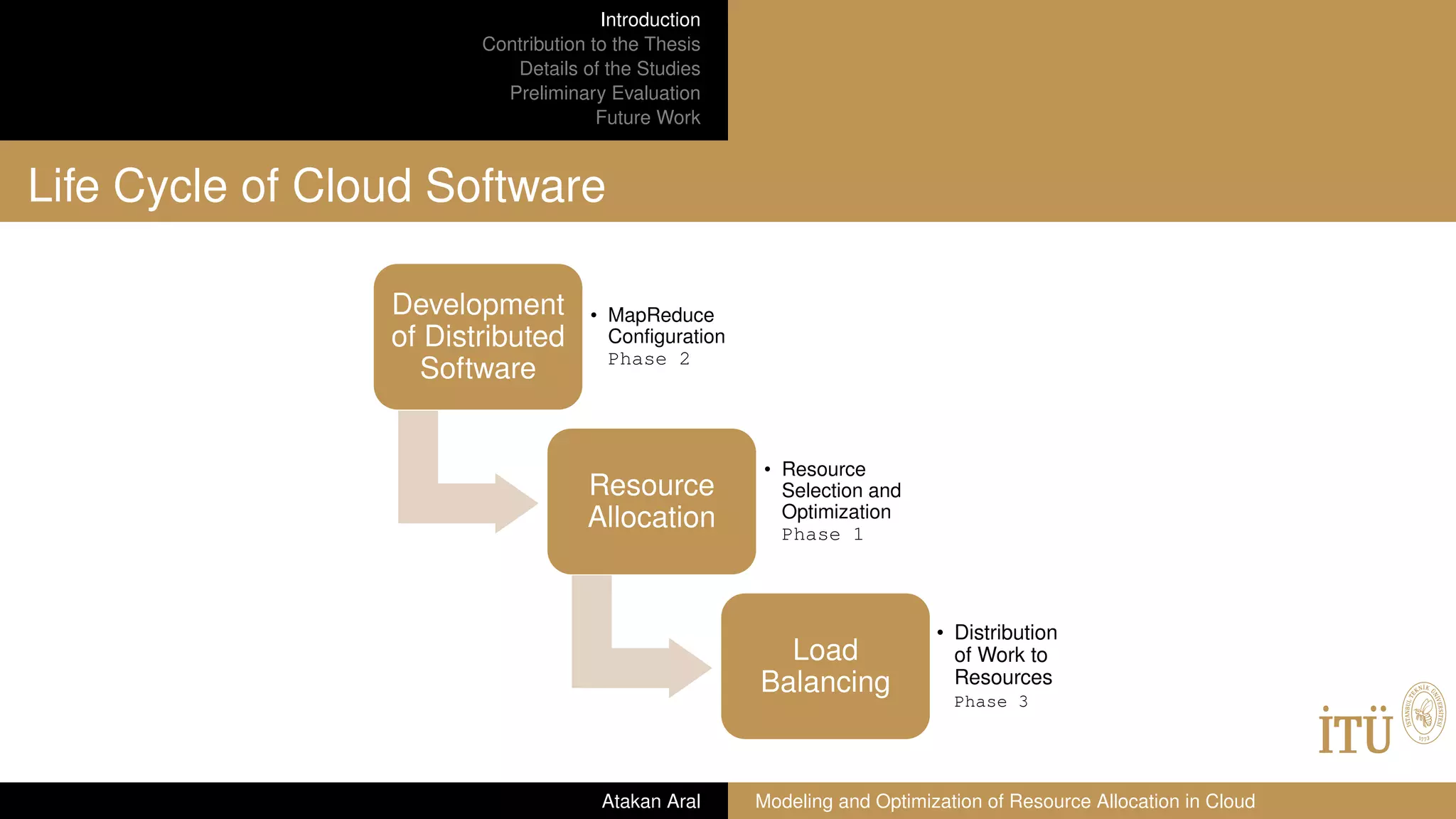
Life Cycle of Cloud Software
Development
of Distributed
Software
• MapReduce
Configuration
Phase 2
Resource
Allocation
• Resource
Selection and
Optimization
Phase 1
Load
Balancing
• Distribution
of Work to
Resources
Phase 3
Atakan Aral Modeling and Optimization of Resource Allocation in Cloud
Introduction
Contribution to the Thesis
Details of the Studies
Preliminary Evaluation
Future Work
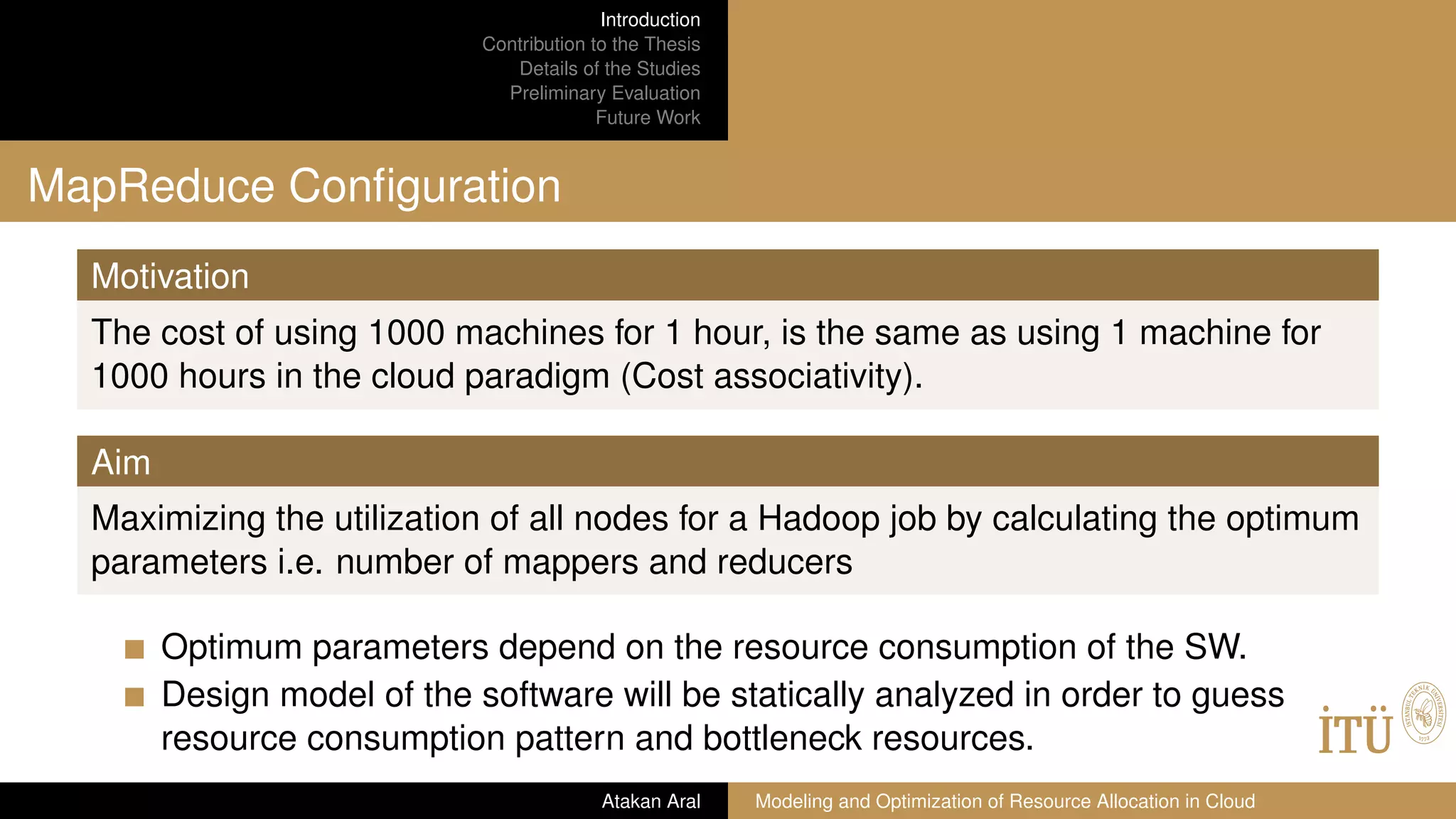
MapReduce Configuration
Motivation
The cost of using 1000 machines for 1 hour, is the same as using 1 machine for
1000 hours in the cloud paradigm (Cost associativity).
Aim
Maximizing the utilization of all nodes for a Hadoop job by calculating the optimum
parameters i.e. number of mappers and reducers
Optimum parameters depend on the resource consumption of the SW.
Design model of the software will be statically analyzed in order to guess
resource consumption pattern and bottleneck resources.
Atakan Aral Modeling and Optimization of Resource Allocation in Cloud
Introduction
Contribution to the Thesis
Details of the Studies
Preliminary Evaluation
Future Work
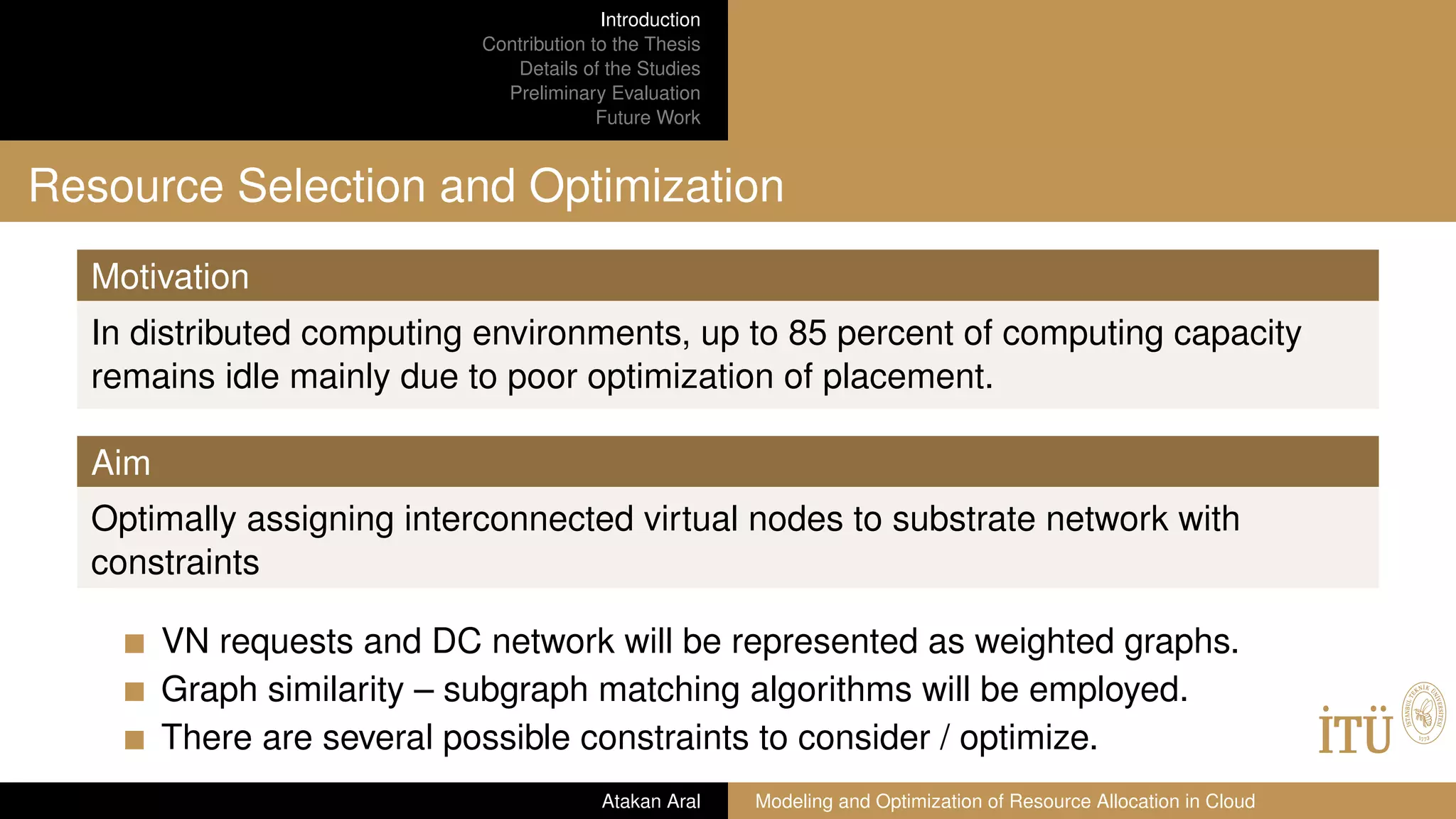
Resource Selection and Optimization
Motivation
In distributed computing environments, up to 85 percent of computing capacity
remains idle mainly due to poor optimization of placement.
Aim
Optimally assigning interconnected virtual nodes to substrate network with
constraints
VN requests and DC network will be represented as weighted graphs.
Graph similarity – subgraph matching algorithms will be employed.
There are several possible constraints to consider / optimize.
Atakan Aral Modeling and Optimization of Resource Allocation in Cloud
Introduction
Contribution to the Thesis
Details of the Studies
Preliminary Evaluation
Future Work
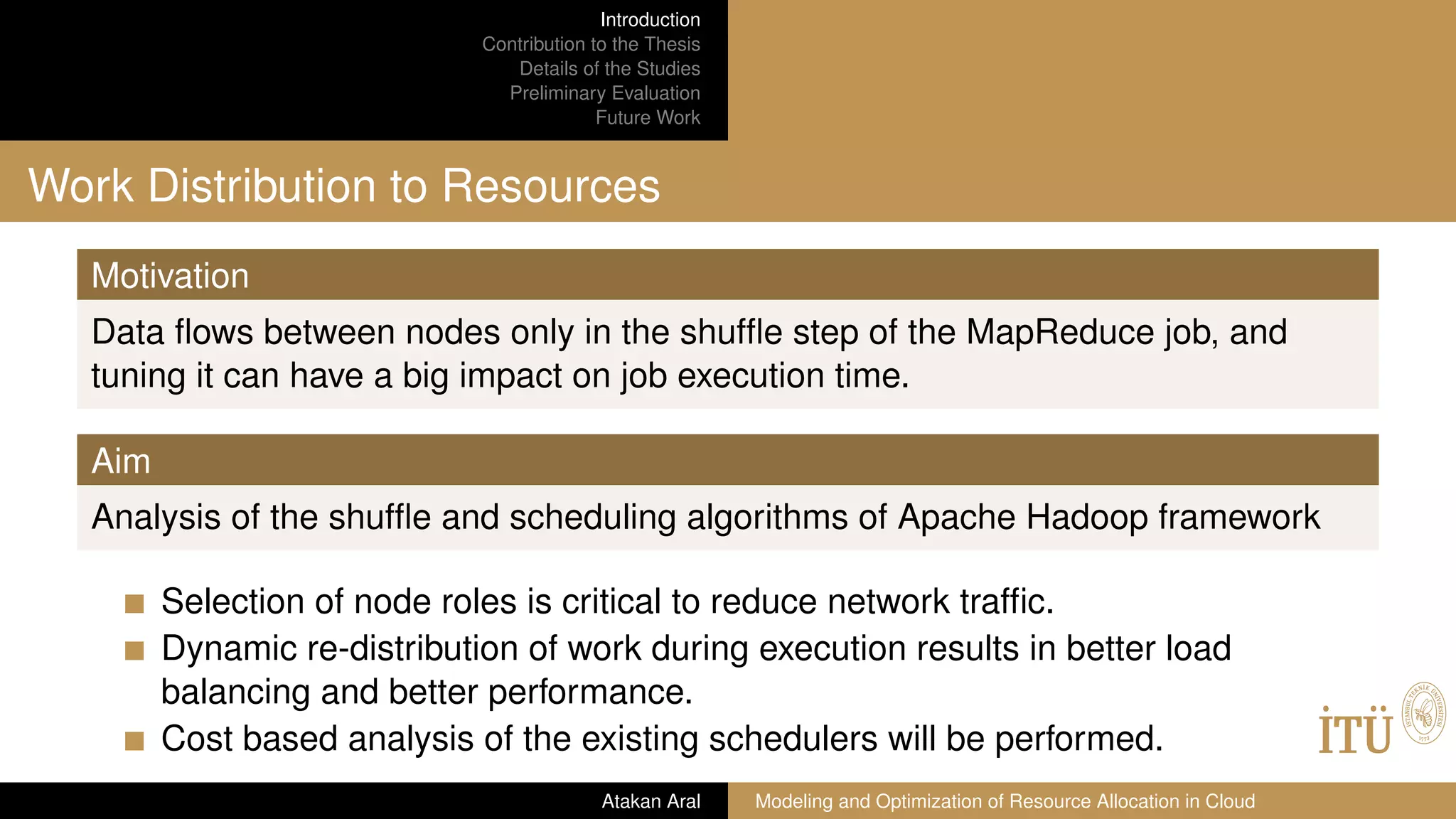
Work Distribution to Resources
Motivation
Data flows between nodes only in the shuffle step of the MapReduce job, and
tuning it can have a big impact on job execution time.
Aim
Analysis of the shuffle and scheduling algorithms of Apache Hadoop framework
Selection of node roles is critical to reduce network traffic.
Dynamic re-distribution of work during execution results in better load
balancing and better performance.
Cost based analysis of the existing schedulers will be performed.
Atakan Aral Modeling and Optimization of Resource Allocation in Cloud
Introduction
Contribution to the Thesis
Details of the Studies
Preliminary Evaluation
Future Work
Studies
Time Plan
Data Collection
We decided to use a real-world cloud datacenter topology for the experiments.
Performed tasks include:
Finding candidate topologies by examining similar studies
Choosing the most appropriate topology
Converting the topology into a machine-readable format
Atakan Aral Modeling and Optimization of Resource Allocation in Cloud
Introduction
Contribution to the Thesis
Details of the Studies
Preliminary Evaluation
Future Work
Studies
Time Plan
Simulator Development
CloudSim Framework is chosen to simulate the cloud infrastructure.
A general purpose tool which allows:
DC and VM creation
DC topologies
Load generation
Simple scheduling and logging
Improvements and extensions:
Interrelated VMs an VM topologies
Delayed and continuous load generation
Automated topology creation
Visualization of resource allocation
Atakan Aral Modeling and Optimization of Resource Allocation in Cloud
Introduction
Contribution to the Thesis
Details of the Studies
Preliminary Evaluation
Future Work
Studies
Time Plan
Experimental Setup
9 baseline methods (6 of them are implemented) for resource selection and
VM placement
16 metrics (10 of them are implemented) to evaluate the performance of
these methods
Analysis and hierarchical categorization of the metrics
Analysis of the baseline methods and their expected effects on the metrics
Atakan Aral Modeling and Optimization of Resource Allocation in Cloud
Introduction
Contribution to the Thesis
Details of the Studies
Preliminary Evaluation
Future Work
Studies
Time Plan
Preliminary Evaluation
Validation of the baseline methods
Comparison of the baseline methods and the initial version of the suggested
algorithm
Validation and improvement of the suggested algorithm
Evaluation of different configurations on each method’s performance
Atakan Aral Modeling and Optimization of Resource Allocation in Cloud
Introduction
Contribution to the Thesis
Details of the Studies
Preliminary Evaluation
Future Work
Studies
Time Plan
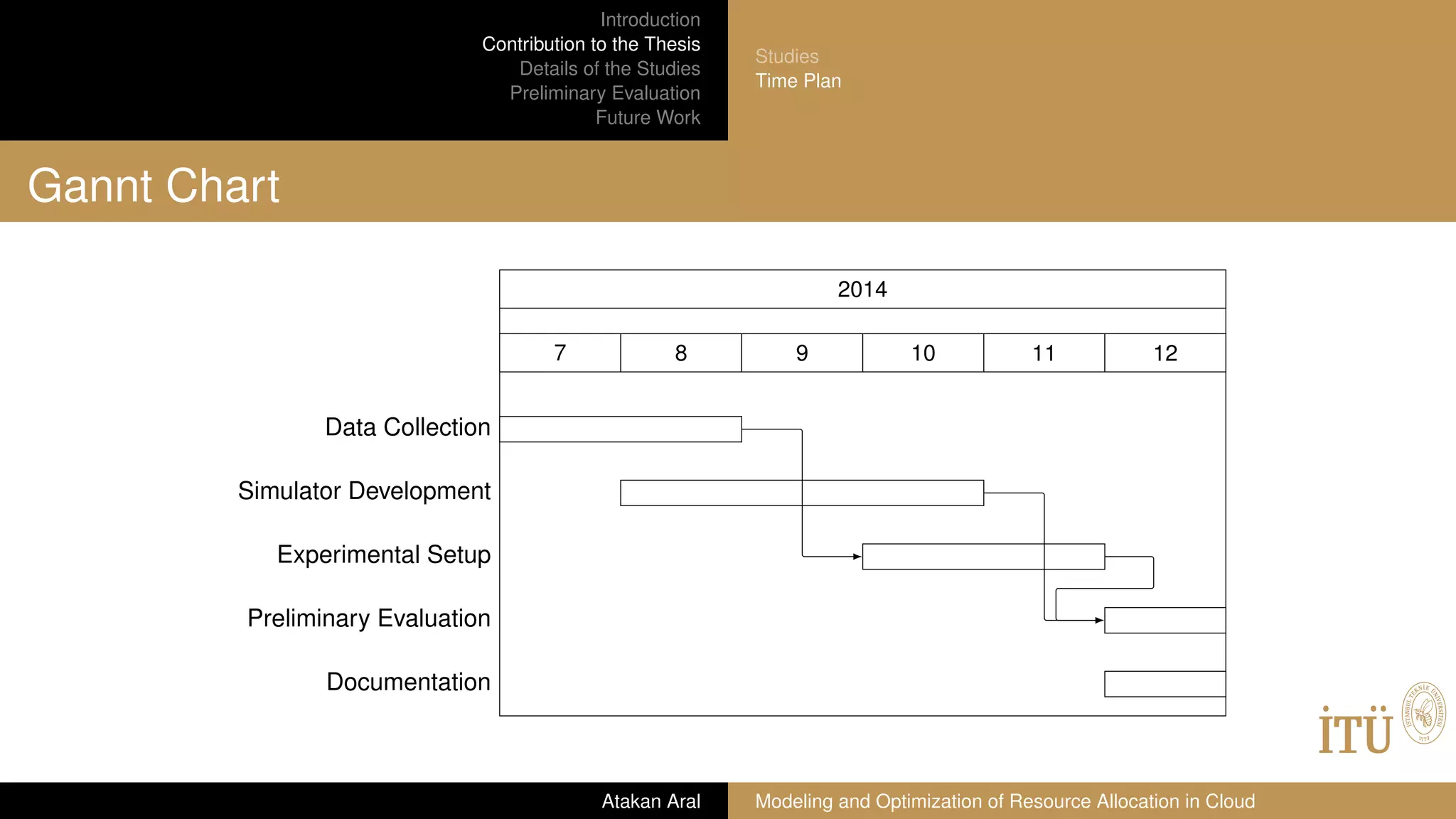
Gannt Chart
2014
7 8 9 10 11 12
Data Collection
Simulator Development
Experimental Setup
Preliminary Evaluation
Documentation
Atakan Aral Modeling and Optimization of Resource Allocation in Cloud
Introduction
Contribution to the Thesis
Details of the Studies
Preliminary Evaluation
Future Work
Data Collection
Simulator Development
Performance Criteria
Baseline Methods
Other Approaches
Randomly generated DC topology [Ilyashenko,2008] and [Ghazar, 2013]
Proprietary data [Agarwal et al., 2010]
DC topology generated based on cities, their populations and locations
[Larumbe and Sanso, 2013]
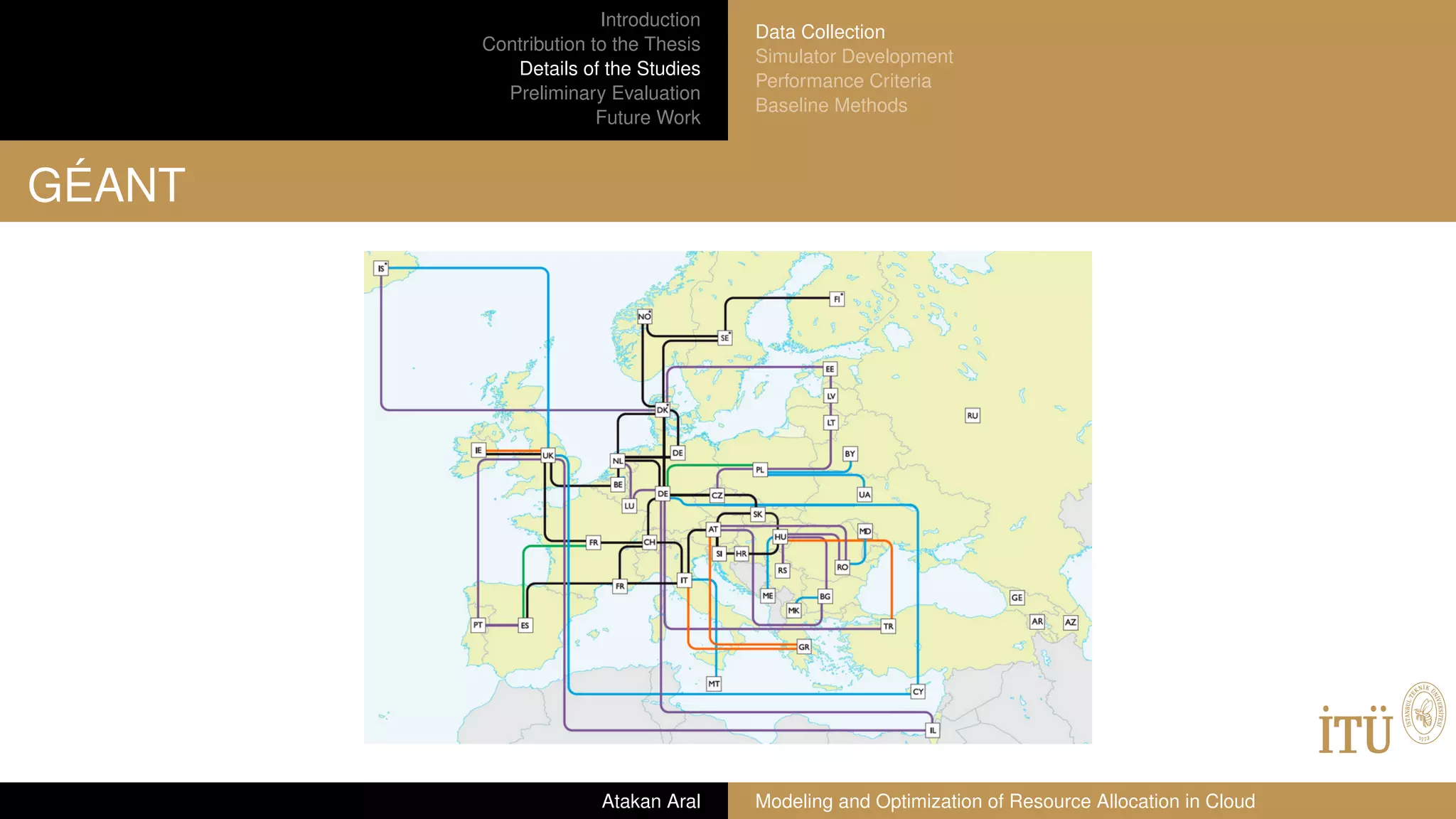
GÉANT network map
A European research and education network that interconnects National
Research and Education Networks
Atakan Aral Modeling and Optimization of Resource Allocation in Cloud
Introduction
Contribution to the Thesis
Details of the Studies
Preliminary Evaluation
Future Work
Data Collection
Simulator Development
Performance Criteria
Baseline Methods
GÉANT
Atakan Aral Modeling and Optimization of Resource Allocation in Cloud
Introduction
Contribution to the Thesis
Details of the Studies
Preliminary Evaluation
Future Work
Data Collection
Simulator Development
Performance Criteria
Baseline Methods
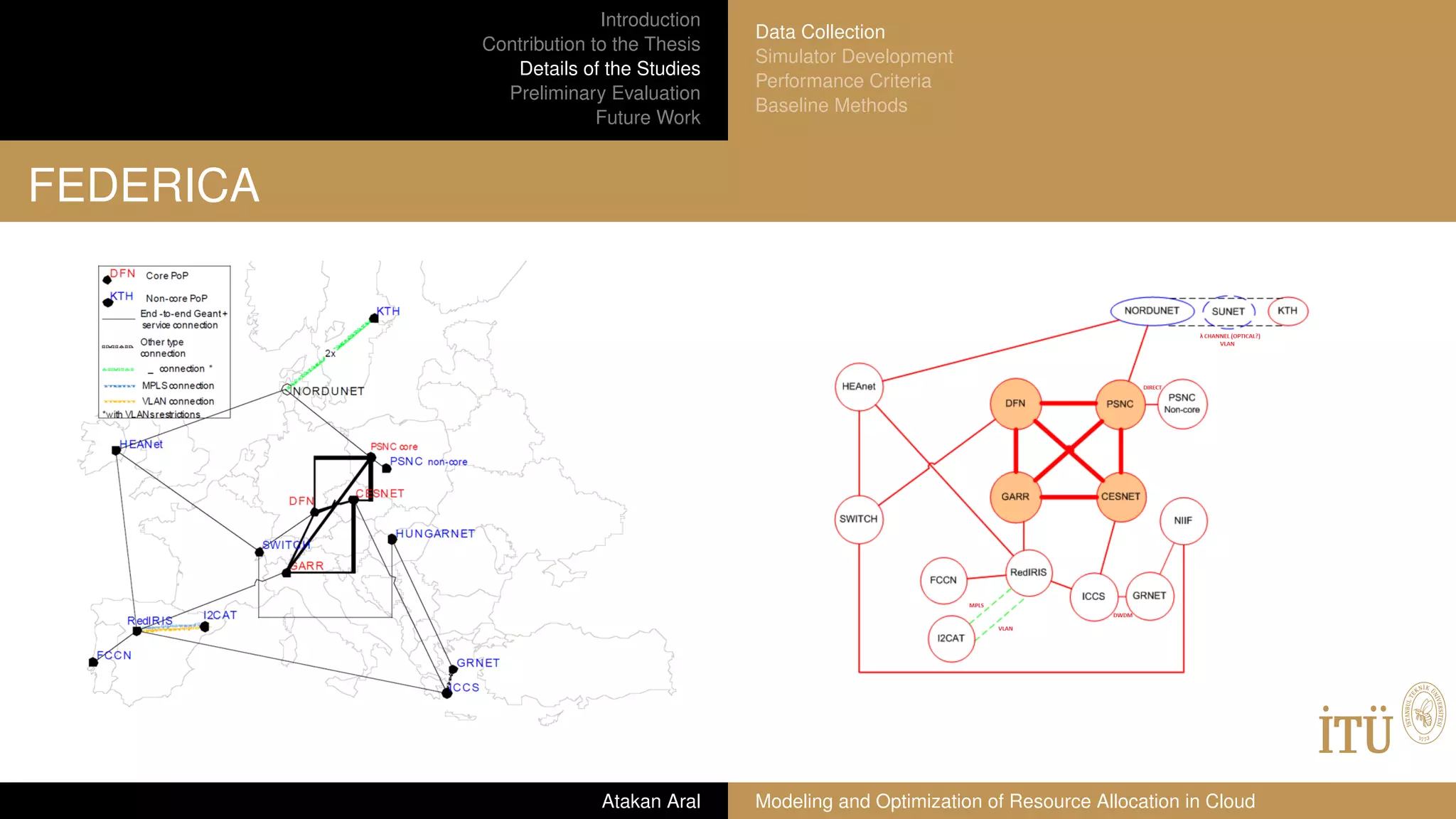
FEDERICA
Atakan Aral Modeling and Optimization of Resource Allocation in Cloud
Introduction
Contribution to the Thesis
Details of the Studies
Preliminary Evaluation
Future Work
Data Collection
Simulator Development
Performance Criteria
Baseline Methods
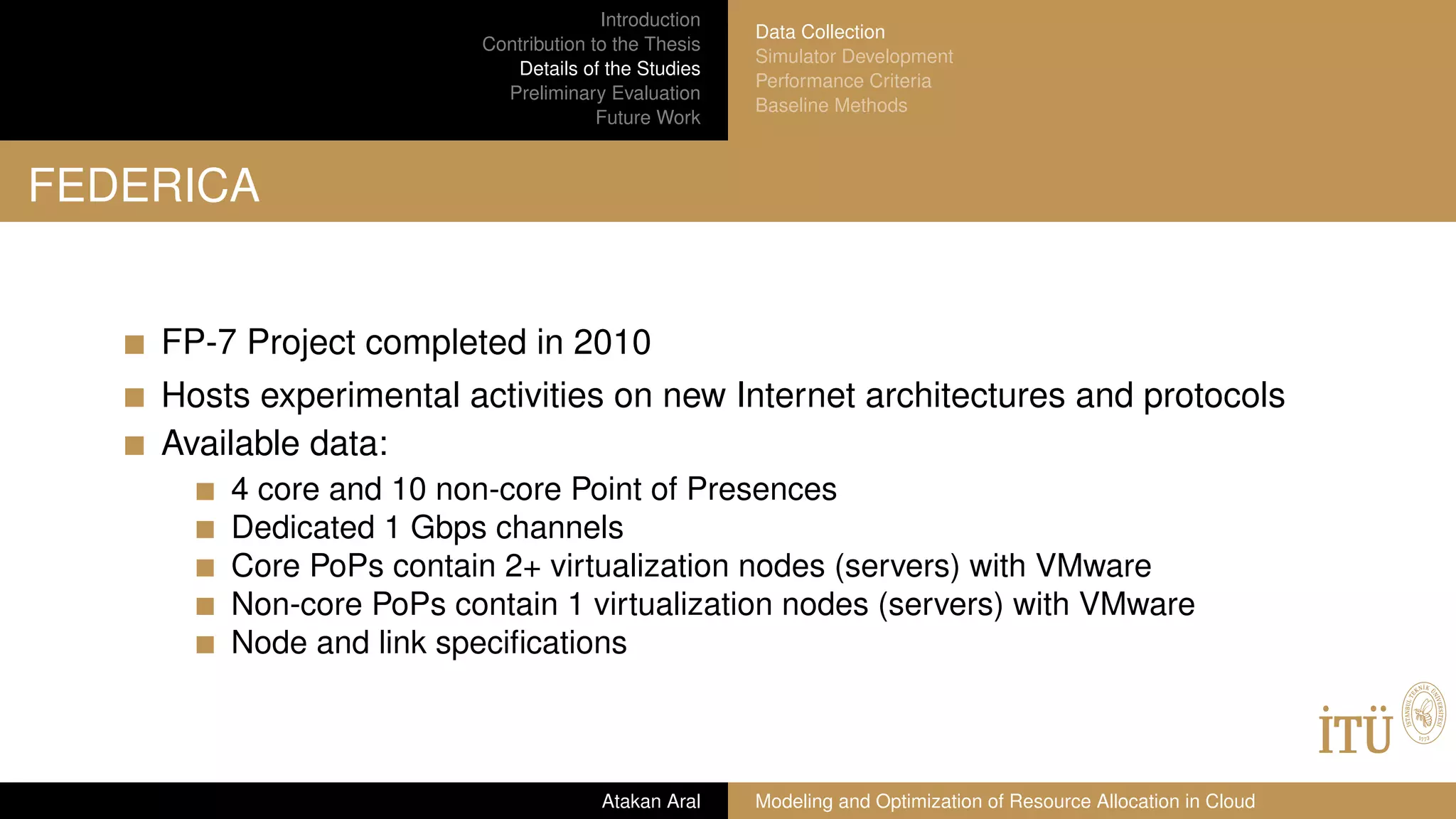
FEDERICA
FP-7 Project completed in 2010
Hosts experimental activities on new Internet architectures and protocols
Available data:
4 core and 10 non-core Point of Presences
Dedicated 1 Gbps channels
Core PoPs contain 2+ virtualization nodes (servers) with VMware
Non-core PoPs contain 1 virtualization nodes (servers) with VMware
Node and link specifications
Atakan Aral Modeling and Optimization of Resource Allocation in Cloud
Introduction
Contribution to the Thesis
Details of the Studies
Preliminary Evaluation
Future Work
Data Collection
Simulator Development
Performance Criteria
Baseline Methods
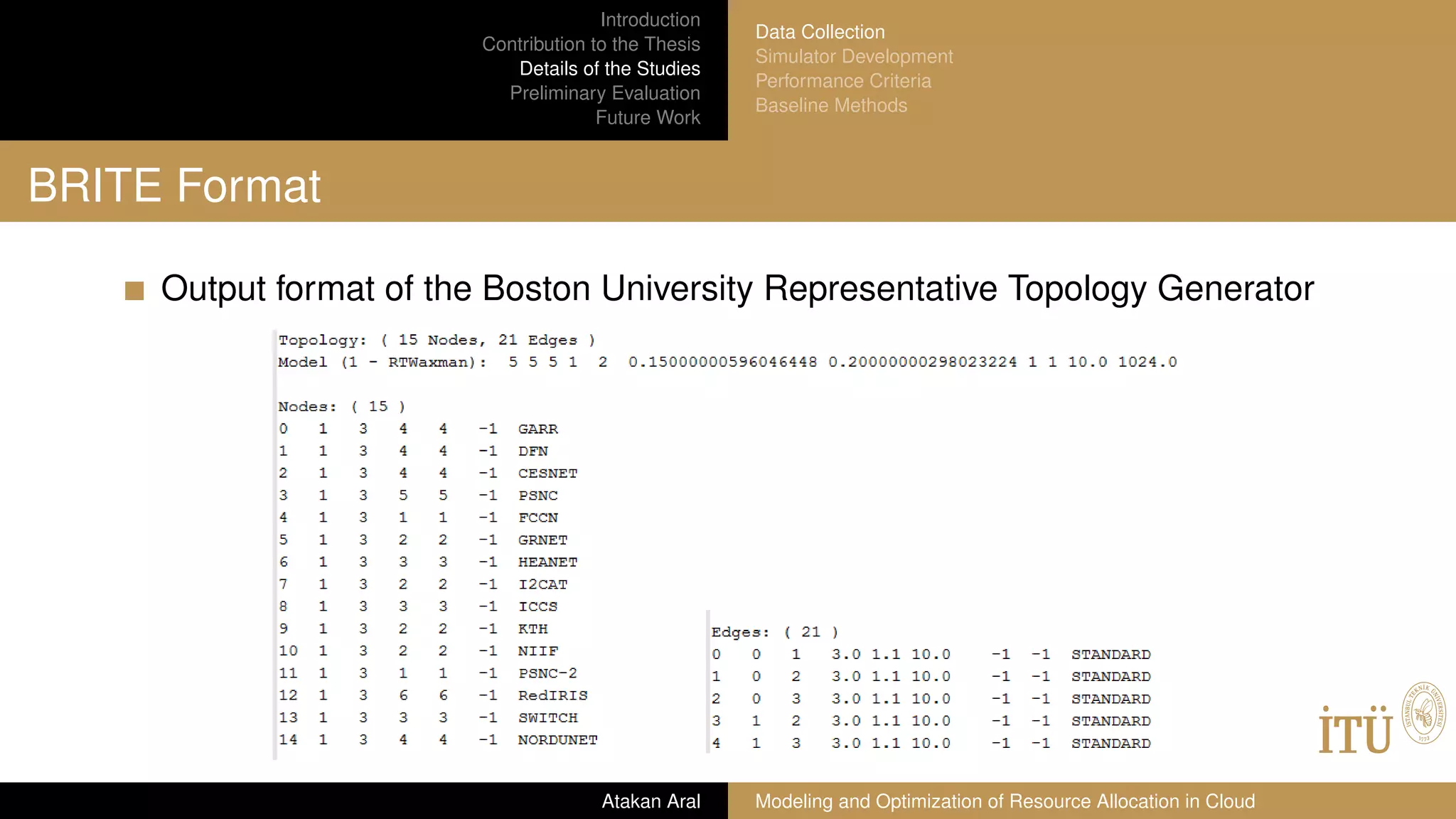
BRITE Format
Output format of the Boston University Representative Topology Generator
Atakan Aral Modeling and Optimization of Resource Allocation in Cloud
Introduction
Contribution to the Thesis
Details of the Studies
Preliminary Evaluation
Future Work
Data Collection
Simulator Development
Performance Criteria
Baseline Methods
CloudSim
A framework for modeling and simulation of cloud computing infrastructures
and services [Calheiros et al., 2011]
Atakan Aral Modeling and Optimization of Resource Allocation in Cloud
Introduction
Contribution to the Thesis
Details of the Studies
Preliminary Evaluation
Future Work
Data Collection
Simulator Development
Performance Criteria
Baseline Methods
CloudSim Features Benefited from
Cloud entity classes: Datacenter, Host, Vm, Cloudlet
Message passing mechanism for the communication among cloud entities
Datacenter network topology
Simulation
Atakan Aral Modeling and Optimization of Resource Allocation in Cloud
Introduction
Contribution to the Thesis
Details of the Studies
Preliminary Evaluation
Future Work
Data Collection
Simulator Development
Performance Criteria
Baseline Methods
Design Decisions
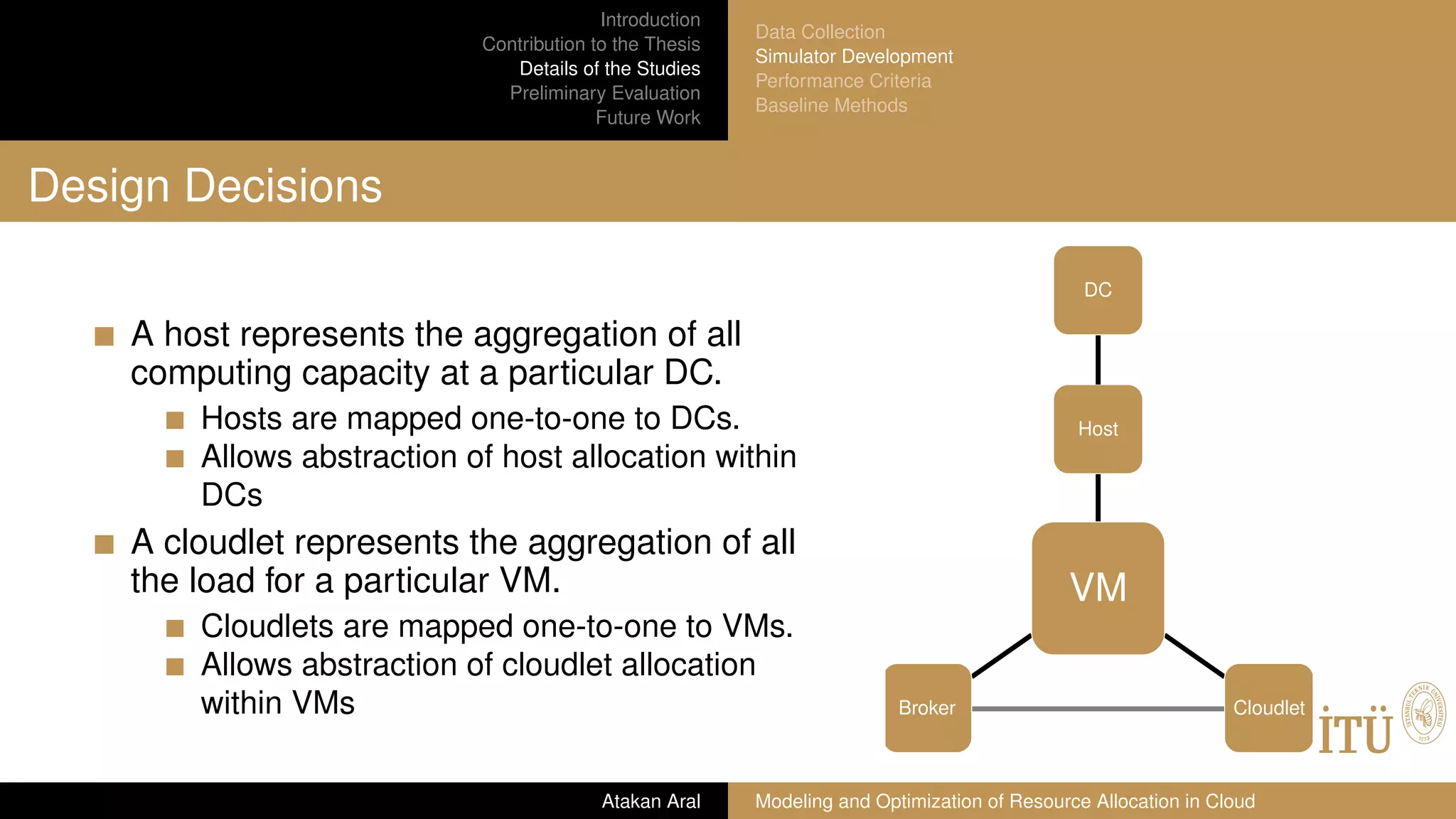
A host represents the aggregation of all
computing capacity at a particular DC.
Hosts are mapped one-to-one to DCs.
Allows abstraction of host allocation within
DCs
A cloudlet represents the aggregation of all
the load for a particular VM.
Cloudlets are mapped one-to-one to VMs.
Allows abstraction of cloudlet allocation
within VMs
VM
Host
DC
CloudletBroker
Atakan Aral Modeling and Optimization of Resource Allocation in Cloud
Introduction
Contribution to the Thesis
Details of the Studies
Preliminary Evaluation
Future Work
Data Collection
Simulator Development
Performance Criteria
Baseline Methods
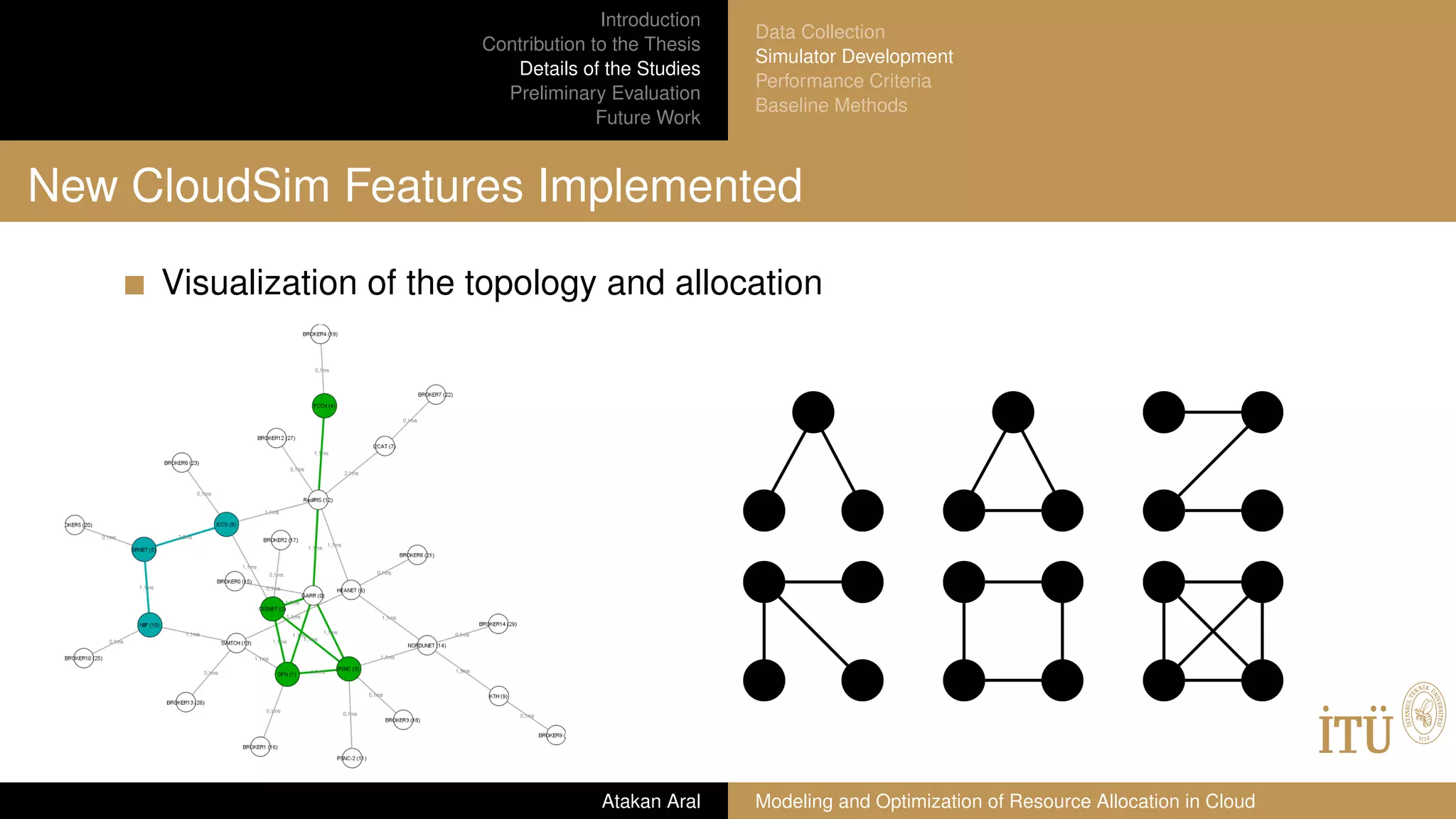
New CloudSim Features Implemented
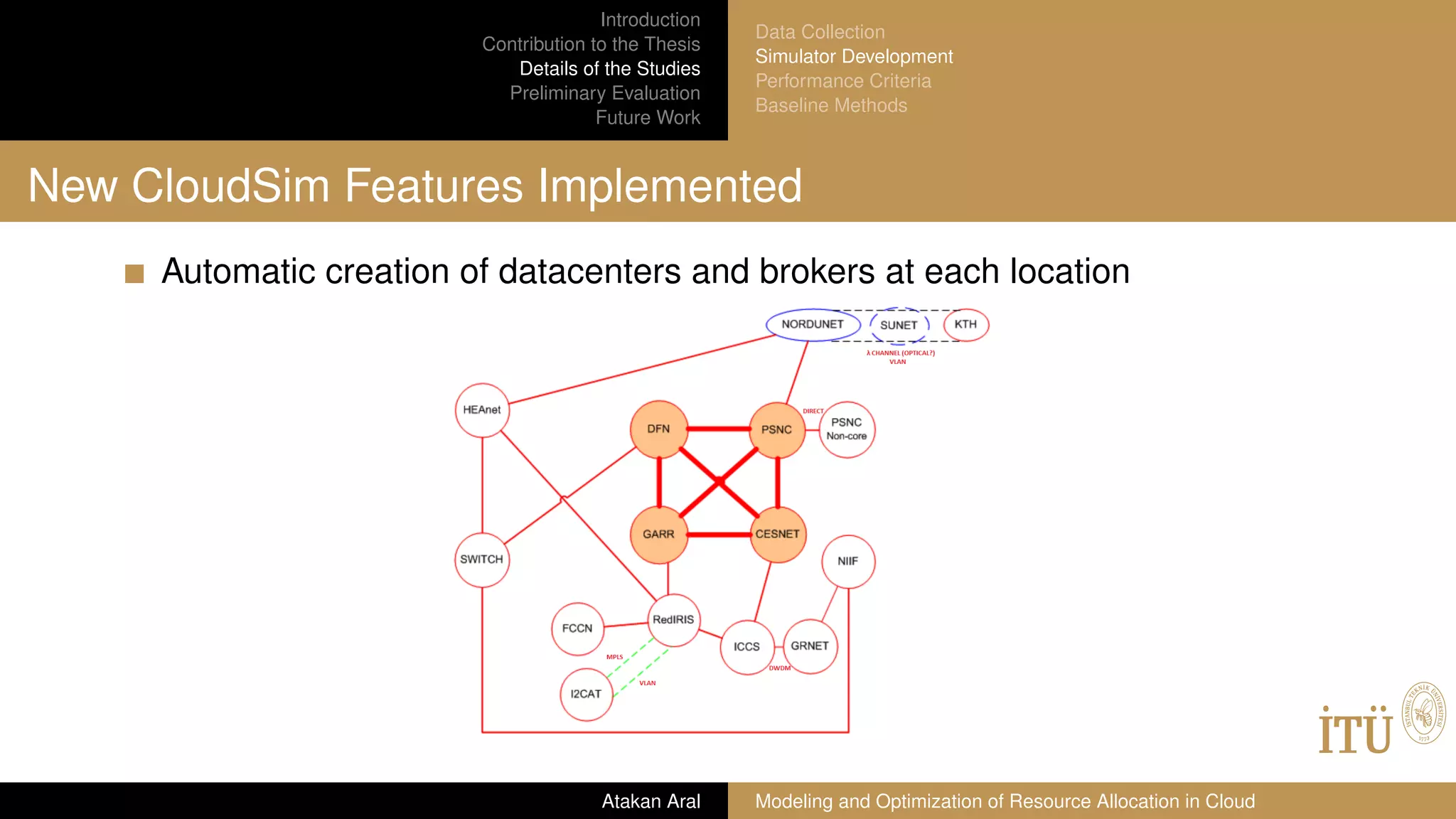
Automatic creation of datacenters and brokers at each location
Atakan Aral Modeling and Optimization of Resource Allocation in Cloud
Introduction
Contribution to the Thesis
Details of the Studies
Preliminary Evaluation
Future Work
Data Collection
Simulator Development
Performance Criteria
Baseline Methods
New CloudSim Features Implemented
Interrelated VMs
VM topology generation (Complete, Linear, Circular, Star, Custom)
Directed–undirected dependencies
Delay for communication
VM Life-cycle
Deferred initialization for related VMs
Destruction after the completion of cloudlets
Statistics logging
Atakan Aral Modeling and Optimization of Resource Allocation in Cloud
Introduction
Contribution to the Thesis
Details of the Studies
Preliminary Evaluation
Future Work
Data Collection
Simulator Development
Performance Criteria
Baseline Methods
New CloudSim Features Implemented
Visualization of the topology and allocation
Atakan Aral Modeling and Optimization of Resource Allocation in Cloud
Introduction
Contribution to the Thesis
Details of the Studies
Preliminary Evaluation
Future Work
Data Collection
Simulator Development
Performance Criteria
Baseline Methods
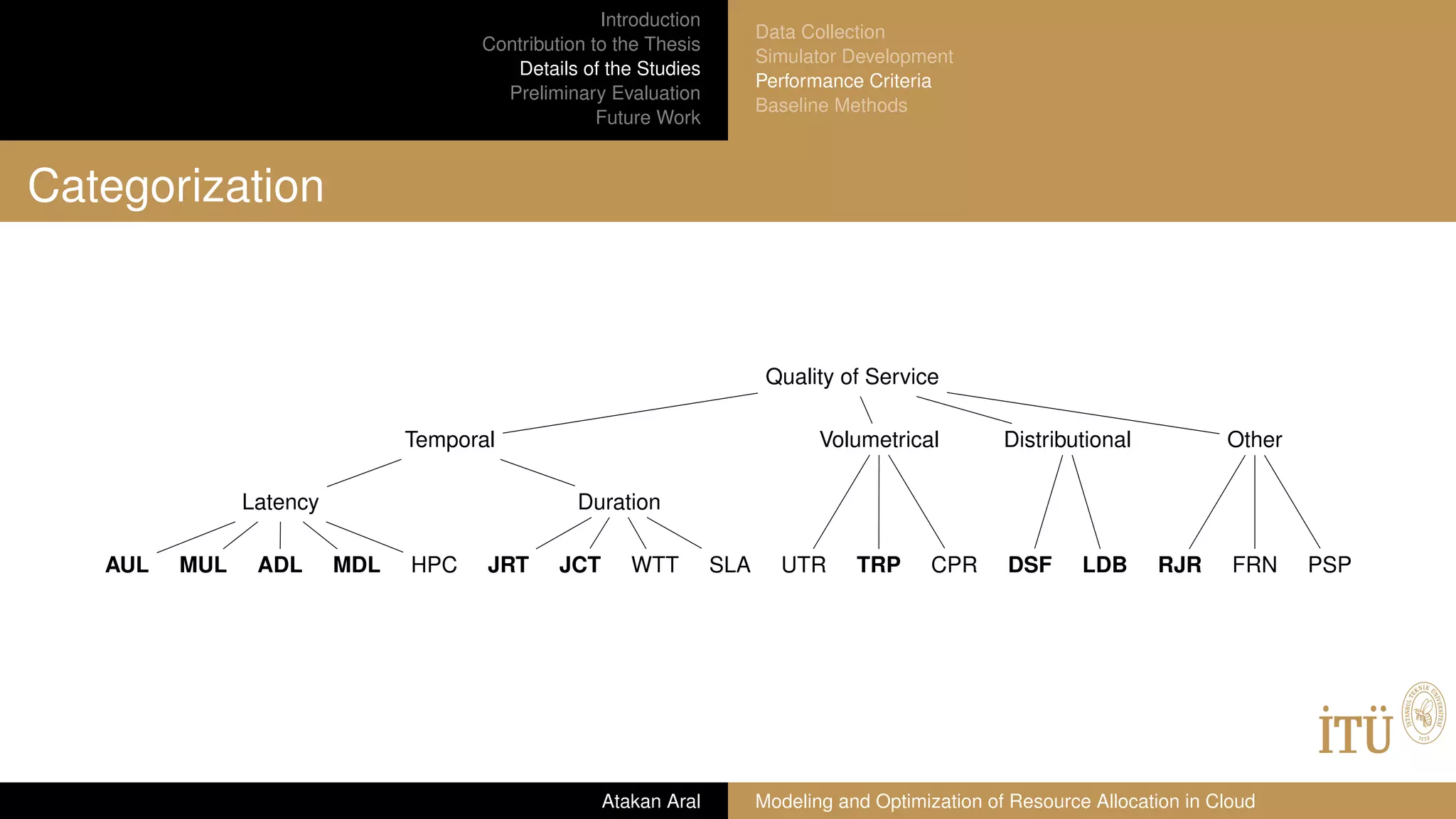
Categorization
Quality of Service
Temporal
Latency
AUL MUL ADL MDL HPC
Duration
JRT JCT WTT SLA
Volumetrical
UTR TRP CPR
Distributional
DSF LDB
Other
RJR FRN PSP
Atakan Aral Modeling and Optimization of Resource Allocation in Cloud
Introduction
Contribution to the Thesis
Details of the Studies
Preliminary Evaluation
Future Work
Data Collection
Simulator Development
Performance Criteria
Baseline Methods
Average User Latency (AUL)
This criterion is the average time (in ms) it takes for cloud users to access their
VMs. Here, average value is calculated both for the users and for their VMs. It
should be measured with equal load of VM requests to compare two methods. A
high value of user latency means the input and output transfer between user and
the processing units is slow.
Atakan Aral Modeling and Optimization of Resource Allocation in Cloud
Introduction
Contribution to the Thesis
Details of the Studies
Preliminary Evaluation
Future Work
Data Collection
Simulator Development
Performance Criteria
Baseline Methods
Maximum User Latency (MUL)
Even if the average user latency is low in a system, one of the users may be
starving to access one of its VMs. To reveal such problems, we suggest the
maximum user latency metric. Here, high values indicate starvation.
Atakan Aral Modeling and Optimization of Resource Allocation in Cloud
Introduction
Contribution to the Thesis
Details of the Studies
Preliminary Evaluation
Future Work
Data Collection
Simulator Development
Performance Criteria
Baseline Methods
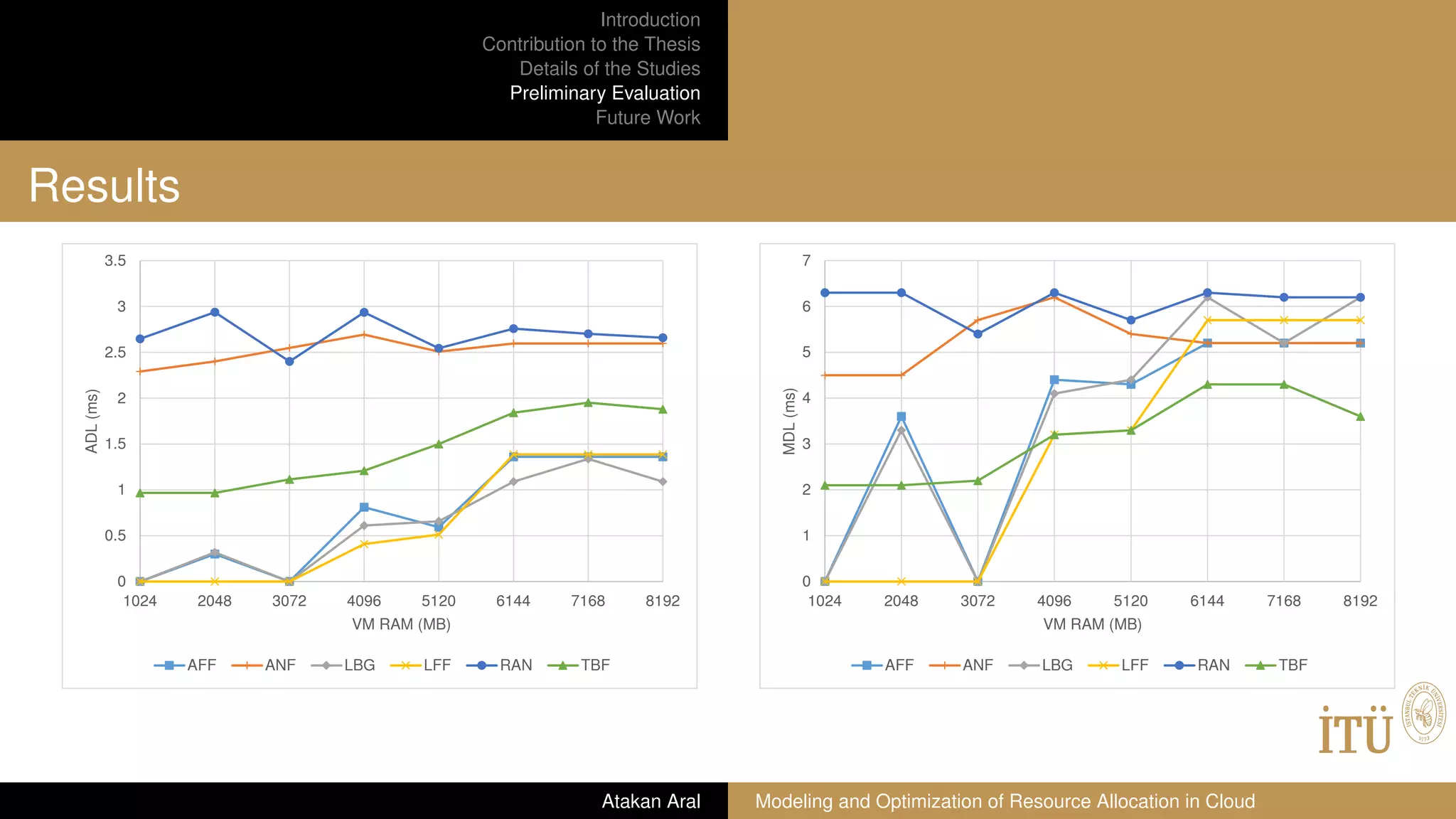
Average Inter-DC Latency (ADL)
If two VMs are adjacent in the topology requested by the user, then these VMs
need to transfer data or communication signals to each other. Average inter-DC
latency is the time it takes to complete transfer between such nodes on average. It
is critical to keep inter-DC latency low for the performance of the cloud software.
Inter-DC latency is minimum when all VMs of a user are placed to the same DC.
Atakan Aral Modeling and Optimization of Resource Allocation in Cloud
Introduction
Contribution to the Thesis
Details of the Studies
Preliminary Evaluation
Future Work
Data Collection
Simulator Development
Performance Criteria
Baseline Methods
Maximum Inter-DC Latency (MDL)
Similar to maximum user latency, maximum inter-DC latency is used to detect
outlier cases where it takes too much time to transfer data or communication
signals between two VMs.
Atakan Aral Modeling and Optimization of Resource Allocation in Cloud
Introduction
Contribution to the Thesis
Details of the Studies
Preliminary Evaluation
Future Work
Data Collection
Simulator Development
Performance Criteria
Baseline Methods
Hop Count (HPC)
Hop count is the average number of hops per dependencies between VMs.
Minimum values of this criterion (which is 0) is achieved when all dependent VMs
in the request are placed to the same DC.
Atakan Aral Modeling and Optimization of Resource Allocation in Cloud
Introduction
Contribution to the Thesis
Details of the Studies
Preliminary Evaluation
Future Work
Data Collection
Simulator Development
Performance Criteria
Baseline Methods
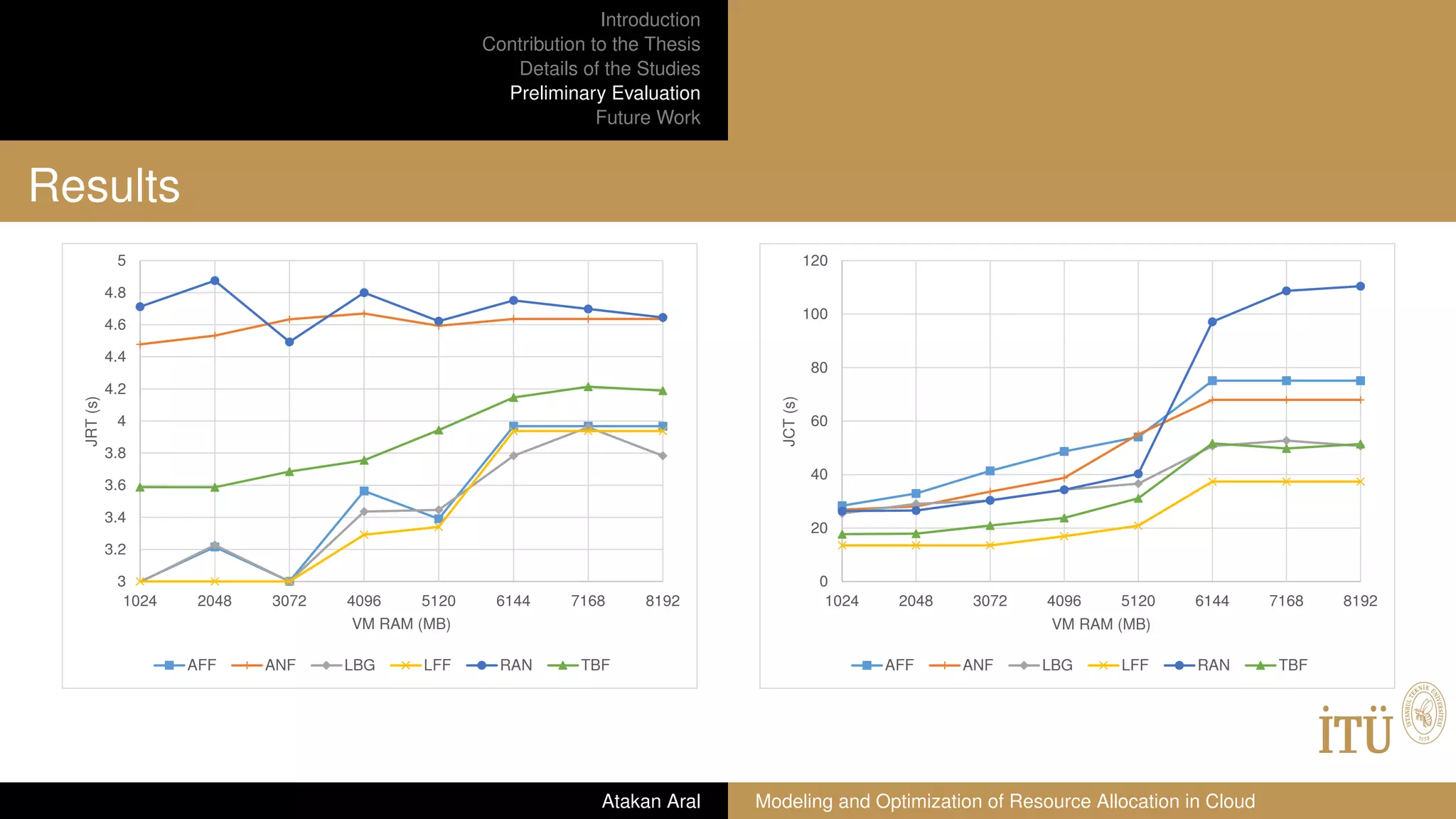
Job Run Time (JRT)
This criterion is the average time it takes to complete the jobs divided by their size
(in million instructions - MI). Since a host has a finite number of CPU cores and a
CPU core can be used by a single VM at a time, time-sharing is used when
number of VMs in a host is greater than the number of CPU cores in that hosts. In
such cases, running time of the job is longer because it can be executed only
part-time and is paused at other times.
For this criterion, we ignore the time spent in data transfer between user and VM
since it is measured in latency criteria. Additionally, we consider each VM
individually since the communication with other VMs also depends on latency.
Atakan Aral Modeling and Optimization of Resource Allocation in Cloud
Introduction
Contribution to the Thesis
Details of the Studies
Preliminary Evaluation
Future Work
Data Collection
Simulator Development
Performance Criteria
Baseline Methods
Job Completion Time (JCT)
Job completion time includes both latency and running times. It is an average
value for all users but is not normalized by job size. It indicates the promptness in
responding user requests.
Atakan Aral Modeling and Optimization of Resource Allocation in Cloud
Introduction
Contribution to the Thesis
Details of the Studies
Preliminary Evaluation
Future Work
Data Collection
Simulator Development
Performance Criteria
Baseline Methods
Waiting Time (WTT)
Apart from latency, some VM requests will be delayed due to lack of available
capacity. Waiting time criteria measures the time it takes until a job restarts after it
is postponed.
Atakan Aral Modeling and Optimization of Resource Allocation in Cloud
Introduction
Contribution to the Thesis
Details of the Studies
Preliminary Evaluation
Future Work
Data Collection
Simulator Development
Performance Criteria
Baseline Methods
SLA Violations (SLA)
Service level agreements (SLAs) usually define a deadline for job completion time
and a penalty is issued if it is not respected. This criterion is the cumulative
number of SLA violations due to tardiness.
Atakan Aral Modeling and Optimization of Resource Allocation in Cloud
Introduction
Contribution to the Thesis
Details of the Studies
Preliminary Evaluation
Future Work
Data Collection
Simulator Development
Performance Criteria
Baseline Methods
Utilization Rate (UTR)
Utilization rate is the percentage of the resources in a given DC topology that are
assigned to VMs. It is measured after the first time the placement algorithm fails to
assign a VM topology to any DC (resources achieve saturation). A different
utilization rate exists for each type of resource e.g. memory utilization, bandwidth
utilization etc. A high utilization rate indicates that the resources are assigned
efficiently so that a great number of VM requests are responded successfully.
Atakan Aral Modeling and Optimization of Resource Allocation in Cloud
Introduction
Contribution to the Thesis
Details of the Studies
Preliminary Evaluation
Future Work
Data Collection
Simulator Development
Performance Criteria
Baseline Methods
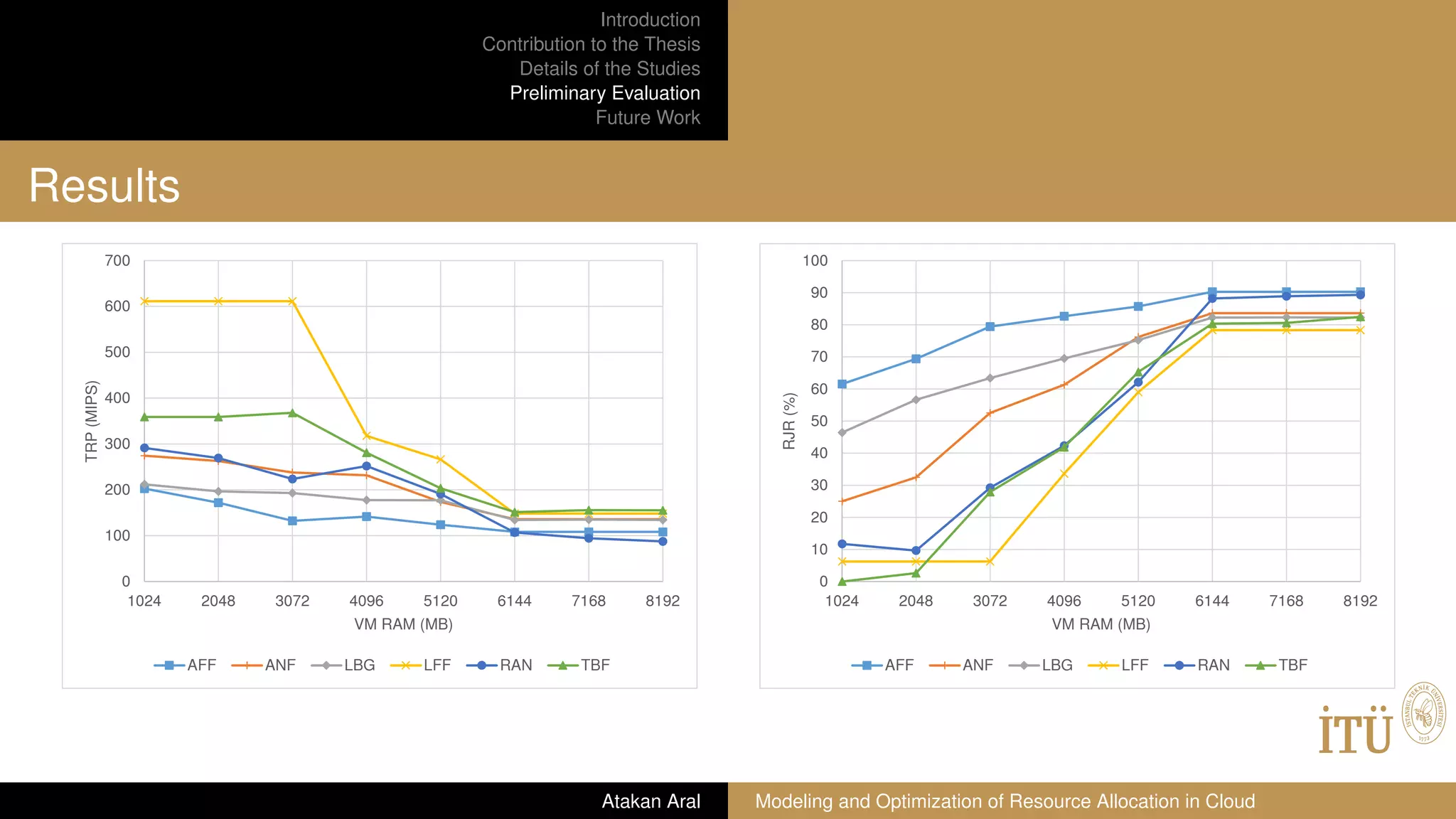
Throughput (TRP)
We measure throughput as the millions instructions processed in the whole system
per second (MIPS). Indeed, it is equal to the total CPU utilization of all DCs. High
throughput means a better placement of VMs and less wasted resources.
Atakan Aral Modeling and Optimization of Resource Allocation in Cloud
Introduction
Contribution to the Thesis
Details of the Studies
Preliminary Evaluation
Future Work
Data Collection
Simulator Development
Performance Criteria
Baseline Methods
Cumulative Profit (CPR)
This criterion aims to represent the profit of the cloud provider in a fixed duration
given prices for each resource type. Cumulative profit is directly proportional to
throughput.
Atakan Aral Modeling and Optimization of Resource Allocation in Cloud
Introduction
Contribution to the Thesis
Details of the Studies
Preliminary Evaluation
Future Work
Data Collection
Simulator Development
Performance Criteria
Baseline Methods
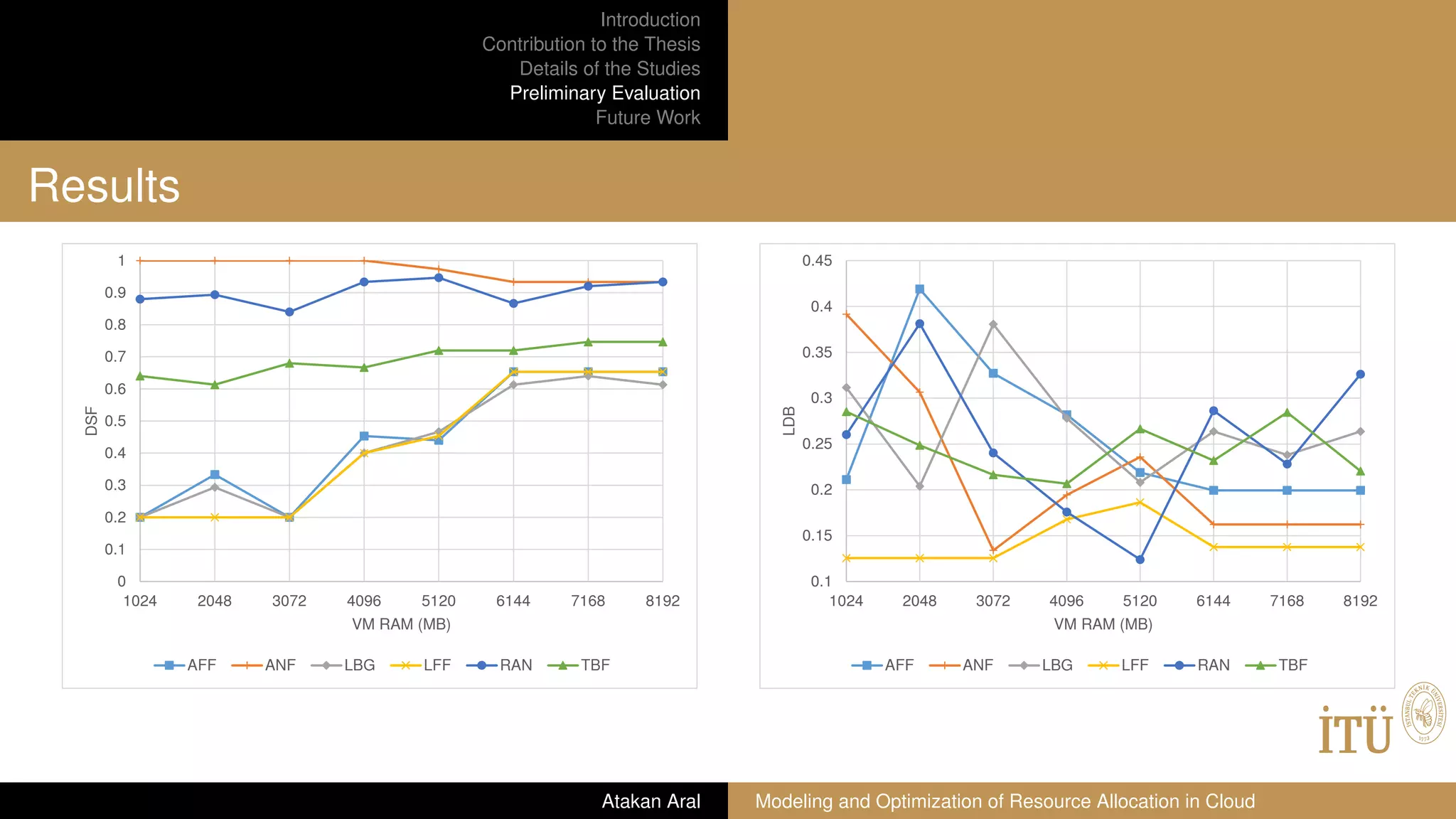
Distribution Factor (DSF)
Distribution factor is the extent that the VMs of a user are placed to separate DCs.
We define distribution factor in Equation 1 where U is the set of users whose VM
requests are responded, VM(u) is the VMs requested by the user u, DC(u) is the
DCs to which these VMs are placed. Range of the DF is (0, 1].
DF =
u∈U |DC(u)|
|VM(u)|
|U|
(1)
Higher values of distribution factor indicates that the VMs are highly distributed to
separate DCs. Benefits of high distribution are high parallelization and low failure
cost.
Atakan Aral Modeling and Optimization of Resource Allocation in Cloud
Introduction
Contribution to the Thesis
Details of the Studies
Preliminary Evaluation
Future Work
Data Collection
Simulator Development
Performance Criteria
Baseline Methods
Load Balance (LDB)
This criterion is the evenness of load assigned to all DCs in terms of utilization
rate. We use standard deviation to measure the amount of variation from the
average utilization.
Atakan Aral Modeling and Optimization of Resource Allocation in Cloud
Introduction
Contribution to the Thesis
Details of the Studies
Preliminary Evaluation
Future Work
Data Collection
Simulator Development
Performance Criteria
Baseline Methods
Rejection Rate (RJR)
This is the percentage of VM requests that are failed to responded immediately
and postponed until completion of other requests make enough room in DCs.
Atakan Aral Modeling and Optimization of Resource Allocation in Cloud
Introduction
Contribution to the Thesis
Details of the Studies
Preliminary Evaluation
Future Work
Data Collection
Simulator Development
Performance Criteria
Baseline Methods
Fairness (FRN)
Fairness is used to determine whether users are receiving a fair share of available
resources. Since not all users require the same amount of resources, fair share
does not mean equality in our case.
Atakan Aral Modeling and Optimization of Resource Allocation in Cloud
Introduction
Contribution to the Thesis
Details of the Studies
Preliminary Evaluation
Future Work
Data Collection
Simulator Development
Performance Criteria
Baseline Methods
Path Splitting (PSP)
Path Splitting is the average number of inter-DC flows utilized to respond a
inter-VM link request. This criterion is valid only if flow bifurcation is allowed.
Otherwise, output is always 1.
Atakan Aral Modeling and Optimization of Resource Allocation in Cloud
Introduction
Contribution to the Thesis
Details of the Studies
Preliminary Evaluation
Future Work
Data Collection
Simulator Development
Performance Criteria
Baseline Methods
Remarks
Strategy design pattern is used for the DC selection policy.
It is possible to decide and use a different policy for each VM group in the
runtime.
It is also possible to use different policies single VMs and VM groups.
Each broker has a list of available DCs in an arbitrary order.
Atakan Aral Modeling and Optimization of Resource Allocation in Cloud
Introduction
Contribution to the Thesis
Details of the Studies
Preliminary Evaluation
Future Work
Data Collection
Simulator Development
Performance Criteria
Baseline Methods
Baseline Methods
Random Choice (RAN)
Arbitrary First-fit (AFF)
Arbitrary Next-fit (ANF)
Latency based First-fit (LFF)
Latency based Next-fit (LNF)
Capacity based Best-fit (CBF)
Load Balancing (LBG)
Minimum Span (MSP)
Shortest Path (SP) vs. Multicommodity Flow (MF)
Atakan Aral Modeling and Optimization of Resource Allocation in Cloud
Introduction
Contribution to the Thesis
Details of the Studies
Preliminary Evaluation
Future Work
Data Collection
Simulator Development
Performance Criteria
Baseline Methods
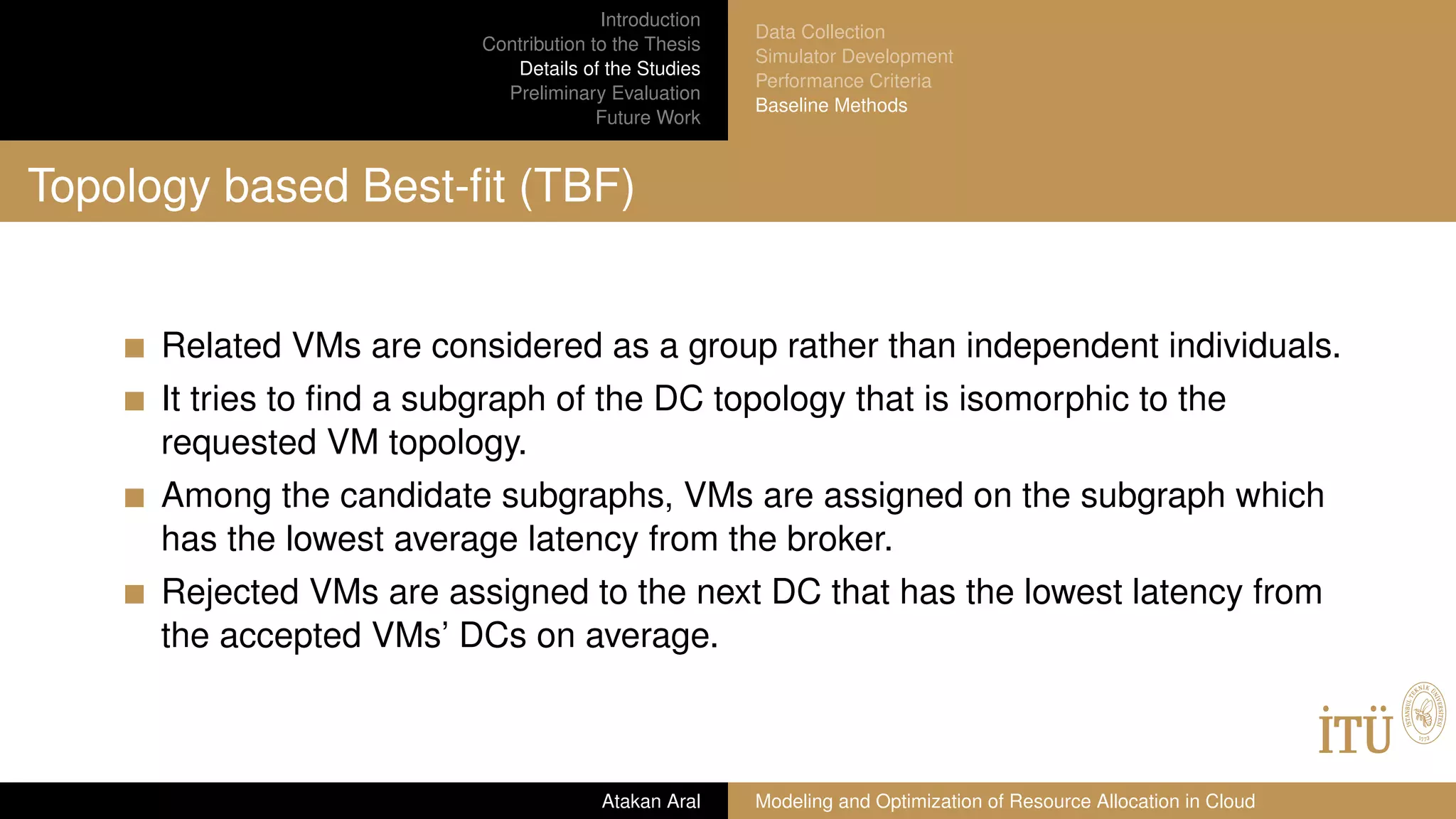
Topology based Best-fit (TBF)
Related VMs are considered as a group rather than independent individuals.
It tries to find a subgraph of the DC topology that is isomorphic to the
requested VM topology.
Among the candidate subgraphs, VMs are assigned on the subgraph which
has the lowest average latency from the broker.
Rejected VMs are assigned to the next DC that has the lowest latency from
the accepted VMs’ DCs on average.
Atakan Aral Modeling and Optimization of Resource Allocation in Cloud
Introduction
Contribution to the Thesis
Details of the Studies
Preliminary Evaluation
Future Work
Data Collection
Simulator Development
Performance Criteria
Baseline Methods
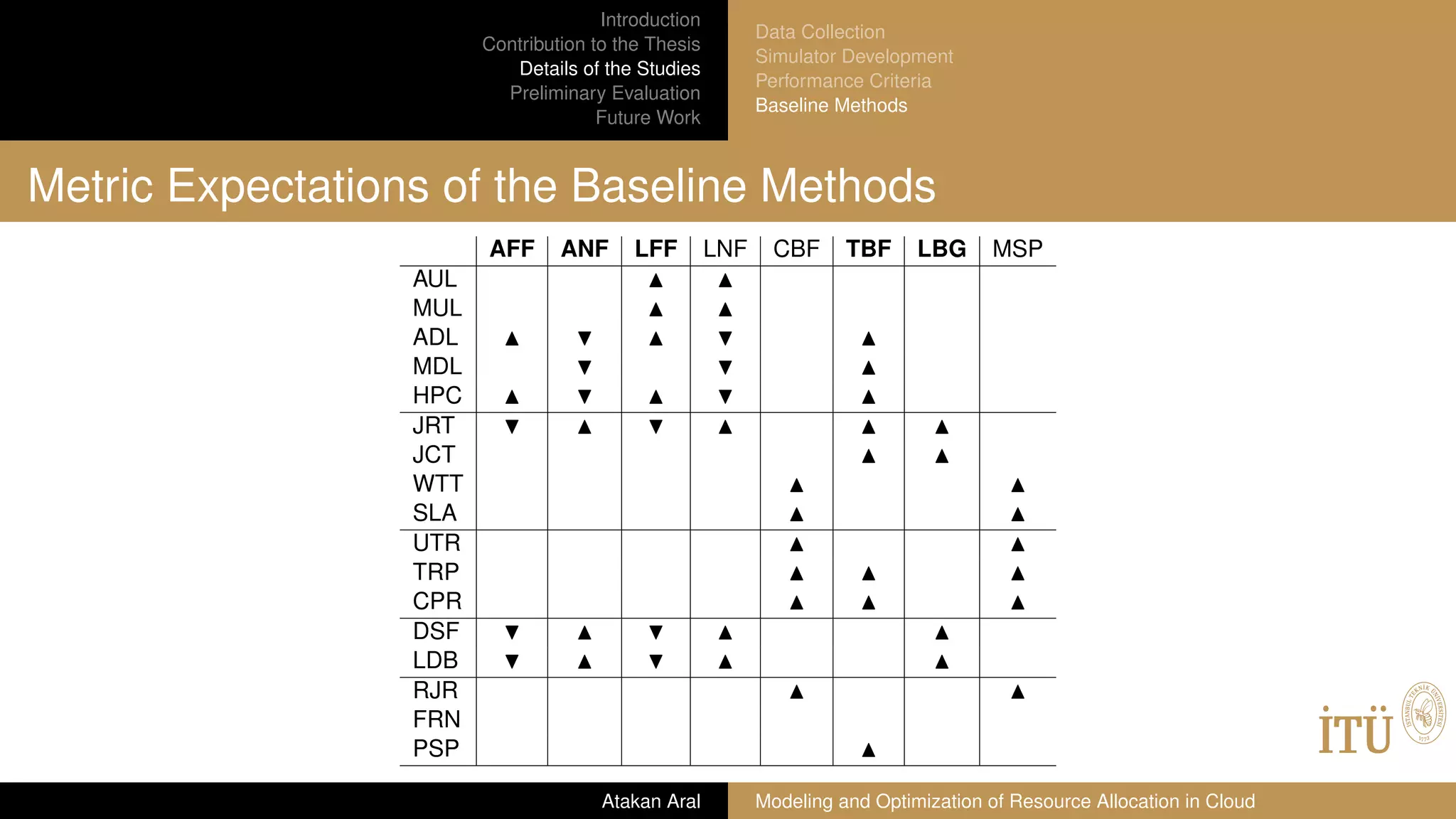
Metric Expectations of the Baseline Methods
AFF ANF LFF LNF CBF TBF LBG MSP
AUL
MUL
ADL
MDL
HPC
JRT
JCT
WTT
SLA
UTR
TRP
CPR
DSF
LDB
RJR
FRN
PSP
Atakan Aral Modeling and Optimization of Resource Allocation in Cloud
Introduction
Contribution to the Thesis
Details of the Studies
Preliminary Evaluation
Future Work
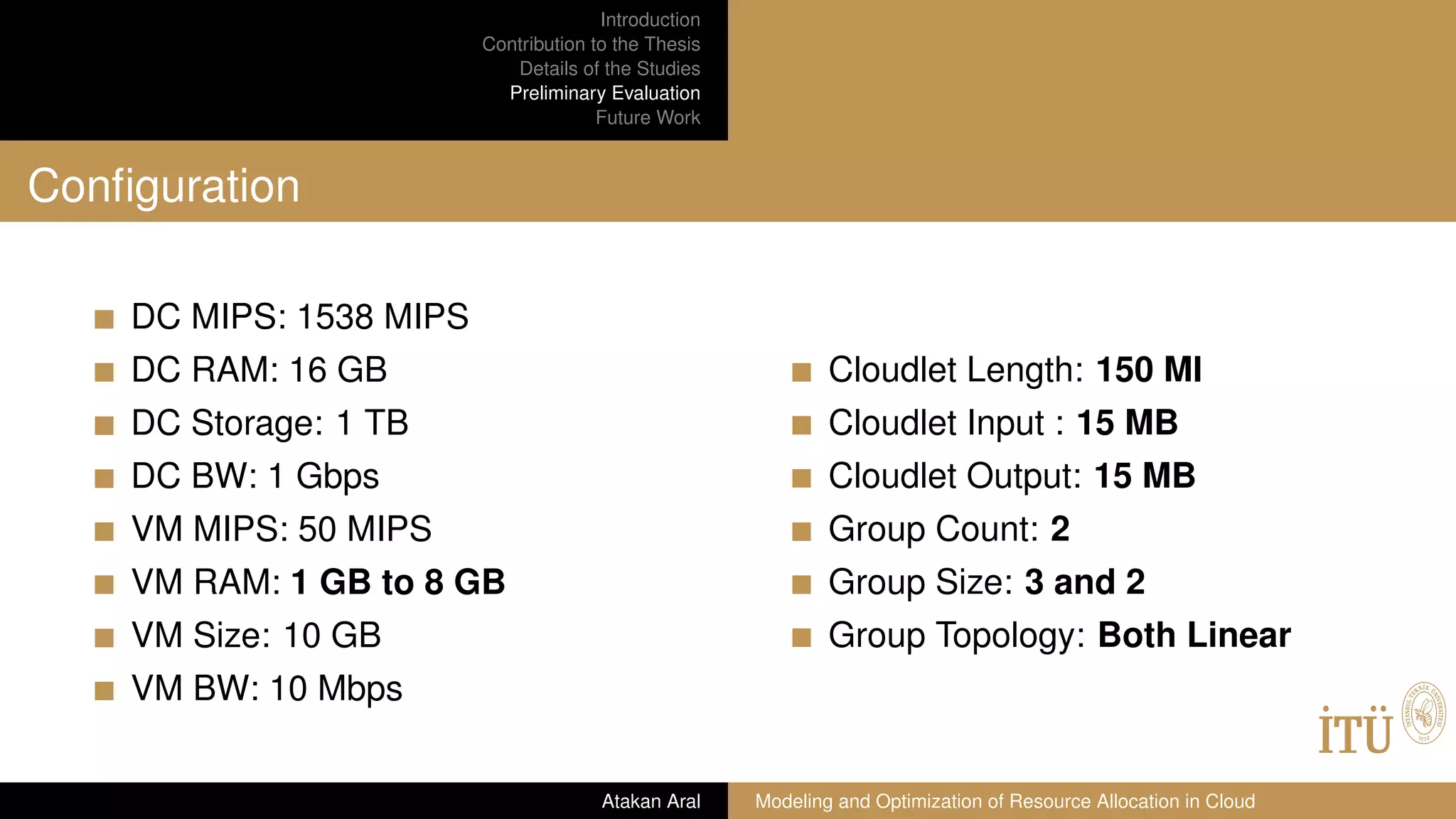
Configuration
DC MIPS: 1538 MIPS
DC RAM: 16 GB
DC Storage: 1 TB
DC BW: 1 Gbps
VM MIPS: 50 MIPS
VM RAM: 1 GB to 8 GB
VM Size: 10 GB
VM BW: 10 Mbps
Cloudlet Length: 150 MI
Cloudlet Input : 15 MB
Cloudlet Output: 15 MB
Group Count: 2
Group Size: 3 and 2
Group Topology: Both Linear
Atakan Aral Modeling and Optimization of Resource Allocation in Cloud
Introduction
Contribution to the Thesis
Details of the Studies
Preliminary Evaluation
Future Work
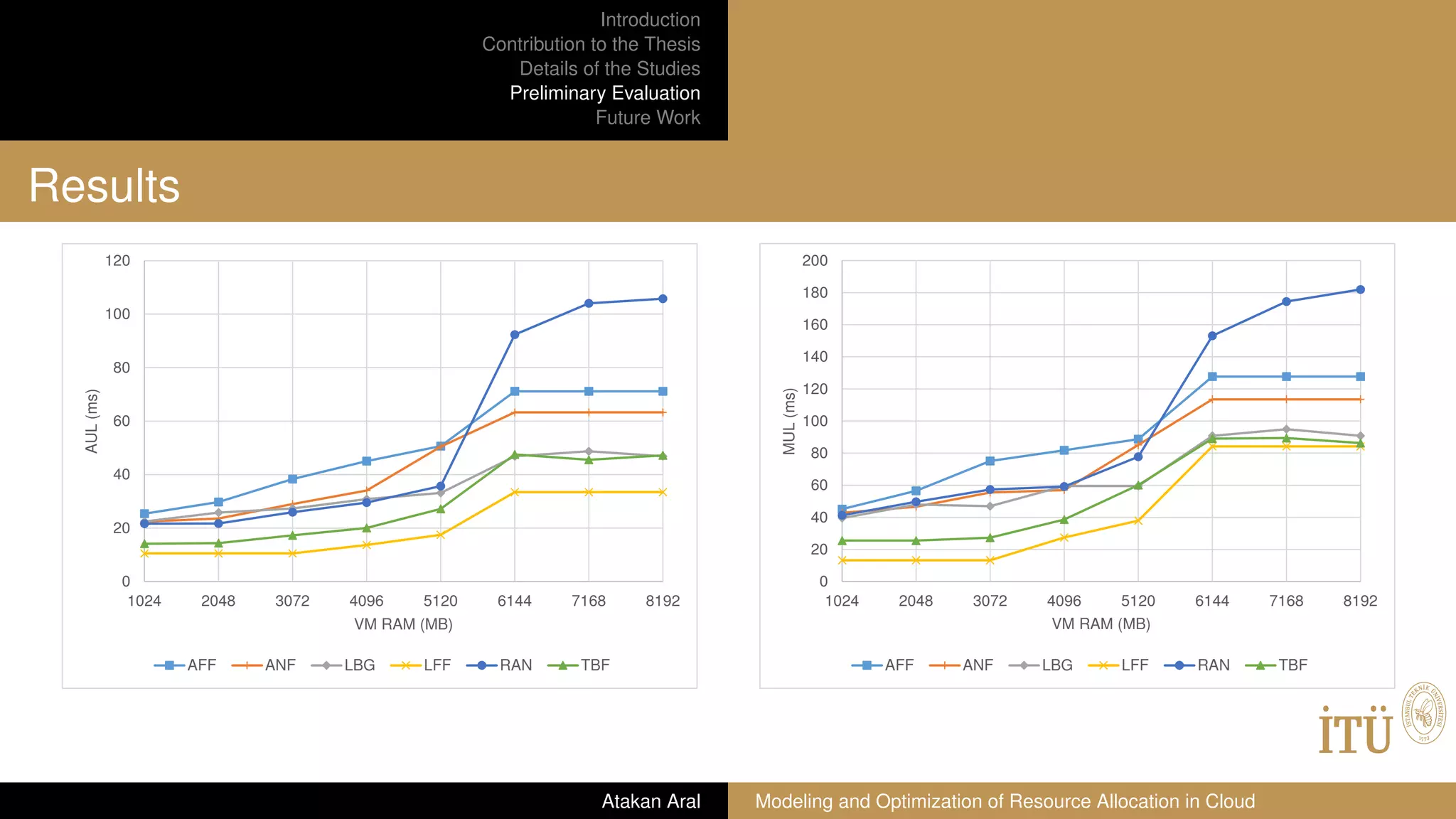
Results
0
20
40
60
80
100
120
1024 2048 3072 4096 5120 6144 7168 8192
AUL(ms)
VM RAM (MB)
AFF ANF LBG LFF RAN TBF
0
20
40
60
80
100
120
140
160
180
200
1024 2048 3072 4096 5120 6144 7168 8192
MUL(ms)
VM RAM (MB)
AFF ANF LBG LFF RAN TBF
Atakan Aral Modeling and Optimization of Resource Allocation in Cloud
Introduction
Contribution to the Thesis
Details of the Studies
Preliminary Evaluation
Future Work
Results
0
0.5
1
1.5
2
2.5
3
3.5
1024 2048 3072 4096 5120 6144 7168 8192
ADL(ms)
VM RAM (MB)
AFF ANF LBG LFF RAN TBF
0
1
2
3
4
5
6
7
1024 2048 3072 4096 5120 6144 7168 8192
MDL(ms)
VM RAM (MB)
AFF ANF LBG LFF RAN TBF
Atakan Aral Modeling and Optimization of Resource Allocation in Cloud
Introduction
Contribution to the Thesis
Details of the Studies
Preliminary Evaluation
Future Work
Results
3
3.2
3.4
3.6
3.8
4
4.2
4.4
4.6
4.8
5
1024 2048 3072 4096 5120 6144 7168 8192
JRT(s)
VM RAM (MB)
AFF ANF LBG LFF RAN TBF
0
20
40
60
80
100
120
1024 2048 3072 4096 5120 6144 7168 8192
JCT(s)
VM RAM (MB)
AFF ANF LBG LFF RAN TBF
Atakan Aral Modeling and Optimization of Resource Allocation in Cloud
Introduction
Contribution to the Thesis
Details of the Studies
Preliminary Evaluation
Future Work
Results
0
100
200
300
400
500
600
700
1024 2048 3072 4096 5120 6144 7168 8192
TRP(MIPS)
VM RAM (MB)
AFF ANF LBG LFF RAN TBF
0
10
20
30
40
50
60
70
80
90
100
1024 2048 3072 4096 5120 6144 7168 8192
RJR(%)
VM RAM (MB)
AFF ANF LBG LFF RAN TBF
Atakan Aral Modeling and Optimization of Resource Allocation in Cloud
Introduction
Contribution to the Thesis
Details of the Studies
Preliminary Evaluation
Future Work
Results
0
0.1
0.2
0.3
0.4
0.5
0.6
0.7
0.8
0.9
1
1024 2048 3072 4096 5120 6144 7168 8192
DSF
VM RAM (MB)
AFF ANF LBG LFF RAN TBF
0.1
0.15
0.2
0.25
0.3
0.35
0.4
0.45
1024 2048 3072 4096 5120 6144 7168 8192
LDB
VM RAM (MB)
AFF ANF LBG LFF RAN TBF
Atakan Aral Modeling and Optimization of Resource Allocation in Cloud
Introduction
Contribution to the Thesis
Details of the Studies
Preliminary Evaluation
Future Work
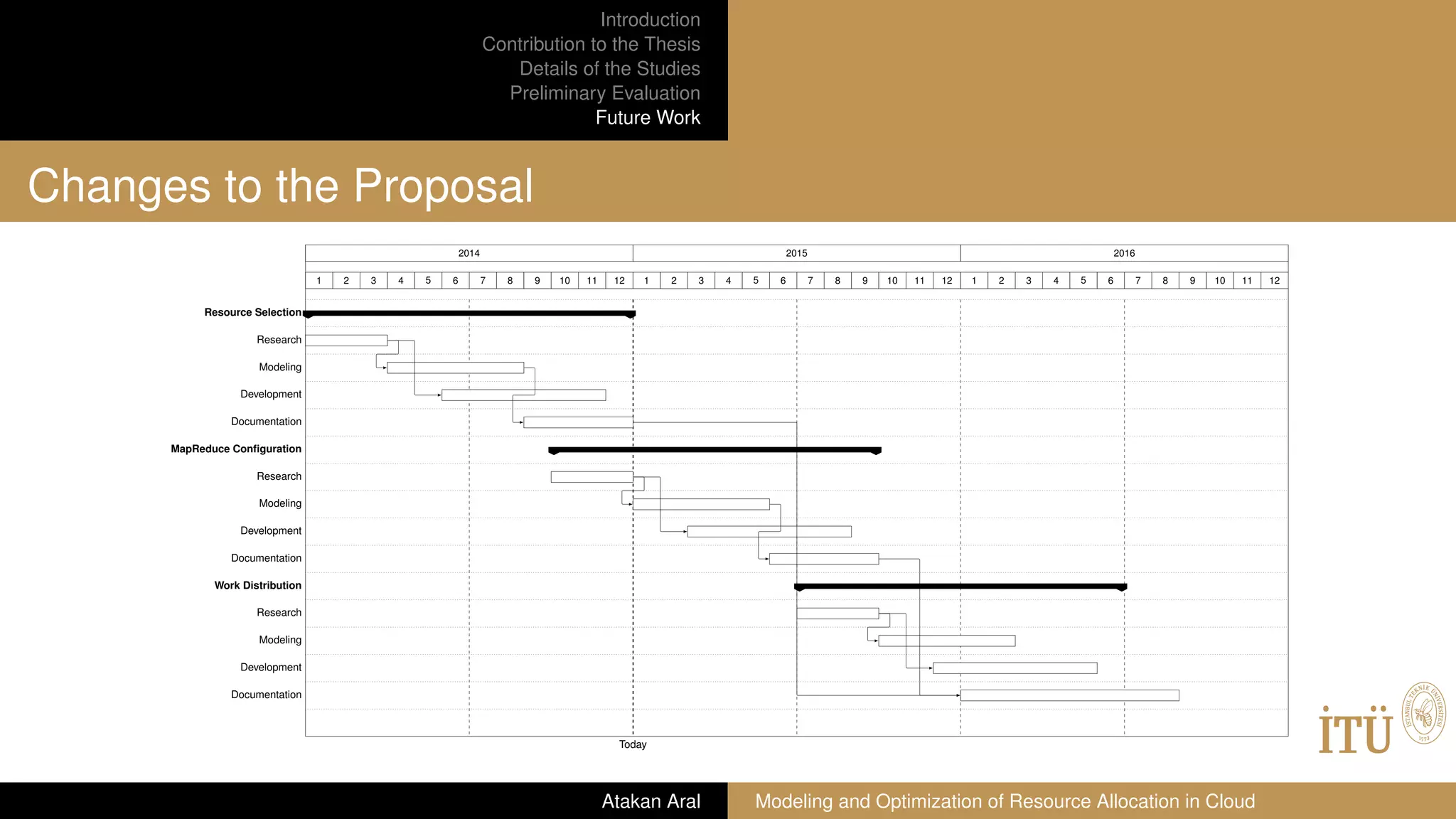
Changes to the Proposal
Today
2014 2015 2016
1 2 3 4 5 6 7 8 9 10 11 12 1 2 3 4 5 6 7 8 9 10 11 12 1 2 3 4 5 6 7 8 9 10 11 12
Resource Selection
Research
Modeling
Development
Documentation
MapReduce Configuration
Research
Modeling
Development
Documentation
Work Distribution
Research
Modeling
Development
Documentation
Atakan Aral Modeling and Optimization of Resource Allocation in Cloud
Introduction
Contribution to the Thesis
Details of the Studies
Preliminary Evaluation
Future Work
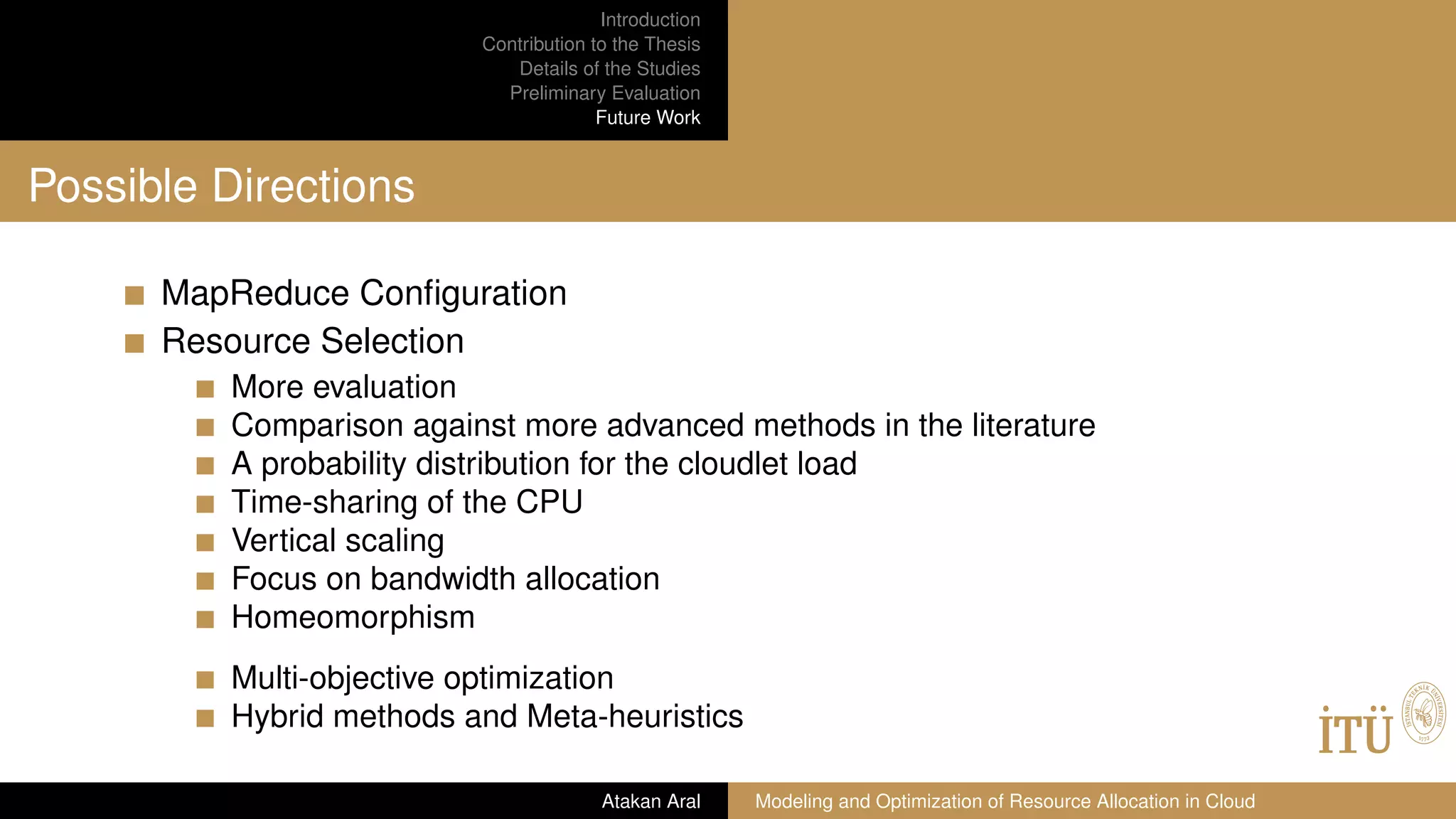
Possible Directions
MapReduce Configuration
Resource Selection
More evaluation
Comparison against more advanced methods in the literature
A probability distribution for the cloudlet load
Time-sharing of the CPU
Vertical scaling
Focus on bandwidth allocation
Homeomorphism
Multi-objective optimization
Hybrid methods and Meta-heuristics
Atakan Aral Modeling and Optimization of Resource Allocation in Cloud
Introduction
Contribution to the Thesis
Details of the Studies
Preliminary Evaluation
Future Work
Thank you for your time.
Atakan Aral Modeling and Optimization of Resource Allocation in Cloud
Appendix MapReduce
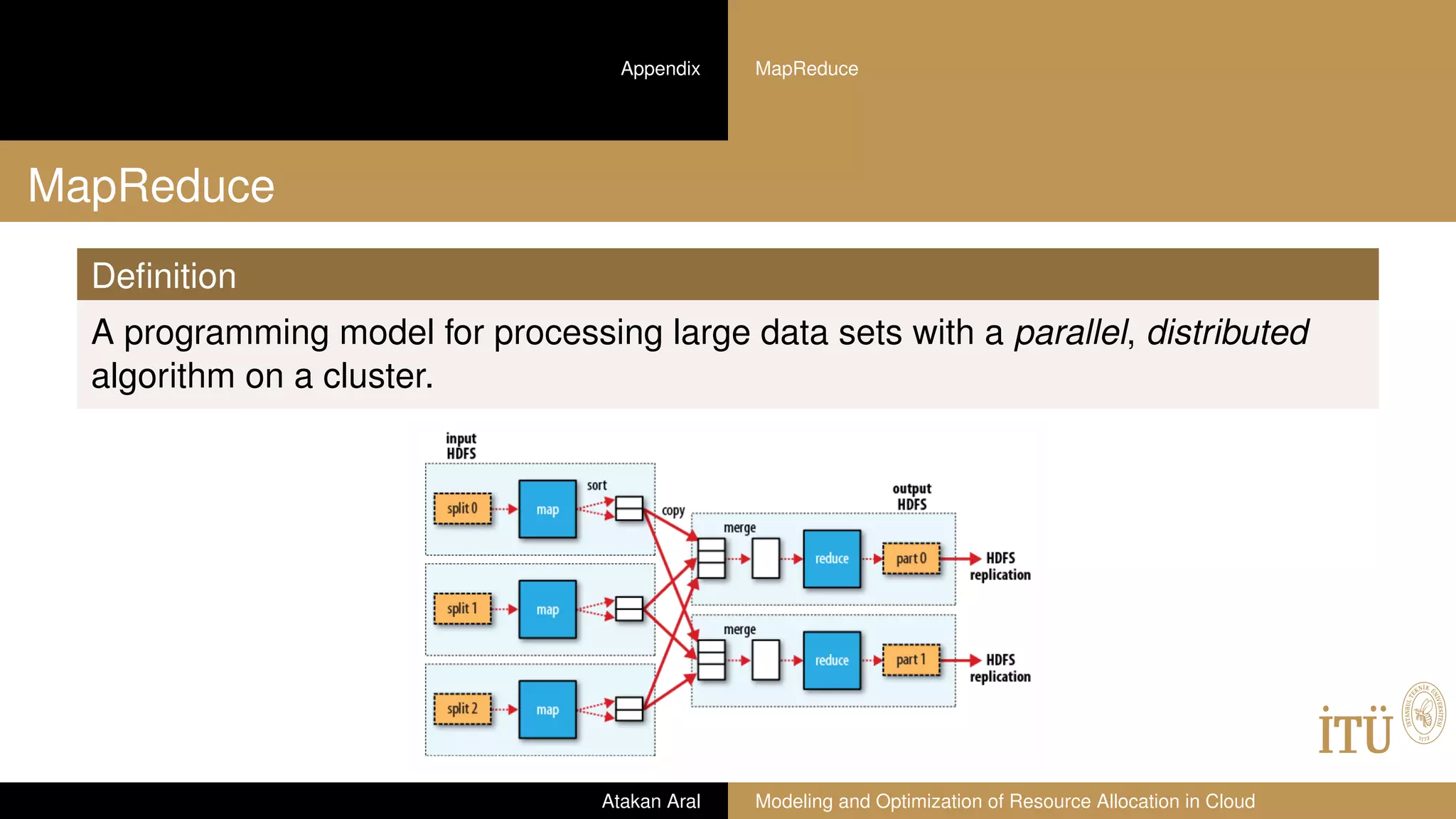
MapReduce
Definition
A programming model for processing large data sets with a parallel, distributed
algorithm on a cluster.
Atakan Aral Modeling and Optimization of Resource Allocation in Cloud
Appendix MapReduce
MapReduce Entities
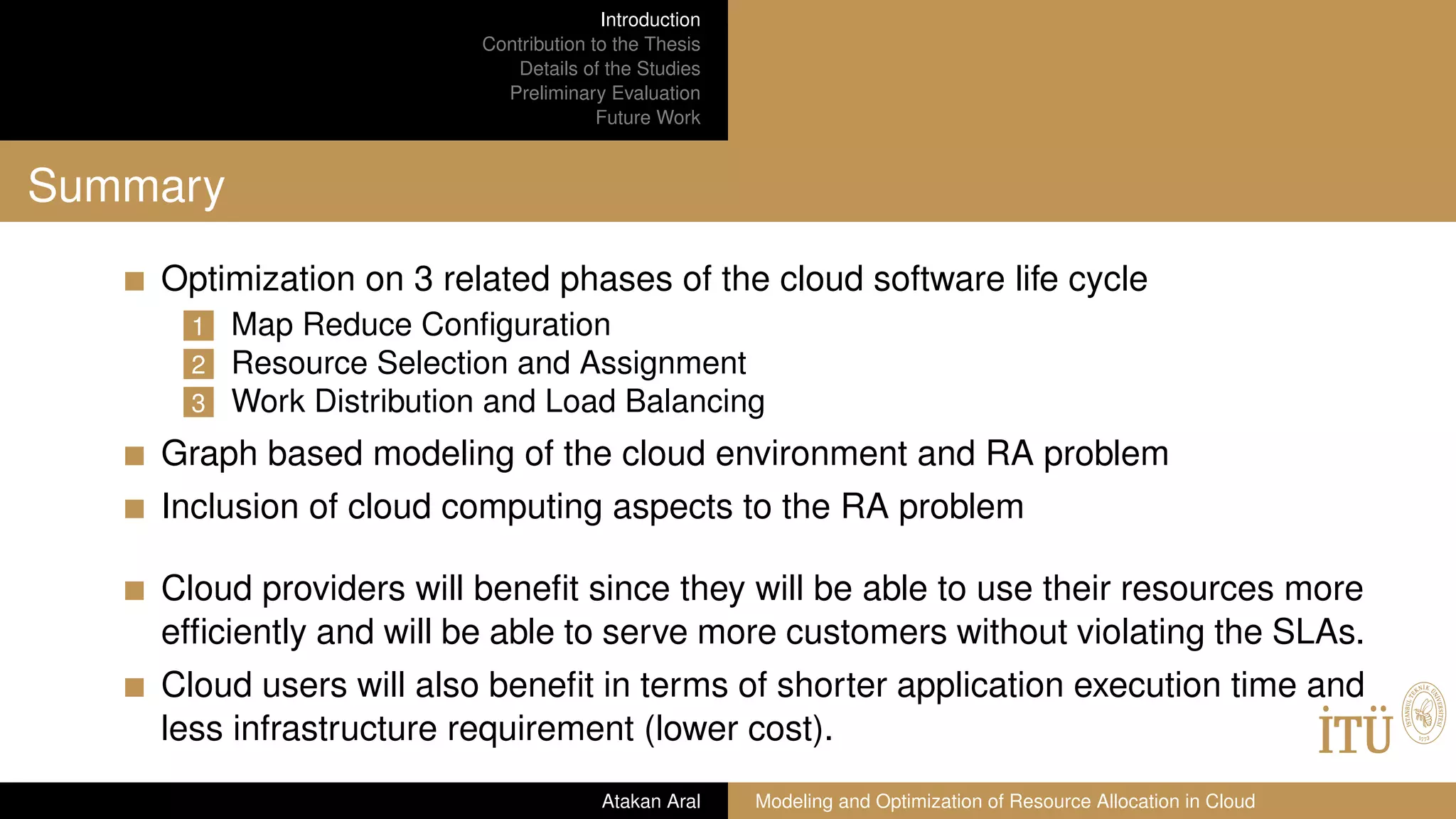
DataNode: Stores blocks of data in distributed filesystem (HDFS).
NameNode: Holds metadata (i.e. location information) of the files in HDFS.
Jobtracker: Coordinates the MapReduce job.
Tasktracker: Runs the tasks that the MapReduce job split into.
Atakan Aral Modeling and Optimization of Resource Allocation in Cloud

Modeling and Optimization of Resource Allocation in Cloud [PhD Thesis Progress 1]

  • 1.
    Introduction Contribution to theThesis Details of the Studies Preliminary Evaluation Future Work Modeling and Optimization of Resource Allocation in Cloud PhD Thesis Progress – First Report Atakan Aral Thesis Advisor: Asst. Prof. Dr. Tolga Ovatman Istanbul Technical University – Department of Computer Engineering January 8, 2015 Atakan Aral Modeling and Optimization of Resource Allocation in Cloud
  • 2.
    Introduction Contribution to theThesis Details of the Studies Preliminary Evaluation Future Work Outline 1 Introduction 2 Contribution to the Thesis Studies Time Plan 3 Details of the Studies Data Collection Simulator Development Performance Criteria Baseline Methods 4 Preliminary Evaluation 5 Future Work Atakan Aral Modeling and Optimization of Resource Allocation in Cloud
  • 3.
    Introduction Contribution to theThesis Details of the Studies Preliminary Evaluation Future Work Summary Optimization on 3 related phases of the cloud software life cycle 1 Map Reduce Configuration 2 Resource Selection and Assignment 3 Work Distribution and Load Balancing Graph based modeling of the cloud environment and RA problem Inclusion of cloud computing aspects to the RA problem Cloud providers will benefit since they will be able to use their resources more efficiently and will be able to serve more customers without violating the SLAs. Cloud users will also benefit in terms of shorter application execution time and less infrastructure requirement (lower cost). Atakan Aral Modeling and Optimization of Resource Allocation in Cloud
  • 4.
    Introduction Contribution to theThesis Details of the Studies Preliminary Evaluation Future Work Life Cycle of Cloud Software Development of Distributed Software • MapReduce Configuration Phase 2 Resource Allocation • Resource Selection and Optimization Phase 1 Load Balancing • Distribution of Work to Resources Phase 3 Atakan Aral Modeling and Optimization of Resource Allocation in Cloud
  • 5.
    Introduction Contribution to theThesis Details of the Studies Preliminary Evaluation Future Work MapReduce Configuration Motivation The cost of using 1000 machines for 1 hour, is the same as using 1 machine for 1000 hours in the cloud paradigm (Cost associativity). Aim Maximizing the utilization of all nodes for a Hadoop job by calculating the optimum parameters i.e. number of mappers and reducers Optimum parameters depend on the resource consumption of the SW. Design model of the software will be statically analyzed in order to guess resource consumption pattern and bottleneck resources. Atakan Aral Modeling and Optimization of Resource Allocation in Cloud
  • 6.
    Introduction Contribution to theThesis Details of the Studies Preliminary Evaluation Future Work Resource Selection and Optimization Motivation In distributed computing environments, up to 85 percent of computing capacity remains idle mainly due to poor optimization of placement. Aim Optimally assigning interconnected virtual nodes to substrate network with constraints VN requests and DC network will be represented as weighted graphs. Graph similarity – subgraph matching algorithms will be employed. There are several possible constraints to consider / optimize. Atakan Aral Modeling and Optimization of Resource Allocation in Cloud
  • 7.
    Introduction Contribution to theThesis Details of the Studies Preliminary Evaluation Future Work Work Distribution to Resources Motivation Data flows between nodes only in the shuffle step of the MapReduce job, and tuning it can have a big impact on job execution time. Aim Analysis of the shuffle and scheduling algorithms of Apache Hadoop framework Selection of node roles is critical to reduce network traffic. Dynamic re-distribution of work during execution results in better load balancing and better performance. Cost based analysis of the existing schedulers will be performed. Atakan Aral Modeling and Optimization of Resource Allocation in Cloud
  • 8.
    Introduction Contribution to theThesis Details of the Studies Preliminary Evaluation Future Work Studies Time Plan Data Collection We decided to use a real-world cloud datacenter topology for the experiments. Performed tasks include: Finding candidate topologies by examining similar studies Choosing the most appropriate topology Converting the topology into a machine-readable format Atakan Aral Modeling and Optimization of Resource Allocation in Cloud
  • 9.
    Introduction Contribution to theThesis Details of the Studies Preliminary Evaluation Future Work Studies Time Plan Simulator Development CloudSim Framework is chosen to simulate the cloud infrastructure. A general purpose tool which allows: DC and VM creation DC topologies Load generation Simple scheduling and logging Improvements and extensions: Interrelated VMs an VM topologies Delayed and continuous load generation Automated topology creation Visualization of resource allocation Atakan Aral Modeling and Optimization of Resource Allocation in Cloud
  • 10.
    Introduction Contribution to theThesis Details of the Studies Preliminary Evaluation Future Work Studies Time Plan Experimental Setup 9 baseline methods (6 of them are implemented) for resource selection and VM placement 16 metrics (10 of them are implemented) to evaluate the performance of these methods Analysis and hierarchical categorization of the metrics Analysis of the baseline methods and their expected effects on the metrics Atakan Aral Modeling and Optimization of Resource Allocation in Cloud
  • 11.
    Introduction Contribution to theThesis Details of the Studies Preliminary Evaluation Future Work Studies Time Plan Preliminary Evaluation Validation of the baseline methods Comparison of the baseline methods and the initial version of the suggested algorithm Validation and improvement of the suggested algorithm Evaluation of different configurations on each method’s performance Atakan Aral Modeling and Optimization of Resource Allocation in Cloud
  • 12.
    Introduction Contribution to theThesis Details of the Studies Preliminary Evaluation Future Work Studies Time Plan Gannt Chart 2014 7 8 9 10 11 12 Data Collection Simulator Development Experimental Setup Preliminary Evaluation Documentation Atakan Aral Modeling and Optimization of Resource Allocation in Cloud
  • 13.
    Introduction Contribution to theThesis Details of the Studies Preliminary Evaluation Future Work Data Collection Simulator Development Performance Criteria Baseline Methods Other Approaches Randomly generated DC topology [Ilyashenko,2008] and [Ghazar, 2013] Proprietary data [Agarwal et al., 2010] DC topology generated based on cities, their populations and locations [Larumbe and Sanso, 2013] GÉANT network map A European research and education network that interconnects National Research and Education Networks Atakan Aral Modeling and Optimization of Resource Allocation in Cloud
  • 14.
    Introduction Contribution to theThesis Details of the Studies Preliminary Evaluation Future Work Data Collection Simulator Development Performance Criteria Baseline Methods GÉANT Atakan Aral Modeling and Optimization of Resource Allocation in Cloud
  • 15.
    Introduction Contribution to theThesis Details of the Studies Preliminary Evaluation Future Work Data Collection Simulator Development Performance Criteria Baseline Methods FEDERICA Atakan Aral Modeling and Optimization of Resource Allocation in Cloud
  • 16.
    Introduction Contribution to theThesis Details of the Studies Preliminary Evaluation Future Work Data Collection Simulator Development Performance Criteria Baseline Methods FEDERICA FP-7 Project completed in 2010 Hosts experimental activities on new Internet architectures and protocols Available data: 4 core and 10 non-core Point of Presences Dedicated 1 Gbps channels Core PoPs contain 2+ virtualization nodes (servers) with VMware Non-core PoPs contain 1 virtualization nodes (servers) with VMware Node and link specifications Atakan Aral Modeling and Optimization of Resource Allocation in Cloud
  • 17.
    Introduction Contribution to theThesis Details of the Studies Preliminary Evaluation Future Work Data Collection Simulator Development Performance Criteria Baseline Methods BRITE Format Output format of the Boston University Representative Topology Generator Atakan Aral Modeling and Optimization of Resource Allocation in Cloud
  • 18.
    Introduction Contribution to theThesis Details of the Studies Preliminary Evaluation Future Work Data Collection Simulator Development Performance Criteria Baseline Methods CloudSim A framework for modeling and simulation of cloud computing infrastructures and services [Calheiros et al., 2011] Atakan Aral Modeling and Optimization of Resource Allocation in Cloud
  • 19.
    Introduction Contribution to theThesis Details of the Studies Preliminary Evaluation Future Work Data Collection Simulator Development Performance Criteria Baseline Methods CloudSim Features Benefited from Cloud entity classes: Datacenter, Host, Vm, Cloudlet Message passing mechanism for the communication among cloud entities Datacenter network topology Simulation Atakan Aral Modeling and Optimization of Resource Allocation in Cloud
  • 20.
    Introduction Contribution to theThesis Details of the Studies Preliminary Evaluation Future Work Data Collection Simulator Development Performance Criteria Baseline Methods Design Decisions A host represents the aggregation of all computing capacity at a particular DC. Hosts are mapped one-to-one to DCs. Allows abstraction of host allocation within DCs A cloudlet represents the aggregation of all the load for a particular VM. Cloudlets are mapped one-to-one to VMs. Allows abstraction of cloudlet allocation within VMs VM Host DC CloudletBroker Atakan Aral Modeling and Optimization of Resource Allocation in Cloud
  • 21.
    Introduction Contribution to theThesis Details of the Studies Preliminary Evaluation Future Work Data Collection Simulator Development Performance Criteria Baseline Methods New CloudSim Features Implemented Automatic creation of datacenters and brokers at each location Atakan Aral Modeling and Optimization of Resource Allocation in Cloud
  • 22.
    Introduction Contribution to theThesis Details of the Studies Preliminary Evaluation Future Work Data Collection Simulator Development Performance Criteria Baseline Methods New CloudSim Features Implemented Interrelated VMs VM topology generation (Complete, Linear, Circular, Star, Custom) Directed–undirected dependencies Delay for communication VM Life-cycle Deferred initialization for related VMs Destruction after the completion of cloudlets Statistics logging Atakan Aral Modeling and Optimization of Resource Allocation in Cloud
  • 23.
    Introduction Contribution to theThesis Details of the Studies Preliminary Evaluation Future Work Data Collection Simulator Development Performance Criteria Baseline Methods New CloudSim Features Implemented Visualization of the topology and allocation Atakan Aral Modeling and Optimization of Resource Allocation in Cloud
  • 24.
    Introduction Contribution to theThesis Details of the Studies Preliminary Evaluation Future Work Data Collection Simulator Development Performance Criteria Baseline Methods Categorization Quality of Service Temporal Latency AUL MUL ADL MDL HPC Duration JRT JCT WTT SLA Volumetrical UTR TRP CPR Distributional DSF LDB Other RJR FRN PSP Atakan Aral Modeling and Optimization of Resource Allocation in Cloud
  • 25.
    Introduction Contribution to theThesis Details of the Studies Preliminary Evaluation Future Work Data Collection Simulator Development Performance Criteria Baseline Methods Average User Latency (AUL) This criterion is the average time (in ms) it takes for cloud users to access their VMs. Here, average value is calculated both for the users and for their VMs. It should be measured with equal load of VM requests to compare two methods. A high value of user latency means the input and output transfer between user and the processing units is slow. Atakan Aral Modeling and Optimization of Resource Allocation in Cloud
  • 26.
    Introduction Contribution to theThesis Details of the Studies Preliminary Evaluation Future Work Data Collection Simulator Development Performance Criteria Baseline Methods Maximum User Latency (MUL) Even if the average user latency is low in a system, one of the users may be starving to access one of its VMs. To reveal such problems, we suggest the maximum user latency metric. Here, high values indicate starvation. Atakan Aral Modeling and Optimization of Resource Allocation in Cloud
  • 27.
    Introduction Contribution to theThesis Details of the Studies Preliminary Evaluation Future Work Data Collection Simulator Development Performance Criteria Baseline Methods Average Inter-DC Latency (ADL) If two VMs are adjacent in the topology requested by the user, then these VMs need to transfer data or communication signals to each other. Average inter-DC latency is the time it takes to complete transfer between such nodes on average. It is critical to keep inter-DC latency low for the performance of the cloud software. Inter-DC latency is minimum when all VMs of a user are placed to the same DC. Atakan Aral Modeling and Optimization of Resource Allocation in Cloud
  • 28.
    Introduction Contribution to theThesis Details of the Studies Preliminary Evaluation Future Work Data Collection Simulator Development Performance Criteria Baseline Methods Maximum Inter-DC Latency (MDL) Similar to maximum user latency, maximum inter-DC latency is used to detect outlier cases where it takes too much time to transfer data or communication signals between two VMs. Atakan Aral Modeling and Optimization of Resource Allocation in Cloud
  • 29.
    Introduction Contribution to theThesis Details of the Studies Preliminary Evaluation Future Work Data Collection Simulator Development Performance Criteria Baseline Methods Hop Count (HPC) Hop count is the average number of hops per dependencies between VMs. Minimum values of this criterion (which is 0) is achieved when all dependent VMs in the request are placed to the same DC. Atakan Aral Modeling and Optimization of Resource Allocation in Cloud
  • 30.
    Introduction Contribution to theThesis Details of the Studies Preliminary Evaluation Future Work Data Collection Simulator Development Performance Criteria Baseline Methods Job Run Time (JRT) This criterion is the average time it takes to complete the jobs divided by their size (in million instructions - MI). Since a host has a finite number of CPU cores and a CPU core can be used by a single VM at a time, time-sharing is used when number of VMs in a host is greater than the number of CPU cores in that hosts. In such cases, running time of the job is longer because it can be executed only part-time and is paused at other times. For this criterion, we ignore the time spent in data transfer between user and VM since it is measured in latency criteria. Additionally, we consider each VM individually since the communication with other VMs also depends on latency. Atakan Aral Modeling and Optimization of Resource Allocation in Cloud
  • 31.
    Introduction Contribution to theThesis Details of the Studies Preliminary Evaluation Future Work Data Collection Simulator Development Performance Criteria Baseline Methods Job Completion Time (JCT) Job completion time includes both latency and running times. It is an average value for all users but is not normalized by job size. It indicates the promptness in responding user requests. Atakan Aral Modeling and Optimization of Resource Allocation in Cloud
  • 32.
    Introduction Contribution to theThesis Details of the Studies Preliminary Evaluation Future Work Data Collection Simulator Development Performance Criteria Baseline Methods Waiting Time (WTT) Apart from latency, some VM requests will be delayed due to lack of available capacity. Waiting time criteria measures the time it takes until a job restarts after it is postponed. Atakan Aral Modeling and Optimization of Resource Allocation in Cloud
  • 33.
    Introduction Contribution to theThesis Details of the Studies Preliminary Evaluation Future Work Data Collection Simulator Development Performance Criteria Baseline Methods SLA Violations (SLA) Service level agreements (SLAs) usually define a deadline for job completion time and a penalty is issued if it is not respected. This criterion is the cumulative number of SLA violations due to tardiness. Atakan Aral Modeling and Optimization of Resource Allocation in Cloud
  • 34.
    Introduction Contribution to theThesis Details of the Studies Preliminary Evaluation Future Work Data Collection Simulator Development Performance Criteria Baseline Methods Utilization Rate (UTR) Utilization rate is the percentage of the resources in a given DC topology that are assigned to VMs. It is measured after the first time the placement algorithm fails to assign a VM topology to any DC (resources achieve saturation). A different utilization rate exists for each type of resource e.g. memory utilization, bandwidth utilization etc. A high utilization rate indicates that the resources are assigned efficiently so that a great number of VM requests are responded successfully. Atakan Aral Modeling and Optimization of Resource Allocation in Cloud
  • 35.
    Introduction Contribution to theThesis Details of the Studies Preliminary Evaluation Future Work Data Collection Simulator Development Performance Criteria Baseline Methods Throughput (TRP) We measure throughput as the millions instructions processed in the whole system per second (MIPS). Indeed, it is equal to the total CPU utilization of all DCs. High throughput means a better placement of VMs and less wasted resources. Atakan Aral Modeling and Optimization of Resource Allocation in Cloud
  • 36.
    Introduction Contribution to theThesis Details of the Studies Preliminary Evaluation Future Work Data Collection Simulator Development Performance Criteria Baseline Methods Cumulative Profit (CPR) This criterion aims to represent the profit of the cloud provider in a fixed duration given prices for each resource type. Cumulative profit is directly proportional to throughput. Atakan Aral Modeling and Optimization of Resource Allocation in Cloud
  • 37.
    Introduction Contribution to theThesis Details of the Studies Preliminary Evaluation Future Work Data Collection Simulator Development Performance Criteria Baseline Methods Distribution Factor (DSF) Distribution factor is the extent that the VMs of a user are placed to separate DCs. We define distribution factor in Equation 1 where U is the set of users whose VM requests are responded, VM(u) is the VMs requested by the user u, DC(u) is the DCs to which these VMs are placed. Range of the DF is (0, 1]. DF = u∈U |DC(u)| |VM(u)| |U| (1) Higher values of distribution factor indicates that the VMs are highly distributed to separate DCs. Benefits of high distribution are high parallelization and low failure cost. Atakan Aral Modeling and Optimization of Resource Allocation in Cloud
  • 38.
    Introduction Contribution to theThesis Details of the Studies Preliminary Evaluation Future Work Data Collection Simulator Development Performance Criteria Baseline Methods Load Balance (LDB) This criterion is the evenness of load assigned to all DCs in terms of utilization rate. We use standard deviation to measure the amount of variation from the average utilization. Atakan Aral Modeling and Optimization of Resource Allocation in Cloud
  • 39.
    Introduction Contribution to theThesis Details of the Studies Preliminary Evaluation Future Work Data Collection Simulator Development Performance Criteria Baseline Methods Rejection Rate (RJR) This is the percentage of VM requests that are failed to responded immediately and postponed until completion of other requests make enough room in DCs. Atakan Aral Modeling and Optimization of Resource Allocation in Cloud
  • 40.
    Introduction Contribution to theThesis Details of the Studies Preliminary Evaluation Future Work Data Collection Simulator Development Performance Criteria Baseline Methods Fairness (FRN) Fairness is used to determine whether users are receiving a fair share of available resources. Since not all users require the same amount of resources, fair share does not mean equality in our case. Atakan Aral Modeling and Optimization of Resource Allocation in Cloud
  • 41.
    Introduction Contribution to theThesis Details of the Studies Preliminary Evaluation Future Work Data Collection Simulator Development Performance Criteria Baseline Methods Path Splitting (PSP) Path Splitting is the average number of inter-DC flows utilized to respond a inter-VM link request. This criterion is valid only if flow bifurcation is allowed. Otherwise, output is always 1. Atakan Aral Modeling and Optimization of Resource Allocation in Cloud
  • 42.
    Introduction Contribution to theThesis Details of the Studies Preliminary Evaluation Future Work Data Collection Simulator Development Performance Criteria Baseline Methods Remarks Strategy design pattern is used for the DC selection policy. It is possible to decide and use a different policy for each VM group in the runtime. It is also possible to use different policies single VMs and VM groups. Each broker has a list of available DCs in an arbitrary order. Atakan Aral Modeling and Optimization of Resource Allocation in Cloud
  • 43.
    Introduction Contribution to theThesis Details of the Studies Preliminary Evaluation Future Work Data Collection Simulator Development Performance Criteria Baseline Methods Baseline Methods Random Choice (RAN) Arbitrary First-fit (AFF) Arbitrary Next-fit (ANF) Latency based First-fit (LFF) Latency based Next-fit (LNF) Capacity based Best-fit (CBF) Load Balancing (LBG) Minimum Span (MSP) Shortest Path (SP) vs. Multicommodity Flow (MF) Atakan Aral Modeling and Optimization of Resource Allocation in Cloud
  • 44.
    Introduction Contribution to theThesis Details of the Studies Preliminary Evaluation Future Work Data Collection Simulator Development Performance Criteria Baseline Methods Topology based Best-fit (TBF) Related VMs are considered as a group rather than independent individuals. It tries to find a subgraph of the DC topology that is isomorphic to the requested VM topology. Among the candidate subgraphs, VMs are assigned on the subgraph which has the lowest average latency from the broker. Rejected VMs are assigned to the next DC that has the lowest latency from the accepted VMs’ DCs on average. Atakan Aral Modeling and Optimization of Resource Allocation in Cloud
  • 45.
    Introduction Contribution to theThesis Details of the Studies Preliminary Evaluation Future Work Data Collection Simulator Development Performance Criteria Baseline Methods Metric Expectations of the Baseline Methods AFF ANF LFF LNF CBF TBF LBG MSP AUL MUL ADL MDL HPC JRT JCT WTT SLA UTR TRP CPR DSF LDB RJR FRN PSP Atakan Aral Modeling and Optimization of Resource Allocation in Cloud
  • 46.
    Introduction Contribution to theThesis Details of the Studies Preliminary Evaluation Future Work Configuration DC MIPS: 1538 MIPS DC RAM: 16 GB DC Storage: 1 TB DC BW: 1 Gbps VM MIPS: 50 MIPS VM RAM: 1 GB to 8 GB VM Size: 10 GB VM BW: 10 Mbps Cloudlet Length: 150 MI Cloudlet Input : 15 MB Cloudlet Output: 15 MB Group Count: 2 Group Size: 3 and 2 Group Topology: Both Linear Atakan Aral Modeling and Optimization of Resource Allocation in Cloud
  • 47.
    Introduction Contribution to theThesis Details of the Studies Preliminary Evaluation Future Work Results 0 20 40 60 80 100 120 1024 2048 3072 4096 5120 6144 7168 8192 AUL(ms) VM RAM (MB) AFF ANF LBG LFF RAN TBF 0 20 40 60 80 100 120 140 160 180 200 1024 2048 3072 4096 5120 6144 7168 8192 MUL(ms) VM RAM (MB) AFF ANF LBG LFF RAN TBF Atakan Aral Modeling and Optimization of Resource Allocation in Cloud
  • 48.
    Introduction Contribution to theThesis Details of the Studies Preliminary Evaluation Future Work Results 0 0.5 1 1.5 2 2.5 3 3.5 1024 2048 3072 4096 5120 6144 7168 8192 ADL(ms) VM RAM (MB) AFF ANF LBG LFF RAN TBF 0 1 2 3 4 5 6 7 1024 2048 3072 4096 5120 6144 7168 8192 MDL(ms) VM RAM (MB) AFF ANF LBG LFF RAN TBF Atakan Aral Modeling and Optimization of Resource Allocation in Cloud
  • 49.
    Introduction Contribution to theThesis Details of the Studies Preliminary Evaluation Future Work Results 3 3.2 3.4 3.6 3.8 4 4.2 4.4 4.6 4.8 5 1024 2048 3072 4096 5120 6144 7168 8192 JRT(s) VM RAM (MB) AFF ANF LBG LFF RAN TBF 0 20 40 60 80 100 120 1024 2048 3072 4096 5120 6144 7168 8192 JCT(s) VM RAM (MB) AFF ANF LBG LFF RAN TBF Atakan Aral Modeling and Optimization of Resource Allocation in Cloud
  • 50.
    Introduction Contribution to theThesis Details of the Studies Preliminary Evaluation Future Work Results 0 100 200 300 400 500 600 700 1024 2048 3072 4096 5120 6144 7168 8192 TRP(MIPS) VM RAM (MB) AFF ANF LBG LFF RAN TBF 0 10 20 30 40 50 60 70 80 90 100 1024 2048 3072 4096 5120 6144 7168 8192 RJR(%) VM RAM (MB) AFF ANF LBG LFF RAN TBF Atakan Aral Modeling and Optimization of Resource Allocation in Cloud
  • 51.
    Introduction Contribution to theThesis Details of the Studies Preliminary Evaluation Future Work Results 0 0.1 0.2 0.3 0.4 0.5 0.6 0.7 0.8 0.9 1 1024 2048 3072 4096 5120 6144 7168 8192 DSF VM RAM (MB) AFF ANF LBG LFF RAN TBF 0.1 0.15 0.2 0.25 0.3 0.35 0.4 0.45 1024 2048 3072 4096 5120 6144 7168 8192 LDB VM RAM (MB) AFF ANF LBG LFF RAN TBF Atakan Aral Modeling and Optimization of Resource Allocation in Cloud
  • 52.
    Introduction Contribution to theThesis Details of the Studies Preliminary Evaluation Future Work Changes to the Proposal Today 2014 2015 2016 1 2 3 4 5 6 7 8 9 10 11 12 1 2 3 4 5 6 7 8 9 10 11 12 1 2 3 4 5 6 7 8 9 10 11 12 Resource Selection Research Modeling Development Documentation MapReduce Configuration Research Modeling Development Documentation Work Distribution Research Modeling Development Documentation Atakan Aral Modeling and Optimization of Resource Allocation in Cloud
  • 53.
    Introduction Contribution to theThesis Details of the Studies Preliminary Evaluation Future Work Possible Directions MapReduce Configuration Resource Selection More evaluation Comparison against more advanced methods in the literature A probability distribution for the cloudlet load Time-sharing of the CPU Vertical scaling Focus on bandwidth allocation Homeomorphism Multi-objective optimization Hybrid methods and Meta-heuristics Atakan Aral Modeling and Optimization of Resource Allocation in Cloud
  • 54.
    Introduction Contribution to theThesis Details of the Studies Preliminary Evaluation Future Work Thank you for your time. Atakan Aral Modeling and Optimization of Resource Allocation in Cloud
  • 55.
    Appendix MapReduce MapReduce Definition A programmingmodel for processing large data sets with a parallel, distributed algorithm on a cluster. Atakan Aral Modeling and Optimization of Resource Allocation in Cloud
  • 56.
    Appendix MapReduce MapReduce Entities DataNode:Stores blocks of data in distributed filesystem (HDFS). NameNode: Holds metadata (i.e. location information) of the files in HDFS. Jobtracker: Coordinates the MapReduce job. Tasktracker: Runs the tasks that the MapReduce job split into. Atakan Aral Modeling and Optimization of Resource Allocation in Cloud