Energy Aware Task Scheduling using Ant 
Colony Optimization in Cloud 
Linda . J, Ananthanarayana V.S. 
NITK Surathkal
Agenda 
•Introduction 
•Need for Task Scheduling & Energy Awareness 
•Problem Statement & Objective 
•Proposed Solution & Methodology 
•Results 
•Conclusion
Cloud Computing 
•“BURST” (Sudden increase or decrease) natured Web 
application demands affected the business. 
•Cloud Computing provided the solution via different 
service models like, 
•IaaS, PaaS, SaaS 
•Deployment Models Public, Private & Hybrid Cloud 
•Cloud computing is a model for enabling ubiquitous, 
convenient, on-demand access to a shared pool of 
resources.
Need for Energy Awareness in Task 
Scheduling 
•Many users access Virtual Machines everyday. 
•Efficient Task Scheduling Algorithms are 
required to increase profit for the cloud 
providers. 
•Consequently, Servers are always ON thereby 
increasing the Total Energy Consumption. 
•There arises a need to reduce the energy 
consumption in datacenters.
Task Scheduling 
•Scheduling [3] the n tasks (T1, T2,…,Tn) to m 
Virtual Machines (VM1, VM2,…,VMm) running 
on p Physical hosts (P1, P2,…,Pp) in such a way 
that maximum completion time or makespan of 
these n tasks will be minimized. 
•n>m>p
Requirements of Energy-aware Scheduler 
•To go through all possible (Task,VM) pairs so as 
to reduce the makespan. 
•To go through the Total Energy Consumption 
in all the hosts.
Problem Statement 
•The Problem is to design a Energy-aware Task 
Scheduling Algorithm. 
•Objective: 
–To design a Task scheduling Algorithm. 
–To add the Energy Awareness factor to the technique. 
–To compare the Energy-aware Algorithm with existing 
algorithms.
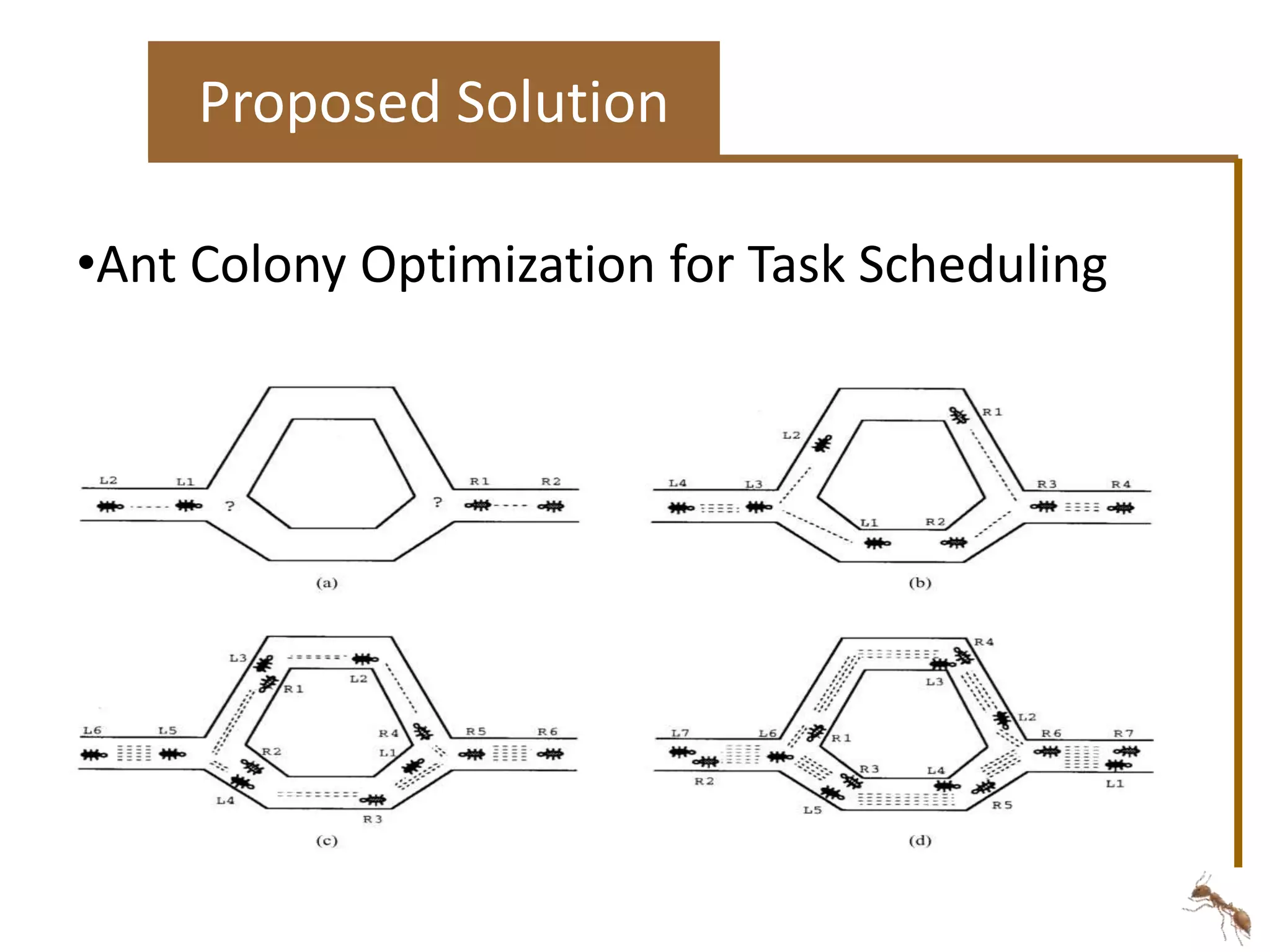
Proposed Solution 
•Ant Colony Optimization for Task Scheduling
System Model 
•Cloudsim [16] 
•CIS registry hold 
information about the 
resources 
•Scheduler (or Broker) 
is enhanced to be an 
energy-aware 
scheduler
System Model 
•LP Model (Based on [13]) 
•ϕ = CPU Utilization 
•Pidle = Power when 
CPU is idle 
•Pmax = Power when 
CPU is fully utilized 
•RT Model (Based on [12] ) 
•The Expected 
Time to Compute is 
given by 
•Wi = Workload 
•CCj = Computing 
Capacity
Methodology 
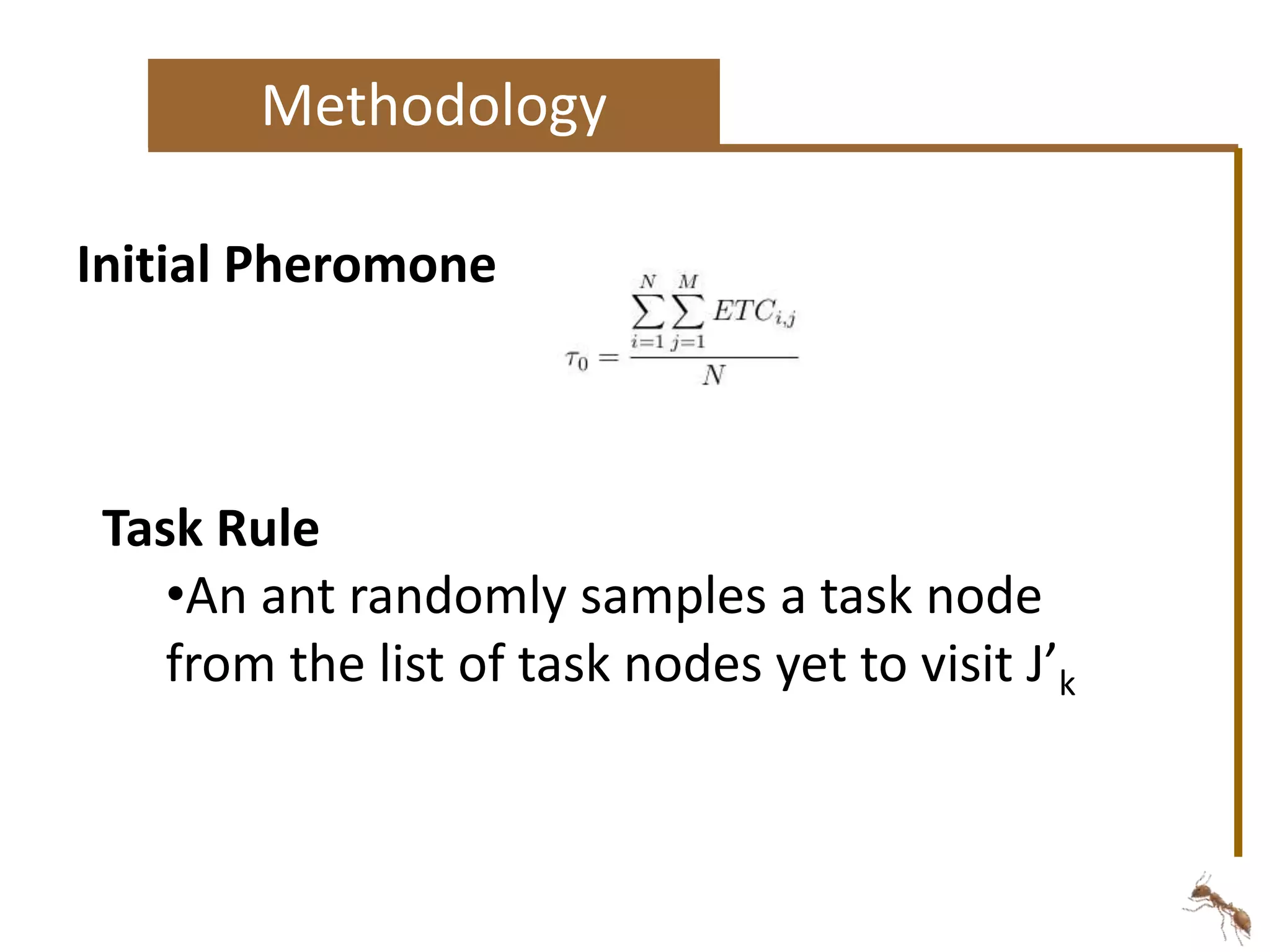
Initial Pheromone 
Task Rule 
•An ant randomly samples a task node 
from the list of task nodes yet to visit J’k
Methodology contd. 
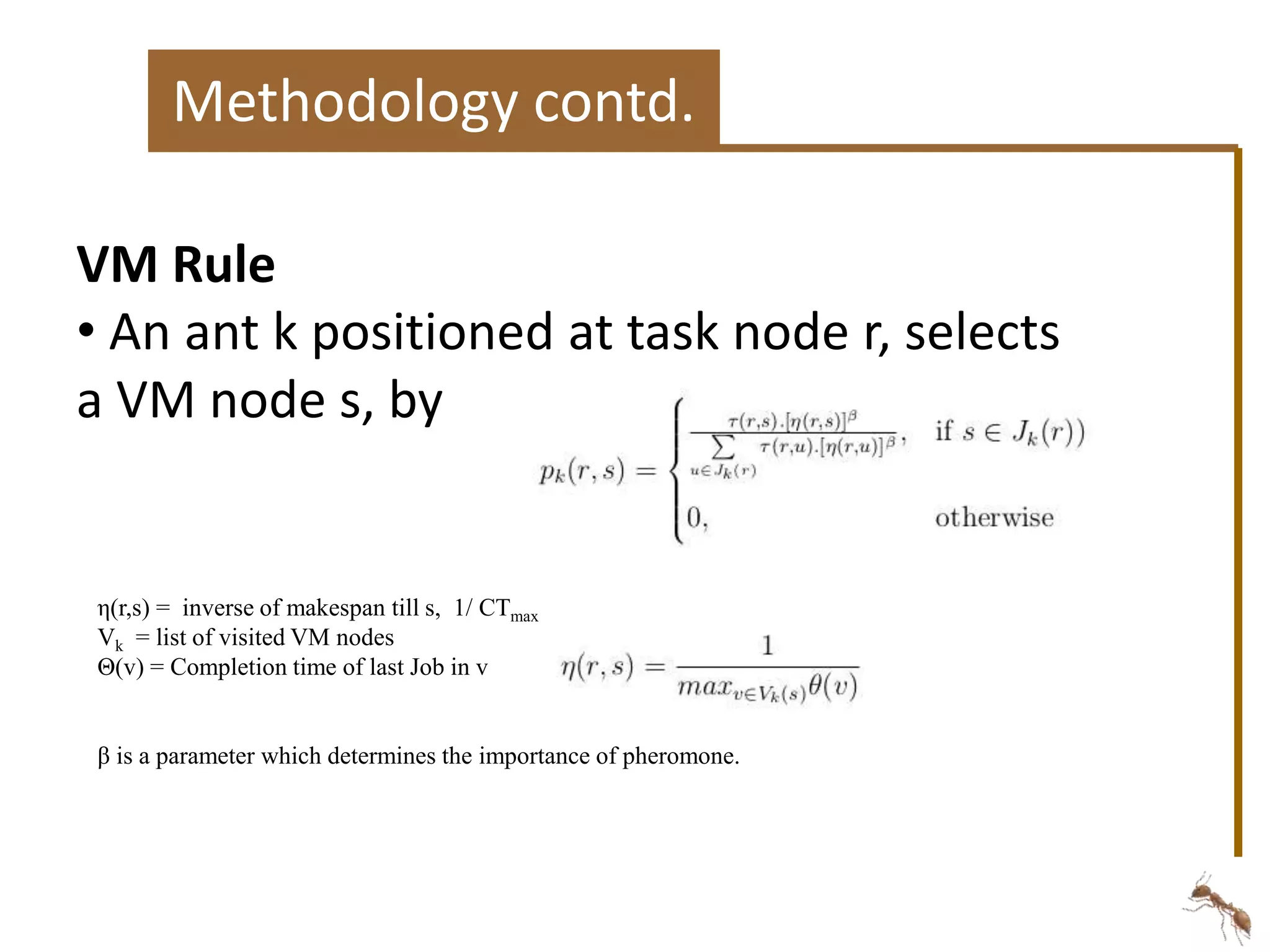
VM Rule 
• An ant k positioned at task node r, selects 
a VM node s, by 
η(r,s) = inverse of makespan till s, 1/ CTmax 
Vk = list of visited VM nodes 
Θ(v) = Completion time of last Job in v 
β is a parameter which determines the importance of pheromone.
Methodology contd. 
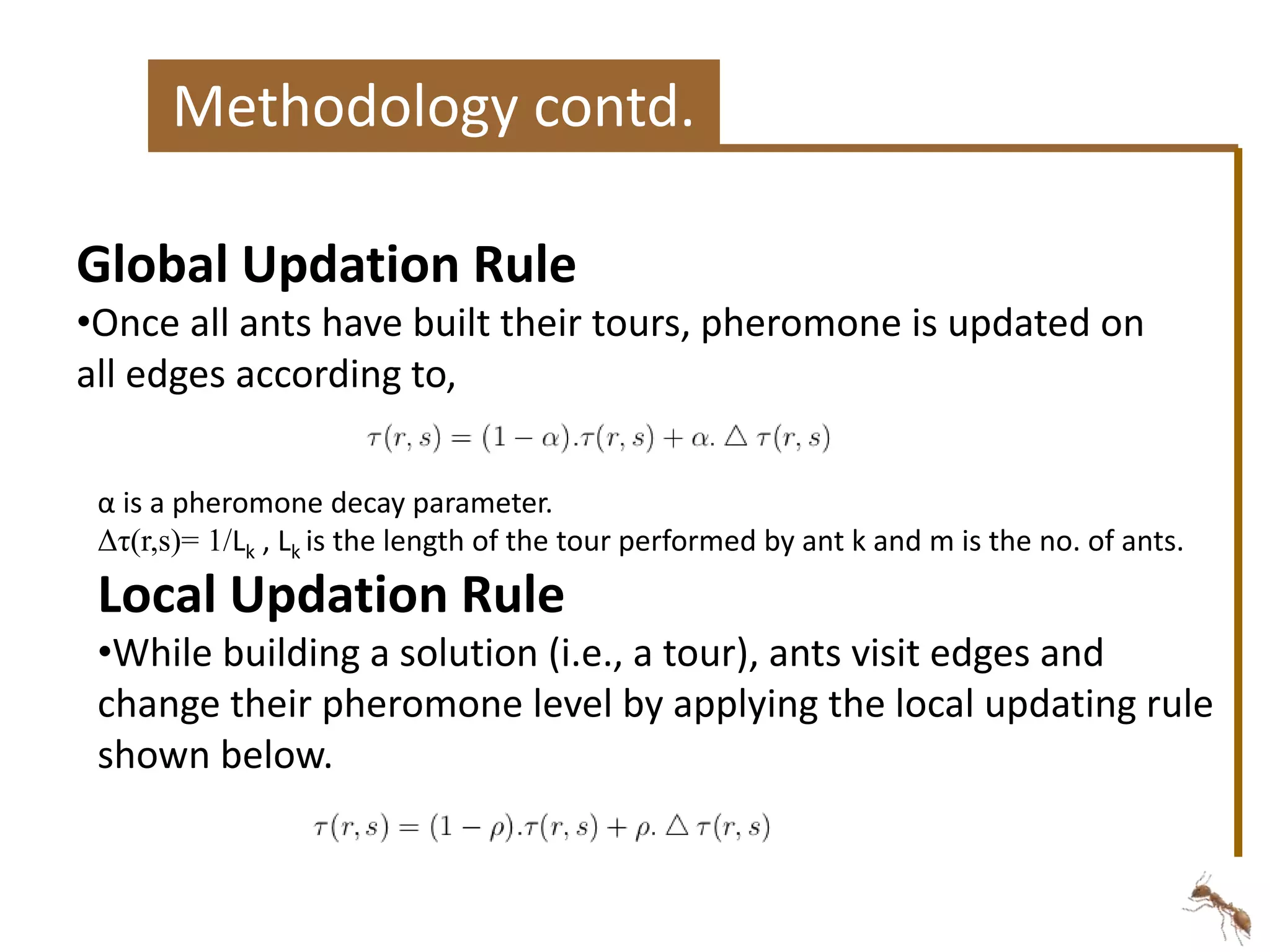
Global Updation Rule 
•Once all ants have built their tours, pheromone is updated on 
all edges according to, 
α is a pheromone decay parameter. 
Δτ(r,s)= 1/Lk , Lk is the length of the tour performed by ant k and m is the no. of ants. 
Local Updation Rule 
•While building a solution (i.e., a tour), ants visit edges and 
change their pheromone level by applying the local updating rule 
shown below.
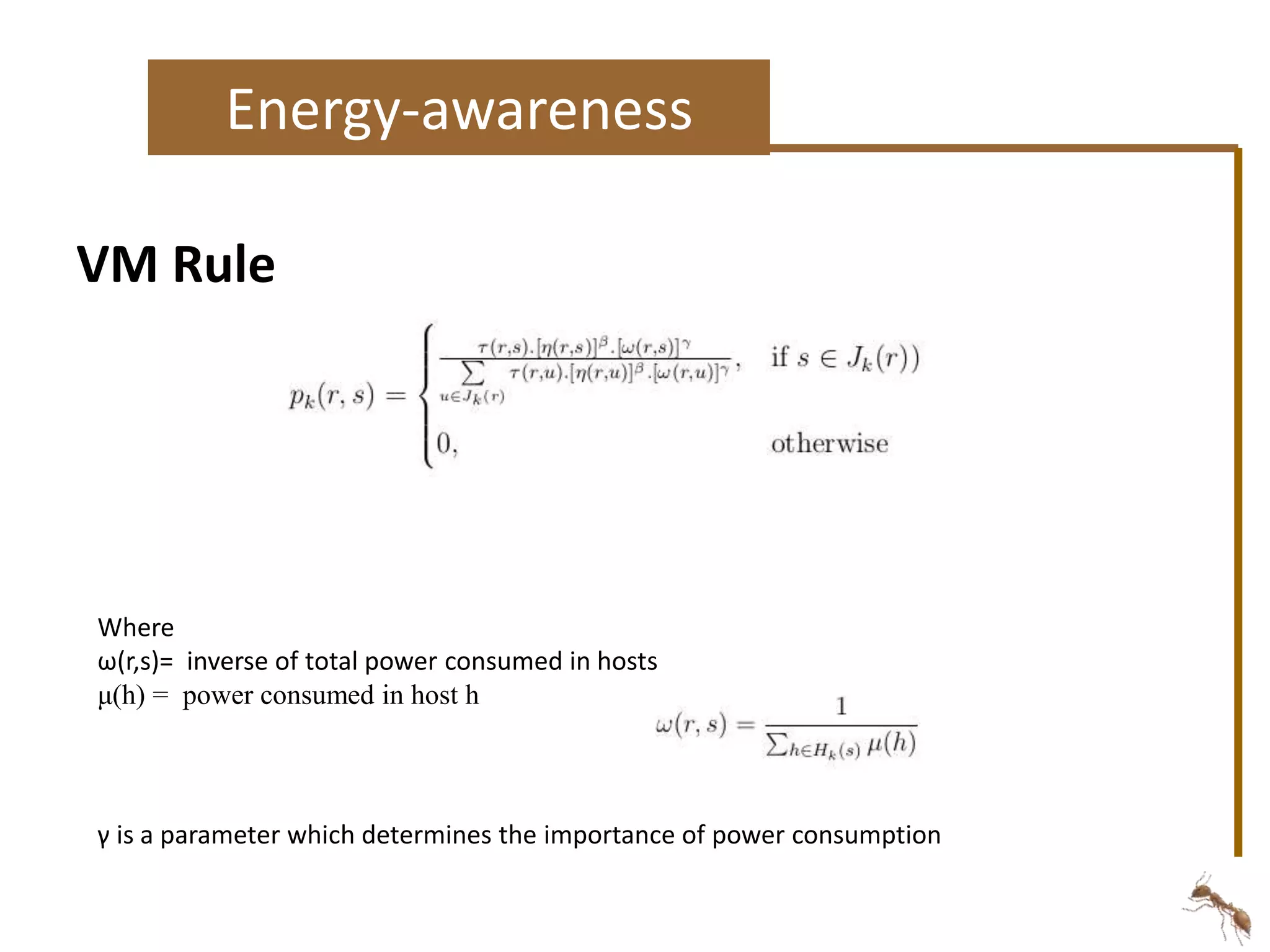
Energy-awareness 
VM Rule 
Where 
ω(r,s)= inverse of total power consumed in hosts 
μ(h) = power consumed in host h 
γ is a parameter which determines the importance of power consumption
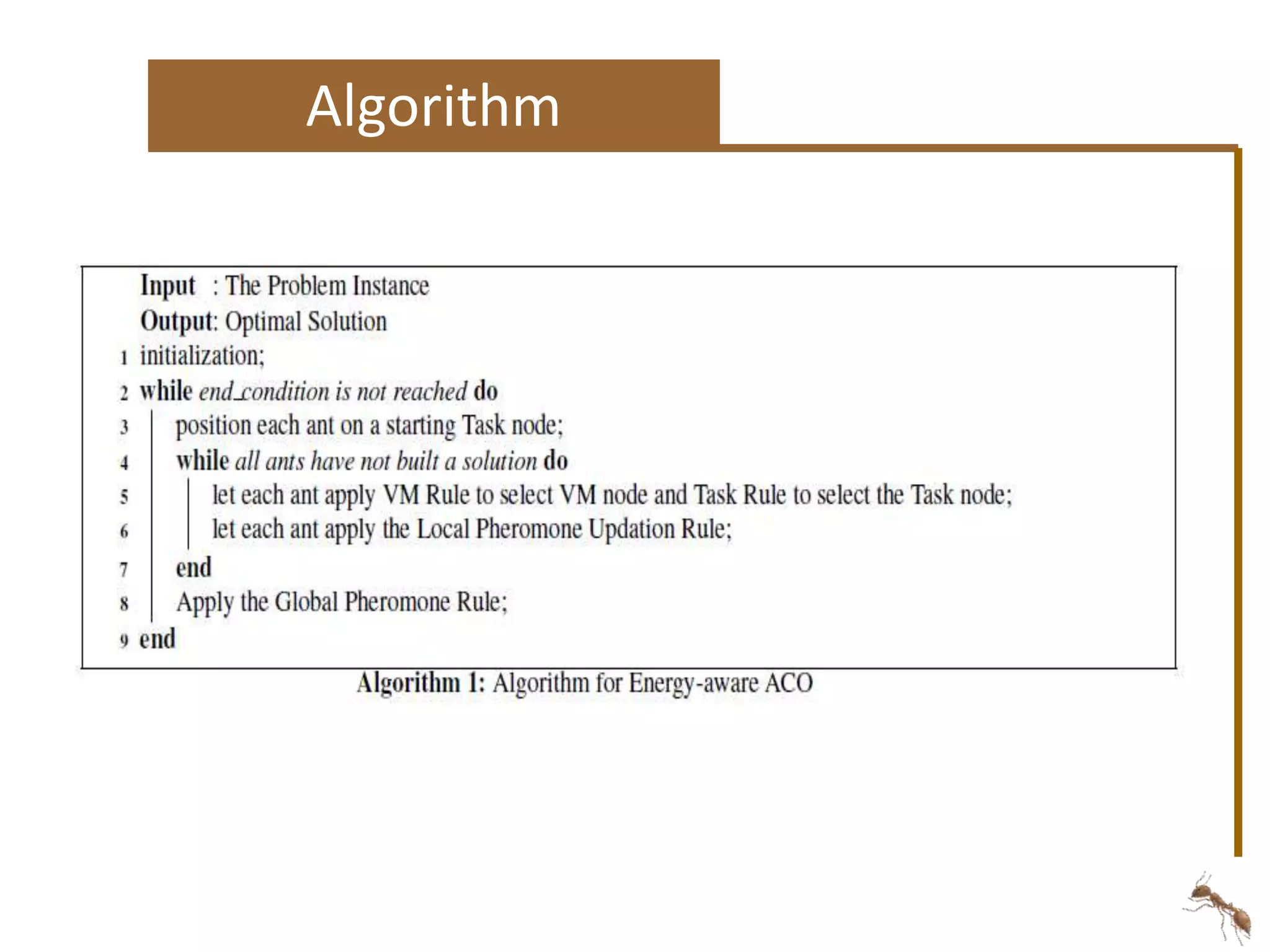
Algorithm
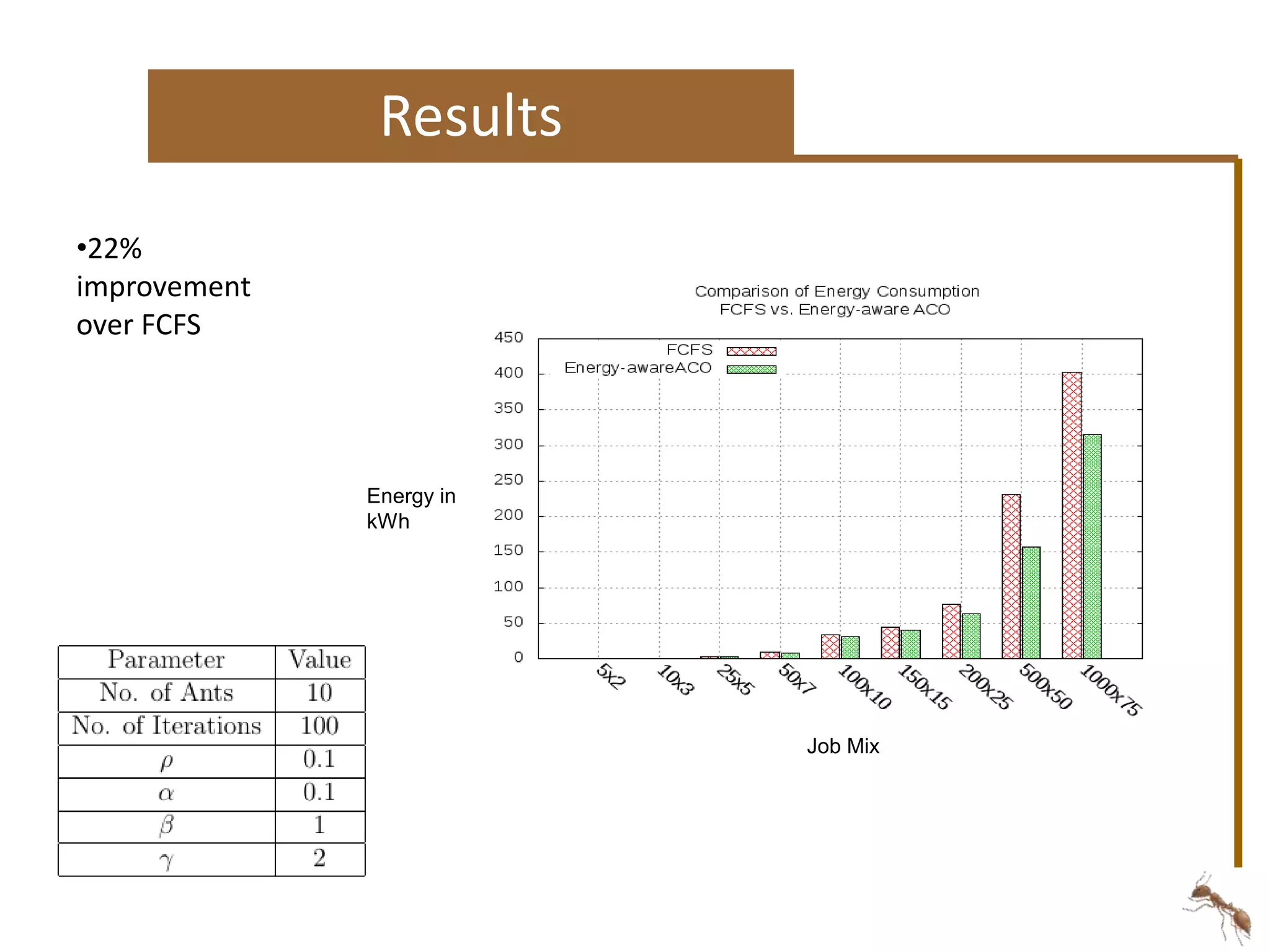
Results 
•22% 
improvement 
over FCFS 
Energy in 
kWh 
Job Mix
Conclusion 
•In this project, a new task scheduling algorithm 
using Ant-colony optimization that reduces the 
power consumption for cloud is proposed. 
•The proposed method outperforms the existing 
method by 22% under the experimental conditions.
References 
1. Kun Li, Gaochao Xu, Guangyu Zhao, Yushuang Dong, Dan Wang, Cloud Task schedul- ing based on Load Balancing Ant 
Colony Optimization, IEEE, 2011. 
2. Marco Dorigo, Luca Maria Gambardella, Ant Colony System: A Cooperative Learning Approach to the Travelling Salesman 
Problem, IEEE Transactions, April 1997. 
3. GU Srikanth, VU Maheswari, AP Shanthi, A Siromoney, Tasks Scheduling Using Ant Colony Optimization, Journal of 
Computer Science, 2012 
4. Alberto Colorni, Marco Dorigo, Vittorio Maniezzo, Marco Trubian, Ant System for Job-shop Scheduling, Belgian Journal of 
Operations Research, 1994. 
5. Mohsen Amini Salehi, P. Radha Krishna, Krishnamurty Sai Deepak and Rajkumar Buyya, Preemption-aware Energy 
Management in Virtualized DataCenters, IEEE, 2012. 
6. Ying Chang-tian, Yi Juong, Energy Aware Task Scheduling using Genetic Algorithms, IEEE, 2012. 
7. Eugen Feller, Louis Rilling, Christine Morin, Energy-Aware Ant Colony Based Work- load Placement in Clouds, INRIA, 
IEEE/ACM Conference on Grid Computing, May 2011. 
8. ODC Alliance Carbon Footprints Values 
9. Rodrigo N. Calheiros, Rajiv Ranjan, Anton Beloglazov, C ́esar A. F. De Rose and Rajkumar Buyya, CloudSim: a toolkit for 
modeling and simulation of cloud computing environments and evaluation of resource provisioning algorithms, IEEE, 2010. 
10. JimBlythe, SonalJain, EwaDeelman, Yolanda Gil, KaranVahi, TaskSchedulingStrategies for Workflow-based Applications in 
Grids, IEEE, 2005. 
11. A. Belaglazov and R. Buyya, “Optimal Online deterministic algorithms and adapative heuristics for energy and performance 
efficient dynamic consolidation of Virtual Machines in Cloud Datacenters”, Concurrency and Computation: Practice and 
Experience, 2011. 
12. Ali, S., Siegel, H.J., Maheswaran, M., and Hensgen, D.: “Task execution time modeling for heterogeneous computing 
systems”, Proceedings of Heterogeneous Computing Workshop, pp. 185–199, 2000. 
13. T. Guerot, Thiery Monteil, Georges Da Costa, Rodrigo Neves Calheiros, Rajkumar Buyya, Mihai Alexandro, Energy-Aware 
Simulation Using Dvfs,Simulation Modelling Practice And Theory, Elsevier 2013. 
14. Josep Ll. Berral, à ñIgo Goiri, Ramã³N Nou, Ferran Juliã , Jordi Guitart, Ricard Gavaldã , Jordi Torres, Towards Energy- 
Aware Scheduling In Data Centers Using Machine Learning, In Proceedings Of The First International Conference Oon 
Energy-Efficient Computing And Networking, Acm 2010. 
15. Armel Esnault, Eugen Feller, Christine Morin, Energy-Aware Distributed Ant Colony Based Vm Consolidation In Iaas 
Cloud,Simulation Modelling Practice And Theory, Elsevier 2013. 
16. Rodrigo N. Calheiros, Rajiv Ranjan, Anton Beloglazov, Cesar A. F. De Rose, and Rajkumar Buyya, “CloudSim: A Toolkit for 
Modeling and Simulation of Cloud Computing Environments and Evaluation of Resource Provisioning Algorithms”, Software: 
Practice and Experience, Volume 41, Number 1, Pages: 23-50, ISSN: 0038-0644, Wiley Press, New York, USA, January 
2011. 
17. http://www.energy.wsu.edu/Documents/Data%20Center%20Energy%20Savings_Feb2013.pdf at 2.19 pm IST, April 30, 2014
Thank You

Energy-aware Task Scheduling using Ant-colony Optimization in cloud

  • 1.
    Energy Aware TaskScheduling using Ant Colony Optimization in Cloud Linda . J, Ananthanarayana V.S. NITK Surathkal
  • 2.
    Agenda •Introduction •Needfor Task Scheduling & Energy Awareness •Problem Statement & Objective •Proposed Solution & Methodology •Results •Conclusion
  • 3.
    Cloud Computing •“BURST”(Sudden increase or decrease) natured Web application demands affected the business. •Cloud Computing provided the solution via different service models like, •IaaS, PaaS, SaaS •Deployment Models Public, Private & Hybrid Cloud •Cloud computing is a model for enabling ubiquitous, convenient, on-demand access to a shared pool of resources.
  • 4.
    Need for EnergyAwareness in Task Scheduling •Many users access Virtual Machines everyday. •Efficient Task Scheduling Algorithms are required to increase profit for the cloud providers. •Consequently, Servers are always ON thereby increasing the Total Energy Consumption. •There arises a need to reduce the energy consumption in datacenters.
  • 5.
    Task Scheduling •Scheduling[3] the n tasks (T1, T2,…,Tn) to m Virtual Machines (VM1, VM2,…,VMm) running on p Physical hosts (P1, P2,…,Pp) in such a way that maximum completion time or makespan of these n tasks will be minimized. •n>m>p
  • 6.
    Requirements of Energy-awareScheduler •To go through all possible (Task,VM) pairs so as to reduce the makespan. •To go through the Total Energy Consumption in all the hosts.
  • 7.
    Problem Statement •TheProblem is to design a Energy-aware Task Scheduling Algorithm. •Objective: –To design a Task scheduling Algorithm. –To add the Energy Awareness factor to the technique. –To compare the Energy-aware Algorithm with existing algorithms.
  • 8.
    Proposed Solution •AntColony Optimization for Task Scheduling
  • 9.
    System Model •Cloudsim[16] •CIS registry hold information about the resources •Scheduler (or Broker) is enhanced to be an energy-aware scheduler
  • 10.
    System Model •LPModel (Based on [13]) •ϕ = CPU Utilization •Pidle = Power when CPU is idle •Pmax = Power when CPU is fully utilized •RT Model (Based on [12] ) •The Expected Time to Compute is given by •Wi = Workload •CCj = Computing Capacity
  • 11.
    Methodology Initial Pheromone Task Rule •An ant randomly samples a task node from the list of task nodes yet to visit J’k
  • 12.
    Methodology contd. VMRule • An ant k positioned at task node r, selects a VM node s, by η(r,s) = inverse of makespan till s, 1/ CTmax Vk = list of visited VM nodes Θ(v) = Completion time of last Job in v β is a parameter which determines the importance of pheromone.
  • 13.
    Methodology contd. GlobalUpdation Rule •Once all ants have built their tours, pheromone is updated on all edges according to, α is a pheromone decay parameter. Δτ(r,s)= 1/Lk , Lk is the length of the tour performed by ant k and m is the no. of ants. Local Updation Rule •While building a solution (i.e., a tour), ants visit edges and change their pheromone level by applying the local updating rule shown below.
  • 14.
    Energy-awareness VM Rule Where ω(r,s)= inverse of total power consumed in hosts μ(h) = power consumed in host h γ is a parameter which determines the importance of power consumption
  • 15.
  • 16.
    Results •22% improvement over FCFS Energy in kWh Job Mix
  • 17.
    Conclusion •In thisproject, a new task scheduling algorithm using Ant-colony optimization that reduces the power consumption for cloud is proposed. •The proposed method outperforms the existing method by 22% under the experimental conditions.
  • 18.
    References 1. KunLi, Gaochao Xu, Guangyu Zhao, Yushuang Dong, Dan Wang, Cloud Task schedul- ing based on Load Balancing Ant Colony Optimization, IEEE, 2011. 2. Marco Dorigo, Luca Maria Gambardella, Ant Colony System: A Cooperative Learning Approach to the Travelling Salesman Problem, IEEE Transactions, April 1997. 3. GU Srikanth, VU Maheswari, AP Shanthi, A Siromoney, Tasks Scheduling Using Ant Colony Optimization, Journal of Computer Science, 2012 4. Alberto Colorni, Marco Dorigo, Vittorio Maniezzo, Marco Trubian, Ant System for Job-shop Scheduling, Belgian Journal of Operations Research, 1994. 5. Mohsen Amini Salehi, P. Radha Krishna, Krishnamurty Sai Deepak and Rajkumar Buyya, Preemption-aware Energy Management in Virtualized DataCenters, IEEE, 2012. 6. Ying Chang-tian, Yi Juong, Energy Aware Task Scheduling using Genetic Algorithms, IEEE, 2012. 7. Eugen Feller, Louis Rilling, Christine Morin, Energy-Aware Ant Colony Based Work- load Placement in Clouds, INRIA, IEEE/ACM Conference on Grid Computing, May 2011. 8. ODC Alliance Carbon Footprints Values 9. Rodrigo N. Calheiros, Rajiv Ranjan, Anton Beloglazov, C ́esar A. F. De Rose and Rajkumar Buyya, CloudSim: a toolkit for modeling and simulation of cloud computing environments and evaluation of resource provisioning algorithms, IEEE, 2010. 10. JimBlythe, SonalJain, EwaDeelman, Yolanda Gil, KaranVahi, TaskSchedulingStrategies for Workflow-based Applications in Grids, IEEE, 2005. 11. A. Belaglazov and R. Buyya, “Optimal Online deterministic algorithms and adapative heuristics for energy and performance efficient dynamic consolidation of Virtual Machines in Cloud Datacenters”, Concurrency and Computation: Practice and Experience, 2011. 12. Ali, S., Siegel, H.J., Maheswaran, M., and Hensgen, D.: “Task execution time modeling for heterogeneous computing systems”, Proceedings of Heterogeneous Computing Workshop, pp. 185–199, 2000. 13. T. Guerot, Thiery Monteil, Georges Da Costa, Rodrigo Neves Calheiros, Rajkumar Buyya, Mihai Alexandro, Energy-Aware Simulation Using Dvfs,Simulation Modelling Practice And Theory, Elsevier 2013. 14. Josep Ll. Berral, à ñIgo Goiri, Ramã³N Nou, Ferran Juliã , Jordi Guitart, Ricard Gavaldã , Jordi Torres, Towards Energy- Aware Scheduling In Data Centers Using Machine Learning, In Proceedings Of The First International Conference Oon Energy-Efficient Computing And Networking, Acm 2010. 15. Armel Esnault, Eugen Feller, Christine Morin, Energy-Aware Distributed Ant Colony Based Vm Consolidation In Iaas Cloud,Simulation Modelling Practice And Theory, Elsevier 2013. 16. Rodrigo N. Calheiros, Rajiv Ranjan, Anton Beloglazov, Cesar A. F. De Rose, and Rajkumar Buyya, “CloudSim: A Toolkit for Modeling and Simulation of Cloud Computing Environments and Evaluation of Resource Provisioning Algorithms”, Software: Practice and Experience, Volume 41, Number 1, Pages: 23-50, ISSN: 0038-0644, Wiley Press, New York, USA, January 2011. 17. http://www.energy.wsu.edu/Documents/Data%20Center%20Energy%20Savings_Feb2013.pdf at 2.19 pm IST, April 30, 2014
  • 19.