
Development of Efficient and Effective Strategic
Methodology for Task Scheduling in Cloud Computing
1
Supervised By:
Prof Dr.
Yu Jiong
Dean Of The Graduate School Of Software
Engineering Xinjiang University
Prepared By:
Qutub-ud-din
Enrolled In Master Degree
Registration #
Department Of Software Engineering
Outline:
 What is Cloud.
 Introduction to Cloud Computing.
 Introduction to scheduling.
 Literature Review.
 Problem Statement.
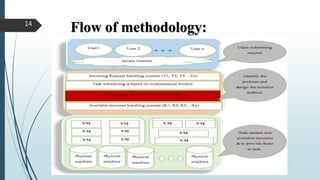
 Flow of methodology.
 References.
2
What is Cloud.3
 cloud is representing a technology
where the user can store data,
without user own storing device.
User have Privileges to manage
Stored data remotely anywhere
and anytime in the world through
the internet.
Introduction to Cloud Computing:4
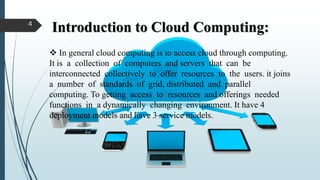
 In general cloud computing is to access cloud through computing.
It is a collection of computers and servers that can be
interconnected collectively to offer resources to the users. it joins
a number of standards of grid, distributed and parallel
computing. To getting access to resources and offerings needed
functions in a dynamically changing environment. It have 4
deployment models and have 3 service models.
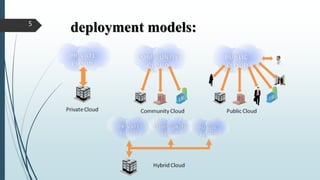
deployment models:5
deployment models:
Private Cloud: Data center architecture owned by a single
company. Eg: IBM’s Blue Cloud, Sun Cloud, Window Azure.
Community Cloud: infrastructure shared with several
organizations.
Public Cloud: It is basically the internet. Service provider use
internet to make resource available to general people. Eg:
Gmail, Office 365, Dropbox.
Hybrid Cloud: For instance during peak periods individual
applications, or portion of applications can be migrate to the
public cloud.
6
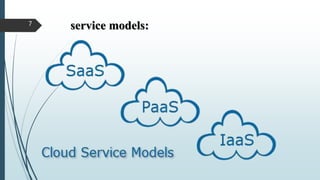
service models:7
service models:
Software as a Service: Application is hosted on the cloud as
a service to the customers
Platform as as a Service: provides platform including
operating system, programming language, execution
environment, and web server to developer such that they
can develop and deploy applications.
Infrastructure as a Service: Provide, manage and control
the underlying infrastructure including data storage, network
resources and computing servers.
8
Introduction to scheduling:
scheduling is assigning jobs or tasks to appropriate machine to
be executed the task.
task scheduling, manage the resource allocation to the task in
cloud environment. Task scheduling is key part in cloud
computing to improve the whole performance of cloud
computing.
In traditional task scheduling are at physical level but now it
preform at two level physical and virtual machine level.
task scheduling have two type static and dynamic scheduling.
9
Literature Review:10
Marios D. Dikaiakos et al,
Concept of organization of
Distributed Internet
Computing as Public Utility
Addressed the several
significant problems and
unexploited opportunities
concerning the deployment,
efficient operations and use
of cloud computing
infrastructures [1].
Dr. Sudha et al,
proposed the efficient two
level scheduler (user centric
meta-scheduler for selection
of resources and system
centric VM scheduler for
dispatching jobs) in cloud
computing environment
based on QoS. [2].
Literature Review.11
Sandeep Tayal et al,
proposed an algorithm based
on Fuzzy-GA optimization
which evaluates the entire
group of tasks in a job queue
on basis of prediction of
execution time of tasks
assigned to certain processors
and makes the scheduling
decision [4].
In 2011
Laiping Zhao et al,
proposed DRR (Deadline,
Reliability, and Resource-
aware) scheduling algorithm,
which schedules the tasks
such that all the jobs can be
completed before the
deadline, ensuring the
Reliability [5].
Literature Review.12
Ekta S. Mathukiya et al,
introduce multi-objective
task scheduling algorithm for
optimization of throughput,
performs non-dominated
sorting for ordering of tasks
and aim of this research is to
prove the effectiveness of the
optimization method [7].
In 2015
Xiao-long Zheng et al,
Proposed Pareto based fruit
fly optimization algorithm
(PFOA) to solve the task
scheduling and resource
allocating problem in cloud
computing its property is to
minimum cost initialize
population, generator non-
dominated solution and
critical path operator to
improve exploitation [8].
Problem Statement:13
 To reduce cost of the task.
 To minimize the time or makespan of the task.
 Maximize the resource utilization or allocation
in cloud computing.
Flow of methodology:14
References:
[1]. Dikaiakos, M., katsaros, D., Mehra, P., Vakali, A.: ―Cloud Computing: Distributed Internet
Computing for IT and Scientific Research‖. In:IEEE Transactions on Internet Computing 13(5), pp. 10-
13 (2009).
[2]. Sadhasivam, S.,Nagaveni, N.: ―Design and Implementation of an efficient Two-level Scheduler for
Cloud Computing Environment‖. In: International Conference on Advances in Recent Technologies in
Communication and Computing, pp. 884-886 (IEEE 2009).
[3]. Van den Bossche, R., Vanmechelen, K., Broeckhove, J.: ―Cost Optimal Scheduling in Hybrid IaaS
Clouds for Deadline Constrained Workloads. In: 3rd IEEE International Conference on Cloud
Computing, Miami (July 2010).
[4]. Tayal, S.: ―Tasks Scheduling Optimization for the Cloud Computing Systems‖. In: (IJAEST)
International Journal of Advanced Engineering Sciences and Technologies, vol. 5, Issue No.2, pp. 111-
115 (2011).
[5]. Zhao, L., Ren, Y., Sakurai, K.: ―A Resource Minimizing Scheduling Algorithm with Ensuring the
Deadline and Reliability in Heterogeneous Systems‖. In: International Conference on Advance
Information Networking and Applications, AINA.( IEEE 2011).
15
References:
[6]. Daji Ergu •Gang Kou • Yi Peng • Yong Shi • Yu Shi, The analytic hierarchy process: task scheduling
and resource allocation in cloud computing environment, The Journal of supercomputing, June 2013,
Volume 64, Issue 3, pp 835–848.
[7]. Ekta S. Mathukiya, Piyush V. Gohel. "Efficient Qos Based Tasks Scheduling usingMulti-Objective
Optimization for Cloud Computing"International Journal of Innovative Research in Computer and
Communication Engineering Vol. 3, Issue 8, August 2015.
[8]. Xiao-long Zheng, Ling Wang, “A Pareto based fruit fly optimization algorithm for task scheduling and
resource allocation in cloud computing environment”, IEEE Congress on Evolutionary Computation
(CEC), 2016.
[9]. Elhossiny Ibrahim, Fatma A. Omara "Task Scheduling Algorithm in Cloud Computing Environment
Based on Cloud Pricing Models" 2016 IEEE.
16
Thanks
17

Task Scheduling methodology in cloud computing

  • 1.
    Development of Efficientand Effective Strategic Methodology for Task Scheduling in Cloud Computing 1 Supervised By: Prof Dr. Yu Jiong Dean Of The Graduate School Of Software Engineering Xinjiang University Prepared By: Qutub-ud-din Enrolled In Master Degree Registration # Department Of Software Engineering
  • 2.
    Outline:  What isCloud.  Introduction to Cloud Computing.  Introduction to scheduling.  Literature Review.  Problem Statement.  Flow of methodology.  References. 2
  • 3.
    What is Cloud.3 cloud is representing a technology where the user can store data, without user own storing device. User have Privileges to manage Stored data remotely anywhere and anytime in the world through the internet.
  • 4.
    Introduction to CloudComputing:4  In general cloud computing is to access cloud through computing. It is a collection of computers and servers that can be interconnected collectively to offer resources to the users. it joins a number of standards of grid, distributed and parallel computing. To getting access to resources and offerings needed functions in a dynamically changing environment. It have 4 deployment models and have 3 service models.
  • 5.
  • 6.
    deployment models: Private Cloud:Data center architecture owned by a single company. Eg: IBM’s Blue Cloud, Sun Cloud, Window Azure. Community Cloud: infrastructure shared with several organizations. Public Cloud: It is basically the internet. Service provider use internet to make resource available to general people. Eg: Gmail, Office 365, Dropbox. Hybrid Cloud: For instance during peak periods individual applications, or portion of applications can be migrate to the public cloud. 6
  • 7.
  • 8.
    service models: Software asa Service: Application is hosted on the cloud as a service to the customers Platform as as a Service: provides platform including operating system, programming language, execution environment, and web server to developer such that they can develop and deploy applications. Infrastructure as a Service: Provide, manage and control the underlying infrastructure including data storage, network resources and computing servers. 8
  • 9.
    Introduction to scheduling: schedulingis assigning jobs or tasks to appropriate machine to be executed the task. task scheduling, manage the resource allocation to the task in cloud environment. Task scheduling is key part in cloud computing to improve the whole performance of cloud computing. In traditional task scheduling are at physical level but now it preform at two level physical and virtual machine level. task scheduling have two type static and dynamic scheduling. 9
  • 10.
    Literature Review:10 Marios D.Dikaiakos et al, Concept of organization of Distributed Internet Computing as Public Utility Addressed the several significant problems and unexploited opportunities concerning the deployment, efficient operations and use of cloud computing infrastructures [1]. Dr. Sudha et al, proposed the efficient two level scheduler (user centric meta-scheduler for selection of resources and system centric VM scheduler for dispatching jobs) in cloud computing environment based on QoS. [2].
  • 11.
    Literature Review.11 Sandeep Tayalet al, proposed an algorithm based on Fuzzy-GA optimization which evaluates the entire group of tasks in a job queue on basis of prediction of execution time of tasks assigned to certain processors and makes the scheduling decision [4]. In 2011 Laiping Zhao et al, proposed DRR (Deadline, Reliability, and Resource- aware) scheduling algorithm, which schedules the tasks such that all the jobs can be completed before the deadline, ensuring the Reliability [5].
  • 12.
    Literature Review.12 Ekta S.Mathukiya et al, introduce multi-objective task scheduling algorithm for optimization of throughput, performs non-dominated sorting for ordering of tasks and aim of this research is to prove the effectiveness of the optimization method [7]. In 2015 Xiao-long Zheng et al, Proposed Pareto based fruit fly optimization algorithm (PFOA) to solve the task scheduling and resource allocating problem in cloud computing its property is to minimum cost initialize population, generator non- dominated solution and critical path operator to improve exploitation [8].
  • 13.
    Problem Statement:13  Toreduce cost of the task.  To minimize the time or makespan of the task.  Maximize the resource utilization or allocation in cloud computing.
  • 14.
  • 15.
    References: [1]. Dikaiakos, M.,katsaros, D., Mehra, P., Vakali, A.: ―Cloud Computing: Distributed Internet Computing for IT and Scientific Research‖. In:IEEE Transactions on Internet Computing 13(5), pp. 10- 13 (2009). [2]. Sadhasivam, S.,Nagaveni, N.: ―Design and Implementation of an efficient Two-level Scheduler for Cloud Computing Environment‖. In: International Conference on Advances in Recent Technologies in Communication and Computing, pp. 884-886 (IEEE 2009). [3]. Van den Bossche, R., Vanmechelen, K., Broeckhove, J.: ―Cost Optimal Scheduling in Hybrid IaaS Clouds for Deadline Constrained Workloads. In: 3rd IEEE International Conference on Cloud Computing, Miami (July 2010). [4]. Tayal, S.: ―Tasks Scheduling Optimization for the Cloud Computing Systems‖. In: (IJAEST) International Journal of Advanced Engineering Sciences and Technologies, vol. 5, Issue No.2, pp. 111- 115 (2011). [5]. Zhao, L., Ren, Y., Sakurai, K.: ―A Resource Minimizing Scheduling Algorithm with Ensuring the Deadline and Reliability in Heterogeneous Systems‖. In: International Conference on Advance Information Networking and Applications, AINA.( IEEE 2011). 15
  • 16.
    References: [6]. Daji Ergu•Gang Kou • Yi Peng • Yong Shi • Yu Shi, The analytic hierarchy process: task scheduling and resource allocation in cloud computing environment, The Journal of supercomputing, June 2013, Volume 64, Issue 3, pp 835–848. [7]. Ekta S. Mathukiya, Piyush V. Gohel. "Efficient Qos Based Tasks Scheduling usingMulti-Objective Optimization for Cloud Computing"International Journal of Innovative Research in Computer and Communication Engineering Vol. 3, Issue 8, August 2015. [8]. Xiao-long Zheng, Ling Wang, “A Pareto based fruit fly optimization algorithm for task scheduling and resource allocation in cloud computing environment”, IEEE Congress on Evolutionary Computation (CEC), 2016. [9]. Elhossiny Ibrahim, Fatma A. Omara "Task Scheduling Algorithm in Cloud Computing Environment Based on Cloud Pricing Models" 2016 IEEE. 16
  • 17.