Area

Cloud Computing
Guided By
Prof. Chaitali Chandankhade
Presented By
Ms.Samruddhi Wagh
ME(IT)12418

MIT COLLEGE OF ENGINEERING KOTHRUD PUNE
Agenda
• Cloud Computing
• Job Sequence Scheduling
•Virtualization
• Energy Conservation for Data Centers
• Network Security And Protection
Cloud Computing
• Cloud Computing is the on demand network access

to shared pool or computing resources such as:
•
•
•
•
•

Network
Server
Storage
Application
Services
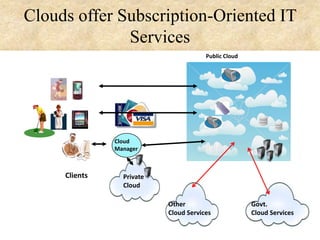
Clouds offer Subscription-Oriented IT
Services
Public Cloud

Cloud
Manager

Clients

Private
Cloud

Other
Cloud Services

Govt.
Cloud Services
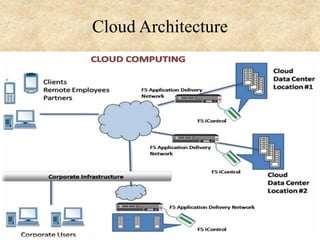
Cloud Architecture
Deployment Models
• Four deployment models of cloud computing:
•
•
•
•

Public Cloud
Community Cloud
Hybrid Cloud
Private Cloud
Service Models
• Three service models of cloud computing:
•
•
•

Cloud Infrastructure as a Service
Cloud Software as a Service
Cloud Platform as a Service
Characteristics
• On-demand self-service

• Broad network access
• Resource pooling
• Rapid elasticity
• Measured service
Job Sequence Scheduling
• Map and Reduce
•

Reduce perform three steps:
•
•
•

•

Copy
Sort
Reduce

Hadoop Distributed File System(HDFS)
•
•

Reliability
Fault Tolerance

• Resource Estimation Model
Job Sequence Scheduling Through
Virtualization
• Resource Configuration
•
•
•
•

Configuration Manager(CM)
Machine Manager(MM)
Release Queue(RQ)
Assign Queue(AQ)

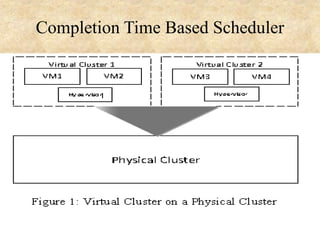
• Completion Time Based Scheduler
•
•

Virtual Cluster
Physical Cluster
Completion Time Based Scheduler
Virtualization
• Flexibility and Energy conservation
• Datacenter Automation and Management
• Cloud Interoperability
• Enterprise Datacenter to Cloud Migrations
• Capacity Planning
• Detecting Compromised Virtual Machines
• Virtual Network Access Control
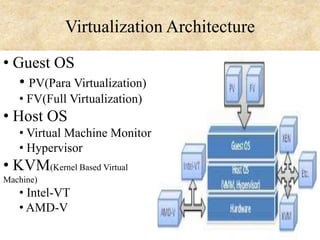
Virtualization Architecture
• Guest OS
• PV(Para Virtualization)
• FV(Full Virtualization)

• Host OS
• Virtual Machine Monitor
• Hypervisor

• KVM(Kernel Based Virtual
Machine)

• Intel-VT
• AMD-V
Energy Conservation for Datacenters
• Economy of scale due to elimination of
redundancies
• Efficient resource management by the Cloud
provider
• Improved utilization of the resources
• Location independence
• Scaling up and down
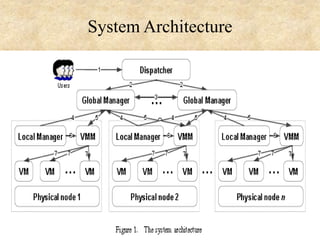
System Architecture
Network Security and Protection
• Cloud computing is the next generation of Network
computing
• The Security of Virtual Network in virtualization
environment
• Xen platform
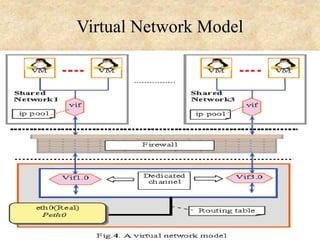
• Virtual Network Model
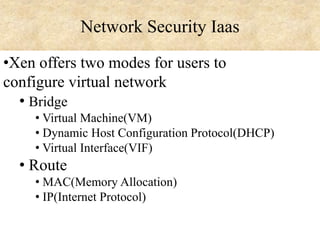
Network Security Iaas
•Xen offers two modes for users to
configure virtual network
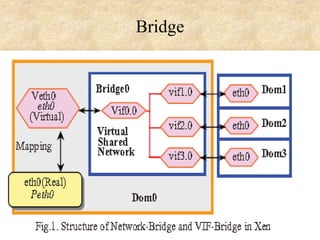
• Bridge
• Virtual Machine(VM)
• Dynamic Host Configuration Protocol(DHCP)
• Virtual Interface(VIF)

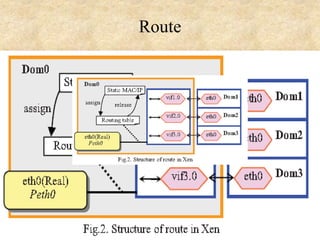
• Route
• MAC(Memory Allocation)
• IP(Internet Protocol)
Bridge
Route
Virtual Network Model
Conclusion
• To reduce energy consumption of data centers one
can consolidate computation workloads of jobs onto a
minimum subset of servers
• To improve the security of the inter-communication
among virtual machines Can be deployed in any
physical server that supports virtualization
• To maintain flexibility and Energy Conservation
References
• Anton Beloglazov and Rajkumar Buyya. Energy efficient
resource management in virtualized cloud data centers. In
Proceedings of the 2010 10th IEEE/ACM International Conference
on Cluster, Cloud and Grid Computing, CCGRID
’10, pages 826–831, Washington, DC, USA, 2010. IEEE
Computer
•Amazon Elastic Compute Cloud (Amazon EC2),
http://aws.amazon.com/ec2/. Society.
•Xen credit scheduler. http://wiki.xen.org/wiki/Credit_Scheduler.
• J. Wolf, et al. FLEX: A Slot Allocation Scheduling Optimizer for MapReduce
Workloads. In Procof Middleware’2010.
•VMsafe: A Security Technology for Virtualized Environments,
http://www.vmware.com/overview/security/vmsafe
Thank You !!
Any Q ?

Job sequence scheduling for cloud computing

  • 1.
  • 2.
    Guided By Prof. ChaitaliChandankhade Presented By Ms.Samruddhi Wagh ME(IT)12418 MIT COLLEGE OF ENGINEERING KOTHRUD PUNE
  • 3.
    Agenda • Cloud Computing •Job Sequence Scheduling •Virtualization • Energy Conservation for Data Centers • Network Security And Protection
  • 4.
    Cloud Computing • CloudComputing is the on demand network access to shared pool or computing resources such as: • • • • • Network Server Storage Application Services
  • 5.
    Clouds offer Subscription-OrientedIT Services Public Cloud Cloud Manager Clients Private Cloud Other Cloud Services Govt. Cloud Services
  • 6.
  • 7.
    Deployment Models • Fourdeployment models of cloud computing: • • • • Public Cloud Community Cloud Hybrid Cloud Private Cloud
  • 8.
    Service Models • Threeservice models of cloud computing: • • • Cloud Infrastructure as a Service Cloud Software as a Service Cloud Platform as a Service
  • 9.
    Characteristics • On-demand self-service •Broad network access • Resource pooling • Rapid elasticity • Measured service
  • 10.
    Job Sequence Scheduling •Map and Reduce • Reduce perform three steps: • • • • Copy Sort Reduce Hadoop Distributed File System(HDFS) • • Reliability Fault Tolerance • Resource Estimation Model
  • 11.
    Job Sequence SchedulingThrough Virtualization • Resource Configuration • • • • Configuration Manager(CM) Machine Manager(MM) Release Queue(RQ) Assign Queue(AQ) • Completion Time Based Scheduler • • Virtual Cluster Physical Cluster
  • 12.
  • 13.
    Virtualization • Flexibility andEnergy conservation • Datacenter Automation and Management • Cloud Interoperability • Enterprise Datacenter to Cloud Migrations • Capacity Planning • Detecting Compromised Virtual Machines • Virtual Network Access Control
  • 14.
    Virtualization Architecture • GuestOS • PV(Para Virtualization) • FV(Full Virtualization) • Host OS • Virtual Machine Monitor • Hypervisor • KVM(Kernel Based Virtual Machine) • Intel-VT • AMD-V
  • 15.
    Energy Conservation forDatacenters • Economy of scale due to elimination of redundancies • Efficient resource management by the Cloud provider • Improved utilization of the resources • Location independence • Scaling up and down
  • 16.
  • 17.
    Network Security andProtection • Cloud computing is the next generation of Network computing • The Security of Virtual Network in virtualization environment • Xen platform • Virtual Network Model
  • 18.
    Network Security Iaas •Xenoffers two modes for users to configure virtual network • Bridge • Virtual Machine(VM) • Dynamic Host Configuration Protocol(DHCP) • Virtual Interface(VIF) • Route • MAC(Memory Allocation) • IP(Internet Protocol)
  • 19.
  • 20.
  • 21.
  • 22.
    Conclusion • To reduceenergy consumption of data centers one can consolidate computation workloads of jobs onto a minimum subset of servers • To improve the security of the inter-communication among virtual machines Can be deployed in any physical server that supports virtualization • To maintain flexibility and Energy Conservation
  • 23.
    References • Anton Beloglazovand Rajkumar Buyya. Energy efficient resource management in virtualized cloud data centers. In Proceedings of the 2010 10th IEEE/ACM International Conference on Cluster, Cloud and Grid Computing, CCGRID ’10, pages 826–831, Washington, DC, USA, 2010. IEEE Computer •Amazon Elastic Compute Cloud (Amazon EC2), http://aws.amazon.com/ec2/. Society. •Xen credit scheduler. http://wiki.xen.org/wiki/Credit_Scheduler. • J. Wolf, et al. FLEX: A Slot Allocation Scheduling Optimizer for MapReduce Workloads. In Procof Middleware’2010. •VMsafe: A Security Technology for Virtualized Environments, http://www.vmware.com/overview/security/vmsafe
  • 24.