PERSONALITY :-
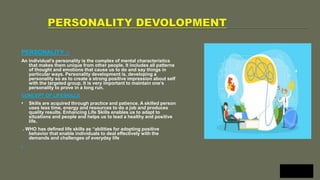
An individual’s personality is the complex of mental characteristics
that makes them unique from other people. It includes all patterns
of thought and emotions that cause us to do and say things in
particular ways. Personality development is, developing a
personality so as to create a strong positive impression about self
with the targeted group. It is very important to maintain one’s
personality to prove in a long run.
CONCEPT OF LIFESKILLS
• Skills are acquired through practice and patience. A skilled person
uses less time, energy and resources to do a job and produces
quality results. Enhancing Life Skills enables us to adapt to
situations and people and helps us to lead a healthy and positive
life.
. WHO has defined life skills as “abilities for adopting positive
behavior that enable individuals to deal effectively with the
demands and challenges of everyday life
-
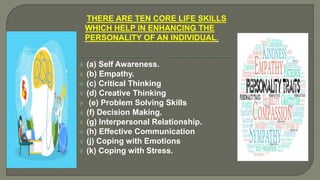
THERE ARE TEN CORE LIFE SKILLS
WHICH HELP IN ENHANCING THE
PERSONALITY OF AN INDIVIDUAL.
 (a) Self Awareness.
 (b) Empathy.
 (c) Critical Thinking
 (d) Creative Thinking
 (e) Problem Solving Skills
 (f) Decision Making.
 (g) Interpersonal Relationship.
 (h) Effective Communication
 (j) Coping with Emotions
 (k) Coping with Stress.
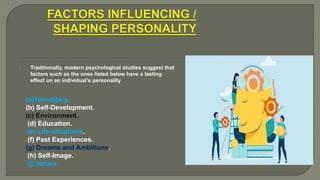
1. Traditionally, modern psychological studies suggest that
factors such as the ones listed below have a lasting
effect on an individual’s personality
(a)Hereditary.
(b) Self-Development.
(c) Environment.
(d) Education.
(e) Life-situations.
(f) Past Experiences.
(g) Dreams and Ambitions.
(h) Self-Image.
(j) Values.
 Hereditary. Your personality can be influenced by the genes you may have inherited from either your
mother’s or your father’s side or a combination of both. Apart from inheriting physical attributes, like
height, weight and skin/hair color, psychologists have ascertained that our mental aptitudes and
temperaments which have the potential for influencing our personality are to a certain extent,
hereditary.
 Self-Development. Of the other factors, self-development is the most important factor that can
influence one’s personality. Self-awareness is the key; it entails believing in oneself and one’s
capabilities. It implies that despite one’s family and environmental background or one’s current
circumstance, one remains in control/charge of molding his/her personality. Such a person is aware
that personality is a changing, evolving process and does everything possible to enhance his/her
personality.
 Environment. Our environment can also play a significant role on our personality. Right from early
childhood through all the stages of development, our home and family, our school and teachers, our
friends and colleagues at work, all exert influence on the development of our personality. Besides
these, the location where we live and the society we associate with, the country of our birth and the
culture we have adopted, are all critical factors that influence our personality
 .. Education. Education falls into two categories; school smarts and street smarts. Thus, the most
effective way of shaping one’s personality is to have a taste of both types and experience both worlds.
School smarts are the knowledge gained from school while street smarts are the learning that come
from even the most unlikely sources.
FACTORS INFLUENCING / SHAPING PERSONALITY
 .Dreams and Ambitions. Dreams and
ambitions shape our personality in a way that it facilitates
our goals. We start to set priorities and change the way we
are in order for such priorities to be fulfilled. Hence, these
aspirations are perhaps the strongest factors that develop
our attitude towards work and career.
 . Values. Personality of an individual is greatly influenced
by the values a person strongly believes in. A person who
adheres to high moral standards is a well-respected member of
the society. He is known for his integrity and is trusted by not
only his family members, but also by his colleagues and friends.
The characteristics of such a person having a strong moral fibre
ingrained into his character can have a significant influence on
the personality of an individual.
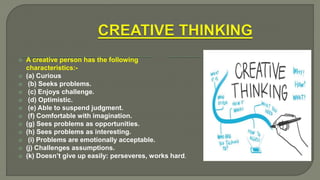
 A creative person has the following
characteristics:-
 (a) Curious
 (b) Seeks problems.
 (c) Enjoys challenge.
 (d) Optimistic.
 (e) Able to suspend judgment.
 (f) Comfortable with imagination.
 (g) Sees problems as opportunities.
 (h) Sees problems as interesting.
 (i) Problems are emotionally acceptable.
 (j) Challenges assumptions.
 (k) Doesn’t give up easily: perseveres, works hard.
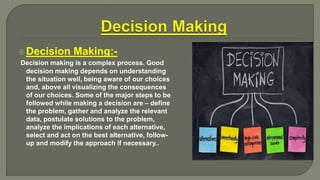
Decision Making:-
Decision making is a complex process. Good
decision making depends on understanding
the situation well, being aware of our choices
and, above all visualizing the consequences
of our choices. Some of the major steps to be
followed while making a decision are – define
the problem, gather and analyze the relevant
data, postulate solutions to the problem,
analyze the implications of each alternative,
select and act on the best alternative, follow-
up and modify the approach if necessary..
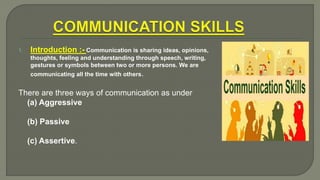
1. Introduction :- Communication is sharing ideas, opinions,
thoughts, feeling and understanding through speech, writing,
gestures or symbols between two or more persons. We are
communicating all the time with others.
There are three ways of communication as under
(a) Aggressive
(b) Passive
(c) Assertive.
Effective Communication involves:-
 (a) Verbal Communication
 . (b) Non-Verbal Communication
 (c) Listening
 Reducing the Communication Gap. The
following steps will help in reducing the
communication gap:-
 (a) Plan ahead.
 (b) Involve others to contribute to planning
 . (c) Listen to the suggestions made by
others.
 (d) Speak with purpose and be specific.
 (e) Justify your stand without upsetting
others. (f) Have sense of humor
 . (g) Have empathy.
 (h) Do not be judgmental.
 (j) Do not underestimate the ability of others
to contribute
 . (k) Observe the body language or the non-
verbal communication of others.
 (l) Be transparent to inform others of the
planned activities and get feedback.
 (m) Make modification in the plan to suit the
need
 . (n) The words ‘yes’ and ‘no’ are very
powerful. Learn to use them appropriately
 Introduction
. Stress is a very common phenomenon and is universal
in nature. It is our body’s reaction to people and events
and to our own thoughts.
Stress Management Techniques
(a) Take Deep Breath
(b) Talk It Out.
(c) Take A Break.
(d) Create A Quiet Place in Your Mind
(e) Pay Attention to Physical Comfort. (f) Move
(f) Take Care of your Body
(g) Laugh.
(h) Manage your Time
(i) Know your Limits.
(j) Have a Good Cry.
(k) Talk Less, Listen More.
 How to Change Your Mindset
 Get the Best Information
 Only Role Model the Best People.
 Examine Your Current Beliefs
 Shape Your Mindset with Vision and
Goals
 Protect Your Mindset
 Find Your Voice
 Put an End to Perfectionism
 Look at the Evidence
 Redefine What Failure Means
 Stop Worrying about What “People”
Think.
 There are some basic principles
of time management
 Develop a Personal Sense of
Time.
 Identify Long-Term Goals.
 Concentrate on High Return
Activities.
 Weekly and Daily Planning.
 Make the Best Use of Your Best
Time.
 Make Use of Committed Time.
 Manage Your Health.
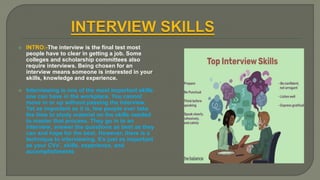
 INTRO:-The interview is the final test most
people have to clear in getting a job. Some
colleges and scholarship committees also
require interviews. Being chosen for an
interview means someone is interested in your
skills, knowledge and experience.
 Interviewing is one of the most important skills
one can have in the workplace. You cannot
move in or up without passing the interview.
Yet as important as it is, few people ever take
the time to study material on the skills needed
to master that process. They go in to an
interview, answer the questions as best as they
can and hope for the best. However, there is a
technique to interviewing. It’s just as important
as your CVs’, skills, experience, and
accomplishments
PERSONALITY DEVOLOPMENT.pptx

PERSONALITY DEVOLOPMENT.pptx

  • 2.
    PERSONALITY :- An individual’spersonality is the complex of mental characteristics that makes them unique from other people. It includes all patterns of thought and emotions that cause us to do and say things in particular ways. Personality development is, developing a personality so as to create a strong positive impression about self with the targeted group. It is very important to maintain one’s personality to prove in a long run. CONCEPT OF LIFESKILLS • Skills are acquired through practice and patience. A skilled person uses less time, energy and resources to do a job and produces quality results. Enhancing Life Skills enables us to adapt to situations and people and helps us to lead a healthy and positive life. . WHO has defined life skills as “abilities for adopting positive behavior that enable individuals to deal effectively with the demands and challenges of everyday life -
  • 3.
    THERE ARE TENCORE LIFE SKILLS WHICH HELP IN ENHANCING THE PERSONALITY OF AN INDIVIDUAL.  (a) Self Awareness.  (b) Empathy.  (c) Critical Thinking  (d) Creative Thinking  (e) Problem Solving Skills  (f) Decision Making.  (g) Interpersonal Relationship.  (h) Effective Communication  (j) Coping with Emotions  (k) Coping with Stress.
  • 4.
    1. Traditionally, modernpsychological studies suggest that factors such as the ones listed below have a lasting effect on an individual’s personality (a)Hereditary. (b) Self-Development. (c) Environment. (d) Education. (e) Life-situations. (f) Past Experiences. (g) Dreams and Ambitions. (h) Self-Image. (j) Values.
  • 5.
     Hereditary. Yourpersonality can be influenced by the genes you may have inherited from either your mother’s or your father’s side or a combination of both. Apart from inheriting physical attributes, like height, weight and skin/hair color, psychologists have ascertained that our mental aptitudes and temperaments which have the potential for influencing our personality are to a certain extent, hereditary.  Self-Development. Of the other factors, self-development is the most important factor that can influence one’s personality. Self-awareness is the key; it entails believing in oneself and one’s capabilities. It implies that despite one’s family and environmental background or one’s current circumstance, one remains in control/charge of molding his/her personality. Such a person is aware that personality is a changing, evolving process and does everything possible to enhance his/her personality.  Environment. Our environment can also play a significant role on our personality. Right from early childhood through all the stages of development, our home and family, our school and teachers, our friends and colleagues at work, all exert influence on the development of our personality. Besides these, the location where we live and the society we associate with, the country of our birth and the culture we have adopted, are all critical factors that influence our personality  .. Education. Education falls into two categories; school smarts and street smarts. Thus, the most effective way of shaping one’s personality is to have a taste of both types and experience both worlds. School smarts are the knowledge gained from school while street smarts are the learning that come from even the most unlikely sources.
  • 6.
    FACTORS INFLUENCING /SHAPING PERSONALITY  .Dreams and Ambitions. Dreams and ambitions shape our personality in a way that it facilitates our goals. We start to set priorities and change the way we are in order for such priorities to be fulfilled. Hence, these aspirations are perhaps the strongest factors that develop our attitude towards work and career.  . Values. Personality of an individual is greatly influenced by the values a person strongly believes in. A person who adheres to high moral standards is a well-respected member of the society. He is known for his integrity and is trusted by not only his family members, but also by his colleagues and friends. The characteristics of such a person having a strong moral fibre ingrained into his character can have a significant influence on the personality of an individual.
  • 7.
     A creativeperson has the following characteristics:-  (a) Curious  (b) Seeks problems.  (c) Enjoys challenge.  (d) Optimistic.  (e) Able to suspend judgment.  (f) Comfortable with imagination.  (g) Sees problems as opportunities.  (h) Sees problems as interesting.  (i) Problems are emotionally acceptable.  (j) Challenges assumptions.  (k) Doesn’t give up easily: perseveres, works hard.
  • 8.
    Decision Making:- Decision makingis a complex process. Good decision making depends on understanding the situation well, being aware of our choices and, above all visualizing the consequences of our choices. Some of the major steps to be followed while making a decision are – define the problem, gather and analyze the relevant data, postulate solutions to the problem, analyze the implications of each alternative, select and act on the best alternative, follow- up and modify the approach if necessary..
  • 9.
    1. Introduction :-Communication is sharing ideas, opinions, thoughts, feeling and understanding through speech, writing, gestures or symbols between two or more persons. We are communicating all the time with others. There are three ways of communication as under (a) Aggressive (b) Passive (c) Assertive.
  • 10.
    Effective Communication involves:- (a) Verbal Communication  . (b) Non-Verbal Communication  (c) Listening  Reducing the Communication Gap. The following steps will help in reducing the communication gap:-  (a) Plan ahead.  (b) Involve others to contribute to planning  . (c) Listen to the suggestions made by others.  (d) Speak with purpose and be specific.  (e) Justify your stand without upsetting others. (f) Have sense of humor  . (g) Have empathy.  (h) Do not be judgmental.  (j) Do not underestimate the ability of others to contribute  . (k) Observe the body language or the non- verbal communication of others.  (l) Be transparent to inform others of the planned activities and get feedback.  (m) Make modification in the plan to suit the need  . (n) The words ‘yes’ and ‘no’ are very powerful. Learn to use them appropriately
  • 11.
     Introduction . Stressis a very common phenomenon and is universal in nature. It is our body’s reaction to people and events and to our own thoughts. Stress Management Techniques (a) Take Deep Breath (b) Talk It Out. (c) Take A Break. (d) Create A Quiet Place in Your Mind (e) Pay Attention to Physical Comfort. (f) Move (f) Take Care of your Body (g) Laugh. (h) Manage your Time (i) Know your Limits. (j) Have a Good Cry. (k) Talk Less, Listen More.
  • 12.
     How toChange Your Mindset  Get the Best Information  Only Role Model the Best People.  Examine Your Current Beliefs  Shape Your Mindset with Vision and Goals  Protect Your Mindset  Find Your Voice  Put an End to Perfectionism  Look at the Evidence  Redefine What Failure Means  Stop Worrying about What “People” Think.  There are some basic principles of time management  Develop a Personal Sense of Time.  Identify Long-Term Goals.  Concentrate on High Return Activities.  Weekly and Daily Planning.  Make the Best Use of Your Best Time.  Make Use of Committed Time.  Manage Your Health.
  • 13.
     INTRO:-The interviewis the final test most people have to clear in getting a job. Some colleges and scholarship committees also require interviews. Being chosen for an interview means someone is interested in your skills, knowledge and experience.  Interviewing is one of the most important skills one can have in the workplace. You cannot move in or up without passing the interview. Yet as important as it is, few people ever take the time to study material on the skills needed to master that process. They go in to an interview, answer the questions as best as they can and hope for the best. However, there is a technique to interviewing. It’s just as important as your CVs’, skills, experience, and accomplishments