MAGNETIC
MATERIALS
MAGNETIC MATERIALS – Introduction
MAGNETIC
MATERIALS
MAGNETIC MATERIALS
• THE MATERIALS WHICH GET
EASILYMAGNETIZED IN A MAGNETIC
FIELD.
MAGNET: A DEVICE THAT ATTRACTS IRON
AND PRODUCES A MAGNETIC FIELD
MANY OF OUR MODERN
TECHNOLOGICAL DEVICES RELAY
ON MAGNETISM AND MAGNETIC
MATERIALS
POWER GENERATORS, TRANSFORMERS,
ELECTRIC MOTORS, RADIO, TELEVISION,
TELEPHONES, COMPUTERS & COMPONENTS OF
SOUND & VIDEO REPRODUCTION SYSTEMS.
i.e. H=
B
ampere m
1
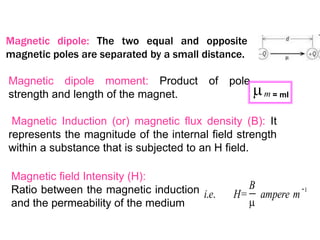
Magnetic dipole: The two equal and opposite
magnetic poles are separated by a small distance.
Magnetic dipole moment: Product of pole
strength and length of the magnet. m = ml
Magnetic Induction (or) magnetic flux density (B): It
represents the magnitude of the internal field strength
within a substance that is subjected to an H field.
Magnetic field Intensity (H):
Ratio between the magnetic induction
and the permeability of the medium
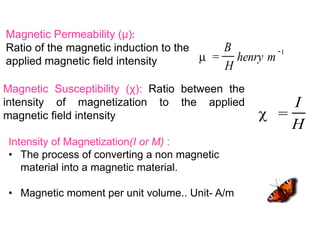
Magnetic Permeability (µ):
Ratio of the magnetic induction to the
applied magnetic field intensity
Magnetic Susceptibility (χ): Ratio between the
intensity of magnetization to the applied
magnetic field intensity
Intensity of Magnetization(I or M) :
• The process of converting a non magnetic
material into a magnetic material.
• Magnetic moment per unit volume.. Unit- A/m
=
B
H
henry m
1
=
I
H
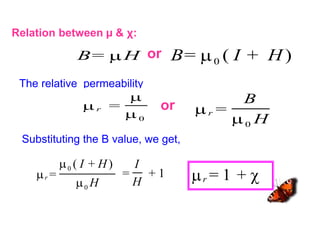
Relation between µ & χ:
B= H B= 0 ( )
I H
+
The relative permeability
or
r =
0
or r =
B
0 H
Substituting the B value, we get,
r =
0 ( )
I H
+
0 H
=
I
H
1
+ r = 1 +
CLASSIFICATION OF MAGNETIC MATERIALS
Classified into two categories,
1. Without permanent magnetic moments:
i) Diamagnetic materials
2. With permanent magnetic moments:
i) Paramagnetic materials
ii) Ferromagnetic materials
iii) Anti-Ferromagnetic materials
iv) Ferri magnetic materials
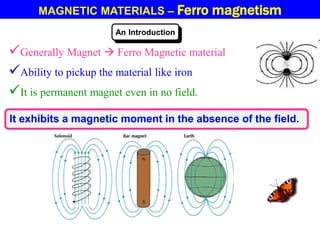
An Introduction
MAGNETIC MATERIALS – Ferro magnetism
Generally Magnet  Ferro Magnetic material
Ability to pickup the material like iron
It is permanent magnet even in no field.
It exhibits a magnetic moment in the absence of the field.
Explanation
MAGNETIC MATERIALS – Ferro magnetism
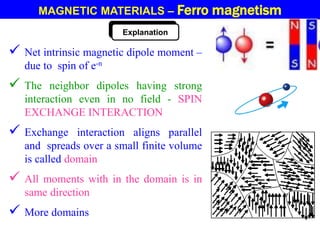
 Net intrinsic magnetic dipole moment –
due to spin of e-n
 The neighbor dipoles having strong
interaction even in no field - SPIN
EXCHANGE INTERACTION
 Exchange interaction aligns parallel
and spreads over a small finite volume
is called domain
 All moments with in the domain is in
same direction
 More domains
Properties
MAGNETIC MATERIALS – Ferro magnetism
Having spontaneous magnetization and domain structure
strongly magnetized in the direction of the external field
If it is suspended freely, it set itself parallel to the external
field.
exhibit hysteresis and relative permeability is large.
The value magnetic susceptibility is large &depends on T
Above certain temperature, the ferromagnetic material
becomes paramagnetic material. This temperature is called Curie
temperature.
Shows magnetostriction effect.
MAGNETIC MATERIALS – Ferro magnetism
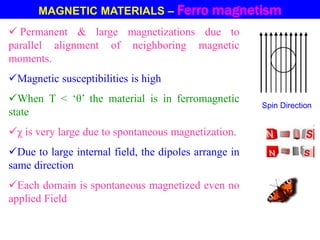
 Permanent & large magnetizations due to
parallel alignment of neighboring magnetic
moments.
Magnetic susceptibilities is high
When T < ‘θ’ the material is in ferromagnetic
state
χ is very large due to spontaneous magnetization.
Due to large internal field, the dipoles arrange in
same direction
Each domain is spontaneous magnetized even no
applied Field
Spin Direction
Domain Theory of Ferromagnetism
MAGNETIC MATERIALS – Ferro magnetism
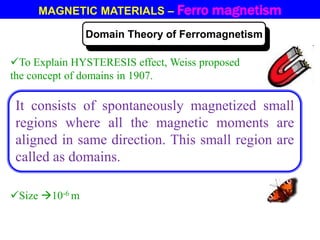
To Explain HYSTERESIS effect, Weiss proposed
the concept of domains in 1907.
Size 10-6 m
It consists of spontaneously magnetized small
regions where all the magnetic moments are
aligned in same direction. This small region are
called as domains.
Domain Theory of Ferromagnetism
MAGNETIC MATERIALS – Ferro magnetism
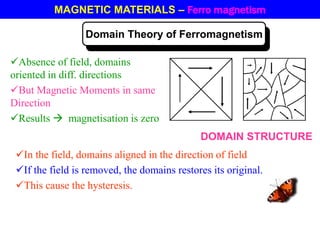
Absence of field, domains
oriented in diff. directions
But Magnetic Moments in same
Direction
Results  magnetisation is zero
DOMAIN STRUCTURE
In the field, domains aligned in the direction of field
If the field is removed, the domains restores its original.
This cause the hysteresis.
MAGNETIZATION OF DOMAINS
MAGNETIC MATERIALS – Ferro magnetism
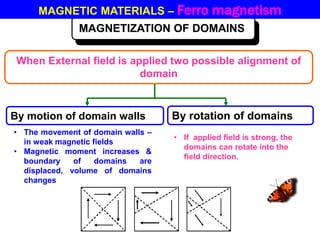
When External field is applied two possible alignment of
domain
By motion of domain walls By rotation of domains
• The movement of domain walls –
in weak magnetic fields
• Magnetic moment increases &
boundary of domains are
displaced, volume of domains
changes
• If applied field is strong, the
domains can rotate into the
field direction.
INTERNAL ENERGY IN DOMAINS
MAGNETIC MATERIALS – Ferro magnetism
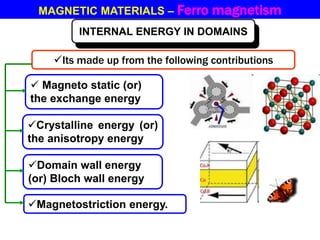
Its made up from the following contributions
 Magneto static (or)
the exchange energy
Crystalline energy (or)
the anisotropy energy
Domain wall energy
(or) Bloch wall energy
Magnetostriction energy.
MAGNETIC MATERIALS – Ferro magnetism
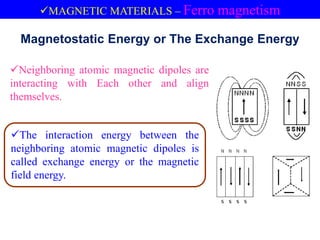
Neighboring atomic magnetic dipoles are
interacting with Each other and align
themselves.
Magnetostatic Energy or The Exchange Energy
The interaction energy between the
neighboring atomic magnetic dipoles is
called exchange energy or the magnetic
field energy.
MAGNETIC MATERIALS – Ferro magnetism
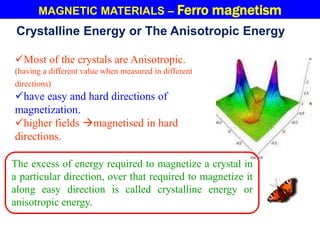
Most of the crystals are Anisotropic.
(having a different value when measured in different
directions)
have easy and hard directions of
magnetization.
higher fields magnetised in hard
directions.
The excess of energy required to magnetize a crystal in
a particular direction, over that required to magnetize it
along easy direction is called crystalline energy or
anisotropic energy.
Crystalline Energy or The Anisotropic Energy
MAGNETIC MATERIALS – Ferro magnetism
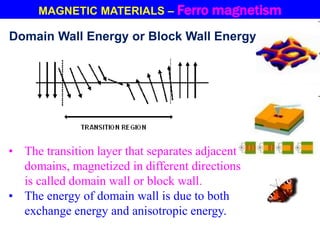
Domain Wall Energy or Block Wall Energy
• The transition layer that separates adjacent
domains, magnetized in different directions
is called domain wall or block wall.
• The energy of domain wall is due to both
exchange energy and anisotropic energy.
MAGNETIC MATERIALS – Ferro magnetism
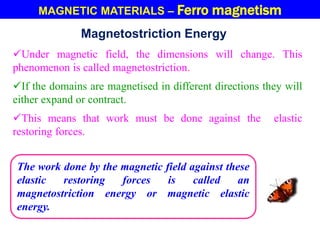
Magnetostriction Energy
Under magnetic field, the dimensions will change. This
phenomenon is called magnetostriction.
If the domains are magnetised in different directions they will
either expand or contract.
This means that work must be done against the elastic
restoring forces.
The work done by the magnetic field against these
elastic restoring forces is called an
magnetostriction energy or magnetic elastic
energy.

magnetic materials.ppt

  • 1.
  • 2.
    MAGNETIC MATERIALS –Introduction MAGNETIC MATERIALS
  • 3.
    MAGNETIC MATERIALS • THEMATERIALS WHICH GET EASILYMAGNETIZED IN A MAGNETIC FIELD.
  • 4.
    MAGNET: A DEVICETHAT ATTRACTS IRON AND PRODUCES A MAGNETIC FIELD MANY OF OUR MODERN TECHNOLOGICAL DEVICES RELAY ON MAGNETISM AND MAGNETIC MATERIALS POWER GENERATORS, TRANSFORMERS, ELECTRIC MOTORS, RADIO, TELEVISION, TELEPHONES, COMPUTERS & COMPONENTS OF SOUND & VIDEO REPRODUCTION SYSTEMS.
  • 5.
    i.e. H= B ampere m 1 Magneticdipole: The two equal and opposite magnetic poles are separated by a small distance. Magnetic dipole moment: Product of pole strength and length of the magnet. m = ml Magnetic Induction (or) magnetic flux density (B): It represents the magnitude of the internal field strength within a substance that is subjected to an H field. Magnetic field Intensity (H): Ratio between the magnetic induction and the permeability of the medium
  • 6.
    Magnetic Permeability (µ): Ratioof the magnetic induction to the applied magnetic field intensity Magnetic Susceptibility (χ): Ratio between the intensity of magnetization to the applied magnetic field intensity Intensity of Magnetization(I or M) : • The process of converting a non magnetic material into a magnetic material. • Magnetic moment per unit volume.. Unit- A/m = B H henry m 1 = I H
  • 7.
    Relation between µ& χ: B= H B= 0 ( ) I H + The relative permeability or r = 0 or r = B 0 H Substituting the B value, we get, r = 0 ( ) I H + 0 H = I H 1 + r = 1 +
  • 8.
    CLASSIFICATION OF MAGNETICMATERIALS Classified into two categories, 1. Without permanent magnetic moments: i) Diamagnetic materials 2. With permanent magnetic moments: i) Paramagnetic materials ii) Ferromagnetic materials iii) Anti-Ferromagnetic materials iv) Ferri magnetic materials
  • 9.
    An Introduction MAGNETIC MATERIALS– Ferro magnetism Generally Magnet  Ferro Magnetic material Ability to pickup the material like iron It is permanent magnet even in no field. It exhibits a magnetic moment in the absence of the field.
  • 10.
    Explanation MAGNETIC MATERIALS –Ferro magnetism  Net intrinsic magnetic dipole moment – due to spin of e-n  The neighbor dipoles having strong interaction even in no field - SPIN EXCHANGE INTERACTION  Exchange interaction aligns parallel and spreads over a small finite volume is called domain  All moments with in the domain is in same direction  More domains
  • 11.
    Properties MAGNETIC MATERIALS –Ferro magnetism Having spontaneous magnetization and domain structure strongly magnetized in the direction of the external field If it is suspended freely, it set itself parallel to the external field. exhibit hysteresis and relative permeability is large. The value magnetic susceptibility is large &depends on T Above certain temperature, the ferromagnetic material becomes paramagnetic material. This temperature is called Curie temperature. Shows magnetostriction effect.
  • 12.
    MAGNETIC MATERIALS –Ferro magnetism  Permanent & large magnetizations due to parallel alignment of neighboring magnetic moments. Magnetic susceptibilities is high When T < ‘θ’ the material is in ferromagnetic state χ is very large due to spontaneous magnetization. Due to large internal field, the dipoles arrange in same direction Each domain is spontaneous magnetized even no applied Field Spin Direction
  • 13.
    Domain Theory ofFerromagnetism MAGNETIC MATERIALS – Ferro magnetism To Explain HYSTERESIS effect, Weiss proposed the concept of domains in 1907. Size 10-6 m It consists of spontaneously magnetized small regions where all the magnetic moments are aligned in same direction. This small region are called as domains.
  • 14.
    Domain Theory ofFerromagnetism MAGNETIC MATERIALS – Ferro magnetism Absence of field, domains oriented in diff. directions But Magnetic Moments in same Direction Results  magnetisation is zero DOMAIN STRUCTURE In the field, domains aligned in the direction of field If the field is removed, the domains restores its original. This cause the hysteresis.
  • 15.
    MAGNETIZATION OF DOMAINS MAGNETICMATERIALS – Ferro magnetism When External field is applied two possible alignment of domain By motion of domain walls By rotation of domains • The movement of domain walls – in weak magnetic fields • Magnetic moment increases & boundary of domains are displaced, volume of domains changes • If applied field is strong, the domains can rotate into the field direction.
  • 16.
    INTERNAL ENERGY INDOMAINS MAGNETIC MATERIALS – Ferro magnetism Its made up from the following contributions  Magneto static (or) the exchange energy Crystalline energy (or) the anisotropy energy Domain wall energy (or) Bloch wall energy Magnetostriction energy.
  • 17.
    MAGNETIC MATERIALS –Ferro magnetism Neighboring atomic magnetic dipoles are interacting with Each other and align themselves. Magnetostatic Energy or The Exchange Energy The interaction energy between the neighboring atomic magnetic dipoles is called exchange energy or the magnetic field energy.
  • 18.
    MAGNETIC MATERIALS –Ferro magnetism Most of the crystals are Anisotropic. (having a different value when measured in different directions) have easy and hard directions of magnetization. higher fields magnetised in hard directions. The excess of energy required to magnetize a crystal in a particular direction, over that required to magnetize it along easy direction is called crystalline energy or anisotropic energy. Crystalline Energy or The Anisotropic Energy
  • 19.
    MAGNETIC MATERIALS –Ferro magnetism Domain Wall Energy or Block Wall Energy • The transition layer that separates adjacent domains, magnetized in different directions is called domain wall or block wall. • The energy of domain wall is due to both exchange energy and anisotropic energy.
  • 20.
    MAGNETIC MATERIALS –Ferro magnetism Magnetostriction Energy Under magnetic field, the dimensions will change. This phenomenon is called magnetostriction. If the domains are magnetised in different directions they will either expand or contract. This means that work must be done against the elastic restoring forces. The work done by the magnetic field against these elastic restoring forces is called an magnetostriction energy or magnetic elastic energy.