


QBA Miguel A. Castro Ramírez
Magnetic Fields


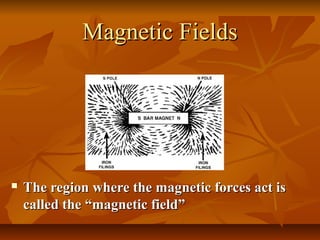
   The region where the magnetic forces act is
    called the “magnetic field”
EARTH’S
MAGNETISM
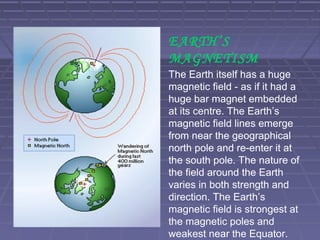
The Earth itself has a huge
magnetic field - as if it had a
huge bar magnet embedded
at its centre. The Earth’s
magnetic field lines emerge
from near the geographical
north pole and re-enter it at
the south pole. The nature of
the field around the Earth
varies in both strength and
direction. The Earth’s
magnetic field is strongest at
the magnetic poles and
weakest near the Equator.
Why does the Earth have a magnetic field?

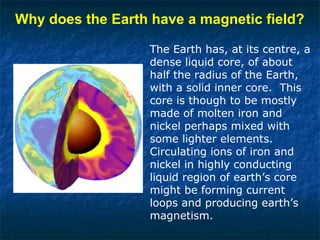
                   The Earth has, at its centre, a
                   dense liquid core, of about
                   half the radius of the Earth,
                   with a solid inner core. This
                   core is though to be mostly
                   made of molten iron and
                   nickel perhaps mixed with
                   some lighter elements.
                   Circulating ions of iron and
                   nickel in highly conducting
                   liquid region of earth’s core
                   might be forming current
                   loops and producing earth’s
                   magnetism.
The Earth’s magnetic field
Magnetic
         eleMents
 Magnetic Declination
 Magnetic Inclination or Magnetic Dip
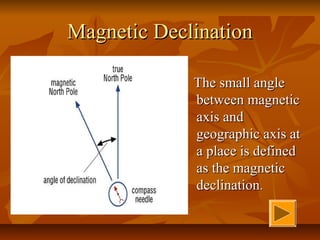
Magnetic Declination

             The small angle
             between magnetic
             axis and
             geographic axis at
             a place is defined
             as the magnetic
             declination.
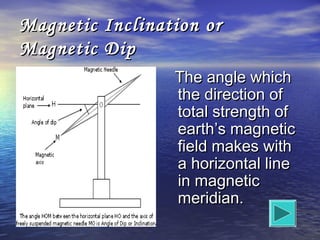
Magnetic Inclination or
Magnetic Dip
                 The angle which
                 the direction of
                 total strength of
                 earth’s magnetic
                 field makes with
                 a horizontal line
                 in magnetic
                 meridian.
 Atoms themselves have magnetic properties
 due to the spin of the atom’s electrons.
 Groups of atoms join so that their
  magnetic fields are all going in the same
 direction
 These areas of atoms are called “domains”
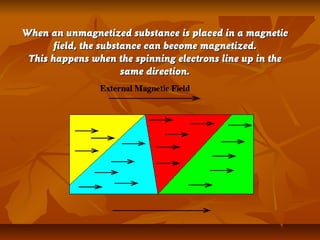
When an unmagnetized substance is placed in a magnetic
      field, the substance can become magnetized.
 This happens when the spinning electrons line up in the
                      same direction.
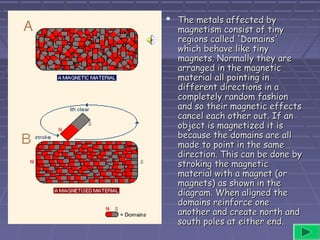
 The metals affected by
  magnetism consist of tiny
  regions called 'Domains'
  which behave like tiny
  magnets. Normally they are
  arranged in the magnetic
  material all pointing in
  different directions in a
  completely random fashion
  and so their magnetic effects
  cancel each other out. If an
  object is magnetized it is
  because the domains are all
  made to point in the same
  direction. This can be done by
  stroking the magnetic
  material with a magnet (or
  magnets) as shown in the
  diagram. When aligned the
  domains reinforce one
  another and create north and
  south poles at either end.
Classification of magnetic
               materials
   Diamagnetic Substances
   Paramagnetic substances
   Ferromagnetic substances
Diamagnetic substances

• The diamagnetic substances are those in
  which the individual atoms or ions do not
  possess any net magnetic moment on
  their own.
• When such substances are placed in an
  external magnetizing field, they get feebly
  magnetized in a direction opposite to a
  magnetizing field.
Paramagnetic Substances
   Paramagnetic substances are those in
    which each individual atom or molecule or
    ion has a net non zero magnetic moment
    of its own.
   When such substances are placed in an
    external magnetic field, they get feebly
    magnetized in the direction of the
    magnetizing field.
Ferromagnetic materials
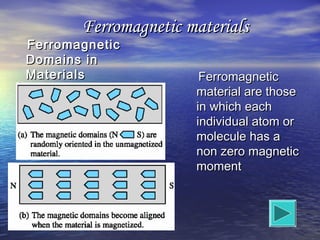
Ferromagnetic
Domains in
Materials              Ferromagnetic
                      material are those
                      in which each
                      individual atom or
                      molecule has a
                      non zero magnetic
                      moment
Hysteresis Curve
   The relationship between magnetic field
    strength (H) and magnetic flux density (B) will
    follow a curve up to a point where further
    increases in magnetic field strength will result
    in no further change in flux density. This
    condition is called magnetic saturation till
    point (a)
• the plotted relationship will follow a
  different curve back towards zero field
  strength at which point it will be offset from
  the original curve by an amount called the
  remanent flux density or Retentity as
  shown in graph at point (b)
• The 'thickness' of the middle, describes
  the amount of hysteresis, related to the
  coercivity of the material as from (c) to (f)
Hysteresis curve of soft and steel
                  The retentivity of soft
                   iron > retentivity of steel
                  Soft iron is more strongly
                   magnetized than steel
                  Coercivity of soft iron <
                   Coercivity of steel
                  Hence, soft iron loses its
                   magnetism more rapidly
                   than steel does.
An
electromagnet
   A soft iron rod has no
    magnetic field
   When current flows in
    the wire the soft iron
    becomes magnetized so
    a magnetic field is
    detected by the plotting
    compasses.
THANK YOU


Efforts By :-
Lovish Uppal
Rajat Verma

MAGNETIC MATERIALS

  • 1.
    QBA Miguel A.Castro Ramírez
  • 2.
    Magnetic Fields  The region where the magnetic forces act is called the “magnetic field”
  • 3.
    EARTH’S MAGNETISM The Earth itselfhas a huge magnetic field - as if it had a huge bar magnet embedded at its centre. The Earth’s magnetic field lines emerge from near the geographical north pole and re-enter it at the south pole. The nature of the field around the Earth varies in both strength and direction. The Earth’s magnetic field is strongest at the magnetic poles and weakest near the Equator.
  • 4.
    Why does theEarth have a magnetic field? The Earth has, at its centre, a dense liquid core, of about half the radius of the Earth, with a solid inner core. This core is though to be mostly made of molten iron and nickel perhaps mixed with some lighter elements. Circulating ions of iron and nickel in highly conducting liquid region of earth’s core might be forming current loops and producing earth’s magnetism.
  • 5.
  • 6.
    Magnetic eleMents  Magnetic Declination  Magnetic Inclination or Magnetic Dip
  • 7.
    Magnetic Declination The small angle between magnetic axis and geographic axis at a place is defined as the magnetic declination.
  • 8.
    Magnetic Inclination or MagneticDip The angle which the direction of total strength of earth’s magnetic field makes with a horizontal line in magnetic meridian.
  • 9.
     Atoms themselveshave magnetic properties due to the spin of the atom’s electrons.  Groups of atoms join so that their magnetic fields are all going in the same direction  These areas of atoms are called “domains”
  • 10.
    When an unmagnetizedsubstance is placed in a magnetic field, the substance can become magnetized. This happens when the spinning electrons line up in the same direction.
  • 11.
     The metalsaffected by magnetism consist of tiny regions called 'Domains' which behave like tiny magnets. Normally they are arranged in the magnetic material all pointing in different directions in a completely random fashion and so their magnetic effects cancel each other out. If an object is magnetized it is because the domains are all made to point in the same direction. This can be done by stroking the magnetic material with a magnet (or magnets) as shown in the diagram. When aligned the domains reinforce one another and create north and south poles at either end.
  • 12.
    Classification of magnetic materials  Diamagnetic Substances  Paramagnetic substances  Ferromagnetic substances
  • 13.
    Diamagnetic substances • Thediamagnetic substances are those in which the individual atoms or ions do not possess any net magnetic moment on their own. • When such substances are placed in an external magnetizing field, they get feebly magnetized in a direction opposite to a magnetizing field.
  • 14.
    Paramagnetic Substances  Paramagnetic substances are those in which each individual atom or molecule or ion has a net non zero magnetic moment of its own.  When such substances are placed in an external magnetic field, they get feebly magnetized in the direction of the magnetizing field.
  • 15.
    Ferromagnetic materials Ferromagnetic Domains in Materials Ferromagnetic material are those in which each individual atom or molecule has a non zero magnetic moment
  • 16.
    Hysteresis Curve  The relationship between magnetic field strength (H) and magnetic flux density (B) will follow a curve up to a point where further increases in magnetic field strength will result in no further change in flux density. This condition is called magnetic saturation till point (a)
  • 17.
    • the plottedrelationship will follow a different curve back towards zero field strength at which point it will be offset from the original curve by an amount called the remanent flux density or Retentity as shown in graph at point (b) • The 'thickness' of the middle, describes the amount of hysteresis, related to the coercivity of the material as from (c) to (f)
  • 21.
    Hysteresis curve ofsoft and steel  The retentivity of soft iron > retentivity of steel  Soft iron is more strongly magnetized than steel  Coercivity of soft iron < Coercivity of steel  Hence, soft iron loses its magnetism more rapidly than steel does.
  • 22.
    An electromagnet  A soft iron rod has no magnetic field  When current flows in the wire the soft iron becomes magnetized so a magnetic field is detected by the plotting compasses.
  • 23.
    THANK YOU Efforts By:- Lovish Uppal Rajat Verma