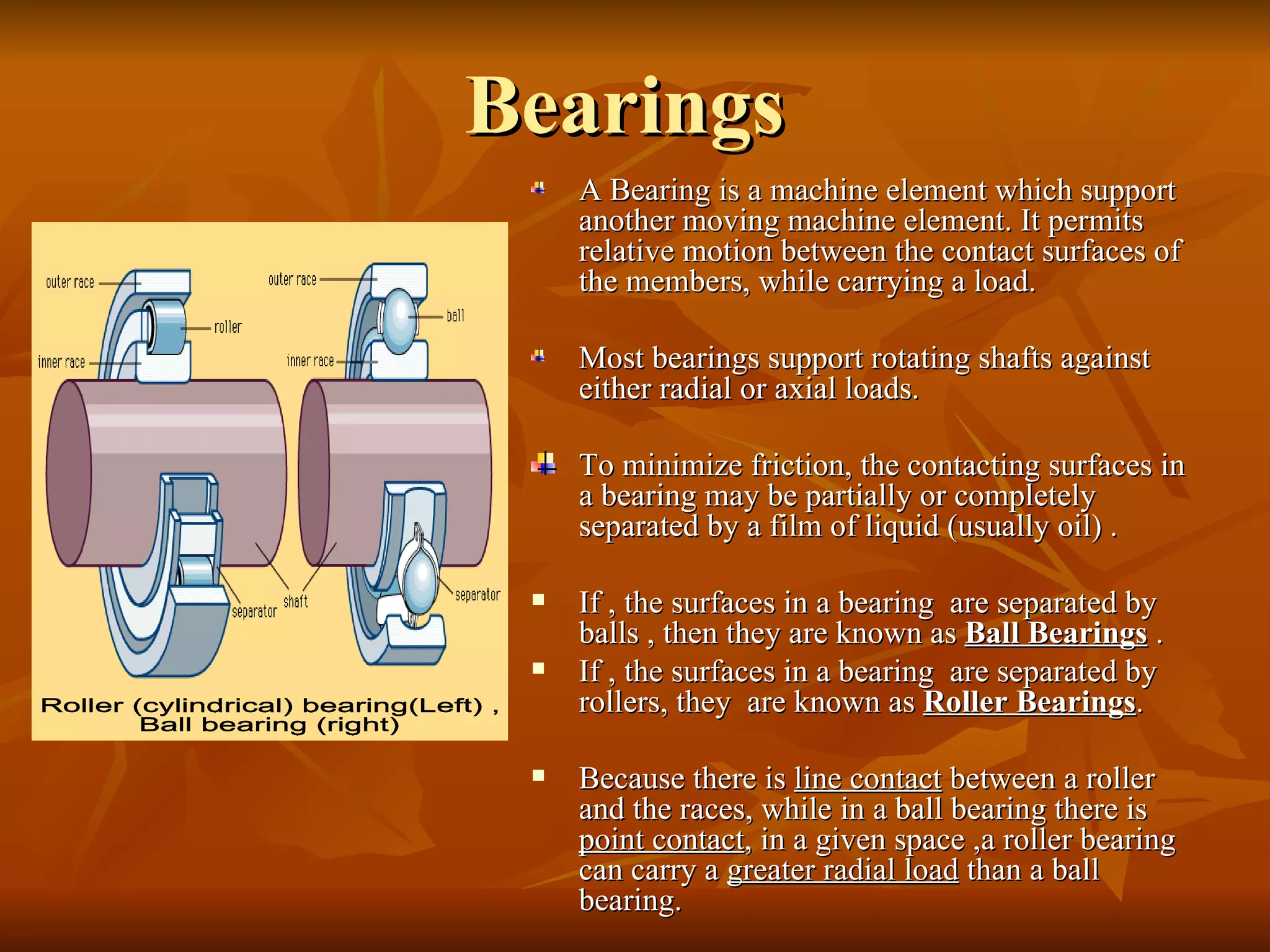
Bearings  A Bearing is a machine element which support another moving machine element. It permits relative motion between the contact surfaces of the members, while carrying a load.  Most bearings support rotating shafts against either radial or axial loads.  To minimize friction, the contacting surfaces in a bearing may be partially or completely separated by a film of liquid (usually oil) .  If , the surfaces in a bearing  are separated by  balls , then they are known as  Ball Bearings  .  If , the surfaces in a bearing  are separated by rollers, they  are known as  Roller Bearings .  Because there is  line contact  between a roller and the races, while in a ball bearing there is  point contact , in a given space ,a roller bearing can carry a  greater radial load  than a ball bearing.  Roller (cylindrical) bearing(Left) , Ball bearing (right)
The  function  of a ball bearing is to connect two machine members that move relative to one another in such a manner that the frictional resistance offered to motion is minimum.  There are three main parts in a ball bearing:--- (1)  Two   grooves ,  (2)  Ring like races or tracks ,  and  (3)  Number   of hardened steel balls . The balls fill the space between the two races and roll with negligible friction in the grooves. The balls are loosely restrained and separated by means of a retainer or cage.
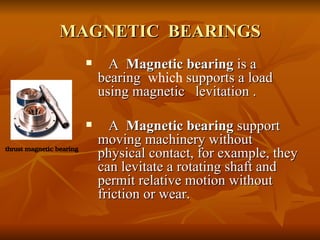
MAGNETIC  BEARINGS A  Magnetic bearing  is a bearing  which  supports a load using magnetic  levitation . A  Magnetic bearing  support moving machinery without physical contact, for example, they can levitate a rotating shaft and permit relative motion without friction or wear.  thrust magnetic bearing
Magnetic bearings are designed to support rotating and linear moving machinery elements without contact with rotor, this is accomplished by   Electro-magnet  (bearin g) which attracts a  Ferromagnetic material  (rotor)  , using this principle rotor can be suspended in magnetic field which is generated by bearing.  There are three components that make up magnetic bearing, which are  Actuators ,  Sensors  and  Control System .
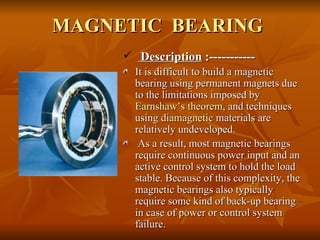
MAGNETIC  BEARING Description  :----------- It is difficult to build a magnetic bearing using permanent magnets due to the limitations imposed by  Earnshaw’s theorem , and techniques using  diamagnetic  materials are relatively undeveloped. As a result, most magnetic bearings require continuous power input and an active control system to hold the load stable. Because of this complexity, the magnetic bearings also typically require some kind of back-up bearing in case of power or control system failure.
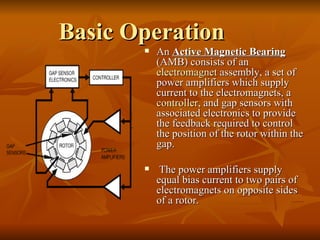
Basic Operation   An  Active Magnetic Bearing  (AMB) consists of an  electromagnet  assembly, a set of power amplifiers which supply current to the electromagnets, a  controller , and gap sensors with associated electronics to provide the feedback required to control the position of the rotor within the gap. The power amplifiers supply equal bias current to two pairs of electromagnets on opposite sides of a rotor.
This constant tug-of-war is mediated by the controller which offsets the bias current by equal but opposite perturbations of current as the rotor deviates by a small amount from its center position. The gap sensors are usually inductive in  nature and sense in a differential mode. The controller is usually a  Microprocessor   or  Digital signal processors  ( DSP ) .
ADVANTAGES Magnetic bearing advantages include  :---- Very low and predictable friction Ability to run without lubrication and in a vacuum.  Free abrasion Free of wear maintenance Good thermal isolation of the rotor and stator  And Small bearing loss.  Disadvantages  include High cost, and Relatively large size.
Applications  Magnetic bearings are increasingly used in industrial machines such as  compressors, turbines, pumps, motors  and g enerators Magnetic bearings are commonly used in  watt-hour meters  by electric utilities to measure home power consumption. Magnetic bearings are also used in  high-precision instruments  and to support equipment in a vacuum. Magnetic bearings are also used to support  Maglev trains  in order to get low noise and smooth ride by eliminating physical contact surfaces.  A very interesting new application of magnetic bearings is their use in  Artificial hearts . Now-a-days, they are in service in such industrial applications as  Electric power generation ,   Petroleum   Refinin g ,   Machine tool operation  and  Natural  g as pipelines .
Magnetic Bearings Perform :- Lubrication free  Clean, contamination free  Reliability  Low vibration  High surface speed  Low energy consumption  Submerged operation Non-contacting Bearing units for industrial equipment High speed motors with integrated magnetic bearings

Magnetic bearings

  • 1.
    Bearings ABearing is a machine element which support another moving machine element. It permits relative motion between the contact surfaces of the members, while carrying a load. Most bearings support rotating shafts against either radial or axial loads. To minimize friction, the contacting surfaces in a bearing may be partially or completely separated by a film of liquid (usually oil) . If , the surfaces in a bearing are separated by balls , then they are known as Ball Bearings . If , the surfaces in a bearing are separated by rollers, they are known as Roller Bearings . Because there is line contact between a roller and the races, while in a ball bearing there is point contact , in a given space ,a roller bearing can carry a greater radial load than a ball bearing. Roller (cylindrical) bearing(Left) , Ball bearing (right)
  • 2.
    The function of a ball bearing is to connect two machine members that move relative to one another in such a manner that the frictional resistance offered to motion is minimum. There are three main parts in a ball bearing:--- (1) Two grooves , (2) Ring like races or tracks , and (3) Number of hardened steel balls . The balls fill the space between the two races and roll with negligible friction in the grooves. The balls are loosely restrained and separated by means of a retainer or cage.
  • 3.
    MAGNETIC BEARINGSA Magnetic bearing is a bearing which supports a load using magnetic levitation . A Magnetic bearing support moving machinery without physical contact, for example, they can levitate a rotating shaft and permit relative motion without friction or wear. thrust magnetic bearing
  • 4.
    Magnetic bearings aredesigned to support rotating and linear moving machinery elements without contact with rotor, this is accomplished by Electro-magnet (bearin g) which attracts a Ferromagnetic material (rotor) , using this principle rotor can be suspended in magnetic field which is generated by bearing. There are three components that make up magnetic bearing, which are Actuators , Sensors and Control System .
  • 5.
    MAGNETIC BEARINGDescription :----------- It is difficult to build a magnetic bearing using permanent magnets due to the limitations imposed by Earnshaw’s theorem , and techniques using diamagnetic materials are relatively undeveloped. As a result, most magnetic bearings require continuous power input and an active control system to hold the load stable. Because of this complexity, the magnetic bearings also typically require some kind of back-up bearing in case of power or control system failure.
  • 6.
    Basic Operation An Active Magnetic Bearing (AMB) consists of an electromagnet assembly, a set of power amplifiers which supply current to the electromagnets, a controller , and gap sensors with associated electronics to provide the feedback required to control the position of the rotor within the gap. The power amplifiers supply equal bias current to two pairs of electromagnets on opposite sides of a rotor.
  • 7.
    This constant tug-of-waris mediated by the controller which offsets the bias current by equal but opposite perturbations of current as the rotor deviates by a small amount from its center position. The gap sensors are usually inductive in nature and sense in a differential mode. The controller is usually a Microprocessor or Digital signal processors ( DSP ) .
  • 8.
    ADVANTAGES Magnetic bearingadvantages include :---- Very low and predictable friction Ability to run without lubrication and in a vacuum. Free abrasion Free of wear maintenance Good thermal isolation of the rotor and stator And Small bearing loss. Disadvantages include High cost, and Relatively large size.
  • 9.
    Applications Magneticbearings are increasingly used in industrial machines such as compressors, turbines, pumps, motors and g enerators Magnetic bearings are commonly used in watt-hour meters by electric utilities to measure home power consumption. Magnetic bearings are also used in high-precision instruments and to support equipment in a vacuum. Magnetic bearings are also used to support Maglev trains in order to get low noise and smooth ride by eliminating physical contact surfaces. A very interesting new application of magnetic bearings is their use in Artificial hearts . Now-a-days, they are in service in such industrial applications as Electric power generation , Petroleum Refinin g , Machine tool operation and Natural g as pipelines .
  • 10.
    Magnetic Bearings Perform:- Lubrication free Clean, contamination free Reliability Low vibration High surface speed Low energy consumption Submerged operation Non-contacting Bearing units for industrial equipment High speed motors with integrated magnetic bearings