




MAGNETIC BEARING
NAME : SHEIKH SADI
ID : 2015006623
MAJOR : MECHATRONICS ENGINEERING
HUZHOU UNIVERSITY
CONTENTS:
BEARING
MAGNETIC BEARING
DESCRIPTION
BASIC OPERATION
CLASSIFICATION
MAGNETIC BEARING PERFORM
ADVANTAGES
DISADVANTAGES
APPLICATION
CONCLUSION
REFERENCE
BEARING
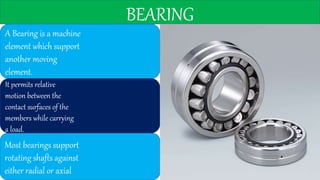
A Bearing is a machine
element which support
another moving
element.
It permits relative
motion between the
contact surfaces of the
members while carrying
a load.
Most bearings support
rotating shafts against
either radial or axial
MAGNETIC BEARING
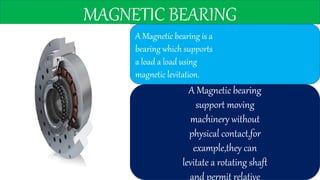
A Magnetic bearing is a
bearing which supports
a load a load using
magnetic levitation.
A Magnetic bearing
support moving
machinery without
physical contact,for
example,they can
levitate a rotating shaft
and permit relative
and linear moving
machinery
Elements,without contact
with rotor,this is
accomplished by electro
magnet(bearing) which
attracts a ferromagnetic
material(rotor),using this
principle rotor can be
suspended in magnetic
field which is generated
by bearing.
DESCRIPTION
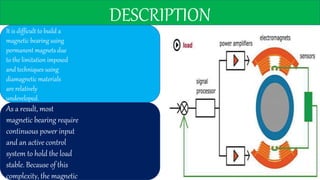
It is difficult to build a
magnetic bearing using
permanent magnets due
to the limitation imposed
and techniques using
diamagnetic materials
are relatively
undeveloped.
As a result, most
magnetic bearing require
continuous power input
and an active control
system to hold the load
stable. Because of this
complexity, the magnetic
BASIC OPERATION
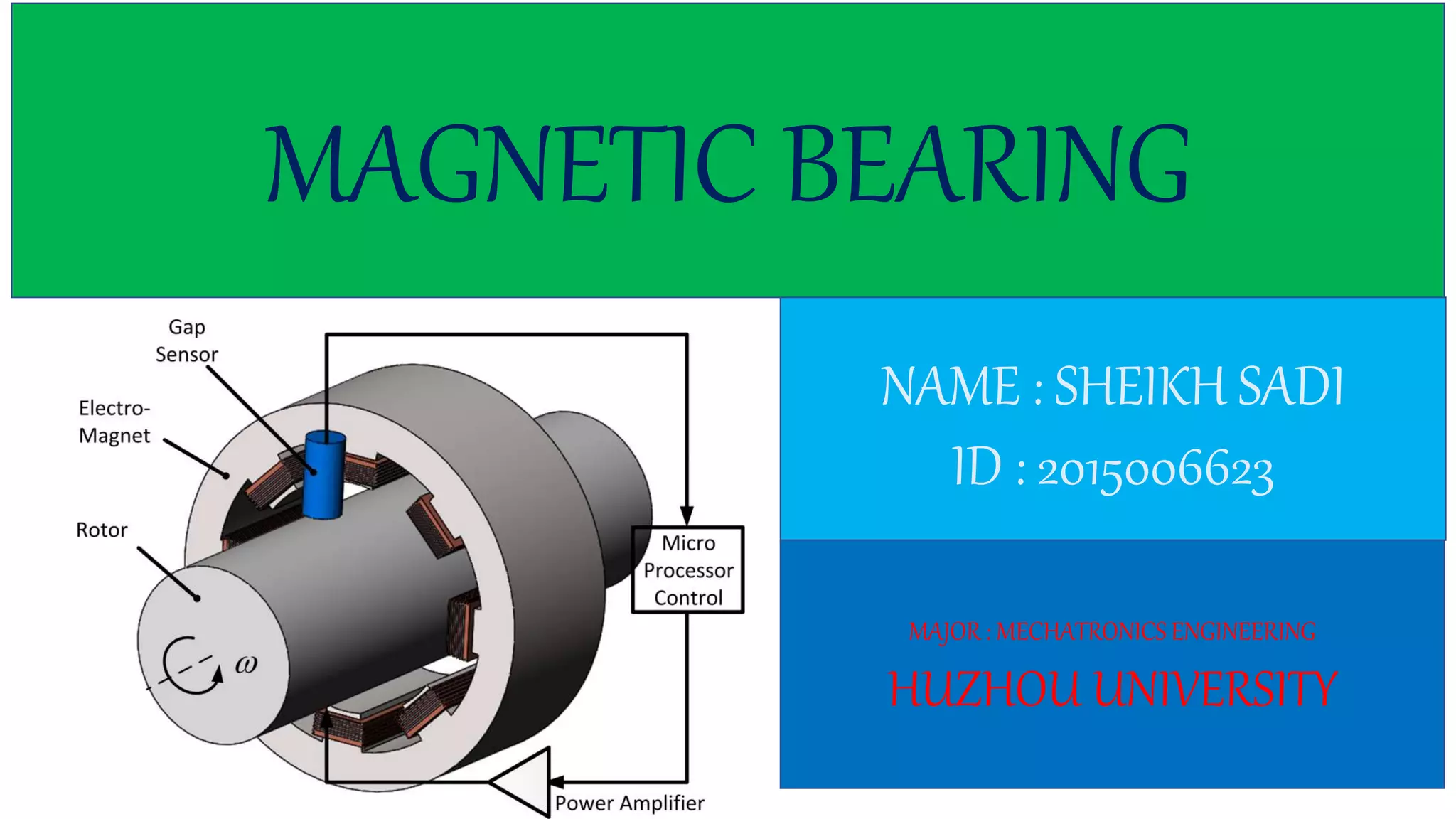
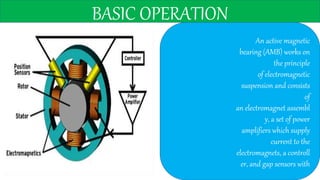
An active magnetic
bearing (AMB) works on
the principle
of electromagnetic
suspension and consists
of
an electromagnet assembl
y, a set of power
amplifiers which supply
current to the
electromagnets, a controll
er, and gap sensors with
The power amplifier supplies equal bias
current to two pairs of electromagnets on
opposite sides of a rotor. This constant
tug-of-war is mediated by the controller
which offsets the bias current by equal
andopposite perturbations of current as
therotor deviates from its center position
The gap sensors are usually inductive in
nature and sense in a differential mode.
The power amplifiers in a modern
commercial application are solid state
devices which operate in a pulse width
modulation (PWM) configuration.
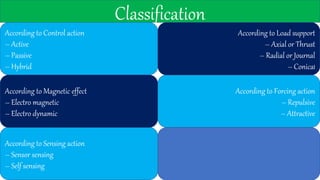
Classification
According to Control action
– Active
– Passive
– Hybrid
According to Forcing action
– Repulsive
– Attractive
According to Sensing action
– Sensor sensing
– Self sensing
According to Magnetic effect
– Electro magnetic
– Electro dynamic
According to Load support
– Axial or Thrust
– Radial or Journal
– Conical
MAGNETIC BEARING PERFORM
Lubrication Free
Clean & Contamination Free
Reliability
High Surface Speed
Low Vibration
Low Energy Consumption
Non-Contacting
Submerged Operation
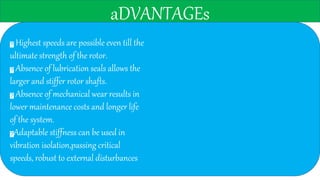
aDVANTAGEs
Highest speeds are possible even till the
ultimate strength of the rotor.
Absence of lubrication seals allows the
larger and stiffer rotor shafts.
Absence of mechanical wear results in
lower maintenance costs and longer life
of the system.
Adaptable stiffness can be used in
vibration isolation,passing critical
speeds, robust to external disturbances
DISADVANTAGES
Include High Cost.
Large in Size.
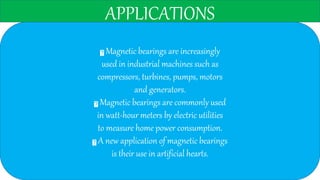
APPLICATIONS
Magnetic bearings are increasingly
used in industrial machines such as
compressors, turbines, pumps, motors
and generators.
Magnetic bearings are commonly used
in watt-hour meters by electric utilities
to measure home power consumption.
A new application of magnetic bearings
is their use in artificial hearts.
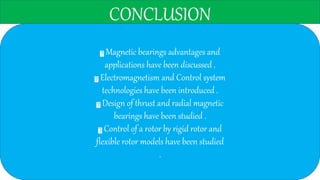
CONCLUSION
Magnetic bearings advantages and
applications have been discussed .
Electromagnetism and Control system
technologies have been introduced .
Design of thrust and radial magnetic
bearings have been studied .
Control of a rotor by rigid rotor and
flexible rotor models have been studied
.
REFERENCES
Internet :
www.google.com
www.Wikipedia.org
www.linkedin.com
Thank you

Magnetic bearing

  • 1.
    MAGNETIC BEARING NAME :SHEIKH SADI ID : 2015006623 MAJOR : MECHATRONICS ENGINEERING HUZHOU UNIVERSITY
  • 2.
    CONTENTS: BEARING MAGNETIC BEARING DESCRIPTION BASIC OPERATION CLASSIFICATION MAGNETICBEARING PERFORM ADVANTAGES DISADVANTAGES APPLICATION CONCLUSION REFERENCE
  • 3.
    BEARING A Bearing isa machine element which support another moving element. It permits relative motion between the contact surfaces of the members while carrying a load. Most bearings support rotating shafts against either radial or axial
  • 4.
    MAGNETIC BEARING A Magneticbearing is a bearing which supports a load a load using magnetic levitation. A Magnetic bearing support moving machinery without physical contact,for example,they can levitate a rotating shaft and permit relative
  • 5.
    and linear moving machinery Elements,withoutcontact with rotor,this is accomplished by electro magnet(bearing) which attracts a ferromagnetic material(rotor),using this principle rotor can be suspended in magnetic field which is generated by bearing.
  • 6.
    DESCRIPTION It is difficultto build a magnetic bearing using permanent magnets due to the limitation imposed and techniques using diamagnetic materials are relatively undeveloped. As a result, most magnetic bearing require continuous power input and an active control system to hold the load stable. Because of this complexity, the magnetic
  • 7.
    BASIC OPERATION An activemagnetic bearing (AMB) works on the principle of electromagnetic suspension and consists of an electromagnet assembl y, a set of power amplifiers which supply current to the electromagnets, a controll er, and gap sensors with
  • 8.
    The power amplifiersupplies equal bias current to two pairs of electromagnets on opposite sides of a rotor. This constant tug-of-war is mediated by the controller which offsets the bias current by equal andopposite perturbations of current as therotor deviates from its center position The gap sensors are usually inductive in nature and sense in a differential mode. The power amplifiers in a modern commercial application are solid state devices which operate in a pulse width modulation (PWM) configuration.
  • 9.
    Classification According to Controlaction – Active – Passive – Hybrid According to Forcing action – Repulsive – Attractive According to Sensing action – Sensor sensing – Self sensing According to Magnetic effect – Electro magnetic – Electro dynamic According to Load support – Axial or Thrust – Radial or Journal – Conical
  • 10.
    MAGNETIC BEARING PERFORM LubricationFree Clean & Contamination Free Reliability High Surface Speed Low Vibration Low Energy Consumption Non-Contacting Submerged Operation
  • 11.
    aDVANTAGEs Highest speeds arepossible even till the ultimate strength of the rotor. Absence of lubrication seals allows the larger and stiffer rotor shafts. Absence of mechanical wear results in lower maintenance costs and longer life of the system. Adaptable stiffness can be used in vibration isolation,passing critical speeds, robust to external disturbances
  • 12.
  • 13.
    APPLICATIONS Magnetic bearings areincreasingly used in industrial machines such as compressors, turbines, pumps, motors and generators. Magnetic bearings are commonly used in watt-hour meters by electric utilities to measure home power consumption. A new application of magnetic bearings is their use in artificial hearts.
  • 14.
    CONCLUSION Magnetic bearings advantagesand applications have been discussed . Electromagnetism and Control system technologies have been introduced . Design of thrust and radial magnetic bearings have been studied . Control of a rotor by rigid rotor and flexible rotor models have been studied .
  • 15.
  • 16.