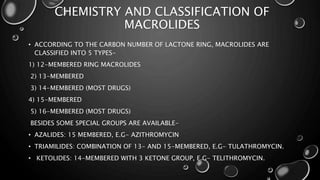
Macrolides are a class of natural products consisting of a large macrocyclic lactone ring with one or more deoxy sugars attached. Some macrolides have antibiotic or antifungal activity and are used as pharmaceutical drugs by inhibiting bacterial protein synthesis. The first discovered macrolide was erythromycin in 1952. Later macrolides like azithromycin and clarithromycin were developed by chemically modifying erythromycin to be more easily absorbed and have fewer side effects. Macrolides are classified based on their lactone ring size and include 14-membered and 15-membered ring structures. They are used to treat infections caused by gram-positive bacteria and some respiratory infections.