MACROECONOMICS
  AND BUSINESS
  ENVIRONMENT
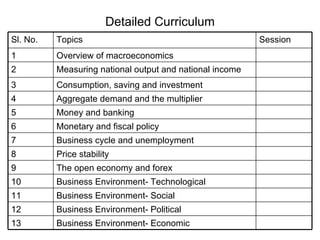
Detailed Curriculum
Sl. No.   Topics                                          Session
1         Overview of macroeconomics
2         Measuring national output and national income
3         Consumption, saving and investment
4         Aggregate demand and the multiplier
5         Money and banking
6         Monetary and fiscal policy
7         Business cycle and unemployment
8         Price stability
9         The open economy and forex
10        Business Environment- Technological
11        Business Environment- Social
12        Business Environment- Political
13        Business Environment- Economic
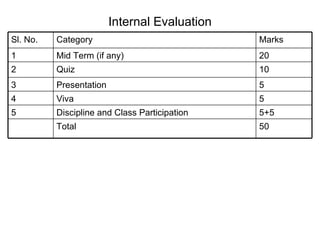
Internal Evaluation
Sl. No.   Category                             Marks
1         Mid Term (if any)                    20
2         Quiz                                 10
3         Presentation                         5
4         Viva                                 5
5         Discipline and Class Participation   5+5
          Total                                50
MACROECONOMICS

  INTRODUCTION
Economics: As a Science
• Economics is the study of the allocation of our
  limited resources to satisfy our unlimited wants.
• Resources are inputs that are used to produce
  goods and services.
• Scarcity forces us to make choices on how
  to make the best use our limited resources.
Macroeconomics And Microeconomics

• Microeconomics deals with the smaller units
  within the economy.
• It attempts to understand the decision making
  behavior of firms and households and their
  interaction in markets for particular goods or
  services.
• Microeconomics looks at the trees while
  macroeconomics looks at the forest.
Macroeconomics And Microeconomics
• Macroeconomics deals with the aggregate or
  total economy.
• It looks at economic problems as they influence
  the whole society, including the topics of inflation,
  unemployment, business cycles and economic
  growth.
Goals of Macroeconomic Policies

• Employment
• High living standards
• Price Stability
• Reduction of economic inequality and removal of
  poverty.
• Rapid Economic Growth (GDP)
• External Balance (Foreign Trade Balance)
Stocks and Flows
• Stocks: Specified point of time
• For example: Money Supply
   Given at a point in time e.g. on 3 April 2005
     or 3 April 2006
• Flows: Specified Period of time
• Flow variables expressed in per unit of time
  e.g. per hour, per week, per month, or per
  year (GDP, consumption, Saving,
  Investments Exports, Imports etc.)
Aggregate Supply and Aggregate Demand
• Aggregate Supply: the amount of output that an
  economy can produce with its given resources and
  technology available.

• Aggregate Demand: the total demand for goods by
  consumer, by industry, by the government and be
  foreign countries (export) etc.

• The Aggregate Supply (AS) curve represents the
  quantity of output firms are willing to supply at each
  given price.

• The Aggregate Demand (AD) curve represents the
  quantity of output the consumers, investors etc. are
  willing to buy at each given price.
•   to consume, for new investment, for goods purchased
Measuring National Output and
         National Income
• Concepts of National Product
• GDP : the value of all final goods and services produced
  in the country within a given period.
• Gross Domestic Product (GDP) at market price
• Gross Domestic Product (GDP) at factor cost
GNP: GDP+ Net income from abroad
  Gross National Product (GNP) at market price
• Gross National Product (GNP) at factor cost
• Net Domestic Product (NDP) at market price
• Net Domestic Product (NDP) at factor cost


• NDP= GDP-Depreciation
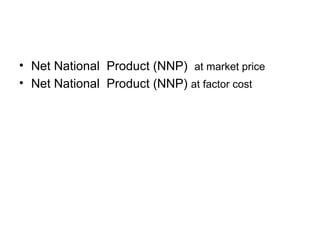
• Net National Product (NNP) at market price
• Net National Product (NNP) at factor cost
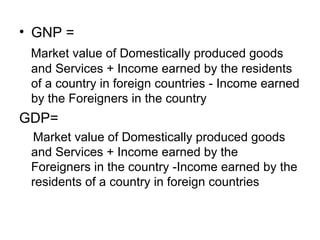
• GNP =
 Market value of Domestically produced goods
 and Services + Income earned by the residents
 of a country in foreign countries - Income earned
 by the Foreigners in the country
GDP=
 Market value of Domestically produced goods
 and Services + Income earned by the
 Foreigners in the country -Income earned by the
 residents of a country in foreign countries
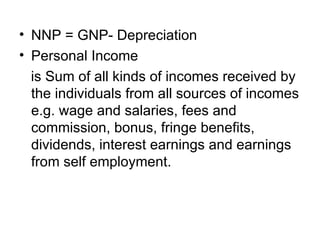
• NNP = GNP- Depreciation
• Personal Income
  is Sum of all kinds of incomes received by
  the individuals from all sources of incomes
  e.g. wage and salaries, fees and
  commission, bonus, fringe benefits,
  dividends, interest earnings and earnings
  from self employment.
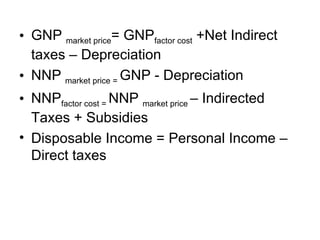
• GNP market price= GNPfactor cost +Net Indirect
  taxes – Depreciation
• NNP market price = GNP - Depreciation
• NNPfactor cost = NNP market price – Indirected
  Taxes + Subsidies
• Disposable Income = Personal Income –
  Direct taxes

Chap 1

  • 1.
    MACROECONOMICS ANDBUSINESS ENVIRONMENT
  • 2.
    Detailed Curriculum Sl. No. Topics Session 1 Overview of macroeconomics 2 Measuring national output and national income 3 Consumption, saving and investment 4 Aggregate demand and the multiplier 5 Money and banking 6 Monetary and fiscal policy 7 Business cycle and unemployment 8 Price stability 9 The open economy and forex 10 Business Environment- Technological 11 Business Environment- Social 12 Business Environment- Political 13 Business Environment- Economic
  • 3.
    Internal Evaluation Sl. No. Category Marks 1 Mid Term (if any) 20 2 Quiz 10 3 Presentation 5 4 Viva 5 5 Discipline and Class Participation 5+5 Total 50
  • 4.
  • 5.
    Economics: As aScience • Economics is the study of the allocation of our limited resources to satisfy our unlimited wants. • Resources are inputs that are used to produce goods and services. • Scarcity forces us to make choices on how to make the best use our limited resources.
  • 6.
    Macroeconomics And Microeconomics •Microeconomics deals with the smaller units within the economy. • It attempts to understand the decision making behavior of firms and households and their interaction in markets for particular goods or services. • Microeconomics looks at the trees while macroeconomics looks at the forest.
  • 7.
    Macroeconomics And Microeconomics •Macroeconomics deals with the aggregate or total economy. • It looks at economic problems as they influence the whole society, including the topics of inflation, unemployment, business cycles and economic growth.
  • 8.
    Goals of MacroeconomicPolicies • Employment • High living standards • Price Stability • Reduction of economic inequality and removal of poverty. • Rapid Economic Growth (GDP) • External Balance (Foreign Trade Balance)
  • 9.
    Stocks and Flows •Stocks: Specified point of time • For example: Money Supply Given at a point in time e.g. on 3 April 2005 or 3 April 2006 • Flows: Specified Period of time • Flow variables expressed in per unit of time e.g. per hour, per week, per month, or per year (GDP, consumption, Saving, Investments Exports, Imports etc.)
  • 10.
    Aggregate Supply andAggregate Demand • Aggregate Supply: the amount of output that an economy can produce with its given resources and technology available. • Aggregate Demand: the total demand for goods by consumer, by industry, by the government and be foreign countries (export) etc. • The Aggregate Supply (AS) curve represents the quantity of output firms are willing to supply at each given price. • The Aggregate Demand (AD) curve represents the quantity of output the consumers, investors etc. are willing to buy at each given price. • to consume, for new investment, for goods purchased
  • 11.
    Measuring National Outputand National Income • Concepts of National Product • GDP : the value of all final goods and services produced in the country within a given period. • Gross Domestic Product (GDP) at market price • Gross Domestic Product (GDP) at factor cost GNP: GDP+ Net income from abroad Gross National Product (GNP) at market price • Gross National Product (GNP) at factor cost
  • 12.
    • Net DomesticProduct (NDP) at market price • Net Domestic Product (NDP) at factor cost • NDP= GDP-Depreciation
  • 13.
    • Net NationalProduct (NNP) at market price • Net National Product (NNP) at factor cost
  • 14.
    • GNP = Market value of Domestically produced goods and Services + Income earned by the residents of a country in foreign countries - Income earned by the Foreigners in the country GDP= Market value of Domestically produced goods and Services + Income earned by the Foreigners in the country -Income earned by the residents of a country in foreign countries
  • 15.
    • NNP =GNP- Depreciation • Personal Income is Sum of all kinds of incomes received by the individuals from all sources of incomes e.g. wage and salaries, fees and commission, bonus, fringe benefits, dividends, interest earnings and earnings from self employment.
  • 16.
    • GNP marketprice= GNPfactor cost +Net Indirect taxes – Depreciation • NNP market price = GNP - Depreciation • NNPfactor cost = NNP market price – Indirected Taxes + Subsidies • Disposable Income = Personal Income – Direct taxes