Theory and Measurement in 
the macroeconomy 
Key measures used by governments and consider differences between the Keynesian and 
Monetarist approach 
CAMBRIDGE A’LEVELS ECONOMICS 
Kalaiarasi Danabalan 
http://www.youtube.com/watch?v=yUiU_xRPwMc
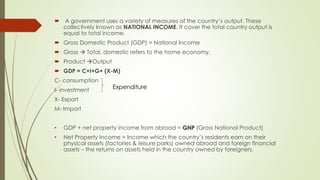
 A government uses a variety of measures of the country’s output. These collectively 
known as NATIONAL INCOME. It cover the total country output is equal to total income. 
 Gross Domestic Product (GDP) = National Income 
 Gross  Total, domestic refers to the home economy. 
 Product Output 
 GDP = C+I+G+ (X-M) 
C- consumption 
I- investment 
Expenditure 
X- Export 
M- Import 
• GDP + net property income from abroad = GNP (Gross National Product) 
• Net Property Income = Income which the country’s residents earn on their physical 
assets (factories & leisure parks) owned abroad and foreign financial assets – the returns 
on assets held in the country owned by foreigners.
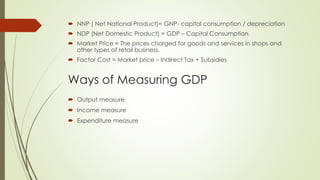
 NNP ( Net National Product)= GNP- capital consumption / depreciation 
 NDP (Net Domestic Product) = GDP – Capital Consumption 
 Market Price = The prices charged for goods and services in shops and other types 
of retail business. 
 Factor Cost = Market price – Indirect Tax + Subsidies 
Ways of Measuring GDP 
 Output measure 
 Income measure 
 Expenditure measure
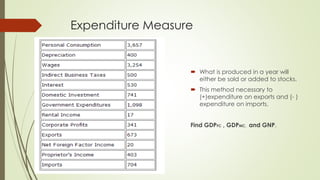
Expenditure Measure 
 What is produced in a year will either 
be sold or added to stocks. 
 This method necessary to 
(+)expenditure on exports and (- ) 
expenditure on imports. 
Find GDPFC , GDPMC, and GNP.
Output Measure 
(Value of output produced by industries) 
 economic activity by adding the market values of goods and services produced, 
excluding any goods and services used up in intermediate stages of production. 
 This approach makes use of the value‐added concept. 
 The value added of any producer is the value of its output (- 
the value of the inputs it purchases from other producers. 
 The product approach computes economic activity by summing the values added by 
all producers.
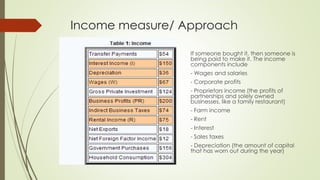
Income measure/ Approach 
If someone bought it, then someone is 
being paid to make it. The income 
components include 
- Wages and salaries 
- Corporate profits 
- Proprietors income (the profits of 
partnerships and solely owned businesses, 
like a family restaurant) 
- Farm income 
- Rent 
- Interest 
- Sales taxes 
- Depreciation (the amount of capital that 
has worn out during the year)
 Find GDP 
1st step : find Nominal Income 
NI = W + R + i + PR 
2nd Step : GDP = NI + Indirect Business Taxes + Depreciation 
Your answer : GDP = $602 
Did you get this answer?
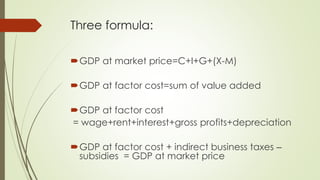
Three formula: 
GDP at market price=C+I+G+(X-M) 
GDP at factor cost=sum of value added 
GDP at factor cost 
= wage+rent+interest+gross profits+depreciation 
GDP at factor cost + indirect business taxes – 
subsidies = GDP at market price
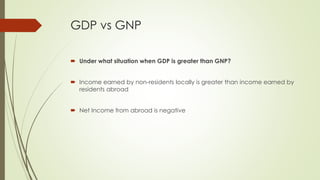
GDP vs GNP 
 Under what situation when GDP is greater than GNP? 
 Income earned by non-residents locally is greater than income earned by residents 
abroad 
 Net Income from abroad is negative
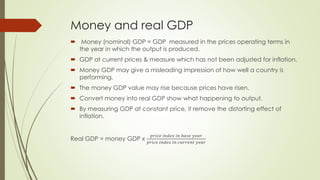
Money and real GDP 
 Money (nominal) GDP = GDP measured in the prices operating terms in the year 
in which the output is produced. 
 GDP at current prices & measure which has not been adjusted for inflation. 
 Money GDP may give a misleading impression of how well a country is performing. 
 The money GDP value may rise because prices have risen. 
 Convert money into real GDP show what happening to output. 
 By measuring GDP at constant price, it remove the distorting effect of inflation. 
Real GDP = money GDP x 
푝푟푖푐푒 푖푛푑푒푥 푖푛 푏푎푠푒 푦푒푎푟 
푝푟푖푐푒 푖푛푑푒푥 푖푛 푐푢푟푟푒푛푡 푦푒푎푟
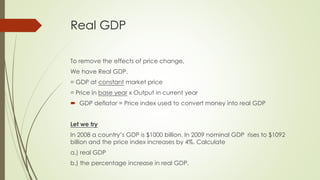
Real GDP 
To remove the effects of price change, 
We have Real GDP, 
= GDP at constant market price 
= Price in base year x Output in current year 
 GDP deflator = Price index used to convert money into real GDP 
Let we try 
In 2008 a country’s GDP is $1000 billion. In 2009 nominal GDP rises to $1092 billion 
and the price index increases by 4%. Calculate 
a.) real GDP 
b.) the percentage increase in real GDP.
Comparison of economic growth over time 
and between countries 
 Changes in real GDP- economic growth 
 Official real GDP- the true change in output  hidden, informal/ underground 
economic activity 
 Reasons of people didn’t declare their earned income to the authorities 
1.) seeking to evade paying tax 
2.) not declaring economic activity is itself illegal (smuggling goods).
Effects of the Size of the Hidden Economy 
 Measuring gap between GDP as measured by the expenditure and income 
methods. 
 Make international comparisons of economic growth rates difficult. It’s happen 
because of the hidden economy size varies between economies.
Factors influence comparing economic 
growth 
 The nature of economic growth 
 Living standard over time 
 Living standard between countries 
 Money supply 
- total amount of money . It consists of currency in circulation plus relevant deposits. 
- 2 types of money supply 
 Narrow money – medium of exchange and consists of notes and coins in 
circulation and notes and coins consists and cash held in banks and balances held 
by banks at the central bank. 
 Broad money – Consists of the above plus a items range that are commensurate 
with money’s function as a value store.
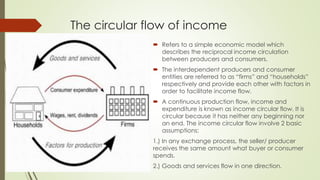
The circular flow of income 
 Refers to a simple economic model which describes the 
reciprocal income circulation between producers and 
consumers. 
 The interdependent producers and consumer entities are 
referred to as “firms” and “households” respectively and 
provide each other with factors in order to facilitate 
income flow. 
 A continuous production flow, income and expenditure 
is known as income circular flow. It is circular because it 
has neither any beginning nor an end. The income 
circular flow involve 2 basic assumptions: 
1.) In any exchange process, the seller/ producer receives 
the same amount what buyer or consumer spends. 
2.) Goods and services flow in one direction.
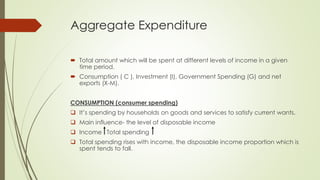
Aggregate Expenditure 
 Total amount which will be spent at different levels of income in a given time 
period. 
 Consumption ( C ), Investment (I), Government Spending (G) and net exports (X-M). 
CONSUMPTION (consumer spending) 
 It’s spending by households on goods and services to satisfy current wants. 
 Main influence- the level of disposable income 
 Income Total spending 
 Total spending rises with income, the disposable income proportion which is spent 
tends to fall.
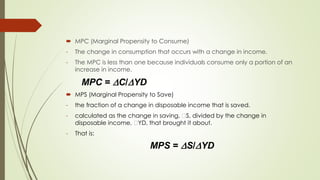
 MPC (Marginal Propensity to Consume) 
- The change in consumption that occurs with a change in income. 
- The MPC is less than one because individuals consume only a portion of an 
increase in income. 
MPC = C/YD 
 MPS (Marginal Propensity to Save) 
- the fraction of a change in disposable income that is saved. 
- calculated as the change in saving, S, divided by the change in disposable income, 
YD, that brought it about. 
- That is: 
MPS = S/YD
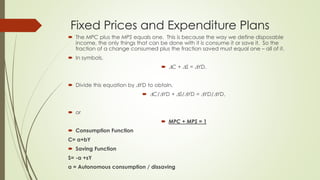
Fixed Prices and Expenditure Plans 
 The MPC plus the MPS equals one. This is because the way we define disposable income, the 
only things that can be done with it is consume it or save it. So the fraction of a change 
consumed plus the fraction saved must equal one – all of it. 
 In symbols, 
 C + S = YD. 
 Divide this equation by YD to obtain, 
 C/YD + S/YD = YD/YD, 
 or 
 MPC + MPS = 1 
 Consumption Function 
C= a+bY 
 Saving Function 
S= -a +sY 
a = Autonomous consumption / dissaving
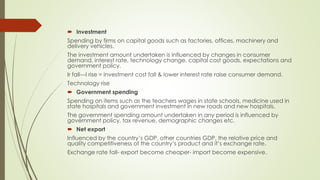
 Investment 
Spending by firms on capital goods such as factories, offices, machinery and delivery 
vehicles. 
The investment amount undertaken is influenced by changes in consumer demand, interest 
rate, technology change, capital cost goods, expectations and government policy. 
Ir fall---I rise = investment cost fall & lower interest rate raise consumer demand. 
Technology rise 
 Government spending 
Spending on items such as the teachers wages in state schools, medicine used in state 
hospitals and government investment in new roads and new hospitals. 
The government spending amount undertaken in any period is influenced by government 
policy, tax revenue, demographic changes etc. 
 Net export 
Influenced by the country’s GDP, other countries GDP, the relative price and quality 
competitiveness of the country’s product and it’s exchange rate. 
Exchange rate fall- export become cheaper- import become expensive.
Income Determination 
 The level of income in an economy is determined where aggregate expenditure = 
output. 
 If aggregate expenditure is below current output, firms will reduce production. 
 Output will change until it matches aggregate expenditure. 
 Money GDP- horizontal and aggregate expenditure- vertical 
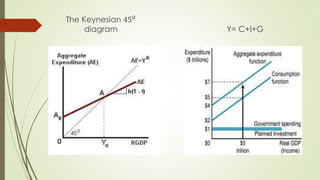
 450line shows the points at which aggregate expenditure = national income (GDP). 
 Output determined where the C+I+G+(X-M) cuts this 450 line. 
AE- PLANNED SPENDING 
GDP – ACTUAL SPENDING
The Keynesian 450 diagram Y= C+I+G
What if AE and Y are not Equal? 
 If AE< Y 
People want to buy less than what has been produced so firms will accumulate 
inventories. 
Firms will reduce production. 
 If AE > Y 
What people want to buy is greater than actual production so inventories will decline 
Firms will increase production
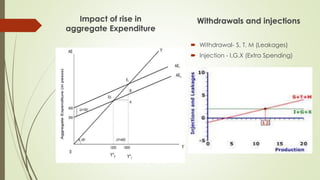
Impact of rise in aggregate 
Expenditure 
Withdrawals and injections 
 Withdrawal- S, T, M (Leakages) 
 Injection - I,G,X (Extra Spending)
Inflationary and Deflationary Gaps 
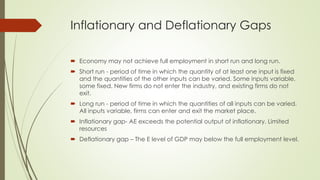
 Economy may not achieve full employment in short run and long run. 
 Short run - period of time in which the quantity of at least one input is fixed and 
the quantities of the other inputs can be varied. Some inputs variable, some fixed. 
New firms do not enter the industry, and existing firms do not exit. 
 Long run - period of time in which the quantities of all inputs can be varied. All 
inputs variable, firms can enter and exit the market place. 
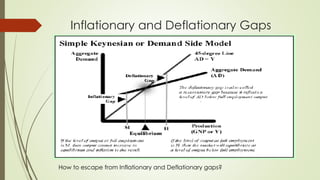
 Inflationary gap- AE exceeds the potential output of inflationary. Limited resources 
 Deflationary gap – The E level of GDP may below the full employment level.
Inflationary and Deflationary Gaps 
How to escape from Inflationary and Deflationary gaps?
The Multiplier 
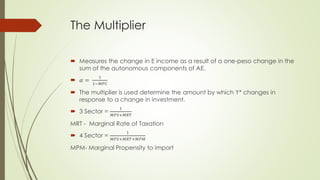
 Measures the change in E income as a result of a one-peso change in the sum of 
the autonomous components of AE. 
 훼 = 
1 
1−푀푃퐶 
 The multiplier is used determine the amount by which Y* changes in response to a 
change in investment. 
 3 Sector = 
1 
푀푃푆+푀푅푇 
MRT - Marginal Rate of Taxation 
 4 Sector = 
1 
푀푃푆+푀푅푇+푀푃푀 
MPM- Marginal Propensity to import
Lets Try 
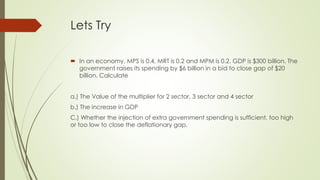
 In an economy, MPS is 0.4, MRT is 0.2 and MPM is 0.2. GDP is $300 billion. The 
government raises its spending by $6 billion in a bid to close gap of $20 billion. 
Calculate 
a.) The Value of the multiplier for 2 sector, 3 sector and 4 sector 
b.) The increase in GDP 
C.) Whether the injection of extra government spending is sufficient, too high or too 
low to close the deflationary gap.
 Autonomous investment- Investment which is undertaken independently of 
changes in income 
 Induced investment- Contrast to autonomous investment. 
 Accelerator – Focus on induced investment and emphasizes the volatility of 
investment. 
Ex: If GDP is rising but at a constant rate, induced investment will not change. Firms 
can continue to buy the same number of machines each year to expand the capacity.
Increase in the Money supply and the 
creation of credit 
 The cause of an increase in aggregate demand is an increase in the money supply. 
 The main cause of an increase in the money supply: 
1.) An increase in commercial money spending 
2.) An Increase in government spending financed by borrowing from the banking 
sector. 
3.) More money entering than leaving the country.
Credit Creation 
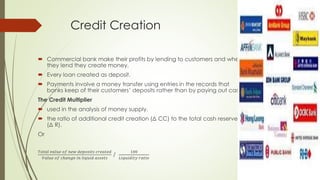
 Commercial bank make their profits by lending to customers and when they 
lend they create money. 
 Every loan created as deposit. 
 Payments involve a money transfer using entries in the records that banks keep 
of their customers’ deposits rather than by paying out cash. 
The Credit Multiplier 
 used in the analysis of money supply. 
 the ratio of additional credit creation (Δ CC) to the total cash reserves (Δ R). 
Or 
푇표푡푎푙 푣푎푙푢푒 표푓 푛푒푤 푑푒푝표푠푖푡푠 푐푟푒푎푡푒푑 
푉푎푙푢푒 표푓 푐ℎ푎푛푔푒 푖푛 푙푖푞푢푖푑 푎푠푠푒푡푠 / 
100 
퐿푖푞푢푖푑푖푡푦 푟푎푡푖표
 The change in liquid assets is deducted from the change in liabilities. This is 
because the change in liabilities will include deposits given to those putting in the 
liquid assets. 
 In practice, a bank may not lend as much as the credit implies it can. There may be 
a lack of households and firms wanting to borrow / a lack of credit-worthy 
borrowers. 
 A bank may also change its liquidity ratio if people alter the proportion of their 
deposits they require as cash, if other banks alter their lending policies / if the 
country central bank requires banks to keep a set liquidity ratio. 
 A central bank may seek to influence commercial banks ability to lend.
Deficit Financing 
 Planned expenditure by a government to put more money into the economy than 
it takes out by taxation, with the expectation that increased business activity will 
bring enough additional revenue to cover the shortfall. 
Total Currency Flow 
 The TCF of the balance of payments refers to the total outflow / inflow of money 
resulting from international transactions as recorded in the current account, 
financial account, capital account and balancing item.
Relationship between money supply, price 
level and output 
 Change in money supply will effect on the price level and output in an economy. 
 Although the change in the money supply has some relevance, there are other 
factors that must be taken into account when explaining a change in the price level.
Interest rate determination and the 
demand for money 
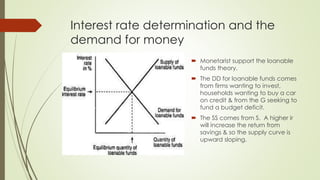
 Monetarist support the loanable 
funds theory. 
 The DD for loanable funds comes 
from firms wanting to invest, 
households wanting to buy a car on 
credit & from the G seeking to fund a 
budget deficit. 
 The SS comes from S. A higher ir will 
increase the return from savings & so 
the supply curve is upward sloping.
Keynes 
 Liquidity preference- Explain the demand for money. 
 There are 3 motives to show why households 7 firms may decide to hold part of 
their wealth in a money form 
- Transaction motive 
The desire to hold money to make everyday purchases & meet everyday payments. 
The more income received & the more infrequently the payments are received, the 
higher the amount which will be held 
- Precautionary motive 
Firms & households hold money rather more of their wealth than they anticipate they 
will spend. They can meet unexpected expenses, take advantage of unforeseen 
bargains. 
- Speculative motive 
Holding money balances is interest elastic. Households & firms will hold what are 
sometimes called idle balances when they believe tht the returns from holding 
financial asset which firms & households may decide to hold is government bonds.
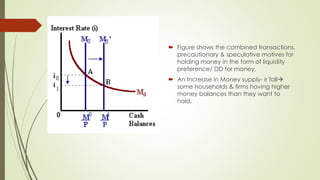
 Figure shows the combined transactions, 
precautionary & speculative motives for 
holding money in the form of liquidity 
preference/ DD for money. 
 An Increase in Money supply- ir fall some 
households & firms having higher money 
balances than they want to hold.
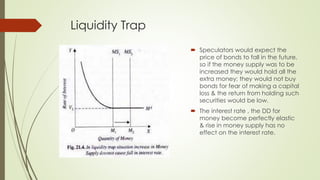
Liquidity Trap 
 Speculators would expect the price of 
bonds to fall in the future, so if the 
money supply was to be increased 
they would hold all the extra money; 
they would not buy bonds for fear of 
making a capital loss & the return 
from holding such securities would 
be low. 
 The interest rate , the DD for money 
become perfectly elastic & rise in 
money supply has no effect on the 
interest rate.

Theory and Measurement in the Macroeconomy

  • 1.
    Theory and Measurementin the macroeconomy Key measures used by governments and consider differences between the Keynesian and Monetarist approach CAMBRIDGE A’LEVELS ECONOMICS Kalaiarasi Danabalan http://www.youtube.com/watch?v=yUiU_xRPwMc
  • 2.
     A governmentuses a variety of measures of the country’s output. These collectively known as NATIONAL INCOME. It cover the total country output is equal to total income.  Gross Domestic Product (GDP) = National Income  Gross  Total, domestic refers to the home economy.  Product Output  GDP = C+I+G+ (X-M) C- consumption I- investment Expenditure X- Export M- Import • GDP + net property income from abroad = GNP (Gross National Product) • Net Property Income = Income which the country’s residents earn on their physical assets (factories & leisure parks) owned abroad and foreign financial assets – the returns on assets held in the country owned by foreigners.
  • 3.
     NNP (Net National Product)= GNP- capital consumption / depreciation  NDP (Net Domestic Product) = GDP – Capital Consumption  Market Price = The prices charged for goods and services in shops and other types of retail business.  Factor Cost = Market price – Indirect Tax + Subsidies Ways of Measuring GDP  Output measure  Income measure  Expenditure measure
  • 4.
    Expenditure Measure What is produced in a year will either be sold or added to stocks.  This method necessary to (+)expenditure on exports and (- ) expenditure on imports. Find GDPFC , GDPMC, and GNP.
  • 5.
    Output Measure (Valueof output produced by industries)  economic activity by adding the market values of goods and services produced, excluding any goods and services used up in intermediate stages of production.  This approach makes use of the value‐added concept.  The value added of any producer is the value of its output (- the value of the inputs it purchases from other producers.  The product approach computes economic activity by summing the values added by all producers.
  • 6.
    Income measure/ Approach If someone bought it, then someone is being paid to make it. The income components include - Wages and salaries - Corporate profits - Proprietors income (the profits of partnerships and solely owned businesses, like a family restaurant) - Farm income - Rent - Interest - Sales taxes - Depreciation (the amount of capital that has worn out during the year)
  • 7.
     Find GDP 1st step : find Nominal Income NI = W + R + i + PR 2nd Step : GDP = NI + Indirect Business Taxes + Depreciation Your answer : GDP = $602 Did you get this answer?
  • 8.
    Three formula: GDPat market price=C+I+G+(X-M) GDP at factor cost=sum of value added GDP at factor cost = wage+rent+interest+gross profits+depreciation GDP at factor cost + indirect business taxes – subsidies = GDP at market price
  • 9.
    GDP vs GNP  Under what situation when GDP is greater than GNP?  Income earned by non-residents locally is greater than income earned by residents abroad  Net Income from abroad is negative
  • 10.
    Money and realGDP  Money (nominal) GDP = GDP measured in the prices operating terms in the year in which the output is produced.  GDP at current prices & measure which has not been adjusted for inflation.  Money GDP may give a misleading impression of how well a country is performing.  The money GDP value may rise because prices have risen.  Convert money into real GDP show what happening to output.  By measuring GDP at constant price, it remove the distorting effect of inflation. Real GDP = money GDP x 푝푟푖푐푒 푖푛푑푒푥 푖푛 푏푎푠푒 푦푒푎푟 푝푟푖푐푒 푖푛푑푒푥 푖푛 푐푢푟푟푒푛푡 푦푒푎푟
  • 11.
    Real GDP Toremove the effects of price change, We have Real GDP, = GDP at constant market price = Price in base year x Output in current year  GDP deflator = Price index used to convert money into real GDP Let we try In 2008 a country’s GDP is $1000 billion. In 2009 nominal GDP rises to $1092 billion and the price index increases by 4%. Calculate a.) real GDP b.) the percentage increase in real GDP.
  • 12.
    Comparison of economicgrowth over time and between countries  Changes in real GDP- economic growth  Official real GDP- the true change in output  hidden, informal/ underground economic activity  Reasons of people didn’t declare their earned income to the authorities 1.) seeking to evade paying tax 2.) not declaring economic activity is itself illegal (smuggling goods).
  • 13.
    Effects of theSize of the Hidden Economy  Measuring gap between GDP as measured by the expenditure and income methods.  Make international comparisons of economic growth rates difficult. It’s happen because of the hidden economy size varies between economies.
  • 14.
    Factors influence comparingeconomic growth  The nature of economic growth  Living standard over time  Living standard between countries  Money supply - total amount of money . It consists of currency in circulation plus relevant deposits. - 2 types of money supply  Narrow money – medium of exchange and consists of notes and coins in circulation and notes and coins consists and cash held in banks and balances held by banks at the central bank.  Broad money – Consists of the above plus a items range that are commensurate with money’s function as a value store.
  • 15.
    The circular flowof income  Refers to a simple economic model which describes the reciprocal income circulation between producers and consumers.  The interdependent producers and consumer entities are referred to as “firms” and “households” respectively and provide each other with factors in order to facilitate income flow.  A continuous production flow, income and expenditure is known as income circular flow. It is circular because it has neither any beginning nor an end. The income circular flow involve 2 basic assumptions: 1.) In any exchange process, the seller/ producer receives the same amount what buyer or consumer spends. 2.) Goods and services flow in one direction.
  • 16.
    Aggregate Expenditure Total amount which will be spent at different levels of income in a given time period.  Consumption ( C ), Investment (I), Government Spending (G) and net exports (X-M). CONSUMPTION (consumer spending)  It’s spending by households on goods and services to satisfy current wants.  Main influence- the level of disposable income  Income Total spending  Total spending rises with income, the disposable income proportion which is spent tends to fall.
  • 17.
     MPC (MarginalPropensity to Consume) - The change in consumption that occurs with a change in income. - The MPC is less than one because individuals consume only a portion of an increase in income. MPC = C/YD  MPS (Marginal Propensity to Save) - the fraction of a change in disposable income that is saved. - calculated as the change in saving, S, divided by the change in disposable income, YD, that brought it about. - That is: MPS = S/YD
  • 18.
    Fixed Prices andExpenditure Plans  The MPC plus the MPS equals one. This is because the way we define disposable income, the only things that can be done with it is consume it or save it. So the fraction of a change consumed plus the fraction saved must equal one – all of it.  In symbols,  C + S = YD.  Divide this equation by YD to obtain,  C/YD + S/YD = YD/YD,  or  MPC + MPS = 1  Consumption Function C= a+bY  Saving Function S= -a +sY a = Autonomous consumption / dissaving
  • 19.
     Investment Spendingby firms on capital goods such as factories, offices, machinery and delivery vehicles. The investment amount undertaken is influenced by changes in consumer demand, interest rate, technology change, capital cost goods, expectations and government policy. Ir fall---I rise = investment cost fall & lower interest rate raise consumer demand. Technology rise  Government spending Spending on items such as the teachers wages in state schools, medicine used in state hospitals and government investment in new roads and new hospitals. The government spending amount undertaken in any period is influenced by government policy, tax revenue, demographic changes etc.  Net export Influenced by the country’s GDP, other countries GDP, the relative price and quality competitiveness of the country’s product and it’s exchange rate. Exchange rate fall- export become cheaper- import become expensive.
  • 20.
    Income Determination The level of income in an economy is determined where aggregate expenditure = output.  If aggregate expenditure is below current output, firms will reduce production.  Output will change until it matches aggregate expenditure.  Money GDP- horizontal and aggregate expenditure- vertical  450line shows the points at which aggregate expenditure = national income (GDP).  Output determined where the C+I+G+(X-M) cuts this 450 line. AE- PLANNED SPENDING GDP – ACTUAL SPENDING
  • 21.
    The Keynesian 450diagram Y= C+I+G
  • 22.
    What if AEand Y are not Equal?  If AE< Y People want to buy less than what has been produced so firms will accumulate inventories. Firms will reduce production.  If AE > Y What people want to buy is greater than actual production so inventories will decline Firms will increase production
  • 23.
    Impact of risein aggregate Expenditure Withdrawals and injections  Withdrawal- S, T, M (Leakages)  Injection - I,G,X (Extra Spending)
  • 24.
    Inflationary and DeflationaryGaps  Economy may not achieve full employment in short run and long run.  Short run - period of time in which the quantity of at least one input is fixed and the quantities of the other inputs can be varied. Some inputs variable, some fixed. New firms do not enter the industry, and existing firms do not exit.  Long run - period of time in which the quantities of all inputs can be varied. All inputs variable, firms can enter and exit the market place.  Inflationary gap- AE exceeds the potential output of inflationary. Limited resources  Deflationary gap – The E level of GDP may below the full employment level.
  • 25.
    Inflationary and DeflationaryGaps How to escape from Inflationary and Deflationary gaps?
  • 26.
    The Multiplier Measures the change in E income as a result of a one-peso change in the sum of the autonomous components of AE.  훼 = 1 1−푀푃퐶  The multiplier is used determine the amount by which Y* changes in response to a change in investment.  3 Sector = 1 푀푃푆+푀푅푇 MRT - Marginal Rate of Taxation  4 Sector = 1 푀푃푆+푀푅푇+푀푃푀 MPM- Marginal Propensity to import
  • 27.
    Lets Try In an economy, MPS is 0.4, MRT is 0.2 and MPM is 0.2. GDP is $300 billion. The government raises its spending by $6 billion in a bid to close gap of $20 billion. Calculate a.) The Value of the multiplier for 2 sector, 3 sector and 4 sector b.) The increase in GDP C.) Whether the injection of extra government spending is sufficient, too high or too low to close the deflationary gap.
  • 28.
     Autonomous investment-Investment which is undertaken independently of changes in income  Induced investment- Contrast to autonomous investment.  Accelerator – Focus on induced investment and emphasizes the volatility of investment. Ex: If GDP is rising but at a constant rate, induced investment will not change. Firms can continue to buy the same number of machines each year to expand the capacity.
  • 29.
    Increase in theMoney supply and the creation of credit  The cause of an increase in aggregate demand is an increase in the money supply.  The main cause of an increase in the money supply: 1.) An increase in commercial money spending 2.) An Increase in government spending financed by borrowing from the banking sector. 3.) More money entering than leaving the country.
  • 30.
    Credit Creation Commercial bank make their profits by lending to customers and when they lend they create money.  Every loan created as deposit.  Payments involve a money transfer using entries in the records that banks keep of their customers’ deposits rather than by paying out cash. The Credit Multiplier  used in the analysis of money supply.  the ratio of additional credit creation (Δ CC) to the total cash reserves (Δ R). Or 푇표푡푎푙 푣푎푙푢푒 표푓 푛푒푤 푑푒푝표푠푖푡푠 푐푟푒푎푡푒푑 푉푎푙푢푒 표푓 푐ℎ푎푛푔푒 푖푛 푙푖푞푢푖푑 푎푠푠푒푡푠 / 100 퐿푖푞푢푖푑푖푡푦 푟푎푡푖표
  • 31.
     The changein liquid assets is deducted from the change in liabilities. This is because the change in liabilities will include deposits given to those putting in the liquid assets.  In practice, a bank may not lend as much as the credit implies it can. There may be a lack of households and firms wanting to borrow / a lack of credit-worthy borrowers.  A bank may also change its liquidity ratio if people alter the proportion of their deposits they require as cash, if other banks alter their lending policies / if the country central bank requires banks to keep a set liquidity ratio.  A central bank may seek to influence commercial banks ability to lend.
  • 32.
    Deficit Financing Planned expenditure by a government to put more money into the economy than it takes out by taxation, with the expectation that increased business activity will bring enough additional revenue to cover the shortfall. Total Currency Flow  The TCF of the balance of payments refers to the total outflow / inflow of money resulting from international transactions as recorded in the current account, financial account, capital account and balancing item.
  • 33.
    Relationship between moneysupply, price level and output  Change in money supply will effect on the price level and output in an economy.  Although the change in the money supply has some relevance, there are other factors that must be taken into account when explaining a change in the price level.
  • 34.
    Interest rate determinationand the demand for money  Monetarist support the loanable funds theory.  The DD for loanable funds comes from firms wanting to invest, households wanting to buy a car on credit & from the G seeking to fund a budget deficit.  The SS comes from S. A higher ir will increase the return from savings & so the supply curve is upward sloping.
  • 35.
    Keynes  Liquiditypreference- Explain the demand for money.  There are 3 motives to show why households 7 firms may decide to hold part of their wealth in a money form - Transaction motive The desire to hold money to make everyday purchases & meet everyday payments. The more income received & the more infrequently the payments are received, the higher the amount which will be held - Precautionary motive Firms & households hold money rather more of their wealth than they anticipate they will spend. They can meet unexpected expenses, take advantage of unforeseen bargains. - Speculative motive Holding money balances is interest elastic. Households & firms will hold what are sometimes called idle balances when they believe tht the returns from holding financial asset which firms & households may decide to hold is government bonds.
  • 36.
     Figure showsthe combined transactions, precautionary & speculative motives for holding money in the form of liquidity preference/ DD for money.  An Increase in Money supply- ir fall some households & firms having higher money balances than they want to hold.
  • 37.
    Liquidity Trap Speculators would expect the price of bonds to fall in the future, so if the money supply was to be increased they would hold all the extra money; they would not buy bonds for fear of making a capital loss & the return from holding such securities would be low.  The interest rate , the DD for money become perfectly elastic & rise in money supply has no effect on the interest rate.

Editor's Notes