

Inflation is the rate at which prices increase annually
Prices go up due to two factors i.e. cost-push factors
and Demand-pull factors .

Too much money chasing, too few goods.
For a Common Man -
    Rise in price.
   In Economics –
Slow & Steady rise in
     price over a
   period of time
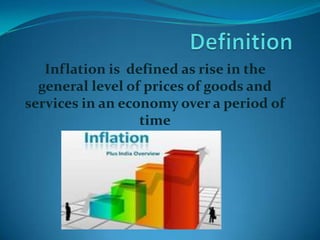
Inflation is defined as rise in the
  general level of prices of goods and
services in an economy over a period of
                  time
Other Definitions
a) Harry Johnson “sustained rise in price”
b) Coulborne “Too much money chasing
   too few goods.”
c) Crowther “a state in which the value of
     money is falling i e. prices are rising.”
d) Samuelson “ inflation occurs when the
   general level prices and costs are
   rising”
e) J M Keynes “ increase price after the
   level of full employment is reached is
   true inflation”
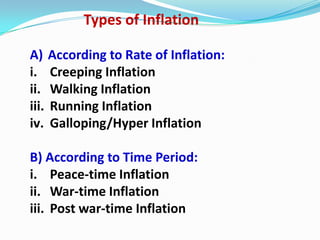
Types of Inflation

A) According to Rate of Inflation:
i. Creeping Inflation
ii. Walking Inflation
iii. Running Inflation
iv. Galloping/Hyper Inflation

B) According to Time Period:
i. Peace-time Inflation
ii. War-time Inflation
iii. Post war-time Inflation
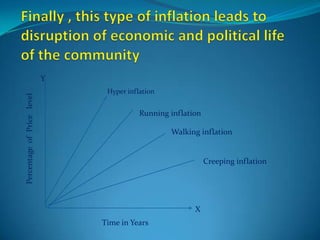
Y
                                 Hyper inflation
Percentage of Price level


                                           Running inflation

                                                   Walking inflation


                                                               Creeping inflation


                                                          X
                                Time in Years
C) According to the scope or coverage
i. Comprehensive inflation
ii. Sporadic inflation


D) According to the Government’s reaction

i. Open inflation
ii. Suppressed inflation
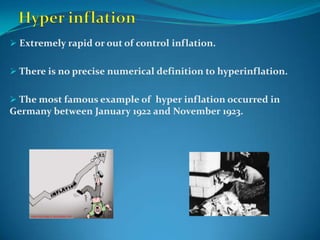
 Extremely rapid or out of control inflation.


 There is no precise numerical definition to hyperinflation.


 The most famous example of hyper inflation occurred in
Germany between January 1922 and November 1923.
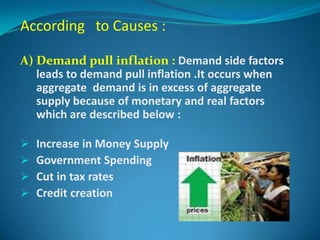
According to Causes :

A) Demand pull inflation : Demand side factors
   leads to demand pull inflation .It occurs when
   aggregate demand is in excess of aggregate
   supply because of monetary and real factors
   which are described below :

   Increase in Money Supply
   Government Spending
   Cut in tax rates
   Credit creation
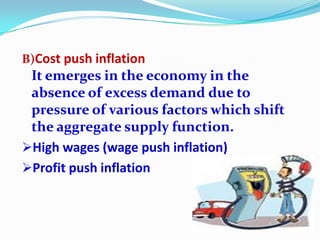
B)Cost push inflation
 It emerges in the economy in the
 absence of excess demand due to
 pressure of various factors which shift
 the aggregate supply function.
High wages (wage push inflation)
Profit push inflation
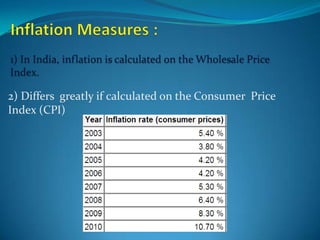
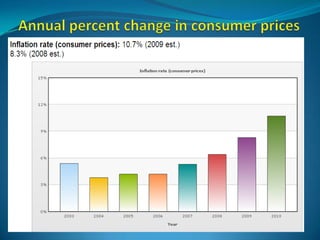
2) Differs greatly if calculated on the Consumer Price
Index (CPI)
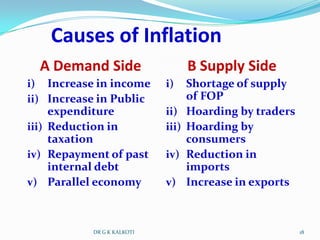
Causes of Inflation
  A Demand Side                    B Supply Side
i) Increase in income       i)     Shortage of supply
ii) Increase in Public             of FOP
     expenditure            ii)    Hoarding by traders
iii) Reduction in           iii)   Hoarding by
     taxation                      consumers
iv) Repayment of past       iv)    Reduction in
     internal debt                 imports
v) Parallel economy         v)     Increase in exports


           DR G K KALKOTI                                18
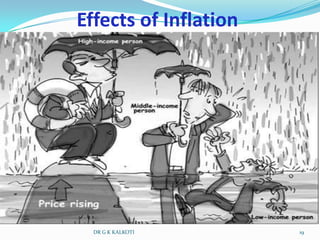
Effects of Inflation


  DR G K KALKOTI       19
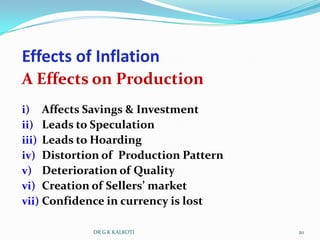
Effects of Inflation
A Effects on Production
i) Affects Savings & Investment
ii) Leads to Speculation
iii) Leads to Hoarding
iv) Distortion of Production Pattern
v) Deterioration of Quality
vi) Creation of Sellers’ market
vii) Confidence in currency is lost

            DR G K KALKOTI             20
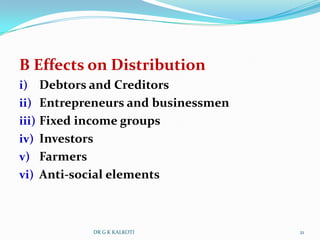
B Effects on Distribution
i) Debtors and Creditors
ii) Entrepreneurs and businessmen
iii) Fixed income groups
iv) Investors
v) Farmers
vi) Anti-social elements


                DR G K KALKOTI      21
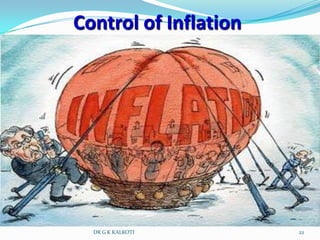
Control of Inflation


  DR G K KALKOTI       22
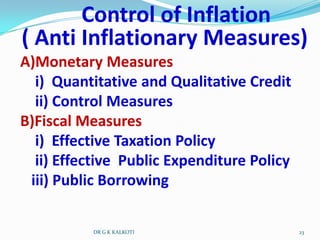
Control of Inflation
( Anti Inflationary Measures)
A)Monetary Measures
  i) Quantitative and Qualitative Credit
  ii) Control Measures
B)Fiscal Measures
  i) Effective Taxation Policy
  ii) Effective Public Expenditure Policy
 iii) Public Borrowing

           DR G K KALKOTI                   23
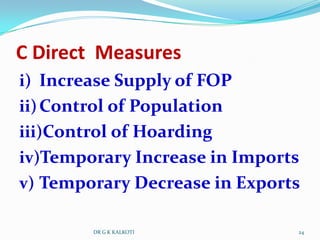
C Direct Measures
i) Increase Supply of FOP
ii) Control of Population
iii)Control of Hoarding
iv)Temporary Increase in Imports
v) Temporary Decrease in Exports

         DR G K KALKOTI        24
Thank You

  DR G K KALKOTI   25

Inflation

  • 6.
    Inflation is therate at which prices increase annually Prices go up due to two factors i.e. cost-push factors and Demand-pull factors . Too much money chasing, too few goods.
  • 7.
    For a CommonMan - Rise in price. In Economics – Slow & Steady rise in price over a period of time
  • 8.
    Inflation is definedas rise in the general level of prices of goods and services in an economy over a period of time
  • 9.
    Other Definitions a) HarryJohnson “sustained rise in price” b) Coulborne “Too much money chasing too few goods.” c) Crowther “a state in which the value of money is falling i e. prices are rising.” d) Samuelson “ inflation occurs when the general level prices and costs are rising” e) J M Keynes “ increase price after the level of full employment is reached is true inflation”
  • 10.
    Types of Inflation A)According to Rate of Inflation: i. Creeping Inflation ii. Walking Inflation iii. Running Inflation iv. Galloping/Hyper Inflation B) According to Time Period: i. Peace-time Inflation ii. War-time Inflation iii. Post war-time Inflation
  • 11.
    Y Hyper inflation Percentage of Price level Running inflation Walking inflation Creeping inflation X Time in Years
  • 12.
    C) According tothe scope or coverage i. Comprehensive inflation ii. Sporadic inflation D) According to the Government’s reaction i. Open inflation ii. Suppressed inflation
  • 13.
     Extremely rapidor out of control inflation.  There is no precise numerical definition to hyperinflation.  The most famous example of hyper inflation occurred in Germany between January 1922 and November 1923.
  • 14.
    According to Causes: A) Demand pull inflation : Demand side factors leads to demand pull inflation .It occurs when aggregate demand is in excess of aggregate supply because of monetary and real factors which are described below :  Increase in Money Supply  Government Spending  Cut in tax rates  Credit creation
  • 15.
    B)Cost push inflation It emerges in the economy in the absence of excess demand due to pressure of various factors which shift the aggregate supply function. High wages (wage push inflation) Profit push inflation
  • 16.
    2) Differs greatlyif calculated on the Consumer Price Index (CPI)
  • 18.
    Causes of Inflation A Demand Side B Supply Side i) Increase in income i) Shortage of supply ii) Increase in Public of FOP expenditure ii) Hoarding by traders iii) Reduction in iii) Hoarding by taxation consumers iv) Repayment of past iv) Reduction in internal debt imports v) Parallel economy v) Increase in exports DR G K KALKOTI 18
  • 19.
    Effects of Inflation DR G K KALKOTI 19
  • 20.
    Effects of Inflation AEffects on Production i) Affects Savings & Investment ii) Leads to Speculation iii) Leads to Hoarding iv) Distortion of Production Pattern v) Deterioration of Quality vi) Creation of Sellers’ market vii) Confidence in currency is lost DR G K KALKOTI 20
  • 21.
    B Effects onDistribution i) Debtors and Creditors ii) Entrepreneurs and businessmen iii) Fixed income groups iv) Investors v) Farmers vi) Anti-social elements DR G K KALKOTI 21
  • 22.
    Control of Inflation DR G K KALKOTI 22
  • 23.
    Control of Inflation (Anti Inflationary Measures) A)Monetary Measures i) Quantitative and Qualitative Credit ii) Control Measures B)Fiscal Measures i) Effective Taxation Policy ii) Effective Public Expenditure Policy iii) Public Borrowing DR G K KALKOTI 23
  • 24.
    C Direct Measures i)Increase Supply of FOP ii) Control of Population iii)Control of Hoarding iv)Temporary Increase in Imports v) Temporary Decrease in Exports DR G K KALKOTI 24
  • 25.
    Thank You DR G K KALKOTI 25