
BALANCE OF PAYMENTS
TRADE
INTERNAL & INTERNATIONAL TRADE
VISIBLE & INVISIBLE ITEMS
BALANCE OF TRADE
BALANCE OF PAYMENTS
DISTINCTION BETWEEN BALANCE OF
TRADE & BALANCE OF PAYMENTS
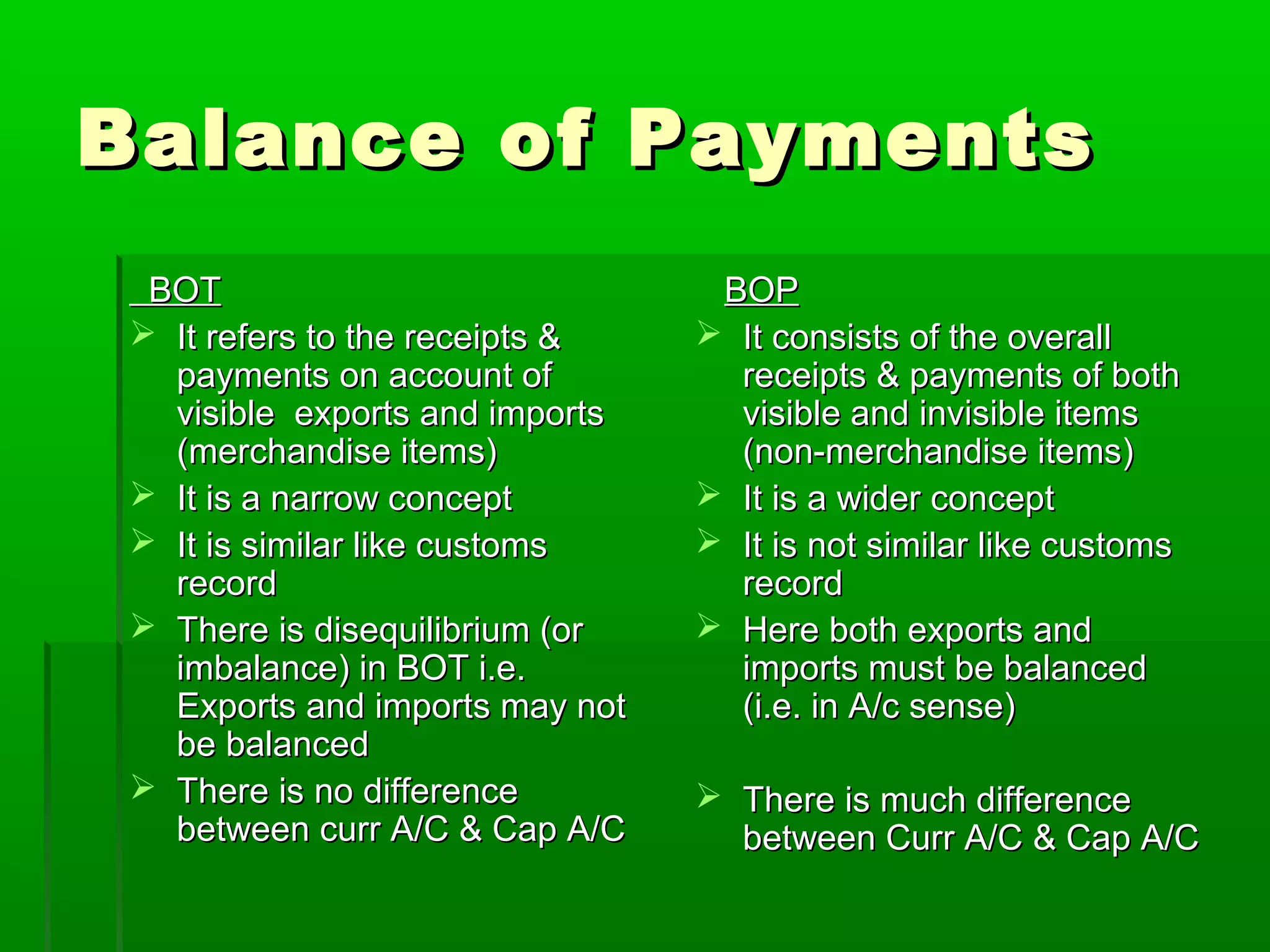
Balance of Payments
 BOT                             BOP
 It refers to the receipts &    It consists of the overall
  payments on account of          receipts & payments of both
  visible exports and imports     visible and invisible items
  (merchandise items)             (non-merchandise items)
 It is a narrow concept         It is a wider concept
 It is similar like customs     It is not similar like customs
  record                          record
 There is disequilibrium (or    Here both exports and
  imbalance) in BOT i.e.          imports must be balanced
  Exports and imports may not     (i.e. in A/c sense)
  be balanced
 There is no difference         There is much difference
  between curr A/C & Cap A/C      between Curr A/C & Cap A/C
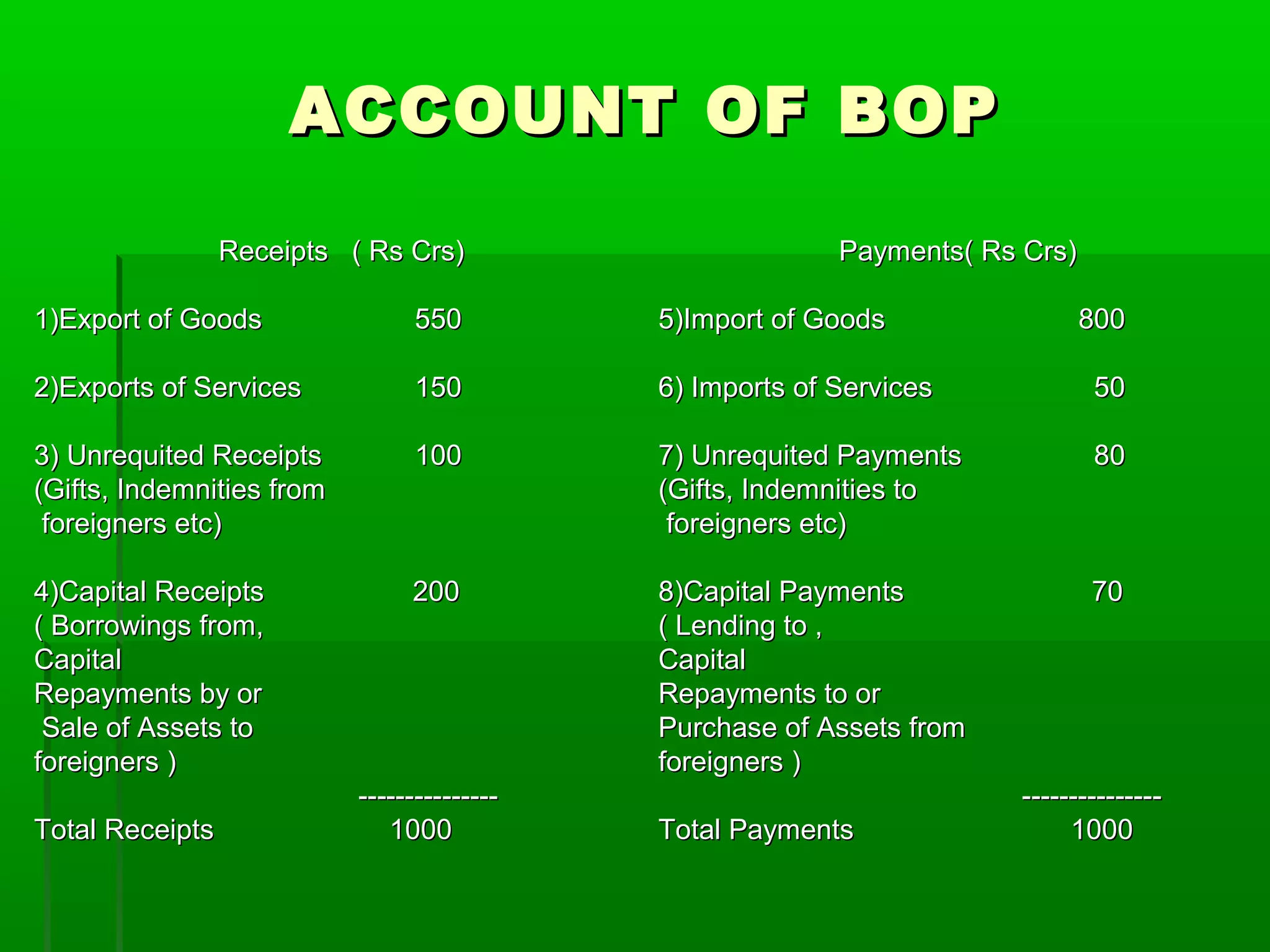
ACCOUNT OF BOP

                 Receipts ( Rs Crs)                        Payments( Rs Crs)

1)Export of Goods                550         5)Import of Goods                 800

2)Exports of Services            150         6) Imports of Services            50

3) Unrequited Receipts           100         7) Unrequited Payments            80
(Gifts, Indemnities from                     (Gifts, Indemnities to
 foreigners etc)                              foreigners etc)

4)Capital Receipts              200          8)Capital Payments                70
( Borrowings from,                           ( Lending to ,
Capital                                      Capital
Repayments by or                             Repayments to or
 Sale of Assets to                           Purchase of Assets from
foreigners )                                 foreigners )
                           ---------------                              ---------------
Total Receipts                1000           Total Payments                  1000
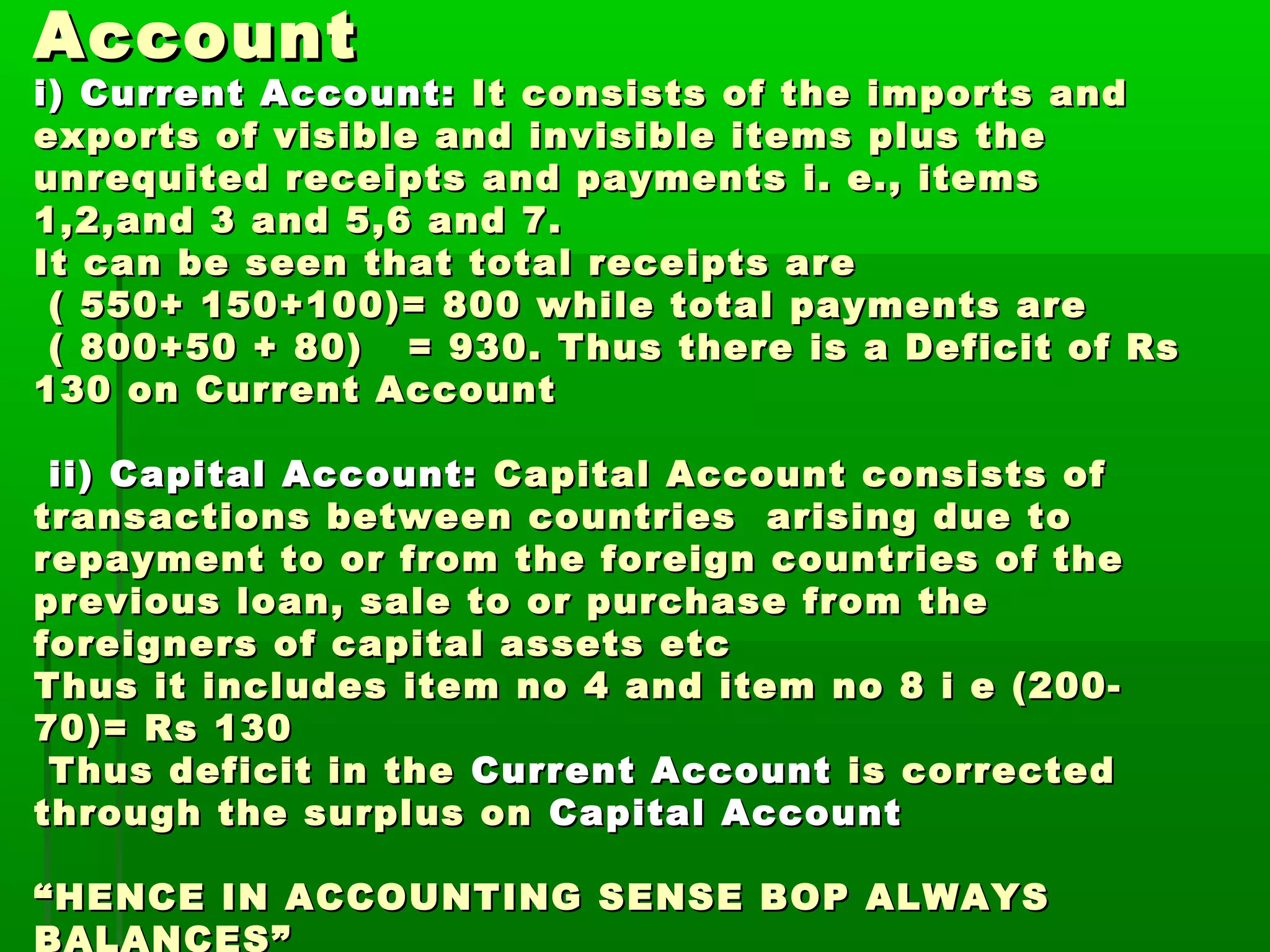
Account
i) Current Account: It consists of the imports and
exports of visible and invisible items plus the
unrequited receipts and payments i. e., items
1,2,and 3 and 5,6 and 7.
It can be seen that total receipts are
 ( 550+ 150+100)= 800 while total payments are
 ( 800+50 + 80) = 930. Thus there is a Deficit of Rs
130 on Current Account

 ii) Capital Account: Capital Account consists of
transactions between countries arising due to
repayment to or from the foreign countries of the
previous loan, sale to or purchase from the
foreigners of capital assets etc
Thus it includes item no 4 and item no 8 i e (200-
70)= Rs 130
 Thus deficit in the Current Account is corrected
through the surplus on Capital Account

“HENCE IN ACCOUNTING SENSE BOP ALWAYS
BALANCES”
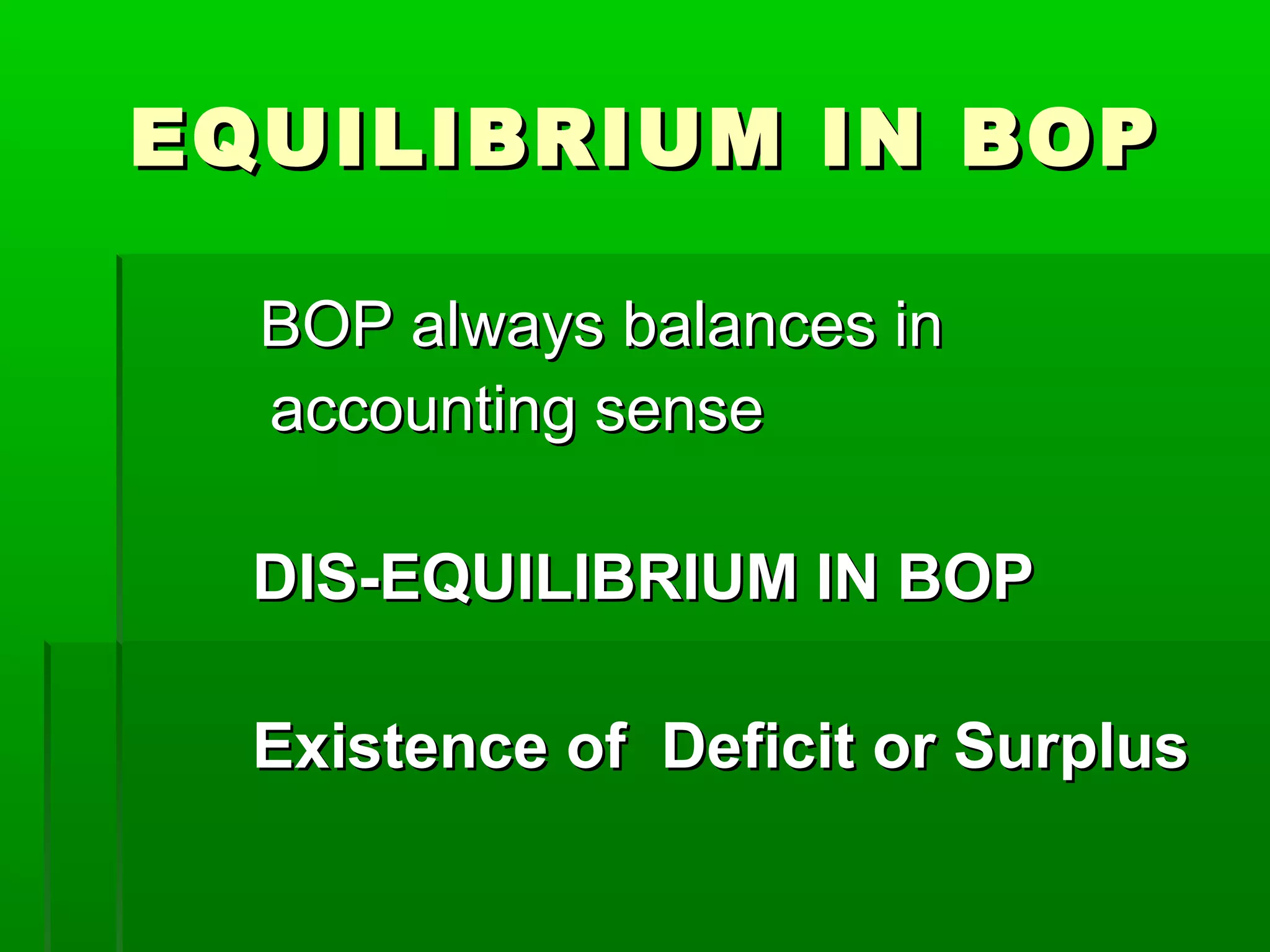
EQUILIBRIUM IN BOP

  BOP always balances in
  accounting sense

  DIS-EQUILIBRIUM IN BOP

  Existence of Deficit or Surplus
TYPES OF DIS-
      EQUILIBRIUM IN BOP
1)CYCLICAL DIS-EQUILIBRIUM
   Caused due to Cyclical Fluctuations

2)SECULAR DIS-EQUILIBRIUM
   Due to change in the economy from one
   stage to another (for eco devpt)

3)STRUCTURAL DIS-EQUILIBRIUM
   Due to change in the structure of the economy
   Eg Decline of a particular industry, Loss of Service,
   War , Nationalizations etc

4)FUNDAMENTAL DIS-EQUILIBRIUM
   Originally coined by I M F
   Long-Term Dis-Equm-
   More than Five Years
CAUSES OF DIS-
     EQUILIBRIUM IN BOP
   1) Economic Development of a Country.
   2) Increase in Income of people.
   3) Rise in Price-Level.
   4) Decrease in Exports.
   5) Repayment of Foreign Loans.
   6) Rapid Growth of Population.
   7) Imposition of Tariffs & Non-Tariff Barriers.
   8) Lack of International Co- operation
Measures to correct Dis- equilibrium in BOP


Monetary Measures                          Non-Monetary Measures
1.Deflation
2.Exchange
                          Export Promotion      Import Restriction
 Depreciation             1.Reducing export    1.Increasing import
3. Devaluation                                    duties
                           duties
a) Elasticity of Demand                        2.Import quotas
                          2.Export subsidies
b) Elasticity of Supply                        3.Licining of import
                          3.Incentives
c) Cost-Price Structure                           of specific goods
d) No-Retaliation
Bop

Bop

  • 1.
    BALANCE OF PAYMENTS TRADE INTERNAL& INTERNATIONAL TRADE VISIBLE & INVISIBLE ITEMS BALANCE OF TRADE BALANCE OF PAYMENTS DISTINCTION BETWEEN BALANCE OF TRADE & BALANCE OF PAYMENTS
  • 2.
    Balance of Payments BOT BOP  It refers to the receipts &  It consists of the overall payments on account of receipts & payments of both visible exports and imports visible and invisible items (merchandise items) (non-merchandise items)  It is a narrow concept  It is a wider concept  It is similar like customs  It is not similar like customs record record  There is disequilibrium (or  Here both exports and imbalance) in BOT i.e. imports must be balanced Exports and imports may not (i.e. in A/c sense) be balanced  There is no difference  There is much difference between curr A/C & Cap A/C between Curr A/C & Cap A/C
  • 3.
    ACCOUNT OF BOP Receipts ( Rs Crs) Payments( Rs Crs) 1)Export of Goods 550 5)Import of Goods 800 2)Exports of Services 150 6) Imports of Services 50 3) Unrequited Receipts 100 7) Unrequited Payments 80 (Gifts, Indemnities from (Gifts, Indemnities to foreigners etc) foreigners etc) 4)Capital Receipts 200 8)Capital Payments 70 ( Borrowings from, ( Lending to , Capital Capital Repayments by or Repayments to or Sale of Assets to Purchase of Assets from foreigners ) foreigners ) --------------- --------------- Total Receipts 1000 Total Payments 1000
  • 4.
    Account i) Current Account:It consists of the imports and exports of visible and invisible items plus the unrequited receipts and payments i. e., items 1,2,and 3 and 5,6 and 7. It can be seen that total receipts are ( 550+ 150+100)= 800 while total payments are ( 800+50 + 80) = 930. Thus there is a Deficit of Rs 130 on Current Account ii) Capital Account: Capital Account consists of transactions between countries arising due to repayment to or from the foreign countries of the previous loan, sale to or purchase from the foreigners of capital assets etc Thus it includes item no 4 and item no 8 i e (200- 70)= Rs 130 Thus deficit in the Current Account is corrected through the surplus on Capital Account “HENCE IN ACCOUNTING SENSE BOP ALWAYS BALANCES”
  • 5.
    EQUILIBRIUM IN BOP BOP always balances in accounting sense DIS-EQUILIBRIUM IN BOP Existence of Deficit or Surplus
  • 6.
    TYPES OF DIS- EQUILIBRIUM IN BOP 1)CYCLICAL DIS-EQUILIBRIUM Caused due to Cyclical Fluctuations 2)SECULAR DIS-EQUILIBRIUM Due to change in the economy from one stage to another (for eco devpt) 3)STRUCTURAL DIS-EQUILIBRIUM Due to change in the structure of the economy Eg Decline of a particular industry, Loss of Service, War , Nationalizations etc 4)FUNDAMENTAL DIS-EQUILIBRIUM Originally coined by I M F Long-Term Dis-Equm- More than Five Years
  • 7.
    CAUSES OF DIS- EQUILIBRIUM IN BOP  1) Economic Development of a Country.  2) Increase in Income of people.  3) Rise in Price-Level.  4) Decrease in Exports.  5) Repayment of Foreign Loans.  6) Rapid Growth of Population.  7) Imposition of Tariffs & Non-Tariff Barriers.  8) Lack of International Co- operation
  • 8.
    Measures to correctDis- equilibrium in BOP Monetary Measures Non-Monetary Measures 1.Deflation 2.Exchange Export Promotion Import Restriction Depreciation 1.Reducing export 1.Increasing import 3. Devaluation duties duties a) Elasticity of Demand 2.Import quotas 2.Export subsidies b) Elasticity of Supply 3.Licining of import 3.Incentives c) Cost-Price Structure of specific goods d) No-Retaliation