



Introduction to Macroeconomics
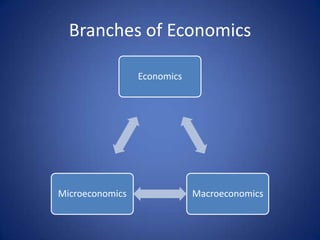
Branches of Economics

                 Economics


Microeconomics               Macroeconomics
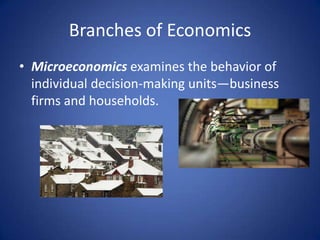
Branches of Economics
• Microeconomics examines the behavior of
  individual decision-making units—business
  firms and households.
• Macroeconomics deals with the economy as a whole; it
  examines the behavior of economic aggregates such as
  aggregate income, consumption, investment, and the overall
  level of prices.
    – Aggregate behavior refers to the behavior of all households and
      firms together.
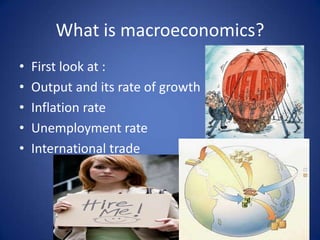
What is macroeconomics?
•   First look at :
•   Output and its rate of growth
•   Inflation rate
•   Unemployment rate
•   International trade
Measuring Economic growth
• Gross Domestic Product (GDP)
Value of all the final goods and services produced
  within a country in given period of time.
• Real GDP
The volume of goods and services produced within a
  country (i.e. GDP adjusted for inflation)
• Economic growth
Percentage rate of increase of real GDP
Measuring Inflation
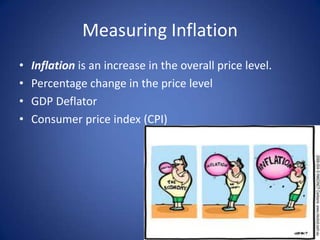
•   Inflation is an increase in the overall price level.
•   Percentage change in the price level
•   GDP Deflator
•   Consumer price index (CPI)
Measuring Unemployment
• Labor force = employed + unemployed
• Unemployment rate = unemployment/labor force
• Unemployment= Does not have a job and has been
  seeking for a job for past 4 weeks.
• The long term unemployment is the share of
  unemployed persons since
  12 months and more in the
  total numbers of the active
  persons in labor market.
International trade/ Trade balance
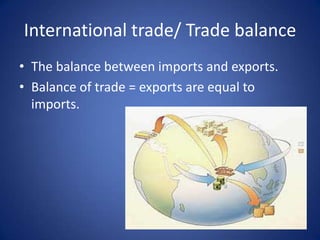
• The balance between imports and exports.
• Balance of trade = exports are equal to
  imports.
Three Models
• Macroeconomics is organised around three
  models
• Each model is concerned with different time
  frames
    – The long run
    – The medium run
    – The short run
• Let’s consider each in more detail
Very Long Run Economic Growth
• Growth theory describes the long run
  behaviour of the economy
• The time is usually measured in multiples of
  decades (e.g. 20 years or more)
• The focus is on the average growth in
  important macroeconomic variables
• Short-run fluctuations in important variables
  like employment, investment and output are
  ignored
Very Long Run Economic Growth
• The long run level of output is determined
  solely by supply-side considerations
• That is, output is determined by the
  productive capacity of the economy
• All factors of production are assumed to be
  fully employed
• Economic growth is, therefore, a function of
  increases in productive capacity
Very Long Run Economic Growth
• Differences in average growth rates of
  economies are important
• Major causes of economic growth are
    –   Development of new technology
    –   Accumulation of physical and human capital
    –   Appropriate provision of infrastructure
    –   Higher rates of domestic saving
Very Long Run Economic Growth
•   Economic growth determines the changes in the
    standard of living
•   A country growing at an average of 4% per year
    instead of 2% will have a 50% higher standard of
    living over a generation of 20 years
•   This higher 4% average annual growth rate will
    lead to a seven fold increase in the standard of
    living over 100 years!
•   Let’s now introduce a model which will be useful
    for our analysis
Fixed Productive Capacity
• What determines the change in the overall
  price level (the inflation rate)?
• The aggregate supply (AS)–aggregate
  demand (AD) model explains short- to
  medium-run determination of inflation and
  real output
• In the long run the productive capacity of the
  economy is assumed to be constant
Fixed Productive Capacity

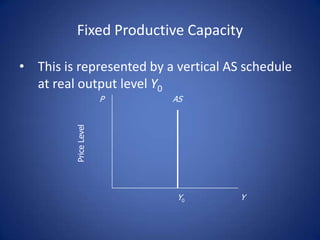
• This is represented by a vertical AS schedule
  at real output level Y0
                       P   AS
         Price Level


                           Y0         Y
Fixed Productive Capacity

• The AD schedule represents, for each price
  level, the level of output where both the
  goods and money markets are in equilibrium
• These schedules will be fully explained in
  next lectures
• The intersection of the AS and AD schedules
  determines the price (P0) and real output (Y0)
Fixed Productive Capacity

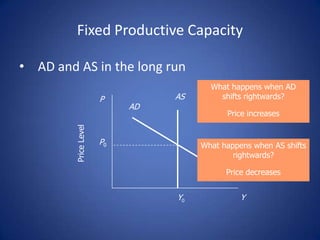
• AD and AS in the long run
                                        What happens when AD
                       P         AS       shifts rightwards?
                            AD
                                            Price increases
         Price Level


                       P0             What happens when AS shifts
                                              rightwards?

                                            Price decreases


                                 Y0             Y
The Short Run

• Short-run fluctuations in real output are
  important
• AD is the major determinant of these
  variations
• In the short run the price level is pegged at
  P0 making the short-run AS schedule
  horizontal
The Short Run

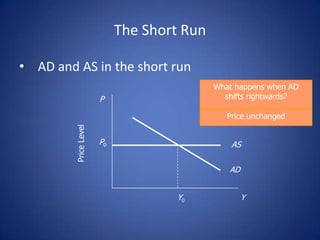
• AD and AS in the short run
                                            What happens when AD
                       P                      shifts rightwards?

                                               Price unchanged
         Price Level


                       P0                       AS

                                               AD


                                    Y0              Y
The Medium Run

• How do we describe the transition between
  the short run and long run?
• High AD pushes real output above Y0
  (according to the long-run model)
• Over time, firms will increase prices and the
  AS curve will move upwards
• The medium run will give an upsloping AS
  curve
The Medium Run

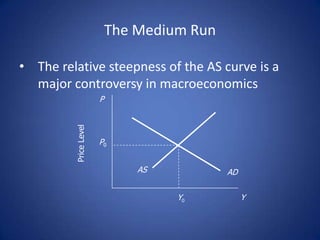
• The relative steepness of the AS curve is a
  major controversy in macroeconomics
                       P
         Price Level


                       P0


                               AS           AD

                                    Y0           Y
To Reiterate …

• Growth theory, AS and AD form a very
  important framework for the further
  analysis of
    – Growth and GDP
    – The business cycle
• Let’s consider each in turn
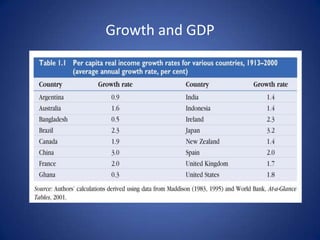
Growth and GDP
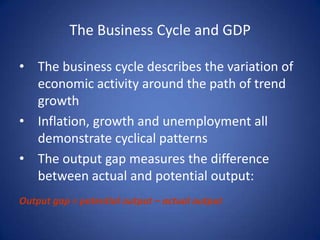
The Business Cycle and GDP

• The business cycle describes the variation of
  economic activity around the path of trend
  growth
• Inflation, growth and unemployment all
  demonstrate cyclical patterns
• The output gap measures the difference
  between actual and potential output:
Output gap = potential output – actual output
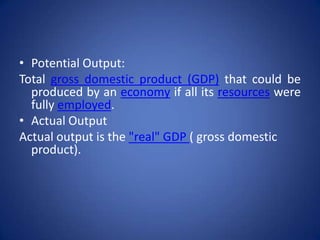
• Potential Output:
Total gross domestic product (GDP) that could be
  produced by an economy if all its resources were
  fully employed.
• Actual Output
Actual output is the "real" GDP ( gross domestic
  product).
The Business Cycle and Inflation

• Increases in inflation are inversely related to
  the output gap
• Expansionary AD policies tend to produce
  inflation when unemployment is relatively
  low
• The cost of the cycle above trend is inflation
  and the cost below trend is unemployment
Business Cycle Features

• Business cycles have common characteristics
• Procyclical variables rise with expansionary
  business activity (e.g.
  output, employment, interest rates and
  money supply)
• Countercyclical variables (like inventories and
  bankruptcies) move in the opposite direction
  to business activity
• Procyclical has a different meaning in the
  context of economic policy. In this context, it
  refers to any aspect of economic policy that
  could magnify economic or financial
  fluctuations.
• An economic policy that is believed to
  decrease fluctuations is called countercyclical.
Business Cycle Features

• Some variables exhibit more variability than
  others (e.g. inventories are volatile while
  consumption is smooth, especially relative to
  output)
• The impulse-propagation model describes:
    – how a shock (impulse) disturbs the economy
      from a long-run trend
    – which lasts (propagates) over time
• Economists disagree over possible
  propagation mechanisms
Business Cycle Features

• There are three broad types of shocks
    – Policy shocks which affect fiscal expenditure
      and interest rates (e.g. fiscal and monetary
      policies)
    – Supply shocks which affect production and
      price-setting (e.g. technology advances)
    – Private sector shocks which affect aggregate
      demand (e.g. changes in private investment)
Business Cycle Features

• There is debate about the actual timing of
  business cycles
• Which measure should be used?
    – Variables like unemployment lag changes in
      real GDP (called lagging indicators)
    – Leading indicators like firms’ profitability and
      building approvals precede changes in GDP
    – Aggregating variables into a composite index
      will give a coincident index to measure turning
      points in the business cycle
Business Cycle Features

• Another debate concerns separating the
  cycle from trend
   – The classical business cycle considers actual
     levels so that a fall in GDP describes negative
     growth
   – Two consecutive quarters of negative growth
     in real GDP is called a (classical) recession
   – The growth cycle considers fluctuations in
     growth rates of the economy around the trend
     growth rate
1.3 Schools of Thought
•   During the 1960s there were two main
    views
     –   The monetarists believed the economy is best
         left to itself
     –   The Keynesian’s argued that government
         intervention could improve economic
         performance
•   Two schools have developed since then
     –   the new classical school in the 1970s
     –   the Keynesian school in the 1980–90s
New Classical School

• Consistent with the monetarist view
    – Economic agents optimise
    – Decisions rationally use all available
      information (rational expectations)
    – Markets are assumed to clear
• These assumptions ensure there is no
  involuntary unemployment
• The real business cycle extension argues that
  real supply side shocks are the major causes
  of fluctuations in economic activity
New Keynesian School

• Extends the earlier Keynesian view that
  markets will not always clear even if agents
  are maximising
• Reasons are varied and include
    – There is incomplete information
    – Institutions affect the workings of markets
    – Costs of changing wages and prices lead to
      price rigidities
• These reasons explain fluctuations in output
  and employment
Economic Controversies

• The two main competing views of modern
  macroeconomics are highlighted in real-
  world political and media discussions
• Frequently these differences are exaggerated
  in debate
• There are significant areas of agreement
• Debate and research continually evolve new
  areas of consensus e.g. there is increasing
  agreement on information problems with
  wage-price setting
Thanks

Macro ch 1

  • 1.
  • 2.
    Branches of Economics Economics Microeconomics Macroeconomics
  • 3.
    Branches of Economics •Microeconomics examines the behavior of individual decision-making units—business firms and households.
  • 4.
    • Macroeconomics dealswith the economy as a whole; it examines the behavior of economic aggregates such as aggregate income, consumption, investment, and the overall level of prices. – Aggregate behavior refers to the behavior of all households and firms together.
  • 5.
    What is macroeconomics? • First look at : • Output and its rate of growth • Inflation rate • Unemployment rate • International trade
  • 6.
    Measuring Economic growth •Gross Domestic Product (GDP) Value of all the final goods and services produced within a country in given period of time. • Real GDP The volume of goods and services produced within a country (i.e. GDP adjusted for inflation) • Economic growth Percentage rate of increase of real GDP
  • 7.
    Measuring Inflation • Inflation is an increase in the overall price level. • Percentage change in the price level • GDP Deflator • Consumer price index (CPI)
  • 8.
    Measuring Unemployment • Laborforce = employed + unemployed • Unemployment rate = unemployment/labor force • Unemployment= Does not have a job and has been seeking for a job for past 4 weeks. • The long term unemployment is the share of unemployed persons since 12 months and more in the total numbers of the active persons in labor market.
  • 9.
    International trade/ Tradebalance • The balance between imports and exports. • Balance of trade = exports are equal to imports.
  • 10.
    Three Models • Macroeconomicsis organised around three models • Each model is concerned with different time frames – The long run – The medium run – The short run • Let’s consider each in more detail
  • 11.
    Very Long RunEconomic Growth • Growth theory describes the long run behaviour of the economy • The time is usually measured in multiples of decades (e.g. 20 years or more) • The focus is on the average growth in important macroeconomic variables • Short-run fluctuations in important variables like employment, investment and output are ignored
  • 12.
    Very Long RunEconomic Growth • The long run level of output is determined solely by supply-side considerations • That is, output is determined by the productive capacity of the economy • All factors of production are assumed to be fully employed • Economic growth is, therefore, a function of increases in productive capacity
  • 13.
    Very Long RunEconomic Growth • Differences in average growth rates of economies are important • Major causes of economic growth are – Development of new technology – Accumulation of physical and human capital – Appropriate provision of infrastructure – Higher rates of domestic saving
  • 14.
    Very Long RunEconomic Growth • Economic growth determines the changes in the standard of living • A country growing at an average of 4% per year instead of 2% will have a 50% higher standard of living over a generation of 20 years • This higher 4% average annual growth rate will lead to a seven fold increase in the standard of living over 100 years! • Let’s now introduce a model which will be useful for our analysis
  • 15.
    Fixed Productive Capacity •What determines the change in the overall price level (the inflation rate)? • The aggregate supply (AS)–aggregate demand (AD) model explains short- to medium-run determination of inflation and real output • In the long run the productive capacity of the economy is assumed to be constant
  • 16.
    Fixed Productive Capacity •This is represented by a vertical AS schedule at real output level Y0 P AS Price Level Y0 Y
  • 17.
    Fixed Productive Capacity •The AD schedule represents, for each price level, the level of output where both the goods and money markets are in equilibrium • These schedules will be fully explained in next lectures • The intersection of the AS and AD schedules determines the price (P0) and real output (Y0)
  • 18.
    Fixed Productive Capacity •AD and AS in the long run What happens when AD P AS shifts rightwards? AD Price increases Price Level P0 What happens when AS shifts rightwards? Price decreases Y0 Y
  • 19.
    The Short Run •Short-run fluctuations in real output are important • AD is the major determinant of these variations • In the short run the price level is pegged at P0 making the short-run AS schedule horizontal
  • 20.
    The Short Run •AD and AS in the short run What happens when AD P shifts rightwards? Price unchanged Price Level P0 AS AD Y0 Y
  • 21.
    The Medium Run •How do we describe the transition between the short run and long run? • High AD pushes real output above Y0 (according to the long-run model) • Over time, firms will increase prices and the AS curve will move upwards • The medium run will give an upsloping AS curve
  • 22.
    The Medium Run •The relative steepness of the AS curve is a major controversy in macroeconomics P Price Level P0 AS AD Y0 Y
  • 23.
    To Reiterate … •Growth theory, AS and AD form a very important framework for the further analysis of – Growth and GDP – The business cycle • Let’s consider each in turn
  • 24.
  • 25.
    The Business Cycleand GDP • The business cycle describes the variation of economic activity around the path of trend growth • Inflation, growth and unemployment all demonstrate cyclical patterns • The output gap measures the difference between actual and potential output: Output gap = potential output – actual output
  • 26.
    • Potential Output: Totalgross domestic product (GDP) that could be produced by an economy if all its resources were fully employed. • Actual Output Actual output is the "real" GDP ( gross domestic product).
  • 27.
    The Business Cycleand Inflation • Increases in inflation are inversely related to the output gap • Expansionary AD policies tend to produce inflation when unemployment is relatively low • The cost of the cycle above trend is inflation and the cost below trend is unemployment
  • 28.
    Business Cycle Features •Business cycles have common characteristics • Procyclical variables rise with expansionary business activity (e.g. output, employment, interest rates and money supply) • Countercyclical variables (like inventories and bankruptcies) move in the opposite direction to business activity
  • 29.
    • Procyclical hasa different meaning in the context of economic policy. In this context, it refers to any aspect of economic policy that could magnify economic or financial fluctuations. • An economic policy that is believed to decrease fluctuations is called countercyclical.
  • 30.
    Business Cycle Features •Some variables exhibit more variability than others (e.g. inventories are volatile while consumption is smooth, especially relative to output) • The impulse-propagation model describes: – how a shock (impulse) disturbs the economy from a long-run trend – which lasts (propagates) over time • Economists disagree over possible propagation mechanisms
  • 31.
    Business Cycle Features •There are three broad types of shocks – Policy shocks which affect fiscal expenditure and interest rates (e.g. fiscal and monetary policies) – Supply shocks which affect production and price-setting (e.g. technology advances) – Private sector shocks which affect aggregate demand (e.g. changes in private investment)
  • 32.
    Business Cycle Features •There is debate about the actual timing of business cycles • Which measure should be used? – Variables like unemployment lag changes in real GDP (called lagging indicators) – Leading indicators like firms’ profitability and building approvals precede changes in GDP – Aggregating variables into a composite index will give a coincident index to measure turning points in the business cycle
  • 33.
    Business Cycle Features •Another debate concerns separating the cycle from trend – The classical business cycle considers actual levels so that a fall in GDP describes negative growth – Two consecutive quarters of negative growth in real GDP is called a (classical) recession – The growth cycle considers fluctuations in growth rates of the economy around the trend growth rate
  • 34.
    1.3 Schools ofThought • During the 1960s there were two main views – The monetarists believed the economy is best left to itself – The Keynesian’s argued that government intervention could improve economic performance • Two schools have developed since then – the new classical school in the 1970s – the Keynesian school in the 1980–90s
  • 35.
    New Classical School •Consistent with the monetarist view – Economic agents optimise – Decisions rationally use all available information (rational expectations) – Markets are assumed to clear • These assumptions ensure there is no involuntary unemployment • The real business cycle extension argues that real supply side shocks are the major causes of fluctuations in economic activity
  • 36.
    New Keynesian School •Extends the earlier Keynesian view that markets will not always clear even if agents are maximising • Reasons are varied and include – There is incomplete information – Institutions affect the workings of markets – Costs of changing wages and prices lead to price rigidities • These reasons explain fluctuations in output and employment
  • 37.
    Economic Controversies • Thetwo main competing views of modern macroeconomics are highlighted in real- world political and media discussions • Frequently these differences are exaggerated in debate • There are significant areas of agreement • Debate and research continually evolve new areas of consensus e.g. there is increasing agreement on information problems with wage-price setting
  • 38.