


National Income
 Accounting &
Gross Domestic
    Product
Chapter Objectives
• State why national income
  accounting is important
Chapter Objectives
• State why national income accounting is
  important.
• Define GDP, GNP, and NI.
• Calculate GDP in a simple example, avoiding
  double counting.
Chapter Objectives
• Explain why GDP = C + 1 + G + (X - M).
• Distinguish between real and nominal values.
• State some limitations of national income
  accounting.
Measures of Output
• National income accounting refers to a
  set of rules and techniques that are used
  to measure the national income of a
  country.
• It refers to the measurement of
  aggregate economic activity, particularly
  national income and its components.
National Income Accounting
• Measuring Total Economic Output of
  Goods and Services
  –Gross Domestic Product (GDP) is the
   total value of all final goods and
   services produced in an economy in a
   one-year period.
    • It is the single most-used economic
      measure.
National Income Accounting
• Measuring Total Economic Output of
  Goods and Services
  –Gross National Product (GNP) is the
   aggregate final output of citizens and
   businesses of an economy in one year.
National Income Accounting
• Measuring Total Economic Output of
  Goods and Services
  –GDP measures the economic activity
   that occurs within a country.
  –GNP measures the economic activity of
   the citizens and businesses of a
   country.
National Income Accounting
• Moving from GDP to GNP
  –To move from GDP to GNP, net foreign
   factor income is added to GDP.
  –Net foreign factor income is the
   income from foreign domestic factor
   sources minus foreign factor incomes
   earned domestically.
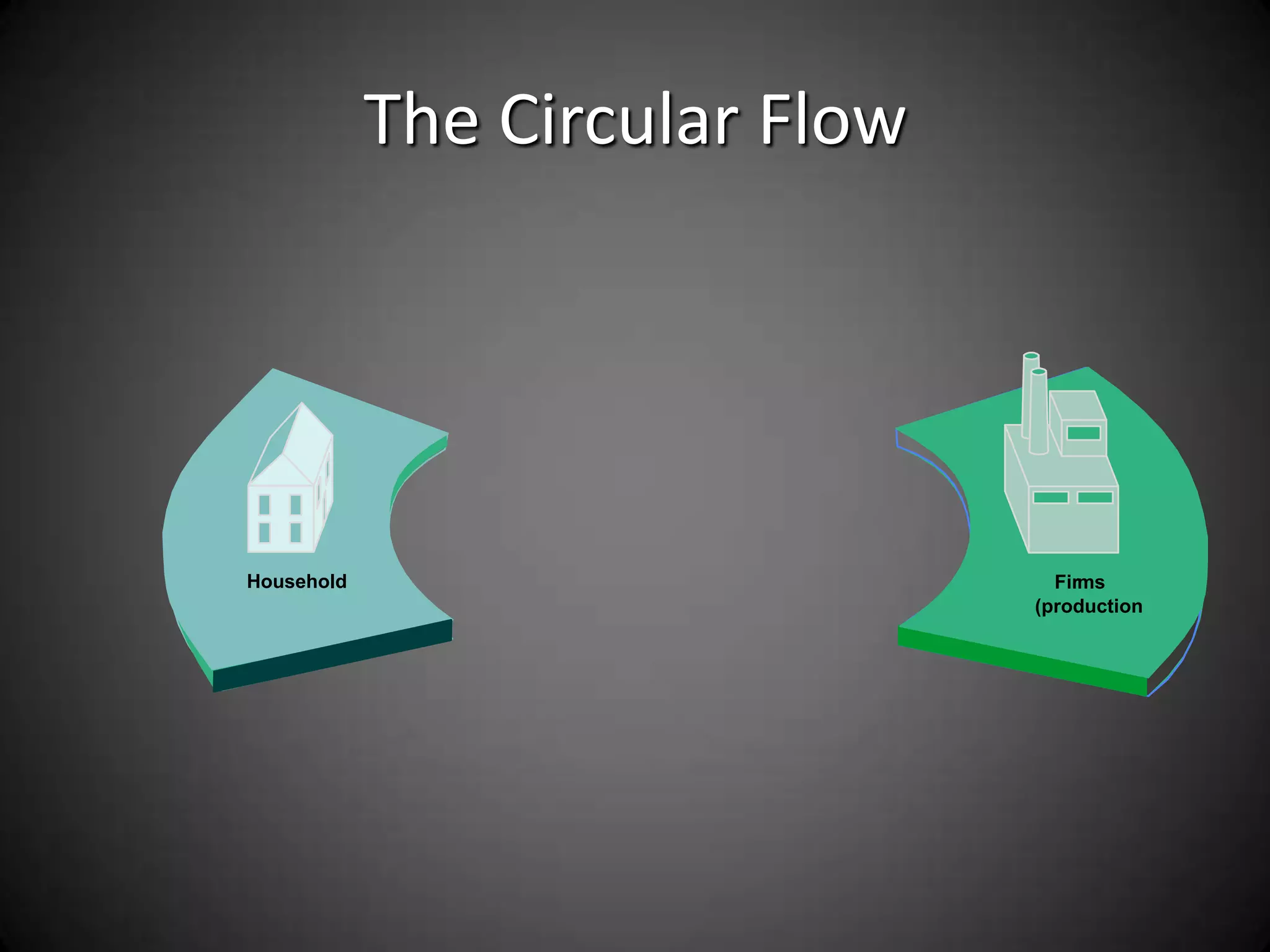
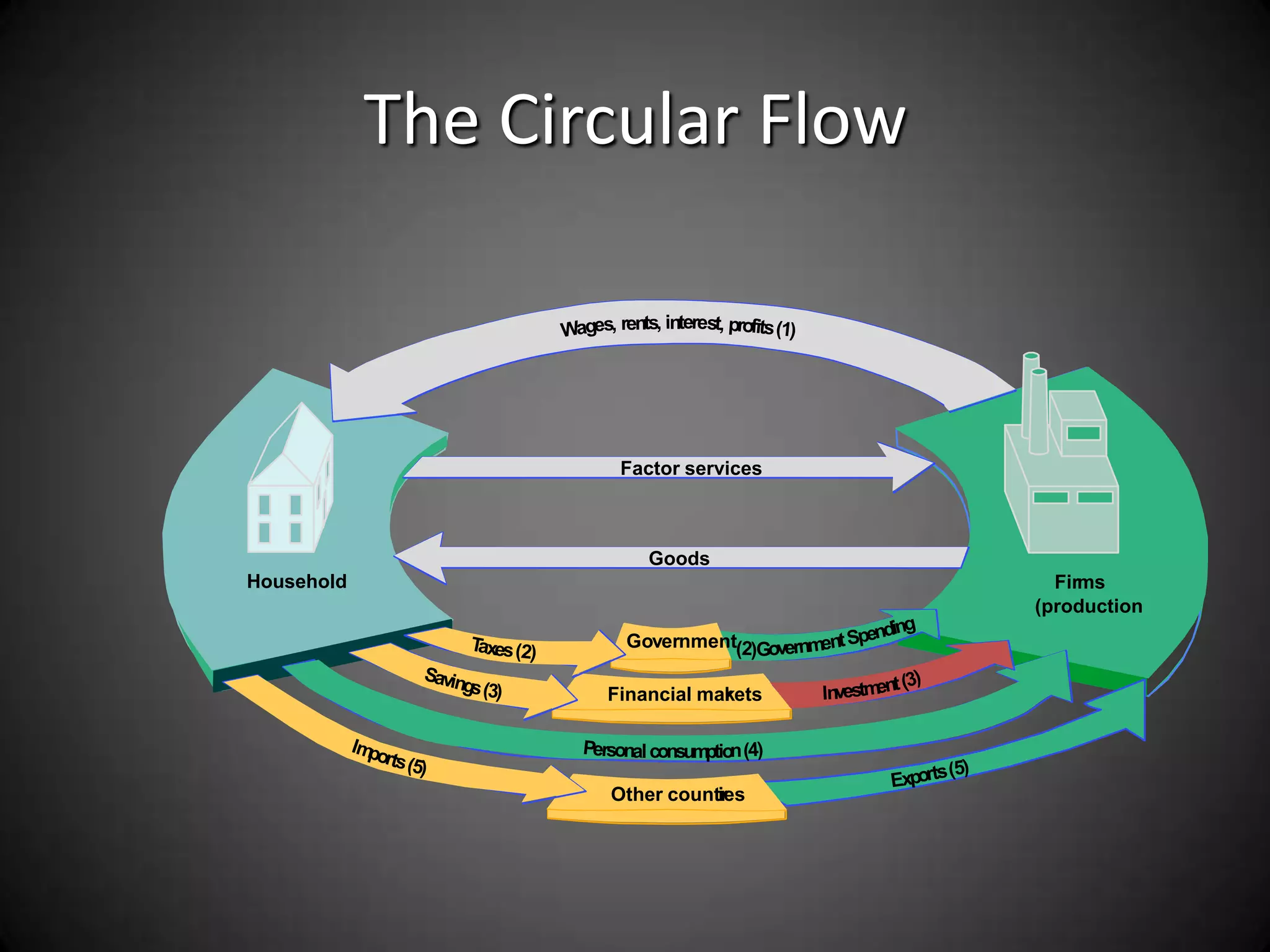
The Circular Flow
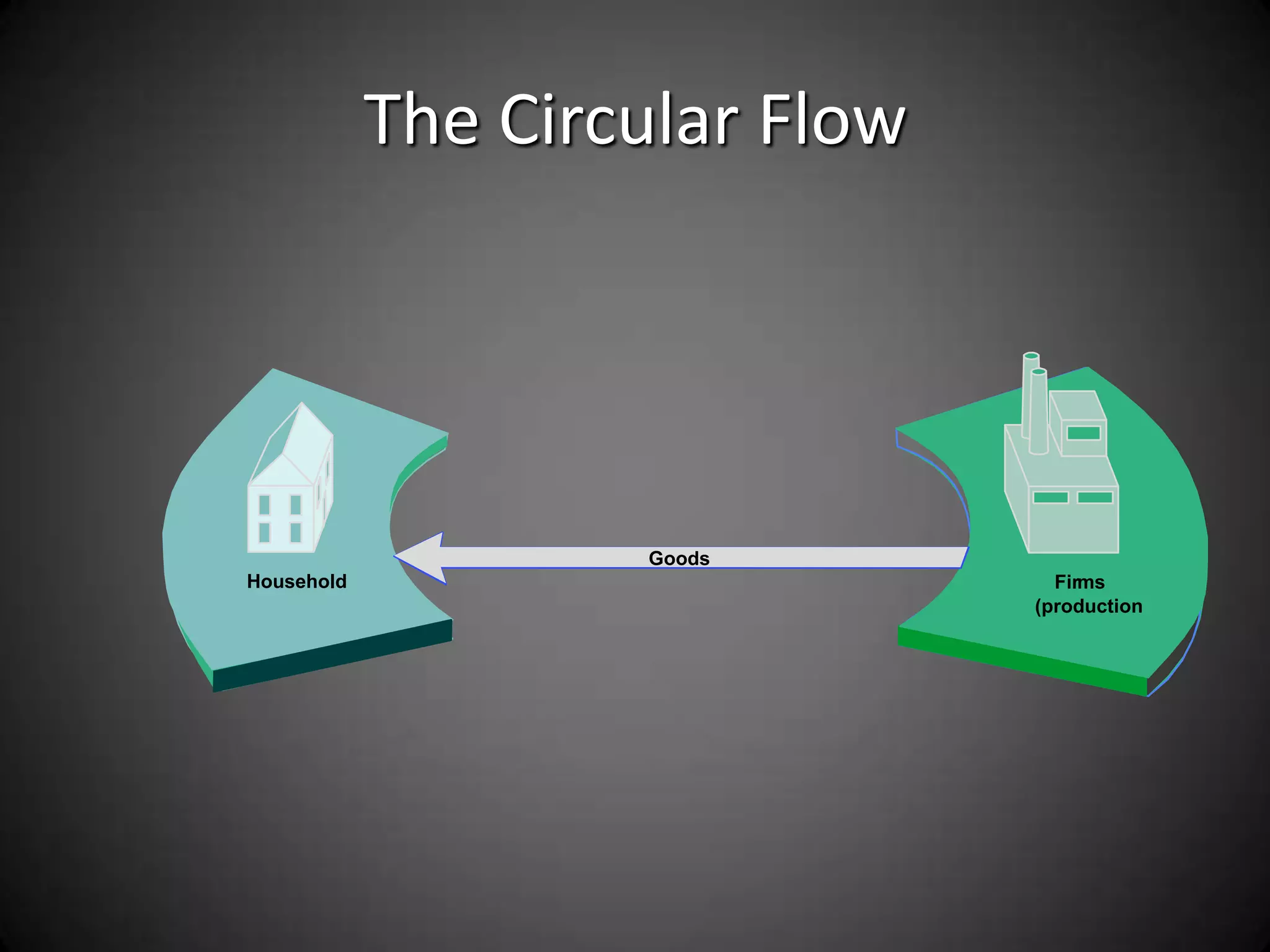
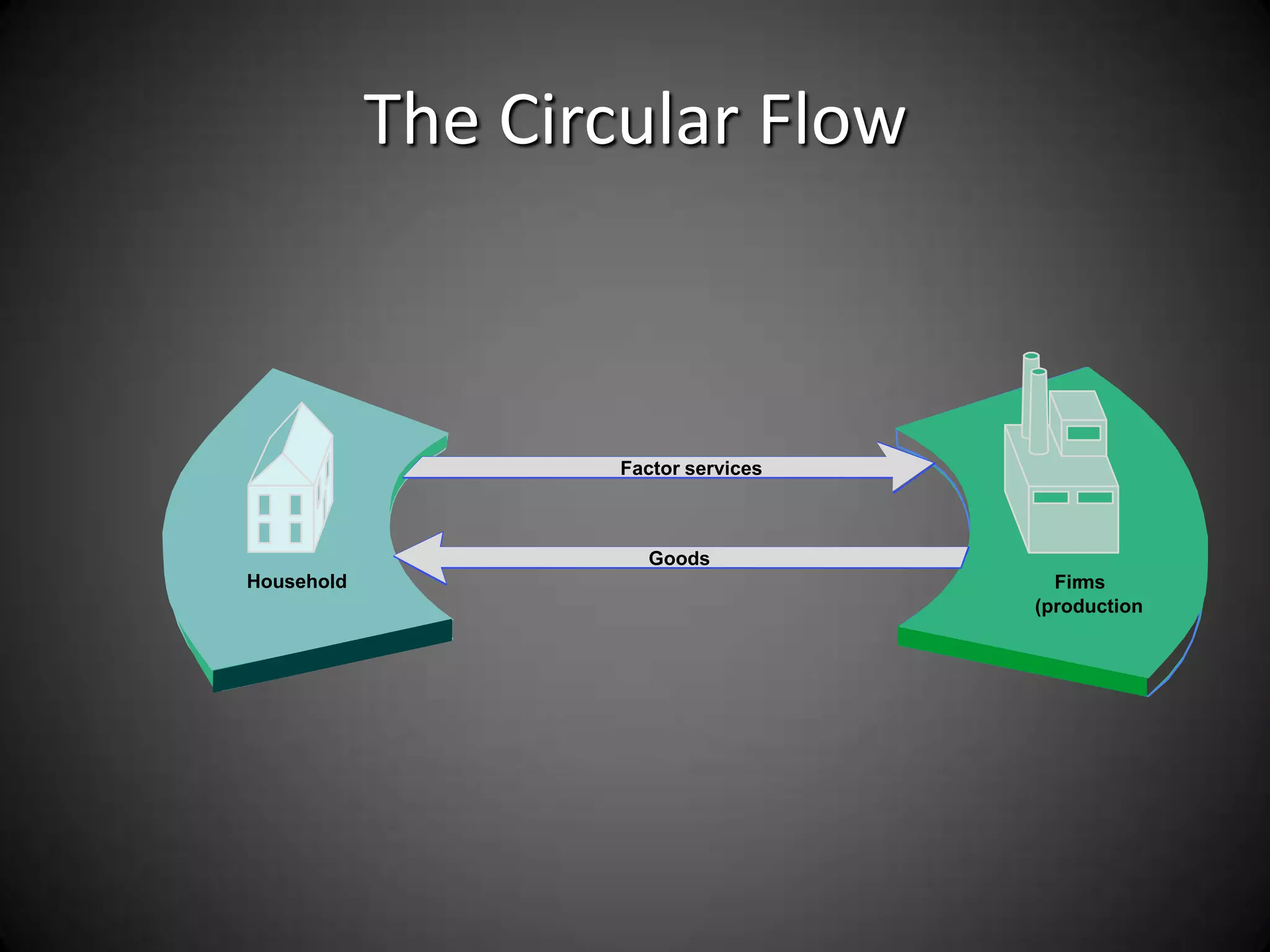
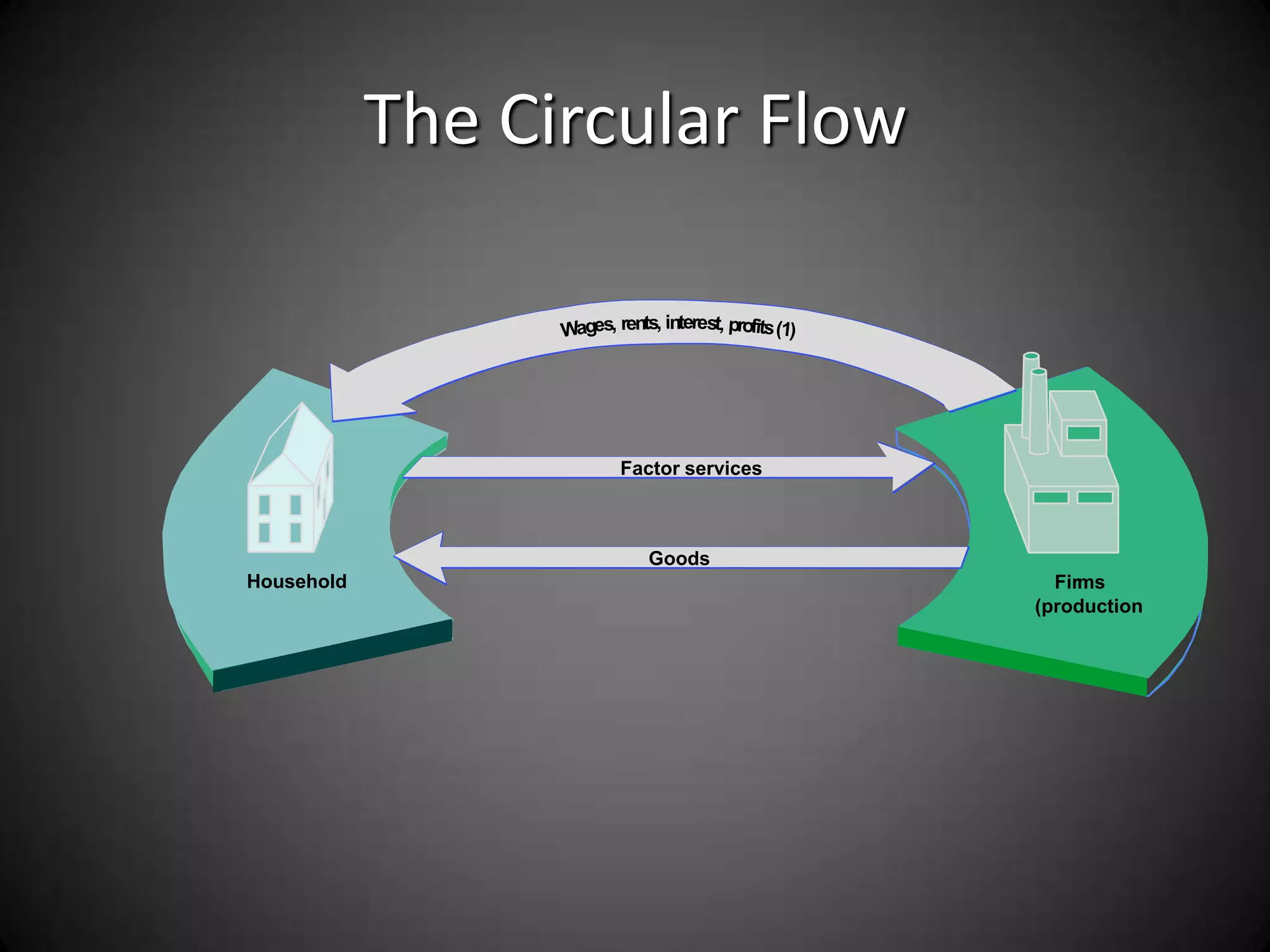
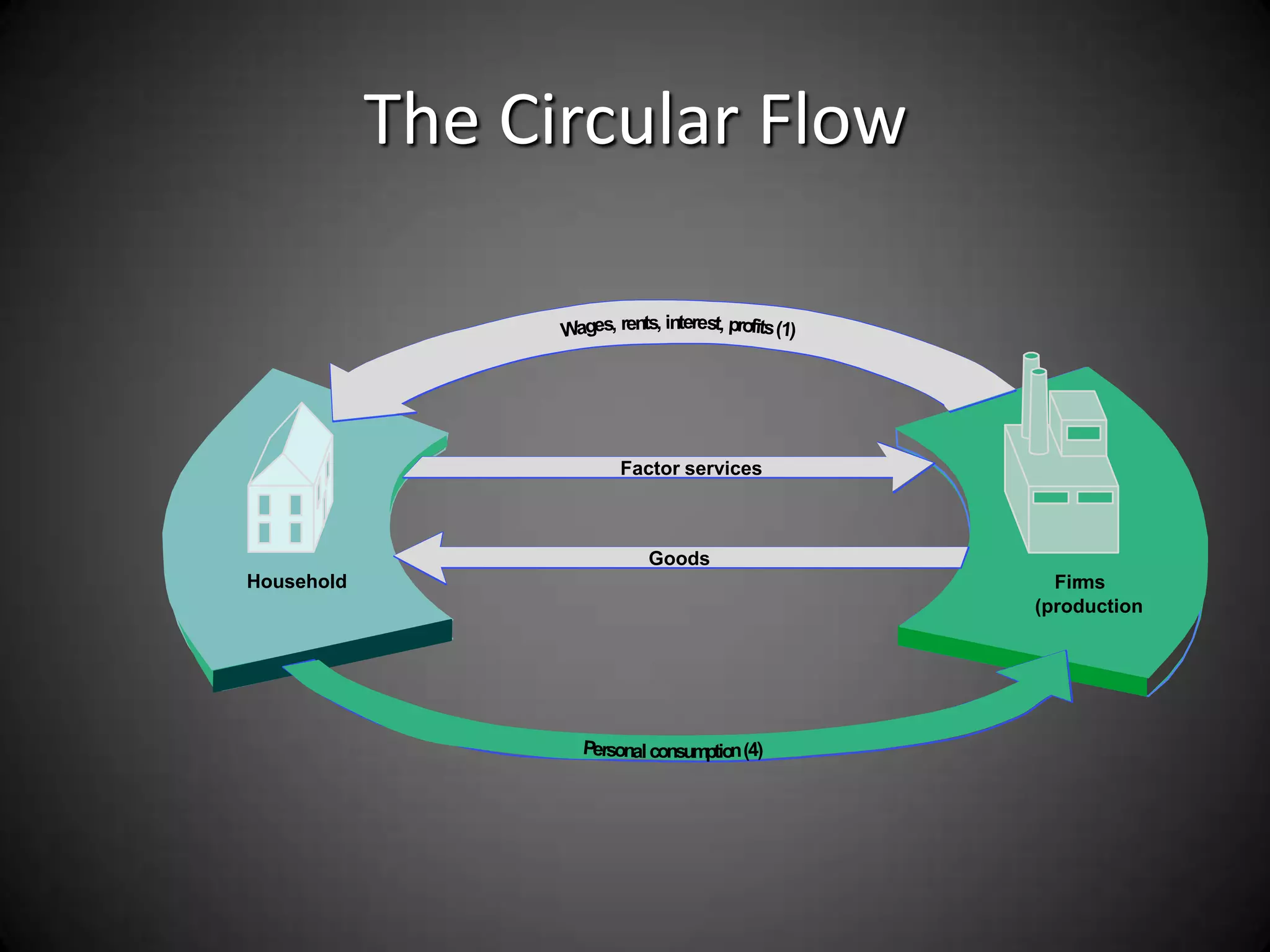
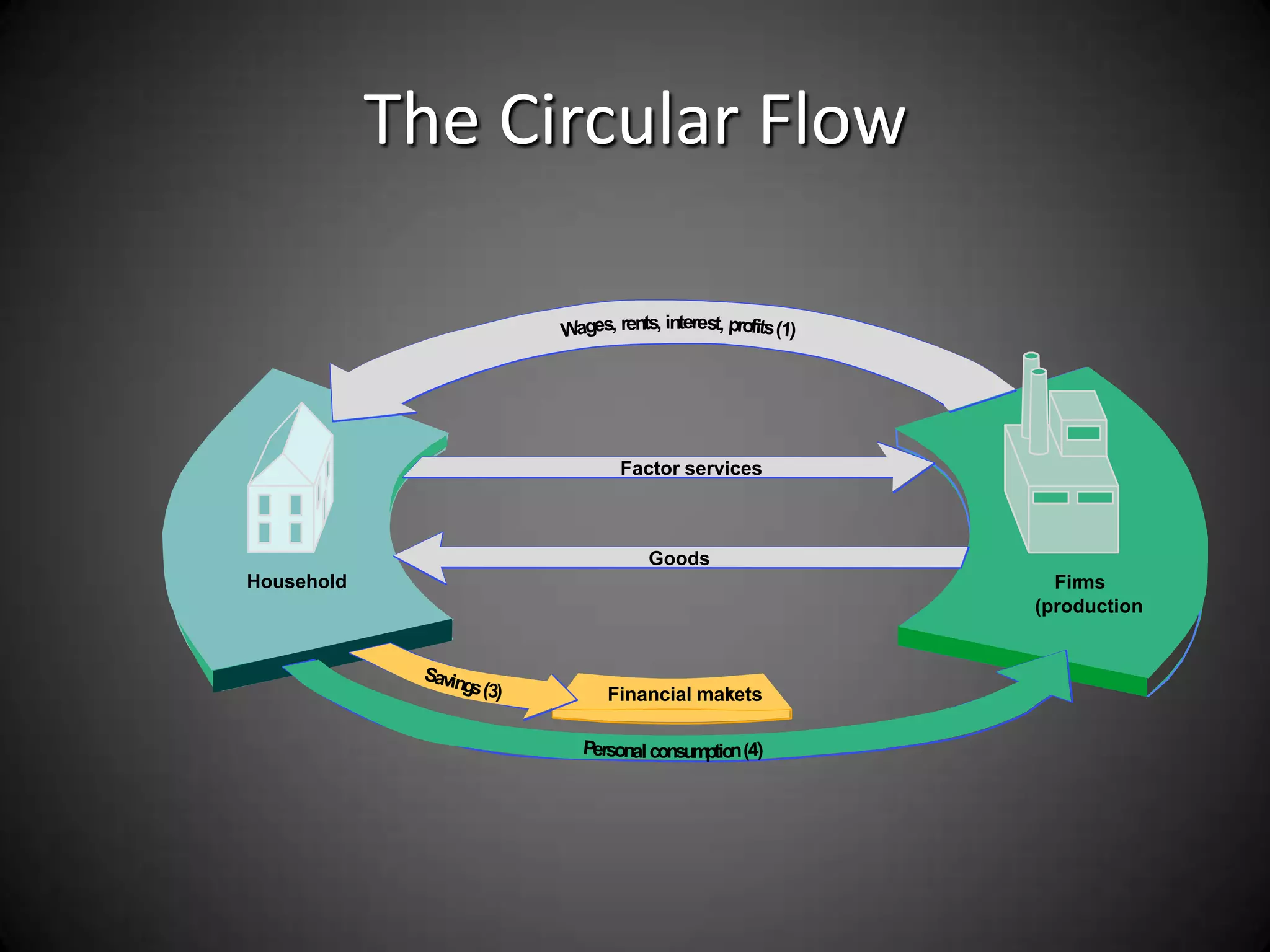
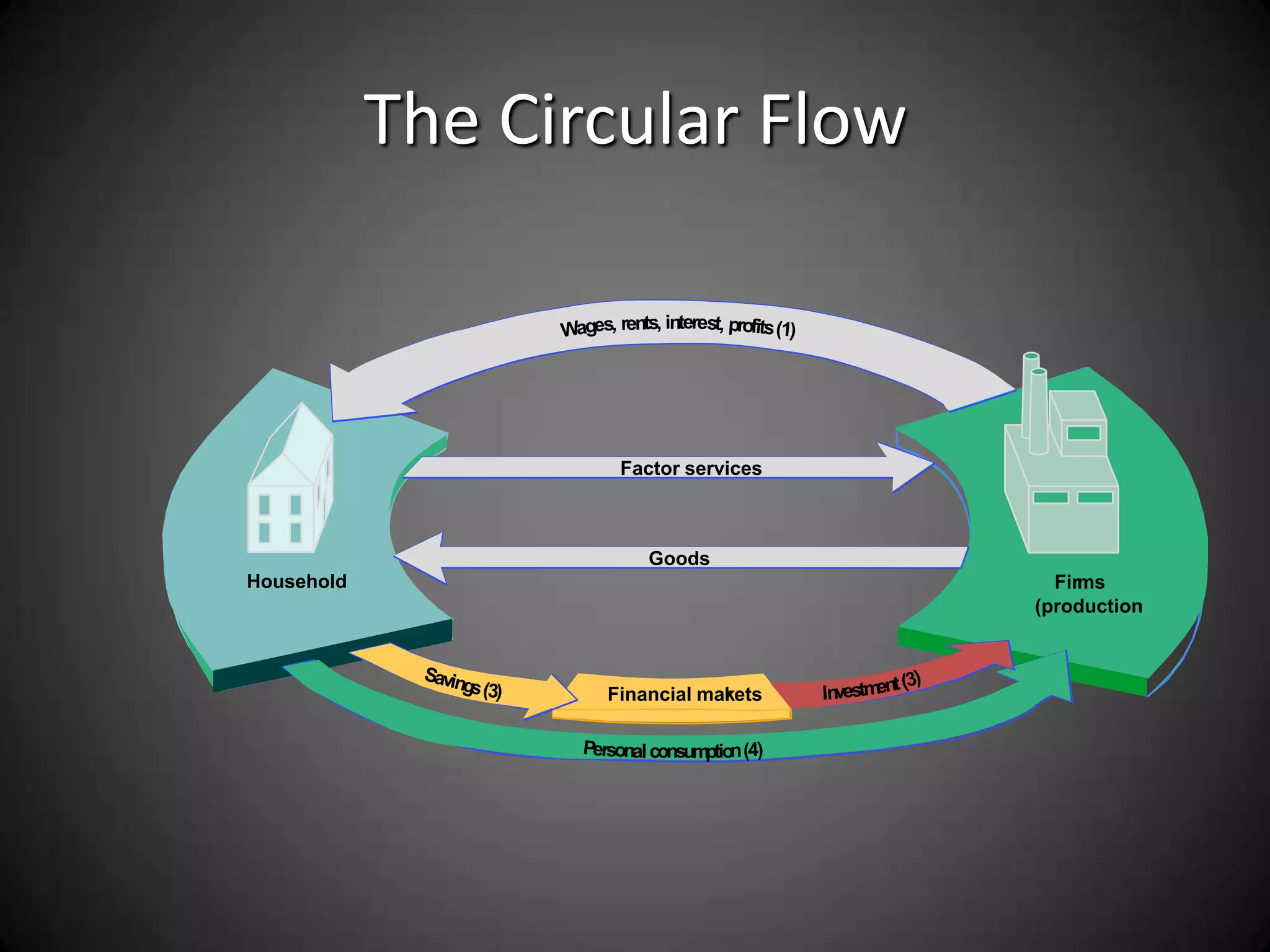
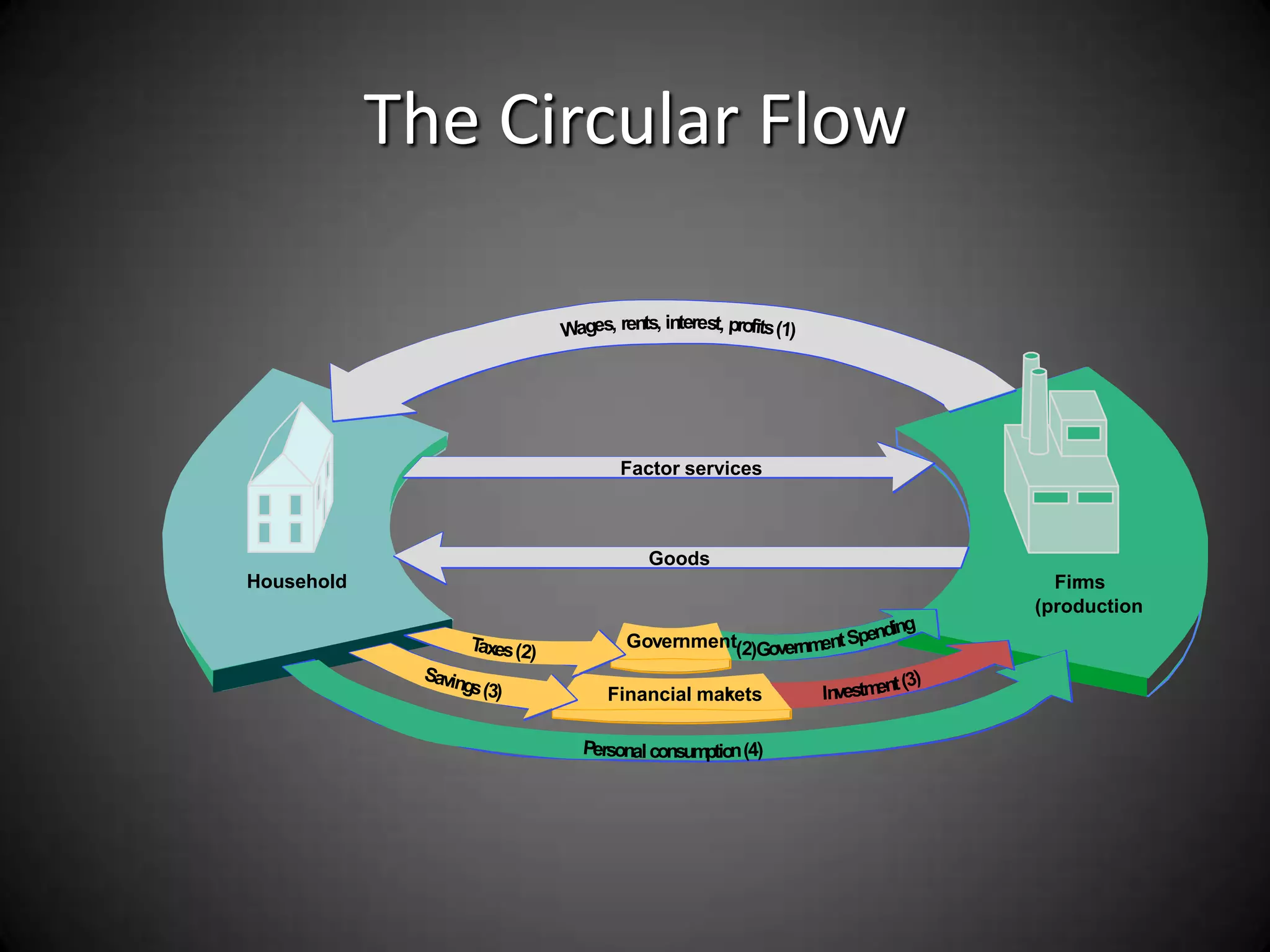
• The national income accounting identity is the
  accounting equality of output and income.
The Circular Flow


Household                         Firms
                                (production
The Circular Flow


                    Goods
Household                         Firms
                                (production
The Circular Flow


                    Factor services


                      Goods
Household                               Firms
                                      (production
The Circular Flow

                         nt


                    Factor services


                      Goods
Household                               Firms
                                      (production
The Circular Flow

                         nt


                    Factor services


                       Goods
Household                               Firms
                                      (production


                     al consumptio
The Circular Flow

                         nt


                    Factor services


                       Goods
Household                                Firms
                                       (production


                   Financial mar ets
                               k

                     al consumptio
The Circular Flow

                         nt


                    Factor services


                       Goods
Household                                Firms
                                       (production


                   Financial mar ets
                               k

                     al consumptio
The Circular Flow

                         nt


                    Factor services


                       Goods
Household                                Firms
                                       (production
                     Government )G

                   Financial mar ets
                               k

                     al consumptio
The Circular Flow

                         nt


                    Factor services


                       Goods
Household                                Firms
                                       (production
                     Government )G

                   Financial mar ets
                               k

                     al consumptio

                   Other countr
                              ies
Two Approaches to Calculating GDP
• The Income Approach
  – The income approach is shown on the top half of
    the circular flow.
  – National income is the total income earned by
    citizens and businesses in a country in one year.
  – Firms make payments to households for supplying
    their services as factors of production.
Two Approaches to Calculating GDP
• The Income Approach
  – These factors are broken up into employee
    compensation, rent, interest, and profits.
     • Employee compensation is payments for labor such as
       salaries and wages.
     • Rents are payments for use of land and buildings.
     • Interest includes payments for loans by households to
       firms.
     • Profits are payments to the owners of firms
Two Approaches to Calculating GDP
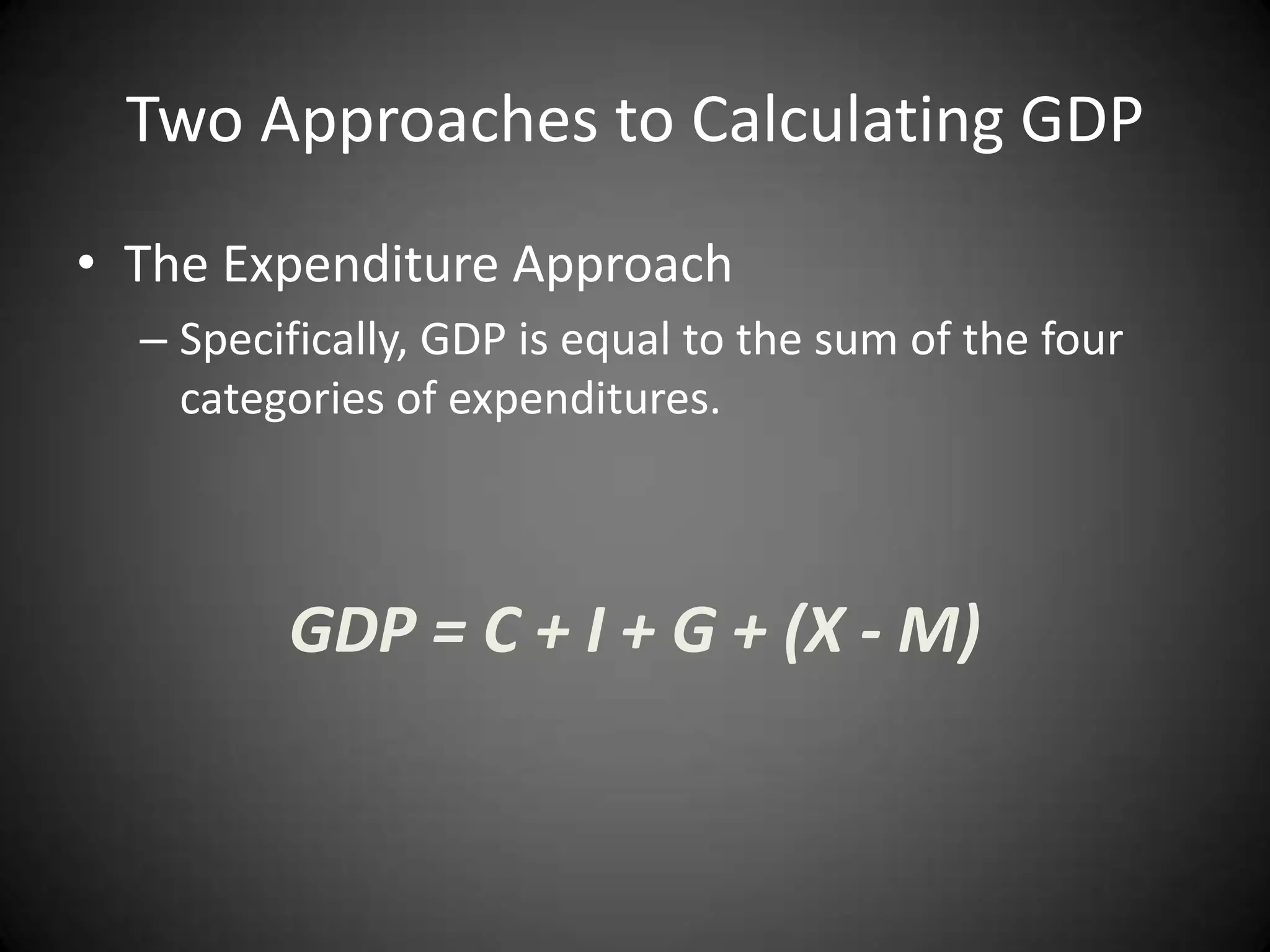
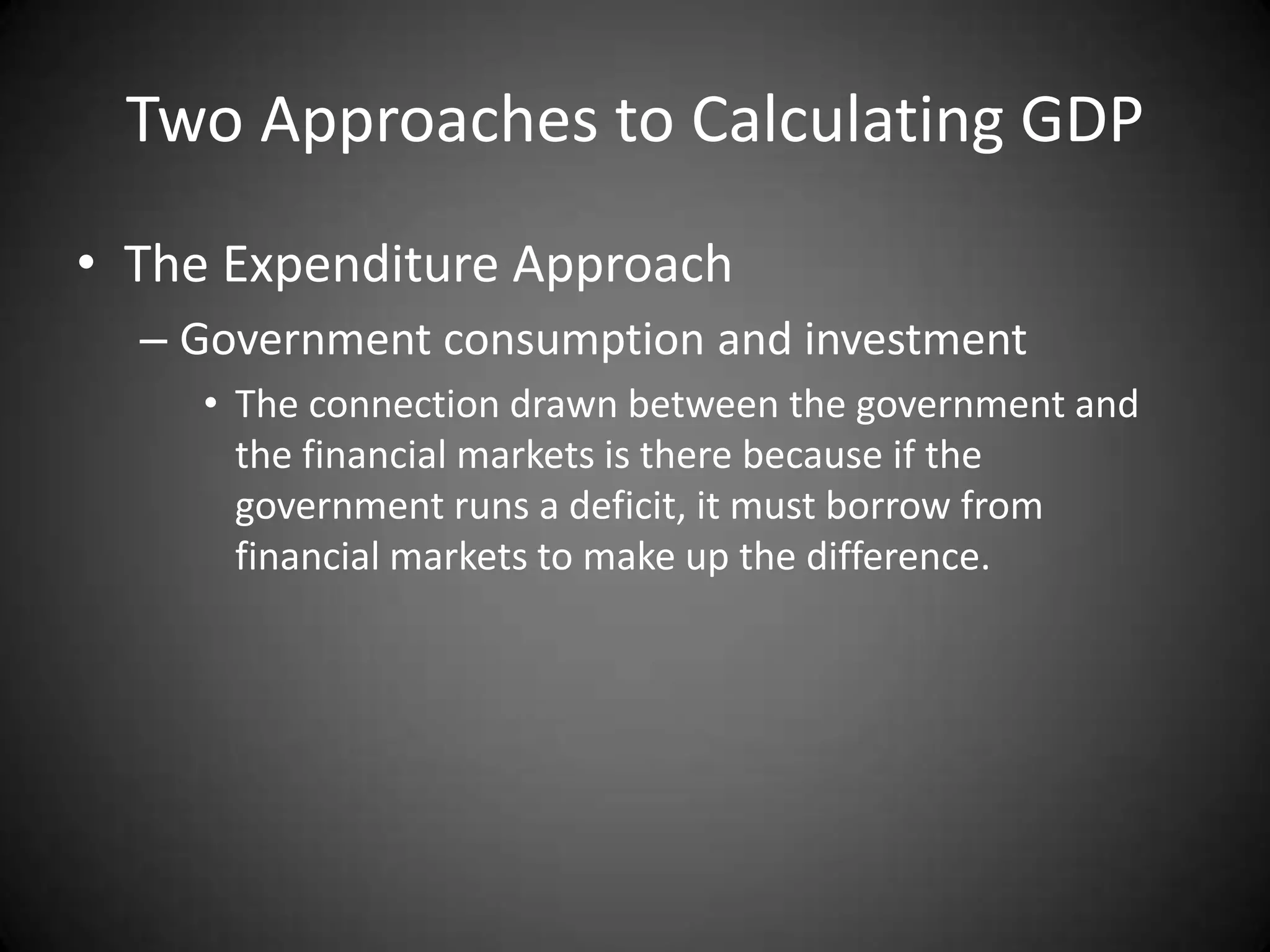
• The Expenditure Approach
  – The expenditure approach is shown on the
    bottom half of the circular flow.
  – Specifically, GDP is equal to the sum of the four
    categories of expenditures.
Two Approaches to Calculating GDP
• The Expenditure Approach
  – Specifically, GDP is equal to the sum of the four
    categories of expenditures.


         GDP = C + I + G + (X - M)
Two Approaches to Calculating GDP
• The Expenditure Approach
  – Consumption
     • When individuals receive income, they can spend it on
       domestic goods, save it, pay taxes, or buy foreign
       goods.
     • This is the largest and most important of the flows.
Two Approaches to Calculating GDP
• The Expenditure Approach
  – Investment
     • The portion of their income that individuals save leaves
       the income stream and goes into financial markets.
     • Business spending on equipment, structures, and
       inventories is counted as investment.
Two Approaches to Calculating GDP
• The Expenditure Approach
  – Government consumption and investment
     • When individuals pay taxes, those taxes are either
       spent by government on goods and services or are
       returned to individuals in the form of transfer
       payments.
Two Approaches to Calculating GDP
• The Expenditure Approach
  – Government consumption and investment
     • The connection drawn between the government and
       the financial markets is there because if the
       government runs a deficit, it must borrow from
       financial markets to make up the difference.
Two Approaches to Calculating GDP
• The Expenditure Approach
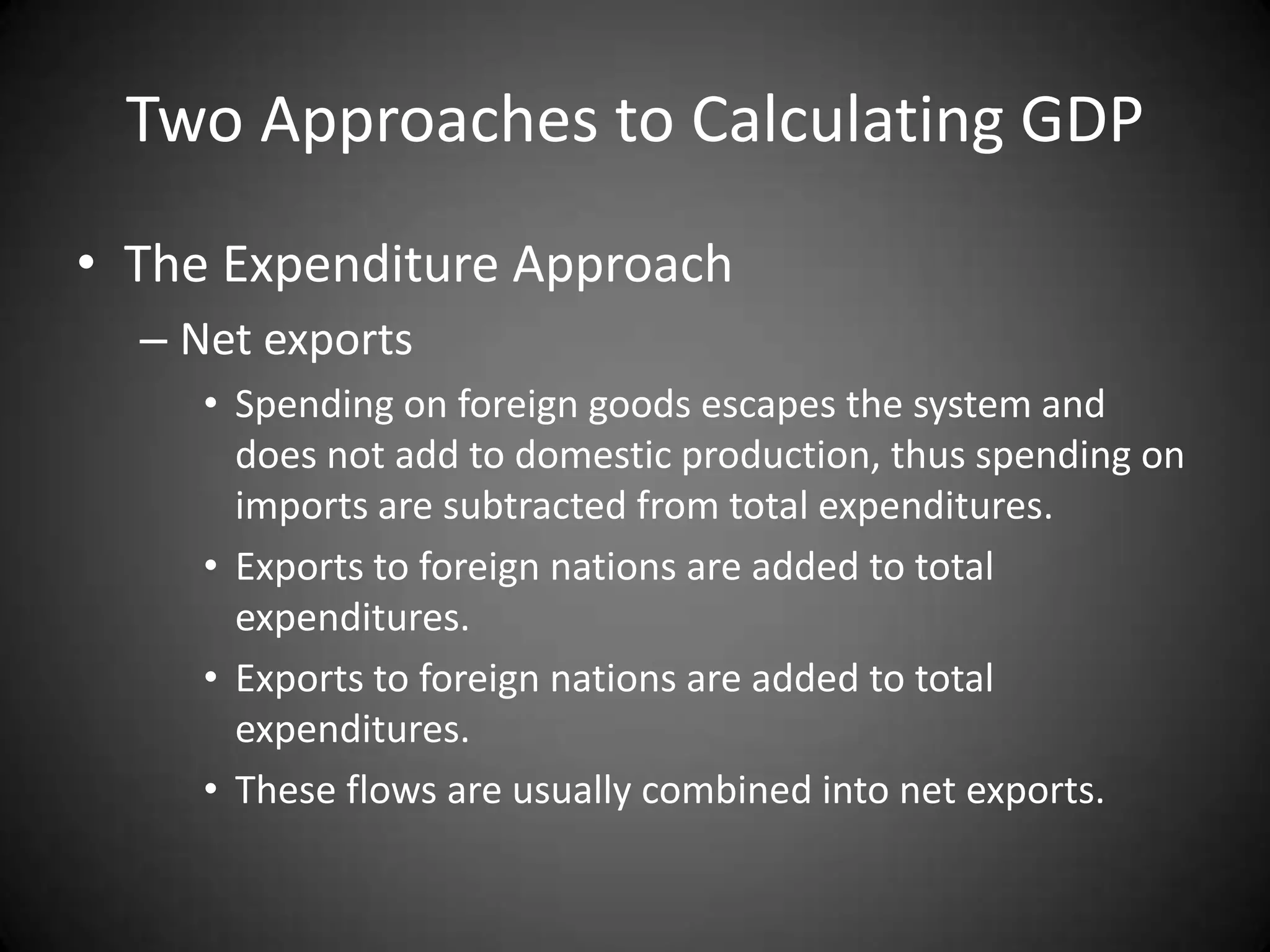
  – Net exports
     • Spending on foreign goods escapes the system and
       does not add to domestic production, thus spending on
       imports are subtracted from total expenditures.
     • Exports to foreign nations are added to total
       expenditures.
     • Exports to foreign nations are added to total
       expenditures.
     • These flows are usually combined into net exports.
Two Approaches to Calculating GDP
• Equality of Income and Expenditure
  – Income and expenditures must be equal because
    of the rules of double-entry bookkeeping.
  – Profit is the balancing item.
Two Approaches to Calculating GDP
• Equality of Income and Expenditure
  – The national income accounting identity allows
    GDP to be calculated either by adding up all values
    of final output or by adding up the values of all
    earnings or income.
Using GDP Figures
• Comparing GDP Among Countries
  – Per capita GDP is another measure often used to
    compare nations' GDP.
     • Per capita can be a poor measure of the various living
       standards in various nations.
Using GDP Figures
• Comparing GDP Among Countries
  – Per capita GDP is another measure often used to
    compare nations' GDP.
     • To get around the problems of per capita GDP,
       economists use purchasing power parity, which adjusts
       for different relative prices among nations before
       making comparisons.
Using GDP Figures
• Economic Welfare Over Time
Using GDP Figures
• Real and Nominal GDP
  – Nominal GDP is GDP calculated at existing prices.
  – Real GDP is nominal GDP adjusted for inflation.
  – Real GDP is nominal GDP adjusted for inflation.
     • Real GDP is important to society because it measures
       what is really produced.
Using GDP Figures
• Real and Nominal GDP
  – Real GDP is nominal GDP adjusted for inflation.
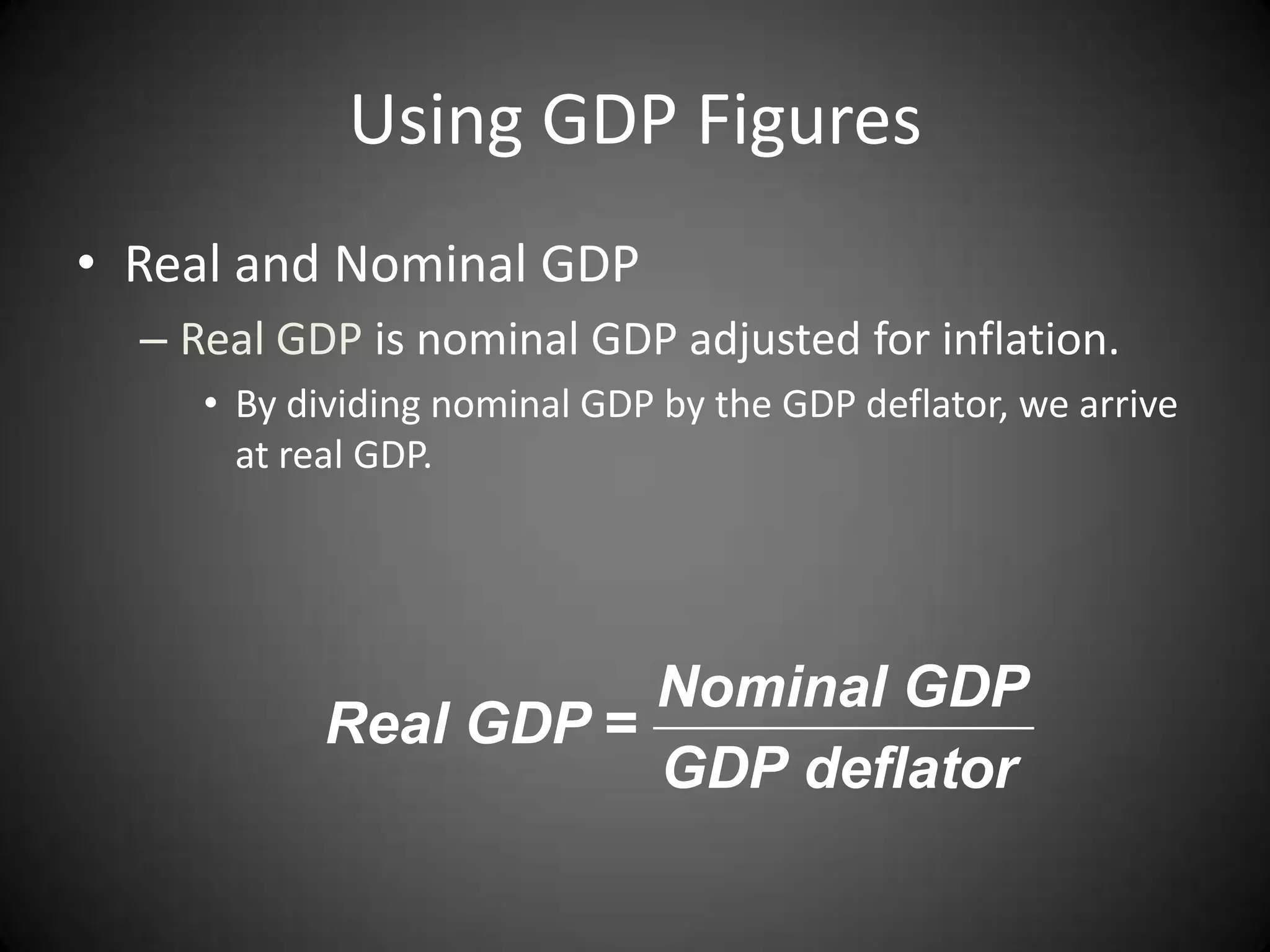
     • By dividing nominal GDP by the GDP deflator, we arrive
       at real GDP.


                      Nominal GDP
           Real GDP =
                      GDP deflator
GDP deflator
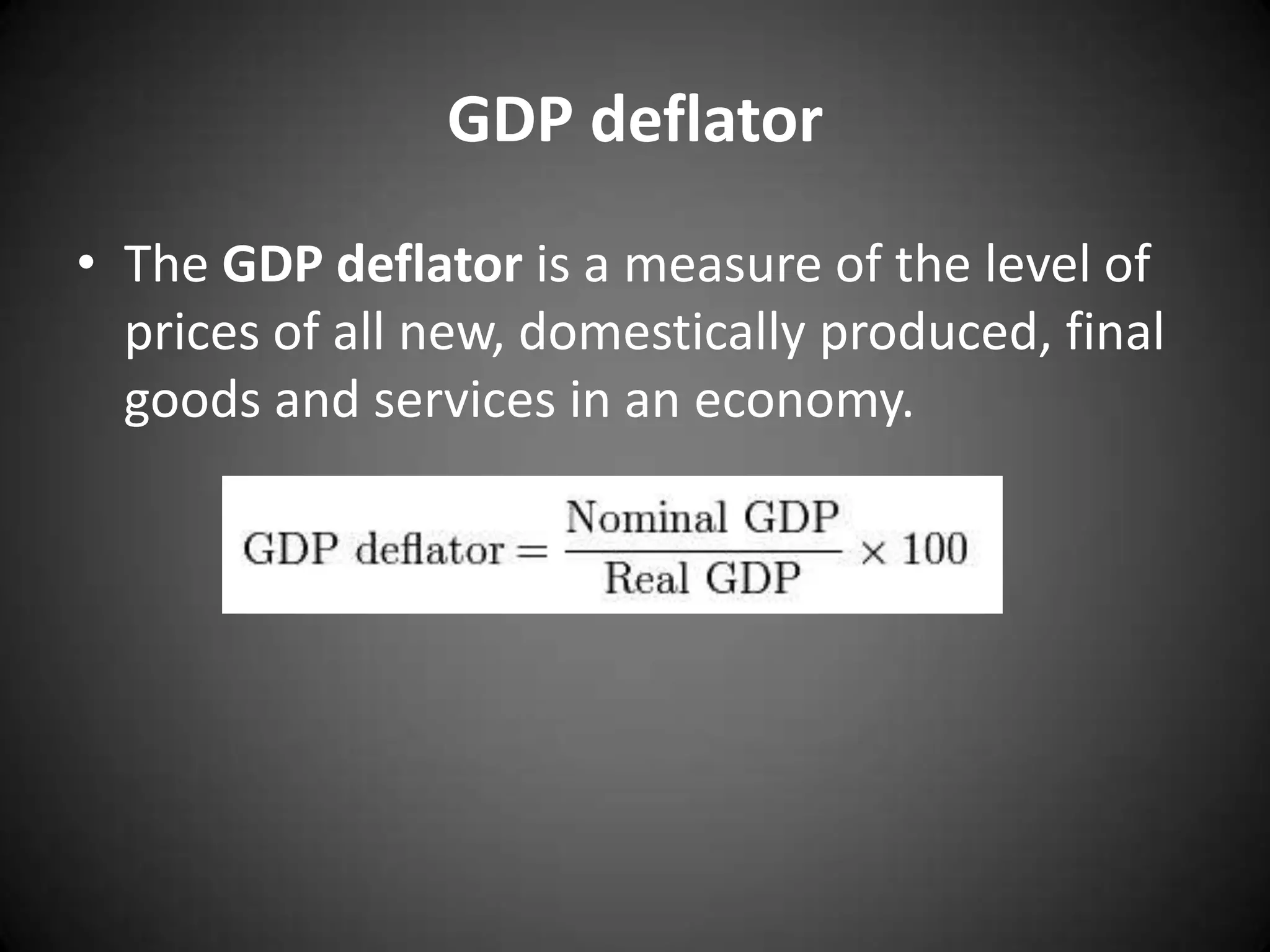
• The GDP deflator is a measure of the level of
  prices of all new, domestically produced, final
  goods and services in an economy.
Per Capita Real GDP

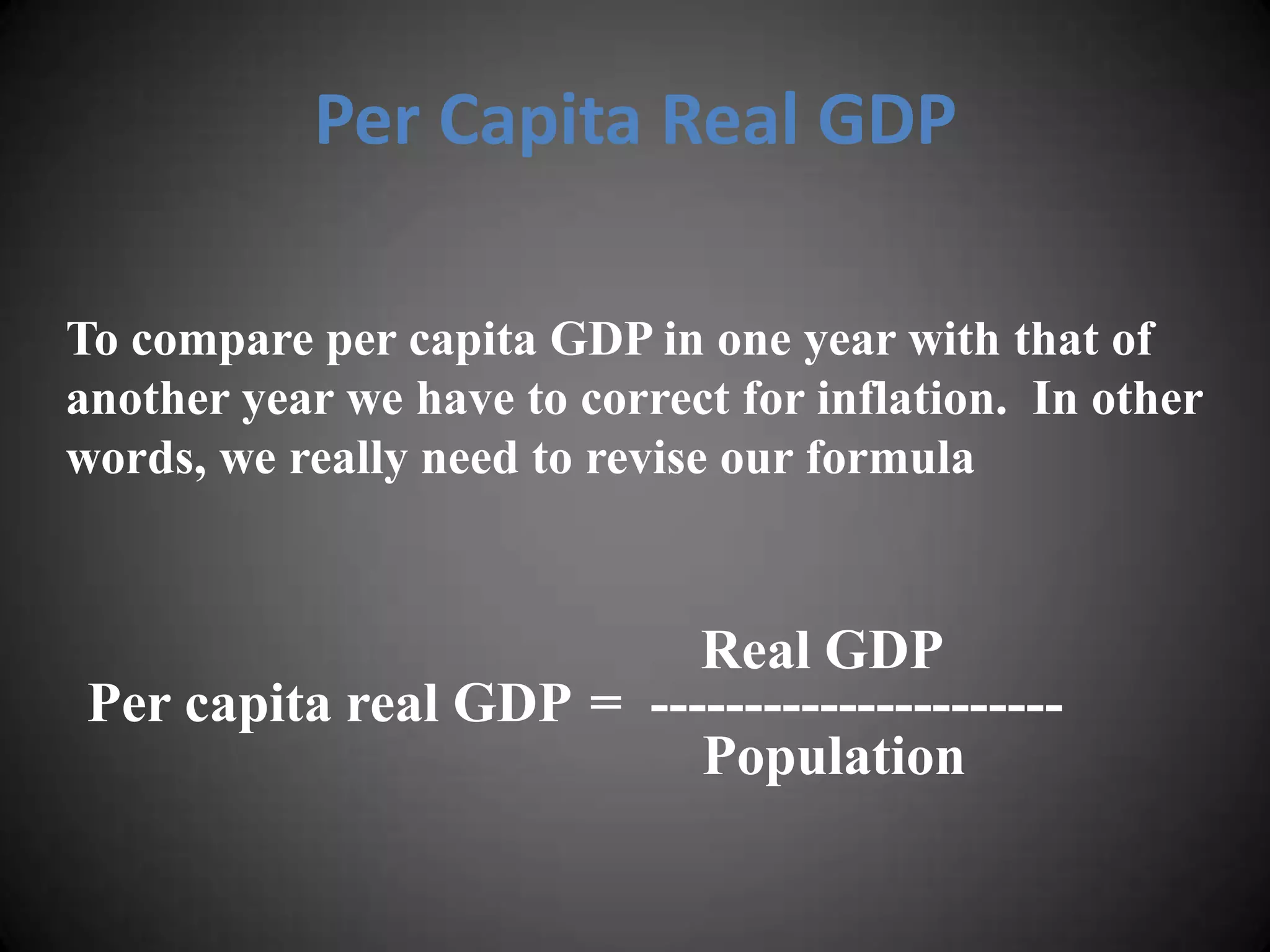
To compare per capita GDP in one year with that of
another year we have to correct for inflation. In other
words, we really need to revise our formula


                          Real GDP
 Per capita real GDP = ----------------------
                          Population
Some Limitations of National Income
             Accounting
• GDP measures market activity, not welfare.
  – GDP does not measure happiness, nor does it
    measure economic welfare.
• GDP measures market activity, not welfare.
  – Welfare is a complicated idea, very difficult to
    measure.
Some Limitations of National Income
             Accounting
• Measurement Errors
Some Limitations of National Income
             Accounting
• Measurement Errors
  – GDP figures do not measure all market economic
    activity.
  – GDP figures do not measure the following market
    activities:
Some Limitations of National Income
             Accounting
• Measurement Errors
  – GDP figures do not measure the following market
    activities:
     • Illegal drug sales.
     • Under-the-counter sales of goods to avoid income and
       sales taxes.
     • Work performed and paid for in cash.
Some Limitations of National Income
             Accounting
• Measurement Errors
  – GDP figures do not measure the following market
    activities:
     • Unreported sales.
     • Prostitution, loan sharking, extortion, and other illegal
       activities.
Some Limitations of National Income
             Accounting
• Measurement Errors
  – Estimates of the size of the underground economy
    range from1.5 to 20 percent of GDP.
Some Limitations of National Income
             Accounting
• Measurement Errors
  – A second type of measurement error occurs in
    adjusting GDP for inflation.
     • If the price and the quality of a product go up together,
       has the price really gone up?
Some Limitations of National Income
             Accounting
• Measurement Errors
  – A second type of measurement error occurs in
    adjusting GDP for inflation.
     • Is it possible to measure the value of quality increases?
Some Limitations of National Income
             Accounting
• Misinterpretation of Subcategories
  – For example, the line between investment and
    consumption is often fuzzy.
Some Limitations of National Income
             Accounting
• Misinterpretation of Subcategories
  – For example, the line between investment and
    consumption is often fuzzy.
     • Buying a steam iron would be consumption, and if it is
       used to iron team T-shirts sold by a home business, it
       would still be counted as consumption.
Some Limitations of National Income
             Accounting
• Misinterpretation of Subcategories
  – For example, the line between investment and
    consumption is often fuzzy.
     • Investment includes private housing units, but they do
       not usually add to our stock of productive tools.
Some Limitations of National Income
             Accounting
• Misinterpretation of Subcategories
  – For example, the line between investment and
    consumption is often fuzzy.
     • Investment includes private housing units, but they do
       not usually add to our stock of productive tools.
     • The garages and spare bedrooms might if they are used
       in an income-producing capacity.
Some Limitations of National Income
             Accounting
• Misinterpretation of Subcategories
  – Some social scientists have developed alternatives
    to GDP such as the Gross Process Indicator (GPI).
Some Limitations of National Income
             Accounting
• Misinterpretation of Subcategories
  – Some social scientists have developed alternatives
    to GDP such as the Gross Process Indicator (GPI).
     • The GPI tries to measure pollution, education, health
       concerns, as well as GDP.
GDP Is Worth Using Despite Its
             Limitations
• National income accounting should be used
  with sophistication.
GDP Is Worth Using Despite Its
              Limitations
• It is a powerful economic tool that informs
  average citizens about the direction the
  economy is moving.
Thanks

Lecture 2

  • 1.
    National Income Accounting& Gross Domestic Product
  • 2.
    Chapter Objectives • Statewhy national income accounting is important
  • 3.
    Chapter Objectives • Statewhy national income accounting is important. • Define GDP, GNP, and NI. • Calculate GDP in a simple example, avoiding double counting.
  • 4.
    Chapter Objectives • Explainwhy GDP = C + 1 + G + (X - M). • Distinguish between real and nominal values. • State some limitations of national income accounting.
  • 5.
    Measures of Output •National income accounting refers to a set of rules and techniques that are used to measure the national income of a country. • It refers to the measurement of aggregate economic activity, particularly national income and its components.
  • 6.
    National Income Accounting •Measuring Total Economic Output of Goods and Services –Gross Domestic Product (GDP) is the total value of all final goods and services produced in an economy in a one-year period. • It is the single most-used economic measure.
  • 7.
    National Income Accounting •Measuring Total Economic Output of Goods and Services –Gross National Product (GNP) is the aggregate final output of citizens and businesses of an economy in one year.
  • 8.
    National Income Accounting •Measuring Total Economic Output of Goods and Services –GDP measures the economic activity that occurs within a country. –GNP measures the economic activity of the citizens and businesses of a country.
  • 9.
    National Income Accounting •Moving from GDP to GNP –To move from GDP to GNP, net foreign factor income is added to GDP. –Net foreign factor income is the income from foreign domestic factor sources minus foreign factor incomes earned domestically.
  • 10.
    The Circular Flow •The national income accounting identity is the accounting equality of output and income.
  • 11.
    The Circular Flow Household Firms (production
  • 12.
    The Circular Flow Goods Household Firms (production
  • 13.
    The Circular Flow Factor services Goods Household Firms (production
  • 14.
    The Circular Flow nt Factor services Goods Household Firms (production
  • 15.
    The Circular Flow nt Factor services Goods Household Firms (production al consumptio
  • 16.
    The Circular Flow nt Factor services Goods Household Firms (production Financial mar ets k al consumptio
  • 17.
    The Circular Flow nt Factor services Goods Household Firms (production Financial mar ets k al consumptio
  • 18.
    The Circular Flow nt Factor services Goods Household Firms (production Government )G Financial mar ets k al consumptio
  • 19.
    The Circular Flow nt Factor services Goods Household Firms (production Government )G Financial mar ets k al consumptio Other countr ies
  • 20.
    Two Approaches toCalculating GDP • The Income Approach – The income approach is shown on the top half of the circular flow. – National income is the total income earned by citizens and businesses in a country in one year. – Firms make payments to households for supplying their services as factors of production.
  • 21.
    Two Approaches toCalculating GDP • The Income Approach – These factors are broken up into employee compensation, rent, interest, and profits. • Employee compensation is payments for labor such as salaries and wages. • Rents are payments for use of land and buildings. • Interest includes payments for loans by households to firms. • Profits are payments to the owners of firms
  • 22.
    Two Approaches toCalculating GDP • The Expenditure Approach – The expenditure approach is shown on the bottom half of the circular flow. – Specifically, GDP is equal to the sum of the four categories of expenditures.
  • 23.
    Two Approaches toCalculating GDP • The Expenditure Approach – Specifically, GDP is equal to the sum of the four categories of expenditures. GDP = C + I + G + (X - M)
  • 24.
    Two Approaches toCalculating GDP • The Expenditure Approach – Consumption • When individuals receive income, they can spend it on domestic goods, save it, pay taxes, or buy foreign goods. • This is the largest and most important of the flows.
  • 25.
    Two Approaches toCalculating GDP • The Expenditure Approach – Investment • The portion of their income that individuals save leaves the income stream and goes into financial markets. • Business spending on equipment, structures, and inventories is counted as investment.
  • 26.
    Two Approaches toCalculating GDP • The Expenditure Approach – Government consumption and investment • When individuals pay taxes, those taxes are either spent by government on goods and services or are returned to individuals in the form of transfer payments.
  • 27.
    Two Approaches toCalculating GDP • The Expenditure Approach – Government consumption and investment • The connection drawn between the government and the financial markets is there because if the government runs a deficit, it must borrow from financial markets to make up the difference.
  • 28.
    Two Approaches toCalculating GDP • The Expenditure Approach – Net exports • Spending on foreign goods escapes the system and does not add to domestic production, thus spending on imports are subtracted from total expenditures. • Exports to foreign nations are added to total expenditures. • Exports to foreign nations are added to total expenditures. • These flows are usually combined into net exports.
  • 29.
    Two Approaches toCalculating GDP • Equality of Income and Expenditure – Income and expenditures must be equal because of the rules of double-entry bookkeeping. – Profit is the balancing item.
  • 30.
    Two Approaches toCalculating GDP • Equality of Income and Expenditure – The national income accounting identity allows GDP to be calculated either by adding up all values of final output or by adding up the values of all earnings or income.
  • 31.
    Using GDP Figures •Comparing GDP Among Countries – Per capita GDP is another measure often used to compare nations' GDP. • Per capita can be a poor measure of the various living standards in various nations.
  • 32.
    Using GDP Figures •Comparing GDP Among Countries – Per capita GDP is another measure often used to compare nations' GDP. • To get around the problems of per capita GDP, economists use purchasing power parity, which adjusts for different relative prices among nations before making comparisons.
  • 33.
    Using GDP Figures •Economic Welfare Over Time
  • 34.
    Using GDP Figures •Real and Nominal GDP – Nominal GDP is GDP calculated at existing prices. – Real GDP is nominal GDP adjusted for inflation. – Real GDP is nominal GDP adjusted for inflation. • Real GDP is important to society because it measures what is really produced.
  • 35.
    Using GDP Figures •Real and Nominal GDP – Real GDP is nominal GDP adjusted for inflation. • By dividing nominal GDP by the GDP deflator, we arrive at real GDP. Nominal GDP Real GDP = GDP deflator
  • 36.
    GDP deflator • TheGDP deflator is a measure of the level of prices of all new, domestically produced, final goods and services in an economy.
  • 37.
    Per Capita RealGDP To compare per capita GDP in one year with that of another year we have to correct for inflation. In other words, we really need to revise our formula Real GDP Per capita real GDP = ---------------------- Population
  • 38.
    Some Limitations ofNational Income Accounting • GDP measures market activity, not welfare. – GDP does not measure happiness, nor does it measure economic welfare. • GDP measures market activity, not welfare. – Welfare is a complicated idea, very difficult to measure.
  • 39.
    Some Limitations ofNational Income Accounting • Measurement Errors
  • 40.
    Some Limitations ofNational Income Accounting • Measurement Errors – GDP figures do not measure all market economic activity. – GDP figures do not measure the following market activities:
  • 41.
    Some Limitations ofNational Income Accounting • Measurement Errors – GDP figures do not measure the following market activities: • Illegal drug sales. • Under-the-counter sales of goods to avoid income and sales taxes. • Work performed and paid for in cash.
  • 42.
    Some Limitations ofNational Income Accounting • Measurement Errors – GDP figures do not measure the following market activities: • Unreported sales. • Prostitution, loan sharking, extortion, and other illegal activities.
  • 43.
    Some Limitations ofNational Income Accounting • Measurement Errors – Estimates of the size of the underground economy range from1.5 to 20 percent of GDP.
  • 44.
    Some Limitations ofNational Income Accounting • Measurement Errors – A second type of measurement error occurs in adjusting GDP for inflation. • If the price and the quality of a product go up together, has the price really gone up?
  • 45.
    Some Limitations ofNational Income Accounting • Measurement Errors – A second type of measurement error occurs in adjusting GDP for inflation. • Is it possible to measure the value of quality increases?
  • 46.
    Some Limitations ofNational Income Accounting • Misinterpretation of Subcategories – For example, the line between investment and consumption is often fuzzy.
  • 47.
    Some Limitations ofNational Income Accounting • Misinterpretation of Subcategories – For example, the line between investment and consumption is often fuzzy. • Buying a steam iron would be consumption, and if it is used to iron team T-shirts sold by a home business, it would still be counted as consumption.
  • 48.
    Some Limitations ofNational Income Accounting • Misinterpretation of Subcategories – For example, the line between investment and consumption is often fuzzy. • Investment includes private housing units, but they do not usually add to our stock of productive tools.
  • 49.
    Some Limitations ofNational Income Accounting • Misinterpretation of Subcategories – For example, the line between investment and consumption is often fuzzy. • Investment includes private housing units, but they do not usually add to our stock of productive tools. • The garages and spare bedrooms might if they are used in an income-producing capacity.
  • 50.
    Some Limitations ofNational Income Accounting • Misinterpretation of Subcategories – Some social scientists have developed alternatives to GDP such as the Gross Process Indicator (GPI).
  • 51.
    Some Limitations ofNational Income Accounting • Misinterpretation of Subcategories – Some social scientists have developed alternatives to GDP such as the Gross Process Indicator (GPI). • The GPI tries to measure pollution, education, health concerns, as well as GDP.
  • 52.
    GDP Is WorthUsing Despite Its Limitations • National income accounting should be used with sophistication.
  • 53.
    GDP Is WorthUsing Despite Its Limitations • It is a powerful economic tool that informs average citizens about the direction the economy is moving.
  • 54.