ECONOMIC MODELS
Chapter 2
Alpha Chiang, Fundamental Methods
of Mathematical Economics, Third
Edition
Chapter 2
Chapter 2
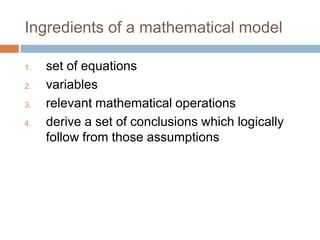
Ingredients of a mathematical model

1.   set of equations
2.   variables
3.   relevant mathematical operations
4.   derive a set of conclusions which logically
     follow from those assumptions
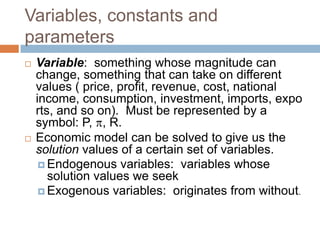
Variables, constants and
parameters
   Variable: something whose magnitude can
    change, something that can take on different
    values ( price, profit, revenue, cost, national
    income, consumption, investment, imports, expo
    rts, and so on). Must be represented by a
    symbol: P, , R.
   Economic model can be solved to give us the
    solution values of a certain set of variables.
      Endogenous variables: variables whose
       solution values we seek
      Exogenous variables: originates from without.
Variables, constants and
parameters
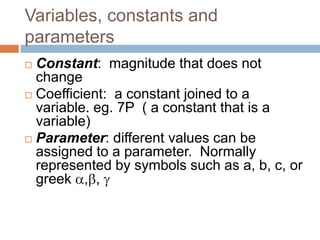
 Constant: magnitude that does not
  change
 Coefficient: a constant joined to a
  variable. eg. 7P ( a constant that is a
  variable)
 Parameter: different values can be
  assigned to a parameter. Normally
  represented by symbols such as a, b, c, or
  greek , ,
Equations and Identities
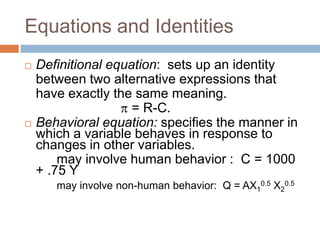
   Definitional equation: sets up an identity
    between two alternative expressions that
    have exactly the same meaning.
                     = R-C.
   Behavioral equation: specifies the manner in
    which a variable behaves in response to
    changes in other variables.
        may involve human behavior : C = 1000
    + .75 Y
       may involve non-human behavior: Q = AX10.5 X20.5
Equations and Identities
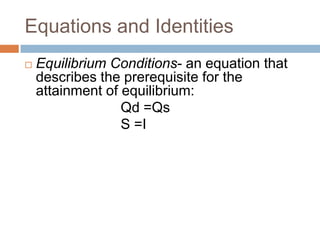
   Equilibrium Conditions- an equation that
    describes the prerequisite for the
    attainment of equilibrium:
                  Qd =Qs
                  S =I
Economic modelschaptern 2

Economic modelschaptern 2

  • 1.
    ECONOMIC MODELS Chapter 2 AlphaChiang, Fundamental Methods of Mathematical Economics, Third Edition
  • 2.
  • 3.
    Ingredients of amathematical model 1. set of equations 2. variables 3. relevant mathematical operations 4. derive a set of conclusions which logically follow from those assumptions
  • 4.
    Variables, constants and parameters  Variable: something whose magnitude can change, something that can take on different values ( price, profit, revenue, cost, national income, consumption, investment, imports, expo rts, and so on). Must be represented by a symbol: P, , R.  Economic model can be solved to give us the solution values of a certain set of variables.  Endogenous variables: variables whose solution values we seek  Exogenous variables: originates from without.
  • 5.
    Variables, constants and parameters Constant: magnitude that does not change  Coefficient: a constant joined to a variable. eg. 7P ( a constant that is a variable)  Parameter: different values can be assigned to a parameter. Normally represented by symbols such as a, b, c, or greek , ,
  • 6.
    Equations and Identities  Definitional equation: sets up an identity between two alternative expressions that have exactly the same meaning. = R-C.  Behavioral equation: specifies the manner in which a variable behaves in response to changes in other variables. may involve human behavior : C = 1000 + .75 Y may involve non-human behavior: Q = AX10.5 X20.5
  • 7.
    Equations and Identities  Equilibrium Conditions- an equation that describes the prerequisite for the attainment of equilibrium: Qd =Qs S =I