CLIMATE
What is climate?
Macro climate
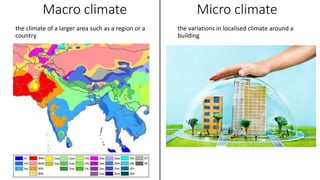
the climate of a larger area such as a region or a
country
the variations in localised climate around a
building
Micro climate
Macro climate
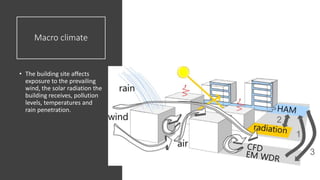
• The building site affects
exposure to the prevailing
wind, the solar radiation the
building receives, pollution
levels, temperatures and
rain penetration.
Site and macro climate
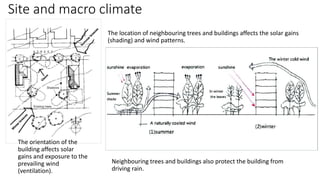
The orientation of the
building affects solar
gains and exposure to the
prevailing wind
(ventilation).
The location of neighbouring trees and buildings affects the solar gains
(shading) and wind patterns.
Neighbouring trees and buildings also protect the building from
driving rain.
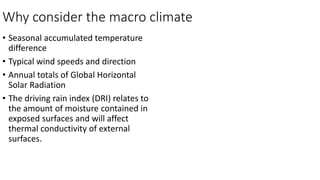
Why consider the macro climate
• Seasonal accumulated temperature
difference
• Typical wind speeds and direction
• Annual totals of Global Horizontal
Solar Radiation
• The driving rain index (DRI) relates to
the amount of moisture contained in
exposed surfaces and will affect
thermal conductivity of external
surfaces.
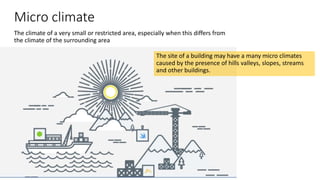
Micro climate
The climate of a very small or restricted area, especially when this differs from
the climate of the surrounding area
The site of a building may have a many micro climates
caused by the presence of hills valleys, slopes, streams
and other buildings.
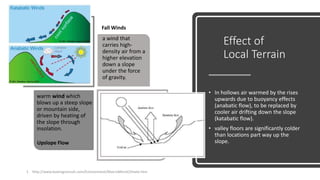
Effect of
Local Terrain
• In hollows air warmed by the rises
upwards due to buoyancy effects
(anabatic flow), to be replaced by
cooler air drifting down the slope
(katabatic flow).
• valley floors are significantly colder
than locations part way up the
slope.
1. http://www.boeingconsult.com/Environment/MacroMicroClimate.htm
a wind that
carries high-
density air from a
higher elevation
down a slope
under the force
of gravity.
warm wind which
blows up a steep slope
or mountain side,
driven by heating of
the slope through
insolation.
Upslope Flow
Fall Winds
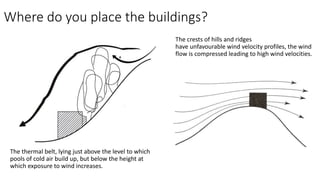
Where do you place the buildings?
The crests of hills and ridges
have unfavourable wind velocity profiles, the wind
flow is compressed leading to high wind velocities.
The thermal belt, lying just above the level to which
pools of cold air build up, but below the height at
which exposure to wind increases.
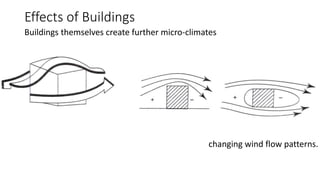
Effects of Buildings
Buildings themselves create further micro-climates
changing wind flow patterns.
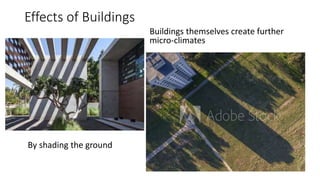
Effects of Buildings
Buildings themselves create further
micro-climates
By shading the ground
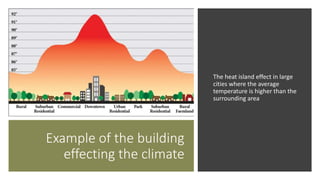
Example of the building
effecting the climate
The heat island effect in large
cities where the average
temperature is higher than the
surrounding area
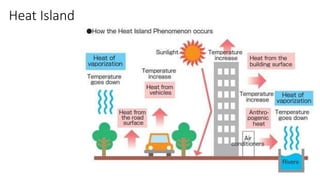
Heat Island
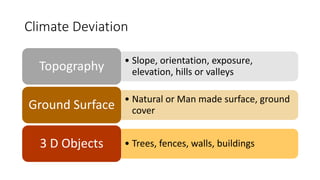
Climate Deviation
• Slope, orientation, exposure,
elevation, hills or valleysTopography
• Natural or Man made surface, ground
coverGround Surface
• Trees, fences, walls, buildings3 D Objects
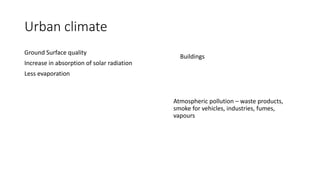
Urban climate
Ground Surface quality
Increase in absorption of solar radiation
Less evaporation
Buildings
Atmospheric pollution – waste products,
smoke for vehicles, industries, fumes,
vapours
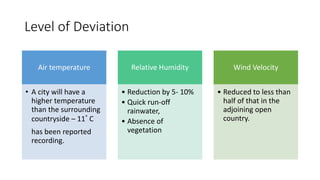
Level of Deviation
Air temperature
• A city will have a
higher temperature
than the surrounding
countryside – 11˚ C
has been reported
recording.
Relative Humidity
• Reduction by 5- 10%
• Quick run-off
rainwater,
• Absence of
vegetation
Wind Velocity
• Reduced to less than
half of that in the
adjoining open
country.
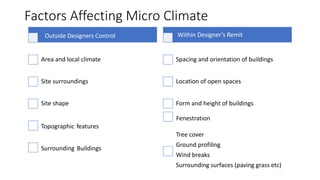
Factors Affecting Micro Climate
Outside Designers Control
Area and local climate
Site surroundings
Site shape
Topographic features
Surrounding Buildings
Within Designer’s Remit
Spacing and orientation of buildings
Location of open spaces
Form and height of buildings
Fenestration
Tree cover
Ground profiling
Wind breaks
Surrounding surfaces (paving grass etc)
Enhancing micro climate
• Reduce costs of winter heating
• Reduce summer overheating and the need for cooling
• Maximise outdoor comfort in summer and winter
• Improve durability of building material (reduced rain penetration)
• Provide a better visual environment in spaces around buildings
• Encourage growth of plants
• Discourage growth of mosses and algae
• Facilitate open air drying of clothes
Solar Access
• Allow maximum daylight into space and buildings
• Allow maximum solar radiation into space and buildings
• Shade space and windows from prolonged exposure to summer sun
• Protect space and windows from glare
Wind Protection
• Protect space and buildings from prevailing winds and cold (e.g.
North/East) winds.
• Prevent buildings and terrain features from generating turbulence
• Protect spaces and buildings from driving rain and snow
• Protect space and buildings from katabatic flows, while retaining
enough air
• movement to disperse pollutants

Macroclimate microclimate

  • 1.
  • 2.
    Macro climate the climateof a larger area such as a region or a country the variations in localised climate around a building Micro climate
  • 3.
    Macro climate • Thebuilding site affects exposure to the prevailing wind, the solar radiation the building receives, pollution levels, temperatures and rain penetration.
  • 4.
    Site and macroclimate The orientation of the building affects solar gains and exposure to the prevailing wind (ventilation). The location of neighbouring trees and buildings affects the solar gains (shading) and wind patterns. Neighbouring trees and buildings also protect the building from driving rain.
  • 5.
    Why consider themacro climate • Seasonal accumulated temperature difference • Typical wind speeds and direction • Annual totals of Global Horizontal Solar Radiation • The driving rain index (DRI) relates to the amount of moisture contained in exposed surfaces and will affect thermal conductivity of external surfaces.
  • 6.
    Micro climate The climateof a very small or restricted area, especially when this differs from the climate of the surrounding area The site of a building may have a many micro climates caused by the presence of hills valleys, slopes, streams and other buildings.
  • 7.
    Effect of Local Terrain •In hollows air warmed by the rises upwards due to buoyancy effects (anabatic flow), to be replaced by cooler air drifting down the slope (katabatic flow). • valley floors are significantly colder than locations part way up the slope. 1. http://www.boeingconsult.com/Environment/MacroMicroClimate.htm a wind that carries high- density air from a higher elevation down a slope under the force of gravity. warm wind which blows up a steep slope or mountain side, driven by heating of the slope through insolation. Upslope Flow Fall Winds
  • 8.
    Where do youplace the buildings? The crests of hills and ridges have unfavourable wind velocity profiles, the wind flow is compressed leading to high wind velocities. The thermal belt, lying just above the level to which pools of cold air build up, but below the height at which exposure to wind increases.
  • 9.
    Effects of Buildings Buildingsthemselves create further micro-climates changing wind flow patterns.
  • 10.
    Effects of Buildings Buildingsthemselves create further micro-climates By shading the ground
  • 11.
    Example of thebuilding effecting the climate The heat island effect in large cities where the average temperature is higher than the surrounding area
  • 12.
  • 13.
    Climate Deviation • Slope,orientation, exposure, elevation, hills or valleysTopography • Natural or Man made surface, ground coverGround Surface • Trees, fences, walls, buildings3 D Objects
  • 14.
    Urban climate Ground Surfacequality Increase in absorption of solar radiation Less evaporation Buildings Atmospheric pollution – waste products, smoke for vehicles, industries, fumes, vapours
  • 15.
    Level of Deviation Airtemperature • A city will have a higher temperature than the surrounding countryside – 11˚ C has been reported recording. Relative Humidity • Reduction by 5- 10% • Quick run-off rainwater, • Absence of vegetation Wind Velocity • Reduced to less than half of that in the adjoining open country.
  • 16.
    Factors Affecting MicroClimate Outside Designers Control Area and local climate Site surroundings Site shape Topographic features Surrounding Buildings Within Designer’s Remit Spacing and orientation of buildings Location of open spaces Form and height of buildings Fenestration Tree cover Ground profiling Wind breaks Surrounding surfaces (paving grass etc)
  • 17.
    Enhancing micro climate •Reduce costs of winter heating • Reduce summer overheating and the need for cooling • Maximise outdoor comfort in summer and winter • Improve durability of building material (reduced rain penetration) • Provide a better visual environment in spaces around buildings • Encourage growth of plants • Discourage growth of mosses and algae • Facilitate open air drying of clothes
  • 18.
    Solar Access • Allowmaximum daylight into space and buildings • Allow maximum solar radiation into space and buildings • Shade space and windows from prolonged exposure to summer sun • Protect space and windows from glare
  • 19.
    Wind Protection • Protectspace and buildings from prevailing winds and cold (e.g. North/East) winds. • Prevent buildings and terrain features from generating turbulence • Protect spaces and buildings from driving rain and snow • Protect space and buildings from katabatic flows, while retaining enough air • movement to disperse pollutants

Editor's Notes

  • #3 The macro and micro climate has a very important effect on both the energy performance and environmental performance of buildings, both in the heating season and in summer. The site and design of a building can have a profound effect upon the interaction between a building and its environment. The building site affects exposure to the prevailing wind, the solar radiation the building receives, pollution levels, temperatures and rain penetration.
  • #6 The macro climate around a building cannot be affected by any design changes, however the building design can be developed with a knowledge of the macro climate in which the building is located. General climatic data give an idea of the local climatic severity: This Metereological data gives a general impression of the climate at the site of a building and the building design can be planned accordingly. However, the building itself and surrounding geography will affect the local climate.
  • #12 Solar energy absorbed and re-emitted from building surfaces, pavements roads etc. creates a warming effect on the surrounding air. Also the large quantities of buildings break up the wind flow, reducing wind speeds and causing the warm air to remain stagnant in the city. This also causes increased pollution as well as temperatures. The presence of local high rise buildings can degrade the local climate as wind speed at ground level can be significantly increased, while extensive shadows block access to sunlight for long periods, increasing space heating costs in surrounding buildings.