20ME706PE
PROCESS PLANNING
AND COST
ESTIMATION
•UNIT I INTRODUCTION TO PROCESS PLANNING
•UNIT II PROCESS PLANNING ACTIVITIES
•UNIT III INTRODUCTION TO COST ESTIMATION
•UNIT IV PRODUCTION COST ESTIMATION
•UNIT V MACHINING TIME CALCULATION
UNIT V
MACHINING TIME CALCULATION
• Estimation of machining time
• Importance of machine time calculation
• Calculation of machining time for different lathe operations,
Drilling and Boring
• Machining time calculation for Milling, Shaping and Planning
• Machining time calculation for grinding
Introduction
• To estimate the total cost of any product involving machining
operations, the machining cost is to be estimated primarily.
• In order to estimate the machining cost, one has to calculate
the machining time required for these machining operations.
• After knowing the machining time and rate of machining, the
total machining cost can be calculated.
• Therefore the estimation of machining time for various
operations such as lathe, drilling. boring, shaping, planning,
milling and grinding operations are very essential in the cost
estimation activity.
What is meant by Machining Time?
• It is time for which the machine works on the component
• From the time when the tool touches the work to when the
tool leaves the component after completion of operation
• The machining time depends on die type and extent of
machining required, material being machined, speed, feed,
depth of cut and number of cuts required
• In addition to the actual machining time, an estimator has to
consider other time elements such as set-up time, handling
time, tear down time, down time and allowances to the
workers.
FACTORS TO BE CONSIDERED FOR
MACHINE TIME CALCULATION
•Set up time
•Operation time
•Tear down time
•Personal allowance
•Fatigue allowance
•Checking allowance
•Miscellaneous allowance
SETUPTIME
• This takes into account the time required to prepare the
machine for doing the job with the time taken to study the
blue print.
• The time to prepare the machine, in turn
• The time to install and adjust the tools in the machine, as well
as to make the machine ready to start the work.
OPERATION TIME
• The sum of handling time and machining time for a job is
called operation time.
• It is the duration of time that elapses between output of two
consecutive units of production.
TEAR DOWN TIME
• Tear down time takes into account the time necessary to
remove from the machine all tools and accessories, such as
jigs and fixtures, gauges and instruments etc.
• The time required for clearing operational chips from the
machine table and clearing of the machine itself are included
on this.
• Tear down time is generally 10 minute per shift of 8 hrs.
PERSONALALLOWANCE
• The time allowed for workers to meet their personal needs,
such as going to the urinal, drinking water, smoking, washing
their hands, etc is known as personal allowance.
• It is generally 5 to 10 minutes
FATIGUE ALLOWANCE
• The long working hours and poor working conditions such as
poor lighting, poor ventilation etc., cause fatigue
• Fatigue effect the efficiency of worker
• Fatigue decreases the worker capacity to work.
• The allowance for fatigue is taken depending upon the type
of work.
IMPORTANCE OF MACHINING TIME
CALCULATION
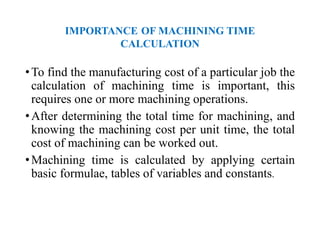
•To find the manufacturing cost of a particular job the
calculation of machining time is important, this
requires one or more machining operations.
•After determining the total time for machining, and
knowing the machining cost per unit time, the total
cost of machining can be worked out.
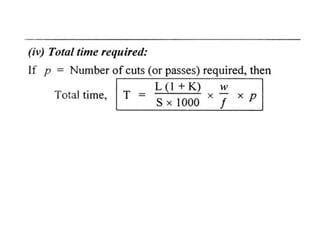
•Machining time is calculated by applying certain
basic formulae, tables of variables and constants.
• The basic formula used is
TRAVEL OF THE TOOL
• This is determined from the dimensions in the actual drawing of the part to be
manufactured.
• The necessary allowances for the tool approach and over-run for clearing the
tool off the job are taken into account with the actual length of the work, to
find the travel of the tool.
FEED
• Feed is the distance, through which the tool advances into the job in
one revolution
• If the work or the distance that the table holding the work travels is
one stroke of the tool. In metric units, feed is usually expressed in
mm/revolution or mm/stroke.
• Feed depends on the depth of cut, fitness of the work desired, rpm of
the job, etc.
DEPTH OF CUT
• It is the penetration of the cutting tool into the job in a single cut.
• In metric units, the depth of cut is expressed in mm.
• The depth of cut depends upon the fitness of the job required, such as
higher depth of cut for rough cut and smaller depth of cut for finish
cut.
RPM
• It represents the number of revolutions of the m/c spindle in one
minute.
• Thus it is the number of revolutions per minute of the job or of tool.
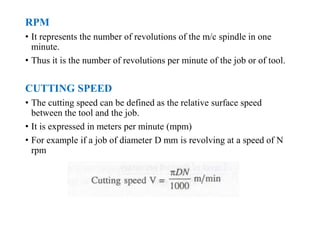
CUTTING SPEED
• The cutting speed can be defined as the relative surface speed
between the tool and the job.
• It is expressed in meters per minute (mpm)
• For example if a job of diameter D mm is revolving at a speed of N
rpm
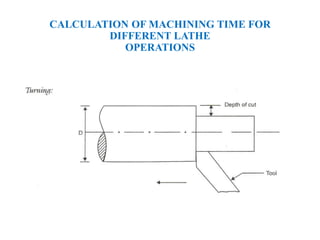
CALCULATION OF MACHINING TIME FOR
DIFFERENT LATHE
OPERATIONS
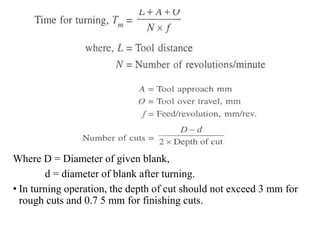
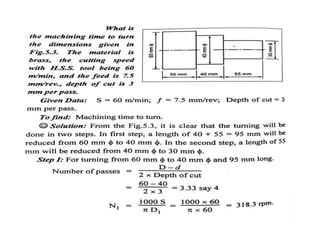
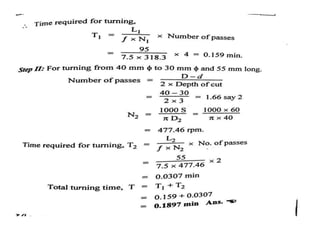
Where D = Diameter of given blank,
d = diameter of blank after turning.
• In turning operation, the depth of cut should not exceed 3 mm for
rough cuts and 0.7 5 mm for finishing cuts.
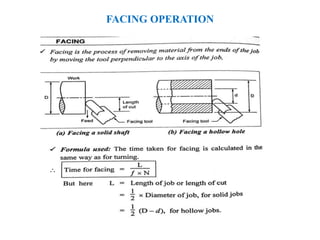
FACING OPERATION
KNURLING
Continued…
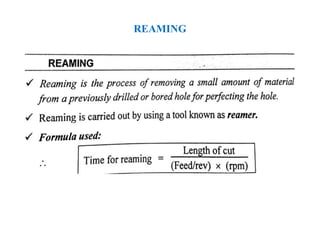
REAMING
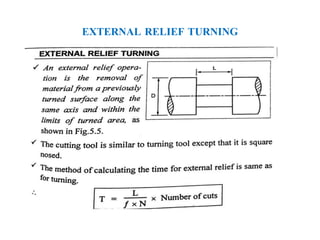
EXTERNAL RELIEF TURNING
TAPPING
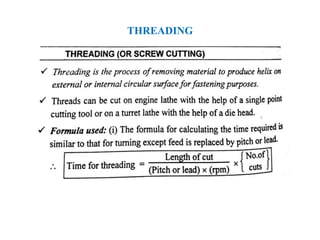
THREADING
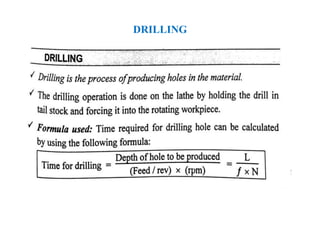
DRILLING
BORING
CHAMFERING
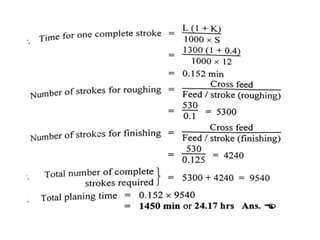
MACHINING TIME FOR SHAPING AND PLANING
• Shaping, planning and slotting operations are carried out on
reciprocating machines with a single point cutting tool.
Formula used
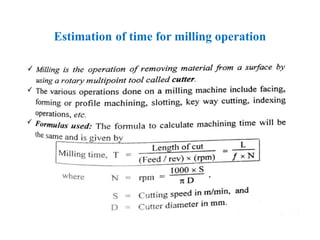
Estimation of time for milling operation
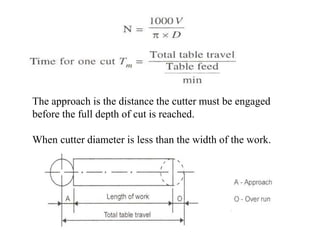
The approach is the distance the cutter must be engaged
before the full depth of cut is reached.
When cutter diameter is less than the width of the work.
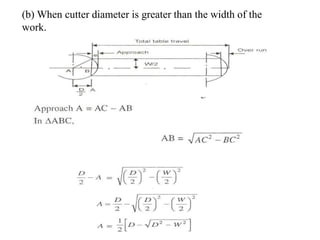
(b) When cutter diameter is greater than the width of the
work.
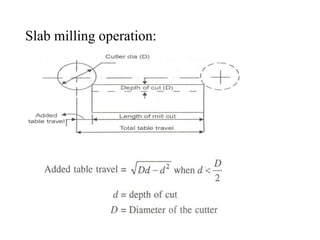
Slab milling operation:
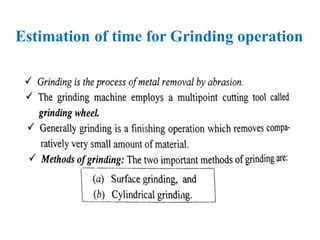
Estimation of time for Grinding operation
Formula used
MACHINING TIME CALCULATION

MACHINING TIME CALCULATION

  • 1.
  • 2.
    •UNIT I INTRODUCTIONTO PROCESS PLANNING •UNIT II PROCESS PLANNING ACTIVITIES •UNIT III INTRODUCTION TO COST ESTIMATION •UNIT IV PRODUCTION COST ESTIMATION •UNIT V MACHINING TIME CALCULATION
  • 3.
    UNIT V MACHINING TIMECALCULATION • Estimation of machining time • Importance of machine time calculation • Calculation of machining time for different lathe operations, Drilling and Boring • Machining time calculation for Milling, Shaping and Planning • Machining time calculation for grinding
  • 4.
    Introduction • To estimatethe total cost of any product involving machining operations, the machining cost is to be estimated primarily. • In order to estimate the machining cost, one has to calculate the machining time required for these machining operations. • After knowing the machining time and rate of machining, the total machining cost can be calculated. • Therefore the estimation of machining time for various operations such as lathe, drilling. boring, shaping, planning, milling and grinding operations are very essential in the cost estimation activity.
  • 5.
    What is meantby Machining Time? • It is time for which the machine works on the component • From the time when the tool touches the work to when the tool leaves the component after completion of operation • The machining time depends on die type and extent of machining required, material being machined, speed, feed, depth of cut and number of cuts required • In addition to the actual machining time, an estimator has to consider other time elements such as set-up time, handling time, tear down time, down time and allowances to the workers.
  • 6.
    FACTORS TO BECONSIDERED FOR MACHINE TIME CALCULATION •Set up time •Operation time •Tear down time •Personal allowance •Fatigue allowance •Checking allowance •Miscellaneous allowance
  • 7.
    SETUPTIME • This takesinto account the time required to prepare the machine for doing the job with the time taken to study the blue print. • The time to prepare the machine, in turn • The time to install and adjust the tools in the machine, as well as to make the machine ready to start the work.
  • 8.
    OPERATION TIME • Thesum of handling time and machining time for a job is called operation time. • It is the duration of time that elapses between output of two consecutive units of production. TEAR DOWN TIME • Tear down time takes into account the time necessary to remove from the machine all tools and accessories, such as jigs and fixtures, gauges and instruments etc. • The time required for clearing operational chips from the machine table and clearing of the machine itself are included on this. • Tear down time is generally 10 minute per shift of 8 hrs.
  • 9.
    PERSONALALLOWANCE • The timeallowed for workers to meet their personal needs, such as going to the urinal, drinking water, smoking, washing their hands, etc is known as personal allowance. • It is generally 5 to 10 minutes FATIGUE ALLOWANCE • The long working hours and poor working conditions such as poor lighting, poor ventilation etc., cause fatigue • Fatigue effect the efficiency of worker • Fatigue decreases the worker capacity to work. • The allowance for fatigue is taken depending upon the type of work.
  • 10.
    IMPORTANCE OF MACHININGTIME CALCULATION •To find the manufacturing cost of a particular job the calculation of machining time is important, this requires one or more machining operations. •After determining the total time for machining, and knowing the machining cost per unit time, the total cost of machining can be worked out. •Machining time is calculated by applying certain basic formulae, tables of variables and constants.
  • 11.
    • The basicformula used is TRAVEL OF THE TOOL • This is determined from the dimensions in the actual drawing of the part to be manufactured. • The necessary allowances for the tool approach and over-run for clearing the tool off the job are taken into account with the actual length of the work, to find the travel of the tool.
  • 12.
    FEED • Feed isthe distance, through which the tool advances into the job in one revolution • If the work or the distance that the table holding the work travels is one stroke of the tool. In metric units, feed is usually expressed in mm/revolution or mm/stroke. • Feed depends on the depth of cut, fitness of the work desired, rpm of the job, etc. DEPTH OF CUT • It is the penetration of the cutting tool into the job in a single cut. • In metric units, the depth of cut is expressed in mm. • The depth of cut depends upon the fitness of the job required, such as higher depth of cut for rough cut and smaller depth of cut for finish cut.
  • 13.
    RPM • It representsthe number of revolutions of the m/c spindle in one minute. • Thus it is the number of revolutions per minute of the job or of tool. CUTTING SPEED • The cutting speed can be defined as the relative surface speed between the tool and the job. • It is expressed in meters per minute (mpm) • For example if a job of diameter D mm is revolving at a speed of N rpm
  • 14.
    CALCULATION OF MACHININGTIME FOR DIFFERENT LATHE OPERATIONS
  • 15.
    Where D =Diameter of given blank, d = diameter of blank after turning. • In turning operation, the depth of cut should not exceed 3 mm for rough cuts and 0.7 5 mm for finishing cuts.
  • 18.
  • 19.
  • 20.
  • 21.
  • 22.
  • 23.
  • 24.
  • 25.
  • 26.
  • 27.
  • 35.
    MACHINING TIME FORSHAPING AND PLANING • Shaping, planning and slotting operations are carried out on reciprocating machines with a single point cutting tool.
  • 36.
  • 41.
    Estimation of timefor milling operation
  • 42.
    The approach isthe distance the cutter must be engaged before the full depth of cut is reached. When cutter diameter is less than the width of the work.
  • 43.
    (b) When cutterdiameter is greater than the width of the work.
  • 44.
  • 46.
    Estimation of timefor Grinding operation
  • 49.