
Mechanics of Machining
(Merchant Circle Diagram )
Presented by
Manish Singh
IIT Delhi
Contents
• Introduction of metal cutting
• Tool signature by ASA system
• Assumptions for Merchant’s force analysis
• Forces on single point cutting tool
• Construction of Merchant circle
diagram(MCD).
Introduction of Metal cutting
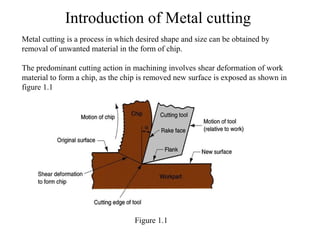
Metal cutting is a process in which desired shape and size can be obtained by
removal of unwanted material in the form of chip.
The predominant cutting action in machining involves shear deformation of work
material to form a chip, as the chip is removed new surface is exposed as shown in
figure 1.1
Figure 1.1
Why metal cutting is important ?
• Variety of work material can be machined.
• Variety of shapes and special geometry can be produced
such as gears, screw threads and very straight edge and
surfaces.
• Very complex object can be produced.
• Very good dimensional accuracy can be obtained.
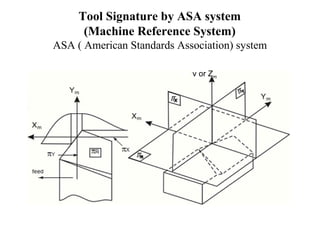
Tool Signature by ASA system
(Machine Reference System)
ASA ( American Standards Association) system
v or Zm
• πR= Reference plane; plane perpendicular to the velocity vector
• πX= Machine longitudinal plane; plane perpendicular to πRand
taken in the direction of assumed longitudinal feed
• πY= Machine Transverse plane; plane perpendicular to both πR and
πX[This plane is taken in the direction of assumed cross feed]
• The axes Xm, Ymand Zmare in the direction of longitudinal feed,
cross feed and cutting velocity (vector) respectively.
Cont…
αb
αs
θs
θe
Cs
Ce
Cont…
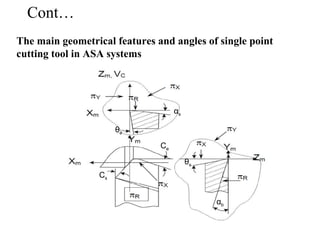
The main geometrical features and angles of single point
cutting tool in ASA systems
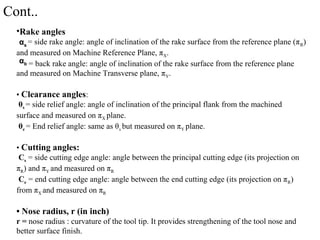
•Rake angles
= side rake angle: angle of inclination of the rake surface from the reference plane (πR)
and measured on Machine Reference Plane, πX.
= back rake angle: angle of inclination of the rake surface from the reference plane
and measured on Machine Transverse plane, πY.
• Clearance angles:
θs = side relief angle: angle of inclination of the principal flank from the machined
surface and measured on πX plane.
θe = End relief angle: same as θs but measured on πY plane.
• Cutting angles:
Cs = side cutting edge angle: angle between the principal cutting edge (its projection on
πR) and πY and measured on πR
Ce = end cutting edge angle: angle between the end cutting edge (its projection on πR)
from πX and measured on πR
• Nose radius, r (in inch)
r = nose radius : curvature of the tool tip. It provides strengthening of the tool nose and
better surface finish.
αs
αb
Cont..
Assumptions for Merchant’s force
analysis
• The tool is perfectly sharp.
• A continuous chip is produced without BUE.
• Uncut chip thickness is constant.
• Metal cutting occurring under plain strain condition (i.e. width of
the chip is remain constant).
• Shear zone is consider as single shear plane
• Orthogonal cutting is consider (side cutting edge angle Cs = 0).
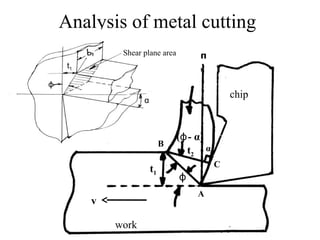
t1
t2
ϕ
( -ϕ α)
chip
work
v
Analysis of metal cutting
α
ϕ
t1
Shear plane area
B
A
C
ᴨ
R
α
Cont…
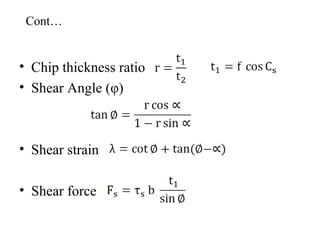
• Chip thickness ratio
• Shear Angle (φ)
• Shear strain
• Shear force
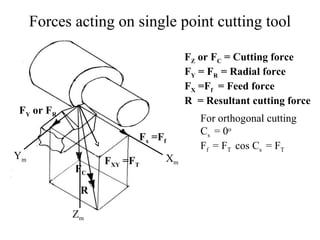
Forces acting on single point cutting tool
FZ or FC = Cutting force
FY = FR = Radial force
FX =Ff = Feed force
R = Resultant cutting force
For orthogonal cutting
Cs = 0o
Ff = FT cos Cs = FT
FY or FR
Fx =Ff
FC
R
Ym Xm
Zm
FXY =FT
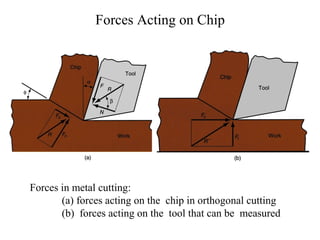
Forces Acting on Chip
Forces in metal cutting:
(a) forces acting on the chip in orthogonal cutting
(b) forces acting on the tool that can be measured
Fn
Fs
FC
FT
F
N
R, R’,R”
α
α
(β-α)
ϕ
β
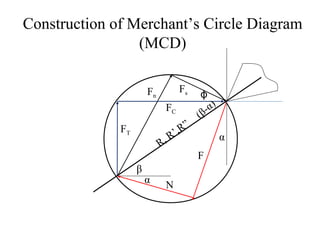
Construction of Merchant’s Circle Diagram
(MCD)
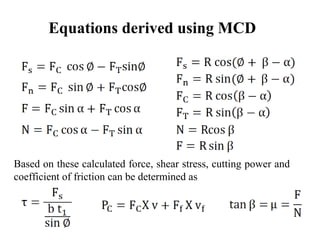
Equations derived using MCD
Based on these calculated force, shear stress, cutting power and
coefficient of friction can be determined as
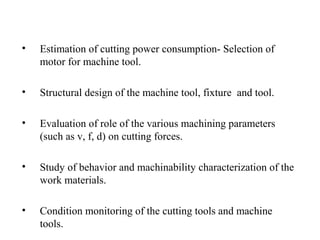
• Estimation of cutting power consumption- Selection of
motor for machine tool.
• Structural design of the machine tool, fixture and tool.
• Evaluation of role of the various machining parameters
(such as v, f, d) on cutting forces.
• Study of behavior and machinability characterization of the
work materials.
• Condition monitoring of the cutting tools and machine
tools.
?
Thank you…

Merchant circle diagram

  • 1.
    Mechanics of Machining (MerchantCircle Diagram ) Presented by Manish Singh IIT Delhi
  • 2.
    Contents • Introduction ofmetal cutting • Tool signature by ASA system • Assumptions for Merchant’s force analysis • Forces on single point cutting tool • Construction of Merchant circle diagram(MCD).
  • 3.
    Introduction of Metalcutting Metal cutting is a process in which desired shape and size can be obtained by removal of unwanted material in the form of chip. The predominant cutting action in machining involves shear deformation of work material to form a chip, as the chip is removed new surface is exposed as shown in figure 1.1 Figure 1.1
  • 4.
    Why metal cuttingis important ? • Variety of work material can be machined. • Variety of shapes and special geometry can be produced such as gears, screw threads and very straight edge and surfaces. • Very complex object can be produced. • Very good dimensional accuracy can be obtained.
  • 5.
    Tool Signature byASA system (Machine Reference System) ASA ( American Standards Association) system v or Zm
  • 6.
    • πR= Referenceplane; plane perpendicular to the velocity vector • πX= Machine longitudinal plane; plane perpendicular to πRand taken in the direction of assumed longitudinal feed • πY= Machine Transverse plane; plane perpendicular to both πR and πX[This plane is taken in the direction of assumed cross feed] • The axes Xm, Ymand Zmare in the direction of longitudinal feed, cross feed and cutting velocity (vector) respectively. Cont…
  • 7.
    αb αs θs θe Cs Ce Cont… The main geometricalfeatures and angles of single point cutting tool in ASA systems
  • 8.
    •Rake angles = siderake angle: angle of inclination of the rake surface from the reference plane (πR) and measured on Machine Reference Plane, πX. = back rake angle: angle of inclination of the rake surface from the reference plane and measured on Machine Transverse plane, πY. • Clearance angles: θs = side relief angle: angle of inclination of the principal flank from the machined surface and measured on πX plane. θe = End relief angle: same as θs but measured on πY plane. • Cutting angles: Cs = side cutting edge angle: angle between the principal cutting edge (its projection on πR) and πY and measured on πR Ce = end cutting edge angle: angle between the end cutting edge (its projection on πR) from πX and measured on πR • Nose radius, r (in inch) r = nose radius : curvature of the tool tip. It provides strengthening of the tool nose and better surface finish. αs αb Cont..
  • 9.
    Assumptions for Merchant’sforce analysis • The tool is perfectly sharp. • A continuous chip is produced without BUE. • Uncut chip thickness is constant. • Metal cutting occurring under plain strain condition (i.e. width of the chip is remain constant). • Shear zone is consider as single shear plane • Orthogonal cutting is consider (side cutting edge angle Cs = 0).
  • 10.
    t1 t2 ϕ ( -ϕ α) chip work v Analysisof metal cutting α ϕ t1 Shear plane area B A C ᴨ R α
  • 11.
    Cont… • Chip thicknessratio • Shear Angle (φ) • Shear strain • Shear force
  • 12.
    Forces acting onsingle point cutting tool FZ or FC = Cutting force FY = FR = Radial force FX =Ff = Feed force R = Resultant cutting force For orthogonal cutting Cs = 0o Ff = FT cos Cs = FT FY or FR Fx =Ff FC R Ym Xm Zm FXY =FT
  • 13.
    Forces Acting onChip Forces in metal cutting: (a) forces acting on the chip in orthogonal cutting (b) forces acting on the tool that can be measured
  • 14.
  • 15.
    Equations derived usingMCD Based on these calculated force, shear stress, cutting power and coefficient of friction can be determined as
  • 16.
    • Estimation ofcutting power consumption- Selection of motor for machine tool. • Structural design of the machine tool, fixture and tool. • Evaluation of role of the various machining parameters (such as v, f, d) on cutting forces. • Study of behavior and machinability characterization of the work materials. • Condition monitoring of the cutting tools and machine tools.
  • 17.