Practical ML
Antonio Pitasi
Samuele Sabella
2019 - Polo Fibonacci
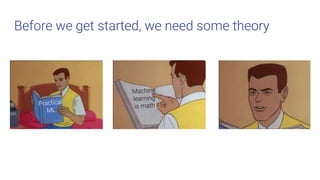
Before we get started, we need some theory
Machine learning
● Practice: We define machine learning as a set of methods that can
automatically detect patterns in data, and then use the uncovered patterns to
predict future data, or to perform other kinds of decision making under
uncertainty
● Theory: How does learning performance vary with the number of training
examples presented? Which learning algorithms are most appropriate for
various types of learning tasks?
- Machine Learning, Tom Mitchell
- Machine Learning: A Probabilistic Perspective, Kevin P.
Murphy
ML is not only artificial neural networks
● Lots of mathematical models
○ Hidden Markov models
○ Support Vector Machines
○ Decision trees
○ Boltzmann machines, Deep belief network, Deep Boltzmann
● Neural network models are many...
○ Shallow network, Deep neural network
○ CNN (Yolo, AlexNet, GoogLeNet)
○ Echo state network, Deep echo state network
○ Rnn, LSTM, GRU
Machine learning categories
● Supervised: the goal is to learn a mapping from input to output given a
dataset of labeled pairs called training set (e.g. Iris Data Set
● Unsupervised: we have only a set of data points and the
goal is to find interesting patterns in the data
Example: young American males who buy diapers also have a predisposition
to buy beer (original story [3])
[2])
How does it work?
● Dataset of examples to learn from
● A model to learn from that data (e.g. neural net)
○ With some parameters to tune
○ With some hyperparameter to choose (neurons, layers, ...)
● Target function (loss) to minimize
cat: 0.9
lobster: 0.1
You are
[0.3, 0.2, 0.1]
wrong!
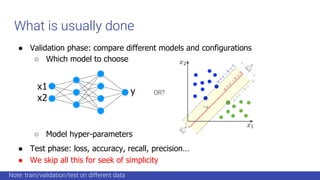
What is usually done
● Validation phase: compare different models and configurations
○ Which model to choose
○ Model hyper-parameters
● Test phase: loss, accuracy, recall, precision…
● We skip all this for seek of simplicity
OR?
Note: train/validation/test on different data
Models: feed-forward neural networks
virginica if argmax(net(input))==0 else setosa
non-linear
function
Note: A non-linear function ensure ANN to be a universal approximator [4]
Stack neurons in layers
Models: feed-forward neural networks
non-linear
function
*
*The optimizer will tune this
weights to minimize the loss
function in batch of examples
(btw we will use Adam [5])
Stack neurons in layers
virginica if argmax(net(input))==0 else setosa
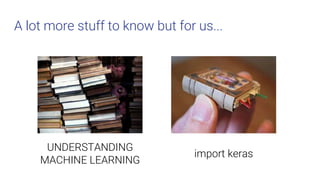
A lot more stuff to know but for us...
UNDERSTANDING
MACHINE LEARNING
import keras
Practical ML
- Interactive
- Collaborative
- Python, R, Julia, Scala, ...
+ =
Easy to build a neural network
Easy to build a neural network wrong
Features:
Accuracy
Fitting
Performance
Keep an eye for:
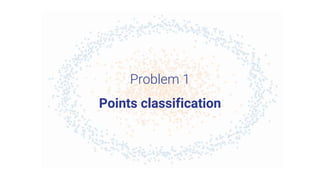
Problem 1
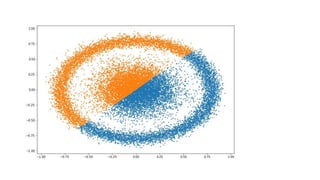
Points classification
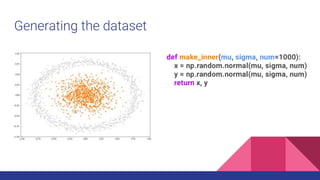
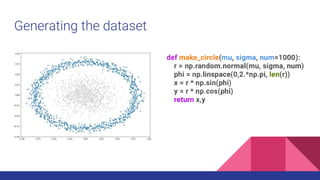
Generating the dataset
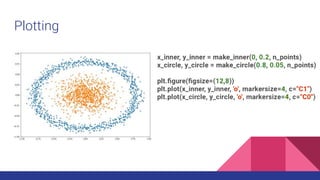
Plotting
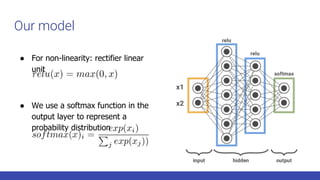
Our model
● For non-linearity: rectifier linear
unit
● We use a softmax function in the
output layer to represent a
probability distribution
Let’s code!
https://colab.research.google.com
https://ml.anto.pt
Me after
training a neural
network
Back to theory - Convolving Lenna
● Given a function f, a convolution g with a kernel w is given by a very complex
formula with a very simple meaning: “adding each element of the image to its
local neighbors, weighted by the kernel” (wikipedia)
Note: check the manual implementation at link http://bit.ly/ml-dummies-lenna References: [11]
Convolution arithmetic
● Zero-padding: deal with borders pixels by adding zeros (preserves the size)
● Pooling: helps the network to become transformation invariant (translations,
rotations...) [7]
padding=same && no strides
GIF credits - https://github.com/vdumoulin/conv_arithmetic
max pooling && 2x2 strides
No padding, no strides
Dealing with multiple input channels
References: [12]
GoogLeNet on ImageNet - Feature visualization
feature visualization of
the 1s conv. layer
layer 3a layer 4d
References: [8,9,10]
Stack multiple filters and
learn kernels dynamically
(hierarchy of features)
Problem 2
Digits recognition
References
[1] Pattern Recognition in a Bucket
https://link.springer.com/chapter/10.1007/978-3-540-39432-7_63
[2] Iris dataset: https://archive.ics.uci.edu/ml/datasets/iris
[3] Beer and diapers: http://www.dssresources.com/newsletters/66.php
[4] Multilayer feedforward networks are universal approximators:
http://cognitivemedium.com/magic_paper/assets/Hornik.pdf
[5] Adam: A Method for Stochastic Optimization: https://arxiv.org/abs/1412.6980
[6] MNIST dataset: http://yann.lecun.com/exdb/mnist/
References
[7] Bengio, Yoshua, Ian Goodfellow, and Aaron Courville. Deep learning. Vol. 1.
MIT press, 2017: http://www.deeplearningbook.org/
[8] Feature-visualization: https://distill.pub/2017/feature-visualization/
[9] Going deeper with convolutions: https://arxiv.org/pdf/1409.4842.pdf
[10] Imagenet: A large-scale hierarchical image database: http://www.image-
net.org/papers/imagenet_cvpr09.pdf
[11] Culture, Communication, and an Information Age Madonna:
http://www.lenna.org/pcs_mirror/may_june01.pdf
References
[12] Intuitively Understanding Convolutions for Deep Learning:
https://towardsdatascience.com/intuitively-understanding-convolutions-for-deep-
learning-1f6f42faee1
Books
Difficulty
Antonio Pitasi
Software Engineer, Nextworks
https://anto.pt
Samuele Sabella
https://github.com/samuelesabella
Antonio Pitasi
Software Engineer, Nextworks
https://anto.pt
Samuele Sabella
https://github.com/samuelesabella
Practical ML

Practical ML

  • 1.
    Practical ML Antonio Pitasi SamueleSabella 2019 - Polo Fibonacci
  • 2.
    Before we getstarted, we need some theory
  • 3.
    Machine learning ● Practice:We define machine learning as a set of methods that can automatically detect patterns in data, and then use the uncovered patterns to predict future data, or to perform other kinds of decision making under uncertainty ● Theory: How does learning performance vary with the number of training examples presented? Which learning algorithms are most appropriate for various types of learning tasks? - Machine Learning, Tom Mitchell - Machine Learning: A Probabilistic Perspective, Kevin P. Murphy
  • 4.
    ML is notonly artificial neural networks ● Lots of mathematical models ○ Hidden Markov models ○ Support Vector Machines ○ Decision trees ○ Boltzmann machines, Deep belief network, Deep Boltzmann ● Neural network models are many... ○ Shallow network, Deep neural network ○ CNN (Yolo, AlexNet, GoogLeNet) ○ Echo state network, Deep echo state network ○ Rnn, LSTM, GRU
  • 5.
    Machine learning categories ●Supervised: the goal is to learn a mapping from input to output given a dataset of labeled pairs called training set (e.g. Iris Data Set ● Unsupervised: we have only a set of data points and the goal is to find interesting patterns in the data Example: young American males who buy diapers also have a predisposition to buy beer (original story [3]) [2])
  • 6.
    How does itwork? ● Dataset of examples to learn from ● A model to learn from that data (e.g. neural net) ○ With some parameters to tune ○ With some hyperparameter to choose (neurons, layers, ...) ● Target function (loss) to minimize cat: 0.9 lobster: 0.1 You are [0.3, 0.2, 0.1] wrong!
  • 7.
    What is usuallydone ● Validation phase: compare different models and configurations ○ Which model to choose ○ Model hyper-parameters ● Test phase: loss, accuracy, recall, precision… ● We skip all this for seek of simplicity OR? Note: train/validation/test on different data
  • 8.
    Models: feed-forward neuralnetworks virginica if argmax(net(input))==0 else setosa non-linear function Note: A non-linear function ensure ANN to be a universal approximator [4] Stack neurons in layers
  • 9.
    Models: feed-forward neuralnetworks non-linear function * *The optimizer will tune this weights to minimize the loss function in batch of examples (btw we will use Adam [5]) Stack neurons in layers virginica if argmax(net(input))==0 else setosa
  • 10.
    A lot morestuff to know but for us... UNDERSTANDING MACHINE LEARNING import keras
  • 11.
  • 14.
    - Interactive - Collaborative -Python, R, Julia, Scala, ...
  • 15.
  • 17.
    Easy to builda neural network Easy to build a neural network wrong Features:
  • 18.
  • 19.
  • 22.
  • 23.
  • 24.
  • 25.
    Our model ● Fornon-linearity: rectifier linear unit ● We use a softmax function in the output layer to represent a probability distribution
  • 26.
  • 27.
    Me after training aneural network
  • 28.
    Back to theory- Convolving Lenna ● Given a function f, a convolution g with a kernel w is given by a very complex formula with a very simple meaning: “adding each element of the image to its local neighbors, weighted by the kernel” (wikipedia) Note: check the manual implementation at link http://bit.ly/ml-dummies-lenna References: [11]
  • 29.
    Convolution arithmetic ● Zero-padding:deal with borders pixels by adding zeros (preserves the size) ● Pooling: helps the network to become transformation invariant (translations, rotations...) [7] padding=same && no strides GIF credits - https://github.com/vdumoulin/conv_arithmetic max pooling && 2x2 strides No padding, no strides
  • 30.
    Dealing with multipleinput channels References: [12]
  • 31.
    GoogLeNet on ImageNet- Feature visualization feature visualization of the 1s conv. layer layer 3a layer 4d References: [8,9,10] Stack multiple filters and learn kernels dynamically (hierarchy of features)
  • 32.
  • 33.
    References [1] Pattern Recognitionin a Bucket https://link.springer.com/chapter/10.1007/978-3-540-39432-7_63 [2] Iris dataset: https://archive.ics.uci.edu/ml/datasets/iris [3] Beer and diapers: http://www.dssresources.com/newsletters/66.php [4] Multilayer feedforward networks are universal approximators: http://cognitivemedium.com/magic_paper/assets/Hornik.pdf [5] Adam: A Method for Stochastic Optimization: https://arxiv.org/abs/1412.6980 [6] MNIST dataset: http://yann.lecun.com/exdb/mnist/
  • 34.
    References [7] Bengio, Yoshua,Ian Goodfellow, and Aaron Courville. Deep learning. Vol. 1. MIT press, 2017: http://www.deeplearningbook.org/ [8] Feature-visualization: https://distill.pub/2017/feature-visualization/ [9] Going deeper with convolutions: https://arxiv.org/pdf/1409.4842.pdf [10] Imagenet: A large-scale hierarchical image database: http://www.image- net.org/papers/imagenet_cvpr09.pdf [11] Culture, Communication, and an Information Age Madonna: http://www.lenna.org/pcs_mirror/may_june01.pdf
  • 35.
    References [12] Intuitively UnderstandingConvolutions for Deep Learning: https://towardsdatascience.com/intuitively-understanding-convolutions-for-deep- learning-1f6f42faee1
  • 36.
  • 37.
    Antonio Pitasi Software Engineer,Nextworks https://anto.pt Samuele Sabella https://github.com/samuelesabella
  • 39.
    Antonio Pitasi Software Engineer,Nextworks https://anto.pt Samuele Sabella https://github.com/samuelesabella

Editor's Notes

  • #4 The explanation goes that when fathers are sent out on an errand to buy diapers, they often purchase a six-pack of their favorite beer as a reward.
  • #9 It is important that g be non- linear, otherwise the whole model collapses into a large linear regression model of the form y = wT (Vx). One can show that an MLP is a universal approximator, meaning it can model any suitably smooth function, given enough hidden units, to any desired level of accuracy (Hornik 1991).
  • #10 It is important that g be non- linear, otherwise the whole model collapses into a large linear regression model of the form y = wT (Vx). One can show that an MLP is a universal approximator, meaning it can model any suitably smooth function, given enough hidden units, to any desired level of accuracy (Hornik 1991).
  • #11 Prima slide Pitasi
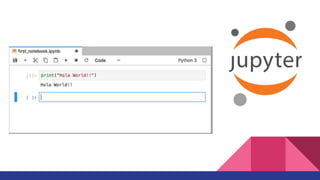
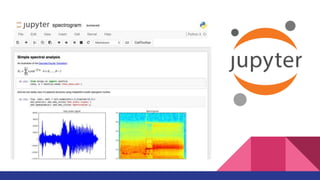
  • #13 Jupyter! Notebook open source per includere codice e il suo output
  • #14 Non solo codice e il suo output: immagini, markdown, latex, link
  • #15 Punti di forza dei notebook: condivisione e collaborazione E supporta linguaggi diversi da Python: al momento Jupyter supporta 40 linguaggi
  • #16 Per il workshop useremo i notebook online di Google: colab(orative)
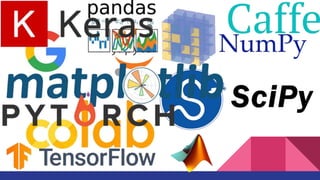
  • #17 Recap: utilizzeremo i notebook di Google Colab Ma useremo anche una libreria: NUMPY - operazioni matematiche in modo efficiente (e.s matrici, vettori, …) Poi ci sarebbe SCIPY che implementa altri algoritmi e utilità matematiche PANDAS implementa strutture dati come tabelle o serie temporali MATPLOTLIB è la libreria fondamentale per la costruzione di grafici TENSORFLOW è la libreria creata da Google per machine learning KERAS è una libreria di alto livello che utilizza TENSORFLOW per fornire funzioni piuttosto semplici per fare machine learning
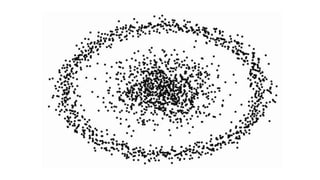
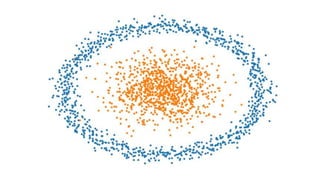
  • #21 Il nostro problema: distinguere i punti accumulati al centro dalla fascia che li circonda Partiamo generando un po’ di questi punti che useremo come training set, dopodichè ne genereremo altri come test set, e infine vedremo come si comporta la nostra rete
  • #22 Il nostro problema: distinguere i punti accumulati al centro dalla fascia che li circonda Partiamo generando un po’ di questi punti che useremo come training set, dopodichè ne genereremo altri come test set, e infine vedremo come si comporta la nostra rete
  • #26 It is important that g be non- linear, otherwise the whole model collapses into a large linear regression model of the form y = wT (Vx). One can show that an MLP is a universal approximator, meaning it can model any suitably smooth function, given enough hidden units, to any desired level of accuracy (Hornik 1991).
  • #29 Sobel operator (the one in the picture) return local intensity changes along one axis. In other words the kernel activates (maximum dot product) when placed over a patch of the image with high changes along one axis (border). A specific convolution kernel can be used to detect features in an image, for example the borders.