Machine Learning and Model-Based Optimization
for Heterogeneous Catalyst Design and Discovery
Ichigaku Takigawa
• Institute for Chemical Reaction Design and Discovery
(WPI-ICReDD), Hokkaido University
• RIKEN Center for Advanced Intelligence Project (AIP)
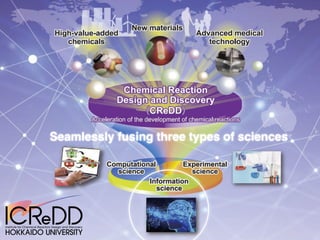
Seamlessly fusing three types of sciences
Rationalize & Accelerate Chemical Design and Discovery
This Symposium Topic

Toward Interdisciplinary Research Guided by Theory and Calculation
To reach "experimental realizations" through "theory and calculation",
supports by implicit/empirical chemical knowledge are still required.
Even though current chemical calculations are fairly accurate, 

chemists would still be driven by ...
1. empirical findings (patterns) reported in papers and textbooks
2. experiences actually doing a lot of experiments
Takeaway: We also need 'data-driven' bridges!

first principles are not enough for us to throw away these empirical
things; data-driven approaches (ML) play a complementary role!
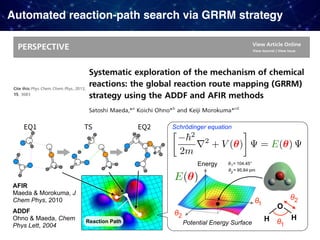
Automated reaction-path search via GRRM strategy
θ1
θ2
O
H H
Energy θ = 104.45°1
θ = 95.84 pm2
θ1
Schrödinger equation
Potential Energy Surface
EQ1 EQ2TS
ADDF

Ohno & Maeda, Chem
Phys Lett, 2004
Reaction Path
AFIR
Maeda & Morokuma, J
Chem Phys, 2010
θ2
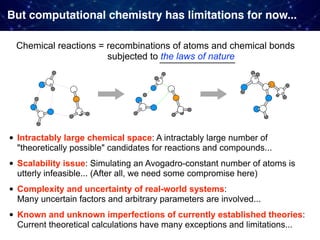
But computational chemistry has limitations for now...
Chemical reactions = recombinations of atoms and chemical bonds

subjected to the laws of nature
• Intractably large chemical space: A intractably large number of
"theoretically possible" candidates for reactions and compounds...
• Scalability issue: Simulating an Avogadro-constant number of atoms is
utterly infeasible... (After all, we need some compromise here)
• Complexity and uncertainty of real-world systems: 

Many uncertain factors and arbitrary parameters are involved...
• Known and unknown imperfections of currently established theories:
Current theoretical calculations have many exceptions and limitations...
Yet another approach: Data-driven
Cause-and-Effect

Relationship
Related factors

(and their states)
Outcome
Reactions
Some
mechanism
[Inputs] [Outputs]
Theory-driven methods try to explicitly model the inner workings
of a target phenomenon (e.g. through first-principles simulations)
Data-driven methods try to precisely approximate its outer behavior
(the input-output relationship) observable as "data". 

(e.g. through machine learning from a large collection of data)
based on very different principles and quite complementary!
governing equation?
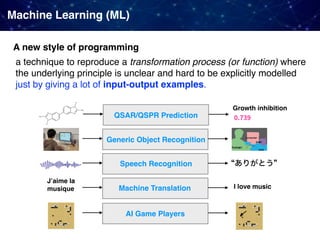
Machine Learning (ML)
Generic Object Recognition
Speech Recognition
Machine Translation
QSAR/QSPR Prediction
AI Game Players
“ ”
J’aime la
musique I love music
CH3
N
N
H
N
H
H3C
N
Growth inhibition
0.739
A new style of programming
a technique to reproduce a transformation process (or function) where
the underlying principle is unclear and hard to be explicitly modelled 

just by giving a lot of input-output examples.
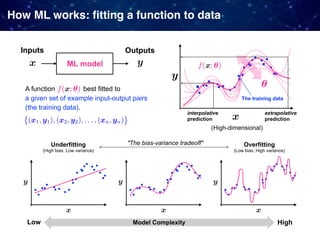
How ML works: fitting a function to data
Inputs Outputs
ML modelx<latexit sha1_base64="BkOuic6isW1cYY2ZNWiUOdOU/tM=">AAACq3ichVFNLwNRFD3G92eLjcRGNMRG8wYJsWrYWJbqR2jTzIxXHvOVmdcGTf+AlZ1gRWIhfoaNP2DhJ4gliY2FO9NJBFF3MvPOO/ee+86bq7um8CVjT21Ke0dnV3dPb1//wOBQLD48kvOdqmfwrOGYjlfQNZ+bwuZZKaTJC67HNUs3eV4/WA3y+Rr3fOHYm/LI5SVL27VFRRiaJCpX1K36YaMcT7AkC2PiN1AjkEAUaSf+gCJ24MBAFRY4bEjCJjT49GxDBYNLXAl14jxCIsxzNNBH2ipVcarQiD2g7y7ttiPWpn3Q0w/VBp1i0uuRcgJT7JHdslf2wO7YM/v4s1c97BF4OaJVb2q5W46djGXe/1VZtErsfalaepaoYCn0Ksi7GzLBLYymvnZ89ppZ3piqT7Nr9kL+r9gTu6cb2LU342adb1y28KOTl7//WJCPKmiE6s+B/Qa5uaQ6n5xbX0ikVqJh9mAck5ihiS0ihTWkkaUT9nGKc1wos0pG2VKKzVKlLdKM4lso/BN9vpmr</latexit>
y<latexit sha1_base64="getvLqfzl+lmP3jVELri0P4Sr2g=">AAACq3ichVG7SgNBFD1ZX/EdtRFsxBCxMUxUUKxEG0tNzAMTkd11Ekf3xe4kEEN+wMpO1ErBQvwMG3/Awk8Qywg2Ft7dLIgG9S67c+bce+6c2as5hvAkY88Rpau7p7cv2j8wODQ8MhobG895dtXVeVa3DdstaKrHDWHxrBTS4AXH5aqpGTyvHW/4+XyNu56wrR1Zd/ieqVYsURa6KonKlTSzUW/ux+IsyYKY7gSpEMQRxpYde0QJB7ChowoTHBYkYQMqPHqKSIHBIW4PDeJcQiLIczQxQNoqVXGqUIk9pm+FdsWQtWjv9/QCtU6nGPS6pJxGgj2xO9Zij+yevbCPX3s1gh6+lzqtWlvLnf3R08nM+78qk1aJwy/Vn54lylgJvAry7gSMfwu9ra+dnLcyq+lEY5bdsFfyf82e2QPdwKq96bfbPH31hx+NvPz+x/x8WEEjTP0cWCfILSRTi8mF7aX42no4zCimMIM5mtgy1rCJLWTphCOc4QKXyrySUXaVUrtUiYSaCXwLhX8CgAGZrA==</latexit>
A function best fitted to
a given set of example input-output pairs
(the training data).
(x1, y1), (x2, y2), . . . , (xn, yn)<latexit sha1_base64="l6cITD180CW4htD4CpRHsG+/qlU=">AAAC+3ichVE9T9xAEB1MSMCQcCENUppTTiCQTqdZJwoHFSINJV8HSBidbLMcK/wle++Uw7o/kD9AQQUoBYE2Tdo0/IEUdLRASaQ0FMz6fCCKI2PZ+/bNvNm3Hjt0RSwRL3q03hd9L1/1D+iDQ6/fDOfejqzGQT1yeMUJ3CBat62Yu8LnFSmky9fDiFue7fI1e/eLyq81eBSLwF+RzZBvelbNF9vCsSRR1dyKaYuaayb6hGl7yddWlRUVaBKYLD6QRoc0iDS3AhnrxU7O7+T8SV01i8xWNVfAEiIyxvIKsKnPSGB6umywcp6pFEUBslgIcudgwhYE4EAdPODggyTsggUxPRvAACEkbhMS4iJCIs1zaIFO2jpVcaqwiN2lb412Gxnr0171jFO1Q6e49EakzMMY/sETvMVzPMUrvOvaK0l7KC9NWu22lofV4W+jy//+q/JolbDzqHrWs4RtKKdeBXkPU0bdwmnrG3v7t8szS2PJOB7hDfk/xAv8TTfwG3+d74t86eAZPzZ56f7HVD6roBF25pTvDlaNEvtYMhY/FWbnsmH2w3v4ABM0sSmYhXlYgAqd8Asu4QqutZZ2rP3QztqlWk+meQdPQvt5D2QXt/E=</latexit>
f(x; ✓)<latexit sha1_base64="33zlDWOHXmZvZwuGF4JM5OwSths=">AAAC53ichVFNT9RQFD1UEUSUUTckbhonGEzI5HYEnJHNRDcu+RogmZlM2vpmeKFfad9MxKZ/wI07NXGFiSaGn8GGhVtM+AmEJSRuXHjbKSHGDNymfeede8995/VagSMjRXQ8ot24OXprbPz2xJ3Ju/emCvcfbER+L7RF3fYdP9yyzEg40hN1JZUjtoJQmK7liE1r51Wa3+yLMJK+t652A9Fyza4nO9I2FVPtQq0zGzezNo2wa7ViKlEWc/+BRG9abvw2SZYy0FTbQpnJ03ahSKVqZZHmy3paWinTIoMFMqpGVTdycRF5LPuFQzTxBj5s9OBCwINi7MBExE8DBggBcy3EzIWMZJYXSDDB2h5XCa4wmd3hb5d3jZz1eJ/2jDK1zac4/Ias1DFDR/SDzuiQ9umE/gztFWc9Ui+7vFoDrQjaU++n135fq3J5Vdi+VF3pWaGDSuZVsvcgY9Jb2AN9/92ns7UXqzPxE/pKp+x/j47pgG/g9c/tbyti9csVfiz2MvyPpfm8gkd4MSd9ONgol4xnpfLKfLH2Mh/mOB7hMWZ5Ys9Rw2sso84nfMdPHOGXJrUP2kft86BUG8k1D/FPaHt/AeNtrV0=</latexit>
x<latexit sha1_base64="BkOuic6isW1cYY2ZNWiUOdOU/tM=">AAACq3ichVFNLwNRFD3G92eLjcRGNMRG8wYJsWrYWJbqR2jTzIxXHvOVmdcGTf+AlZ1gRWIhfoaNP2DhJ4gliY2FO9NJBFF3MvPOO/ee+86bq7um8CVjT21Ke0dnV3dPb1//wOBQLD48kvOdqmfwrOGYjlfQNZ+bwuZZKaTJC67HNUs3eV4/WA3y+Rr3fOHYm/LI5SVL27VFRRiaJCpX1K36YaMcT7AkC2PiN1AjkEAUaSf+gCJ24MBAFRY4bEjCJjT49GxDBYNLXAl14jxCIsxzNNBH2ipVcarQiD2g7y7ttiPWpn3Q0w/VBp1i0uuRcgJT7JHdslf2wO7YM/v4s1c97BF4OaJVb2q5W46djGXe/1VZtErsfalaepaoYCn0Ksi7GzLBLYymvnZ89ppZ3piqT7Nr9kL+r9gTu6cb2LU342adb1y28KOTl7//WJCPKmiE6s+B/Qa5uaQ6n5xbX0ikVqJh9mAck5ihiS0ihTWkkaUT9nGKc1wos0pG2VKKzVKlLdKM4lso/BN9vpmr</latexit>
y<latexit sha1_base64="getvLqfzl+lmP3jVELri0P4Sr2g=">AAACq3ichVG7SgNBFD1ZX/EdtRFsxBCxMUxUUKxEG0tNzAMTkd11Ekf3xe4kEEN+wMpO1ErBQvwMG3/Awk8Qywg2Ft7dLIgG9S67c+bce+6c2as5hvAkY88Rpau7p7cv2j8wODQ8MhobG895dtXVeVa3DdstaKrHDWHxrBTS4AXH5aqpGTyvHW/4+XyNu56wrR1Zd/ieqVYsURa6KonKlTSzUW/ux+IsyYKY7gSpEMQRxpYde0QJB7ChowoTHBYkYQMqPHqKSIHBIW4PDeJcQiLIczQxQNoqVXGqUIk9pm+FdsWQtWjv9/QCtU6nGPS6pJxGgj2xO9Zij+yevbCPX3s1gh6+lzqtWlvLnf3R08nM+78qk1aJwy/Vn54lylgJvAry7gSMfwu9ra+dnLcyq+lEY5bdsFfyf82e2QPdwKq96bfbPH31hx+NvPz+x/x8WEEjTP0cWCfILSRTi8mF7aX42no4zCimMIM5mtgy1rCJLWTphCOc4QKXyrySUXaVUrtUiYSaCXwLhX8CgAGZrA==</latexit>
✓<latexit sha1_base64="lTDMb0MkD19hJd3A01US8Q9hJ/8=">AAACsHichVG9TgJBEB7PP/wFtTGxIRKMFZk7EcGKaGMJIkoChNydK5zeX+4WEiS8gL2xMNFoYmF8DBtewMJHMJaa2Fg4d5wxFuhsdnf2m/lmv91RbF1zOeLzkDA8Mjo2HpqYnJqemQ1H5ub3XavpqKyoWrrllBTZZbpmsiLXuM5KtsNkQ9HZgXKy7cUPWsxxNcvc422bVQ25bmpHmipzgsoVxehUeINxuVuLxDCRSacwKUUxgZiWMEXOOooZMRMVCfEsBoHlrEgPKnAIFqjQBAMYmMDJ10EGl0YZRECwCatChzCHPM2PM+jCJHGblMUoQyb0hNY6ncoBatLZq+n6bJVu0Wk6xIxCHJ/wHt+whw/4gp8Da3X8Gp6WNu1Kn8vsWvhssfDxL8ugnUPjh/WnZg5HkPa1aqTd9hHvFWqf3zq9eCts7sY7K3iLr6T/Bp/xkV5gtt7VuzzbvfxDj0JaBv+YFw8yqIXffYoOdvalhLiWkPLJWHYraGYIlmAZVqljG5CFHchB0f/zc7iCa0ESSkJNkPupwlDAWYBfJhx/AVqsnB0=</latexit>
x<latexit sha1_base64="BkOuic6isW1cYY2ZNWiUOdOU/tM=">AAACq3ichVFNLwNRFD3G92eLjcRGNMRG8wYJsWrYWJbqR2jTzIxXHvOVmdcGTf+AlZ1gRWIhfoaNP2DhJ4gliY2FO9NJBFF3MvPOO/ee+86bq7um8CVjT21Ke0dnV3dPb1//wOBQLD48kvOdqmfwrOGYjlfQNZ+bwuZZKaTJC67HNUs3eV4/WA3y+Rr3fOHYm/LI5SVL27VFRRiaJCpX1K36YaMcT7AkC2PiN1AjkEAUaSf+gCJ24MBAFRY4bEjCJjT49GxDBYNLXAl14jxCIsxzNNBH2ipVcarQiD2g7y7ttiPWpn3Q0w/VBp1i0uuRcgJT7JHdslf2wO7YM/v4s1c97BF4OaJVb2q5W46djGXe/1VZtErsfalaepaoYCn0Ksi7GzLBLYymvnZ89ppZ3piqT7Nr9kL+r9gTu6cb2LU342adb1y28KOTl7//WJCPKmiE6s+B/Qa5uaQ6n5xbX0ikVqJh9mAck5ihiS0ihTWkkaUT9nGKc1wos0pG2VKKzVKlLdKM4lso/BN9vpmr</latexit>
y<latexit sha1_base64="getvLqfzl+lmP3jVELri0P4Sr2g=">AAACq3ichVG7SgNBFD1ZX/EdtRFsxBCxMUxUUKxEG0tNzAMTkd11Ekf3xe4kEEN+wMpO1ErBQvwMG3/Awk8Qywg2Ft7dLIgG9S67c+bce+6c2as5hvAkY88Rpau7p7cv2j8wODQ8MhobG895dtXVeVa3DdstaKrHDWHxrBTS4AXH5aqpGTyvHW/4+XyNu56wrR1Zd/ieqVYsURa6KonKlTSzUW/ux+IsyYKY7gSpEMQRxpYde0QJB7ChowoTHBYkYQMqPHqKSIHBIW4PDeJcQiLIczQxQNoqVXGqUIk9pm+FdsWQtWjv9/QCtU6nGPS6pJxGgj2xO9Zij+yevbCPX3s1gh6+lzqtWlvLnf3R08nM+78qk1aJwy/Vn54lylgJvAry7gSMfwu9ra+dnLcyq+lEY5bdsFfyf82e2QPdwKq96bfbPH31hx+NvPz+x/x8WEEjTP0cWCfILSRTi8mF7aX42no4zCimMIM5mtgy1rCJLWTphCOc4QKXyrySUXaVUrtUiYSaCXwLhX8CgAGZrA==</latexit>
x<latexit sha1_base64="BkOuic6isW1cYY2ZNWiUOdOU/tM=">AAACq3ichVFNLwNRFD3G92eLjcRGNMRG8wYJsWrYWJbqR2jTzIxXHvOVmdcGTf+AlZ1gRWIhfoaNP2DhJ4gliY2FO9NJBFF3MvPOO/ee+86bq7um8CVjT21Ke0dnV3dPb1//wOBQLD48kvOdqmfwrOGYjlfQNZ+bwuZZKaTJC67HNUs3eV4/WA3y+Rr3fOHYm/LI5SVL27VFRRiaJCpX1K36YaMcT7AkC2PiN1AjkEAUaSf+gCJ24MBAFRY4bEjCJjT49GxDBYNLXAl14jxCIsxzNNBH2ipVcarQiD2g7y7ttiPWpn3Q0w/VBp1i0uuRcgJT7JHdslf2wO7YM/v4s1c97BF4OaJVb2q5W46djGXe/1VZtErsfalaepaoYCn0Ksi7GzLBLYymvnZ89ppZ3piqT7Nr9kL+r9gTu6cb2LU342adb1y28KOTl7//WJCPKmiE6s+B/Qa5uaQ6n5xbX0ikVqJh9mAck5ihiS0ihTWkkaUT9nGKc1wos0pG2VKKzVKlLdKM4lso/BN9vpmr</latexit>
y<latexit sha1_base64="getvLqfzl+lmP3jVELri0P4Sr2g=">AAACq3ichVG7SgNBFD1ZX/EdtRFsxBCxMUxUUKxEG0tNzAMTkd11Ekf3xe4kEEN+wMpO1ErBQvwMG3/Awk8Qywg2Ft7dLIgG9S67c+bce+6c2as5hvAkY88Rpau7p7cv2j8wODQ8MhobG895dtXVeVa3DdstaKrHDWHxrBTS4AXH5aqpGTyvHW/4+XyNu56wrR1Zd/ieqVYsURa6KonKlTSzUW/ux+IsyYKY7gSpEMQRxpYde0QJB7ChowoTHBYkYQMqPHqKSIHBIW4PDeJcQiLIczQxQNoqVXGqUIk9pm+FdsWQtWjv9/QCtU6nGPS6pJxGgj2xO9Zij+yevbCPX3s1gh6+lzqtWlvLnf3R08nM+78qk1aJwy/Vn54lylgJvAry7gSMfwu9ra+dnLcyq+lEY5bdsFfyf82e2QPdwKq96bfbPH31hx+NvPz+x/x8WEEjTP0cWCfILSRTi8mF7aX42no4zCimMIM5mtgy1rCJLWTphCOc4QKXyrySUXaVUrtUiYSaCXwLhX8CgAGZrA==</latexit>
x<latexit sha1_base64="BkOuic6isW1cYY2ZNWiUOdOU/tM=">AAACq3ichVFNLwNRFD3G92eLjcRGNMRG8wYJsWrYWJbqR2jTzIxXHvOVmdcGTf+AlZ1gRWIhfoaNP2DhJ4gliY2FO9NJBFF3MvPOO/ee+86bq7um8CVjT21Ke0dnV3dPb1//wOBQLD48kvOdqmfwrOGYjlfQNZ+bwuZZKaTJC67HNUs3eV4/WA3y+Rr3fOHYm/LI5SVL27VFRRiaJCpX1K36YaMcT7AkC2PiN1AjkEAUaSf+gCJ24MBAFRY4bEjCJjT49GxDBYNLXAl14jxCIsxzNNBH2ipVcarQiD2g7y7ttiPWpn3Q0w/VBp1i0uuRcgJT7JHdslf2wO7YM/v4s1c97BF4OaJVb2q5W46djGXe/1VZtErsfalaepaoYCn0Ksi7GzLBLYymvnZ89ppZ3piqT7Nr9kL+r9gTu6cb2LU342adb1y28KOTl7//WJCPKmiE6s+B/Qa5uaQ6n5xbX0ikVqJh9mAck5ihiS0ihTWkkaUT9nGKc1wos0pG2VKKzVKlLdKM4lso/BN9vpmr</latexit>
y<latexit sha1_base64="getvLqfzl+lmP3jVELri0P4Sr2g=">AAACq3ichVG7SgNBFD1ZX/EdtRFsxBCxMUxUUKxEG0tNzAMTkd11Ekf3xe4kEEN+wMpO1ErBQvwMG3/Awk8Qywg2Ft7dLIgG9S67c+bce+6c2as5hvAkY88Rpau7p7cv2j8wODQ8MhobG895dtXVeVa3DdstaKrHDWHxrBTS4AXH5aqpGTyvHW/4+XyNu56wrR1Zd/ieqVYsURa6KonKlTSzUW/ux+IsyYKY7gSpEMQRxpYde0QJB7ChowoTHBYkYQMqPHqKSIHBIW4PDeJcQiLIczQxQNoqVXGqUIk9pm+FdsWQtWjv9/QCtU6nGPS6pJxGgj2xO9Zij+yevbCPX3s1gh6+lzqtWlvLnf3R08nM+78qk1aJwy/Vn54lylgJvAry7gSMfwu9ra+dnLcyq+lEY5bdsFfyf82e2QPdwKq96bfbPH31hx+NvPz+x/x8WEEjTP0cWCfILSRTi8mF7aX42no4zCimMIM5mtgy1rCJLWTphCOc4QKXyrySUXaVUrtUiYSaCXwLhX8CgAGZrA==</latexit>
interpolative
prediction
(High-dimensional)
HighLow Model Complexity
Underfitting
(High bias, Low variance)
Overfitting
(Low bias, High variance)
"The bias-variance tradeoff"
The training data
f(x; ✓)<latexit sha1_base64="33zlDWOHXmZvZwuGF4JM5OwSths=">AAAC53ichVFNT9RQFD1UEUSUUTckbhonGEzI5HYEnJHNRDcu+RogmZlM2vpmeKFfad9MxKZ/wI07NXGFiSaGn8GGhVtM+AmEJSRuXHjbKSHGDNymfeede8995/VagSMjRXQ8ot24OXprbPz2xJ3Ju/emCvcfbER+L7RF3fYdP9yyzEg40hN1JZUjtoJQmK7liE1r51Wa3+yLMJK+t652A9Fyza4nO9I2FVPtQq0zGzezNo2wa7ViKlEWc/+BRG9abvw2SZYy0FTbQpnJ03ahSKVqZZHmy3paWinTIoMFMqpGVTdycRF5LPuFQzTxBj5s9OBCwINi7MBExE8DBggBcy3EzIWMZJYXSDDB2h5XCa4wmd3hb5d3jZz1eJ/2jDK1zac4/Ias1DFDR/SDzuiQ9umE/gztFWc9Ui+7vFoDrQjaU++n135fq3J5Vdi+VF3pWaGDSuZVsvcgY9Jb2AN9/92ns7UXqzPxE/pKp+x/j47pgG/g9c/tbyti9csVfiz2MvyPpfm8gkd4MSd9ONgol4xnpfLKfLH2Mh/mOB7hMWZ5Ys9Rw2sso84nfMdPHOGXJrUP2kft86BUG8k1D/FPaHt/AeNtrV0=</latexit>
extrapolative
prediction
Multilevel representations of chemical reactions
Brc1cncc(Br)c1 C[O-] CN(C)C=O Na+ COc1cncc(Br)c1SMILES
Structural Formla
Steric Structures
Electronic States
Reactants Reagents Products
As pattern languages (e.g. known facts in textbooks/databases)
As physical entities (e.g. quantum chemical calculations)
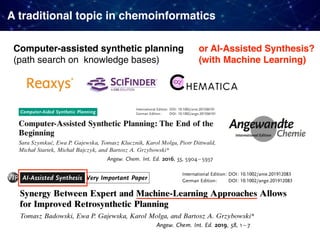
A traditional topic in chemoinformatics
Computer-assisted synthetic planning
(path search on knowledge bases)
or AI-Assisted Synthesis?
(with Machine Learning)
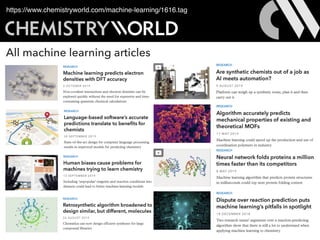
https://www.chemistryworld.com/machine-learning/1616.tag
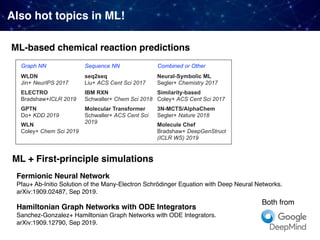
Also hot topics in ML!
ML-based chemical reaction predictions
3N-MCTS/AlphaChem

Segler+ Nature 2018
Molecular Transformer

Schwaller+ ACS Cent Sci
2019
seq2seq

Liu+ ACS Cent Sci 2017
WLDN

Jin+ NeurIPS 2017
ELECTRO

Bradshaw+ICLR 2019
WLN

Coley+ Chem Sci 2019
GPTN

Do+ KDD 2019
Graph NN Sequence NN Combined or Other
IBM RXN

Schwaller+ Chem Sci 2018
Molecule Chef

Bradshaw+ DeepGenStruct

(ICLR WS) 2019
Neural-Symbolic ML

Segler+ Chemistry 2017
Similarity-based

Coley+ ACS Cent Sci 2017
Fermionic Neural Network
Pfau+ Ab-Initio Solution of the Many-Electron Schrödinger Equation with Deep Neural Networks. 

arXiv:1909.02487, Sep 2019.
ML + First-principle simulations
Hamiltonian Graph Networks with ODE Integrators
Sanchez-Gonzalez+ Hamiltonian Graph Networks with ODE Integrators. 

arXiv:1909.12790, Sep 2019.
Both from
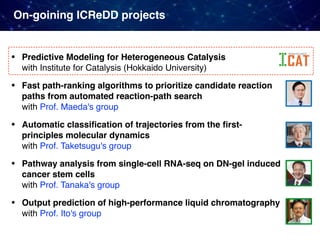
On-goining ICReDD projects
• Predictive Modeling for Heterogeneous Catalysis

with Institute for Catalysis (Hokkaido University)
• Fast path-ranking algorithms to prioritize candidate reaction
paths from automated reaction-path search

with Prof. Maeda's group
• Automatic classification of trajectories from the first-
principles molecular dynamics

with Prof. Taketsugu's group
• Pathway analysis from single-cell RNA-seq on DN-gel induced
cancer stem cells

with Prof. Tanaka's group
• Output prediction of high-performance liquid chromatography

with Prof. Ito's group
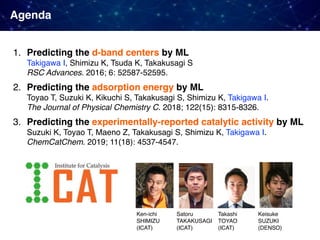
Agenda
1. Predicting the d-band centers by ML

Takigawa I, Shimizu K, Tsuda K, Takakusagi S

RSC Advances. 2016; 6: 52587-52595.
2. Predicting the adsorption energy by ML

Toyao T, Suzuki K, Kikuchi S, Takakusagi S, Shimizu K, Takigawa I.

The Journal of Physical Chemistry C. 2018; 122(15): 8315-8326.
3. Predicting the experimentally-reported catalytic activity by ML

Suzuki K, Toyao T, Maeno Z, Takakusagi S, Shimizu K, Takigawa I.

ChemCatChem. 2019; 11(18): 4537-4547.
Ken-ichi
SHIMIZU

(ICAT)
Satoru
TAKAKUSAGI

(ICAT)
Takashi
TOYAO

(ICAT)
Keisuke

SUZUKI

(DENSO)
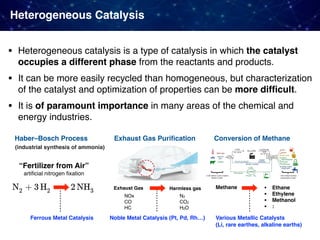
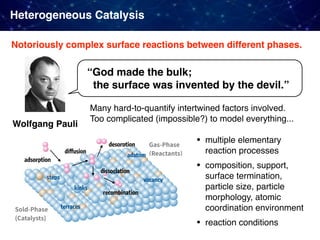
Heterogeneous Catalysis
Haber–Bosch Process
Ferrous Metal Catalysis
NOx
CO
HC
N2
CO2
H2O
Exhaust Gas Harmless gas
Noble Metal Catalysis (Pt, Pd, Rh…)
• Ethane
• Ethylene
• Methanol
• :
Methane
Various Metallic Catalysts

(Li, rare earthes, alkaline earths)
(industrial synthesis of ammonia)
Exhaust Gas Purification Conversion of Methane
“Fertilizer from Air”
artificial nitrogen fixation
• Heterogeneous catalysis is a type of catalysis in which the catalyst
occupies a different phase from the reactants and products.
• It can be more easily recycled than homogeneous, but characterization
of the catalyst and optimization of properties can be more difficult.
• It is of paramount importance in many areas of the chemical and
energy industries.
Heterogeneous Catalysis
Wolfgang Pauli
“God made the bulk; 

the surface was invented by the devil.”
adsorption
diffusion
desorption
dissociation
recombination
kinks
terraces
adatom
vacancysteps
Gas-Phase
(Reactants)
Sold-Phase
(Catalysts)
Many hard-to-quantify intertwined factors involved.
Too complicated (impossible?) to model everything...
• multiple elementary
reaction processes
• composition, support,
surface termination,
particle size, particle
morphology, atomic
coordination environment
• reaction conditions
Notoriously complex surface reactions between different phases.
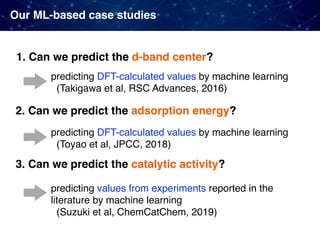
Our ML-based case studies
1. Can we predict the d-band center?
2. Can we predict the adsorption energy?
3. Can we predict the catalytic activity?
predicting DFT-calculated values by machine learning
  (Takigawa et al, RSC Advances, 2016)
predicting DFT-calculated values by machine learning
  (Toyao et al, JPCC, 2018)
predicting values from experiments reported in the 
literature by machine learning
  (Suzuki et al, ChemCatChem, 2019)
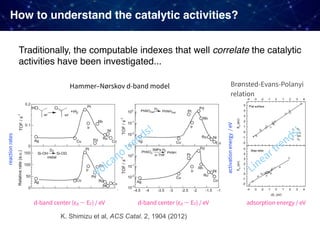
How to understand the catalytic activities?
K. Shimizu et al, ACS Catal. 2, 1904 (2012)
d-band center (εd EF) / eVd-band center (εd EF) / eV
Hammer Nørskov d-band model
reactionrates
Volcano
trends!
adsorption energy / eV
Brønsted-Evans-Polanyi
relation
activationenergy/eV
Linear trends!
Traditionally, the computable indexes that well correlate the catalytic
activities have been investigated...
Case 1. Predicting the d-band centers
Guest
Host
Ruban, Hammer, Stoltze, Skriver, Nørskov, J Mol Catal A, 115:421-429 (1997)
J. K. Nørskov, et al.,
Advances in Catalysis,
2000
Host
Guest
Two types of models
• 1% doped
• overlayer
[1% doped]
The d-band center is one of the established indexes to understand
the trends of heterogeneous catalysts (transition metals based).
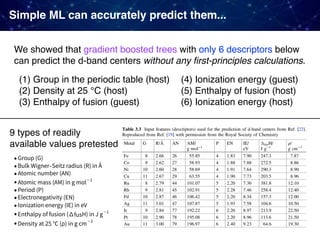
Simple ML can accurately predict them...
Group (G)
Bulk Wigner Seitz radius (R) in Å
Atomic number (AN)
Atomic mass (AM) in g mol
1
Period (P)
Electronegativity (EN)
Ionization energy (IE) in eV
Enthalpy of fusion ( fusH) in J g
1
Density at 25 (ρ) in g cm
3
(1) Group in the periodic table (host)
(2) Density at 25 ℃ (host)
(3) Enthalpy of fusion (guest)
(4) Ionization energy (guest)
(5) Enthalpy of fusion (host)
(6) Ionization energy (host)
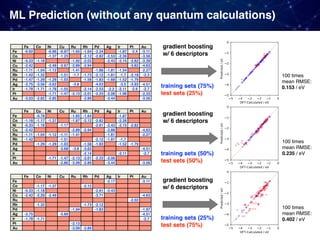
We showed that gradient boosted trees with only 6 descriptors below

can predict the d-band centers without any first-principles calculations.
9 types of readily

available values pretested
Fe Co Ni Cu Ru Rh Pd Ag Ir Pt Au
Fe -0.92 -0.96 -0.97 -1.65 -1.64 -2.24 -1.87 -2.4 -3.11
Co -1.37 -1.23 -2.12 -2.82 -2.53 -2.26 -3.56
Ni -0.33 -1.18 -1.92 -2.03 -2.43 -2.15 -2.82 -3.39
Cu -2.42 -2.49 -2.67 -2.89 -2.94 -3.82 -4.63
Ru -1.11 -1.04 -1.12 -1.41 -1.88 -1.81 -1.54 -2.27
Rh -1.42 -1.32 -1.51 -1.7 -1.73 -2.12 -1.81 -1.7 -2.18 -2.3
Pd -1.47 -1.29 -1.29 -1.03 -1.58 -1.83 -1.68 -1.52 -1.79
Ag -3.75 -3.56 -3.62 -3.8 -4.03 -3.5 -3.93 -4.51
Ir -1.78 -1.71 -1.78 -1.55 -2.14 -2.53 -2.2 -2.11 -2.6 -2.7
Pt -1.71 -1.47 -2.13 -2.01 -2.23 -2.06 -1.96 -2.33
Au -3.03 -2.82 -2.85 -2.89 -3.44 -3.56
Fe Co Ni Cu Ru Rh Pd Ag Ir Pt Au
Fe -0.78 -1.65 -1.64 -1.87
Co -1.18 -1.17 -1.37 -1.87 -2.12 -2.82 -2.26
Ni -0.33 -1.18 -1.17 -2.61 -2.43 -2.15 -2.82
Cu -2.42 -2.89 -2.94 -3.88 -4.63
Ru -1.11 -1.04 -1.12 -1.11 -1.41 -1.81 -2.27
Rh -1.42 -1.51 -2.12 -1.81 -1.7
Pd -1.29 -1.29 -1.03 -1.58 -1.83 -1.52 -1.79
Ag -3.68 -3.8 -3.63 -4.51
Ir -2.14 -2.11 -2.7
Pt -1.71 -1.47 -2.13 -2.01 -2.23 -2.06
Au -2.86 -3.09 -2.89 -3.44 -3.56
Fe Co Ni Cu Ru Rh Pd Ag Ir Pt Au
Fe -2.17 -3.11
Co -1.17 -1.37 -2.12
Ni -0.33 -1.18 -2.61 -2.43
Cu -2.42 -2.29 -2.49 -3.71 -4.63
Ru -2.02
Rh -1.32 -1.73 -2.12
Pd -1.94 -1.83 -1.97
Ag -3.75 -3.68 -4.51
Ir -1.78 -1.71 -2.7
Pt -2.13
Au -3.09 -2.89
training sets (75%)
test sets (25%)
training sets (50%)
test sets (50%)
training sets (25%)
test sets (75%)
gradient boosting
w/ 6 descriptors
gradient boosting
w/ 6 descriptors
gradient boosting
w/ 6 descriptors
100 times

mean RMSE:
0.153 / eV
100 times

mean RMSE:
0.235 / eV
100 times

mean RMSE:
0.402 / eV
ML Prediction (without any quantum calculations)
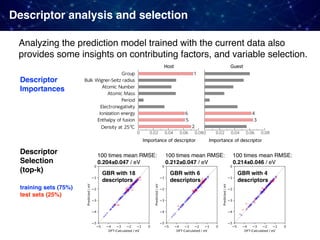
Descriptor analysis and selection
100 times mean RMSE:
0.204±0.047 / eV
100 times mean RMSE:
0.212±0.047 / eV
100 times mean RMSE:
0.214±0.046 / eV
GBR with 18
descriptors
GBR with 6
descriptors
GBR with 4
descriptors
Descriptor
Importances
Descriptor
Selection

(top-k)
training sets (75%)
test sets (25%)
Analyzing the prediction model trained with the current data also
provides some insights on contributing factors, and variable selection.
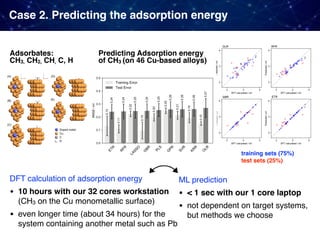
DFT calculation of adsorption energy
• 10 hours with our 32 cores workstation 

(CH3 on the Cu monometallic surface)
• even longer time (about 34 hours) for the
system containing another metal such as Pb
Predicting Adsorption energy
of CH3 (on 46 Cu-based alloys)
ML prediction
• < 1 sec with our 1 core laptop
• not dependent on target systems,
but methods we choose
training sets (75%)
test sets (25%)
Adsorbates: 

CH3, CH2, CH, C, H
Case 2. Predicting the adsorption energy
Case 3. Predicting the experimental catalyst activities
For some reactions, large datasets from already published results are
available. Why not just directly applying ML to them!
• Oxidative coupling of methane (OCM) 

1866 catalysts [Zavyalova+ 2011]
• Water gas shift reaction (WGS) 

4360 catalysts [Odabaşi+ 2014]
• CO oxidation 

5610 catalysts [Günay+ 2013]
Collections from various papers published in the past including
• catalyst compositions, support types, promotor types
• catalyst performance (C2 yields, CO conversion)
• experimental conditions (pressure, temperature, etc)
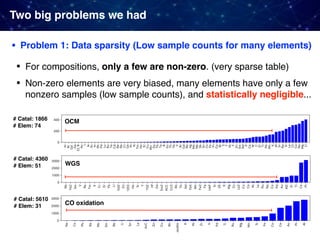
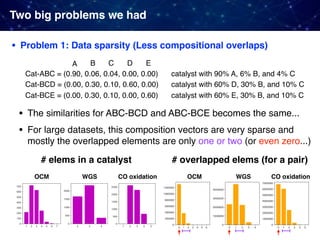
Two big problems we had
• Problem 1: Data sparsity (Low sample counts for many elements)
OCM
WGS
CO oxidation
# Catal: 1866
# Elem: 74
# Catal: 4360
# Elem: 51
# Catal: 5610
# Elem: 31
• For compositions, only a few are non-zero. (very sparse table)
• Non-zero elements are very biased, many elements have only a few
nonzero samples (low sample counts), and statistically negligible...
Two big problems we had
Cat-ABC = (0.90, 0.06, 0.04, 0.00, 0.00) catalyst with 90% A, 6% B, and 4% C
catalyst with 60% D, 30% B, and 10% C
catalyst with 60% E, 30% B, and 10% C
Cat-BCD = (0.00, 0.30, 0.10, 0.60, 0.00)
Cat-BCE = (0.00, 0.30, 0.10, 0.00, 0.60)
A B C D E
• The similarities for ABC-BCD and ABC-BCE becomes the same...
• For large datasets, this composition vectors are very sparse and
mostly the overlapped elements are only one or two (or even zero...)
• Problem 1: Data sparsity (Less compositional overlaps)
OCM OCMWGS WGSCO oxidation CO oxidation
# elems in a catalyst # overlapped elems (for a pair)
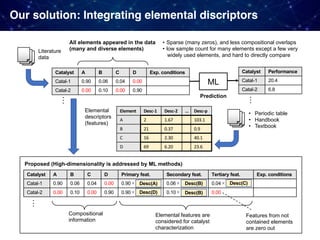
Catalyst A B C D Exp. conditions
Catal-1 0.90 0.06 0.04 0.00
Catal-2 0.00 0.10 0.00 0.90
• Sparse (many zeros), and less compositional overlaps
• low sample count for many elements except a few very
widely used elements, and hard to directly compare
Element Desc-1 Desc-2 … Desc-p
A 2 1.67 103.1
B 21 0.37 0.9
C 16 2.30 40.1
D 69 6.20 23.6
Catalyst Performance
Catal-1 20.4
Catal-2 6.8
ML
Literature
data
Prediction
All elements appeared in the data
(many and diverse elements)
Elemental
descriptors
(features)
Catalyst A B C D Primary feat. Secondary feat. Tertiary feat. Exp. conditions
Catal-1 0.90 0.06 0.04 0.00 0.90 0.06 0.04
Catal-2 0.00 0.10 0.00 0.90 0.90 0.10 0.00
Desc(A) Desc(B) Desc(C)
Desc(B)Desc(D)
Features from not
contained elements
are zero out
Proposed (High-dimensionality is addressed by ML methods)
Elemental features are
considered for catalyst
characterization
Compositional
information
…
…
…
• Periodic table
• Handbook
• Textbook
Our solution: Integrating elemental discriptors
• Problem 2: Very strong "selection bias" in existing datasets
Catalyst research has relied heavily on prior published data, tends
to be biased toward catalyst composition that were successful
Two big problems we had
Example) Oxidative coupling of methane (OCM)
• 1868 catalysts in the original dataset [Zavyalova+ 2011]
• Composed of 68 different elements: 61 cations and 7 anions
(Cl, F, Br, B, S, C, and P) excluding oxygen
• only 317 catalysts performed well with C2 yields 15% and 

C2 selectivity 50%; Occurrences of only a few elements such
as La, Ba, Sr, Cl, Mn, and F are very high.
• Widely used elements such as Li, Mg, Na, Ca, and La also
frequent in the data
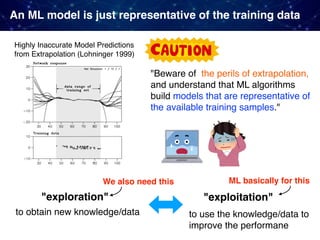
An ML model is just representative of the training data
Highly Inaccurate Model Predictions
from Extrapolation (Lohninger 1999)
"Beware of the perils of extrapolation,
and understand that ML algorithms
build models that are representative of
the available training samples."
"exploitation""exploration"
to obtain new knowledge/data to use the knowledge/data to
improve the performane
We also need this ML basically for this
No guarantee of data-driven for the outside of given data
Cause-and-Effect

Relationship
Related factors

(and their states)
Outcome
Reactions
Some
mechanism
[Inputs] [Outputs]
Data-driven methods try to precisely approximate its outer behavior
(the input-output relationship) observable as "data". 

(e.g. through machine learning from a large collection of data)
Keep in mind: Given data DEFINES the data-driven prediction!
Theory-driven methods try to explicitly model the inner workings
of a target phenomenon (e.g. through first-principles simulations)
governing equation?
Model-based optimization
1. Initial Sampling (DoE)
2. Loop:
1. Construct a Surrogate Model.
2. Search the Infill Criterion.
3. Add new samples.
• Optimal design of experiments (DoE)
• Active learning
• Bayesian optimization
• Blackbox optimization
• Reinforcement learning
• Multi-armed bandit
• Evolutional computation
• Game-theoretic approaches
An Open Research Topic in ML
Use ML to guide the balance between "exploitation" and "exploration"!
Our solution:
Model-based optimization
• Representation: Our elemental-descriptor based vectors
• Surrogate: Tree ensembles with prediction variance
• Optimization: Extending SMAC algorithm (Hutter+ 2011) to
• Constrained search (e.g. sum to 1, [0,1]-valued, one-hot encodings)
• Sparsity constraint (otherwise it always suggests dense vectors..)
• Discrete local search for nominal value updating
• Multiple suggestion at one time (batched optimization)
• Infill criterion: Expected improvement (EI) + small explicit exploration
• Oxidative coupling of methane (OCM) 

[Zavyalova+ 2011]
• Water gas shift (WGS) 

[Odabaşi+ 2014]
• CO oxidation [Günay+ 2013]
Test on 3 Datasets
Our model
GPR-based BO
Random
• Our model finds high-performance catalysts more quickly than other alternatives
• Our models can suggest a list of promising candidate catalysts with
experimental conditions from the entire available data
Suggested exp conditions
are omitted in this figure
Results
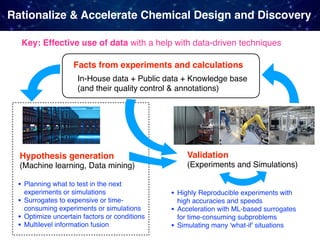
Facts from experiments and calculations
Rationalize & Accelerate Chemical Design and Discovery
In-House data + Public data + Knowledge base

(and their quality control & annotations)
Hypothesis generation Validation
(Experiments and Simulations)(Machine learning, Data mining)
• Planning what to test in the next
experiments or simulations
• Surrogates to expensive or time-
consuming experiments or simulations
• Optimize uncertain factors or conditions
• Multilevel information fusion
• Highly Reproducible experiments with
high accuracies and speeds
• Acceleration with ML-based surrogates
for time-consuming subproblems
• Simulating many 'what-if' situations
Key: Effective use of data with a help with data-driven techniques
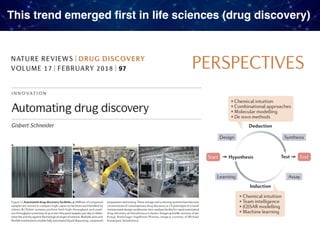
This trend emerged first in life sciences (drug discovery)
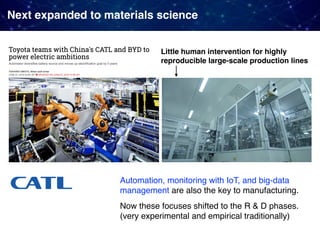
Next expanded to materials science
Little human intervention for highly
reproducible large-scale production lines
Automation, monitoring with IoT, and big-data
management are also the key to manufacturing.
Now these focuses shifted to the R & D phases.
(very experimental and empirical traditionally)
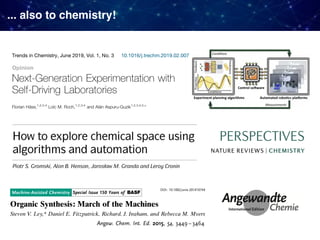
... also to chemistry!
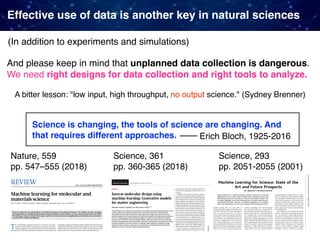
Effective use of data is another key in natural sciences
REVIEW
Inverse molecular design using
machine learning: Generative models
for matter engineering
Benjamin Sanchez-Lengeling1
and Alán Aspuru-Guzik2,3,4
*
The discovery of new materials can bring enormous societal and technological progress. In this
context, exploring completely the large space of potential materials is computationally
intractable. Here, we review methods for achieving inverse design, which aims to discover
tailored materials from the starting point of a particular desired functionality. Recent advances
from the rapidly growing field of artificial intelligence, mostly from the subfield of machine
learning, have resulted in a fertile exchange of ideas, where approaches to inverse molecular
design are being proposed and employed at a rapid pace. Among these, deep generative models
have been applied to numerous classes of materials: rational design of prospective drugs,
synthetic routes to organic compounds, and optimization of photovoltaics and redox flow
batteries, as well as a variety of other solid-state materials.
M
any of the challenges of the 21st century
(1), from personalized health care to
energy production and storage, share a
common theme: materials are part of
the solution (2). In some cases, the solu-
mapped 166.4 billion molecules that contain at
most 17 heavy atoms. For pharmacologically rele-
vant small molecules, the number of structures is
estimated to be on the order of 1060
(9). Adding
consideration of the hierarchy of scale from sub-
act properties. In practice, approximations are
used to lower computational time at the cost of
accuracy.
Although theory enjoys enormous progress,
now routinely modeling molecules, clusters, and
perfect as well as defect-laden periodic solids, the
size of chemical space is still overwhelming, and
smart navigation is required. For this purpose,
machine learning (ML), deep learning (DL), and
artificial intelligence (AI) have a potential role
to play because their computational strategies
automatically improve through experience (11).
In the context of materials, ML techniques are
often used for property prediction, seeking to
learn a function that maps a molecular material
to the property of choice. Deep generative models
are a special class of DL methods that seek to
model the underlying probability distribution of
both structure and property and relate them in a
nonlinear way. By exploiting patterns in massive
datasets, these models can distill average and
salient features that characterize molecules (12, 13).
Inverse design is a component of a more
complex materials discovery process. The time
scale for deployment of new technologies, from
discovery in a laboratory to a commercial pro-
duct, historically, is 15 to 20 years (14). The pro-
cess (Fig. 1) conventionally involves the following
steps: (i) generate a new or improved material
FRONTIERS IN COMPUTATION
httpDownloadedfrom
REVIEW https://doi.org/10.1038/s41586-018-0337-2
Machine learning for molecular and
materials science
Keith T. Butler1
, Daniel W. Davies2
, Hugh Cartwright3
, Olexandr Isayev4
* & Aron Walsh5,6
*
Here we summarize recent progress in machine learning for the chemical sciences. We outline machine-learning
techniques that are suitable for addressing research questions in this domain, as well as future directions for the field.
We envisage a future in which the design, synthesis, characterization and application of molecules and materials is
accelerated by artificial intelligence.
T
he Schrödinger equation provides a powerful structure–
property relationship for molecules and materials. For a given
spatial arrangement of chemical elements, the distribution of
electrons and a wide range of physical responses can be described. The
development of quantum mechanics provided a rigorous theoretical
foundationforthechemicalbond.In1929,PaulDiracfamouslyproclaimed
that the underlying physical laws for the whole of chemistry are “completely
known”1
. John Pople, realizing the importance of rapidly developing
generating, testing and refining scientific models. Such techniques are
suitable for addressing complex problems that involve massive combi-
natorial spaces or nonlinear processes, which conventional procedures
either cannot solve or can tackle only at great computational cost.
As the machinery for artificial intelligence and machine learning
matures, important advances are being made not only by those in main-
stream artificial-intelligence research, but also by experts in other fields
(domain experts) who adopt these approaches for their own purposes. As
DNA to be sequences into distinct pieces,
parcel out the detailed work of sequencing,
and then reassemble these independent ef-
forts at the end. It is not quite so simple in the
world of genome semantics.
Despite the differences between genome se-
quencing and genetic network discovery, there
are clear parallels that are illustrated in Table 1.
In genome sequencing, a physical map is useful
to provide scaffolding for assembling the fin-
ished sequence. In the case of a genetic regula-
tory network, a graphical model can play the
same role. A graphical model can represent a
high-level view of interconnectivity and help
isolate modules that can be studied indepen-
dently. Like contigs in a genomic sequencing
project, low-level functional models can ex-
plore the detailed behavior of a module of genes
in a manner that is consistent with the higher
level graphical model of the system. With stan-
dardized nomenclature and compatible model-
ing techniques, independent functional models
can be assembled into a complete model of the
cell under study.
To enable this process, there will need to
be standardized forms for model representa-
tion. At present, there are many different
modeling technologies in use, and although
models can be easily placed into a database,
they are not useful out of the context of their
specific modeling package. The need for a
standardized way of communicating compu-
tational descriptions of biological systems ex-
tends to the literature. Entire conferences
have been established to explore ways of
mining the biology literature to extract se-
mantic information in computational form.
Going forward, as a community we need
to come to consensus on how to represent
what we know about biology in computa-
tional form as well as in words. The key to
postgenomic biology will be the computa-
tional assembly of our collective knowl-
edge into a cohesive picture of cellular and
organism function. With such a comprehen-
sive model, we will be able to explore new
types of conservation between organisms
and make great strides toward new thera-
peutics that function on well-characterized
pathways.
References
1. S. K. Kim et al., Science 293 , 2087 (2001).
2. A. Hartemink et al., paper presented at the Pacific
Symposium on Biocomputing 2000, Oahu, Hawaii, 4
to 9 January 2000.
3. D. Pe’er et al., paper presented at the 9th Conference
on Intelligent Systems in Molecular Biology (ISMB),
Copenhagen, Denmark, 21 to 25 July 2001.
4. H. McAdams, A. Arkin, Proc. Natl. Acad. Sci. U.S.A.
94 , 814 ( 1997 ).
5. A. J. Hartemink, thesis, Massachusetts Institute of
Technology, Cambridge (2001).
V I E W P O I N T
Machine Learning for Science: State of the
Art and Future Prospects
Eric Mjolsness* and Dennis DeCoste
Recent advances in machine learning methods, along with successful
applications across a wide variety of fields such as planetary science and
bioinformatics, promise powerful new tools for practicing scientists. This
viewpoint highlights some useful characteristics of modern machine learn-
ing methods and their relevance to scientific applications. We conclude
with some speculations on near-term progress and promising directions.
Machine learning (ML) (1) is the study of
computer algorithms capable of learning to im-
prove their performance of a task on the basis of
their own previous experience. The field is
closely related to pattern recognition and statis-
tical inference. As an engineering field, ML has
become steadily more mathematical and more
successful in applications over the past 20
years. Learning approaches such as data clus-
tering, neural network classifiers, and nonlinear
regression have found surprisingly wide appli-
cation in the practice of engineering, business,
and science. A generalized version of the stan-
dard Hidden Markov Models of ML practice
have been used for ab initio prediction of gene
structures in genomic DNA (2). The predictions
correlate surprisingly well with subsequent
gene expression analysis (3). Postgenomic bi-
ology prominently features large-scale gene ex-
pression data analyzed by clustering methods
(4), a standard topic in unsupervised learning.
Many other examples can be given of learning
and pattern recognition applications in science.
Where will this trend lead? We believe it will
lead to appropriate, partial automation of every
element of scientific method, from hypothesis
generation to model construction to decisive
experimentation. Thus, ML has the potential to
amplify every aspect of a working scientist’s
progress to understanding. It will also, for better
or worse, endow intelligent computer systems
with some of the general analytic power of
scientific thinking.
creating hypotheses, testing by decisive exper-
iment or observation, and iteratively building
up comprehensive testable models or theories is
shared across disciplines. For each stage of this
abstracted scientific process, there are relevant
developments in ML, statistical inference, and
pattern recognition that will lead to semiauto-
matic support tools of unknown but potentially
broad applicability.
Increasingly, the early elements of scientific
method—observation and hypothesis genera-
tion—face high data volumes, high data acqui-
sition rates, or requirements for objective anal-
ysis that cannot be handled by human percep-
tion alone. This has been the situation in exper-
imental particle physics for decades. There
automatic pattern recognition for significant
events is well developed, including Hough
transforms, which are foundational in pattern
recognition. A recent example is event analysis
for Cherenkov detectors (8) used in neutrino
oscillation experiments. Microscope imagery in
cell biology, pathology, petrology, and other
fields has led to image-processing specialties.
So has remote sensing from Earth-observingMachine Learning Systems Group, Jet Propulsion Lab-
Table 1. Parallels between genome sequencing
and genetic network discovery.
Genome
sequencing
Genome semantics
Physical maps Graphical model
Contigs Low-level functional
models
Contig
reassembly
Module assembly
Finished genome
sequence
Comprehensive model
C O M P U T E R S A N D S C I E N C E
onAugust29,2018http://science.sciencemag.org/Downloadedfrom
Nature, 559

pp. 547–555 (2018)
Science, 293
pp. 2051-2055 (2001)
Science, 361
pp. 360-365 (2018)
Science is changing, the tools of science are changing. And
that requires different approaches. ── Erich Bloch, 1925-2016
(In addition to experiments and simulations)
And please keep in mind that unplanned data collection is dangerous.
We need right designs for data collection and right tools to analyze.
A bitter lesson: "low input, high throughput, no output science." (Sydney Brenner)
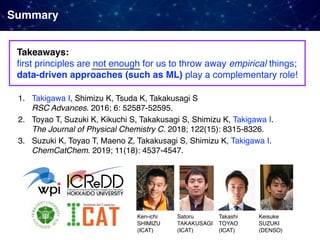
Summary
Takeaways: 

first principles are not enough for us to throw away empirical things;
data-driven approaches (such as ML) play a complementary role!
1. Takigawa I, Shimizu K, Tsuda K, Takakusagi S

RSC Advances. 2016; 6: 52587-52595.
2. Toyao T, Suzuki K, Kikuchi S, Takakusagi S, Shimizu K, Takigawa I.

The Journal of Physical Chemistry C. 2018; 122(15): 8315-8326.
3. Suzuki K, Toyao T, Maeno Z, Takakusagi S, Shimizu K, Takigawa I.

ChemCatChem. 2019; 11(18): 4537-4547.
Ken-ichi
SHIMIZU

(ICAT)
Satoru
TAKAKUSAGI

(ICAT)
Takashi
TOYAO

(ICAT)
Keisuke

SUZUKI

(DENSO)

Machine Learning and Model-Based Optimization for Heterogeneous Catalyst Design and Discovery

  • 1.
    Machine Learning andModel-Based Optimization for Heterogeneous Catalyst Design and Discovery Ichigaku Takigawa • Institute for Chemical Reaction Design and Discovery (WPI-ICReDD), Hokkaido University • RIKEN Center for Advanced Intelligence Project (AIP)
  • 2.
    Seamlessly fusing threetypes of sciences
  • 3.
    Rationalize & AccelerateChemical Design and Discovery This Symposium Topic
 Toward Interdisciplinary Research Guided by Theory and Calculation To reach "experimental realizations" through "theory and calculation", supports by implicit/empirical chemical knowledge are still required. Even though current chemical calculations are fairly accurate, 
 chemists would still be driven by ... 1. empirical findings (patterns) reported in papers and textbooks 2. experiences actually doing a lot of experiments Takeaway: We also need 'data-driven' bridges!
 first principles are not enough for us to throw away these empirical things; data-driven approaches (ML) play a complementary role!
  • 4.
    Automated reaction-path searchvia GRRM strategy θ1 θ2 O H H Energy θ = 104.45°1 θ = 95.84 pm2 θ1 Schrödinger equation Potential Energy Surface EQ1 EQ2TS ADDF
 Ohno & Maeda, Chem Phys Lett, 2004 Reaction Path AFIR Maeda & Morokuma, J Chem Phys, 2010 θ2
  • 5.
    But computational chemistryhas limitations for now... Chemical reactions = recombinations of atoms and chemical bonds
 subjected to the laws of nature • Intractably large chemical space: A intractably large number of "theoretically possible" candidates for reactions and compounds... • Scalability issue: Simulating an Avogadro-constant number of atoms is utterly infeasible... (After all, we need some compromise here) • Complexity and uncertainty of real-world systems: 
 Many uncertain factors and arbitrary parameters are involved... • Known and unknown imperfections of currently established theories: Current theoretical calculations have many exceptions and limitations...
  • 6.
    Yet another approach:Data-driven Cause-and-Effect
 Relationship Related factors
 (and their states) Outcome Reactions Some mechanism [Inputs] [Outputs] Theory-driven methods try to explicitly model the inner workings of a target phenomenon (e.g. through first-principles simulations) Data-driven methods try to precisely approximate its outer behavior (the input-output relationship) observable as "data". 
 (e.g. through machine learning from a large collection of data) based on very different principles and quite complementary! governing equation?
  • 7.
    Machine Learning (ML) GenericObject Recognition Speech Recognition Machine Translation QSAR/QSPR Prediction AI Game Players “ ” J’aime la musique I love music CH3 N N H N H H3C N Growth inhibition 0.739 A new style of programming a technique to reproduce a transformation process (or function) where the underlying principle is unclear and hard to be explicitly modelled 
 just by giving a lot of input-output examples.
  • 8.
    How ML works:fitting a function to data Inputs Outputs ML modelx<latexit sha1_base64="BkOuic6isW1cYY2ZNWiUOdOU/tM=">AAACq3ichVFNLwNRFD3G92eLjcRGNMRG8wYJsWrYWJbqR2jTzIxXHvOVmdcGTf+AlZ1gRWIhfoaNP2DhJ4gliY2FO9NJBFF3MvPOO/ee+86bq7um8CVjT21Ke0dnV3dPb1//wOBQLD48kvOdqmfwrOGYjlfQNZ+bwuZZKaTJC67HNUs3eV4/WA3y+Rr3fOHYm/LI5SVL27VFRRiaJCpX1K36YaMcT7AkC2PiN1AjkEAUaSf+gCJ24MBAFRY4bEjCJjT49GxDBYNLXAl14jxCIsxzNNBH2ipVcarQiD2g7y7ttiPWpn3Q0w/VBp1i0uuRcgJT7JHdslf2wO7YM/v4s1c97BF4OaJVb2q5W46djGXe/1VZtErsfalaepaoYCn0Ksi7GzLBLYymvnZ89ppZ3piqT7Nr9kL+r9gTu6cb2LU342adb1y28KOTl7//WJCPKmiE6s+B/Qa5uaQ6n5xbX0ikVqJh9mAck5ihiS0ihTWkkaUT9nGKc1wos0pG2VKKzVKlLdKM4lso/BN9vpmr</latexit> y<latexit sha1_base64="getvLqfzl+lmP3jVELri0P4Sr2g=">AAACq3ichVG7SgNBFD1ZX/EdtRFsxBCxMUxUUKxEG0tNzAMTkd11Ekf3xe4kEEN+wMpO1ErBQvwMG3/Awk8Qywg2Ft7dLIgG9S67c+bce+6c2as5hvAkY88Rpau7p7cv2j8wODQ8MhobG895dtXVeVa3DdstaKrHDWHxrBTS4AXH5aqpGTyvHW/4+XyNu56wrR1Zd/ieqVYsURa6KonKlTSzUW/ux+IsyYKY7gSpEMQRxpYde0QJB7ChowoTHBYkYQMqPHqKSIHBIW4PDeJcQiLIczQxQNoqVXGqUIk9pm+FdsWQtWjv9/QCtU6nGPS6pJxGgj2xO9Zij+yevbCPX3s1gh6+lzqtWlvLnf3R08nM+78qk1aJwy/Vn54lylgJvAry7gSMfwu9ra+dnLcyq+lEY5bdsFfyf82e2QPdwKq96bfbPH31hx+NvPz+x/x8WEEjTP0cWCfILSRTi8mF7aX42no4zCimMIM5mtgy1rCJLWTphCOc4QKXyrySUXaVUrtUiYSaCXwLhX8CgAGZrA==</latexit> A function best fitted to a given set of example input-output pairs (the training data). (x1, y1), (x2, y2), . . . , (xn, yn)<latexit sha1_base64="l6cITD180CW4htD4CpRHsG+/qlU=">AAAC+3ichVE9T9xAEB1MSMCQcCENUppTTiCQTqdZJwoHFSINJV8HSBidbLMcK/wle++Uw7o/kD9AQQUoBYE2Tdo0/IEUdLRASaQ0FMz6fCCKI2PZ+/bNvNm3Hjt0RSwRL3q03hd9L1/1D+iDQ6/fDOfejqzGQT1yeMUJ3CBat62Yu8LnFSmky9fDiFue7fI1e/eLyq81eBSLwF+RzZBvelbNF9vCsSRR1dyKaYuaayb6hGl7yddWlRUVaBKYLD6QRoc0iDS3AhnrxU7O7+T8SV01i8xWNVfAEiIyxvIKsKnPSGB6umywcp6pFEUBslgIcudgwhYE4EAdPODggyTsggUxPRvAACEkbhMS4iJCIs1zaIFO2jpVcaqwiN2lb412Gxnr0171jFO1Q6e49EakzMMY/sETvMVzPMUrvOvaK0l7KC9NWu22lofV4W+jy//+q/JolbDzqHrWs4RtKKdeBXkPU0bdwmnrG3v7t8szS2PJOB7hDfk/xAv8TTfwG3+d74t86eAZPzZ56f7HVD6roBF25pTvDlaNEvtYMhY/FWbnsmH2w3v4ABM0sSmYhXlYgAqd8Asu4QqutZZ2rP3QztqlWk+meQdPQvt5D2QXt/E=</latexit> f(x; ✓)<latexit sha1_base64="33zlDWOHXmZvZwuGF4JM5OwSths=">AAAC53ichVFNT9RQFD1UEUSUUTckbhonGEzI5HYEnJHNRDcu+RogmZlM2vpmeKFfad9MxKZ/wI07NXGFiSaGn8GGhVtM+AmEJSRuXHjbKSHGDNymfeede8995/VagSMjRXQ8ot24OXprbPz2xJ3Ju/emCvcfbER+L7RF3fYdP9yyzEg40hN1JZUjtoJQmK7liE1r51Wa3+yLMJK+t652A9Fyza4nO9I2FVPtQq0zGzezNo2wa7ViKlEWc/+BRG9abvw2SZYy0FTbQpnJ03ahSKVqZZHmy3paWinTIoMFMqpGVTdycRF5LPuFQzTxBj5s9OBCwINi7MBExE8DBggBcy3EzIWMZJYXSDDB2h5XCa4wmd3hb5d3jZz1eJ/2jDK1zac4/Ias1DFDR/SDzuiQ9umE/gztFWc9Ui+7vFoDrQjaU++n135fq3J5Vdi+VF3pWaGDSuZVsvcgY9Jb2AN9/92ns7UXqzPxE/pKp+x/j47pgG/g9c/tbyti9csVfiz2MvyPpfm8gkd4MSd9ONgol4xnpfLKfLH2Mh/mOB7hMWZ5Ys9Rw2sso84nfMdPHOGXJrUP2kft86BUG8k1D/FPaHt/AeNtrV0=</latexit> x<latexit sha1_base64="BkOuic6isW1cYY2ZNWiUOdOU/tM=">AAACq3ichVFNLwNRFD3G92eLjcRGNMRG8wYJsWrYWJbqR2jTzIxXHvOVmdcGTf+AlZ1gRWIhfoaNP2DhJ4gliY2FO9NJBFF3MvPOO/ee+86bq7um8CVjT21Ke0dnV3dPb1//wOBQLD48kvOdqmfwrOGYjlfQNZ+bwuZZKaTJC67HNUs3eV4/WA3y+Rr3fOHYm/LI5SVL27VFRRiaJCpX1K36YaMcT7AkC2PiN1AjkEAUaSf+gCJ24MBAFRY4bEjCJjT49GxDBYNLXAl14jxCIsxzNNBH2ipVcarQiD2g7y7ttiPWpn3Q0w/VBp1i0uuRcgJT7JHdslf2wO7YM/v4s1c97BF4OaJVb2q5W46djGXe/1VZtErsfalaepaoYCn0Ksi7GzLBLYymvnZ89ppZ3piqT7Nr9kL+r9gTu6cb2LU342adb1y28KOTl7//WJCPKmiE6s+B/Qa5uaQ6n5xbX0ikVqJh9mAck5ihiS0ihTWkkaUT9nGKc1wos0pG2VKKzVKlLdKM4lso/BN9vpmr</latexit> y<latexit sha1_base64="getvLqfzl+lmP3jVELri0P4Sr2g=">AAACq3ichVG7SgNBFD1ZX/EdtRFsxBCxMUxUUKxEG0tNzAMTkd11Ekf3xe4kEEN+wMpO1ErBQvwMG3/Awk8Qywg2Ft7dLIgG9S67c+bce+6c2as5hvAkY88Rpau7p7cv2j8wODQ8MhobG895dtXVeVa3DdstaKrHDWHxrBTS4AXH5aqpGTyvHW/4+XyNu56wrR1Zd/ieqVYsURa6KonKlTSzUW/ux+IsyYKY7gSpEMQRxpYde0QJB7ChowoTHBYkYQMqPHqKSIHBIW4PDeJcQiLIczQxQNoqVXGqUIk9pm+FdsWQtWjv9/QCtU6nGPS6pJxGgj2xO9Zij+yevbCPX3s1gh6+lzqtWlvLnf3R08nM+78qk1aJwy/Vn54lylgJvAry7gSMfwu9ra+dnLcyq+lEY5bdsFfyf82e2QPdwKq96bfbPH31hx+NvPz+x/x8WEEjTP0cWCfILSRTi8mF7aX42no4zCimMIM5mtgy1rCJLWTphCOc4QKXyrySUXaVUrtUiYSaCXwLhX8CgAGZrA==</latexit> ✓<latexit sha1_base64="lTDMb0MkD19hJd3A01US8Q9hJ/8=">AAACsHichVG9TgJBEB7PP/wFtTGxIRKMFZk7EcGKaGMJIkoChNydK5zeX+4WEiS8gL2xMNFoYmF8DBtewMJHMJaa2Fg4d5wxFuhsdnf2m/lmv91RbF1zOeLzkDA8Mjo2HpqYnJqemQ1H5ub3XavpqKyoWrrllBTZZbpmsiLXuM5KtsNkQ9HZgXKy7cUPWsxxNcvc422bVQ25bmpHmipzgsoVxehUeINxuVuLxDCRSacwKUUxgZiWMEXOOooZMRMVCfEsBoHlrEgPKnAIFqjQBAMYmMDJ10EGl0YZRECwCatChzCHPM2PM+jCJHGblMUoQyb0hNY6ncoBatLZq+n6bJVu0Wk6xIxCHJ/wHt+whw/4gp8Da3X8Gp6WNu1Kn8vsWvhssfDxL8ugnUPjh/WnZg5HkPa1aqTd9hHvFWqf3zq9eCts7sY7K3iLr6T/Bp/xkV5gtt7VuzzbvfxDj0JaBv+YFw8yqIXffYoOdvalhLiWkPLJWHYraGYIlmAZVqljG5CFHchB0f/zc7iCa0ESSkJNkPupwlDAWYBfJhx/AVqsnB0=</latexit> x<latexit sha1_base64="BkOuic6isW1cYY2ZNWiUOdOU/tM=">AAACq3ichVFNLwNRFD3G92eLjcRGNMRG8wYJsWrYWJbqR2jTzIxXHvOVmdcGTf+AlZ1gRWIhfoaNP2DhJ4gliY2FO9NJBFF3MvPOO/ee+86bq7um8CVjT21Ke0dnV3dPb1//wOBQLD48kvOdqmfwrOGYjlfQNZ+bwuZZKaTJC67HNUs3eV4/WA3y+Rr3fOHYm/LI5SVL27VFRRiaJCpX1K36YaMcT7AkC2PiN1AjkEAUaSf+gCJ24MBAFRY4bEjCJjT49GxDBYNLXAl14jxCIsxzNNBH2ipVcarQiD2g7y7ttiPWpn3Q0w/VBp1i0uuRcgJT7JHdslf2wO7YM/v4s1c97BF4OaJVb2q5W46djGXe/1VZtErsfalaepaoYCn0Ksi7GzLBLYymvnZ89ppZ3piqT7Nr9kL+r9gTu6cb2LU342adb1y28KOTl7//WJCPKmiE6s+B/Qa5uaQ6n5xbX0ikVqJh9mAck5ihiS0ihTWkkaUT9nGKc1wos0pG2VKKzVKlLdKM4lso/BN9vpmr</latexit> y<latexit sha1_base64="getvLqfzl+lmP3jVELri0P4Sr2g=">AAACq3ichVG7SgNBFD1ZX/EdtRFsxBCxMUxUUKxEG0tNzAMTkd11Ekf3xe4kEEN+wMpO1ErBQvwMG3/Awk8Qywg2Ft7dLIgG9S67c+bce+6c2as5hvAkY88Rpau7p7cv2j8wODQ8MhobG895dtXVeVa3DdstaKrHDWHxrBTS4AXH5aqpGTyvHW/4+XyNu56wrR1Zd/ieqVYsURa6KonKlTSzUW/ux+IsyYKY7gSpEMQRxpYde0QJB7ChowoTHBYkYQMqPHqKSIHBIW4PDeJcQiLIczQxQNoqVXGqUIk9pm+FdsWQtWjv9/QCtU6nGPS6pJxGgj2xO9Zij+yevbCPX3s1gh6+lzqtWlvLnf3R08nM+78qk1aJwy/Vn54lylgJvAry7gSMfwu9ra+dnLcyq+lEY5bdsFfyf82e2QPdwKq96bfbPH31hx+NvPz+x/x8WEEjTP0cWCfILSRTi8mF7aX42no4zCimMIM5mtgy1rCJLWTphCOc4QKXyrySUXaVUrtUiYSaCXwLhX8CgAGZrA==</latexit> x<latexit sha1_base64="BkOuic6isW1cYY2ZNWiUOdOU/tM=">AAACq3ichVFNLwNRFD3G92eLjcRGNMRG8wYJsWrYWJbqR2jTzIxXHvOVmdcGTf+AlZ1gRWIhfoaNP2DhJ4gliY2FO9NJBFF3MvPOO/ee+86bq7um8CVjT21Ke0dnV3dPb1//wOBQLD48kvOdqmfwrOGYjlfQNZ+bwuZZKaTJC67HNUs3eV4/WA3y+Rr3fOHYm/LI5SVL27VFRRiaJCpX1K36YaMcT7AkC2PiN1AjkEAUaSf+gCJ24MBAFRY4bEjCJjT49GxDBYNLXAl14jxCIsxzNNBH2ipVcarQiD2g7y7ttiPWpn3Q0w/VBp1i0uuRcgJT7JHdslf2wO7YM/v4s1c97BF4OaJVb2q5W46djGXe/1VZtErsfalaepaoYCn0Ksi7GzLBLYymvnZ89ppZ3piqT7Nr9kL+r9gTu6cb2LU342adb1y28KOTl7//WJCPKmiE6s+B/Qa5uaQ6n5xbX0ikVqJh9mAck5ihiS0ihTWkkaUT9nGKc1wos0pG2VKKzVKlLdKM4lso/BN9vpmr</latexit> y<latexit sha1_base64="getvLqfzl+lmP3jVELri0P4Sr2g=">AAACq3ichVG7SgNBFD1ZX/EdtRFsxBCxMUxUUKxEG0tNzAMTkd11Ekf3xe4kEEN+wMpO1ErBQvwMG3/Awk8Qywg2Ft7dLIgG9S67c+bce+6c2as5hvAkY88Rpau7p7cv2j8wODQ8MhobG895dtXVeVa3DdstaKrHDWHxrBTS4AXH5aqpGTyvHW/4+XyNu56wrR1Zd/ieqVYsURa6KonKlTSzUW/ux+IsyYKY7gSpEMQRxpYde0QJB7ChowoTHBYkYQMqPHqKSIHBIW4PDeJcQiLIczQxQNoqVXGqUIk9pm+FdsWQtWjv9/QCtU6nGPS6pJxGgj2xO9Zij+yevbCPX3s1gh6+lzqtWlvLnf3R08nM+78qk1aJwy/Vn54lylgJvAry7gSMfwu9ra+dnLcyq+lEY5bdsFfyf82e2QPdwKq96bfbPH31hx+NvPz+x/x8WEEjTP0cWCfILSRTi8mF7aX42no4zCimMIM5mtgy1rCJLWTphCOc4QKXyrySUXaVUrtUiYSaCXwLhX8CgAGZrA==</latexit> x<latexit sha1_base64="BkOuic6isW1cYY2ZNWiUOdOU/tM=">AAACq3ichVFNLwNRFD3G92eLjcRGNMRG8wYJsWrYWJbqR2jTzIxXHvOVmdcGTf+AlZ1gRWIhfoaNP2DhJ4gliY2FO9NJBFF3MvPOO/ee+86bq7um8CVjT21Ke0dnV3dPb1//wOBQLD48kvOdqmfwrOGYjlfQNZ+bwuZZKaTJC67HNUs3eV4/WA3y+Rr3fOHYm/LI5SVL27VFRRiaJCpX1K36YaMcT7AkC2PiN1AjkEAUaSf+gCJ24MBAFRY4bEjCJjT49GxDBYNLXAl14jxCIsxzNNBH2ipVcarQiD2g7y7ttiPWpn3Q0w/VBp1i0uuRcgJT7JHdslf2wO7YM/v4s1c97BF4OaJVb2q5W46djGXe/1VZtErsfalaepaoYCn0Ksi7GzLBLYymvnZ89ppZ3piqT7Nr9kL+r9gTu6cb2LU342adb1y28KOTl7//WJCPKmiE6s+B/Qa5uaQ6n5xbX0ikVqJh9mAck5ihiS0ihTWkkaUT9nGKc1wos0pG2VKKzVKlLdKM4lso/BN9vpmr</latexit> y<latexit sha1_base64="getvLqfzl+lmP3jVELri0P4Sr2g=">AAACq3ichVG7SgNBFD1ZX/EdtRFsxBCxMUxUUKxEG0tNzAMTkd11Ekf3xe4kEEN+wMpO1ErBQvwMG3/Awk8Qywg2Ft7dLIgG9S67c+bce+6c2as5hvAkY88Rpau7p7cv2j8wODQ8MhobG895dtXVeVa3DdstaKrHDWHxrBTS4AXH5aqpGTyvHW/4+XyNu56wrR1Zd/ieqVYsURa6KonKlTSzUW/ux+IsyYKY7gSpEMQRxpYde0QJB7ChowoTHBYkYQMqPHqKSIHBIW4PDeJcQiLIczQxQNoqVXGqUIk9pm+FdsWQtWjv9/QCtU6nGPS6pJxGgj2xO9Zij+yevbCPX3s1gh6+lzqtWlvLnf3R08nM+78qk1aJwy/Vn54lylgJvAry7gSMfwu9ra+dnLcyq+lEY5bdsFfyf82e2QPdwKq96bfbPH31hx+NvPz+x/x8WEEjTP0cWCfILSRTi8mF7aX42no4zCimMIM5mtgy1rCJLWTphCOc4QKXyrySUXaVUrtUiYSaCXwLhX8CgAGZrA==</latexit> interpolative prediction (High-dimensional) HighLow Model Complexity Underfitting (High bias, Low variance) Overfitting (Low bias, High variance) "The bias-variance tradeoff" The training data f(x; ✓)<latexit sha1_base64="33zlDWOHXmZvZwuGF4JM5OwSths=">AAAC53ichVFNT9RQFD1UEUSUUTckbhonGEzI5HYEnJHNRDcu+RogmZlM2vpmeKFfad9MxKZ/wI07NXGFiSaGn8GGhVtM+AmEJSRuXHjbKSHGDNymfeede8995/VagSMjRXQ8ot24OXprbPz2xJ3Ju/emCvcfbER+L7RF3fYdP9yyzEg40hN1JZUjtoJQmK7liE1r51Wa3+yLMJK+t652A9Fyza4nO9I2FVPtQq0zGzezNo2wa7ViKlEWc/+BRG9abvw2SZYy0FTbQpnJ03ahSKVqZZHmy3paWinTIoMFMqpGVTdycRF5LPuFQzTxBj5s9OBCwINi7MBExE8DBggBcy3EzIWMZJYXSDDB2h5XCa4wmd3hb5d3jZz1eJ/2jDK1zac4/Ias1DFDR/SDzuiQ9umE/gztFWc9Ui+7vFoDrQjaU++n135fq3J5Vdi+VF3pWaGDSuZVsvcgY9Jb2AN9/92ns7UXqzPxE/pKp+x/j47pgG/g9c/tbyti9csVfiz2MvyPpfm8gkd4MSd9ONgol4xnpfLKfLH2Mh/mOB7hMWZ5Ys9Rw2sso84nfMdPHOGXJrUP2kft86BUG8k1D/FPaHt/AeNtrV0=</latexit> extrapolative prediction
  • 9.
    Multilevel representations ofchemical reactions Brc1cncc(Br)c1 C[O-] CN(C)C=O Na+ COc1cncc(Br)c1SMILES Structural Formla Steric Structures Electronic States Reactants Reagents Products As pattern languages (e.g. known facts in textbooks/databases) As physical entities (e.g. quantum chemical calculations)
  • 10.
    A traditional topicin chemoinformatics Computer-assisted synthetic planning (path search on knowledge bases) or AI-Assisted Synthesis? (with Machine Learning)
  • 11.
  • 12.
    Also hot topicsin ML! ML-based chemical reaction predictions 3N-MCTS/AlphaChem
 Segler+ Nature 2018 Molecular Transformer
 Schwaller+ ACS Cent Sci 2019 seq2seq
 Liu+ ACS Cent Sci 2017 WLDN
 Jin+ NeurIPS 2017 ELECTRO
 Bradshaw+ICLR 2019 WLN
 Coley+ Chem Sci 2019 GPTN
 Do+ KDD 2019 Graph NN Sequence NN Combined or Other IBM RXN
 Schwaller+ Chem Sci 2018 Molecule Chef
 Bradshaw+ DeepGenStruct
 (ICLR WS) 2019 Neural-Symbolic ML
 Segler+ Chemistry 2017 Similarity-based
 Coley+ ACS Cent Sci 2017 Fermionic Neural Network Pfau+ Ab-Initio Solution of the Many-Electron Schrödinger Equation with Deep Neural Networks. 
 arXiv:1909.02487, Sep 2019. ML + First-principle simulations Hamiltonian Graph Networks with ODE Integrators Sanchez-Gonzalez+ Hamiltonian Graph Networks with ODE Integrators. 
 arXiv:1909.12790, Sep 2019. Both from
  • 13.
    On-goining ICReDD projects •Predictive Modeling for Heterogeneous Catalysis
 with Institute for Catalysis (Hokkaido University) • Fast path-ranking algorithms to prioritize candidate reaction paths from automated reaction-path search
 with Prof. Maeda's group • Automatic classification of trajectories from the first- principles molecular dynamics
 with Prof. Taketsugu's group • Pathway analysis from single-cell RNA-seq on DN-gel induced cancer stem cells
 with Prof. Tanaka's group • Output prediction of high-performance liquid chromatography
 with Prof. Ito's group
  • 14.
    Agenda 1. Predicting thed-band centers by ML
 Takigawa I, Shimizu K, Tsuda K, Takakusagi S
 RSC Advances. 2016; 6: 52587-52595. 2. Predicting the adsorption energy by ML
 Toyao T, Suzuki K, Kikuchi S, Takakusagi S, Shimizu K, Takigawa I.
 The Journal of Physical Chemistry C. 2018; 122(15): 8315-8326. 3. Predicting the experimentally-reported catalytic activity by ML
 Suzuki K, Toyao T, Maeno Z, Takakusagi S, Shimizu K, Takigawa I.
 ChemCatChem. 2019; 11(18): 4537-4547. Ken-ichi SHIMIZU
 (ICAT) Satoru TAKAKUSAGI
 (ICAT) Takashi TOYAO
 (ICAT) Keisuke
 SUZUKI
 (DENSO)
  • 15.
    Heterogeneous Catalysis Haber–Bosch Process FerrousMetal Catalysis NOx CO HC N2 CO2 H2O Exhaust Gas Harmless gas Noble Metal Catalysis (Pt, Pd, Rh…) • Ethane • Ethylene • Methanol • : Methane Various Metallic Catalysts
 (Li, rare earthes, alkaline earths) (industrial synthesis of ammonia) Exhaust Gas Purification Conversion of Methane “Fertilizer from Air” artificial nitrogen fixation • Heterogeneous catalysis is a type of catalysis in which the catalyst occupies a different phase from the reactants and products. • It can be more easily recycled than homogeneous, but characterization of the catalyst and optimization of properties can be more difficult. • It is of paramount importance in many areas of the chemical and energy industries.
  • 16.
    Heterogeneous Catalysis Wolfgang Pauli “Godmade the bulk; 
 the surface was invented by the devil.” adsorption diffusion desorption dissociation recombination kinks terraces adatom vacancysteps Gas-Phase (Reactants) Sold-Phase (Catalysts) Many hard-to-quantify intertwined factors involved. Too complicated (impossible?) to model everything... • multiple elementary reaction processes • composition, support, surface termination, particle size, particle morphology, atomic coordination environment • reaction conditions Notoriously complex surface reactions between different phases.
  • 17.
    Our ML-based casestudies 1. Can we predict the d-band center? 2. Can we predict the adsorption energy? 3. Can we predict the catalytic activity? predicting DFT-calculated values by machine learning   (Takigawa et al, RSC Advances, 2016) predicting DFT-calculated values by machine learning   (Toyao et al, JPCC, 2018) predicting values from experiments reported in the  literature by machine learning   (Suzuki et al, ChemCatChem, 2019)
  • 18.
    How to understandthe catalytic activities? K. Shimizu et al, ACS Catal. 2, 1904 (2012) d-band center (εd EF) / eVd-band center (εd EF) / eV Hammer Nørskov d-band model reactionrates Volcano trends! adsorption energy / eV Brønsted-Evans-Polanyi relation activationenergy/eV Linear trends! Traditionally, the computable indexes that well correlate the catalytic activities have been investigated...
  • 19.
    Case 1. Predictingthe d-band centers Guest Host Ruban, Hammer, Stoltze, Skriver, Nørskov, J Mol Catal A, 115:421-429 (1997) J. K. Nørskov, et al., Advances in Catalysis, 2000 Host Guest Two types of models • 1% doped • overlayer [1% doped] The d-band center is one of the established indexes to understand the trends of heterogeneous catalysts (transition metals based).
  • 20.
    Simple ML canaccurately predict them... Group (G) Bulk Wigner Seitz radius (R) in Å Atomic number (AN) Atomic mass (AM) in g mol 1 Period (P) Electronegativity (EN) Ionization energy (IE) in eV Enthalpy of fusion ( fusH) in J g 1 Density at 25 (ρ) in g cm 3 (1) Group in the periodic table (host) (2) Density at 25 ℃ (host) (3) Enthalpy of fusion (guest) (4) Ionization energy (guest) (5) Enthalpy of fusion (host) (6) Ionization energy (host) We showed that gradient boosted trees with only 6 descriptors below
 can predict the d-band centers without any first-principles calculations. 9 types of readily
 available values pretested
  • 21.
    Fe Co NiCu Ru Rh Pd Ag Ir Pt Au Fe -0.92 -0.96 -0.97 -1.65 -1.64 -2.24 -1.87 -2.4 -3.11 Co -1.37 -1.23 -2.12 -2.82 -2.53 -2.26 -3.56 Ni -0.33 -1.18 -1.92 -2.03 -2.43 -2.15 -2.82 -3.39 Cu -2.42 -2.49 -2.67 -2.89 -2.94 -3.82 -4.63 Ru -1.11 -1.04 -1.12 -1.41 -1.88 -1.81 -1.54 -2.27 Rh -1.42 -1.32 -1.51 -1.7 -1.73 -2.12 -1.81 -1.7 -2.18 -2.3 Pd -1.47 -1.29 -1.29 -1.03 -1.58 -1.83 -1.68 -1.52 -1.79 Ag -3.75 -3.56 -3.62 -3.8 -4.03 -3.5 -3.93 -4.51 Ir -1.78 -1.71 -1.78 -1.55 -2.14 -2.53 -2.2 -2.11 -2.6 -2.7 Pt -1.71 -1.47 -2.13 -2.01 -2.23 -2.06 -1.96 -2.33 Au -3.03 -2.82 -2.85 -2.89 -3.44 -3.56 Fe Co Ni Cu Ru Rh Pd Ag Ir Pt Au Fe -0.78 -1.65 -1.64 -1.87 Co -1.18 -1.17 -1.37 -1.87 -2.12 -2.82 -2.26 Ni -0.33 -1.18 -1.17 -2.61 -2.43 -2.15 -2.82 Cu -2.42 -2.89 -2.94 -3.88 -4.63 Ru -1.11 -1.04 -1.12 -1.11 -1.41 -1.81 -2.27 Rh -1.42 -1.51 -2.12 -1.81 -1.7 Pd -1.29 -1.29 -1.03 -1.58 -1.83 -1.52 -1.79 Ag -3.68 -3.8 -3.63 -4.51 Ir -2.14 -2.11 -2.7 Pt -1.71 -1.47 -2.13 -2.01 -2.23 -2.06 Au -2.86 -3.09 -2.89 -3.44 -3.56 Fe Co Ni Cu Ru Rh Pd Ag Ir Pt Au Fe -2.17 -3.11 Co -1.17 -1.37 -2.12 Ni -0.33 -1.18 -2.61 -2.43 Cu -2.42 -2.29 -2.49 -3.71 -4.63 Ru -2.02 Rh -1.32 -1.73 -2.12 Pd -1.94 -1.83 -1.97 Ag -3.75 -3.68 -4.51 Ir -1.78 -1.71 -2.7 Pt -2.13 Au -3.09 -2.89 training sets (75%) test sets (25%) training sets (50%) test sets (50%) training sets (25%) test sets (75%) gradient boosting w/ 6 descriptors gradient boosting w/ 6 descriptors gradient boosting w/ 6 descriptors 100 times
 mean RMSE: 0.153 / eV 100 times
 mean RMSE: 0.235 / eV 100 times
 mean RMSE: 0.402 / eV ML Prediction (without any quantum calculations)
  • 22.
    Descriptor analysis andselection 100 times mean RMSE: 0.204±0.047 / eV 100 times mean RMSE: 0.212±0.047 / eV 100 times mean RMSE: 0.214±0.046 / eV GBR with 18 descriptors GBR with 6 descriptors GBR with 4 descriptors Descriptor Importances Descriptor Selection
 (top-k) training sets (75%) test sets (25%) Analyzing the prediction model trained with the current data also provides some insights on contributing factors, and variable selection.
  • 23.
    DFT calculation ofadsorption energy • 10 hours with our 32 cores workstation 
 (CH3 on the Cu monometallic surface) • even longer time (about 34 hours) for the system containing another metal such as Pb Predicting Adsorption energy of CH3 (on 46 Cu-based alloys) ML prediction • < 1 sec with our 1 core laptop • not dependent on target systems, but methods we choose training sets (75%) test sets (25%) Adsorbates: 
 CH3, CH2, CH, C, H Case 2. Predicting the adsorption energy
  • 24.
    Case 3. Predictingthe experimental catalyst activities For some reactions, large datasets from already published results are available. Why not just directly applying ML to them! • Oxidative coupling of methane (OCM) 
 1866 catalysts [Zavyalova+ 2011] • Water gas shift reaction (WGS) 
 4360 catalysts [Odabaşi+ 2014] • CO oxidation 
 5610 catalysts [Günay+ 2013] Collections from various papers published in the past including • catalyst compositions, support types, promotor types • catalyst performance (C2 yields, CO conversion) • experimental conditions (pressure, temperature, etc)
  • 25.
    Two big problemswe had • Problem 1: Data sparsity (Low sample counts for many elements) OCM WGS CO oxidation # Catal: 1866 # Elem: 74 # Catal: 4360 # Elem: 51 # Catal: 5610 # Elem: 31 • For compositions, only a few are non-zero. (very sparse table) • Non-zero elements are very biased, many elements have only a few nonzero samples (low sample counts), and statistically negligible...
  • 26.
    Two big problemswe had Cat-ABC = (0.90, 0.06, 0.04, 0.00, 0.00) catalyst with 90% A, 6% B, and 4% C catalyst with 60% D, 30% B, and 10% C catalyst with 60% E, 30% B, and 10% C Cat-BCD = (0.00, 0.30, 0.10, 0.60, 0.00) Cat-BCE = (0.00, 0.30, 0.10, 0.00, 0.60) A B C D E • The similarities for ABC-BCD and ABC-BCE becomes the same... • For large datasets, this composition vectors are very sparse and mostly the overlapped elements are only one or two (or even zero...) • Problem 1: Data sparsity (Less compositional overlaps) OCM OCMWGS WGSCO oxidation CO oxidation # elems in a catalyst # overlapped elems (for a pair)
  • 27.
    Catalyst A BC D Exp. conditions Catal-1 0.90 0.06 0.04 0.00 Catal-2 0.00 0.10 0.00 0.90 • Sparse (many zeros), and less compositional overlaps • low sample count for many elements except a few very widely used elements, and hard to directly compare Element Desc-1 Desc-2 … Desc-p A 2 1.67 103.1 B 21 0.37 0.9 C 16 2.30 40.1 D 69 6.20 23.6 Catalyst Performance Catal-1 20.4 Catal-2 6.8 ML Literature data Prediction All elements appeared in the data (many and diverse elements) Elemental descriptors (features) Catalyst A B C D Primary feat. Secondary feat. Tertiary feat. Exp. conditions Catal-1 0.90 0.06 0.04 0.00 0.90 0.06 0.04 Catal-2 0.00 0.10 0.00 0.90 0.90 0.10 0.00 Desc(A) Desc(B) Desc(C) Desc(B)Desc(D) Features from not contained elements are zero out Proposed (High-dimensionality is addressed by ML methods) Elemental features are considered for catalyst characterization Compositional information … … … • Periodic table • Handbook • Textbook Our solution: Integrating elemental discriptors
  • 28.
    • Problem 2:Very strong "selection bias" in existing datasets Catalyst research has relied heavily on prior published data, tends to be biased toward catalyst composition that were successful Two big problems we had Example) Oxidative coupling of methane (OCM) • 1868 catalysts in the original dataset [Zavyalova+ 2011] • Composed of 68 different elements: 61 cations and 7 anions (Cl, F, Br, B, S, C, and P) excluding oxygen • only 317 catalysts performed well with C2 yields 15% and 
 C2 selectivity 50%; Occurrences of only a few elements such as La, Ba, Sr, Cl, Mn, and F are very high. • Widely used elements such as Li, Mg, Na, Ca, and La also frequent in the data
  • 29.
    An ML modelis just representative of the training data Highly Inaccurate Model Predictions from Extrapolation (Lohninger 1999) "Beware of the perils of extrapolation, and understand that ML algorithms build models that are representative of the available training samples." "exploitation""exploration" to obtain new knowledge/data to use the knowledge/data to improve the performane We also need this ML basically for this
  • 30.
    No guarantee ofdata-driven for the outside of given data Cause-and-Effect
 Relationship Related factors
 (and their states) Outcome Reactions Some mechanism [Inputs] [Outputs] Data-driven methods try to precisely approximate its outer behavior (the input-output relationship) observable as "data". 
 (e.g. through machine learning from a large collection of data) Keep in mind: Given data DEFINES the data-driven prediction! Theory-driven methods try to explicitly model the inner workings of a target phenomenon (e.g. through first-principles simulations) governing equation?
  • 31.
    Model-based optimization 1. InitialSampling (DoE) 2. Loop: 1. Construct a Surrogate Model. 2. Search the Infill Criterion. 3. Add new samples. • Optimal design of experiments (DoE) • Active learning • Bayesian optimization • Blackbox optimization • Reinforcement learning • Multi-armed bandit • Evolutional computation • Game-theoretic approaches An Open Research Topic in ML Use ML to guide the balance between "exploitation" and "exploration"! Our solution: Model-based optimization • Representation: Our elemental-descriptor based vectors • Surrogate: Tree ensembles with prediction variance • Optimization: Extending SMAC algorithm (Hutter+ 2011) to • Constrained search (e.g. sum to 1, [0,1]-valued, one-hot encodings) • Sparsity constraint (otherwise it always suggests dense vectors..) • Discrete local search for nominal value updating • Multiple suggestion at one time (batched optimization) • Infill criterion: Expected improvement (EI) + small explicit exploration
  • 32.
    • Oxidative couplingof methane (OCM) 
 [Zavyalova+ 2011] • Water gas shift (WGS) 
 [Odabaşi+ 2014] • CO oxidation [Günay+ 2013] Test on 3 Datasets Our model GPR-based BO Random • Our model finds high-performance catalysts more quickly than other alternatives • Our models can suggest a list of promising candidate catalysts with experimental conditions from the entire available data Suggested exp conditions are omitted in this figure Results
  • 33.
    Facts from experimentsand calculations Rationalize & Accelerate Chemical Design and Discovery In-House data + Public data + Knowledge base
 (and their quality control & annotations) Hypothesis generation Validation (Experiments and Simulations)(Machine learning, Data mining) • Planning what to test in the next experiments or simulations • Surrogates to expensive or time- consuming experiments or simulations • Optimize uncertain factors or conditions • Multilevel information fusion • Highly Reproducible experiments with high accuracies and speeds • Acceleration with ML-based surrogates for time-consuming subproblems • Simulating many 'what-if' situations Key: Effective use of data with a help with data-driven techniques
  • 34.
    This trend emergedfirst in life sciences (drug discovery)
  • 35.
    Next expanded tomaterials science Little human intervention for highly reproducible large-scale production lines Automation, monitoring with IoT, and big-data management are also the key to manufacturing. Now these focuses shifted to the R & D phases. (very experimental and empirical traditionally)
  • 36.
    ... also tochemistry!
  • 37.
    Effective use ofdata is another key in natural sciences REVIEW Inverse molecular design using machine learning: Generative models for matter engineering Benjamin Sanchez-Lengeling1 and Alán Aspuru-Guzik2,3,4 * The discovery of new materials can bring enormous societal and technological progress. In this context, exploring completely the large space of potential materials is computationally intractable. Here, we review methods for achieving inverse design, which aims to discover tailored materials from the starting point of a particular desired functionality. Recent advances from the rapidly growing field of artificial intelligence, mostly from the subfield of machine learning, have resulted in a fertile exchange of ideas, where approaches to inverse molecular design are being proposed and employed at a rapid pace. Among these, deep generative models have been applied to numerous classes of materials: rational design of prospective drugs, synthetic routes to organic compounds, and optimization of photovoltaics and redox flow batteries, as well as a variety of other solid-state materials. M any of the challenges of the 21st century (1), from personalized health care to energy production and storage, share a common theme: materials are part of the solution (2). In some cases, the solu- mapped 166.4 billion molecules that contain at most 17 heavy atoms. For pharmacologically rele- vant small molecules, the number of structures is estimated to be on the order of 1060 (9). Adding consideration of the hierarchy of scale from sub- act properties. In practice, approximations are used to lower computational time at the cost of accuracy. Although theory enjoys enormous progress, now routinely modeling molecules, clusters, and perfect as well as defect-laden periodic solids, the size of chemical space is still overwhelming, and smart navigation is required. For this purpose, machine learning (ML), deep learning (DL), and artificial intelligence (AI) have a potential role to play because their computational strategies automatically improve through experience (11). In the context of materials, ML techniques are often used for property prediction, seeking to learn a function that maps a molecular material to the property of choice. Deep generative models are a special class of DL methods that seek to model the underlying probability distribution of both structure and property and relate them in a nonlinear way. By exploiting patterns in massive datasets, these models can distill average and salient features that characterize molecules (12, 13). Inverse design is a component of a more complex materials discovery process. The time scale for deployment of new technologies, from discovery in a laboratory to a commercial pro- duct, historically, is 15 to 20 years (14). The pro- cess (Fig. 1) conventionally involves the following steps: (i) generate a new or improved material FRONTIERS IN COMPUTATION httpDownloadedfrom REVIEW https://doi.org/10.1038/s41586-018-0337-2 Machine learning for molecular and materials science Keith T. Butler1 , Daniel W. Davies2 , Hugh Cartwright3 , Olexandr Isayev4 * & Aron Walsh5,6 * Here we summarize recent progress in machine learning for the chemical sciences. We outline machine-learning techniques that are suitable for addressing research questions in this domain, as well as future directions for the field. We envisage a future in which the design, synthesis, characterization and application of molecules and materials is accelerated by artificial intelligence. T he Schrödinger equation provides a powerful structure– property relationship for molecules and materials. For a given spatial arrangement of chemical elements, the distribution of electrons and a wide range of physical responses can be described. The development of quantum mechanics provided a rigorous theoretical foundationforthechemicalbond.In1929,PaulDiracfamouslyproclaimed that the underlying physical laws for the whole of chemistry are “completely known”1 . John Pople, realizing the importance of rapidly developing generating, testing and refining scientific models. Such techniques are suitable for addressing complex problems that involve massive combi- natorial spaces or nonlinear processes, which conventional procedures either cannot solve or can tackle only at great computational cost. As the machinery for artificial intelligence and machine learning matures, important advances are being made not only by those in main- stream artificial-intelligence research, but also by experts in other fields (domain experts) who adopt these approaches for their own purposes. As DNA to be sequences into distinct pieces, parcel out the detailed work of sequencing, and then reassemble these independent ef- forts at the end. It is not quite so simple in the world of genome semantics. Despite the differences between genome se- quencing and genetic network discovery, there are clear parallels that are illustrated in Table 1. In genome sequencing, a physical map is useful to provide scaffolding for assembling the fin- ished sequence. In the case of a genetic regula- tory network, a graphical model can play the same role. A graphical model can represent a high-level view of interconnectivity and help isolate modules that can be studied indepen- dently. Like contigs in a genomic sequencing project, low-level functional models can ex- plore the detailed behavior of a module of genes in a manner that is consistent with the higher level graphical model of the system. With stan- dardized nomenclature and compatible model- ing techniques, independent functional models can be assembled into a complete model of the cell under study. To enable this process, there will need to be standardized forms for model representa- tion. At present, there are many different modeling technologies in use, and although models can be easily placed into a database, they are not useful out of the context of their specific modeling package. The need for a standardized way of communicating compu- tational descriptions of biological systems ex- tends to the literature. Entire conferences have been established to explore ways of mining the biology literature to extract se- mantic information in computational form. Going forward, as a community we need to come to consensus on how to represent what we know about biology in computa- tional form as well as in words. The key to postgenomic biology will be the computa- tional assembly of our collective knowl- edge into a cohesive picture of cellular and organism function. With such a comprehen- sive model, we will be able to explore new types of conservation between organisms and make great strides toward new thera- peutics that function on well-characterized pathways. References 1. S. K. Kim et al., Science 293 , 2087 (2001). 2. A. Hartemink et al., paper presented at the Pacific Symposium on Biocomputing 2000, Oahu, Hawaii, 4 to 9 January 2000. 3. D. Pe’er et al., paper presented at the 9th Conference on Intelligent Systems in Molecular Biology (ISMB), Copenhagen, Denmark, 21 to 25 July 2001. 4. H. McAdams, A. Arkin, Proc. Natl. Acad. Sci. U.S.A. 94 , 814 ( 1997 ). 5. A. J. Hartemink, thesis, Massachusetts Institute of Technology, Cambridge (2001). V I E W P O I N T Machine Learning for Science: State of the Art and Future Prospects Eric Mjolsness* and Dennis DeCoste Recent advances in machine learning methods, along with successful applications across a wide variety of fields such as planetary science and bioinformatics, promise powerful new tools for practicing scientists. This viewpoint highlights some useful characteristics of modern machine learn- ing methods and their relevance to scientific applications. We conclude with some speculations on near-term progress and promising directions. Machine learning (ML) (1) is the study of computer algorithms capable of learning to im- prove their performance of a task on the basis of their own previous experience. The field is closely related to pattern recognition and statis- tical inference. As an engineering field, ML has become steadily more mathematical and more successful in applications over the past 20 years. Learning approaches such as data clus- tering, neural network classifiers, and nonlinear regression have found surprisingly wide appli- cation in the practice of engineering, business, and science. A generalized version of the stan- dard Hidden Markov Models of ML practice have been used for ab initio prediction of gene structures in genomic DNA (2). The predictions correlate surprisingly well with subsequent gene expression analysis (3). Postgenomic bi- ology prominently features large-scale gene ex- pression data analyzed by clustering methods (4), a standard topic in unsupervised learning. Many other examples can be given of learning and pattern recognition applications in science. Where will this trend lead? We believe it will lead to appropriate, partial automation of every element of scientific method, from hypothesis generation to model construction to decisive experimentation. Thus, ML has the potential to amplify every aspect of a working scientist’s progress to understanding. It will also, for better or worse, endow intelligent computer systems with some of the general analytic power of scientific thinking. creating hypotheses, testing by decisive exper- iment or observation, and iteratively building up comprehensive testable models or theories is shared across disciplines. For each stage of this abstracted scientific process, there are relevant developments in ML, statistical inference, and pattern recognition that will lead to semiauto- matic support tools of unknown but potentially broad applicability. Increasingly, the early elements of scientific method—observation and hypothesis genera- tion—face high data volumes, high data acqui- sition rates, or requirements for objective anal- ysis that cannot be handled by human percep- tion alone. This has been the situation in exper- imental particle physics for decades. There automatic pattern recognition for significant events is well developed, including Hough transforms, which are foundational in pattern recognition. A recent example is event analysis for Cherenkov detectors (8) used in neutrino oscillation experiments. Microscope imagery in cell biology, pathology, petrology, and other fields has led to image-processing specialties. So has remote sensing from Earth-observingMachine Learning Systems Group, Jet Propulsion Lab- Table 1. Parallels between genome sequencing and genetic network discovery. Genome sequencing Genome semantics Physical maps Graphical model Contigs Low-level functional models Contig reassembly Module assembly Finished genome sequence Comprehensive model C O M P U T E R S A N D S C I E N C E onAugust29,2018http://science.sciencemag.org/Downloadedfrom Nature, 559
 pp. 547–555 (2018) Science, 293 pp. 2051-2055 (2001) Science, 361 pp. 360-365 (2018) Science is changing, the tools of science are changing. And that requires different approaches. ── Erich Bloch, 1925-2016 (In addition to experiments and simulations) And please keep in mind that unplanned data collection is dangerous. We need right designs for data collection and right tools to analyze. A bitter lesson: "low input, high throughput, no output science." (Sydney Brenner)
  • 38.
    Summary Takeaways: 
 first principlesare not enough for us to throw away empirical things; data-driven approaches (such as ML) play a complementary role! 1. Takigawa I, Shimizu K, Tsuda K, Takakusagi S
 RSC Advances. 2016; 6: 52587-52595. 2. Toyao T, Suzuki K, Kikuchi S, Takakusagi S, Shimizu K, Takigawa I.
 The Journal of Physical Chemistry C. 2018; 122(15): 8315-8326. 3. Suzuki K, Toyao T, Maeno Z, Takakusagi S, Shimizu K, Takigawa I.
 ChemCatChem. 2019; 11(18): 4537-4547. Ken-ichi SHIMIZU
 (ICAT) Satoru TAKAKUSAGI
 (ICAT) Takashi TOYAO
 (ICAT) Keisuke
 SUZUKI
 (DENSO)