GDSC, University of Bologna, November 15 2021
A short intro to Physics-
informed Machine Learning
Andrea Panizza
Introduction
The case for Physics-Informed
Machine Learning
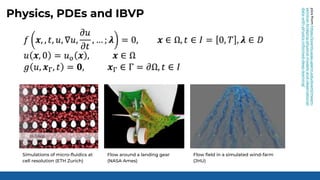
Physics, PDEs and IBVP
Flow around a landing gear
(NASA Ames)
Simulations of micro-fluidics at
cell resolution (ETH Zurich)
Flow field in a simulated wind-farm
(JHU)
pics
from
https://events.seas.upenn.edu/event/meam-
seminar-bridging-physical-models-and-observational-
data-with-physics-informed-deep-learning/
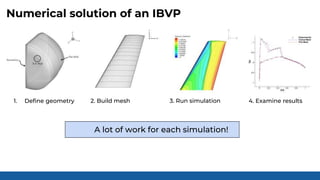
Numerical solution of an IBVP
1. Define geometry 2. Build mesh 3. Run simulation 4. Examine results
A lot of work for each simulation!
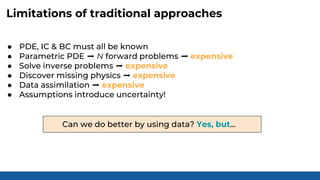
Limitations of traditional approaches
● PDE, IC & BC must all be known
● Parametric PDE ➡︎ N forward problems ➡︎ expensive
● Solve inverse problems ➡︎ expensive
● Discover missing physics ➡︎ expensive
● Data assimilation ➡︎ expensive
● Assumptions introduce uncertainty!
Can we do better by using data? Yes, but...
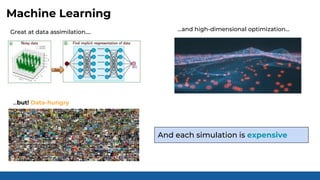
Machine Learning
Great at data assimilation…. ...and high-dimensional optimization...
...but! Data-hungry
And each simulation is expensive
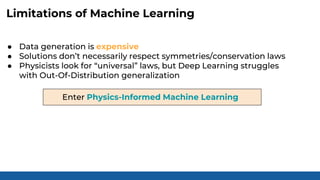
Limitations of Machine Learning
● Data generation is expensive
● Solutions don’t necessarily respect symmetries/conservation laws
● Physicists look for “universal” laws, but Deep Learning struggles
with Out-Of-Distribution generalization
Enter Physics-Informed Machine Learning
How to embed physics in ML
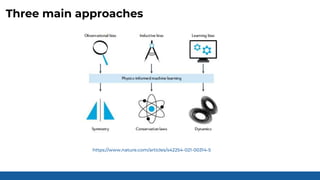
Three main approaches
https://www.nature.com/articles/s42254-021-00314-5
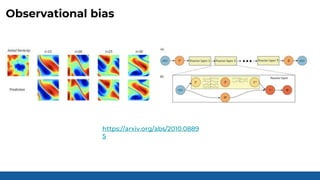
Observational bias
https://arxiv.org/abs/2010.0889
5
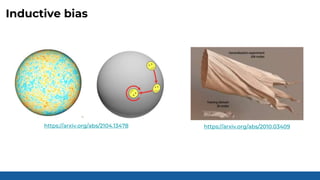
Inductive bias
https://arxiv.org/abs/2104.13478 https://arxiv.org/abs/2010.03409
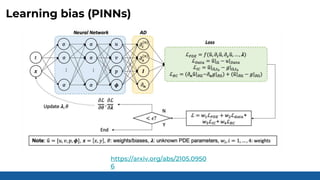
Learning bias (PINNs)
https://arxiv.org/abs/2105.0950
6
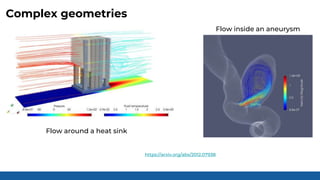
https://arxiv.org/abs/2012.07938
Complex geometries
Flow around a heat sink
Flow inside an aneurysm
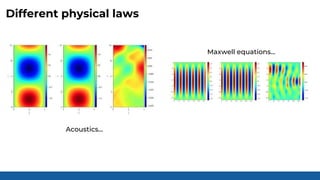
Different physical laws
Acoustics...
Maxwell equations...
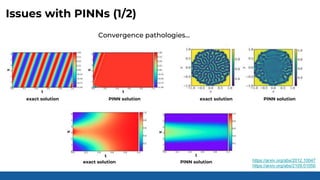
Issues with PINNs (1/2)
Convergence pathologies...
exact solution PINN solution
https://arxiv.org/abs/2012.10047
https://arxiv.org/abs/2109.01050
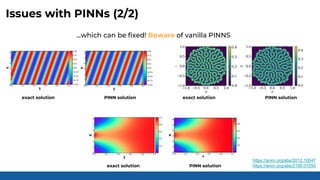
Issues with PINNs (2/2)
...which can be fixed! Beware of vanilla PINNS
exact solution PINN solution exact solution PINN solution
exact solution PINN solution
https://arxiv.org/abs/2012.10047
https://arxiv.org/abs/2109.01050
Conclusions
Key takeaways
● Embed Physics into ML
● Many different approaches
● Some great results…
● ...but many open problems!
What we didn’t cover
● Differentiable physics
● Learning Symbolic Physics with Graph Networks
● Hybrid approaches
Thanks for listening!
https://www.linkedin.com/in/andrea-panizza-
7114025/
https://github.com/AndreaPi
https://twitter.com/unsorsodicorda
Andrea Panizza
Senior AI Specialist
*special thanks to Simone Scardapane for the slides layout

Physics-Informed Machine Learning